
In This Article
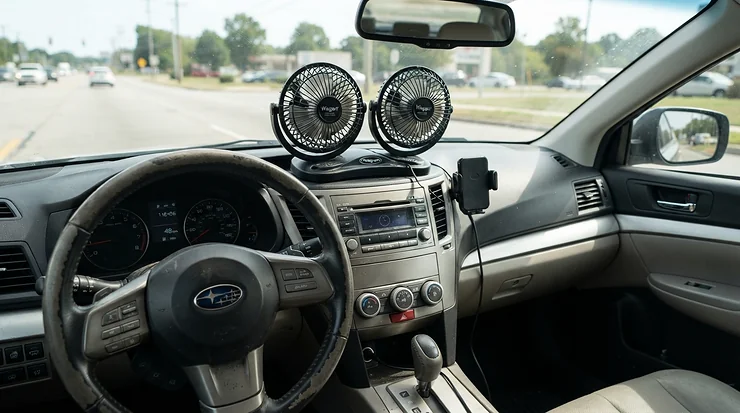
The best 12V car fan is a compact, plug-in air circulator that runs off your vehicle’s cigarette lighter socket. It moves real air at a low current draw (often around half an amp), clamps or mounts securely without blocking your view, and stays quiet enough to talk over. Think of it as a personal breeze you can aim.

Car air conditioning is a one-size-fits-nobody system. The driver freezes, the middle-row passenger stews, and the dog in the cargo area lives in a different climate zone entirely. A good car fan 12 volt model doesn’t replace your AC. It fixes the geometry problem by pushing air where the vents can’t reach, or by stirring a stuffy cabin when the compressor is tired, broken or missing altogether.
The plumbing behind this is wonderfully boring. The cigarette lighter socket has become a de facto DC connector for portable accessories, and Wikipedia’s overview of the automobile auxiliary power outlet lists cooling fans right alongside phone chargers. The circuit is typically fused at 10 to 20 amps, so a fan pulling half an amp barely registers.
Here’s how this guide works. I compared seven real models across budget, mid-range and pro-grade territory, using their published specs, retailer review patterns and independent roundups. I did not test them hands-on, so treat every verdict below as informed analysis rather than lab results. Where a detail couldn’t be verified, I say so.
Best 12V Car Fan Quick Comparison Table
| Fan | Mount Style | Best For | Price Range* |
|---|---|---|---|
| Hynoo 12V Car Clip Fan | Spring clip, dual 4″ heads | All-round first pick | ~$20-$35 |
| VersionTECH Dual Head Car Fan | Headrest, dual head | Back-seat coverage | ~$20-$40 |
| Auto Drive 12-Volt 6″ Clip-on/Dash Mount Fan | Clip or metal dash mount | Dashboard mount and sun-visor use | Under $25 |
| Zone Tech 12V Dual Head Rear Seat Fan | Headrest, dual head | Families with kids | ~$20-$30 |
| RoadPro RPSC8572 12V Dual Fan | Heavy-duty clip | Trucks, vans, RVs | ~$25-$45 |
| Endless Breeze 12V Fan | 12V plug-in | Camping and off-grid | ~$25-$45 |
| Koonie 8-Inch Car Fan | Clip-on, 8″ blades | Budget airflow | ~$20-$35 |
*Approximate ranges at the time of research. Prices vary, so check current price before buying.
Notice the pattern. Dual-head designs cluster around rear-seat duty, while single big-blade clip fans chase raw airflow. The RoadPro RPSC8572 is the odd one out, built for semi-truck cabs rather than family hatchbacks. If you only skim one thing, skim the “Best For” column. In this category, the right mount style matters more than a spec-sheet brag.
💬 Just one click — help others make better buying decisions too!😊
Top 7 Best 12V Car Fan Picks: Expert Analysis
Each pick below follows the same logic: what the specs mean in practice, who the fan suits, and what reviewers consistently say.
1. Hynoo 12V Car Clip Fan — dual 4-inch heads for two-zone airflow
The headline feature is the pair of independently aimable 4-inch heads. One can cool you while the other tackles a rear passenger, which is more flexible than any single-blade fan.
On paper, the 12V lighter plug and 360° rotation mean you can mount it on a headrest post, seat frame or visor and swing it wherever it’s needed. Four-inch blades also keep the profile low, so rear visibility stays intact. The trade-off is physics: small blades move less air per head than an 8-inch fan, so this is a targeted-breeze machine, not a cabin-flushing one.
It suits commuters and small families who want a vehicle 12V fan that disappears when it’s not needed. A published roundup ranked it best overall in its category. That same roundup noted that plug-in clip fans lose power with the ignition and may need a button press after a restart, a quirk of the category rather than a defect.
Pros:
- ✅ Two aimable heads cover two people
- ✅ Low profile keeps sightlines clear
- ✅ Simple plug-in 12V operation, no charging
Cons:
- ❌ Moderate airflow versus larger single-blade fans
- ❌ May need re-starting after ignition cycles
Expect a price in the $20-$35 range. For most people, Hynoo is the safest “just buy this” starting point.

2. VersionTECH Dual Head Car Fan — built around back-seat coverage
The standout here is a dual-head, headrest-style layout aimed squarely at the rear row. Fans that mount to the headrest put air at face and torso level, exactly where a back-seat passenger needs it, rather than blowing at a dashboard.
Exact blade size and cord length vary by listing, so verify those before buying. What matters in practice is the headrest-bar fit. Measure the gap between your front headrest posts, because clamp ranges are finite. A fan that won’t grip is just an expensive paperweight.
This is the rear seat fan I’d shortlist for kids, pets and grandparents. A published buying guide named VersionTECH its pick for back-seat coverage, which fits the design logic. I couldn’t verify a deep pool of independent review text, so lean on the roundup’s ranking and the compatibility checks above.
Pros:
- ✅ Headrest mounting targets the back row directly
- ✅ Dual heads share airflow between seats
- ✅ No dashboard clutter or sightline issues
Cons:
- ❌ Clamp may not fit unusual headrest designs
- ❌ Needs a long cord path to the front socket
Typically in the $20-$40 range. The verdict is strong value for anyone cooling the back seat.
3. Auto Drive 12-Volt 6″ Clip-on or Dash Mount Fan — two mounting styles in one box
The hook is versatility: a large spring clip for a sun visor plus a sturdy metal dash mount for permanent installation. Few fans in this price bracket give you both.
The 6-inch oscillating head means broader sweep than a fixed dual-head design, though oscillation spreads the breeze thinner. The replaceable fuse is the sleeper spec. When the fuse blows, you swap a fuse instead of the whole fan.
It’s built for trucks, older cars and anyone who wants a true dashboard mount. Retail reviews average roughly four stars across several hundred ratings. Buyers praise the clip’s flexibility and the oscillation, and some bought it for vehicles without working AC. The recurring complaint is that the mounting system doesn’t secure well in certain vehicles. Another reviewer wished for a USB plug, since the lighter socket often hosts a dash cam.
Pros:
- ✅ Visor clip and metal dash mount included
- ✅ Oscillating head sweeps the cabin
- ✅ Replaceable fuse extends fan life
Cons:
- ❌ Mounting doesn’t suit every dashboard shape
- ❌ Occupies the lighter socket, no USB option
Typically under $25. Auto Drive is a bargain workhorse if your dash geometry cooperates.
4. Zone Tech 12V Dual Head Car Fan for Rear Seat — kid-safe design on a budget
The tag that matters is the kid-safe design. Guarded blades make this the sensible rear seat fan for families with curious fingers.
It’s a two-speed, 360°-rotatable dual-head unit that plugs into the 12V socket. Two speeds is less granular than a stepless knob, but it’s also simpler for a passenger to operate without reading a manual. Dual heads mean one can face a car seat’s general direction while the other stays aimed at an older sibling.
I’d steer anyone with small children here first, then verify the clamp fits your headrest. Retail pages show a modest review count, and I couldn’t verify detailed review sentiment I’d be comfortable summarizing. Judge it on its safety-minded design and compare against VersionTECH if rear-seat coverage is your priority.
Pros:
- ✅ Guarded, kid-safe blade design
- ✅ Dual heads cover multiple passengers
- ✅ Simple two-speed operation
Cons:
- ❌ Only two speed settings
- ❌ Limited independent review data available
Typically $20-$30. A sensible family pick, provided the clamp fits.
5. RoadPro RPSC8572 12V Dual Fan — trucker-grade durability and a long cord
The standout is a 7.5-foot cord with a fused 12V plug and a heavy-duty clip. That cord length reaches a sleeper berth or rear bench without stretching.
Retailer spec sheets list roughly 0.5 amps and 6.5 watts of draw, plus about 14 CFM of airflow, which is modest but fine for a personal breeze. At roughly 1.75 pounds it’s heavier than most clip fans, and that heft is part of why the clip feels planted.
It’s built for semis, RVs, cargo vans and work trucks, where vibration eats flimsy mounts. Reviewer sentiment is small-sample but positive: roughly 4.8 stars across about nine ratings on one marketplace. Reviewers call it quiet and strong for its size, and one used it to push rooftop-AC air toward a van’s driver seat.
Pros:
- ✅ Heavy-duty clip tolerates vibration
- ✅ 7.5-foot cord reaches rear areas
- ✅ Fused plug and low draw
Cons:
- ❌ Airflow figure is modest at about 14 CFM
- ❌ Bulkier than compact passenger-car fans
Expect roughly $25-$45 depending on retailer. RoadPro is the durable choice for commercial and long-haul use.

6. Endless Breeze 12V Fan — off-grid reliability at half an amp
Its calling card is efficiency: it plugs into the lighter socket and reportedly draws only about 0.5 amps on low. That matters in a camper or a car where the accessory socket stays live with the engine off.
A half-amp draw means a healthy battery can run it for hours, though always monitor battery voltage if the engine is off. The catch, per one buying guide, is that it needs constant 12V power, with no internal battery. Unplug the socket and it stops.
It suits campers, van-lifers and parked-car lounging. A roundup named Endless Breeze its best for camping and off-grid use. I couldn’t verify deep independent review text, so I’d treat that as a category-fit endorsement rather than a performance guarantee.
Pros:
- ✅ Very low current draw on low speed
- ✅ Simple, reliable 12V design
- ✅ Suits camping and idle use
Cons:
- ❌ No built-in battery for cordless use
- ❌ Limited verified review detail
Roughly the $25-$45 range. A strong pick if you want a quiet breeze at camp.
7. Koonie 8-Inch Car Fan — the budget pick with bigger blades
The 8-inch blade is the story. Bigger blades move more air at lower speed, and lower speed usually means less noise.
That’s why a budget model can feel more substantial than a tiny dual-head unit. A published guide ranked it best budget, though its overall score trailed the leaders. The spec to check is mounting strength: larger fans need a firmer clamp, and a weak one will sag.
It suits drivers who want maximum airflow per dollar and don’t need two heads. Reviews I could verify were limited, so treat the ranking as a directional signal. If your priority is a cheap, simple automotive 12V fan with real breeze, Koonie is worth a look.
Pros:
- ✅ Large 8-inch blades push more air
- ✅ Budget-friendly price tier
- ✅ Single-head simplicity
Cons:
- ❌ Bulkier on the dash or headrest
- ❌ Limited verified review detail
Typically $20-$35. A smart, thrifty airflow play.
Top 7 Specs and Value at a Glance
| Fan | Power / Draw | Heads / Size | Control | Best For |
|---|---|---|---|---|
| Hynoo 12V Car Clip Fan | 12V plug-in | Dual 4″ | Verify on listing | Commuters |
| VersionTECH Dual Head Car Fan | 12V plug-in | Dual head | Verify on listing | Back-seat riders |
| Auto Drive 6″ Clip-on/Dash Fan | 12V, replaceable fuse | Single 6″, oscillating | Verify on listing | Dash-mount fans |
| Zone Tech 12V Dual Head | 12V plug-in | Dual head | Two speeds | Families |
| RoadPro RPSC8572 | ~0.5A / 6.5W | Dual, ~14 CFM | Variable | Trucks and RVs |
| Endless Breeze 12V Fan | ~0.5A on low | Single | Verify on listing | Camping |
| Koonie 8-Inch Car Fan | 12V plug-in | Single 8″ | Verify on listing | Budget airflow |
Looking at the table, the RoadPro is the only pick with fully published draw and airflow numbers, which is itself a trust signal. Buyers who prioritize airflow per dollar should weigh the Koonie‘s 8-inch blades against the Hynoo‘s two-zone flexibility. Anyone chasing quiet, low-draw operation should look hard at the Endless Breeze.
How to Choose the Best 12V Car Fan
Choosing the best 12V car fan comes down to seven checks. Work through them in order.
- Confirm your socket. Make sure your vehicle has a working 12V accessory socket. Many newer cars replace it with USB, as noted in the Wikipedia overview.
- Pick your seat target. Front-seat cooling suits a dash or visor clip, while back-row cooling calls for a headrest-mounted rear seat fan.
- Match blade size to airflow needs. Bigger blades move more air quietly, and smaller dual heads give targeted breeze.
- Check cord length. A 7.5-foot cord reaches the back row, while a short one doesn’t.
- Decide on speed control. Stepless dials offer fine-tuning, while two-speed switches are simpler.
- Inspect the clamp. Rubberized, spring-loaded grips hold better than thin plastic clips.
- Look for a fused plug. A fuse protects both the fan and your car’s circuit.
Treat this list as a funnel. Skip step one and everything else is moot, and skip step six and your fan may spend the trip sliding off the headrest.

Cigarette Lighter Car Fan: Power, Fuses, and Compatibility
A cigarette lighter car fan trades convenience for a few quirks worth understanding. The socket was designed to heat a lighter coil, not to run electronics, so it’s tolerant of fans but not perfect.
The “12 volts” you read about is actually a range. Per Wikipedia, voltage sits near 12.5V with the engine off and about 14.5V when running, and it can dip sharply during engine start. A simple DC fan shrugs this off. Fans with fussy electronics can misbehave.
Retention is the other gotcha. Plugs can vibrate loose on rough roads, and poor contact can heat the plug tip. Check that the plug seats firmly, and pick fans with a fuse rated well within your circuit’s limit.
Here’s the practical rule. Half-amp fans like the RoadPro and Endless Breeze sit far below a 10-to-20 amp fuse limit, so you can run them alongside a phone charger. If you also run a dash cam, pick a fan with a short, tidy cord and consider a socket splitter.
Dashboard Mount vs Adjustable Clip Fan
The dashboard mount versus adjustable clip fan question is really about permanence versus flexibility.
A dashboard mount, like the metal bracket on the Auto Drive, bolts or sticks in place. It stays put, aims forward, and never goes missing. It’s ideal for work trucks and older vehicles you plan to keep. The downside is fixed geometry. If your dashboard curves oddly, you can’t fix the angle.
An adjustable clip fan, like the Hynoo or Koonie, grabs a visor, seat frame or headrest post and relocates in seconds. It suits shared cars and anyone who wants to move the breeze between seats. The cost is grip: a clamp is only as good as its jaws and rubber pads.
My rule of thumb: pick a dashboard mount if one person drives the same vehicle daily, and pick a clip if the car changes hands or passengers. Either way, route the cord away from the gear shifter and pedals. A fan is a comfort tool, not a hazard.
Rear Seat Fan: Cooling the Back Row
The rear seat fan deserves its own spotlight because back-row passengers are the most underserved people in any car. Dash vents rarely reach them, and some vehicles have no rear vents at all.
Forced air movement works. A university study from Thapar, on controlling cabin temperature in a parked car through forced ventilation, found that auxiliary fans cut cabin air temperature by 11 to 13°C and the dashboard by 24.4°C. That study involved ventilation systems rather than clip fans, so don’t expect numbers like those from a headrest fan. The takeaway is directional: moving air beats stagnant air.
Dual-head headrest models like the VersionTECH and Zone Tech are built for this job. Aim one head at each passenger’s torso rather than their face, which feels cooler and less drafty. Reviewers on related rear-seat models mention that they’re easy to attach to the headrest, quiet compared with AC vents, and handy for pets prone to car sickness.
Vehicle 12V Fan vs Automotive 12V Fan vs USB and Battery Alternatives
“Vehicle 12V fan” and “automotive 12V fan” are mostly marketing synonyms for plug-in fans that use your lighter socket. The real decision is 12V plug-in versus USB versus battery.
| Power Type | Strength | Weakness | Best For |
|---|---|---|---|
| 12V plug-in | Strongest airflow, no charging | Needs a free lighter socket | Daily drivers, trucks |
| USB (5V) | Fits modern cars with USB-only ports | Typically weaker airflow | Newer cars |
| Rechargeable battery | Works with the engine off | Limited runtime, needs charging | Parked-car and cordless use |
Per one buying guide, a 12V fan will be more powerful than a USB model, though you need a cord long enough to reach your mounting spot. USB fans draw minimal power but give up some muscle. Battery models free you from cords but run out of juice.
Put differently, if your car has a lighter socket and you want the best 12V car fan performance, 12V plug-in is the default winner. Choose USB only if your car has no socket, and choose battery if you need cooling with the engine off.
✨ Don’t Miss These Exclusive Deals!
🔍 Take your summer drives to the next level with these carefully selected fans. Click on any highlighted item to check current pricing and availability. These picks will help you create a cooler, more comfortable cabin your whole family will love!
How to Set Up and Maintain Your 12V Car Fan
This is a practical guide Amazon listings rarely provide.
Setup in five minutes. Clip the fan on, then run the cord along trim and under seats so it never crosses pedals or the shifter. Plug it in with the car running. Turn the speed low first, then raise it.
First-use tips.
- Aim the airflow at torsos, not faces, to avoid eye dryness.
- Position the head so it doesn’t whip loose items like papers.
- Test the clip by tugging firmly before driving.
Maintenance schedule.
- Monthly: wipe blades and guard with a dry cloth, since dust unbalances blades and adds noise.
- Quarterly: check the plug for discoloration and the fuse for continuity.
- Seasonally: store the fan out of direct sun to protect plastics.
Common mistakes in the first 30 days. Over-tightening the clamp on soft headrests, leaving a fan plugged in on a socket that stays live with the engine off, and ignoring a plug that wiggles loose. Each is easy to prevent.

Real-World Scenarios: Which Fan for Which Driver
Matching products to people is where buying guides earn their keep.
Scenario 1: The college commuter. She drives 8 miles daily in a compact car with weak rear vents and no budget for gadgets. A Koonie or Hynoo clipped to the visor or headrest costs little and gives instant relief. The Hynoo‘s dual heads handle a carpool friend too.
Scenario 2: The family with two kids. A minivan, a rear bench with no vents, and sticky summer road trips. A Zone Tech or VersionTECH on the headrest solves back-row airflow, and the Zone Tech‘s kid-safe guard design earns it a point for peace of mind.
Scenario 3: The long-haul trucker. A cab that bakes under the sun and a sleeper berth far from the dash. The RoadPro‘s 7.5-foot cord and heavy-duty clip fit this job, and the Auto Drive‘s metal dash mount is a sturdy alternative.
Scenario 4: The weekend camper. A parked car or van with a live accessory socket. An Endless Breeze at half an amp draw keeps air moving without hammering the battery. Research on in-cabin ventilation, such as this study on cabin temperature and ventilation under direct sun, shows cabins can reach 36°C and even 50°C in the sun, so moving air matters.
Problem and Solution Guide for Car Fan Owners
Problem 1: The fan keeps sliding off. Choose a clamp with rubberized grips, add a thin rubber pad under the jaw, or switch to a dash mount like the Auto Drive‘s metal bracket.
Problem 2: The fan stops with the ignition. That’s standard behavior for sockets that switch off with the key. Use it only while driving, or pick a battery-backed model for parked use.
Problem 3: The plug wiggles out. Check the socket for debris, seat the plug fully, and consider a model with a firmer plug body. Poor contact can heat the tip, so don’t ignore it.
Problem 4: It’s too loud. Lower the speed, tighten the mount to reduce vibration, and clean the blades. Larger blades like the Koonie‘s 8-inch design tend to run quieter at lower speeds.
Problem 5: The fan blocks the dash cam socket. Add a lighter-socket splitter with a fused output, and keep total draw well under the circuit’s limit.
Safety Guide: What a Car Fan Can and Can’t Do
A fan makes you comfortable. It does not make a parked car safe.
According to the National Highway Traffic Safety Administration, hot cars are a leading non-crash cause of death among children. NHTSA notes that children’s bodies heat up much faster than adults’, and that rolling a window down does little to keep a vehicle cool. A fan won’t change that math. Never leave a child or pet alone in a parked vehicle, with or without a fan running.
Electrical safety matters too. Choose fans with fused plugs, keep cords clear of pedals, and don’t run a cord through a door seal. If you see melting, discoloration or a burning smell at the plug, unplug it immediately and replace the unit.
Long-Term Cost and Value
The best 12V car fan is the rare accessory with almost no running cost. At around half an amp, a RoadPro-class draw is a rounding error on your fuel and battery budget. The real cost is replacement: cheap clamps and thin plastic blades wear out first.
Spend slightly more for a replaceable fuse, a firm clamp and a plug that seats well. Over a few summers, a $30 fan that lasts beats a $15 fan you replace each year. The Auto Drive‘s replaceable fuse is a good example of a small spec with long-term payoff.

FAQ
❓ Will a car fan 12 volt model drain my battery?
❓ Do 12V car fans work in newer cars without a lighter socket?
❓ What's the best way to mount a fan for the back seat?
❓ Is a clip fan or a dashboard mount more stable?
❓ Can a car fan replace air conditioning?
Conclusion
Summer-grade comfort doesn’t require a mechanic or a big budget. It requires matching the right fan to your seat, your socket and your driving habits.
If you want one all-round answer, the Hynoo is the safest start. Choose the VersionTECH or Zone Tech for the back row, the Auto Drive if a dashboard mount matters, and the RoadPro for trucks and vans. Go for the Endless Breeze if low draw is the priority, and the Koonie when airflow per dollar rules.
Remember the fine print: confirm your socket, measure your headrest, and treat any fan as a comfort tool rather than a safety device. Never leave children or pets in a parked car.
✨ Ready to cool your cabin?
Compare current prices on your favorite picks, pick the mount style that fits your car, and give every seat its own breeze.
Recommended for You
- Best Car Seat Cooling Pad: 7 Ultimate Picks For 2026
- Construction Site Cooling: 7 Proven Picks To Beat Heat (2026)
- Tent Air Conditioner For Events: 7 Proven Picks For 2026
Disclaimer: This article contains affiliate links. As an Amazon Associate, I earn from qualifying purchases. If you purchase products through these links, we may earn a small commission at no additional cost to you.
✨ Found this helpful? Share it with your friends! 💬🤗
