
In This Article
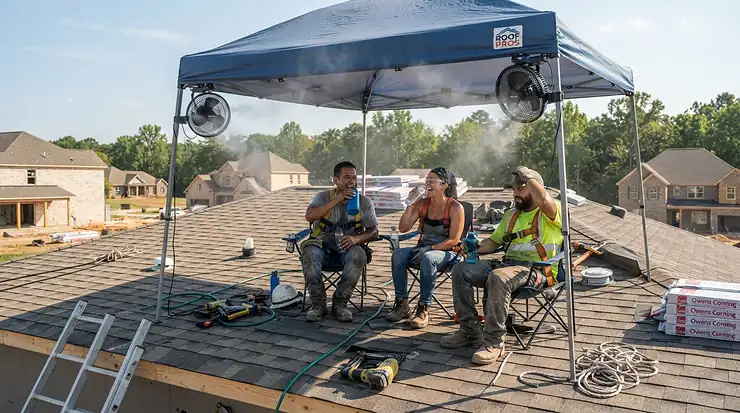
Construction site cooling is the combined use of equipment, wearable gear, shade, scheduling, and hydration to keep a worker’s core temperature in a safe range during hot-weather work. It spans everything from a cooling towel that costs less than lunch to a spot cooler humming inside a site trailer, and it works best as a layered system rather than a single miracle gadget.
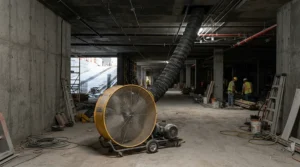
Heat doesn’t announce itself. There’s no siren and no flashing light, just a slightly slower hand, a fuzzier decision, a missed step on a ladder. That’s why construction site cooling is a safety issue first and a comfort perk a distant second.
The official playbook is refreshingly unglamorous. NIOSH heat stress guidance centers on gradual acclimatization over seven to fourteen days, rest breaks in shaded or air-conditioned spots, and steady fluids, roughly a cup every 15 to 20 minutes during moderate work in the heat. Gear helps. But gear is the supporting cast.
So here’s the plan. This guide walks through seven real products across budget, mid-range, and premium tiers, from a heavy-duty portable AC for site trailers to an under-$10 cooling towel. Then it zooms out to job site cooling equipment selection, OSHA heat regulations as they stand in October 2026, and setups you can copy.
One honest note first. Everything here comes from manufacturer specs, retailer listings, trade coverage, and review sentiment I could verify. I haven’t field-tested any of this gear, and where review data was thin, I say so.
Quick Comparison: The 7 Best Construction Site Cooling Picks at a Glance
Here’s the whole lineup on one screen, so you can skim before the deep dive.
| Product | Type | Standout Spec | Price Range | Best For |
|---|---|---|---|---|
| MovinCool Climate Pro X14 | Spot cooler (portable AC) | 13,200 Btu/h on a 115V circuit | Roughly $3,900–$4,600 | Site trailers, tents, temporary job cooling hubs |
| Perfect Aire 7000 BTU Spot Cooler | Spot cooler | Rated for ambient air up to 109°F | Roughly $500–$650 | Small crew rooms, tool cribs, garages |
| DeWalt DCE512 20V MAX Jobsite Fan | Cordless fan | 650 CFM, IP54 rated | Roughly $100–$220 | Open work zones, crews on the 20V MAX platform |
| Ergodyne Chill-Its 6260 | Phase-change vest | Packs recharge in as little as 5 minutes | Roughly $125–$175 | Humid or enclosed work |
| Ergodyne Chill-Its 6665 | Evaporative vest | Water-activated, no batteries | Roughly $30–$50 | Crew-wide rollouts in dry air |
| Ergodyne Chill-Its 6602 | Cooling towel | Up to about 4 hours per soak | Under $10 | Every worker, every day |
| Ergodyne Chill-Its 6670CT | Hard-hat neck shade | Clip-on evaporative shade | Around $15–$20 | Roofing, road, and utility crews in direct sun |
Look at the spread. The MovinCool Climate Pro X14 is the only pick that lowers the air temperature for a whole room of people, which is why it costs far more than the other six combined. If the budget is tight, the Ergodyne Chill-Its 6602 and Ergodyne Chill-Its 6665 deliver the most relief per dollar, as long as the air is dry enough for evaporation to work. The Ergodyne Chill-Its 6260 earns its premium only where humidity or enclosed work shuts evaporation down.
💬 Just one click — help others make better buying decisions too!😊
Top 7 Construction Site Cooling Products: Expert Analysis
Each pick below gets the same treatment: what the specs mean in practice, who should care, and what the review picture looks like. Prices are ranges, and they may vary by seller and season, so check current price before buying.
1. MovinCool Climate Pro X14 — heavy-duty spot cooling for trailers and tents
If a site trailer is the crew’s only refuge, this is the machine that makes the refuge real.
The MovinCool Climate Pro X14 delivers 13,200 Btu/h, about 1.1 tons of cooling. It draws roughly 1.3 kW on a standard 115V, 15-amp circuit, according to the manufacturer. In practice, you can plug it into an ordinary outlet or a properly sized generator instead of hunting for 230V. It’s rated for ambient conditions from 70°F to 113°F, which covers most of a brutal July afternoon. A distributor listing puts it near 165 pounds with a five-gallon condensate tank, so think “rolls into place and stays there,” not “carry it upstairs.”
Here’s what the spec sheet won’t say out loud: this is portable AC construction site crews should treat as infrastructure, not a gadget. The maker positions it for trailers, tents, and temporary offices, and also pitches its moisture removal for speeding up the drying of drywall compound and grout. One machine can protect both the crew’s comfort and the finish schedule.
I couldn’t find a large, verifiable pool of customer reviews for this exact unit, so no star rating appears here. What’s documented is the heavy-duty positioning and an extended warranty program in the manufacturer’s literature (confirm terms with a dealer).
Pros:
- ✅ Real cooling power for trailers and tents
- ✅ Runs on a standard 115V, 15-amp circuit
- ✅ Programmable operation and moisture removal
Cons:
- ❌ Premium purchase price
- ❌ Heavy, with duct setup required
Dealer listings ran from the high-$3,000s to the mid-$4,000s at the time of research. For a multi-month project, that’s easier to justify than a pile of underpowered cheap units.

2. Perfect Aire 7000 BTU Spot Cooler — rated to 109°F without the premium price
Think of it as the entry ticket to portable AC construction site cooling: small, rolling, and gentler on the wallet than industrial units.
The Perfect Aire 7000 BTU Spot Cooler (model 2SPOT6800) is rated to operate in ambient air up to 109°F, the number that matters on a real job site. Listings describe 360-degree spinner wheels, an adjustable blower, a washable filter, and two drainage options: an empty-it bucket or a continuous-drain hose. Its listed energy efficiency ratio of 7.95 means more electricity per unit of cooling than a commercial unit, a trade-off you accept for the lower sticker price.
Here’s the catch. Retailer listings don’t agree with each other. One shows 250 square feet of coverage and a 15-amp draw, while the ProAire-branded version lists 150 square feet and 8 amps. Verify the spec on the exact box you’re buying before plugging it into a shared circuit or small generator. Realistically, this is a foreman’s shack, tool crib, or garage cooler, not an answer for a wide-open bay.
I couldn’t verify a meaningful pool of customer reviews, so there’s no star rating here. Treat manufacturer claims as claims until the seller confirms them.
Pros:
- ✅ Rated for ambient air up to 109°F
- ✅ Rolls easily on spinner wheels
- ✅ Bucket or hose drainage options
Cons:
- ❌ Specs conflict across retailer listings
- ❌ Less efficient than commercial units
Retail listings sat in roughly the $500–$650 range. It’s fair value for small enclosed spaces and poor value if you expect it to rescue a large work area.
3. DeWalt DCE512 20V MAX Jobsite Fan — 650 CFM on batteries you already own
No cord, no outlet, no excuses.
The DeWalt DCE512 20V MAX Jobsite Fan moves up to 650 cubic feet of air per minute through an 11-inch blade. Listings cite IP54 dust and water resistance, variable speed control, a 180-degree pivoting head, and hang, wall-mount, or freestanding options. Retailers quote up to 4.5 hours of runtime on max speed with a 5.0Ah battery, and one distributor lists a three-year limited warranty. In plain English: it’s built for dusty sites, you can aim it where the crew actually stands, and one battery covers roughly half a shift at full blast.
A fan doesn’t cool air. It moves air across skin so sweat can evaporate. That’s why it shines in dry, open work zones, the heart of outdoor construction cooling, and does little in a sealed, humid room, where it mostly stirs hot soup. For crews already on the 20V MAX platform, it’s the cheapest way to add airflow where a plug-in fan would need extension-cord gymnastics.
Verified review data was limited. One distributor listing showed no reviews yet, so what’s documented here are the specs, not a satisfaction score.
Pros:
- ✅ Strong 650 CFM airflow
- ✅ IP54 dust and water resistance
- ✅ Runs on common 20V MAX batteries
Cons:
- ❌ Moves air without lowering its temperature
- ❌ Bare tool excludes battery and charger
Expect roughly $100–$220, depending on bare tool (DCE512B) versus kit with battery and charger (DCE512P1). It’s excellent value if you own batteries already.
4. Ergodyne Chill-Its 6260 — phase-change vest that works when sweat can’t
Evaporative gear has a failure mode: humidity. This vest ignores it.
The Ergodyne Chill-Its 6260 uses rechargeable phase-change packs that hold a fixed cool temperature, listed between roughly 59°F and 64°F depending on the retailer, for up to two hours. Listings say packs recharge in as little as five minutes, the vest runs 30–60% lighter than many cooling vests, and the whole thing weighs about four pounds with packs. Because it doesn’t depend on evaporation, it makes sense in humid air and inside coveralls where no breeze reaches.
Two hours per pack set means the math only works with spares. Extra packs are sold separately, and the swap-at-break routine is what makes the vest a full-shift tool. Four pounds over a hot torso is a trade-off, so for general outdoor work it’s overkill. Target it at the crews whose environment defeats evaporation.
WC Safety, a safety-gear retailer, gives it a 4.6 out of 5 editorial rating. That’s a seller’s own review, not aggregated customer feedback, so weigh it accordingly. I couldn’t verify a large customer-review pool.
Pros:
- ✅ Works in humid air and enclosed spaces
- ✅ Rechargeable packs swap quickly at breaks
- ✅ Lighter than many ice vests
Cons:
- ❌ Cooling lasts about two hours per set
- ❌ Spare packs add real cost
US retailer listings landed around $125–$175. Worth it for the right crew.
5. Ergodyne Chill-Its 6665 — the budget vest for dry-air outdoor work
Cheap enough to outfit a whole crew without a budget meeting.
The Ergodyne Chill-Its 6665 is an evaporative vest with polymer-embedded fabric and a water-repellent interior, activated with water. No batteries, no freezer. A trade roundup listed it in the low-$30s, and WC Safety’s guide names it the best-value vest in the Chill-Its line. The polymer fabric holds water that evaporates slowly, pulling heat off the body, while the repellent lining helps keep the shirt underneath from soaking through.
Its weakness is the same as every evaporative product’s: humidity. In muggy air there’s less evaporation, so there’s less cooling. Pair it with moving air from the DeWalt DCE512 20V MAX Jobsite Fan and the effect improves. For dry-climate crews working outside, it offers arguably the best cost-to-relief ratio on this list, and fleet-wide rollouts become realistic.
Verified customer reviews were thin during research. The best signal I could document is the seller’s own best-value ranking, which is an opinion rather than aggregated buyer feedback.
Pros:
- ✅ Low cost makes crew-wide rollouts realistic
- ✅ Water-repellent interior keeps clothing drier
- ✅ No batteries or freezers required
Cons:
- ❌ Weak performance in humid conditions
- ❌ Needs airflow to work well
Expect roughly $30–$50. Strong value in dry air, a poor bet in muggy conditions.
6. Ergodyne Chill-Its 6602 — the under-$10 baseline every worker should own
The humblest item on this list might also be the smartest purchase.
The Ergodyne Chill-Its 6602 is a PVA evaporative towel measuring 13 by 29.5 inches. Run it under water, wring it out, and it’s ready. Listings claim up to about four hours of cooling per soak, re-wetting extends that, and it’s machine washable in cold water with mild detergent. In practice, it’s big enough to drape across the neck and shoulders, and a good wring keeps it from dripping onto tools or electrical gear.
WC Safety’s guide recommends a sensible ladder: a towel or bandana per worker first, hard-hat inserts second, vests for sustained-heat roles third. The Ergodyne Chill-Its 6602 isn’t a substitute for water, shade, and rest, and its performance sags in humid air. But it’s low-friction. Workers actually use cheap, simple gear, and that matters more than specs.
On one major retailer’s listing, it averages 4.0 out of 5 across 64 ratings. The few written reviews I saw praised ease of use and how long it holds moisture, though some were labeled as collected through a promotion, so treat them cautiously.
Pros:
- ✅ Costs under $10 per worker
- ✅ Reusable and machine washable
- ✅ Large enough for neck-and-shoulder coverage
Cons:
- ❌ Cooling fades faster in humid air
- ❌ Needs re-wetting through the shift
Listings ran roughly $5–$10. It’s the easiest yes in this guide.
7. Ergodyne Chill-Its 6670CT — clip-on neck shade for roofing and road crews
The back of the neck gets cooked first and thanked last.
The Ergodyne Chill-Its 6670CT is a clip-on evaporative neck shade with an attached cooling towel. It uses PVA material, hook-and-loop straps, and a hi-vis lime color. A multi-pack listing works out to roughly $15 per unit. On a hard hat, it adds shade and evaporative cooling right where direct sun hits behind the head, and the bright color doubles as extra visibility.
WC Safety suggests it for road, rail, roofing, and utility crews working under direct sun, and that fits the physics: sun-exposed trades face radiant heat that fans and towels alone don’t solve. Because it attaches to the hard hat, it’s one less thing for a worker to remember. Check fit against your hard hat model before ordering a case, since clip-on designs vary.
I couldn’t verify aggregated customer reviews for this model, so the evidence here is the construction and the retailer’s use-case guidance.
Pros:
- ✅ Shades the neck from direct sun
- ✅ Evaporative towel adds cooling relief
- ✅ Hi-vis color adds visibility
Cons:
- ❌ Fit depends on your hard hat model
- ❌ Evaporative effect weakens in humid air
Expect around $15–$20 each, often in multi-packs. It’s modest money for crews who live under open sky.
Here’s how the seven stack up on mechanics, which matters more than marketing.
| Product | Cooling Method | Power or Activation | Duration or Coverage | Verified Review Signal |
|---|---|---|---|---|
| MovinCool Climate Pro X14 | Refrigerant spot cooling | 115V, 15-amp circuit | Room or trailer scale | None verified |
| Perfect Aire 7000 BTU Spot Cooler | Refrigerant spot cooling | Plug-in; listings conflict on amps | Small spaces (coverage figures conflict) | None verified |
| DeWalt DCE512 20V MAX Jobsite Fan | Air movement | 20V MAX battery | Up to 4.5 hrs on 5.0Ah (listed) | None verified |
| Ergodyne Chill-Its 6260 | Phase-change packs | Recharge in ice chest | Up to 2 hrs per pack set | 4.6/5 seller editorial |
| Ergodyne Chill-Its 6665 | Evaporative | Water | Needs airflow and dry air | Seller “best value” ranking |
| Ergodyne Chill-Its 6602 | Evaporative PVA | Water | Up to ~4 hrs per soak | 4.0 across 64 ratings (one retailer) |
| Ergodyne Chill-Its 6670CT | Evaporative shade | Water | Neck and head zone | None verified |
The last column is deliberately blunt: most of these products have thin, verifiable review data, so specs and use-case logic carry the argument. The mechanics split cleanly into two camps. Refrigerant and phase-change products work regardless of humidity, while evaporative products and fans depend on dry, moving air. That one distinction should drive most buying decisions.
✨ Ready to Cool Down Your Crew?
🔍 Take your construction site cooling to the next level with these carefully researched products. Click on any highlighted item to check current pricing and availability. The right gear will help you build safer, steadier shifts your whole crew will thank you for!
How to Choose Job Site Cooling Equipment: 6 Steps That Actually Work
Start with the heat problem you’re solving, then match the tool to your power, space, and budget. Here’s the sequence worth following.
- Identify the heat source. Is it sun on bare skin, a sealed hot room, or both? Open, sun-baked work favors shade, airflow, and wearable cooling. Hot enclosed spaces call for a spot cooler.
- Check the humidity. Evaporative gear, such as towels, evaporative vests, and neck shades, fades as humidity rises. Phase-change vests and refrigerant coolers don’t depend on evaporation.
- Count your power. The MovinCool Climate Pro X14 wants a 115V, 15-amp circuit. On a generator, leave headroom for compressor start-up, and confirm requirements with the manufacturer.
- Size for people, not square footage. Spot cooling targets the people in the space, so aim it at the break area or work zone.
- Think about PPE. NIOSH notes that protective clothing can increase heat stress, so check how any vest or neck shade fits under hard hats, hi-vis, and FR layers.
- Plan the logistics. Pack recharging, condensate draining, filter cleaning, and battery charging all take real time. Cooling gear nobody maintains stops working.
That’s the framework for choosing job site cooling equipment without overbuying. A crew of six in dry air may need only towels, vests, shade, and a DeWalt DCE512 20V MAX Jobsite Fan. A drywall crew in a humid, closed building needs a different answer entirely.
Portable AC Construction Site Setups vs Evaporative Cooling and Fans
Which technology wins? Wrong question. The better one: where does each win?
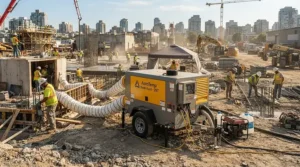
A portable AC construction site setup, using a spot cooler like the MovinCool Climate Pro X14 or the Perfect Aire 7000 BTU Spot Cooler, uses refrigerant to pull heat and moisture out of the air. That’s why it can drop temperatures in a closed trailer or tent. United Rentals’ heat mitigation overview draws the same line: spot coolers remove moisture as they cool, while evaporative coolers need only air and water but work best with plenty of fresh airflow, making them better suited to outdoor or well-ventilated areas.
| Option | How It Cools | Best Conditions | Weak Spot | Best For |
|---|---|---|---|---|
| Portable AC spot cooler (MovinCool Climate Pro X14, Perfect Aire 7000 BTU Spot Cooler) | Refrigerant cooling and dehumidification | Enclosed or semi-enclosed spaces | Power, weight, ducting | Trailers, tents, break rooms |
| Evaporative cooler or mister | Water evaporation | Dry air with airflow | Humidity, water supply | Open or ventilated areas |
| Cordless fan (DeWalt DCE512 20V MAX Jobsite Fan) | Moves air over skin | Dry, open work zones | Doesn’t lower air temperature | Active work zones |
| Shade structure | Blocks solar load | Any sunny site | No air cooling by itself | Stationary tasks, rest areas |
The table shows why “one product” thinking fails. A spot cooler is the only option that genuinely lowers air temperature, but it needs power and a contained space. Fans and evaporative gear are cheap and mobile, and they can quietly fail in humid air. Shade is the unsung hero for stationary tasks, a point industry safety groups emphasize because it blocks heat before you have to remove it.
Outdoor Construction Cooling: What Actually Works in Open Sun
Open sky changes the physics. You can’t air-condition a field, so outdoor construction cooling is about blocking heat, moving air, and giving the body help evaporating.
Beat the sun, not just the temperature
Radiant heat from direct sun is a separate load from air temperature, which is why a shade tent or overhead cover can matter as much as any gadget. For stationary tasks, overhead shade is among the most effective tools available. For roving work, wearable shade like the Ergodyne Chill-Its 6670CT takes over.
Make evaporation work for you
NIOSH suggests breathable, light-colored, loose-fitting clothing, and notes that cotton can be soaked in water to help cooling. The Ergodyne Chill-Its 6602 and Ergodyne Chill-Its 6665 apply the same principle with better materials. Add moving air from a DeWalt DCE512 20V MAX Jobsite Fan at a rest station, and evaporation speeds up.
Know the limits
In humid climates, evaporative products underperform, and that’s when phase-change options like the Ergodyne Chill-Its 6260 earn their keep. Also remember that PPE itself can add to heat stress. A crew in dry Arizona air and a crew on a muggy Gulf Coast pour need different outdoor construction cooling kits, and pretending otherwise is how budgets get wasted.
Temporary Job Cooling: Trailers, Tents, and the Rent-vs-Buy Math
Construction is temporary by nature, so temporary job cooling has its own logic. Equipment must arrive fast, work immediately, and leave without drama.
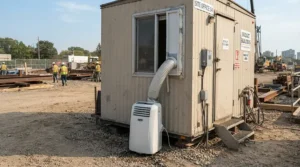
Spot coolers fit this role well. The manufacturer of the MovinCool Climate Pro X14 specifically pitches its machines for workers in trailers, tents, and temporary offices, and for jobs where central HVAC is down or off. Rental companies list spot coolers for interior construction and renovation, and pricing depends on unit size, rental duration, and location.
Here’s a simple rent-vs-buy framework. Take the purchase range, around $3,900–$4,600 for the MovinCool Climate Pro X14 at dealers, and divide it by a current weekly rental quote. The result is your break-even in weeks. If you’d rent that machine for more weeks per year than the break-even across all your jobs, buying starts to make sense. If not, rent. Smaller units like the Perfect Aire 7000 BTU Spot Cooler run the same math at a much lower scale.
Logistics matter as much as price for temporary job cooling. Confirm circuit capacity, plan for condensate (the MovinCool Climate Pro X14 lists a five-gallon tank), and decide where the hot exhaust goes before the unit lands. For tents, ducting through the wall beats exhausting heat back into the space you’re trying to cool.
Construction Worker Cooling: Gear That Rides on the Body
Equipment cools spaces. Construction worker cooling gear cools people, wherever the work takes them.
The ladder from WC Safety’s guide is a practical template: a towel or bandana per worker, then hard-hat inserts for full-shift hat wearers, then vests for sustained-heat roles. The Ergodyne Chill-Its 6602 is rung one. The Ergodyne Chill-Its 6670CT is rung two for sun-exposed trades. The Ergodyne Chill-Its 6665 and Ergodyne Chill-Its 6260 are rung three, split by humidity.
Fit under PPE matters here. NIOSH warns that protective clothing may increase heat stress, so a vest that fights a harness or snags on hi-vis isn’t helping. Try gear with the actual PPE stack before ordering for a crew.
Think about how the gear dies, too. Evaporative products fail quietly when humidity rises, and phase-change packs fail loudly when they run out after two hours. Neither is a flaw, but supervisors should know which failure each product has. Great construction worker cooling is less about buying the fanciest vest and more about issuing the right tool to the right job and making sure it’s recharged, re-wetted, or swapped on schedule.
OSHA Heat Regulations in 2026: Where Things Actually Stand
Is there a federal heat rule? Not yet. Here’s the picture as of the most recent reporting I found (August 2026), and I’m not a lawyer, so verify with counsel or your state agency.
OSHA published its proposed rule, “Heat Injury and Illness Prevention in Outdoor and Indoor Work Settings,” on August 30, 2024, covering construction among other sectors. It proposed a written heat plan, an initial trigger at an 80°F heat index, and a high-heat trigger at 90°F, where proposed requirements include 15-minute paid rest breaks every two hours. It remains a proposal, not an enforceable standard. Safety Services’ 2026 rulemaking summary reports that the Department of Labor’s regulatory plan targets a supplemental proposal in December 2026.
Enforcement hasn’t paused. The same source notes OSHA issued an updated Heat National Emphasis Program on April 10, 2026, replacing the version that expired days earlier, and that OSHA cites heat hazards under the General Duty Clause. Several states, including California, Washington, and Oregon, maintain their own heat standards.
Practical takeaway on OSHA heat regulations: don’t wait for a final rule. Water, rest, shade, acclimatization, and a written plan are already the enforcement benchmark, and they’re the same practices that prevent heat illness.
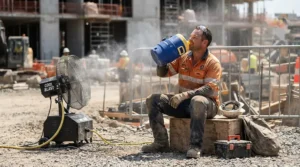
Worker Safety Cooling: Water, Rest, and Shade Come First
Gear is the garnish. The main course is worker safety cooling built on water, rest, and shade, with acclimatization underneath all of it.
The fundamentals
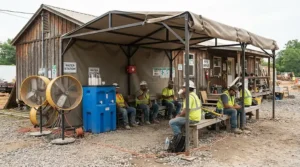
NIOSH recommends about one cup of water every 15 to 20 minutes during moderate work in the heat, which works out to roughly 24 to 32 ounces per hour. Rest breaks belong in shaded or air-conditioned recovery areas, and a short planned break with water is very effective at lowering body temperature. A large container of cool water for hands and forearms, a tip cited in industry safety coverage, adds a cheap recovery boost.
Acclimatization
For new workers, NIOSH advises no more than 20% heat exposure on day one, adding no more than 20% each day. Experienced workers can ramp faster, starting at 50% on day one, 60% on day two, and 80% on day three. Skipping this step on a new hire is where good worker safety cooling programs quietly break.
Know the signs
Train everyone to recognize heat cramps, heat exhaustion, and heat stroke. Heat stroke is a medical emergency, so call for help, move the person to shade or air conditioning, and begin cooling with water or ice while waiting. The Ergodyne Chill-Its 6602 or a spot cooler like the MovinCool Climate Pro X14 can support recovery, but they never replace protocol.
Practical Usage Guide: Setup, Maintenance, and First-30-Day Mistakes
Buying the gear is step one. Using it right is where the value lives.
Spot coolers: Place the unit near occupied space, but keep it away from foot traffic and water pooling. Decide the exhaust route before powering on. Empty the condensate bucket on the Perfect Aire 7000 BTU Spot Cooler or use its continuous-drain hose, and clean the washable filter regularly. Confirm circuit capacity first, since the MovinCool Climate Pro X14 wants a 115V, 15-amp circuit.
Vests: Keep a second set of packs for the Ergodyne Chill-Its 6260 and swap them at breaks. Hand wash the vest and packs per listing guidance. For the Ergodyne Chill-Its 6665, wet it before the shift and re-wet through the day.
Towels and neck shades: Wring the Ergodyne Chill-Its 6602 so it doesn’t drip, re-wet as it dries, and machine wash cold with mild detergent. Re-wet the Ergodyne Chill-Its 6670CT the same way.
Fans: Stage charged batteries for the DeWalt DCE512 20V MAX Jobsite Fan, since max-speed runtime is a few hours, not a full day.
Common first-30-day mistakes: underestimating generator load, forgetting condensate, wearing evaporative gear in muggy air, and skipping acclimatization. OSHA’s guidance on protecting new workers is a good starting point for that last one.
Real-World Scenarios: Matching Gear to Three Crews
These are illustrative profiles, not case studies of real crews. They show how the pieces fit when budget, climate, and work type differ.
Scenario 1: The dry-climate framing crew
Six workers, outdoor framing, dry summer heat, tight budget, daily use. The answer: an Ergodyne Chill-Its 6602 for everyone, an Ergodyne Chill-Its 6665 for each worker, and a shared DeWalt DCE512 20V MAX Jobsite Fan at the rest station, plus a shade canopy. Total spend stays modest, and the dry air makes evaporation work.
Scenario 2: The humid interior finishing crew
Eight workers hanging and finishing drywall in a closed building, humid weather, several months. Evaporation struggles here. A MovinCool Climate Pro X14 protects both the crew and drying drywall compound, with Ergodyne Chill-Its 6260 vests for the hottest tasks. This is also where temporary job cooling economics favor a rental-to-buy comparison.
Scenario 3: The roofing subcontractor
Four roofers in direct sun, intense radiant heat, daily use, little shade. Outfit everyone with an Ergodyne Chill-Its 6670CT and an Ergodyne Chill-Its 6602, and schedule breaks in a shaded or air-conditioned recovery spot. Layer in OSHA heat regulations-driven practices like acclimatization for new hires.
Long-Term Cost & Maintenance: What Cooling Really Costs Over a Season
Sticker price isn’t total cost. Power, packs, consumables, and downtime all count, and cheap gear can be the most expensive when it doesn’t get used.
| Product | Upfront Range | Ongoing Costs | Value Verdict |
|---|---|---|---|
| MovinCool Climate Pro X14 | Roughly $3,900–$4,600 | Electricity, condensate handling, filter care | Best for long projects or repeat use |
| Perfect Aire 7000 BTU Spot Cooler | Roughly $500–$650 | Electricity, filter cleaning | Good for small spaces only |
| DeWalt DCE512 20V MAX Jobsite Fan | Roughly $100–$220 | Battery charging | Great if you own batteries |
| Ergodyne Chill-Its 6260 | Roughly $125–$175 | Spare packs | Target to humid or enclosed roles |
| Ergodyne Chill-Its 6665 | Roughly $30–$50 | Water, washing | Strong value in dry air |
| Ergodyne Chill-Its 6602 | Under $10 | Washing | Best per-worker value |
| Ergodyne Chill-Its 6670CT | Roughly $15–$20 | Water, washing | Solid for sun-exposed trades |
Run the numbers per worker. A ten-person crew can issue the Ergodyne Chill-Its 6602 for under $100 total, and that’s a rounding error against a single lost shift. Vests are the middle tier, and the Ergodyne Chill-Its 6260 only pays off when the environment demands it.
The big-ticket decision is the spot cooler. For short or occasional use, rental logic wins, and for long or repeat use, owning a MovinCool Climate Pro X14 can beat repeated rental. Whatever you buy, schedule maintenance, because job site cooling equipment that quietly clogs, leaks, or runs out of charge protects no one.
FAQ
❓ How much does a portable AC for a construction site cost?
❓ Can I run a spot cooler off a generator at a construction site?
❓ Is it better to rent or buy job site cooling equipment?
❓ Do cooling vests work in humid weather?
❓ Can cooling towels be used with flame-resistant or welding gear?
Conclusion: Build a Cooling Plan, Not a Gear Pile
Construction site cooling works when it’s layered. Water, rest, shade, and acclimatization form the base, and gear fills the gaps. A spot cooler like the MovinCool Climate Pro X14 protects trailers and tents, and the Perfect Aire 7000 BTU Spot Cooler handles smaller rooms at a gentler price. The DeWalt DCE512 20V MAX Jobsite Fan adds airflow in dry, open zones.
On the body, the ladder is simple: start with the Ergodyne Chill-Its 6602, add the Ergodyne Chill-Its 6670CT for sun-exposed trades, and choose between the Ergodyne Chill-Its 6665 and the Ergodyne Chill-Its 6260 based on humidity. Remember that evaporative gear fades in muggy air, while refrigerant and phase-change tools don’t.
On the regulatory side, OSHA heat regulations are still a proposal, but enforcement through the General Duty Clause and state standards is real. Don’t wait for a final rule to adopt worker safety cooling practices that already work. And treat temporary job cooling like any other piece of project planning: rent or buy based on the math, not on panic in July.
🔥 Don’t wait for the next heat advisory! Review the picks above, check current pricing and availability on the products that fit your crew, and build your job site cooling kit before the temperature spikes.
Recommended for You
- Tent Air Conditioner For Events: 7 Proven Picks For 2026
- High Volume Low Speed Fan: 7 Best Picks For 2026
- Warehouse Cooling Solutions: 7 Best Picks To Beat the Heat In 2026
Disclaimer: This article contains affiliate links. As an Amazon Associate, I earn from qualifying purchases. If you purchase products through these links, we may earn a small commission at no additional cost to you.
✨ Found this helpful? Share it with your friends! 💬🤗
