

In This Article
A tent air conditioner for events is any temporary, self-contained cooling unit (a portable AC, a rented spot cooler, or a compact battery-powered model) placed inside or ducted into an event tent to lower air temperature and humidity for guests. It works by venting waste heat outside the canopy instead of just shuffling warm air around. 🌡️
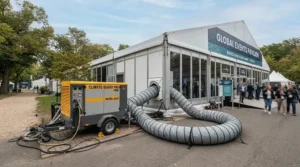
Here’s the problem. A tent is a greenhouse wearing a nice tablecloth. Sun hammers the vinyl, ninety guests add body heat, the caterer’s warming trays hum in the corner, and by the first toast your bridesmaids are fanning themselves with the program. A fan won’t fix that. You need actual refrigeration, or at least a very smart workaround.
Anyone shopping for a tent air conditioner for events hits an awkward truth fast: most consumer portable ACs are built to cool a bedroom, not a canopy. Rental specialists such as United Rentals explain that true spot coolers also dehumidify, but inside an enclosed tent they need a duct to push hot exhaust outside. That single detail separates a comfortable reception from a sauna with chandeliers.
This guide covers seven real products across budget, mid-range, and premium tiers, plus the sizing math, setup playbook, and safety context. One note on honesty: everything below comes from manufacturer specs, retailer listings, and aggregated review commentary. I haven’t field-tested these units, and I’ll flag every place where the evidence runs thin. Along the way we’ll cover wedding tent AC, outdoor event air conditioning, and the quieter question of guest comfort outdoor.
Quick Comparison Table: Tent Air Conditioner for Events at a Glance
| Product | Type | Rated Cooling | Price Range | Best For |
|---|---|---|---|---|
| Whynter ARC-14S | Dual-hose portable AC | 14,000 BTU ASHRAE / 9,500 BTU SACC | Around $300-$450 | Budget zone cooling |
| Midea Duo | Hose-in-hose inverter AC | 14,000 BTU / 12,000 BTU SACC | Mid-hundreds; check current price | Quiet lounge areas |
| ZAFRO Smart Inverter 16,000 BTU | Dual-hose inverter AC | 16,000 BTU / 12,000 BTU SACC | Mid-hundreds; check current price | Efficiency-minded hosts |
| EcoFlow Wave 3 | Battery-capable portable AC | 6,100 BTU | $900 and up; battery extra | Outlet-free ceremony nooks |
| Zero Breeze Mark 3 | Battery/solar portable AC | 5,280 BTU | Around $1,800-$2,100 with battery | Off-grid bridal tents |
| Hessaire MC37V | Evaporative cooler | 3,100 CFM (no BTU rating) | Mid-$300s to mid-$400s | Dry-climate patios |
| Cybertake S2 Pro | Compact 3-way-power AC | 5,100 BTU cooling / 6,100 BTU heating | Mid-hundreds; check current price | VIP nooks, shoulder seasons |
Read the cooling column with a squint. The Whynter ARC-14S, Midea Duo, and ZAFRO Smart Inverter 16,000 BTU look like heavyweights, yet their real SACC output lands between 9,500 and 12,000 BTU. The EcoFlow Wave 3, Zero Breeze Mark 3, and Cybertake S2 Pro trade capacity for freedom from wall outlets. The Hessaire MC37V plays a different game entirely, using airflow and evaporation instead of refrigerant.
💬 Just one click — help others make better buying decisions too!😊
Top 7 Tent Air Conditioner for Events: Expert Analysis
1. Whynter ARC-14S — dual-hose workhorse on a budget
Dual hoses are the headline, and for tent work they matter more than the BTU badge. One hose feeds outside air across the condenser; the other throws the heat back out. That keeps the unit from sucking its own chilled air out of your tent and hauling warm air in through every seam.
The ARC-14S carries a 14,000 BTU ASHRAE label but only 9,500 BTU SACC, and that second number is the one to plan around. Using a common rental rule of thumb, it covers roughly 200 square feet of real cooling: a head-table corner, not a whole tent. It runs as an AC, fan, or dehumidifier, rolls on casters, and uses a self-evaporating drain so nobody is emptying a bucket mid-toast. The hose reaches about 60 inches, which limits how far the unit can sit from the tent wall.
Based on the spec comparison, this is the sensible choice for a DJ booth, a vendor corner, or a sweetheart table. Big guest lists should treat it as a supplement to rented spot coolers.
Retail listings show it around 4.2 to 4.3 stars across thousands of reviews, and the manufacturer cites a Good Housekeeping “best overall” nod. Most reviewers are home users, so tent-specific feedback is thin.
Pros:
- ✅ Dual-hose design cools more efficiently than single-hose rivals
- ✅ Self-evaporating drain keeps cleanup minimal
- ✅ Cool, fan, and dehumidify modes in one unit
Cons:
- ❌ 9,500 BTU SACC limits it to zone cooling
- ❌ Roughly 60-inch hose restricts placement
Price: around $300-$450 range. Strong value per effective BTU if you only need spot cooling.
2. Midea Duo — quietest hose-in-hose design
The Midea Duo folds intake and exhaust into one wide conduit, which sounds like a gimmick until you picture routing it through a tent sidewall. One opening, one collar, done. The maker rates it 14,000 BTU, 12,000 BTU SACC, for spaces up to 550 square feet, and says it throws cool air up to 26 feet.
What matters at an event is the noise floor. An inverter compressor ramps up and down instead of cycling on and off, and the listed low of about 44 dB means a muffled hum under the vows rather than a rattle. Wi-Fi and voice control are nice for a home, but outdoors they’re mostly a bonus.
By the numbers, 12,000 SACC is about one ton, so apply the rental rule and you’re cooling around 250 square feet in decent conditions. Two units in a shaded 20-by-30 tent get you close to the target. That’s a smarter plan than hoping one bigger box will do it.
One long-term owner write-up praises its bedroom performance but mentions compressor start-up noise for roughly half a minute and calls the installation hardware flimsy. I couldn’t verify a large event-specific review pool.
Pros:
- ✅ Around 44 dB at its quietest setting
- ✅ 12,000 BTU SACC rating is genuinely useful
- ✅ App and voice control for quick adjustments
Cons:
- ❌ Owners report start-up compressor noise
- ❌ Wide hose-in-hose conduit is bulkier to route
Price: mid-hundreds, generally above basic dual-hose units; check current price. Worth it if quiet matters more than cost.
3. ZAFRO Smart Inverter 16,000 BTU — biggest headline number
Don’t let “16,000” fool you. The ZAFRO Smart Inverter 16,000 BTU carries a 12,000 BTU SACC rating, the same real-world figure as the Midea Duo. Marketing numbers are generous. Cooling you can feel is what the SACC number measures.
Where it earns attention is efficiency and noise. A roundup of 14,000-class dual-hose units cites a CEER near 12.8 and a 42 dB rating, both strong. It adds a four-way air swing and an “Extra” rapid-cool mode, which helps if guests arrive in waves and you need the tent pulled down fast before the ceremony ends.
What the spec sheet won’t tell you is how it behaves with a tent’s leaky envelope. Dual-hose units tolerate leaks better than single-hose ones, but nothing tolerates an open sidewall. Close the canvas near the unit, aim the swing toward seating, and give it a pre-cool head start.
Review evidence is the weak spot. I found a roundup noting the dual-hose install is slightly more involved than single-hose setups, but not a deep, verifiable event-use review base. Treat it as promising rather than proven.
Pros:
- ✅ Inverter compressor with a quoted 42 dB level
- ✅ CEER around 12.8 per one roundup
- ✅ Rapid-cool “Extra” mode and four-way swing
Cons:
- ❌ Dual-hose installation takes more effort
- ❌ Verified review base is thin in my research
Price: mid-hundreds; check current price. Good value if efficiency is the priority and you’ll test it before the event.
4. EcoFlow Wave 3 — cordless cooling for no-outlet tents
Picture a ceremony site in a field, forty yards from the nearest outlet. The EcoFlow Wave 3 is built for that headache. It delivers 6,100 BTU of cooling (1,800W) and 6,800 BTU of heating, runs on standard 100-240V power, and goes cordless with the optional add-on battery for a quoted 2 to 8 hours.
That runtime range deserves a sceptical read. Eight hours almost certainly assumes gentle settings; hard cooling sits at the short end. The unit weighs 33.7 lbs and the battery adds 21.4 lbs, so you’re carrying 55 pounds total, which is manageable for two people. The maker claims a 15°F drop in 15 minutes, a spec-sheet number in a small space, not a promise for open canvas.
On paper, it’s an ideal cooler for a bridal suite tent, a grandparents’ seating pod, or a vendor station. It’s the wrong tool for a 400-square-foot reception. Tech reviewers describe the third generation as a clear step up from the Wave 2, but I couldn’t verify a large consumer review pool.
Pros:
- ✅ Cordless runtime with the add-on battery
- ✅ Both cooling and 6,800 BTU heating
- ✅ App control and a manageable 33.7 lb unit weight
Cons:
- ❌ Battery is sold separately
- ❌ 6,100 BTU suits small zones only
Price: $900 and up for the unit, with the battery extra, based on regional listings; check current price. Premium, but unmatched for outlet-free spots.
5. Zero Breeze Mark 3 — lightest battery-and-solar option
The Zero Breeze Mark 3 is the featherweight of the group at about 22 lbs, with 5,280 BTU of cooling, a 46 dB rating, and a 48V system. The pitch is simple: no outlets, no drilling, five-minute setup. The maker rates it for 100 to 150 square feet, and its dual-hose layout keeps outside air out of the cooled zone.
Now the math that sellers skip. A single 1,022Wh battery runs it roughly 2 to 3 hours at 350-500W. A six-hour reception means two or three batteries, and the budget balloons. It also specifies an operating ambient ceiling of 104°F, which matters at a Texas July wedding.
Where it shines is a private, shaded, small tent: a bridal getting-ready space, a nursing nook, a quiet room for an overwhelmed grandparent. It can charge from solar, which is clever for remote sites.
Reviews I could find are sparse. One storefront thread has a buyer reporting a long delivery delay for the unit and battery, which the seller acknowledged, so order early.
Pros:
- ✅ Only about 22 lbs to carry
- ✅ Solar-compatible 48V battery system
- ✅ Rated input of just 500W
Cons:
- ❌ Roughly 2-3 hours per battery
- ❌ Highest cost per BTU in this lineup
Price: around $1,800-$2,100 for the unit plus battery. Niche value, but real if you have zero power.
6. Hessaire MC37V — most coverage per dollar in dry climates
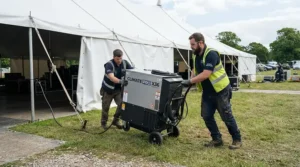
This is the odd one out, and deliberately so. The Hessaire MC37V is an evaporative cooler: water-soaked rigid pads on three sides, a 3,100 CFM fan, a 10.3-gallon tank, and a hose hookup with a float valve for continuous fill. The maker claims coverage up to 950 square feet.
The catch is physics. Evaporative coolers lower temperature by adding moisture, so they can only drop air toward its wet-bulb temperature. In dry air they’re brilliant. In humid air they just make a muggy tent muggier. Guidance I found points to relative humidity under about 50% as the working zone, and one roundup says it performed best below 30%.
Its power draw, listed around 2.4 amps (roughly 275 watts), means it can share circuits that would choke a compressor-based unit. That’s a real advantage on generator-limited sites. One retailer reviewer says you can feel the airflow 15-20 feet away on high.
On that retailer, it averages 4.5 stars from 87 reviews, and a big-box listing shows a couple thousand ratings. Buyers mostly describe patios and garages, not tents, so extrapolate with care.
Pros:
- ✅ 3,100 CFM airflow covers a large area
- ✅ Draws only about 2.4 amps
- ✅ 10.3-gallon tank plus continuous-fill hose connection
Cons:
- ❌ Adds humidity; weak in humid regions
- ❌ Listed at 51-60 dB, louder than inverter ACs
Price: mid-$300s to mid-$400s range. Excellent value in Arizona, a poor bet in Georgia.
7. Cybertake S2 Pro — compact three-way-power micro-cooler
The Cybertake S2 Pro is a camping-tent unit that moonlights nicely for event nooks. It offers 5,100 BTU cooling and 6,100 BTU heating, and accepts 48V DC, 12-24V vehicle power, or 100-240V wall power. The maker claims 8 hours of operation on about 1 kWh.
That power flexibility is the story. A generator, a battery station, or a car outlet can feed it, which makes it useful for a photographer’s changing tent or a small VIP lounge. The heating mode also stretches its season: an October reception with a chilly evening dip suddenly makes sense for a single unit.
Be realistic about scale. At roughly 5,000 BTU, it cools about 100 square feet by the rental rule. A roundup labels it best for camping tents, and I couldn’t verify a meaningful pool of event-specific reviews. Use it as a satellite, never the main act.
Pros:
- ✅ Runs on wall power, vehicle power, or 48V DC
- ✅ Heating mode extends the season
- ✅ Claimed 1 kWh per 8 hours of operation
Cons:
- ❌ 5,100 BTU is micro-zone capacity
- ❌ Camping-first design with limited event feedback
Price: mid-hundreds; check current price. Good value as a flexible add-on.
Top 7 Specs and Coverage Comparison
| Product | Power Source | Realistic Coverage* | Review Signal | Best For |
|---|---|---|---|---|
| Whynter ARC-14S | Wall outlet | About 200 sq ft | Thousands of reviews, 4.2-4.3 stars | Whynter ARC-14S for budget zones |
| Midea Duo | Wall outlet | About 250 sq ft | Owner write-ups; large pool unverified | Midea Duo for quiet lounges |
| ZAFRO Smart Inverter 16,000 BTU | Wall outlet | About 250 sq ft | Thin verified base | ZAFRO Smart Inverter 16,000 BTU for efficiency |
| EcoFlow Wave 3 | Outlet or battery | About 125 sq ft | Tech reviews positive | EcoFlow Wave 3 for cordless nooks |
| Zero Breeze Mark 3 | Battery or solar | 100-150 sq ft (maker) | Sparse; delivery delay noted | Zero Breeze Mark 3 for off-grid suites |
| Hessaire MC37V | Wall outlet + water | Up to 950 sq ft (dry air only) | 4.5 stars, 87 reviews at one retailer | Hessaire MC37V for dry patios |
| Cybertake S2 Pro | Outlet, vehicle, or DC | About 100 sq ft | Event-specific reviews limited | Cybertake S2 Pro for VIP nooks |
*Back-of-envelope estimate using the 12,000 BTU per 250 square feet rental rule of thumb, applied to SACC or stated capacity.
Notice how the coverage column compresses the field. No single refrigerant unit here handles a full reception tent, which is exactly why event pros stack units or rent one big spot cooler. The Hessaire MC37V looks like the coverage champion, but only when the air is dry. For humid climates, the Midea Duo or ZAFRO Smart Inverter 16,000 BTU, used in pairs, give the most believable cooling per outlet.
Event Tent Cooling 101: Why Canopies Get So Hot
Understanding event tent cooling starts with where the heat comes from. It isn’t just the weather. Sun load hits the roof and sidewalls first, and thin vinyl barely resists it. Then come the people: commonly cited estimates put each seated adult at a few hundred BTU per hour of heat output, so a hundred guests behave like a small space heater farm. Add string lights, a kitchen tent next door, and a dance floor, and you’ve stacked a heat load no bedroom AC was designed for.
The second problem is leakage. Tents have gaps at the sidewall seams, the entrances, and the floor edge, and warm air sneaks in constantly. A single-hose portable AC makes it worse by pulling room air out and creating negative pressure that invites outside air back through every gap, which is why dual-hose designs dominate this guide.
So the winning strategy isn’t “cool the tent.” It’s cool the people. Shade the roof if you can, close sidewalls on the sunny side, pre-cool before guests arrive, and aim cold air at seating and the head table rather than empty volume. A well-placed 12,000 BTU unit that targets a 15-by-15 zone beats a lonely giant machine shouting at the ceiling.

How to Choose a Portable AC for Event Tent Use
Choosing a portable AC for event tent use comes down to seven steps. Run through them in order and you’ll avoid the most expensive mistakes.
- Measure the zone, not the tent. Decide which areas truly need cold air: seating, head table, DJ booth. Cooling dead space wastes capacity.
- Trust SACC, not ASHRAE. Manufacturers advertise the bigger ASHRAE figure. One buyer’s guide notes a “14,000 BTU” unit may deliver only 9,600 to 10,200 BTU by the DOE measure, and that’s the number that counts.
- Apply a sizing rule. Herc Rentals suggests about 12,000 BTU (one ton) per 250 square feet of commercial venue. Treat that as a starting point, then add margin for sun, guest count, and open sides.
- Prefer dual-hose or inverter designs. Both cool more efficiently and run quieter, which matters during vows and speeches.
- Check your power. Whynter’s own FAQ says to plug its units directly into a grounded outlet on a dedicated circuit. Count circuits before counting units, and budget for a generator if the site has none.
- Plan the exhaust. Inside a closed tent, hot air has to leave through a duct or hose. Decide where it exits and keep it away from guests.
- Listen to the spec sheet. For moments of silence, look for units around or below the low-50s dB range, ideally lower.
Run those seven checks and the shortlist shrinks quickly, usually to two units plus a rental backup.
Outdoor Event Air Conditioning: Portable AC vs Evaporative Cooler vs Rental
Outdoor event air conditioning isn’t one product category. It’s three, and each fails in a different way.
| Option | Works Best When | Strength | Watch-Out | Best For |
|---|---|---|---|---|
| Consumer portable AC (e.g., Midea Duo) | Humid or dry; tent mostly closed | True dehumidified cooling | Limited capacity per unit | Midea Duo for two-unit zone cooling |
| Evaporative cooler (e.g., Hessaire MC37V) | Low humidity, open or ventilated space | Huge airflow, low power draw | Raises humidity; weak above about 50% RH | Hessaire MC37V for dry-climate patios |
| Rented spot cooler / commercial AC | Large tent, 100+ guests | Real tonnage, often delivered and set up | Needs power and a duct plan | Large weddings and corporate events |
Rental fleets list spot coolers from about 1 ton up to 5 tons and beyond, and some larger units advertise cooling a well-insulated 1,200-square-foot tent. That’s a different universe from a consumer box. Rental pros also sell sizing as an airflow (CFM) question rather than a square-footage one, and they recommend working with a temporary HVAC provider.
The practical read: buy a consumer unit when you need a flexible zone cooler you’ll reuse, choose evaporative only if your climate is truly dry, and rent when the guest list tops roughly one hundred. A hybrid, such as a rented spot cooler for the main space plus a Cybertake S2 Pro in the bridal nook, is the sneaky-smart move.
Wedding Tent AC: Planning Cool Comfort for the Big Day
Wedding tent AC has quirks that a corporate picnic never faces. The people wearing the most fabric are the ones standing in the sun for photos. The ceremony has silence requirements. And everything must look good, which means hoses and cords shouldn’t snake through the aisle shot.
Start with a timeline. Cool the tent for at least two to three hours before guests arrive, because a cold-soaked space holds up better than one you’re chasing. Plan separate zones: a cooler reception, a lightly cooled cocktail area, and a small battery-powered nook (an EcoFlow Wave 3 or Zero Breeze Mark 3) for the couple to reset between portraits.
Noise is the second priority. A Midea Duo at low settings keeps near the mid-40s dB mark, but a generator rumbling nearby can ruin the quiet it paid for. Park generators far away and downwind, and run longer cords.
Third, hide the machinery without blocking airflow. Use drape or planters to disguise the unit’s body, but never wall off the intake or exhaust. Finally, confirm venue rules: many sites restrict generators or cord runs, and tent permits can come with fire-code conditions. Check locally before you build a plan around any single unit.
Setting Up a Temporary Event Climate: Your Step-by-Step Playbook
Creating a temporary event climate is mostly logistics, and logistics is where events succeed or fail. Use this order on setup day.
- Confirm power the day before. Count outlets and circuits, and label which units use which. Never daisy-chain multiple AC units onto one cord.
- Position for coverage. Place units near seating and aim airflow across guests. Keep at least a few feet of clearance around intakes.
- Route the exhaust outside. Cut a clean opening in the sidewall (or use the tent’s vent panel), seal gaps with weather-safe tape or a collar, and angle the hot air away from walkways.
- Manage condensate. Units with self-evaporating drains need little attention, but check your model’s manual and keep a pan handy as backup.
- Pre-cool. Start two to three hours early with sidewalls closed.
- Monitor. Tape an inexpensive thermometer at head height in the seating area and check it hourly.
- Teardown. Let units run in fan mode briefly to dry the interior before packing.
Common first-30-days mistakes if you buy a unit: skipping filter cleaning, kinking the exhaust hose, and forgetting that evaporative pads grow algae and mineral crust if left wet. A five-minute rinse after each event saves hours of frustration later.
Real-World Scenarios: Matching the Right Unit to Your Event
Three user profiles show how the choices change.
Scenario 1: A 40-guest backyard wedding in a humid region. The tent is 20 by 30 feet (600 square feet), shaded by trees, with grid power on the patio. The rule of thumb points to roughly 29,000 BTU. Two Midea Duo units deliver about 24,000 BTU SACC, which gets you most of the way if sidewalls stay closed. Budget: low four figures. Frequency: once, so buying isn’t ideal unless you reuse them.
Scenario 2: A 100-guest corporate event under an open-sided pavilion in a dry climate. Open sides kill refrigerant efficiency, but dry air makes evaporative cooling attractive. Two or three Hessaire MC37V units spread around the seating, at a low combined power draw, are the smartest play. Budget: under $1,500. The company repeats the event yearly, so owning makes sense.
Scenario 3: An off-grid field ceremony with a small bridal tent. No power, 10-by-10 space. The Zero Breeze Mark 3 with two batteries or the EcoFlow Wave 3 with its add-on battery covers a four-hour window. Budget: the premium end. One-time use points to renting a power station instead if you can find one.
Notice the pattern: the cheapest unit is rarely the right one, and the right one depends on humidity, power, and guest count.
✨ Ready to Beat the Heat?
🔍 Take your event to the next level with these carefully selected cooling options. Click any highlighted product name to check current pricing and availability. These units can help you create a comfortable, memorable day your guests will talk about for the right reasons!
Problem → Solution: Guest Comfort Outdoor, Fixed
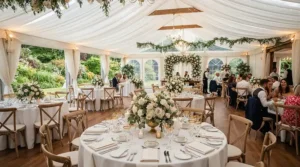
Even with a good unit, guest comfort outdoor can slip. Here are four common problems and fixes.
Problem: The air feels cold but clammy. That’s a humidity problem. Switch to the dehumidify mode on units like the Whynter ARC-14S, and if you’re using the Hessaire MC37V, crack a sidewall for cross-ventilation so moisture can escape.
Problem: A hot spot near the kitchen tent. Keep a small unit such as the Cybertake S2 Pro aimed at the nearest seating, and move the hottest guests (and the buffet line) away from the heat source.
Problem: Breakers keep tripping. You’ve overloaded a circuit. Move units to separate circuits, or bring a generator sized for the combined draw. The Hessaire MC37V’s low amp draw is a useful stand-in if power is tight.
Problem: Older guests look flushed. Heat doesn’t hit everyone equally. The New York City health department’s outdoor event heat guidance recommends checking the forecast heat index and preparing extra steps once it reaches 85°F or above, including signage, water, and shade. Stage a cooler seating area near the AC and keep water stations visible.
Common Mistakes When Buying a Tent Air Conditioner for Events
Most regrets come from the same handful of errors:
- Buying by ASHRAE BTU. The bigger number flatters the unit, while SACC tells the truth.
- Ignoring the exhaust. An unvented portable AC just heats your tent.
- Choosing single-hose to save money. In a leaky tent, negative pressure pulls warm air right back in. Dual-hose models like the Whynter ARC-14S avoid most of that.
- Underestimating guests. Capacity assumed for 40 people won’t survive 70.
- Skipping the power audit. One venue outlet isn’t one unit’s worth of power.
- Trusting evaporative coolers in humid weather. The Hessaire MC37V is superb in dry heat and disappointing in sticky air.
- Forgetting the backup plan. Keep a rental number handy for the morning of the event.
Each of these costs far more to fix on the day than to prevent a week earlier.
Long-Term Cost & Maintenance: Portable Event Cooling Economics
Portable event cooling pays off or doesn’t based on how often you use it. If you host three to five events a year, owning a couple of units usually beats renting every time. A guide aimed at event planners suggests commercial rental-grade equipment makes more sense for weekly operators, which fits the usage logic.
Efficiency adds up slowly. One guide claims dual-hose and Energy Star units can run 30-40% more efficiently and save roughly $20 to $40 a year at home, but events run a handful of days annually, so the purchase price dominates. Spend your money on capacity and reliability, not on the last drop of efficiency.
Maintenance is cheap but non-negotiable: clean air filters regularly, inspect hoses for kinks or tears, keep the drain clear, rinse and dry evaporative pads to prevent algae and mineral buildup, and store lithium batteries like the EcoFlow Wave 3 and Zero Breeze Mark 3 according to the maker’s instructions. For the long run, a Whynter ARC-14S with sensible care is a safer investment than the flashiest unit with a thin support network.
Heat Safety and Regulations Guide for Tent Events
Cooling isn’t just comfort; it’s safety. The CDC’s MMWR study on heat stress reviewed 25 outdoor occupational heat illnesses and concluded that a heat index of 85°F could serve as a screening threshold when better measurements aren’t available. It also notes that some serious cases occurred below the thresholds commonly assumed to be lower risk. That research concerns workers, not guests, but it’s a useful reminder that moderate-looking temperatures can still hurt.
For your event, check the forecast heat index, schedule outdoor activities for cooler hours, and provide shade, water, and a clearly marked cool zone. Know the signs of heat illness (headache, dizziness, heavy sweating or hot dry skin, confusion) and have a plan to get anyone showing them to cooler air and medical help.
On compliance, rules vary by location. Many jurisdictions regulate tent size, flame-retardant fabrics, generator placement, and carbon monoxide risk. Keep generators well away from the tent and downwind, and verify permits with your local fire marshal or venue manager before cooling gear arrives.

FAQ: Tent Air Conditioner for Events
❓ How many BTUs do I need for a 20x20 party tent?
❓ Can a regular portable AC cool an open-sided tent?
❓ How much does it cost to rent a spot cooler for a tent event?
❓ Do I need a generator to run a portable AC in a tent?
❓ Is an evaporative cooler better than a portable AC for outdoor weddings?
Conclusion
The best tent air conditioner for events isn’t one product; it’s a plan. Cool the people, not the volume. Trust SACC numbers over splashy ASHRAE ones. Respect your power limits. Match the technology to your climate, since evaporation rewards dry air and refrigeration rewards everyone else.
If you’re on a budget and need zone cooling, the Whynter ARC-14S is the proven starting point. For quiet, efficient reception cooling, the Midea Duo and ZAFRO Smart Inverter 16,000 BTU are the better-tuned options. When outlets are scarce, the EcoFlow Wave 3, Zero Breeze Mark 3, and Cybertake S2 Pro each solve a different off-grid puzzle. In dry country, the Hessaire MC37V stretches a modest budget further than anything else here. For a hundred-plus guests, add a rental spot cooler and keep a backup number handy.
Do the sizing math, run the power audit, and pre-cool the tent. Your guests may never thank you for the thermostat, but they’ll stay for the last dance instead of leaving early.
✨ Don’t Let the Heat Steal the Show!
🔍 Check current pricing and availability on your favorite pick, then plan your cooling layout with confidence. A comfortable tent makes every toast, speech, and slow dance better!
Recommended for You
- High Volume Low Speed Fan: 7 Best Picks For 2026
- Warehouse Cooling Solutions: 7 Best Picks To Beat the Heat In 2026
- Best Spot Cooler: 7 Ultimate Picks Ranked For 2026
Disclaimer: This article contains affiliate links. As an Amazon Associate, I earn from qualifying purchases. If you purchase products through these links, we may earn a small commission at no additional cost to you.
✨ Found this helpful? Share it with your friends! 💬🤗
