

In This Article
Some rooms are hot in a polite way. Others are hot like a blacksmith’s apprenticeship: the garage where the welder runs all afternoon, the network closet where the racks hum like a beehive, the wedding tent at 3 p.m. in July. Cooling a whole building to fix one hot corner is like heating a swimming pool to warm a single toe. That’s why the best spot cooler isn’t necessarily the biggest unit on the market. It’s the one that aims cold air at the person or machine that needs it.

Heat is also more than a comfort problem. OSHA’s heat exposure guidance treats hot work environments as a real safety issue. That matters whether you run a shop floor or just spend weekends in a baking garage. A well-chosen portable industrial AC can be part of the answer, alongside water, rest, and good airflow.
This guide ranks seven real units, from compact 7,000 BTU rollers to a 24,000 BTU commercial spot AC. It rests on manufacturer spec sheets, retailer listings, one independent lab write-up, and whatever genuine customer-review data I could verify. Where the review evidence is thin, I’ll say so plainly instead of dressing it up. Think of it as portable spot cooler reviews with the marketing fog cleared out.
What Is the Best Spot Cooler?
The best spot cooler is a self-contained portable cooling unit that sends chilled air through a flexible duct to one specific person, machine, or work area instead of conditioning a whole building. The right pick matches its BTU rating, power requirements, and operating temperature range to your actual heat load.
Treat most spot cooling unit reviews with healthy skepticism. A lot of them are written from spec sheets anyway, so we’ll start there and add context.
Quick Comparison Table: Best Spot Cooler Options at a Glance
| Product | Type & Capacity | Standout Trait | Best For |
|---|---|---|---|
| Perfect Aire 2SPOT6800 | Compressor, 7,000 BTU | Light, wheeled, continuous drain | Garages, hobby shops |
| Equator OAC 2000 | Compressor, 7,000 BTU | IP24 weather-resistant housing | Patios, open garages |
| Hessaire MC37M | Evaporative, 3,100 CFM | Very low running cost | Dry-climate patios, barns |
| Tripp Lite SRCOOL12K | Compressor, 12,000 BTU | 100% duty cycle, ducted output | Server closets, IT rooms |
| MovinCool Classic Plus 14 | Compressor, 13,200 BTU | Digital control on 115V power | Small shops, production cells |
| KwiKool KPAC1411-2 | Compressor, 13,700 BTU | American-made commercial build | Equipment rooms, work stations |
| MovinCool Classic Plus 26 | Compressor, 24,000 BTU | Handles up to 113°F ambient | Factories, large hot zones |
Read the table as a ladder. The two 7,000 BTU units cool a workstation, the middle pair cool a small shop bay or closet, and the MovinCool Classic Plus 26 is for serious industrial heat. The Hessaire MC37M sits off to the side because it cools by evaporation, which makes it brilliant in dry air and disappointing in swampy air. If you’re a typical garage user, start at the top of the ladder. If you manage equipment that can’t overheat, start in the middle.
💬 Just one click — help others make better buying decisions too!😊
Top 7 Best Spot Cooler Picks: Expert Analysis
Each pick below gets the same treatment: what the specs mean in practice, who should care, what verified reviews say, and where the price lands. Prices are ranges at the time of research and will drift, so check current price before you buy.
1. Perfect Aire 2SPOT6800 — best entry-level roller for garages
Light, wheeled, and simple, this is the unit most first-timers should shortlist. The spec sheet lists 7,000 BTU, about 135 CFM of cool airflow, a 52 dB noise rating, and operation up to 109°F. In practice, that means a person-sized zone cooled from a few feet away, not a 600-square-foot shop rescued from July. Retailers quote anywhere from 150 to 250 square feet of coverage, and that spread is a clue: treat it as a spot cooler, not a room cooler.
At roughly 56 pounds with 360° wheels, it rolls easily. The 6-foot drain hose allows continuous drainage, so you aren’t playing bucket roulette mid-project. The adjustable blower hose does the heavy lifting, because aiming it at a workbench beats what the BTU figure suggests. On paper this suits woodworkers, patio grillers, and hobbyists on a standard 115V outlet. What the spec sheet won’t tell you: an EER of 7.95 isn’t frugal, so think “hours,” not “all summer.”
I couldn’t verify a deep pool of consumer reviews for this exact model number, so reliability claims deserve caution. The manufacturer’s 1-year full-replacement warranty is the main safety net.
Pros:
- ✅ Aim-anywhere blower hose for focused cooling
- ✅ Continuous drain hose included
- ✅ Light enough to roll solo
Cons:
- ❌ Modest coverage; not a whole-shop solution
- ❌ Middling efficiency for long run times
Expect roughly a $500-$750 range depending on retailer. It’s a fair value for an entry-level spot cooler. Check current price.

2. Equator OAC 2000 — the weather-resistant option for open-air spaces
Most spot coolers hate rain, which is awkward because many hot spots are outdoors. This 7,000 BTU unit is housed in an IP24-rated metal body, built to shrug off splashing and light weather. The spec sheet lists 700 W rated power at 110V, a 64.4°F to 113°F operating range, and a footprint of about 22.4 x 19 x 11 inches. Translation: it can live on a covered patio or in an open-bay garage without a tantrum. IP24 means splash resistance, not a hose-down, so keep it under cover during storms.
Net weight is around 60 pounds, and it uses a single flexible outlet to push cool air where you point it. It also carries overheat protection and ETL certification. Coverage claims at big-box listings swing between 130 and 250 square feet, so size your expectations to a single seating area or work zone. Based on the spec comparison, it’s a pick for cookout corners, tent edges, and carport workbenches.
Independent review depth is limited. Much of the retail copy I found is promotional, so I can’t summarize genuine reviewer consensus. The 1-year parts-and-labor warranty is the practical reassurance.
Pros:
- ✅ Weather-resistant housing for outdoor placement
- ✅ Wide operating range up to 113°F
- ✅ Compact footprint with casters
Cons:
- ❌ Costs more than similar-capacity indoor units
- ❌ Splash-rated, not storm-proof
Expect roughly a $750-$1,050 range. You’re paying a weatherproofing premium, so it’s worth it only if your hot spot is truly exposed. Check current price.
3. Hessaire MC37M — lowest running cost for dry climates
This one’s an evaporative “swamp” cooler, not a compressor air conditioner, and the distinction decides everything. It moves 3,100 CFM, covers up to about 950 square feet of semi-open space, and holds a 10.3-gallon tank good for roughly 3 to 4 hours per fill. A garden hose adapter allows continuous filling. It draws about 250 watts on a standard 115V outlet, a fraction of what a compressor unit pulls. Controls include four fan-only speeds, two evaporative settings, oscillating vents, and an 8-hour timer.
The catch is humidity. Retail listings stress that evaporative coolers work best in dry climates, and refurbished-unit copy suggests 40 percent relative humidity or less. In muggy air, you get a damp breeze instead of relief. In dry or moderate air, this is a bargain for big, ventilated areas like barns, patios, and open shops.
The retailer listing I found shows 4.3 stars across 128 ratings. Reviewers describe indoor drops from the mid-80s to the high 70s in moderate humidity, and desert owners are enthusiastic. Others note it won’t help much in cooler or wetter conditions.
Pros:
- ✅ Very low electricity draw
- ✅ Huge coverage for open spaces
- ✅ Hose adapter for continuous fill
Cons:
- ❌ Weak in humid climates
- ❌ Adds moisture and needs filter drying
Expect the mid-$400s range. For dry climates, it’s the strongest value on this list. Check current price.
4. Tripp Lite SRCOOL12K — built for always-on equipment rooms
If a server closet could choose its own cooler, it would pick this one. The unit delivers 12,000 BTU on 120V and offers two airflow options: a standard louvered vent for general cooling and a roughly 71-inch flexible duct that sends cold air straight at the hot gear. The manufacturer states a 100 percent duty cycle, copper tubing, and auto-restart after a power loss. That last feature matters at 3 a.m. after a brownout. Dimensions run about 32.6 x 12.6 x 19.75 inches, with a weight in the high-60-pound range.
An independent lab write-up from StorageReview found it integrated quickly without a dedicated circuit, drain line, or outside contractors. That makes it a middle ground compared to an expensive mini-split. The same write-up lists a 50 dB rating at full speed and 1,250 watts max draw. What most buyers overlook is that this is a closet cooler first and a general-purpose spot cooler second, so it’s pricier than a garage unit for the same BTUs.
Pros:
- ✅ Ducted output targets the heat source
- ✅ Auto-restart and built-in timer
- ✅ No-water, low-maintenance design
Cons:
- ❌ Premium price for the BTU rating
- ❌ Louder than home-oriented units
Pricing varies widely by retailer, so check current price. It typically lands in the high-hundreds range, which is fair for IT-grade reliability.
5. MovinCool Classic Plus 14 — the workhorse on a standard outlet
MovinCool has been in the spot-cooling business for decades, and this model shows it. The spec sheet lists 13,200 BTU at 95°F, which the maker calls the maximum possible on standard 115V power. It draws about 12 amps on a 15-amp circuit and runs between roughly 70°F and 113°F. Evaporator airflow is 440 or 380 CFM, with a 5-gallon condensate tank, a flexible duct, and digital push-button controls. It weighs around 153 to 166 pounds, so think “rolls easily once placed,” not “carry it upstairs.”
The real-world meaning: this unit can hold a small shop bay, a press operator’s station, or a broadcast closet at a livable temperature without a 230V circuit. MovinCool advertises operating costs from about 15 cents per hour, a manufacturer claim worth treating as a best case. The warranty is notable too: 12 months on the whole unit and 36 months on the compressor per MovinCool’s spec literature.
I found no verifiable aggregated consumer reviews, since most sales run through commercial dealers. The track record is its main credential.
Pros:
- ✅ Strong capacity on 115V power
- ✅ Digital temperature control
- ✅ Long compressor warranty
Cons:
- ❌ Heavy at roughly 150-plus pounds
- ❌ Priced like commercial equipment
Expect roughly the $3,000-$4,000 range at dealers. It’s a solid value for daily commercial use. Check current price.
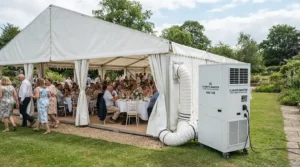
6. KwiKool KPAC1411-2 — American-made commercial muscle
KwiKool builds this one in the USA and sells it for commercial use. It’s rated at 13,700 BTU, plugs into a standard 115V/15-amp circuit, and pulls about 11.5 amps. Evaporator airflow is rated at 460 CFM. According to the manufacturer, the coil produces a roughly 20°F temperature drop, so 95°F intake air leaves around 75°F. The company says it effectively cools a person or equipment within about 5 to 7 feet.
That matters because it tells you exactly how to use it: close, aimed, and ducted. Two flexible air chutes let you split the output. It has automatic restart, ETL and CSA certification, and a condensate tank with float cutoff that you empty manually. The cabinet is heavy, with shipping weights above 200 pounds, so plan your location once.
What reviewers say is mostly unavailable. Listings stress commercial-only sales, and I couldn’t verify a meaningful consumer-review pool. Expect the one-year parts warranty and the brand’s reputation among HVAC dealers to be your assurance. The larger KwiKool KPAC2421-2, rated near 22,900 BTU, is the step up when this one runs out of steam.
Pros:
- ✅ Made in the USA with ETL/CSA listing
- ✅ Two flexible chutes for splitting airflow
- ✅ Auto restart after power loss
Cons:
- ❌ Very heavy; place it once
- ❌ Ducting accessories sold separately
Expect roughly a $3,100-$4,400 range. It’s pricey, but it justifies itself in daily-use settings. Check current price.
7. MovinCool Classic Plus 26 — maximum cooling for demanding spaces
When a single hot zone is the bottleneck for a whole operation, this is the pick. It provides up to 24,000 BTU/h, the maximum MovinCool says is possible on standard 208/230V power. It handles ambient temperatures up to about 113°F and offers a programmable digital controller with a two-speed fan. The spec literature shows evaporator airflow near 708/600 CFM, and the cabinet runs about 19 x 29 x 47 inches at around 235 pounds. MovinCool pitches it at production lines, injection molding, and metal forming.
The practical meaning: you need a 230V circuit, so budget an electrician if your site lacks one. In return, you get roughly double the output of the 115V units, aimed at large heat loads like machinery or crowded work cells. For heavy industry, that’s why it earns a spot on any industrial spot cooler best list.
No verified consumer review pool turned up, which is normal for dealer-sold industrial gear. The brand’s warranty program is the main safety net, and its larger siblings, the MovinCool Classic 40 and MovinCool Classic 60, exist for warehouse-scale work.
Pros:
- ✅ Up to 24,000 BTU of cooling
- ✅ Programmable digital control
- ✅ Rated for 113°F environments
Cons:
- ❌ Needs a 230V circuit
- ❌ Heavy and a serious investment
Expect roughly a $4,000-$5,000 range at dealers. It’s the right value when downtime costs more than the unit. Check current price.
How to Choose the Best Spot Cooler: 7 Steps That Matter
Choosing the best spot cooler comes down to seven checks. Each one filters out a different kind of regret.
- Measure the heat load, not just the floor area. A running welder or a rack of servers adds far more heat than a person does. Sources of heat decide capacity, not square footage.
- Match BTU to the zone. In the units above, 7,000 BTU suits one workstation, 12,000 to 14,000 BTU covers a small bay or closet, and 24,000 BTU suits production heat.
- Check your power. Most picks run on a standard 115V outlet, but the MovinCool Classic Plus 26 needs 230V. Confirm the breaker before you buy.
- Check the temperature ceiling. Listings run from 109°F to 113°F maximum, so a hot attic or foundry bay may exceed what a cheap unit tolerates.
- Decide how cold air gets where you need it. A flexible duct (as on the Tripp Lite SRCOOL12K) targets a rack or a person, while a louver cools generally.
- Plan for condensate. Continuous drain hoses beat tanks for unattended use.
- Confirm duty cycle and warranty. A unit rated for continuous running belongs in server rooms. Hobby units belong in hobby rooms.

Portable Spot Cooler Reviews: What the Evidence Actually Says
Here’s the awkward truth about portable spot cooler reviews: for industrial gear, genuine customer reviews barely exist. Dealers sell commercial units by quote, so ratings are scarce. The best-documented consumer-style product here is the Hessaire MC37M, with 4.3 stars across 128 ratings on one major retailer’s listing. Reviewers there praise strong airflow in dry or moderate conditions and note that it falters when it’s cool or humid.
For the Tripp Lite SRCOOL12K, the strongest evidence is the lab write-up mentioned earlier, a hands-on evaluation in an enterprise test environment rather than a crowd of anonymous ratings. For the Perfect Aire 2SPOT6800 and the Equator OAC 2000, I found mostly manufacturer and retailer copy.
Several listing pages for newer industrial units I came across display only a handful of reviews. Some “tested” roundups for spot cooling unit reviews cite those same thin listings while claiming months of hands-on testing. That’s a red flag. A fair rule: treat any claim of testing without methodology as marketing, and weigh warranty terms, spec sheets, and independent lab write-ups more heavily than star counts. If a review pool is tiny, the warranty is your real review.
Industrial Spot Cooler Best Picks vs Commercial Spot AC: Which Class Do You Need?
Shoppers lump these together, but they behave differently. A hobby-class roller like the Perfect Aire 2SPOT6800 is built for occasional use. A commercial spot AC such as the KwiKool KPAC1411-2 or the MovinCool Classic Plus 14 is built to run daily for years, with heavier cabinets and longer compressor warranties. The industrial spot cooler best choice for a factory floor is usually the MovinCool Classic Plus 26 or its larger siblings, because extra capacity buys headroom.
| Product | Power | Operating Range | Weight | Price Range |
|---|---|---|---|---|
| Perfect Aire 2SPOT6800 | 115V | 68-109°F | ~56 lb | $500-$750 |
| Equator OAC 2000 | 110V | 64-113°F | ~60 lb | $750-$1,050 |
| Hessaire MC37M | 115V, ~250 W | Best in dry air | Light | Mid-$400s |
| Tripp Lite SRCOOL12K | 120V, 1,250 W max | Indoor IT use | ~68 lb | High hundreds |
| MovinCool Classic Plus 14 | 115V, 15 A circuit | 70-113°F | ~153-166 lb | $3,000-$4,000 |
| KwiKool KPAC1411-2 | 115V, 15 A circuit | ~70-110°F | 200+ lb | $3,100-$4,400 |
| MovinCool Classic Plus 26 | 208/230V | Up to 113°F | ~235 lb | $4,000-$5,000 |
Looking at the table, weight and price climb together for a reason: heavier cabinets hold bigger coils and compressors built for long duty cycles. If you only need a cool bench for four hours a week, the Perfect Aire 2SPOT6800 or Equator OAC 2000 is plenty. If your operation loses money when a machine overheats, a portable industrial AC from the commercial tier is cheap insurance.
Spot Cooler vs Evaporative Cooler vs Other Cooling Options
Spot cooling isn’t the only way to beat heat, and the right alternative sometimes wins. Evaporative cooling works by evaporating water into moving air, which is cheap and effective in dry climates but loses punch as humidity rises. Compressor spot coolers work in humid air because they remove heat and moisture with refrigerant.
| Option | Best For | Main Strength | Main Weakness |
|---|---|---|---|
| Compressor spot cooler (MovinCool Classic Plus 14) | Hot, humid work zones | Reliable cold air anywhere | Higher cost, heavy |
| Evaporative cooler (Hessaire MC37M) | Dry-climate open spaces | Tiny power draw | Struggles in humidity |
| Window or room AC | Permanent single rooms | Efficient for a fixed space | Needs a window, not mobile |
| Fans only | Mild heat | Nearly free | No actual temperature drop |
| Central AC | Whole buildings | Comfort everywhere | Expensive to extend to hot spots |
The pattern is simple. Humid climate plus a hot, defined zone points toward a compressor unit like the Tripp Lite SRCOOL12K. Dry climate plus lots of open space points toward the Hessaire MC37M. Fans are a supporting actor, not the lead.
Targeted Cooling Zone: How to Set Up Yours for Maximum Effect
Buying a unit is half the job. A targeted cooling zone works when you control three things: where cold air lands, where hot air leaves, and how long the unit runs.
Step 1: Aim, don’t blanket. Place the unit within a few feet of the person or equipment, then aim the duct at them. KwiKool’s own guidance suggests effective cooling within about 5 to 7 feet.
Step 2: Send the hot exhaust somewhere useful. Spot coolers dump condenser heat. If that exhaust stays in your zone, you’ve built an expensive space heater. Duct it outside or into a large, unoccupied area where possible.
Step 3: Close the zone. Hang a curtain, close a door, or use a partition to keep cold air where you need it.
Step 4: Build a maintenance routine. Clean or replace filters regularly, empty condensate tanks daily if no drain is used, and keep intake clear.
First-30-day mistakes: blocking the intake with boxes, running a 115V unit off an overloaded power strip, and forgetting to level the unit so condensate drains properly. Each one is easy to avoid with ten minutes of setup.
Temporary Cooling Solution: Real-World Scenarios
Sometimes you don’t need permanent cooling, just a temporary cooling solution that works for a season or an event. Here’s how three profiles map to the picks above.
The weekend woodworker. A two-car garage, evenings and weekends, standard 115V outlets, and a budget under $800. Based on the specs, the Perfect Aire 2SPOT6800 matches the use pattern. Aim the blower hose at the bench and run the drain hose to a floor drain.
The small-office IT manager. A closet with a handful of devices running around the clock. The Tripp Lite SRCOOL12K, with its stated 100 percent duty cycle and auto-restart, fits better than a hobby unit. It’s built for continuous operation.
The event or outdoor-bay operator. An open-sided tent or carport in a dry climate suits the Hessaire MC37M. In humid regions, the Equator OAC 2000 is the more sensible choice because it uses a compressor and a weather-resistant body.
A fourth profile deserves a mention: a plant manager facing a hot machine cell. Here, the 230V MovinCool Classic Plus 26 earns its price.

Problem → Solution Guide: Fixing Common Spot Cooler Headaches
Problem: the zone gets warmer, not cooler. Hot exhaust is leaking back into the space. Duct the exhaust outside or into a larger area.
Problem: the unit shuts off repeatedly. Many units carry condensate-tank cutoffs, as the KwiKool KPAC1411-2 does. Empty the tank, or connect a drain hose like the one on the Perfect Aire 2SPOT6800.
Problem: airflow weakens over time. Dirty filters are the usual suspect. Wash or replace them on a schedule.
Problem: the breaker trips. Compressor units draw significant current. The MovinCool Classic Plus 14 pulls about 12 amps on a 15-amp circuit, so don’t share that circuit with a heater or compressor.
Problem: cold air doesn’t reach the target. Extend or reposition the duct, and avoid long kinked runs. Tight bends choke airflow.
Long-Term Cost & Maintenance: What You’ll Really Pay
Purchase price is only the opening bid. Electricity, filters, and downtime decide total cost of ownership. As an illustration, the Tripp Lite SRCOOL12K lists a 1,250 watt maximum draw. At an assumed $0.15 per kilowatt-hour, that’s roughly 19 cents per hour at full load, or under $2 for an eight-hour day. The Hessaire MC37M, at about 250 watts, costs a fraction of that. Manufacturers advertise even lower figures, but those are best-case claims.
| Product | Price Range | Running Cost | Value Verdict |
|---|---|---|---|
| Perfect Aire 2SPOT6800 | $500-$750 | Moderate | Best budget compressor pick |
| Equator OAC 2000 | $750-$1,050 | Moderate | Worth it for outdoor use only |
| Hessaire MC37M | Mid-$400s | Very low | Best value in dry climates |
| Tripp Lite SRCOOL12K | High hundreds | Moderate | Strong for IT use |
| MovinCool Classic Plus 14 | $3,000-$4,000 | Moderate | Strong for daily use |
| KwiKool KPAC1411-2 | $3,100-$4,400 | Moderate | Strong for daily use |
| MovinCool Classic Plus 26 | $4,000-$5,000 | Higher | Right for heavy industry |
The numbers show a clear split. Entry-level units have low upfront cost and moderate lifespans, while commercial units cost several times more but are built to run daily for years. If you’d run a unit more than a few hours a day, the commercial tier tends to win on total cost.
Features That Actually Matter (And Those That Don’t)
Features worth paying for: a high operating-temperature ceiling (109°F to 113°F in this lineup), a flexible duct you can aim, continuous drain capability, and auto-restart after power loss. The last one quietly saves equipment during brownouts, and it’s standard on the KwiKool KPAC1411-2 and the Tripp Lite SRCOOL12K.
Features worth ignoring: fancy app connectivity on a unit that lives in a shop, and dramatic coverage claims in square feet. Those figures wobble between retailers (the Perfect Aire 2SPOT6800 shows both 150 and 250 square feet), so use BTU and airflow instead.
Features that depend on you: programmable controls matter if you want to set a temperature and walk away, as with the MovinCool Classic Plus 14. Timers matter for unattended or off-hours cooling. If you’d never use them, don’t pay for them.
Common Mistakes When Buying a Spot Cooler
The most common error is buying by square footage. Spot cooling targets a zone, so a unit that looks “too small” for the room may be exactly right for the bench.
Another is ignoring voltage. The MovinCool Classic Plus 26 needs 230V, and discovering that after delivery is an expensive surprise.
A third is choosing evaporative cooling in a humid region. The Hessaire MC37M is excellent when the air is dry and a letdown when it isn’t.
Fourth, buyers overlook where the hot exhaust goes. Venting it into the same room defeats the purpose.
Finally, many people skip the warranty fine print. Warranty terms range from a year on the KwiKool KPAC1411-2 to longer compressor coverage on MovinCool units, and that difference can matter more than a small price gap.
✨ Ready to Cool Your Hot Spot?
🔍 Take your workspace to the next level with these carefully selected units. Click any highlighted product name to check current pricing and availability. The right spot cooler will help you create the comfortable, productive zone you’ve been missing!
Safety, Regulations & Compliance for Spot Cooling
Cooling gear is part of a larger heat-safety picture. Older OSHA tips reported by EHS Today recommend general ventilation and spot cooling at points of high heat production. They also call for monitoring temperature and humidity and watching workers for signs of heat illness at least hourly. A spot cooler helps, but it doesn’t replace water, rest breaks, and acclimatization.
On the electrical side, follow the manufacturer’s circuit requirements. MovinCool’s service literature calls for outlets with ground-fault protection, and its spec sheets list recommended fuse sizes for each model. Never use a light-duty extension cord with a compressor unit.
On efficiency rules, federal standards for portable air conditioners took effect in 2025, and rulemaking documents treat true spot air conditioners as a distinct category. Labels and certifications can vary by product, so check the nameplate and your state’s rules before buying for commercial use.
Frequently Asked Questions
❓ How much does the best spot cooler cost?
❓ Do spot coolers need to vent outside?
❓ What size spot cooler do I need for a garage?
❓ Can a spot cooler run outdoors in the rain?
❓ Can I run a spot cooler 24/7?
Conclusion
The best spot cooler is the one that fits your heat source, your power supply, and your climate. For most garage and workshop users, the Perfect Aire 2SPOT6800 is the sensible starting point. For outdoor or exposed spaces, the Equator OAC 2000 earns its premium, and for dry climates, the Hessaire MC37M is the value standout. IT closets belong to the Tripp Lite SRCOOL12K, while daily commercial use points to the MovinCool Classic Plus 14 or the KwiKool KPAC1411-2. When heat is the bottleneck for an entire operation, the MovinCool Classic Plus 26 is the heavyweight.
Whichever you choose, set it up properly: aim the duct, route the exhaust, and keep filters clean. That’s how a targeted cooling zone turns a miserable corner into a usable one. Prices and availability change, so check current price and confirm specs before you buy.
Recommended for You
- Greenhouse Evaporative Cooler: 7 Best Picks For 2026
- Oscillating Fan For Grow Tent: 7 Best Quiet Picks For 2026
- Inline Fan For Grow Tent: 7 Best Proven Picks In 2026
Disclaimer: This article contains affiliate links. As an Amazon Associate, I earn from qualifying purchases. If you purchase products through these links, we may earn a small commission at no additional cost to you.
✨ Found this helpful? Share it with your friends! 💬🤗
