
In This Article
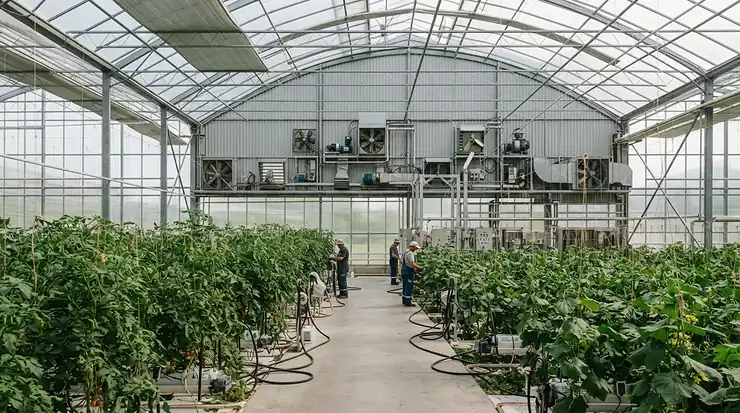
A greenhouse in July is a solar oven with a hobby attached. Glass and polycarbonate trap heat on purpose, which is wonderful in February and brutal in August. Leaves scorch. Blossoms drop. Tomatoes quietly stop setting fruit while you stand there, sweating, next to seedlings that look like wilted spinach.
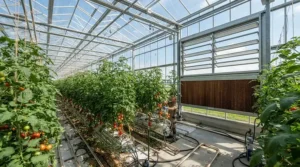
Most growers eventually land on the same fix: a greenhouse evaporative cooler. It cools air by evaporating water, with no refrigerant and no compressor. UF/IFAS Extension calls evaporative cooling the most common way to cool a greenhouse, and it also flags a real limit: performance drops in hot, humid climates. Agra Tech, a commercial greenhouse manufacturer, says these systems cost about 70% less to run than conventional air conditioning.
So why isn’t everyone using one? Because the category is confusing. A greenhouse swamp cooler on wheels, a fan-and-pad wall, and a fog system all use the same physics but behave very differently. Sizing mistakes are common, and the coverage numbers on product boxes are, let’s say, optimistic.
This guide sorts it out. You’ll get seven real portable units compared, the airflow math growers use for pad-and-fan systems, and honest notes on humidity limits. Fall is also the cheapest time to plan, since nobody is panic-buying in October. Prices below are ranges, so check current pricing before you buy.
Quick Comparison: Seven Greenhouse Evaporative Cooler Options at a Glance
| Product | Airflow | Claimed Coverage | Price Range | Best For |
|---|---|---|---|---|
| Hessaire MC18M | 1,300 CFM | 500 sq ft | Roughly $200-$300 | Small hobby greenhouses |
| VEVOR 2100 CFM Evaporative Air Cooler | 2,100 CFM | 750 sq ft | Check current price | Budget oscillating coverage |
| Hessaire MC37M | 3,100 CFM | 950 sq ft | Mid-$300s to mid-$400s | Mid-size backyard houses |
| VEVOR 4129 CFM Evaporative Air Cooler | 4,129 CFM | Not stated | Check current price | Big airflow, bigger tank |
| Uthfy 4800 CFM Swamp Cooler | 4,800 CFM | 1,200 sq ft | Check current price | Workshops and big hobby houses |
| Hessaire MC61M | 5,300 CFM | 1,600 sq ft | Roughly $600-$700 | Largest portable footprint |
| Port-A-Cool Cyclone 3000 | 3,000 CFM (2,400 delivered) | 700 sq ft | Premium tier | Durability and hose hookup |
Notice that airflow, not claimed coverage, is the honest comparison column. The Hessaire MC37M and Port-A-Cool Cyclone 3000 have nearly identical coverage claims, yet the Hessaire MC61M moves almost twice the air of the Port-A-Cool. Budget shoppers should note that the Hessaire MC18M is cheapest per CFM, while the Port-A-Cool Cyclone 3000 is what you pay extra for when you want something built to live outdoors.
💬 Just one click — help others make better buying decisions too!😊
Top 7 Greenhouse Evaporative Cooler Picks: Expert Analysis
1. Hessaire MC18M — cheapest airflow per dollar
Hessaire markets this as the most CFM per dollar in its category, and on paper that holds. It’s the entry ticket for anyone who wants a greenhouse evaporative cooler without a wet wall.
The 1,300 CFM, two-speed fan runs at about 53.4 dB, which is quiet enough that neighbors won’t complain. Here’s the catch: by the pad-and-fan yardstick of 8 CFM per square foot, 1,300 CFM covers roughly 160 square feet of greenhouse, not the 500 square feet on the box. That makes it a seedling-shed or 8×12 hobby-house tool.
Published reviews describe the 500 sq ft claim as optimistic and note there’s no continuous-fill option, so plan to top off the tank during long runs. Treat that as aggregated reviewer feedback rather than a lab result.
Pros:
- ✅ Lowest cost per CFM in this lineup
- ✅ Quiet, two-speed operation
- ✅ Light and easy to move
Cons:
- ❌ Coverage claim runs well ahead of reality
- ❌ No continuous water-fill option
Price: roughly $200-$300, which is solid value for a small greenhouse and poor value for anything bigger.
2. VEVOR 2100 CFM Evaporative Air Cooler — wide 135° oscillation
The oscillating head is the real feature here. Plants don’t care about spec sheets, but they do care about stagnant air pockets.
VEVOR lists 2,100 CFM, three speeds, a 12-hour timer, and a 7-gallon tank, rated for 750 sq ft. Using the greenhouse yardstick, 2,100 CFM works out to about 260 square feet of properly ventilated space. The sweep helps spread cooled air across benches, so the effective footprint feels larger than the number suggests.
The timer is an underrated bonus. Set it to shut off in the evening, and you avoid running a humidifier overnight when plants are already damp. I couldn’t verify a large body of independent greenhouse-specific reviews for this exact model, so lean on the listing specs and check current customer feedback before buying.
Pros:
- ✅ Wide oscillation reduces dead air
- ✅ Built-in timer helps control humidity
- ✅ Remote control for hard-to-reach spots
Cons:
- ❌ Seven-gallon tank needs frequent refills
- ❌ Limited independent greenhouse feedback
Price: check current price; VEVOR generally targets the value end of the market.
3. Hessaire MC37M — the dependable middle child
If a greenhouse evaporative cooler had a “default recommendation,” this would be it. Hessaire pairs 3,100 CFM with a 10.3-gallon tank and a claimed 950 sq ft.
Reviewers note the evaporation surface is about 80% larger than older Hessaire designs, which is the real engineering win. By the 8 CFM rule, that airflow properly serves about 385 square feet, which fits a typical 10×30 or 12×24 hobby greenhouse.
One reviewer reported running two units from a single 2,000-watt generator, which suggests modest power draw. The same review flagged reduced effectiveness in humid Florida conditions. That’s physics, not a defect, and it’s the most important caveat in this whole article.
Pros:
- ✅ Strong airflow for the money
- ✅ Larger evaporation surface than older models
- ✅ Low power draw
Cons:
- ❌ Loses punch in humid weather
- ❌ Manual fill unless you plumb it
Price: mid-$300s to mid-$400s range; strong value for 300-400 sq ft greenhouses.
4. VEVOR 4129 CFM Evaporative Air Cooler — bigger tank, bigger breeze
This one fills the awkward gap between the Hessaire MC37M and the Hessaire MC61M.
The listing shows 4,129 CFM, a 12.7-gallon tank, three speeds, a remote, a 12-hour timer, and four ice boxes. Applying the pad-and-fan yardstick, that airflow serves roughly 515 square feet. The larger tank means fewer refills, which matters more than you’d think during a heat wave.
The ice boxes are a bit of a gimmick in a greenhouse, but on the worst afternoons, adding ice can squeeze out a few extra degrees. Don’t count on it as a primary strategy.
Honest caveat: I couldn’t confirm a deep pool of greenhouse-specific reviews for this model. Read recent buyer feedback on the Amazon listing before committing.
Pros:
- ✅ Large airflow for a mid-price unit
- ✅ 12.7-gallon tank cuts refill trips
- ✅ Timer and remote included
Cons:
- ❌ Coverage figure isn’t clearly stated
- ❌ Limited independent testing data
Price: check current price; good value if the airflow matches your greenhouse size.
5. Uthfy 4800 CFM Swamp Cooler — workshop muscle
Uthfy’s 4,800 CFM unit is rated at 1,200 sq ft, and reviewers lean toward big, hot, open spaces rather than delicate seedling rooms.
One published review credits it as the first evaporative cooler that made a hot garage workable in the afternoon. That’s a useful clue: it moves air hard. For greenhouses, that’s an advantage in a 600-700 sq ft house (4,800 divided by 8 gives about 600) and a disadvantage if you’ve got delicate seedlings that dislike a stiff breeze.
I’d pair it with a deflector or place it to blow across, not at, your plants. Strong airflow also dries potting media faster, so expect to water more.
Pros:
- ✅ Serious airflow for larger spaces
- ✅ Reviewers praise afternoon heat relief
- ✅ Good for combined greenhouse and workshop
Cons:
- ❌ Strong breeze can stress tender seedlings
- ❌ Bulkier to store off-season
Price: check current price; best value for 500-650 sq ft greenhouses.

6. Hessaire MC61M — biggest portable footprint
For a portable unit, this is as big as the mainstream market gets. It’s rated 5,300 CFM and 1,600 sq ft, with three speeds, oscillation, and a 14.6-gallon tank.
Sylvane’s review describes the pads as OEM XeL50 high-density rigid media in a corrugated design, and other sources say there are three pads, giving about 80% more evaporation surface than the smaller Hessaire MC18M. Sylvane also described it as a budget-friendly choice for covering larger areas.
By the greenhouse yardstick, 5,300 CFM properly supports roughly 660 square feet. That’s the sweet spot for a serious backyard grower with a 20×30 house. At about 63 dB, it’s not whisper-quiet, but it’s tolerable in a greenhouse.
Pros:
- ✅ Highest airflow in this lineup
- ✅ Rigid high-density pads resist sagging
- ✅ Oscillation spreads cooling evenly
Cons:
- ❌ Noticeably louder than small units
- ❌ Heavier tank means more lifting
Price: roughly $600-$700 range; good value if you’d otherwise buy two smaller coolers.
7. Port-A-Cool Cyclone 3000 — built like a tank, plumbed like a pro
Port-A-Cool’s polyethylene housing is rust-free and leak-proof, which matters in a space designed to be damp. A centrifugal blower replaces the open fan blade, making it quieter than its airflow suggests.
Specs: 3,000 CFM free air, 2,400 CFM delivered, about 100 lb, 5.6 amps, and a reported 15-25°F temperature drop. The 3/4-inch garden-hose connection is the standout. Hook it up and you’ve got continuous operation instead of a refill routine. By the 8 CFM rule, 2,400 delivered CFM serves roughly 300 square feet, honest numbers for a small, serious greenhouse.
This is where you pay for longevity and plumbing convenience rather than raw airflow. I couldn’t verify a large body of greenhouse-specific reviews, so lean on the manufacturer’s specs and the unit’s reputation in outdoor-space cooling.
Pros:
- ✅ Garden-hose hookup for continuous running
- ✅ Rugged, rust-free polyethylene body
- ✅ Centrifugal blower runs quieter
Cons:
- ❌ Less airflow per dollar than Hessaire models
- ❌ Heavy to reposition
Price: premium tier; check current price. Worth it if you value durability and automatic fill over raw CFM.
What Is a Greenhouse Evaporative Cooler?
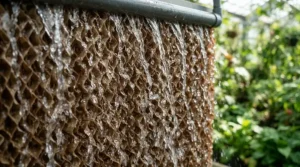
A greenhouse evaporative cooler is a system that lowers air temperature by evaporating water into an airstream. Warm outside air passes over water-saturated pads, the water absorbs heat as it evaporates, and cooler, more humid air enters the growing space. It uses a fan and water instead of refrigerant, which is why many growers call it a swamp cooler.
The science behind evaporative cooling in a greenhouse is straightforward. Evaporation absorbs heat. Think of stepping out of a swimming pool on a breezy day. Agra Tech uses exactly that analogy for their cooling pads.
The key number isn’t the air temperature on your thermometer; it’s the wet-bulb temperature. UF/IFAS explains that wet-bulb temperature sets the floor for how cold evaporative cooling can get the air. Pad efficiency then determines how close you get to that floor. UF’s worked example uses an 85% efficient pad.
Here’s an illustration using that efficiency. With outside air at 90°F and a wet-bulb temperature of 70°F, air leaving the pad would be about 73°F (90 minus 0.85 times 20). Same 90°F day with much higher humidity and a wet-bulb of 80°F, and you’d only reach about 81.5°F. That’s the entire story of why dry climates love these systems.
How to Choose a Greenhouse Evaporative Cooler
Picking the right model comes down to seven decisions. Here’s the order I’d tackle them in, with the reasoning attached.
- Measure floor area first. Multiply length by width. Everything else flows from this number.
- Convert to required airflow. The standard design target is 8 CFM per square foot of floor area, per UMass Extension. A 300 sq ft house needs about 2,400 CFM.
- Match airflow to the unit’s delivered CFM. Ignore box coverage claims; they’re written for open-air comfort, not greenhouse temperature control.
- Check your local humidity. If summer afternoons run humid, expect smaller temperature drops and plan for dehumidification or fog.
- Decide on water supply. Hose hookups beat manual refills for long runs.
- Plan the exhaust. Cooled air has to go somewhere. Roof vents or an exhaust fan keep the cycle moving.
- Consider noise and power. Check amp draw against your outlet, especially if running two units.
The analysis here is simple: airflow beats everything else on the spec sheet. A cooler with the right CFM and mediocre features will outperform a feature-rich cooler that’s undersized.
Greenhouse Pad and Fan Systems: Doing the Sizing Math
Greenhouse pad and fan systems are the traditional answer, and for good reason. UMass Extension says this design has been the standard for evaporative greenhouse cooling for more than 50 years.
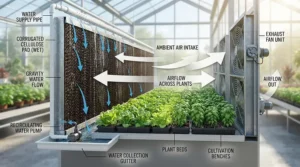
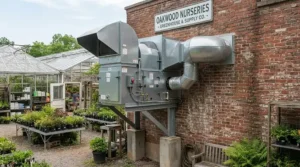
The layout is simple: exhaust fans on one end, wetted cellulose pads on the opposite wall. Fans create negative pressure, outside air gets pulled through the wet pads, and cooled air sweeps across the plants. UF/IFAS notes the coolest zone sits next to the pads and the warmest by the fans.
Michigan State University’s guidance gives the numbers. Fan capacity should be at least 8 CFM per square foot of floor. Pad area equals fan CFM divided by 250 for 4-inch pads or 350 for 6-inch pads.
Take a 30×96 ft house, which is 2,880 sq ft. At 8 CFM per square foot, you need about 23,040 CFM of exhaust. With 6-inch pads, that means roughly 66 sq ft of pad area. With 4-inch pads, roughly 92 sq ft.
Operation matters as much as hardware. UConn’s Extension guidance says doors should stay closed while the system runs to prevent short-circuiting of airflow. UMass suggests a humidistat can control the pump to avoid excess humidity. A greenhouse pad and fan setup is also usually the last stage of cooling, kicking in only when ordinary ventilation can’t hold temperature.
Wet Wall Greenhouse Cooling: What the Wall Does That Portables Can’t
Wet wall greenhouse cooling is the same fan-and-pad concept with a more permanent footprint: a full wall of cellulose pad, a water distribution line along the top, a collection sump below, and a recirculation pump.
Agra Tech describes the cross-fluted pad design as one that forces turbulent mixing of water and air, boosting evaporative efficiency while keeping airflow resistance low. Vendors advertise efficiencies up to roughly 80%, though real-world numbers vary with water quality and airflow.
The advantage over a portable cooler is distribution. A wet wall pulls air evenly through a large surface area, so you aren’t blasting one corner. It also scales: add pad length and fans as your greenhouse grows.
Pads come in 4-inch and 6-inch thicknesses. Thicker pads generally deliver higher cooling efficiency but demand more fan power and slightly more space. Some pads, like EasyFong’s black-coated cellulose, add a coating on one side to slow algae growth, a smart upgrade in sunlit greenhouses.
Greenhouse Megastore notes that self-contained wet-wall coolers suit large areas, though additional fans will be needed to circulate cooled air. The trade-off is cost and permanence. If you rent or plan to move, a portable cooler wins. If you’re staying put, a wet wall pays back.
Greenhouse Swamp Cooler vs. Wet Wall vs. Fog vs. Air Conditioning
The phrase “greenhouse swamp cooler” gets used loosely, so let’s separate the options.
| Option | Upfront Cost | Operating Cost | Humidity Impact | Best For |
|---|---|---|---|---|
| Portable greenhouse swamp cooler (e.g., Hessaire MC37M) | Low | Low | Raises humidity | Hobby growers under ~500 sq ft |
| Wet wall pad-and-fan | Medium to high | Low | Raises humidity | Permanent greenhouses 500+ sq ft |
| Fog system | High | Low to medium | High, uniform | Humidity-loving crops, uniform cooling |
| Air conditioning | High | High | Dries air | Sealed growth chambers |
Agra Tech describes swamp coolers as self-contained units for very small compartments where fan-and-pad isn’t feasible. That’s a fair summary: a greenhouse swamp cooler is the flexible, low-commitment choice.
Here’s the interpretation. Portable units win on price and portability but lose on distribution and scale. Wet walls win on uniformity and efficiency at size. UF notes fog systems cost more than fan-and-pad but can be best when uniform temperature and high humidity are needed. Air conditioning works only in nearly sealed environments, and the electric bill reflects it.
Humid Environment Growing: Where Evaporative Cooling Runs Out of Road
Humid environment growing is where the physics gets awkward. Evaporative cooling pushes humidity up as it pushes temperature down. If outside air is already near saturation, there’s little room left for evaporation.
UF/IFAS directly acknowledges limitations in hot, humid climates, and a reviewer testing the Hessaire MC37M in humid Florida reported reduced effectiveness. That’s consistent with the wet-bulb math.
You still have options. Run the cooler in the afternoon, when relative humidity typically bottoms out and cooling potential peaks. UF notes that afternoon is when the system has maximum cooling potential. Add shade cloth to cut solar load, so the cooler has less heat to remove. Use a humidistat or timer to cycle the pump.
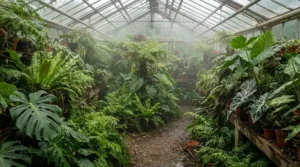
Choose crops to match. Ferns, orchids, and many tropical foliage plants tolerate or enjoy the extra moisture. Tomatoes, peppers, and succulents may struggle with fungal pressure if humidity stays high. Cooler air isn’t automatically healthier air if it brings Botrytis with it.
Honest verdict: in persistently humid regions, evaporative cooling is a partial solution. Pair it with ventilation, shade, and airflow fans rather than expecting it to carry the whole load.
Large Area Coverage: How to Scale Without Wasting Money
Large area coverage is where box specs mislead the most. A cooler claiming 1,600 sq ft is describing comfort in open space, not temperature control inside an enclosed greenhouse.
Apply the yardstick consistently. At 8 CFM per sq ft, the Hessaire MC18M serves about 160 sq ft, the Hessaire MC37M about 385, the Port-A-Cool Cyclone 3000 about 300 (delivered airflow), and the Hessaire MC61M about 660. That’s still enough for many serious hobby greenhouses, just not the numbers on the packaging.
For anything above roughly 700 sq ft, stop stacking portables. Two or three units create uneven zones, double the refill chores, and often cost more than a proper fan-and-pad install. If you do go multi-unit, place them at one end blowing toward an exhaust opening at the other, creating a single airflow path instead of competing currents.
Don’t forget the exit. Air that can’t leave will stall, and your cooler will turn into an expensive humidifier. Open roof vents or add an exhaust fan sized to match the incoming airflow.
Commercial Greenhouse Cooling: What the Pros Do Differently
Commercial greenhouse cooling is less about the cooler and more about the control strategy. Rutgers Extension describes two main evaporative approaches, pad-and-fan and fog, with distinct trade-offs in uniformity and installation complexity. See their Greenhouse Evaporative Cooling guide for the engineering detail.
Here’s what separates commercial setups. Staged control: natural ventilation first, fans second, evaporative cooling last. Humidistats and thermostats working together. Pads sized by the formula rather than by guesswork. Regular water testing, since mineral content shortens pad life.
Pad-and-fan systems create a temperature gradient from pad end to fan end, which is why commercial houses rarely exceed a certain length without staging or alternate systems. Fog systems distribute cooling more uniformly, at higher installation cost and with more maintenance sensitivity.
The takeaway for smaller growers: borrow the logic, not the hardware. Stage your cooling, size by airflow, and treat water quality as a first-class concern.
Long-Term Cost & Maintenance: The Real Price of Cool
Sticker price is only the first chapter. A greenhouse evaporative cooler’s lifetime cost comes from electricity, water, pads, and your time.
| Cost Factor | Portable Unit | Wet Wall System |
|---|---|---|
| Purchase | Roughly $200-$700 | Higher; varies with size |
| Electricity | Low (e.g., 5.6 amps for the Port-A-Cool Cyclone 3000) | Low to moderate |
| Pad replacement | Periodic; easy swap | Periodic; larger job |
| Water use | Moderate | Higher |
| Best For | Small to mid greenhouses | Permanent, larger operations |
Power draw is a bargain. At 115 volts, 5.6 amps works out to roughly 640 watts, or about 0.64 kWh per hour. That’s a small fraction of what an air conditioner pulls.
Maintenance is where hidden costs live. Michigan State’s guidance says maintenance is critical, and that hard water leads to more frequent pad replacement. Mineral scale clogs pads and drops airflow. If you’ve got hard water, a water softener or inline filter may pay for itself.
Value verdict: for under 400 sq ft, a Hessaire MC37M often delivers the best cost-per-degree. Above 600 sq ft, a pad-and-fan installation usually wins over multiple portables within a few seasons.
Setting Up Your Greenhouse Evaporative Cooler: A 30-Day Practical Guide
Transformation time. Here’s what manufacturers’ listings leave out.
Week 1: Placement and airflow. Position the cooler at the windward end, blowing along the length of the greenhouse. Open roof vents or a far-end door slightly so air can exit. Doors and vents should be arranged so air follows one path.
Week 1: First fill. Soak new pads before the first run so they absorb water evenly. Dry pads can shed dust and wick unevenly.
Week 2: Pair it with shade. Add shade cloth during peak summer. Reducing incoming heat is cheaper than removing it.
Week 2-3: Tune the schedule. Run the cooler during the hottest part of the day, then dial back as temps fall. Use a timer or humidistat to avoid nighttime humidity spikes.
Week 3-4: Start maintenance habits. Michigan State’s maintenance guide emphasizes routine checks. Inspect pads for scale and algae, flush the reservoir, and make sure nothing blocks the pad face.
Common first-month mistakes: running with doors open, skipping the exhaust path, overfilling with hard water, and ignoring pad condition until performance drops. At the end of the season, drain the tank completely, clean the pads, and store the cooler dry.
Problem-Solution Guide: Fixing Common Greenhouse Cooling Headaches
Problem: Cooler runs but air feels warm. Check humidity first. If outside air is near saturation, the physics is working against you. Add shade and ventilation. Also confirm pads are fully wet.
Problem: One end is hot, the other is fine. That’s the normal gradient in pad-and-fan layouts, where the fan end runs warmest. Add internal circulation fans, or shorten the airflow path.
Problem: Humidity is climbing. Use a humidistat or timer, cycle the pump, and increase exhaust. For tomatoes or peppers, consider moving the cooler’s run window to the driest part of the day.
Problem: White crust on the pads. That’s mineral scale. Flush the system, replace badly clogged pads, and consider a softener. Hard water shortens pad life.
Problem: Green slime or musty smell. Algae. Black-coated pads, shaded water lines, and regular reservoir cleaning help. The Port-A-Cool Cyclone 3000 and Hessaire MC61M both allow easy tank access.
Problem: Not enough cooling. Re-check sizing. If your cooler’s delivered CFM is below 8 per sq ft, you’re undersized. Upgrading from a Hessaire MC18M to a Hessaire MC37M often solves it.
Frequently Asked Questions
❓ How much does it cost to run a greenhouse evaporative cooler?
❓ Can a portable cooler replace a wet wall in my greenhouse?
❓ How cold can a greenhouse evaporative cooler get my greenhouse?
❓ Should I run my cooler at night?
❓ How often should I replace evaporative cooling pads?
Conclusion
A greenhouse evaporative cooler is the rare piece of equipment that’s cheap to buy, cheap to run, and genuinely effective, as long as you respect the physics. Dry climates reward it. Humid ones demand help from shade, ventilation, and smart scheduling.
For small hobby houses, the Hessaire MC18M and VEVOR 2100 CFM Evaporative Air Cooler are sensible starting points. The Hessaire MC37M is the all-around pick for 300-400 sq ft. If you want more airflow, look at the VEVOR 4129 CFM Evaporative Air Cooler, the Uthfy 4800 CFM Swamp Cooler, or the Hessaire MC61M. And if durability and hose-fed operation matter most, the Port-A-Cool Cyclone 3000 earns its premium.
Whatever you choose, size by airflow, not by box coverage. Give the air a way out. Keep pads clean. Do those three things, and your plants will stop treating July like a personal insult.
Fall is the time to prepare, so check current prices and availability while demand is quiet.
✨ Don’t Miss These Exclusive Deals!
🔍 Ready to cool your greenhouse? Click on any highlighted product above to check current pricing and availability. A cooler, healthier growing space is just a few clicks away!
Recommended for You
- Oscillating Fan For Grow Tent: 7 Best Quiet Picks For 2026
- Inline Fan For Grow Tent: 7 Best Proven Picks In 2026
- Greenhouse Exhaust Fan: 7 Best Picks To Beat The Heat (2026)
Disclaimer: This article contains affiliate links. As an Amazon Associate, I earn from qualifying purchases. If you purchase products through these links, we may earn a small commission at no additional cost to you.
✨ Found this helpful? Share it with your friends! 💬🤗
