
In This Article
What is an inline fan for grow tent use? It is a duct-mounted fan that sits outside your tent and pulls stale, hot, humid air out through a duct. It also creates gentle negative pressure, so odors stay put and temperature and humidity stay in the range plants like.
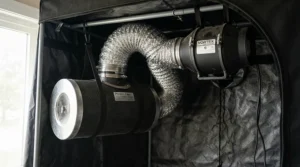
Picture a sealed tent under a 300-watt light on a July afternoon. Without moving air, it turns into a terrarium with sauna ambitions. The right fan stops that story.
Choosing one is trickier than the box suggests. Every listing shouts a CFM number, yet CFM is a surprisingly slippery unit. It shifts with air pressure and temperature, and it shrinks with whatever you bolt onto the fan. A carbon filter, a couple of duct bends and one hot light each quietly shave airflow off the printed number.
So this guide goes beyond a product list. You’ll get seven real fans with what their specs mean in practice, a CFM requirement calculation worked step by step, a plain-English look at duct connection size, and rules for picking a carbon filter compatible with your fan. Whether you run a closet-sized tent or plumb a tent ventilation inline fan into a full inline duct fan grow room, the goal is the same: steady air, low noise, no surprises.
A quick note on method. Specs come from manufacturer and retailer spec sheets. Review commentary is aggregated from published roundups and retailer review summaries. Nothing here is hands-on testing, and prices appear as ranges because they change constantly.
Quick Comparison: 7 Inline Fan for Grow Tent Options at a Glance
| Fan | Duct | Rated CFM | Rated Noise | Control | Approx. Price Range | Best For |
|---|---|---|---|---|---|---|
| AC Infinity CLOUDLINE T6 | 6″ | 402 | 32 dBA | Smart (temp/humidity/VPD) | $150-$200 range | 4×4 and 5×5 tents wanting automation |
| AC Infinity CLOUDLINE S6 | 6″ | 402 (some listings 425) | 32 dBA | 8-speed manual | Around $100 | Value-minded 4×4 growers |
| AC Infinity CLOUDLINE T4 | 4″ | 205 | 28 dBA | Smart | $110-$150 range | 2×2 to 3×3 tents |
| AC Infinity CLOUDLINE T8 | 8″ | 807 | 39 dBA | Smart | $200-$300 range | 4×8 tents and hot, big setups |
| VIVOSUN 6-Inch 440 CFM | 6″ | 440 | about 50 dB | Varies by version | Budget tier | Garages where noise is no issue |
| VIVOSUN 4-Inch Inline Fan | 4″ | about 195-203 | about 49 dB | Varies by kit | Budget tier | Small tents on tight budgets |
| iPower 6-Inch 240 CFM Booster | 6″ | 240 | 35-48 dB (listing-dependent) | Optional speed controller | Budget tier | Short, low-restriction runs |
Prices vary. Check current price before buying; “budget tier” means typically well below the AC Infinity pricing at the time of research.
Looking at the table, the AC Infinity CLOUDLINE S6 offers the best blend of airflow, quiet running and price for a standard 4×4. The AC Infinity CLOUDLINE T6 earns its premium if you want the fan to react to temperature on its own. Budget buyers should note that the VIVOSUN 6-Inch 440 CFM pushes the most rated air per dollar but gives some of it back in noise and electricity. If your tent is small, the AC Infinity CLOUDLINE T4 keeps you from buying power you’d only have to throttle.
💬 Just one click — help others make better buying decisions too!😊
Top 7 Inline Fan for Grow Tent Picks: Expert Analysis
1. AC Infinity CLOUDLINE T6 — smart control that runs itself
The headline here is the brain, not the brawn. A built-in controller watches temperature, humidity and VPD and adjusts speed without you touching a dial. The 6-inch mixed-flow body pairs with an EC motor rated at 402 CFM and 32 dBA. EC motors hold their efficiency at low speeds, which is where a tent fan spends most of its day.
Based on the spec comparison, 402 CFM comfortably clears the roughly 193 CFM a 4×4 needs after filter, duct and heat losses (worked out below). That leaves room for a scorching afternoon. This is the fan for people who hate babysitting dials, since the controller replaces a separate thermostat-and-humidity unit you’d otherwise buy.
Published roundups consistently name it the best overall pick, citing quiet running and automation. One retailer-page reviewer pointed out that the 402 CFM and 32 dBA ratings don’t happen at the same speed: peak airflow is at full tilt, rated noise is at low speed.
Pros:
- ✅ Auto speed from temperature and humidity
- ✅ Whisper-quiet at lower speeds
- ✅ Generous headroom for 4×4 and 5×5
Cons:
- ❌ Costs more than its manual-dial sibling
- ❌ Rated noise doesn’t apply at full speed
Roughly $150-$200 at the time of research (check current price). Verdict: premium, but it pays you back in convenience.

2. AC Infinity CLOUDLINE S6 — same airflow, manual dial, lower cost
Think of this as the T6 without the smart controller. You get the same 6-inch mixed-flow design, rated around 402 CFM and 32 dBA (some newer listings show 425 CFM and 30 dBA). The published static pressure is 503 Pa, and power draw is 64 W maximum and 38 W average.
Static pressure is how hard the fan can keep pushing through a carbon filter and duct bends. A high number matters more in a tent than headline CFM. An 8-speed PWM dial lets you set a speed and forget it, and the manufacturer says the fan can later join a CLOUDLINE T6-style smart controller.
Roundups frequently label it the best-value pick in the brand’s lineup. One retailer reviewer noted that if the corded controller is unplugged, the fan runs at maximum, so mount the dial where you can reach it.
Pros:
- ✅ Strong static pressure for filters and ducting
- ✅ Low average power draw
- ✅ Upgradeable to smart control later
Cons:
- ❌ Manual dial means no automatic response
- ❌ Defaults to full speed without controller
Around $100 at the time of research (check current price). Verdict: the sweet spot for most fixed-schedule 4×4 growers.
3. AC Infinity CLOUDLINE T4 — smallest footprint, quietest of the bunch
Small tents don’t need a leaf blower. This 4-inch model is rated at 205 CFM and 28 dBA. One roundup reports it near 25 dB at its lowest speed, which is barely a murmur.
On paper that is nearly double the roughly 97-109 CFM a 2×4 or 3×3 needs after losses, so the carbon filter won’t strangle it. The built-in controller can ramp speed when conditions drift. Reviewers and roundups commonly call it the most popular inline fan for small-to-medium tents. A few treat it only as supplemental airflow for a 4×4.
The catch is scalability. If you upgrade to a bigger tent, a 4-inch duct becomes a bottleneck, and you’ll be buying again.
Pros:
- ✅ Very quiet even near the bedroom
- ✅ Smart controller built in
- ✅ Compact, easy to hang
Cons:
- ❌ Limited headroom if you expand later
- ❌ Higher cost per CFM than budget 4-inch fans
Roughly $110-$150 at the time of research (check current price). Verdict: ideal for closets and apartments.
4. AC Infinity CLOUDLINE T8 — big-tent reserve power
At 8 inches, this fan is rated for roughly 740-857 CFM depending on the listing, 39 dBA and 746 Pa of static pressure. It draws 110 W maximum and 78 W on average, with dual ball bearings rated at 67,000 hours and an IP44 housing.
What does that mean for you? A 4×8 tent needs around 386 CFM after losses (see the table below), so the CLOUDLINE T8 can run at half speed and stay quiet. That reserve also helps with long duct runs and multiple lights.
I couldn’t verify a deep pool of independent review sentiment for this model. Third-party commentary mostly frames the 8-inch as the step-up for 4×8 tents or hot 5×5 setups, so read recent buyer reviews before you commit.
Pros:
- ✅ Huge airflow reserve for big heat loads
- ✅ High static pressure for long runs
- ✅ Quiet when throttled down
Cons:
- ❌ Needs 8-inch ducting and filter
- ❌ Overkill for small tents, may over-dry
Roughly $200-$300 at the time of research (check current price). Verdict: right for large tents, wasteful for small ones.
5. VIVOSUN 6-Inch 440 CFM — most rated airflow per dollar
This one chases raw numbers: 440 CFM at 2450 RPM, 135 W, a centrifugal impeller, ETL listing and flanges on both ends. Some versions ship with a variable speed controller, and kits often bundle a 6×18 carbon filter and ducting.
The honest read is that 440 beats the 402 of the 6-inch AC Infinity models on paper. But it uses about 135 W against 38 W for the AC Infinity CLOUDLINE S6 average rating, and its listed noise is roughly 49-50 dB. That works out to about 3.3 CFM per watt.
Roundups consistently call it louder than the AC Infinity fans but effective. One places budget fans of this type at 40-50 dB at max. It’s best in garages, sheds or spare rooms where noise is a non-issue.
Pros:
- ✅ Highest rated CFM in the 6-inch group
- ✅ ETL-listed and widely bundled in kits
- ✅ Budget-friendly entry price
Cons:
- ❌ Noticeably louder at around 50 dB
- ❌ Draws roughly 3x the power of EC rivals
Budget tier at the time of research (check current price). Verdict: great value if you can live with the volume.

6. VIVOSUN 4-Inch Inline Fan — cheapest way into a small tent
For 2×2 to 3×3 spaces, this fan matches the AC Infinity CLOUDLINE T4‘s rated airflow (roughly 195-203 CFM depending on version) at a lower price. VIVOSUN’s own lineup table lists about 49 dB for the 4-inch.
Based on the spec comparison, you get enough air to clear a small tent plus a filter, but no smart automation. Roundups call it a good starter when budget is tight, though louder than AC Infinity. One 2026 roundup that scored a VIVOSUN 4-inch model praised the value but flagged long-term durability compromises.
Pair it with a 4-inch carbon filter compatible with the same flange size, and a simple speed controller to tame the noise.
Pros:
- ✅ Lowest cost of entry on this list
- ✅ Often bundled with filter and ducting
- ✅ Enough airflow for 2×2 to 3×3
Cons:
- ❌ Louder than EC-motor alternatives
- ❌ Reviewers flag durability trade-offs
Budget tier at the time of research (check current price). Verdict: a fair starter, not a forever fan.
7. iPower 6-Inch 240 CFM Booster — light, simple, only 37 watts
This is an HVAC-style booster that growers also use: 240 CFM, roughly 2,950 RPM and 37 W, which works out to about 6.5 CFM per watt. Listed noise ranges from 35 to 48 dB depending on the listing. The manufacturer notes the motor isn’t enclosed and shouldn’t be used in high-humidity environments, a big caution for tents.
On paper, 240 CFM covers a 2×4 or 3×3 only with minimal restriction. Add a 6-inch filter and long ducting, and real airflow drops. It fits supplemental or low-restriction runs better than a main exhaust.
On one Amazon listing, noise mentions were mixed-to-negative at the time of research (31 negative versus 18 positive among 49), with some mentions of squeaking or wobble in the fan wheel.
Pros:
- ✅ Very light and easy to mount
- ✅ Low wattage and decent CFM per watt
- ✅ Inexpensive 6-inch option
Cons:
- ❌ Mixed noise feedback in reviews
- ❌ Open motor, poor fit for humid tents
Budget tier at the time of research (check current price). Verdict: acceptable for short, dry runs, risky as a main tent exhaust.
How to Choose an Inline Fan for Grow Tent Setups
To choose an inline fan for grow tent use, calculate tent volume, add loss factors, match duct size, pick the motor type and confirm filter fit. Here are the steps, with the reasoning behind each:
- Measure your tent volume. Length x width x height in feet gives the baseline CFM for one full air exchange per minute.
- Stack the losses. A carbon filter, duct length, bends and hot lights all demand more airflow than the baseline.
- Match duct size to everything else. The fan flange, the filter flange and your tent port should all agree (more in the duct connection size section below).
- Pick the motor type. EC motors cost more but run quieter and slow down efficiently. AC-motor fans give more rated CFM per dollar and make more noise.
- Decide how much control you want. A manual dial is fine for set-and-forget. A smart controller earns its price if your room’s temperature swings.
- Check noise at the speed you’ll actually run. Rated dBA often applies at low speed, while rated CFM applies at full speed.
- Confirm the filter is carbon filter compatible. Same diameter, and a filter CFM rating at or above the fan’s maximum.
Run those seven checks and the shortlist usually narrows to two or three fans. Everything left is a budget-versus-noise decision.

CFM Requirement Calculation: A Worked Example for Your Tent
A CFM requirement calculation sounds like homework, but it takes one calculator and about a minute. The core idea is that you size for your real setup, not the bare tent.
Take a 4x4x7 tent. That’s 112 cubic feet, so one exchange per minute needs 112 CFM. Common sizing guidance, such as Gorilla Grow Tent’s inline fan and filter guide, adds about 25% for a carbon filter, 15% for long duct runs and roughly 5% per 90-degree bend. Here is how that stacks up:
- 112 CFM x 1.25 (carbon filter) = 140 CFM
- x 1.15 (duct run) = 161 CFM
- x 1.10 (two bends) = about 177 CFM
- x 1.20 (hot light and warm room) = about 213 CFM
For quick sizing, I use a combined shortcut of x1.725 (1.25 x 1.15 x 1.20), which skips the bend math:
| Tent | Volume | Stacked CFM Need | Duct | Best For |
|---|---|---|---|---|
| 2x4x7 | 56 ft³ | about 97 | 4″ | AC Infinity CLOUDLINE T4 |
| 3x3x7 | 63 ft³ | about 109 | 4″ | AC Infinity CLOUDLINE T4 |
| 4x4x7 | 112 ft³ | about 193 | 6″ | AC Infinity CLOUDLINE S6 |
| 5x5x7 | 175 ft³ | about 302 | 6″ | AC Infinity CLOUDLINE T6 |
| 4x8x7 | 224 ft³ | about 386 | 8″ | AC Infinity CLOUDLINE T8 |
Notice that every recommendation has a rated CFM well above the need. That gap is deliberate: ratings come from open-air tests, and real life is never open-air. Aim for the fan’s rated CFM to be 1.5x to 2x your calculated need, then run it slower. Slower means quieter, cooler electricity bills, and a fan that can still cope on a heat-wave afternoon.
Grow Inline Fan CFM: Rated Numbers vs Real-World Performance
Grow inline fan CFM claims deserve a raised eyebrow. A rated figure usually describes free-air flow with nothing attached. Your tent adds a filter, ducting and bends, each creating resistance.
That’s why static pressure, shown in pascals, matters. The AC Infinity CLOUDLINE S6 lists 503 Pa and the AC Infinity CLOUDLINE T8 lists 746 Pa. Fans with higher static pressure hold more of their airflow when the air path gets tight. Mixed-flow designs are built for exactly that.
Two other details separate marketing from reality:
- Speed versus noise. As one retailer reviewer of the AC Infinity CLOUDLINE S6 observed, rated CFM is at max speed while rated noise is at minimum. You never get both at once.
- Efficiency. Rated CFM per watt reveals who is working hard versus who is just loud (we compare this in the cost section).
Treat the printed number as a ceiling, not a promise. Buy a bit bigger than you need, use a controller, and run it low. The extra capacity costs little, and it prevents the scenario where a hot week outruns your fan.
Duct Connection Size: 4, 6 or 8 Inch?
Duct connection size is the quiet hero of ventilation. A mismatch can cut airflow more than picking a slightly weaker fan.
Here’s the rule: fan flange, filter flange, ducting and tent port should all be the same diameter. Each step up in size roughly doubles the rated airflow in AC Infinity’s lineup: 205 CFM at 4 inches, 402 at 6 inches and 807 at 8 inches.
Here’s how that maps to tents:
- 4-inch: 2×2 to 3×3 tents.
- 6-inch: 4×4 and 5×5 tents.
- 8-inch: 4×8 and bigger.
If your tent ports don’t match your fan, use a short, gradual reducer rather than a sharp stepped adapter. Every transition adds turbulence and noise. Check your tent’s port sizes before you order, since many tents offer several.
For ducting, keep runs short and as straight as possible. Stretch flexible duct taut rather than leaving it accordion-crumpled, and seal joints with clamps and foil tape. Leaks near the fan pull air from the wrong place and weaken the exhaust effect. Smooth, short, matched: that’s the whole recipe.
Carbon Filter Compatible Setups: Matching Fan and Filter
A carbon filter compatible with your fan comes down to three checks. First, match the diameter (4, 6 or 8 inch) to the fan flange. Second, confirm the filter’s CFM rating is at or above the fan’s maximum. Some guidance suggests exceeding fan capacity by around 25%. Third, expect the filter to add roughly 20-25% resistance, which is why the fan needs headroom.
Bundles can simplify this. For example, VIVOSUN sells a 6-inch kit that pairs its 440 CFM fan with a 6×18 filter using an Australian charcoal bed. Pre-matched kits remove the guesswork, though you should still check the fan-and-filter pairing against your own CFM requirement calculation.
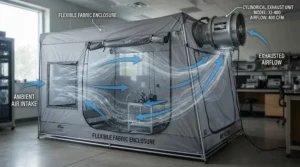
Placement matters as much as sizing. The correct order is tent, then filter hung high inside the tent, then duct, then fan, then outside air. Because the fan sits downstream, it pulls air through the filter, and the tent stays under slight negative pressure. Mixed-flow fans such as the AC Infinity CLOUDLINE S6 are designed to maintain airflow through filters and long duct runs.
Replacement timing depends on the filter. Many manufacturers suggest changing carbon after roughly a year or two of regular use, so check your filter’s own guidance.
Grow Tent Inline Exhaust: Step-by-Step Setup
A grow tent inline exhaust is simple once you see the order of operations. Here is a first-install walkthrough:
- Hang the filter. Suspend it high inside the tent, using rope or hangers, so it pulls from the hottest air.
- Run the duct. Connect the filter’s outlet to the tent’s exhaust port, keeping it short and straight.
- Mount the fan outside. Use rubber isolation hangers, not hard mounts, to cut vibration noise.
- Vent away from intake. Exhaust to another room, a window or the outdoors, never toward your intake opening.
- Seal every joint. Clamps and foil tape stop leaks that sabotage negative pressure.
- Open the intake. Leave passive intake vents so the fan has air to pull.
- Test and tune. Tent walls should flex slightly inward. Set the fan at the lowest speed that holds your target temperature.
For maintenance, wipe dust off blades and housing monthly, since dust drags down airflow. The AC Infinity CLOUDLINE line uses a detachable motor box for easier cleaning.
Common first-30-day mistakes include forgetting the intake, hard-mounting the fan, running at full speed 24/7, and crushing flex duct behind the tent. Fix those four and most setups behave.
Inline Duct Fan Grow Room: When Tents Become Rooms
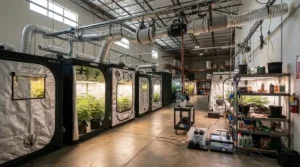
An inline duct fan grow room has different physics than a single tent. The volume jumps, heat loads add up, and duct runs often get longer.
That is where static pressure becomes your best friend. The AC Infinity CLOUDLINE T8 delivers its rated airflow with high resistance, and one sizing guide suggests either an 8-inch fan or two 6-inch fans on a single controller for tents around 4×8 or bigger. Two smaller fans also give redundancy: if one fails, you still have airflow.
For basements and garages, noise matters less and raw CFM matters more, so a budget unit like the VIVOSUN 6-Inch 440 CFM can work. For bedrooms and apartments, favor the AC Infinity CLOUDLINE T4 or AC Infinity CLOUDLINE T6, whose rated noise sits near or below ordinary background sound.
Whatever you choose, give the room make-up air. A fan can’t exhaust air that has nowhere to enter, so a cracked door or intake vent keeps airflow honest.
Real-World Scenarios: Which Fan Fits Which Grower?
Here are three profiles matched to specific fans, with the reasoning:
The apartment renter (2×4 tent, one LED, bedroom). Budget is moderate, noise is the enemy and the tent runs daily. The AC Infinity CLOUDLINE T4 fits: 205 CFM against a roughly 97 CFM need, plus quiet low-speed operation.
The garage grower on a budget (4×4 tent, two or three runs a year). Noise is irrelevant and cost matters. The VIVOSUN 6-Inch 440 CFM gives the most rated airflow per dollar. If daily use or a quieter space enters the picture, the AC Infinity CLOUDLINE S6 becomes the smarter long-term buy.
The enthusiast (4×8 tent, two lights, warm basement). Heat is the problem, and the room runs year-round. The AC Infinity CLOUDLINE T8 has the reserve capacity, and its efficiency at average draw keeps the power bill sane.
Notice the pattern: environment and frequency of use, not just tent size, decide the winner. A fan used 24/7 for years punishes inefficiency, while a fan used a few weeks a year rewards a low sticker price.
Inline Fan for Grow Tent vs Alternatives: Where Inline Wins
| Option | Best At | Weak At | Noise | Best For |
|---|---|---|---|---|
| EC mixed-flow inline (e.g., AC Infinity CLOUDLINE S6) | Holding airflow through filters and ducts | Higher upfront cost | About 25-39 dBA rated | Quiet rooms, 24/7 running |
| Budget centrifugal inline (e.g., VIVOSUN 6-Inch 440 CFM) | Rated CFM per dollar | Louder, more wattage | About 49-50 dB | Garages and tight budgets |
| Light booster (e.g., iPower 6-Inch 240 CFM Booster) | Low weight and wattage | Open motor, limited headroom | 35-48 dB (varies) | Short, dry, low-resistance runs |
| Clip-on circulation fan | Moving air inside the canopy | Cannot exhaust heat or odor | Low | Supplement only |
The takeaway is that an inline fan for grow tent duty wins because it exhausts rather than just stirs. A clip fan helps leaves, but it can’t pull heat or smells out of the tent. Among inline types, EC fans reward you over time, while AC-motor budget fans reward you on day one.
Long-Term Cost & Maintenance: What the Fan Really Costs
Sticker price is only the first bill. A fan that runs around the clock turns watts into a monthly cost, and noise into a daily tax.
| Fan | Rated CFM | Rated Power | CFM per Watt | Est. Monthly Power Cost* | Best For |
|---|---|---|---|---|---|
| AC Infinity CLOUDLINE S6 | 402 | 38 W avg (64 W max) | about 10.6 | about $4-$5 | Quiet 24/7 running |
| AC Infinity CLOUDLINE T8 | 807 | 78 W avg (110 W max) | about 10.3 | about $9-$10 | Large tents |
| VIVOSUN 6-Inch 440 CFM | 440 | 135 W | about 3.3 | about $16-$17 | Occasional, budget use |
| iPower 6-Inch 240 CFM Booster | 240 | 37 W | about 6.5 | about $4-$5 | Small, low-restriction runs |
*Illustrative only: assumes full speed 24/7 at an assumed $0.17 per kWh. Real use runs lower since fans rarely sit at max.
Looking at the data above, the AC Infinity CLOUDLINE S6 moves about three times more air per watt than the VIVOSUN 6-Inch 440 CFM. Over a year, that gap can erase the budget fan’s purchase-price advantage. The iPower 6-Inch 240 CFM Booster is frugal in watts, but its smaller airflow limits where it makes sense.
On longevity, the AC Infinity CLOUDLINE T8 lists a 67,000-hour L10 bearing rating, roughly 7.6 years of nonstop running. Maintenance is mostly dusting: wipe the housing monthly and check duct clamps each season.
Common Mistakes When Buying an Inline Fan for Grow Tent Setups
Most regrets trace back to a short list of errors:
- Buying on CFM alone. The number says nothing about static pressure, noise or efficiency.
- Ignoring the filter. Forgetting its 20-25% resistance leaves you short on airflow.
- Mismatching duct sizes. Reducers and stepped adapters add noise and cut flow.
- Skipping speed control. An uncontrolled fan sized for hot days over-dries the tent on cool ones.
- Hard-mounting the fan. Vibration through tent poles turns a quiet fan into a drone.
- Overlooking humidity ratings. The iPower 6-Inch 240 CFM Booster has an open motor and isn’t meant for high-humidity spaces.
- Placing exhaust near intake. You end up recycling your own stale air.
There’s also a physics point behind many of these. Fan speed largely determines pressure rise and airflow, so running a fan at its limit to compensate for bad ducting is the loudest and least efficient fix. Solve the restriction first, then trim the speed.
FAQ
❓ Can I use a 4-inch inline fan with a 6-inch carbon filter?
❓ Where should I mount an inline fan for grow tent use, inside or outside?
❓ How loud is an inline duct fan grow room setup at night?
❓ Can an inline fan run 24/7?
❓ Do I need a separate controller for a tent ventilation inline fan?
Conclusion
Choosing an inline fan for grow tent use comes down to four things: honest sizing, matched duct connection size, a carbon filter compatible with your fan, and a fan you can live with at the speed you’ll actually run.
For most 4×4 growers, the AC Infinity CLOUDLINE S6 is the best value, and the AC Infinity CLOUDLINE T6 is the better buy if you want automation. Small tents belong with the AC Infinity CLOUDLINE T4. Large or hot setups deserve the AC Infinity CLOUDLINE T8. If budget is the deciding factor and noise isn’t, the VIVOSUN 6-Inch 440 CFM and VIVOSUN 4-Inch Inline Fan offer entry points, while the iPower 6-Inch 240 CFM Booster suits only short, dry, low-restriction runs.
Run your own CFM requirement calculation first, buy with headroom, then dial the speed down. That one habit separates tents that purr from tents that roar.
Recommended for You
- Greenhouse Exhaust Fan: 7 Best Picks To Beat The Heat (2026)
- Best Greenhouse Fan: 7 Proven Picks That Actually Work (2026)
- Cooling Products For Elderly: 7 Best Safe Picks For 2026
Disclaimer: This article contains affiliate links. As an Amazon Associate, I earn from qualifying purchases. If you purchase products through these links, we may earn a small commission at no additional cost to you.
✨ Found this helpful? Share it with your friends! 💬🤗
