
In This Article
Somewhere around week three of flower, your grow tent stops being a cute little indoor Eden and starts feeling like a sauna with a light bill attached. That’s the moment most growers start Googling portable AC for grow tent setups at 11 p.m., squinting at BTU charts like they’re reading tea leaves. Here’s the short version: a portable AC for grow tent use is a self-contained cooling unit that vents hot exhaust out through a duct, pulling your canopy temperature back into the 70–85°F zone plants actually like without requiring a window unit, ductwork, or a call to your landlord. It’s the difference between plants that stretch and stress in 90°F heat and a tent that holds steady no matter what your 600-watt LED throws at it.
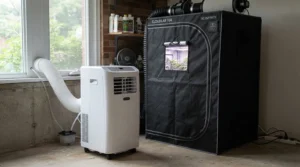
What most first-time growers overlook is that grow tent cooling isn’t just about temperature — it’s about the tug-of-war between heat and humidity happening every second your lights are on. A good grow room AC unit tackles both at once, which is exactly why a plain box fan or an inline duct fan eventually stops being enough. Below, we’ve researched seven real, currently available units spanning budget single-tent coolers to purpose-built VPD systems for full grow rooms, backed by actual specs and aggregated review sentiment — not marketing copy.
Quick Comparison Table
| Product | Cooling Capacity | Best For | Price Range |
|---|---|---|---|
| AC Infinity TERRAFORM 7 | 8,000 BTU | 4×4 tents, VPD-driven growers | $450–$550 range |
| VIVOSUN AeroLush C08 | 8,000 BTU | 5×5 tents, sensor-obsessed growers | $350–$450 range |
| BLACK+DECKER BPACT08WT | 9,000 BTU (5,300 SACC) | Budget-conscious, first tent | Under $350 |
| Midea Duo MAP12S1TGR-S | 12,000 BTU (10,000 SACC) | Efficiency-focused mid-size rooms | $400–$500 range |
| Whynter ARC-1230WNH | 14,000 BTU (12,000 SACC) | Year-round cooling + heat | $600–$750 range |
| AC Infinity TERRAFORM 8 | 12,000 BTU | 10×10 rooms, hands-off automation | $600–$700 range |
| AC Infinity TERRAFORM 12 | 16,000 BTU | Commercial-scale, multi-tent rooms | $900–$1,100 range |
Looking at the spread above, there’s a clean logic to it: the two 8,000 BTU units (AC Infinity TERRAFORM 7 and VIVOSUN AeroLush C08) are purpose-built for single 4×4 or 5×5 tents and duel it out on sensor sophistication rather than raw power. The BLACK+DECKER BPACT08WT undercuts everything on price but pays for it in coverage area, while the Whynter ARC-1230WNH and AC Infinity TERRAFORM 12 sit at the top for anyone running larger rooms or stacking multiple tents. If you’re not sure where you land, our BTU sizing math later in this guide will tell you exactly which row to circle.
💬 Found a unit that fits your setup already? Bookmark this page and share it with a fellow grower who’s still sweating through summer!
Top 7 Portable AC for Grow Tent Options: Expert Analysis
1. AC Infinity TERRAFORM 7 — best VPD-driven all-in-one for 4×4 tents
The AC Infinity TERRAFORM 7 isn’t a repurposed home AC squeezed into a grow tent — it’s built from the ground up for one. That distinction matters more than the spec sheet lets on. This 8,000 BTU unit switches between cooling, heating, dehumidifying, and fan modes through a 4-way ducting system, which means you can dial in positive, negative, or neutral pressure depending on whether odor control or intake filtration is your bigger concern. It covers tents up to 10x10x10 feet and ships with a window duct kit for custom intake and exhaust routing. What most buyers overlook about this model is the 10-level VPD programming — instead of chasing a temperature number, it tracks the actual vapor pressure deficit driving your plants’ transpiration, which is the metric serious growers actually care about.
Based on the spec comparison, this is squarely a mid-range investment that punches like a premium one, thanks to UIS smart controller compatibility for growers building out a full automated tent. Aggregated review sentiment across hydroponics retailers consistently flags the app connectivity and one-unit convenience as standout features, though some reviewers note the learning curve on VPD programming takes a grow cycle or two to master. This is the pick for someone who’s already outgrown a basic inline fan and wants one box that replaces three separate devices.
Pros:
- ✅ Handles cooling, heating, dehumidifying, and fan in one unit
- ✅ True VPD programming instead of basic thermostat control
- ✅ 4-way ducting lets you control tent pressure precisely
Cons:
- ❌ VPD setup has a real learning curve for beginners
- ❌ 8,000 BTU caps out around a standard 4×4 tent
Price sits in the $450–$550 range at the time of research, and for growers who’ve been juggling separate heaters, dehumidifiers, and fans, consolidating into one TERRAFORM unit is often a net wash on cost while being a clear win on tent space.
2. VIVOSUN AeroLush C08 — smartest sensor suite for small tents
If the AC Infinity TERRAFORM 7 is the automation play, the VIVOSUN AeroLush C08 is the precision play. This 8,000 BTU compressor pairs with professional-grade Sensirion sensors that deliver real-time temperature, humidity, and VPD monitoring — the same sensor brand used in lab-grade instrumentation, not the generic thermistors found in most consumer ACs. What that means practically: the readings on your app match what’s actually happening at canopy level, not what the unit’s internal housing thinks the room feels like.
Here’s what the spec sheet won’t tell you, but reviewers note: the self-evaporating design genuinely eliminates the bucket-emptying chore that makes cheaper units a daily hassle during humid flower weeks. It’s recommended for tents up to 5×5 feet, with actual performance depending on ambient temperature, humidity load, and tent insulation. This is a tighter footprint than the TERRAFORM 7’s 10×10 rating, so it’s the better fit for a genuinely small operation rather than a room-sized tent. Aggregated sentiment from hydro retailers points to strong satisfaction with the sensor accuracy specifically, with occasional notes that duct fan speed needs to stay low for the AC to keep pace.
Pros:
- ✅ Lab-grade Sensirion sensors for genuinely accurate VPD readings
- ✅ Self-evaporating system means no manual drain emptying
- ✅ Syncs with the broader VIVOSUN Smart Grow System
Cons:
- ❌ Cooling efficiency drops if your duct fan runs too fast
- ❌ 5×5 tent ceiling means it’s outgrown quickly by larger setups
Expect to pay in the $350–$450 range, making it one of the more accessible sensor-driven units on this list — a smart entry point if VPD precision matters more to you than raw cooling headroom.
3. BLACK+DECKER BPACT08WT — best budget entry point
Not every grower needs a VPD computer bolted to their tent. Sometimes you just need cold air moving through a hot box, and that’s exactly what the BLACK+DECKER BPACT08WT delivers. This is a 9,000 BTU unit rated at 5,300 BTU SACC for rooms up to 400 square feet, which in grow tent terms comfortably handles a 2×4 or 3×3 setup without breaking a sweat. It’s a single-hose configuration, so it pulls replacement air from the same room it’s cooling — a real limitation in a sealed tent, but a non-issue if you’re running the tent door cracked or feeding it from a ventilated grow room.
What most buyers overlook here is the SACC-versus-ASHRAE distinction: that 9,000 BTU headline number is inflated compared to the more honest 5,300 SACC rating, and independent testing on similar B+D units confirms SACC is the number that predicts real-world cooling performance. Reviewers consistently report easy setup — just wheel it in, attach the roughly five-foot hose and window adapter, and plug it in — and appreciate that filters slide out for a quick rinse every couple of weeks. The honest tradeoff is coverage area and hose flexibility for grow tent ducting, which more purpose-built units solve more elegantly.
Pros:
- ✅ Lowest price point of any unit on this list
- ✅ Genuinely simple setup — no smart app required
- ✅ Washable filter takes seconds to clean
Cons:
- ❌ Single-hose design isn’t ideal for a fully sealed tent
- ❌ No VPD or humidity-specific monitoring built in
At under $350, this is the “prove the concept works before you commit” unit — ideal for a first small tent where budget matters more than automation.
4. Midea Duo MAP12S1TGR-S — best inverter efficiency for the price
The Midea Duo MAP12S1TGR-S is what happens when a mainstream appliance brand actually nails inverter technology at a mid-tier price. This is a 10,000 BTU DOE unit built for spaces up to 450 square feet, and the variable-speed inverter compressor is the real story: rather than cycling on and off at full blast, it modulates output to hold your target temperature, which Midea states saves more than 40% energy compared to the U.S. federal standard. For a tent running 18 hours of lights a day for months at a time, that efficiency compounds into a meaningfully lower electric bill.
Based on the spec comparison, the Duo’s hose-in-hose design also does something dual-hose grow tent setups specifically benefit from: it intakes and exhausts air outdoors while preventing hot outside air from seeping back in through gaps, which keeps your tent from fighting itself on hot days. Reviewers on retail platforms consistently praise the near-silent operation — rated as low as 42 dBA — as a standout for grow spaces located near bedrooms or shared living areas. The tradeoff is that this is a mainstream home AC repurposed for tent duty, not a purpose-built grow unit, so you won’t get VPD readouts without pairing it with a separate sensor.
Pros:
- ✅ Inverter tech genuinely cuts energy use versus standard compressors
- ✅ Dual-hose design resists hot outside air infiltration
- ✅ Whisper-quiet operation even at higher settings
Cons:
- ❌ No native VPD or grow-specific monitoring
- ❌ Smart app control requires a stable home WiFi connection
Priced in the $400–$500 range, this is the pick for growers who want serious efficiency gains without paying the premium that dedicated grow-brand units command.
5. Whynter ARC-1230WNH — best premium dual-hose with heat mode
For growers cooling a bigger room — or anyone who also needs to keep a tent warm during winter veg cycles — the Whynter ARC-1230WNH is the most complete unit on this list. It delivers 14,000 BTU (ASHRAE) cooling and heating with an 87-pint dehumidifying capacity, using R32 refrigerant and a patented auto-drain function that fully exhausts condensate in most environments. That dehumidification number deserves attention: late-flower humidity spikes from a mature canopy’s transpiration are exactly the scenario where lesser units get overwhelmed, and 87 pints a day is enough headroom to handle a genuinely lush tent.
What the spec sheet undersells is how much the NEX Inverter technology changes daily operation. Advanced inverter technology achieves roughly 20% more cooling capacity and over 40% energy savings compared to fixed-speed compressors, and the dual-hose “hose-in-hose” configuration draws fresh outside air for cooling rather than depressurizing your grow space — a meaningful advantage if you’re running CO2 enrichment and can’t afford negative pressure pulling unfiltered air in. Reviewers and outlets alike have recognized the ARC series repeatedly; aggregated sentiment highlights the 3-year compressor warranty as reassurance on a pricier purchase, with the main gripe being the unit’s footprint in smaller rooms.
Pros:
- ✅ Dual-hose design ideal for sealed, CO2-enriched tents
- ✅ 87-pint dehumidification handles heavy late-flower humidity
- ✅ Heat mode doubles as winter climate control
Cons:
- ❌ Bulkier footprint than single-hose alternatives
- ❌ Premium pricing reflects the added heat function
Expect the $600–$750 range for this one — a legitimate investment, but for a room-sized grow running CO2, it’s often the unit that finally stops the temperature swings other models can’t touch.
6. AC Infinity TERRAFORM 8 — best one-duct auto-switching for 10×10 rooms
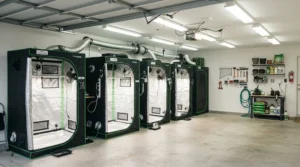
Scale up from a single 4×4 tent to a proper 10×10 grow room, and the AC Infinity TERRAFORM 8 becomes the natural next step. This 12,000 BTU all-in-one climate control system delivers effortless environmental management through adaptive AI that automatically switches between cooling, heating, and fan modes through a single duct connection — no manual mode-flipping required as conditions shift through the day. It’s a 5-in-1 design handling cooling, heating, dehumidifying, circulation, and air exchange through that one duct, which simplifies installation considerably versus running separate intake and exhaust lines.
What most buyers overlook is how much the “set it and forget it” automation actually matters at this scale — a room-sized tent generates enough heat variance between lights-on and lights-off that manual adjustment becomes a real chore. Based on the spec comparison against the smaller TERRAFORM 7, the jump to 12,000 BTU and full room coverage justifies the price increase for anyone who’s outgrown a single tent. Reviewers consistently point to the VPD targeting as the standout, letting the unit chase a vapor pressure target rather than a static temperature number, which large-canopy growers find keeps plants noticeably more stable through flower.
Pros:
- ✅ AI auto-switching eliminates manual mode changes
- ✅ Single-duct install simplifies setup in larger rooms
- ✅ VPD targeting keeps large canopies stable through flower
Cons:
- ❌ Overkill and overpriced for a single small tent
- ❌ Requires more careful duct planning at this size
At $600–$700 range, this is the unit growers reach for once a single-tent AC just can’t keep pace with room-scale heat load.
7. AC Infinity TERRAFORM 12 — best for commercial-scale grow rooms
At the top of this lineup sits the AC Infinity TERRAFORM 12, built for operations where a single tent AC would be laughably undersized. This 16,000 BTU unit uses a dual-cylinder inverter compressor with adaptive AI that automatically switches between cooling, heating, and fan modes through a single duct, and it’s rated for spaces up to 20 x 20 feet — think multi-tent rooms or a dedicated grow closet rather than a solo 4×4.
Here’s the honest analysis: the dual-cylinder design isn’t just a bigger motor bolted onto the TERRAFORM 8’s architecture. Reviewers and industry coverage consistently note it runs noticeably quieter even under heavy load, and the self-evaporative system recycles condensate to help stabilize humidity during large-canopy growth without constant drain maintenance — a genuine differentiator when you’re not eager to babysit a bucket in a 400-square-foot room. Automated VPD cycling means operators running scheduled lighting don’t need to check sensors hourly, which aggregated sentiment flags as the single biggest quality-of-life upgrade over manually-adjusted units. The catch, predictably, is cost and physical footprint — this isn’t a unit you tuck into a spare closet corner.
Pros:
- ✅ Dual-cylinder inverter handles up to 20×20 ft spaces
- ✅ Self-evaporative system reduces manual humidity maintenance
- ✅ Noticeably quieter than comparable single-cylinder units
Cons:
- ❌ Steep price point relative to single-tent options
- ❌ Physical size demands genuine floor space to install
At $900–$1,100 range, this is a commercial-leaning investment — appropriate once you’re managing multiple tents or a full grow room rather than a hobby setup.
Full Spec Comparison: All 7 Units Side by Side
| Product | BTU | Dehumidify | Control | Best For |
|---|---|---|---|---|
| AC Infinity TERRAFORM 7 | 8,000 | Yes, VPD-linked | App + VPD sensors | 4×4 tents |
| VIVOSUN AeroLush C08 | 8,000 | Self-evaporating | App + Sensirion sensors | 5×5 tents |
| BLACK+DECKER BPACT08WT | 9,000 (5,300 SACC) | Basic | Remote | Small budget tents |
| Midea Duo MAP12S1TGR-S | 10,000 SACC | Yes | App + voice | Efficiency-focused rooms |
| Whynter ARC-1230WNH | 14,000 (12,000 SACC) | 87 pints/day | App + voice + heat | Large sealed/CO2 tents |
| AC Infinity TERRAFORM 8 | 12,000 | Yes, VPD-linked | App + AI auto-switch | 10×10 rooms |
| AC Infinity TERRAFORM 12 | 16,000 | Self-evaporative | App + AI auto-switch | 20×20 rooms |
The pattern across this table is worth spelling out: BTU alone doesn’t tell you what you need — the “Best For” column matters more. A Whynter ARC-1230WNH at 14,000 BTU and a AC Infinity TERRAFORM 8 at 12,000 BTU are close in raw power, but they solve different problems — one prioritizes dehumidification headroom, the other prioritizes hands-off automation. If your tent runs CO2 enrichment, the dual-hose Whynter avoids the pressure problems a single-duct unit can introduce.
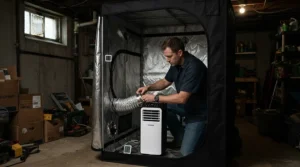
Practical Usage Guide: Setting Up Your Grow Tent AC Right
Getting a portable AC for grow tent use running well isn’t just plugging it in and walking away — the first 30 days determine whether it performs like the spec sheet promises or fights you the whole grow cycle. Start by routing the exhaust hose through the shortest possible path to your vent port; every extra foot of hose and every bend reduces airflow and forces the compressor to work harder. Seal any gaps around the ducting collar with foam tape, because a leaky seal lets conditioned air escape and pulls the exact humidity swings you’re trying to eliminate right back in.
Placement matters more than most growers expect. Keep the unit’s air intake clear of grow lights and reflective mylar, since radiant heat bleeding onto the housing skews internal sensors and forces harder cycling. During the first week, monitor your tent’s temperature and humidity at canopy height rather than trusting the AC’s own display — a cheap hygrometer placed at plant level tells you what your plants actually experience. Common first-month mistakes include running the duct fan too aggressively (which, as noted with the VIVOSUN AeroLush C08, actively fights the AC’s cooling efficiency) and skipping filter cleaning, which chokes airflow within a few weeks in a dusty grow environment. Clean washable filters every two weeks, and if your unit includes a condensate drain, check it before every lights-on cycle during flower.
Real-World Scenario: Which Grow Tent AC Actually Fits Your Setup?
Picture three different growers walking into this decision. First, there’s the balcony hobbyist running a single 2×4 tent for tomatoes and herbs on a tight budget — for them, the BLACK+DECKER BPACT08WT makes total sense: cheap, simple, and more than sufficient for a small footprint with occasional door-cracking to solve the single-hose limitation. Second, there’s the serious home grower with a 4×4 tent, a 600-watt LED, and genuine interest in dialing in VPD through flower — the AC Infinity TERRAFORM 7 or VIVOSUN AeroLush C08 both fit, with the choice largely coming down to whether you want AC Infinity’s broader UIS ecosystem or VIVOSUN’s Sensirion sensor precision.
Third, imagine a small commercial operator running a converted spare room with two or three tents and CO2 supplementation for consistent, scheduled harvests. That’s where the Whynter ARC-1230WNH or AC Infinity TERRAFORM 12 earn their higher price tags — the dehumidification headroom and automated switching aren’t luxuries at that scale, they’re what keeps a multi-tent room from becoming a daily maintenance chore. Matching the unit to your actual square footage and grow ambitions, not just your budget ceiling, is the single biggest factor in long-term satisfaction.
How to Choose a Portable AC for Grow Tent
Picking the right unit comes down to running through a short checklist before you buy:
- Calculate your heat load first. Multiply your light wattage by roughly 3.4 BTU per watt, then add your tent’s cubic footage — this gives a baseline BTU target before you shop.
- Match BTU to tent size, not room size. A sealed 4×4 tent needs far less cooling power than an open 10×10 grow room, even with similar lighting.
- Decide single-hose versus dual-hose. Sealed tents running CO2 enrichment do better with dual-hose units, since single-hose designs create negative pressure that draws unfiltered outside air in.
- Check dehumidification capacity separately from cooling. Late-flower transpiration spikes humidity fast — undersized dehumidification is a common bottleneck even when temperature is fine.
- Consider VPD-native controls if you’re past the beginner stage. Units like the AC Infinity TERRAFORM line or VIVOSUN AeroLush C08 track the metric that actually drives plant transpiration, not just a temperature number.
- Factor in noise if the tent shares living space. Inverter-driven units like the Midea Duo run noticeably quieter than fixed-speed compressors.
- Confirm your electrical setup can handle the draw. Units under 15,000 BTU typically run on standard 115–125V outlets, while larger units may require 220V wiring.
Grow Room AC Unit vs. Traditional Ventilation-Only Setups
A lot of growers start with just an inline duct fan and call it good enough — and for veg-stage plants under modest lighting, it often is. But a dedicated grow room AC unit solves a problem ventilation alone physically can’t: it actively removes heat and moisture rather than just moving air around. An inline fan exhausts hot air, sure, but it can only pull your tent down to roughly ambient room temperature, which does nothing if your grow space itself runs warm in summer. A portable AC, by contrast, actively chills the air below ambient and pulls latent moisture out at the same time, which is exactly why late-flower humidity control becomes so much more manageable once an AC enters the picture.
The tradeoff is upfront cost and a slightly more involved install — running exhaust ducting for an AC takes more planning than clipping an inline fan to a port. But for anyone growing through a genuinely hot summer, or running high-intensity lighting that pushes canopy temps past 85°F, ventilation alone simply can’t keep pace, and an AC becomes less of an upgrade and more of a requirement.
Temperature Control Growing: What to Expect in Real-World Performance
Spec sheets promise clean numbers, but real tents are messier. Most plants in a grow tent do best between 70°F and 85°F, and the gap between that range and reality usually comes down to light heat and insulation quality. Expect your AC to cycle more frequently during the first hour after lights turn on, as it fights the initial thermal spike from a cold-start LED or HID fixture — this is normal, not a sign of an undersized unit. Once temperature stabilizes, well-matched units hold within a couple degrees of target, while undersized units will show a visible sawtooth pattern on any temperature logger, cooling briefly then losing ground.
Where temperature control growing gets genuinely tricky is the lights-off period, when temperatures naturally drop and some growers over-correct by running the AC on high, accidentally pushing humidity too high as cooler air holds less moisture. The fix, covered more in the humidity section below, is to let your AC’s dehumidify mode do double duty during lights-off rather than relying on cooling mode alone.
Humidity Management for Plants: Why Dehumidification Matters as Much as Cooling
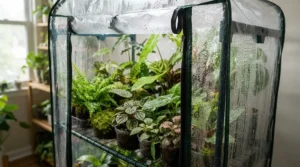
Growers fixate on temperature because it’s the number displayed front and center, but humidity management for plants is arguably the bigger risk factor for crop loss. When vapor pressure deficit runs too low — meaning humidity is too high relative to temperature — nutrient and water uptake slows, which can cause deficiencies and lower growth rates, and low VPD is closely associated with mold and root rot. That’s not a minor cosmetic issue; a humidity spike during flower is one of the fastest ways to lose an entire canopy to bud rot.
Keeping indoor humidity below roughly 60%, and ideally in the 30–50% range, is the standard guidance for preventing mold growth in any enclosed space, and a grow tent is no exception — if anything, the moisture output from actively transpiring plants makes tents more prone to humidity creep than an average room. This is exactly why every unit on this list pairs cooling with dehumidification rather than offering cooling alone; units like the Whynter ARC-1230WNH, rated for 87 pints of daily removal, exist specifically because dense, mature canopies push far more moisture into the air than most people expect.
✨ Don’t Miss These Exclusive Deals!
Click through to check current pricing on the unit that fits your tent size — your plants will thank you.
Indoor Garden Cooling for Different Grow Types
Indoor garden cooling needs shift dramatically depending on what’s actually growing under your lights. A leafy green or herb tent running low-intensity LEDs generates comparatively little heat, so a smaller unit like the BLACK+DECKER BPACT08WT or VIVOSUN AeroLush C08 typically has plenty of headroom. Flowering crops under high-intensity LED or HID lighting are a different story entirely — heat output roughly doubles or triples compared to veg-stage lighting, and that’s before accounting for the extra humidity load from denser, more mature foliage.
Hydroponic and aeroponic setups add another wrinkle: standing nutrient reservoirs and constant misting push ambient humidity higher than soil-based grows, which means dehumidification capacity should weigh more heavily in your decision than it would for a simple soil tent. Multi-tent rooms, meanwhile, benefit from centralizing cooling in one larger unit like the AC Infinity TERRAFORM 12 rather than running several small units independently, both for cost efficiency and because multiple compressors cycling on and off unevenly tends to create more temperature swing, not less.
Plant Grow AC System: Long-Term Cost & Maintenance
Sticker price is only part of the equation with any plant grow AC system — running cost and upkeep matter just as much over a full year of lights-on operation. Inverter-driven units like the Midea Duo and Whynter ARC-1230WNH cost more upfront but consistently use less electricity than fixed-speed compressors over months of daily 18-hour cycles, which can offset the price gap within a year or two depending on your local electricity rates. Fixed-speed budget units like the BLACK+DECKER BPACT08WT are cheaper to buy but run at full power every cycle, so total cost of ownership narrows the gap between “budget” and “premium” more than the sticker prices suggest.
Maintenance costs are modest across the board but not zero: washable filters need rinsing every two weeks during active grows, exhaust hoses should be inspected for kinks or condensation buildup, and any unit without a self-evaporating system needs its drain pan checked regularly during humid flower weeks. Budget roughly an hour a month for upkeep on most units, with VPD-driven units like the AC Infinity TERRAFORM line requiring a bit more attention early on to fine-tune programming before it runs largely hands-off.
Common Mistakes When Buying a Grow Room AC Unit
The single most common mistake is buying based on ASHRAE BTU numbers alone without checking SACC ratings — as the BLACK+DECKER BPACT08WT comparison shows, a 9,000 BTU headline number can translate to a real-world 5,300 SACC rating, a meaningfully smaller cooling footprint than the box implies. The second mistake is oversizing: a unit rated well beyond your tent’s actual heat load short-cycles constantly, which sounds harmless but actually destabilizes humidity because the compressor never runs long enough to properly dehumidify the air before shutting off. Third, growers running sealed, CO2-enriched tents frequently grab a single-hose unit out of convenience, not realizing it depressurizes the tent and pulls unfiltered outside air — and CO2 — right back out. Finally, skipping the dehumidification spec entirely and shopping on cooling power alone is a mistake that tends to surface too late, right around the point when a lush flowering canopy starts pushing serious moisture into the air.
FAQ
❓ What size portable AC do I need for a 4x4 grow tent?
❓ Can I use a single-hose portable AC in a sealed grow tent?
❓ How much humidity should a grow tent AC maintain?
❓ Do grow tent AC units use a lot of electricity?
❓ Is a dedicated grow tent AC better than a regular portable air conditioner?
Conclusion
Choosing the right portable AC for grow tent use really comes down to matching three things honestly: your tent’s actual square footage, your appetite for VPD-level automation versus simple thermostat control, and your budget’s tolerance for inverter efficiency over time. Budget growers land well with the BLACK+DECKER BPACT08WT, mid-range setups benefit from the sensor precision of the VIVOSUN AeroLush C08 or efficiency of the Midea Duo, and larger rooms genuinely need the dehumidification muscle of the Whynter ARC-1230WNH or the automated scale of the AC Infinity TERRAFORM line.
Whichever unit you land on, remember that temperature and humidity are two halves of the same problem — chasing one without the other is how good grows go sideways in week six. Get both dialed in, and you’ve built the optimal growth environment your plants actually need to finish strong, cycle after cycle.
Recommended for You
- Server Room Air Conditioner: 7 Picks That Won’t Let You Down (2026)
- Portable Air Conditioner For Tiny House: 7 Picks For 2026
- Portable Air Conditioner For Shed: 7 Best Picks For 2026
Disclaimer: This article contains affiliate links. As an Amazon Associate, I earn from qualifying purchases. If you purchase products through these links, we may earn a small commission at no additional cost to you.
✨ Found this helpful? Share it with a fellow grower who needs to cool down their tent! 💬🌱
