
In This Article
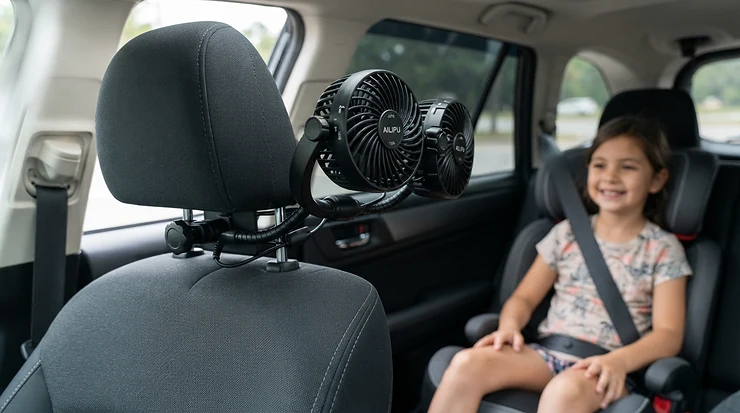
Picture the scene. The dash vents are blasting arctic air, the front seats feel like a walk-in fridge, and in row two a small human is slowly turning into a damp dinner roll. That is the exact problem a car fan for back seat passengers solves, and it is why this humble gadget has become a summer road-trip staple.

Car air conditioning is built around the driver. Cold air leaves the dash, hits the windshield-side cabin first, and arrives in row two tired, late, and nowhere near the kids. Add a sun-baked rear window and a car seat that traps heat against a child’s back, and the rear of the cabin can feel ten degrees warmer than the front. A well-placed car fan for back seat cooling doesn’t change the air temperature. It moves air across skin, which helps sweat evaporate and makes everyone feel cooler.
What Is a Car Fan for Back Seat?
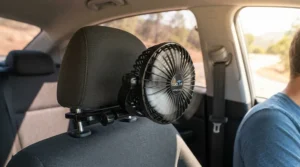
A car fan for back seat use is a small portable fan, usually USB, 12V, or battery powered, that clips onto a front-seat headrest, seat frame, or car seat. It pushes airflow toward rear passengers, children, or pets. Most models have one or two rotating heads, three speed settings, and a cord or rechargeable battery.
Why does this matter beyond comfort? Because rear seats are where heat risk concentrates. NHTSA’s heatstroke prevention guidance notes that a child’s body temperature rises three to five times faster than an adult’s, and that a parked vehicle’s interior can climb about 20 degrees in just ten minutes. A fan helps with comfort while you’re driving. It is never a substitute for attention, and I’ll come back to that in the safety section.
Quick Comparison: Best Car Fan for Back Seat at a Glance
Here are five of the seven picks, side by side, before we get into the detail. Price ranges are approximate and based on listings at the time of research, so check current price before buying.
| Product | Power Type | Best For | Approx. Price Range |
|---|---|---|---|
| Dealswin Rechargeable Dual-Head Fan | Battery + USB | Cordless freedom, road trips | $20–$35 range |
| HUENLYEL Dual Fan | USB (wired) | Budget buyers, night driving | $12–$22 range |
| XOOL Dual Head USB Fan | USB (wired) | Quiet cabins, long drives | $15–$28 range |
| DICMKY Long Arm Dual Fan | USB (wired) | Low rear-facing seats | $18–$30 range |
| Momcozy 8000mAh Portable Fan | Rechargeable battery | Child seat cooling, strollers | $25–$40 range |
Looking at the table, the Dealswin Rechargeable Dual-Head Fan is the pick if you want to be unplugged, while the HUENLYEL Dual Fan wins on pure price. The DICMKY Long Arm Dual Fan earns its spot by solving a geometry problem the others ignore, and the Momcozy 8000mAh Portable Fan gives up headrest-first design for a battery that can outlast a long drive.
💬 Just one click — help others make better buying decisions too!😊
Top 7 Car Fan for Back Seat Picks: Expert Analysis
A note on method. I couldn’t hold these in my hands, so everything below comes from published specs, manufacturer feature lists, and published product roundups. Where I can’t verify review sentiment for a listing, I say so. The seven picks span budget, mid-range, and premium, and they cover both clip-on headrest designs and portable fans that double for child seats.
1. Dealswin Rechargeable Dual-Head Fan — cordless freedom with USB backup
The big idea here is dual power. One roundup lists a roughly 4000 mAh battery alongside USB power, so you can run it unplugged and top it up whenever a port is free. It also has two 360-degree rotating heads and three speeds.
What does that mean in practice? Two heads let you cover two seats, or one seat from two angles. A battery means no cord snaking across a toddler’s footwell. Fans draw more power at top speed, so expect shorter runtime on high than on low, and check the maker’s runtime claim at the setting you’ll actually use.
Based on the spec comparison, this is the best fit for people who dislike cables, camp or tailgate, or drive a car with awkwardly placed rear ports. I couldn’t verify individual review text for this listing. Published roundups highlight the battery as its differentiator, while the usual caveat for any battery fan applies: runtime on high will be shorter than the headline figure.
Pros:
- ✅ Runs cordless, then plugs in when needed
- ✅ Two independently aimed 360-degree heads
- ✅ Useful beyond the car at tailgates and campsites
Cons:
- ❌ Battery runtime drops noticeably on top speed
- ❌ Heavier headrest load than slim wired models
Price range: roughly $20–$35, so check current price. For families who value flexibility, that premium is easy to justify.
2. Hayousui USB Dual-Head Car Fan — plug-in power with independent airflow
The Hayousui USB Dual-Head Car Fan keeps things simple: two heads, three speeds, 360-degree rotation, and a 5V/2A USB plug with an adjustable clip for the rear headrest. There’s no battery, so there’s no charging chore and no runtime anxiety.
The 5V/2A rating tells you the fan expects a proper 2-amp port, ideally the one built into your car or a decent 12V adapter. Plug it into a weak port and you may see sluggish blades. Two heads move more air across a bench seat than a single small head can, which matters most when two kids share row two.
My take, grounded in the specs: this is the workhorse for parents with a rear USB port and steady power. A related rechargeable Hayousui model gets praise in roundups for independent airflow aimed at multiple passengers. I couldn’t verify review text for this exact USB listing, so treat the “reviewers say” claims on any model with caution and read recent reviews yourself.
Pros:
- ✅ No battery to charge or replace
- ✅ Two heads cover both rear window seats
- ✅ Clip adjusts to many headrest post widths
Cons:
- ❌ Cord can tangle without careful routing
- ❌ Needs a true 2A port for best airflow
Price range: around $12–$25, check current price. Strong value for the airflow you get.
3. HUENLYEL Dual Fan — budget-friendly with night-friendly LEDs
The standout on the HUENLYEL Dual Fan is independent switches for each head, plus a two-level LED light. Control each side separately and you can run one fan for the kid who’s roasting and leave the other off for the one who’s napping and chilly.
Independent switches are one of those features that sound minor and turn out to matter. In a family car, comfort needs are never symmetrical. The LED is a useful bonus for night drives, though I’d keep it off when your driver needs a dark cabin.
One roundup reported that owners of a vehicle with a glass sunroof saw a noticeable improvement in rear-seat comfort for hot toddlers. That’s the sort of vehicle where this fan makes sense. I’d treat that as anecdotal and not as a guarantee.
Pros:
- ✅ Each head switches on and off independently
- ✅ Soft LED lighting for evening drives
- ✅ One of the cheapest dual-head options
Cons:
- ❌ Budget plastics may feel less sturdy
- ❌ Wired power limits placement freedom
Price range: typically under $25, check current price. It is the budget pick I’d start with.
4. XOOL Dual Head USB Fan — quiet brushless motor with a long cord
The XOOL Dual Head USB Fan pairs a brushless motor with a roughly 70-inch cord. That combination is the point: the cord reaches a front or center-console port without a stretched-out loop, and the motor is built for low noise.
Brushless motors, explained simply on this Wikipedia overview of brushless DC motors, have no physical brushes rubbing against the motor, so they typically run quieter and last longer than cheap brushed ones. For a baby who naps in the car, or a driver who hates whine, that’s a real feature rather than marketing.
Based on the specs, this is the best match for long-haul drives where a constant fan hum would wear on you after an hour. Some vehicles with very long second rows might still need an extension, so measure from your rear headrest to your power source before ordering.
Pros:
- ✅ Brushless motor for lower noise
- ✅ 70-inch cord reaches most front ports
- ✅ Dual heads for wide rear coverage
Cons:
- ❌ No battery option for cordless use
- ❌ Long cord needs tidy routing
Price range: around $15–$28, check current price. A smart middle-of-the-road choice.
5. DICMKY Long Arm Dual Fan — articulating arm for low rear-facing seats
The DICMKY Long Arm Dual Fan solves a problem that other headrest fans quietly ignore. If your child sits in a rear-facing seat that rides lower than the headrest, a rigid fan blows air over their head and into the roof. This one has an articulating arm, a roughly 70-inch cord, and a brushless motor.
The arm lets you lower the heads closer to the seat and angle the airflow across the child instead of over them. Here’s my safety note: aim it gently across the seat, not directly into a baby’s face. A soft breeze across the body is comfortable. A direct blast at the face isn’t what you want.
This is the product to consider if rear-facing seats are part of your life. Published roundups describe the arm as its defining feature. I couldn’t verify review text for this listing, so check recent buyer feedback on how well the arm holds its position over bumps.
Pros:
- ✅ Arm lowers airflow to child seat level
- ✅ Brushless motor keeps noise down
- ✅ Long cord for flexible routing
Cons:
- ❌ Arm joints may loosen over time
- ❌ Sticks out more than slim clip-on models
Price range: roughly $18–$30, check current price. The geometry fix justifies the extra few dollars.
6. Momcozy 8000mAh Portable Fan — marathon battery with a night-light mode
The Momcozy 8000mAh Portable Fan comes from a different tradition: it is a stroller and travel fan that happens to be excellent for child seat cooling. The maker advertises an 8000mAh battery with up to 27 hours of runtime, four speeds, 360-degree rotation, a detachable design, and two LED night-light modes.
Treat that 27-hour claim as a best-case figure measured at low speed. Even a fraction of it is plenty for a long road trip, and the battery can recharge your phone in a pinch if the model supports it, so check the listing. Because it detaches, it moves from the car seat to the stroller to the hotel crib, which is a real advantage if you travel with a baby.
Where it gives ground is mounting. Stroller fans are designed to clip or flex onto frames and handles, so confirm how it will grip your headrest post or seat edge. Product roundups list this model among the better-selling backseat options for kids, but I wasn’t able to verify specific review text.
Pros:
- ✅ Huge battery for all-day cordless use
- ✅ Detaches for strollers, cribs, and hotels
- ✅ Four speeds plus soft night-light modes
Cons:
- ❌ Mounting varies by seat and headrest type
- ❌ Pricier than basic wired dual-head fans
Price range: around $25–$40, check current price. Best for travel-heavy parents who need one fan for everything.
7. Alagoo 6-Inch 12V Car Clip Fan — big-blade power through the lighter socket
The Alagoo 6-Inch 12V Car Clip Fan is the muscle car of this list. It uses a 12V cigarette-lighter plug, a clip mount, and 360-degree rotation. Larger blades mean more air per rotation, and 12V power means it isn’t limited by the modest wattage of a USB port.
One published roundup describes it as about the size of a soup can and notes it circulates air through the back seats. In my read, that single large head is good for blowing air across a bench seat or toward a third row. The trade-off is that there’s one head instead of two, and you need a 12V socket within cord reach of row two.
This fits SUVs, minivans, trucks, and RVs where cabin volume is large and USB fans feel underpowered. Check the cord length against your layout before buying, and don’t assume it will reach from a front socket to a third-row headrest.
Pros:
- ✅ Larger blades move more air per pass
- ✅ 12V power avoids USB wattage limits
- ✅ Clip mount fits headrests and seat frames
Cons:
- ❌ Single head covers less of the seat
- ❌ Requires a 12V socket within reach
Price range: roughly $15–$30, check current price. A solid choice for big vehicles.
Top 7 Specs Comparison
| Product | Power | Heads | Standout | Approx. Price Range | Best For |
|---|---|---|---|---|---|
| Dealswin Rechargeable Dual-Head Fan | Battery + USB | 2 | Dual power | $20–$35 | Cordless road trips |
| Hayousui USB Dual-Head Car Fan | USB 5V/2A | 2 | Plug-in simplicity | $12–$25 | Steady wired power |
| HUENLYEL Dual Fan | USB | 2 | Independent switches, LED | Under $25 | Budget families |
| XOOL Dual Head USB Fan | USB | 2 | Brushless, 70-inch cord | $15–$28 | Quiet long drives |
| DICMKY Long Arm Dual Fan | USB | 2 | Articulating arm | $18–$30 | Rear-facing seats |
| Momcozy 8000mAh Portable Fan | Battery | 1 | 27-hour claimed battery | $25–$40 | Child seat cooling |
| Alagoo 6-Inch 12V Car Clip Fan | 12V socket | 1 | Large blades | $15–$30 | SUVs and minivans |
Reading across the table, the real divide isn’t brand. It’s power source and head count. If you have a rear port and two kids, the Hayousui USB Dual-Head Car Fan or the XOOL Dual Head USB Fan gives the most airflow per dollar. If you want freedom from cables, the Dealswin Rechargeable Dual-Head Fan and the Momcozy 8000mAh Portable Fan are the two to compare. Ratings change by the week, so check them live instead of trusting a number frozen in an article.
How to Choose a Car Fan for Back Seat
Picking the right model is mostly about matching the fan to your car, not hunting for a magic brand. Work through these steps in order.
- Measure your power path. Find the distance from your rear headrest to the nearest USB or 12V port. A fan that arrives with a short cord is a fan that goes back.
- Pick your power type. Wired USB is simple and constant. A battery adds freedom but adds a charging chore. A 12V plug gives you the most power.
- Count your passengers. Two kids on a bench seat usually want dual heads. A single back seat passenger can do with one larger head.
- Check the mount against your headrest. Look at post spacing and whether your headrests are fixed or adjustable. A clip that grips poorly will rattle.
- Prioritize noise. A brushless motor costs a little more and usually pays back on long drives.
- Look at finger protection. If young children will be in reach, look for tight grille gaps or soft blades, and read the product’s safety details.
- Confirm airflow control. Independent speeds or switches turn a good fan into a flexible one.
Notice the order. Power and mounting come before features, because a gadget that can’t physically work in your car isn’t a bargain at any price.
Setup Guide: Installing a Headrest Fan for Car Seats the Right Way
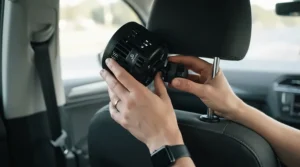
A headrest fan for car use is easy to install and surprisingly easy to install badly. This is the part the product listing won’t tell you.
Step-by-step installation
- Dry-fit first. Hold the fan against the front headrest posts before plugging anything in. Check the angle toward your rear passengers.
- Tighten the clip evenly. Loose clips rattle and slowly slide. Tighten until it doesn’t budge when you tug.
- Route the cord safely. Run it along the seat back or under the seat, away from feet, car seat straps, and seat rails.
- Aim before driving. Angle the airflow across passengers, not directly into faces.
- Test all speeds. Run through every setting while parked.
First 30 days: maintenance and common mistakes
Wipe the blades and guards every few weeks, because dust makes fans louder and weaker. Re-tighten the clip after a week, since vibration loosens everything. Don’t leave a rechargeable fan baking in a closed car for days, because high interior heat is hard on lithium batteries. Take it inside during heat waves.
The biggest mistake I see in published buyer complaints and Q&A threads is cord management. A dangling cord in a footwell gets kicked and eventually yanked. Spend two minutes routing it properly.
✨ Don’t Miss These Exclusive Deals!
🔍 Take your backseat comfort to the next level with these carefully selected fans. Click on any highlighted product to check current pricing and availability. These picks will help you build a cooler, calmer second row your whole family will love!
Real-World Scenarios: Matching a Backseat Car Fan to Your Life
Specs are abstract. Here are three buyer profiles and the fan I’d steer each toward, with the reasoning.
Scenario 1: The minivan family with three kids. Budget is moderate, trips are long, and the car has rear USB ports. Row two and three both want airflow. The Hayousui USB Dual-Head Car Fan in row two and the XOOL Dual Head USB Fan for noise-sensitive naps cover this. If a 12V socket is in the cargo area, the Alagoo 6-Inch 12V Car Clip Fan can push air toward the third row.
Scenario 2: The new parent with a rear-facing infant seat. The seat sits low, the baby naps often, and everything must be quiet and gentle. The DICMKY Long Arm Dual Fan handles the geometry, and the Momcozy 8000mAh Portable Fan lets you move the fan to the stroller. Airflow should graze the baby, never blast them.
Scenario 3: The commuter who carpools. Two adults and a teen sit in row two for 40 minutes a day in summer. The Dealswin Rechargeable Dual-Head Fan works well here because it moves between cars and doesn’t depend on a particular port. The HUENLYEL Dual Fan is the budget alternative if the car has reliable ports.
The pattern is simple. Match power to your ports, match mounting to your seats, and match noise tolerance to your passengers.
Problem → Solution: Fixing Common Rear-Seat Heat Complaints
Rear-seat discomfort tends to repeat in the same five ways. Here is what usually fixes each.
- “The AC feels fine up front but nothing reaches the back.” Point the vents toward the ceiling or back, and put a rear fan to push air along the seat. A Hayousui USB Dual-Head Car Fan moves that air to where it’s needed.
- “The fan is too loud at night.” Drop to the lowest speed or switch to a brushless model like the XOOL Dual Head USB Fan.
- “Kids keep fiddling with it.” Choose models with tight grilles and independent switches you can turn off, such as the HUENLYEL Dual Fan, then keep the controls out of reach.
- “The cord won’t reach.” A 70-inch cord, as on the DICMKY Long Arm Dual Fan, solves most layouts. Otherwise go cordless with the Dealswin Rechargeable Dual-Head Fan.
- “The fan keeps slipping.” Re-tighten the clip, and add a strip of non-slip tape on the headrest posts if needed.
A fan isn’t magic, but it fixes a surprising number of these once you match the problem to the feature.
Features That Actually Matter (And Those That Don’t)
Marketing copy for car fans is a carnival of adjectives. Here’s how I’d sort the noise.
Matter a lot: mounting that grips, cord length or battery capacity, honest noise levels, and finger protection around children. These decide whether the fan works every day.
Matter somewhat: independent head control, two or more speeds, and rotation range. They improve comfort, but a fan without them still works.
Barely matter: fancy LED colors, scent slots, and novelty body shapes. A fragrance slot is a nice touch if you like it, but it won’t change how cool you feel.
Be skeptical of: “turbo” and “cooling air” claims. A fan moves existing air. It doesn’t chill it. The cooling effect comes from airflow across skin, which helps evaporation. If a listing promises that it will drop cabin temperature by many degrees, read that as marketing.
For back seat cooling fan shopping, the sweet spot is solid mounting, a reasonable motor, and a cord or battery that fits your car. Everything else is a bonus.
Child Seat Cooling: What Parents Need to Know
Child seat cooling is the reason many people buy a car fan for back seat use, and it’s also where most caution belongs. Car seats trap heat against a child’s back, and babies can’t regulate temperature as well as adults. NHTSA’s car seat guidance is the right starting point for installation basics, and your seat’s manual is the authority on what you may attach to the seat itself.
Safe use principles
- Mount the fan to the vehicle, not the car seat, unless the seat maker explicitly permits it.
- Keep cords away from straps and buckles.
- Aim the airflow across the child. A gentle breeze on the body beats a direct blast at the face.
- Choose guarded or soft-bladed designs when little hands can reach.
- Dress the child appropriately. A fan can’t replace removing a layer or using a sunshade.
Which fans suit child seat cooling?
The DICMKY Long Arm Dual Fan suits low rear-facing seats, and the Momcozy 8000mAh Portable Fan suits parents who want a detachable, cordless option. Both fit the child seat cooling need better than a fixed clip-on mounted high on a headrest.
One honest limit: a fan only helps while the car is moving and someone is watching the child. It does not make a parked car safe. More on that shortly.

Rear Seat Car Fan vs Alternatives
A rear seat car fan isn’t your only option, and sometimes it isn’t the best one. Here is how it stacks up against common alternatives.
| Option | Cost Range | Strength | Weakness | Best For |
|---|---|---|---|---|
| Rear seat car fan | $12–$40 | Cheap, targeted airflow | Doesn’t chill air | Most families |
| Window sunshades | $8–$25 | Blocks solar heat | No active airflow | Parked or sunny drives |
| Cooling seat cushions | $25–$80 | Direct back cooling | Needs power, one seat only | Adult passengers |
| Rear AC vents (factory) | Built in | Strong cooling | Not available on every car | Minivans and SUVs |
| Aftermarket vent extenders | $10–$30 | Redirects front AC | Limited effect | Sedans |
Read the table this way. A rear seat car fan is the cheapest way to improve airflow, but it works best combined with window shades, which block heat before it enters the cabin, and with factory rear vents where you have them. If your vehicle already has strong rear AC, a fan is a supplement. If it doesn’t, the fan is your first move. For total solar-load control, shades plus a fan beat either alone.
Second Row Comfort and Passenger Cooling Rear in Minivans and 3-Row SUVs
Second row comfort depends on more than a gadget. Layout matters, and so does who’s sitting there.
Passenger cooling rear for adults and teens
Adults and teens run warmer in a crowded back seat, and they notice noise more than toddlers do. Passenger cooling rear works best with a quiet brushless fan, such as the XOOL Dual Head USB Fan, aimed at upper-body airflow. Teens will fiddle with settings, so independent switches like those on the HUENLYEL Dual Fan keep everyone happier.
Pets in the back
Dogs also run warm and can’t sweat as people do. A fan helps, but only as a supplement to water, shade, and frequent stops. Never leave a pet in a parked car.
Third-row logistics
In a three-row vehicle, the third row is the hot spot. The Alagoo 6-Inch 12V Car Clip Fan, with its larger blades and 12V power, helps push air toward that last row. If the cord can’t reach, the cordless Dealswin Rechargeable Dual-Head Fan solves the routing problem.
For second row comfort in any vehicle, combine a fan, window shades, and sensible pre-cooling. Run the AC with the windows down for the first minute to flush trapped hot air before you set the fan going.
Safety and Heat: What a Fan Can’t Do
This section matters more than any spec table.
A car fan does nothing to protect a child in a parked car. NHTSA states that a vehicle’s interior can heat quickly, that cracking windows has little effect, and that heatstroke begins when core temperature reaches about 104 degrees. According to figures NHTSA cited through state safety agencies, 31 children died of vehicular heatstroke in 2025. The research group at NoHeatStroke.org tracks these cases and the patterns behind them, and reading it will change how you handle your back seat.
Practical rules:
- Never leave a child or pet in a parked car, with or without a fan.
- Look before you lock. Many tragedies involve a forgotten child. Keep a bag, shoe, or phone in the back seat as a reminder.
- Keep keys out of children’s reach, since some cases involve a child who got into a car alone.
- Act immediately if you see a child alone in a locked car. Call 911.
Regarding fan safety itself, keep cords clear of seat belts and buckles, make sure nothing sits in an airbag deployment zone, and replace any fan with cracked guards or a loose mount. A fan is a comfort tool. Treat it that way.
Long-Term Cost & Maintenance
Cheap fans are cheap partly because they cut corners. Here’s how I’d think about total cost.
| Cost Factor | Wired USB Fan | Battery Fan | 12V Fan |
|---|---|---|---|
| Upfront | $12–$28 | $20–$40 | $15–$30 |
| Ongoing | None | Charging time, battery wear | None |
| Typical weak point | Cord and clip | Battery degradation | Plug and cord |
| Likely lifespan | Multiple summers | Battery ages first | Multiple summers |
| Best value for | Daily commuters | Travel-heavy families | Large vehicles |
On a per-summer basis, a $20 fan used over three summers costs less than seven dollars a year, which is excellent value for the comfort it adds. The Hayousui USB Dual-Head Car Fan and the XOOL Dual Head USB Fan have no battery to wear out, so their lifespan is usually limited by the clip and motor. The Dealswin Rechargeable Dual-Head Fan and Momcozy 8000mAh Portable Fan are more flexible, but the battery is the part that eventually fades.
Maintenance is minimal: wipe the blades, re-tighten the clip, and store rechargeable models somewhere cooler in extreme heat. Treat this as a three-minute task each month.
Common Mistakes When Buying a Car Fan for Back Seat
The best-reviewed fan in the world can still be wrong for your car. These are the errors I’d steer you around.
Skipping the cord check. A fan that can’t reach your port is useless. Measure first.
Ignoring headrest type. Some vehicles have integrated or very wide headrests that standard clips can’t grip. Check the post spacing.
Buying for airflow alone. A powerful fan that whines at every speed will get switched off within a week.
Assuming the fan cools the air. It doesn’t. It moves air. Set your expectations there and you’ll be happy with the result.
Overloading a single port. Plugging a high-draw fan into a splitter that is already charging three devices can produce weak airflow.
Forgetting the shade. A fan can’t do everything. Sunshades on rear windows stop heat before it builds.
Avoid those six and any fan on this list should serve you well.
FAQ: Car Fan for Back Seat Questions
❓ How long does a rechargeable back seat cooling fan last on one charge?
❓ Will a backseat car fan actually cool a hot car?
❓ Where do I plug in a rear seat fan if my car has no back USB?
❓ Can I leave a headrest fan in the car all summer?
❓ Do headrest fan clips fit every vehicle?
Conclusion
The right car fan for back seat comfort comes down to a short list of honest questions. Where’s your power? Who’s sitting back there? How much noise can you tolerate? If you have a reliable port and two passengers, the Hayousui USB Dual-Head Car Fan or the XOOL Dual Head USB Fan gives the best airflow per dollar. If you want freedom from cables, the Dealswin Rechargeable Dual-Head Fan is the strongest all-rounder. The HUENLYEL Dual Fan is the budget champion, the DICMKY Long Arm Dual Fan is the specialist for low rear-facing seats, the Momcozy 8000mAh Portable Fan is the traveler’s friend, and the Alagoo 6-Inch 12V Car Clip Fan is the muscle for big vehicles.
Whatever you choose, remember what a fan is and isn’t. It is a cheap, effective way to make the second row more comfortable while you’re driving. It is not a safety device, and it never replaces the rule that nobody gets left in a parked car. Pair it with window shades, smart pre-cooling, and a habit of checking the back seat, and your passengers will arrive happier.
🚗 Ready to Cool Down Your Second Row?
✨ Pick the fan that matches your car, your ports, and your passengers, then click through to check current pricing and availability. A few dollars and five minutes of setup can turn the hottest seat in the car into the most comfortable one!
Recommended for You
- Car Seat Cooling Cushion: 7 Best Picks To Beat Heat In 2026
- Best 12V Car Fan: 7 Ultimate Picks To Beat the Heat In 2026
- Best Car Seat Cooling Pad: 7 Ultimate Picks For 2026
Disclaimer: This article contains affiliate links. As an Amazon Associate, I earn from qualifying purchases. If you purchase products through these links, we may earn a small commission at no additional cost to you.
✨ Found this helpful? Share it with your friends! 💬🤗
