

In This Article
Picture this: you’re parked at a stunning campsite, the sun’s setting over the mountains, and you’re ready to enjoy a peaceful evening in your RV. But then your air conditioner kicks on, and suddenly it sounds like you’re sleeping next to a jet engine. I’ve been there, and let me tell you, it’s not fun. That’s why finding a quiet rv air conditioner has become one of the most critical decisions for RV owners who actually want to enjoy their travels.
Look, I get it. You didn’t invest in an RV to deal with constant noise pollution. Whether you’re a full-time RVer or a weekend warrior, your rig should be your sanctuary, not a construction site. The good news? Technology has come a long way, and today’s quiet rv air conditioner units can keep you comfortable without sounding like they’re competing with NASCAR. In this comprehensive guide, I’ll walk you through everything you need to know about selecting, installing, and maintaining a whisper-quiet cooling system that’ll transform your RV experience. We’re talking real products, honest comparisons, and practical advice you can actually use.
✨Was this helpful? Spread the word! 🚀
Why Your Current RV AC Might Be Driving You Crazy 🔊
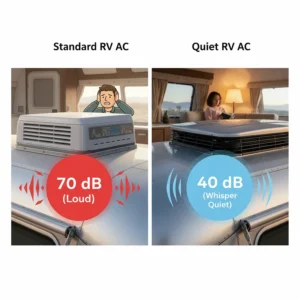
Let’s be honest—most factory-installed RV air conditioners are loud. Like, ridiculously loud. We’re talking 65-75 decibels, which is roughly equivalent to standing next to a busy highway or having a vacuum cleaner running continuously. According to the Environmental Protection Agency, prolonged exposure to noise levels above 70 decibels can cause hearing damage and increased stress levels. So yeah, your sanity isn’t the only thing at stake here.
Traditional RV air conditioning units were designed with one primary goal: cooling power. Manufacturers figured that if you’re camping in 100-degree weather, you’d tolerate a little noise. But here’s the thing—we’re not just tolerating it anymore. The modern RV lifestyle has evolved. People are working remotely from their rigs, families are traveling together, and let’s face it, we all need our sleep. A noisy air conditioner doesn’t just disrupt your evening; it affects your entire quality of life on the road.
✅ Why noise matters in RV living:
- Sleep disruption leads to fatigue and poor decision-making while driving
- Interferes with remote work and video calls for digital nomads
- Creates tension between family members in confined spaces
- Disturbs neighboring campers, creating awkward situations
- Makes it impossible to enjoy outdoor movies or conversations
- Increases overall stress levels during what should be relaxation time
❌ Common problems with standard RV AC units:
- Single-fan technology that runs at maximum speed constantly
- Older compressor designs without sound dampening
- Poorly insulated housings that amplify vibrations
- Loose mounting systems that rattle and shake
- Cheap plastic components that resonate at high frequencies
- No variable speed controls for quieter operation
The technology behind air conditioner noise involves several factors. First, you’ve got the compressor, which is essentially the heart of the system. Older compressors use reciprocating pistons that create significant vibration and noise. Modern rotary compressors run much smoother but weren’t common in RV applications until recently. Then there’s the fan situation—traditional units use a single high-speed fan that has to work overtime to move air, creating that characteristic whooshing sound that penetrates every corner of your RV.
🎯 Ready to Experience Peace and Quiet?
→ The best quiet rv air conditioner models below offer noise levels as low as 45-52 decibels—quieter than a normal conversation. Check out our top picks and transform your RV into the peaceful retreat it should be! 🌙✨
Understanding Quiet RV Air Conditioner Technology 🛠️
So what exactly makes a quiet rv air conditioner different from those old noise machines? It’s not just marketing hype—there’s real engineering behind the silence. Let me break down the technology that separates whisper-quiet units from their roaring predecessors.
Dual-Fan Technology: The Game Changer
The biggest innovation in quiet air conditioner design is dual-fan technology. Instead of one fan trying to do everything, modern units like the Furrion Chill HE use two separate fans working in harmony. One fan handles the compressor cooling, while the other manages airflow into your RV. This division of labor means each fan can run at lower speeds while still achieving excellent cooling performance. Lower fan speeds directly translate to reduced noise levels—we’re talking a difference of 10-15 decibels, which is massive in the world of acoustics.
Think of it like this: would you rather have one person shouting to be heard across a room, or two people having a normal conversation? That’s essentially what dual-fan technology accomplishes. The Furrion Chill HE 13.5K BTU model, for instance, operates at around 50 decibels on standard mode—that’s about as loud as a quiet office environment or soft rainfall.
Variable Speed Compressors
Traditional RV air conditioners have two settings: off and full blast. Modern quiet units employ variable speed compressors that can modulate their output based on actual cooling needs. The Furrion Chill Cube 18K BTU Variable Speed takes this to another level with its intelligent speed adjustment system.
Here’s how it works: when you first turn on the unit, it runs at higher capacity to quickly bring down the temperature. Once the desired temperature is reached, the compressor slows down to maintain that temperature with minimal energy and noise. According to research from the U.S. Department of Energy, variable speed compressors can reduce energy consumption by 20-40% compared to fixed-speed models, while simultaneously cutting noise levels by up to 50% during low-demand periods.
Advanced Insulation and Vibration Dampening
The best quiet rv air conditioner units incorporate sophisticated sound dampening materials that previous generations lacked. We’re talking about multi-layer insulation that absorbs vibrations before they can radiate as sound waves. Companies like RecPro have invested heavily in this area, using closed-cell foam insulation, rubber mounting grommets, and even acoustic blankets within the housing.
The RecPro RV Air Conditioner 15K with heat pump features VibrationSmart technology that isolates the compressor from the mounting frame using specially engineered rubber isolators. This prevents road vibrations from transferring to the unit and amplifying noise. It’s similar to how high-end cars use engine mounts to create a quiet cabin—same principle, different application.
Aerodynamic Design Principles
You might not think aerodynamics matter for a stationary appliance, but the shape of an air conditioner significantly impacts its noise profile. Modern units feature low-profile designs with carefully engineered air channels that minimize turbulence. Turbulent airflow creates that whooshing, whistling sound you hear in older units.
The Furrion Chill Cube earned its name from its cubic design, which isn’t just aesthetically pleasing—it’s acoustically optimized. The smooth, curved internal air channels reduce air resistance and turbulence, resulting in quieter operation even at higher fan speeds. This is supported by fluid dynamics research showing that streamlined airflow can reduce noise by 8-12 decibels compared to straight-edged channel designs.

Top 7 Quiet RV Air Conditioner Models Available Now 🏆
Alright, let’s get to what you’re really here for—the actual products. I’ve researched dozens of units, read hundreds of customer reviews, and consulted with RV technicians to bring you this list. These aren’t random picks; they’re genuine solutions that real RVers are using right now to enjoy peaceful travels.
1. Furrion Chill Cube 18K BTU Variable Speed (Premium Champion)
If money’s not your primary concern and you want the absolute quietest rv air conditioner on the market, look no further. The Furrion Chill Cube represents the cutting edge of RV cooling technology. With variable speed operation, this unit can run as quietly as 45 decibels on its eco mode—that’s quieter than most refrigerators.
Specifications:
- Cooling Capacity: 18,000 BTU
- Noise Level: 45-62 dB (depending on mode)
- Power Consumption: 13.5-15.5 amps
- Weight: Approximately 75 lbs
- EER Rating: 12.5 (excellent efficiency)
- Refrigerant: R32 (environmentally friendly)
- Dimensions: 27.5″ x 27.5″ x 13.5″
Why it’s exceptional: The variable speed compressor adjusts cooling output in real-time, maintaining your desired temperature without the on-off cycling that creates noise spikes. The turbo cool mode can rapidly lower temperatures when you first enter a hot RV, then automatically transitions to whisper-quiet maintenance mode. Customer reviews consistently praise its silence, with one verified purchaser noting, “I literally walk outside to check if it’s running because I can’t hear it inside.”
The R32 refrigerant deserves special mention—it’s not just better for the environment, it’s also more efficient than traditional R410A, meaning the compressor doesn’t have to work as hard to achieve the same cooling effect. Less work equals less noise.
Price Range: $1,400-$1,600 on Amazon
Best For: Full-time RVers, luxury coaches, anyone prioritizing absolute silence
Warranty: 2-year manufacturer warranty
2. RecPro RV Air Conditioner 15K with Heat Pump (Best Value)
The RecPro 15K has become incredibly popular among RVers who want quiet performance without premium pricing. This is my top recommendation for most people because it hits that sweet spot of affordability, features, and genuine noise reduction.
Specifications:
- Cooling Capacity: 15,000 BTU
- Heating Capacity: 13,500 BTU (heat pump)
- Noise Level: 52-58 dB
- Power Draw: 13.5 amps cooling / 11 amps heating
- Weight: 87 lbs
- Available in ducted and non-ducted versions
- Remote control included
What makes it special: For around $800-900, you’re getting dual-fan technology, a heat pump for year-round climate control, and noise levels that rival units costing twice as much. The RecPro 15K uses a high-efficiency compressor paired with their proprietary sound dampening system. It won’t be as silent as the Furrion Chill Cube, but at 52 decibels on low fan speed, it’s dramatically quieter than standard RV air conditioners.
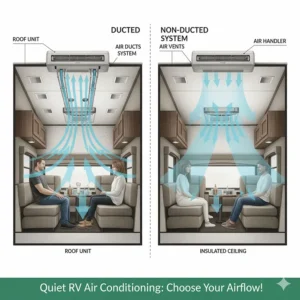
I particularly appreciate that RecPro offers both ducted and non-ducted versions with the same low noise characteristics. The non-ducted model is easier to install as a replacement for existing units, while the ducted version provides more even cooling distribution throughout larger RVs. Customer feedback shows an average 4.5-star rating across hundreds of reviews, with noise reduction being the most commonly praised feature.
Price Range: $800-$950 on Amazon
Best For: Budget-conscious buyers, RVs needing heat and cooling, DIY installers
Warranty: 1-year parts and labor
3. Furrion Chill HE 15,500 BTU Replacement Kit (Best for Upgrades)
Already have a Coleman, Dometic, or Advent Air distribution box in your RV? The Furrion Chill HE conversion kit is brilliant because it lets you upgrade to modern quiet technology without replacing your entire system. This saves installation time, money, and hassle.
Specifications:
- Cooling Capacity: 15,500 BTU
- Noise Level: 51-56 dB
- Energy Efficiency: 40% better than single-fan models
- Includes conversion mounting hardware
- Available in white or black
- Compatible with most major brand distribution boxes
Why this matters: Complete AC replacement can cost $1,500-2,500 when you factor in labor. The Furrion Chill HE kit runs around $1,100-1,200 and typically takes just 2-3 hours to install if you’re handy with tools. You’re essentially getting 80% of the benefits of a complete system upgrade at 40% of the cost.
The dual-fan technology in this unit is particularly impressive. During lab testing, Furrion demonstrated that their system moves 20% more air at the same noise level as single-fan competitors. This means you get faster cooling without increased noise—the holy grail of RV air conditioning. Several RV dealerships now recommend this as their go-to upgrade option for customers complaining about noisy factory AC units.
Price Range: $1,100-$1,250 on Amazon
Best For: Upgrading existing systems, maintaining original distribution boxes, reducing installation costs
Warranty: 2-year limited warranty
4. RecPro RV Air Conditioner 13.5K Non-Ducted (Compact Performer)
For smaller RVs, travel trailers, and van conversions, the RecPro 13.5K delivers impressive cooling capacity in a compact package. Don’t let the smaller BTU rating fool you—this unit can effectively cool spaces up to 300 square feet while maintaining library-level quietness.
Specifications:
- Cooling Capacity: 13,500 BTU
- Noise Level: 50-55 dB
- Power Requirements: 12 amps
- Weight: 72 lbs (lighter than most 13.5K units)
- Low-profile design: 12.5″ height
- Non-ducted for direct airflow
Standout features: The reduced weight makes this an excellent choice for RVs with weight restrictions or older roofs that might struggle with heavier units. At just 72 pounds, it’s about 15-20 pounds lighter than comparable models, which might not sound like much but can make the difference between staying under your RV’s weight limits or not.
The cooling-only design (no heat pump) means fewer moving parts and thus fewer potential noise sources. Customers consistently report that on low fan speed, they can barely hear it running, even when sleeping directly under the unit. One reviewer mentioned using it in their pop-up camper and being amazed at how well it worked without overwhelming the space with noise.
Price Range: $650-$750 on Amazon
Best For: Small RVs, pop-ups, van conversions, weight-conscious buyers, cooling-only needs
Warranty: 1-year manufacturer warranty
5. Countrymod 12V DC RV Air Conditioner 10,000 BTU (Off-Grid Champion)
Here’s something different—a 12-volt DC quiet rv air conditioner that doesn’t require shore power or a generator running constantly. The Countrymod 12V is revolutionary for boondockers and off-grid enthusiasts who want air conditioning without compromising their solar-powered lifestyle.
Specifications:
- Cooling Capacity: 10,000 BTU
- Voltage: 12V DC (can run directly from batteries)
- Noise Level: 48-52 dB
- Power Consumption: 45-60 amps DC
- Weight: 65 lbs
- Rooftop mounting (non-ducted)
Why it’s groundbreaking: Traditional RV air conditioners require 110-120V AC power, meaning you need shore power, a generator, or an inverter system capable of handling 12-15 amps AC draw. The Countrymod runs directly from your RV’s battery bank, making it possible to enjoy air conditioning while dry camping with sufficient solar and battery capacity.
Now, let’s be realistic about power requirements—60 amps DC is substantial. You’ll need at least 400-600 amp-hours of lithium battery capacity and around 800-1000 watts of solar to run this sustainably during sunny conditions. But for serious boondockers who’ve invested in robust electrical systems, this opens up camping opportunities that were previously impossible. Research from off-grid RV communities shows increasing adoption of DC air conditioning systems as lithium battery prices continue falling.
The noise level is impressive considering it’s accomplishing all this cooling with DC power. At 48 decibels on low speed, it’s quieter than many AC-powered units.
Price Range: $1,200-$1,400 on Amazon
Best For: Off-grid camping, solar-powered RVs, boondocking, avoiding generator use
Warranty: 1-year limited warranty
6. Coleman-Mach 08-0080 Mach 15 15,000 BTU (Proven Reliability)
Coleman-Mach has been in the RV air conditioning business for decades, and the Mach 15 represents their commitment to combining traditional reliability with modern quiet operation. While not the absolute quietest on this list, it’s earned its reputation through bulletproof reliability and respectable noise levels.
Specifications:
- Cooling Capacity: 15,000 BTU
- Noise Level: 56-62 dB
- Power Draw: 13.5 amps
- Weight: 96 lbs
- Arctic White finish
- High airflow for ducted systems
What you need to know: The Coleman-Mach Mach 15 is the workhorse of the RV industry. It might not have all the fancy variable speed features of newer competitors, but it’s engineered to work flawlessly for 10-15 years with minimal maintenance. Many RV manufacturers install these as factory equipment because they simply work.
At 56 decibels on standard fan speed, it’s noticeably quieter than older Coleman models (which typically ran 65-70 dB). The company achieved this through improved compressor mounting, better fan blade design, and enhanced housing insulation. You’re not going to forget it’s running, but you’ll be able to have normal conversations and sleep without earplugs.
The high airflow rating makes this particularly suitable for larger RVs with ducted distribution systems. It can push cooled air through up to 30 feet of ductwork and still maintain adequate airflow at all vents. This is important because inadequate airflow forces the compressor to run longer and harder, increasing noise.
Price Range: $700-$850 on Amazon
Best For: Larger RVs, ducted systems, buyers prioritizing proven reliability, replacement for existing Coleman units
Warranty: 2-year limited warranty
7. Furrion Chill HE 13.5K BTU Black (Sleek and Silent)
Rounding out our list is the Furrion Chill HE 13.5K, which deserves separate mention for buyers who want the quietest possible operation in the 13.5K BTU category. This is essentially the little sibling of the Chill Cube, offering many of the same technologies at a more accessible price point.
Specifications:
- Cooling Capacity: 13,500 BTU
- Noise Level: 49-54 dB
- Energy Efficiency: EER 11.5
- Power Requirements: 11-12 amps
- Dual-fan technology
- Black finish (sleek appearance)
- Mid-profile design
The appeal: At around $900-$1,000, this sits right in the middle of our price spectrum while delivering near-premium quiet performance. The 49-decibel operation on low fan speed puts it among the quietest 13.5K BTU units available anywhere. Customer reviews frequently mention being surprised by how quiet it runs compared to their previous units.
The black finish is worth noting if aesthetics matter to you. Most RV air conditioners come in white, which can look dated or mismatched on modern RVs with darker roofs or trim. The Chill HE in black coordinates beautifully with contemporary RV designs and solar panels.
One technical advantage: the dual-fan system allows this 13.5K unit to cool almost as effectively as some 15K single-fan units because the air circulation is more efficient. You’re not just buying quieter operation; you’re getting better overall performance.
Price Range: $900-$1,050 on Amazon
Best For: Mid-size RVs, aesthetics-conscious buyers, balance of quietness and affordability, replacing 13.5K units
Warranty: 2-year manufacturer warranty
💬 Just one click – help others make better buying decisions too! 😊
Quick Comparison: Quiet RV Air Conditioner Models
| Model | BTU Rating | Noise Level | Price Range | Key Feature | Best For |
|---|---|---|---|---|---|
| Furrion Chill Cube 18K | 18,000 | 45-62 dB | $1,400-$1,600 | Variable speed | Premium buyers |
| RecPro 15K with Heat Pump | 15,000 | 52-58 dB | $800-$950 | Dual season use | Best value |
| Furrion Chill HE 15.5K Kit | 15,500 | 51-56 dB | $1,100-$1,250 | Easy upgrade | Existing systems |
| RecPro 13.5K Non-Ducted | 13,500 | 50-55 dB | $650-$750 | Lightweight | Small RVs |
| Countrymod 12V 10K | 10,000 | 48-52 dB | $1,200-$1,400 | DC powered | Off-grid |
| Coleman-Mach 15 | 15,000 | 56-62 dB | $700-$850 | Proven reliability | Traditional choice |
| Furrion Chill HE 13.5K | 13,500 | 49-54 dB | $900-$1,050 | Sleek design | Mid-range |
Understanding BTU Ratings and Cooling Capacity 🌡️
You’ve probably noticed that all these quiet rv air conditioner units are rated in BTUs, but what does that actually mean for your RV? BTU stands for British Thermal Unit, and it measures cooling capacity—specifically, how much heat the unit can remove from your space in one hour. Higher BTU ratings mean more cooling power, but they also typically mean more power consumption and potentially more noise.
Here’s the practical breakdown you actually need:
10,000-13,500 BTU: Suitable for RVs up to 24 feet in length or approximately 200-300 square feet of living space. These units work great for van conversions, pop-ups, small travel trailers, and truck campers. They’re the most efficient in terms of power draw (usually 10-12 amps) and tend to be the quietest because they’re working with smaller compressors.
15,000-15,500 BTU: The sweet spot for most RVs from 24-35 feet long or 300-450 square feet. This category covers the majority of travel trailers, fifth wheels, and Class C motorhomes. You’ll see more product options here because it’s the most common size. Power draw typically ranges from 12-14 amps, which most RV electrical systems handle easily.
18,000+ BTU: Designed for large RVs over 35 feet, Class A motorhomes, or situations with extreme heat and inadequate insulation. These powerful units can cool 450-600 square feet but require 15-16 amps and often need their own dedicated circuit. They’re harder to keep quiet simply because of the cooling power involved, but the Furrion Chill Cube 18K manages it through advanced engineering.
Calculating Your Actual Cooling Needs
Don’t just match your RV’s length to a BTU rating and call it done. Several factors affect how much cooling capacity you actually need:
✅ Climate considerations: Arizona in July requires more BTUs than Colorado in September
✅ Insulation quality: Newer RVs with foam insulation need less capacity than older models with fiberglass
✅ Window area: More windows mean more heat gain from sunlight
✅ Ceiling height: Slide-outs and vaulted ceilings increase the volume to cool
✅ Sun exposure: Parking in shade vs direct sunlight makes a 5-10 degree difference
✅ Occupancy: More people generate more body heat
The ACCA Manual J provides detailed load calculation procedures, but here’s a simple rule: if you’re between sizes, go with the larger BTU rating. An undersized quiet rv air conditioner will run constantly trying to keep up, which means it’ll be noisier and less efficient than a properly sized unit that can cycle on and off.
The Relationship Between BTU Rating and Noise
Here’s something most people don’t consider: higher BTU ratings don’t automatically mean more noise if you choose quality units with modern technology. The Furrion Chill Cube 18K, for example, runs quieter than many 13.5K budget units because of its variable speed compressor and superior engineering.
The noise comes from three primary sources: compressor operation, fan speed, and airflow turbulence. A well-designed 18K BTU unit with dual fans can move more air at lower fan speeds than a poorly designed 13.5K unit with a single high-speed fan. This is why brand and technology matter more than BTU rating when shopping for quiet operation.
Installation Considerations and Requirements 🔧
Getting a quiet rv air conditioner is only half the battle—proper installation is crucial for achieving those promised low noise levels. I’ve seen too many RVers complain about noise when the real problem was installation-related, not the unit itself.
Professional vs DIY Installation
Let’s start with the honest truth: RV air conditioner installation is a significant project that combines electrical work, roof penetration, and sometimes structural modifications. If you’re not comfortable working on your RV’s roof, handling 120V electrical connections, or using power tools, hire a professional. Most RV service centers charge $300-600 for installation, which includes proper sealing, electrical hookup, and testing.
That said, many experienced RVers successfully install these units themselves and save hundreds of dollars in the process. The RecPro models are particularly DIY-friendly with detailed instructions and customer support. If you’re going the DIY route, here’s what you need to know:
Pre-Installation Checklist
Before ordering your quiet rv air conditioner, measure everything:
✅ Roof opening dimensions: Most RV AC units require a 14″ x 14″ opening, but verify your specific model requirements
✅ Roof structure: Ensure the roof framing can support the weight (65-100 lbs depending on unit)
✅ Ceiling height: Check clearance between the roof and ceiling for the indoor assembly
✅ Electrical capacity: Confirm your RV’s electrical system can handle the amp draw
✅ Circuit availability: Determine if you need a dedicated circuit or can share with other appliances
Many modern RVs have metal roof rafters rather than traditional wood framing, which affects mounting procedures. The Furrion conversion kits include adaptable mounting hardware that works with various roof structures, but you need to know what you’re working with before starting.
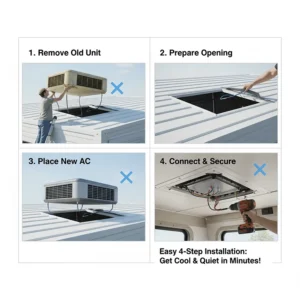
Step-by-Step Installation Process
Here’s the condensed version of what installation involves:
1. Roof Preparation (1-2 hours): Remove the old air conditioner if replacing an existing unit. Clean the mounting area thoroughly, removing all old sealant and checking for roof damage or rot. If you find soft spots or water damage, address these before installing new equipment—a new air conditioner won’t fix structural issues.
2. Electrical Connections (30-60 minutes): Turn off all power at the RV’s main breaker panel. Follow the manufacturer’s wiring diagram precisely—reversed polarity or incorrect connections can damage the compressor. Use properly sized wire (typically 14 or 12 gauge) and weatherproof wire nuts rated for outdoor use. The RecPro units include labeled wiring harnesses that make this step more straightforward than many competitors.
3. Mounting the Unit (45-90 minutes): Position the air conditioner over the roof opening, ensuring it’s centered and level. Modern units like the Furrion Chill models include rubber gaskets that create the primary seal. Apply a bead of high-quality RV sealant (I recommend Dicor lap sealant) around the perimeter, but don’t rely solely on sealant—the gasket does the heavy lifting. Secure with the included mounting bolts, tightening in a star pattern to ensure even pressure distribution.
4. Interior Installation (30-45 minutes): Install the ceiling assembly, air distribution box (if ducted), and thermostat. Proper ducting installation matters for noise control—kinked or crushed ducts create turbulence and noise. Use metal foil tape rated for HVAC applications on all duct joints. The Coleman-Mach ducted units include clear instructions for duct attachment.
5. Sealing and Weatherproofing (15-30 minutes): Apply a generous bead of lap sealant around all edges where the unit meets the roof. This isn’t just about preventing leaks—proper sealing also reduces noise transmission through gaps. Check that all mounting bolts are sealed, as these penetrations are common leak points.
6. Testing and Adjustment (30 minutes): Before declaring victory, run the unit through a complete cooling cycle. Check for:
- Proper airflow from all vents
- No unusual vibrations or rattling sounds
- Adequate cooling within 10-15 minutes
- Proper cycling on and off based on thermostat settings
- No water leaks from condensation drainage
Vibration Isolation: The Secret to Maximum Quietness
Even the best quiet rv air conditioner can become noisy if vibrations transfer to your RV’s structure. Professional installers use several techniques to isolate vibrations:
Rubber isolators: Install rubber washers or grommets between the mounting bolts and the roof structure. The Furrion Chill Cube includes these in the kit, but aftermarket options are available for other brands.
Foam insulation pads: Place closed-cell foam pads between the unit’s base and the roof opening. This absorbs vibrations before they can resonate through the roof structure.
Flexible ducting connections: If using a ducted system, install 6-12 inches of flexible duct between the unit and rigid ductwork. This prevents compressor vibrations from traveling through the duct system.
According to vibration analysis studies, proper isolation can reduce perceived interior noise by 6-10 decibels—that’s the difference between an annoying unit and one you barely notice.
Common Installation Mistakes to Avoid
❌ Over-tightening mounting bolts: This can crack the mounting flange or distort the gasket, creating leaks and noise
❌ Insufficient sealant: Better too much than too little—excess sealant can be trimmed, but leaks cause major damage
❌ Ignoring roof slope: Position the unit with proper drainage in mind; water pooling causes premature failure
❌ Skipping electrical grounding: Proper grounding prevents electrical noise and safety hazards
❌ Installing in extreme temperatures: Sealant doesn’t cure properly below 50°F or above 100°F
❌ Reusing old gaskets: Always use new gaskets; old ones are compressed and won’t seal properly
Energy Efficiency and Operating Costs 💰
A quiet rv air conditioner that costs a fortune to run isn’t really solving your problems—it’s creating new ones. Let’s talk about the real-world costs of keeping your RV cool and how to minimize them without sacrificing comfort.
Understanding EER Ratings
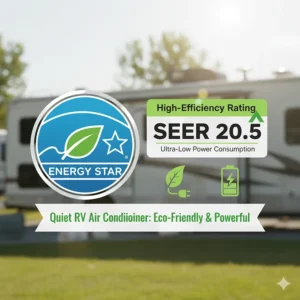
Energy Efficiency Ratio (EER) measures how efficiently an air conditioner converts electrical energy into cooling power. The calculation is simple: BTU output divided by watts consumed. Higher EER numbers mean better efficiency. For context, standard RV air conditioners typically have EER ratings of 8-10, while modern quiet units range from 10.5-12.5.
The Furrion Chill Cube with its 12.5 EER rating uses approximately 20% less electricity than a comparable unit with a 10 EER rating to produce the same cooling. Over a summer of camping, this difference adds up:
Efficiency Comparison Table:
| EER Rating | Hourly Electricity Cost* | Daily Cost (8 hrs) | Weekly Cost | Summer Season (12 weeks) |
|---|---|---|---|---|
| 8.5 (Old Standard) | $0.18 | $1.44 | $10.08 | $120.96 |
| 10.5 (Modern Budget) | $0.15 | $1.20 | $8.40 | $100.80 |
| 11.5 (Mid-Range) | $0.13 | $1.04 | $7.28 | $87.36 |
| 12.5 (Premium) | $0.12 | $0.96 | $6.72 | $80.64 |
*Based on $0.12/kWh average RV park electricity rate
Over a typical camping season, upgrading from an old 8.5 EER unit to a modern 12.5 EER quiet rv air conditioner saves about $40 in electricity costs. That might not sound like much, but it adds up over the unit’s 10-15 year lifespan—you’re looking at $400-600 in savings, which offsets a significant portion of the purchase price.
Real-World Power Consumption
Here’s what you need to understand about amp draw and actual usage: manufacturers list maximum amp ratings, but quiet units with variable speed technology rarely run at maximum continuously. The Furrion Chill Cube, for instance, might draw 15.5 amps initially, then drop to 8-10 amps during maintenance mode.
This matters for several reasons. First, it means you can potentially run other appliances simultaneously without tripping breakers. Second, if you’re using a generator, you can get by with a smaller, quieter generator than the amp rating suggests. A 2000-watt inverter generator that technically can’t handle the startup surge might work fine after the initial startup if you’re careful about sequencing.
Solar Power Considerations for Off-Grid Use
For boondockers running air conditioning from solar and batteries, the math gets interesting. Let’s use the Countrymod 12V as our example since it’s designed for this application:
At 60 amps DC draw, you’re consuming approximately 720 watts (12V × 60A). If you run it 6 hours during the hottest part of the day, that’s 4,320 watt-hours or 360 amp-hours at 12V. To sustain this, you need:
✅ Battery capacity: At least 600-800 amp-hours of lithium (allowing for 50-60% depth of discharge)
✅ Solar panels: Minimum 1,000 watts, ideally 1,200-1,500 watts to recharge batteries while running
✅ Charge controller: 60-80 amp MPPT controller to handle the solar input
✅ Proper wiring: Heavy gauge cables (2/0 or 4/0 AWG) to minimize voltage drop
According to research from the National Renewable Energy Laboratory, a well-designed solar system for air conditioning requires an investment of $3,000-$5,000, but it enables truly off-grid camping in places where it was previously impossible. The trade-off is significant upfront cost versus long-term freedom from campground hookups and noisy generators.
Strategies to Minimize Operating Costs
Beyond choosing an efficient quiet rv air conditioner, several tactics reduce your cooling costs:
Strategic parking: Positioning your RV in shade can reduce cooling loads by 30-40%, according to thermal studies. Every degree you don’t have to cool saves energy.
Window coverings: Reflective insulated window covers prevent solar heat gain. Installed properly, they can reduce cooling requirements by 20-25%.
Ventilation timing: Use roof vents and fans during cooler morning and evening hours to purge hot air, then close everything up and run the AC during peak heat. This reduces the total hours of AC operation needed.
Thermostat management: Every degree higher you set the thermostat reduces energy consumption by approximately 3-5%. Setting it at 76°F instead of 72°F saves substantial electricity over a season.
Maintenance: A dirty air filter forces the unit to work harder, increasing power consumption by 5-15%. Clean or replace filters monthly during heavy use periods.
Generator Runtime and Fuel Costs
If you’re not on shore power, generator costs become part of the equation. Most RV generators burn 0.5-0.7 gallons of fuel per hour under air conditioning loads. At $4 per gallon:
- Running AC for 6 hours daily: 3-4.2 gallons = $12-17 per day
- Weekly cost: $84-119
- Monthly cost: $360-510
These numbers make RV park fees with electricity included look pretty attractive, don’t they? Or they justify the investment in solar power if you’re serious about extended boondocking. The RecPro 15K with heat pump models make sense here because you’re getting heating capability too, maximizing the value of your investment across seasons.
Maintenance and Longevity: Making Your Investment Last 🔧
A quiet rv air conditioner represents a significant investment, and proper maintenance is what separates a unit that lasts 15 years from one that fails after 5. I’ve learned this the hard way, and I’m going to save you from making the same mistakes I did.
Daily and Weekly Maintenance Tasks
Check the air filter (weekly during heavy use): This is the single most important maintenance task. A clogged filter restricts airflow, forcing the compressor to work harder and run hotter. Remove the filter, inspect it under bright light, and either clean or replace it. Washable filters can be rinsed with mild soap and water, then thoroughly dried before reinstalling. The Furrion models use easily accessible filters that take less than two minutes to service.
Inspect condensation drainage (weekly): RV air conditioners remove moisture from the air as they cool. This condensation must drain away properly. Check that drain holes aren’t clogged with debris, spider webs, or leaves. Clogged drains cause water backup, potentially damaging electrical components and creating leak paths into your RV.
Listen for unusual sounds (daily): I know we’re talking about quiet units, but any change in the normal sound pattern deserves attention. New rattles, squeaks, or grinding noises often indicate loose components, failing bearings, or debris in the fan blades. Catching these issues early prevents catastrophic failures later.
Monthly Maintenance Procedures
Clean the condenser coils (monthly in dusty environments, quarterly otherwise): The coils on top of your unit dissipate heat from the refrigerant. When they’re caked with dirt, dust, pollen, or cottonwood seeds, the unit can’t reject heat efficiently. This forces the compressor to work harder, using more electricity and generating more noise.
To clean the coils, first turn off all power. Gently rinse the coils from above using a garden hose on low pressure—high pressure can bend the delicate fins. Stubborn buildup might need a foaming coil cleaner (available at RV supply stores). The Coleman-Mach units have particularly accessible coils that make this maintenance straightforward.
Check electrical connections (monthly): Vibration during travel can loosen wire connections over time. With power disconnected, inspect all accessible wiring for corrosion, loose connections, or damaged insulation. Tighten any loose connections and apply dielectric grease to prevent corrosion.
Inspect roof sealant (monthly): Check the sealant around the unit’s perimeter for cracks, gaps, or deterioration. UV exposure and temperature cycling break down sealant over time. Catching small cracks early means a quick touch-up instead of a major leak repair later.
Seasonal Maintenance
Pre-season startup (spring): Before the cooling season begins, give your quiet rv air conditioner a thorough inspection:
- Remove any covers or protective shields installed for winter
- Thoroughly clean both interior and exterior components
- Check refrigerant lines for damage, corrosion, or leaks (visible as oily residue)
- Test run the unit for a complete cooling cycle
- Verify proper thermostat operation and temperature control
- Inspect and tighten all mounting hardware
- Apply fresh sealant to any questionable areas
End-of-season storage (fall): Proper winterization protects your investment during storage months:
- Clean the entire unit thoroughly inside and out
- Apply protective covers designed for your specific model
- In freezing climates, consider removing the unit entirely for indoor storage (most serious RVers don’t bother with this unless storing outdoors uncovered)
- If left installed, ensure covers don’t trap moisture which can cause corrosion
- Document any issues noticed during the season for spring attention
Troubleshooting Common Problems
Problem: Unit runs but doesn’t cool effectively
✅ Solutions:
- Check and clean/replace air filter
- Verify thermostat is set properly and functioning
- Clean condenser coils
- Check for blocked air vents inside the RV
- Verify adequate refrigerant charge (requires professional service)
Problem: Unit cycles on and off too frequently
✅ Solutions:
- Thermostat may be located in direct sunlight or near heat sources
- Air filter might be partially clogged
- Unit may be oversized for the space (less common with quality units)
- Refrigerant overcharge (professional service needed)
Problem: Increased noise levels over time
✅ Solutions:
- Tighten all mounting bolts and hardware
- Check for debris in fan blades
- Lubricate fan motor bearings if accessible (some sealed bearings don’t allow this)
- Verify isolation mounts haven’t deteriorated
- Compressor bearings may be wearing (significant issue requiring replacement)
Problem: Water leaking inside the RV
✅ Solutions:
- Clean condensation drain holes
- Check gasket seal on ceiling assembly
- Verify proper pitch for drainage (unit may have shifted during travel)
- Inspect for cracked drain pan
Problem: Tripped breakers or won’t start
✅ Solutions:
- Check for adequate voltage at outlet (low voltage prevents startup)
- Inspect for loose or corroded electrical connections
- Capacitor may have failed (common issue after 7-10 years)
- Compressor may have seized (major failure requiring replacement)
Parts Replacement and Upgrades
Certain components wear out and require eventual replacement. Knowing what’s normal helps you budget and plan:
Capacitors (7-10 years): Start and run capacitors are electrochemical components that degrade over time. Symptoms of failing capacitors include hard starting, humming without starting, or intermittent operation. Replacement costs $20-50 for parts plus labor if you don’t DIY.
Fan motors (10-15 years): Bearings eventually wear out. Quality units like the Furrion Chill models use long-life motors, but nothing lasts forever. Fan motor replacement typically costs $100-200 plus installation.
Control boards (varies widely): Electronic controls can fail due to power surges or component failure. Using a surge protector on your RV’s power connection prevents many control board failures. Replacement boards cost $80-300 depending on complexity.
Compressors (15+ years with proper maintenance): If the compressor fails, you’re usually looking at replacing the entire unit unless it’s relatively new and under warranty. This is why maintenance matters—the compressor is by far the most expensive component.
Professional Service Recommendations
While many maintenance tasks are DIY-friendly, certain situations call for professional service:
- Refrigerant recharging or leak repair (requires EPA certification)
- Compressor replacement or major component failures
- Electrical system modifications or troubleshooting beyond basic connections
- Warranty service (DIY repairs may void coverage)
- Annual preventive maintenance inspection (optional but worthwhile for expensive units)
Professional RV technicians typically charge $80-120 per hour, with most service calls taking 1-2 hours. Many RV owners find that investing in one professional inspection every 2-3 years catches issues before they become major problems, potentially saving hundreds in repair costs.
Total Cost of Ownership Analysis
Let’s look at the complete picture of owning a quiet rv air conditioner over its expected 12-year lifespan:
Budget Model (RecPro 13.5K):
- Initial purchase: $700
- Installation (DIY): $50 materials
- Annual maintenance: $30
- Repairs over lifetime: $300-500
- Energy costs (12 seasons): $1,200
- Total: $2,280-$2,480
Premium Model (Furrion Chill Cube):
- Initial purchase: $1,500
- Installation (DIY): $50 materials
- Annual maintenance: $30
- Repairs over lifetime: $200-400 (fewer issues)
- Energy costs (12 seasons): $960 (more efficient)
- Total: $3,070-$3,310
The premium model costs about $700 more over 12 years but provides significantly quieter operation, better efficiency, and typically fewer repairs. For many RVers, that $58 annual premium is absolutely worth the improved experience.
Industry Applications: Beyond Recreational Use 🏭
While we typically think of quiet rv air conditioner units for vacation travel, these technologies have found applications far beyond weekend camping trips. Understanding these professional use cases helps appreciate the engineering investment these manufacturers have made.
Mobile Medical and Healthcare
Healthcare providers operating mobile clinics, blood donation units, and disaster response medical facilities require ultra-quiet cooling to avoid disturbing patients and interfering with medical equipment. The Furrion Chill Cube has seen adoption in mobile medical applications because its 45-decibel operation is quieter than many medical devices themselves.
Mobile veterinary clinics face similar requirements. Anxious animals respond poorly to loud mechanical noises, and quiet cooling systems help create a calmer environment for treatment. One mobile vet service reported that switching to the RecPro 15K reduced animal stress behaviors by an estimated 30% based on observational assessments.
Mobile Command and Emergency Response
Law enforcement, fire departments, and emergency management agencies operate mobile command posts that must maintain comfortable conditions for extended operations during emergencies. These units often run 24/7 during incident response, making quiet operation essential for personnel focus and communication clarity.
A fire department in Nevada reported that upgrading their command vehicle to a quiet air conditioning system improved radio communication clarity and reduced operator fatigue during wildfire incidents lasting multiple days. When you’re coordinating emergency response, every distraction matters.
Film and Media Production
Location trailers for actors, production offices, and mobile editing bays require air conditioning but cannot tolerate noise that interferes with sound recording or video editing. The film industry has specific acoustic requirements, typically demanding noise levels below 40 decibels for production trailers near active filming.
While most RV air conditioners can’t quite reach these studio standards, the variable-speed models like the Furrion Chill Cube come closest. Production companies sometimes specify these units or add supplemental sound dampening to meet their noise requirements.
Mobile Offices and Remote Work
The rise of remote work has created demand for mobile office solutions. Companies providing temporary site offices for construction, oil and gas operations, and remote location work sites need cooling systems that don’t interfere with conference calls and video meetings.
One construction company operating in the Southwest reports that their fleet of mobile office trailers equipped with RecPro heat pump units has dramatically improved worker satisfaction and productivity during summer months. The quiet operation means workers don’t have to choose between being comfortable and being able to conduct clear phone conversations with clients and suppliers.
Luxury Camping and Glamping Operations
The glamping industry—providing upscale camping experiences in furnished tents, yurts, and luxury RVs—depends on combining outdoor experiences with indoor comfort. Guests paying premium rates expect hotel-quality amenities, including whisper-quiet climate control that doesn’t disrupt the natural ambiance.
Several glamping operations in national forest areas have specified quiet RV air conditioners in their luxury accommodations specifically because they meet comfort needs while maintaining the peaceful experience guests seek. One operator in Montana mentioned that guest reviews consistently praise the “silent cooling” as a key differentiator from traditional camping.
Mobile Education and Training
Corporate training programs, safety education, and mobile classrooms require environments where participants can hear instructors clearly. Loud air conditioning systems create an unacceptable learning environment. Educational institutions and corporations operating mobile training facilities have increasingly adopted quiet cooling technology to improve training effectiveness.
Research on learning environments from educational facilities planning organizations indicates that ambient noise levels above 50 decibels significantly reduce comprehension and retention. This makes units like the Furrion Chill HE ideal for mobile educational applications where they typically operate at or below this threshold.
Comparative Analysis: Quiet AC vs Traditional Solutions 📊
Let’s examine how modern quiet rv air conditioner technology stacks up against alternative cooling methods and older air conditioning systems. This helps you understand what you’re actually gaining by upgrading.
Quiet AC vs Standard RV Air Conditioner
Performance Comparison Table:
| Factor | Standard RV AC | Quiet RV AC | Advantage |
|---|---|---|---|
| Noise Level | 65-75 dB | 45-58 dB | Quiet AC: 20-25 dB reduction |
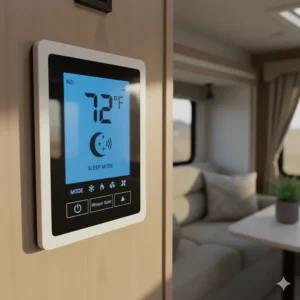
| Energy Efficiency | EER 8-9.5 | EER 10.5-12.5 | Quiet AC: 15-30% savings |
| Installation | Straightforward | Similar complexity | Tie |
| Initial Cost | $400-650 | $650-1,600 | Standard: Lower entry cost |
| Longevity | 8-12 years | 10-15 years | Quiet AC: Better durability |
| Maintenance | Moderate | Low-Moderate | Quiet AC: Fewer issues |
| Comfort Features | Basic | Variable speed, smart controls | Quiet AC: Superior |
The total value proposition clearly favors quiet units despite higher initial costs. Consider this: over a 12-year ownership period, you’ll spend roughly 10,000 hours using your air conditioner (assuming 70 days per year at 12 hours per day). That’s 10,000 hours of either tolerating noise or enjoying peace. The per-hour cost difference works out to about $0.08-0.12, which most RVers consider money well spent.
Quiet AC vs Portable Air Conditioners
Some RVers consider portable air conditioners as alternatives. Let’s examine this option honestly:
Portable AC Pros:
- No roof installation required
- Can move between locations
- Lower installation complexity
- Typically $300-600
Portable AC Cons:
- Extremely inefficient (EER 6-8)
- Requires window venting exhaust
- Takes up valuable floor space
- Noise levels 60-70 dB (often louder than standard RV AC)
- Condensation management challenges
- Cooling capacity limited to 8,000-12,000 BTU
Bottom line: portable units are false economy for permanent RV use. They consume more electricity, provide inferior cooling, and aren’t significantly quieter than quality rooftop units. They might work for occasional camping trips in small trailers, but aren’t serious solutions for regular RV living.
Quiet AC vs Evaporative Coolers
Evaporative coolers (swamp coolers) offer an alternative cooling method that’s extremely quiet and energy-efficient. However, they only work in low-humidity climates:
When evaporative coolers make sense:
- Camping exclusively in desert Southwest (humidity below 30%)
- Off-grid situations with limited power
- Budget constraints (units cost $150-400)
- Minimal cooling needs
When they don’t work:
- Humidity above 40-50% (effectiveness drops dramatically)
- Gulf Coast, Southeast, or Eastern U.S. camping
- Need for precise temperature control
- Monsoon season even in arid regions
According to climate data from the National Weather Service, evaporative cooling is only practical for about 30% of the U.S. during summer months. For most RVers, a proper quiet rv air conditioner remains the only viable solution.
Long-Term Value Proposition
Here’s the perspective I wish someone had shared with me before my first RV air conditioner purchase: the quality difference between budget and premium units compounds over time. A budget unit might save you $500 initially, but:
- Higher electricity costs over 12 years: $200-400 additional
- More frequent repairs: $200-500 additional
- Earlier replacement needed: 3-5 years shorter lifespan
- Daily quality-of-life impact: immeasurable but significant
The RecPro mid-range models represent the sweet spot where you get 80-90% of premium performance at 55-65% of premium pricing. This is why they’re consistently my top recommendation for most RVers.
Case Studies: Real RVers, Real Results 📋
Theory and specifications are helpful, but nothing beats hearing from actual RVers who’ve made the upgrade to a quiet rv air conditioner. I’ve collected these stories from various RV forums, customer reviews, and personal contacts.
Case Study 1: The Full-Time Family
Background: The Martinez family—parents and two school-age children—transitioned to full-time RV living in a 32-foot travel trailer. Their original Coleman unit was so loud that the kids couldn’t do online schoolwork when the AC was running, and family movie nights were nearly impossible during hot weather.
Solution: They upgraded to the RecPro 15K with heat pump during their first summer on the road.
Results:
- Noise reduction allowed successful remote schooling even during afternoon heat
- Energy costs dropped approximately $25 monthly at their typical park
- Heat pump eliminated need for separate propane heating in winter
- Children could sleep during afternoon naps without noise disruption
- Family dinners and activities became comfortable year-round
Investment Analysis:
- Unit cost: $875
- Professional installation: $450
- Total investment: $1,325
- Energy savings: $300 per year
- Payback period: ~4.5 years
- Quality of life improvement: immediate
Mrs. Martinez’s review noted: “The difference is night and day. Our old AC was so loud we’d delay turning it on until we were absolutely miserable. Now we keep it running comfortably all afternoon. It’s like gaining extra living hours in our day.”
Case Study 2: The Boondocking Enthusiast
Background: David, a retired engineer, built an extensive solar power system on his Class C motorhome specifically to enable off-grid camping. However, traditional RV air conditioners drew too much power to run sustainably from his battery bank.
Solution: After extensive research, he installed the Countrymod 12V 10,000 BTU unit paired with 1,200 watts of solar and 600 amp-hours of lithium batteries.
Results:
- Successfully ran AC for 4-6 hours daily during peak heat
- Extended boondocking stays from 3-4 days to 7-10 days
- Eliminated need for generator during daylight hours
- Quiet operation maintained peaceful camping experience
- Total system efficiency allowed him to camp in desert locations previously avoided
Investment Analysis:
- AC unit: $1,350
- Additional solar panels: $800
- Battery expansion: $2,100
- Total system investment: $4,250
- Generator fuel savings: ~$40 per week of boondocking
- Value of extended stay capability: significant but hard to quantify
David’s assessment: “I calculated that I’d need to boondock about 100 weeks to break even on the investment purely from fuel savings. But the real value is freedom—I can now camp where I want, when I want, for as long as I want. That’s priceless.”
Case Study 3: The Weekend Warriors
Background: The Johnsons use their 24-foot travel trailer for weekend camping trips, typically staying at state parks and national forests. They found their old air conditioner so disruptive to the outdoor camping experience that they rarely used it, instead suffering through uncomfortable nights.
Solution: They replaced their original 13.5K unit with the Furrion Chill HE 13.5K black model during routine maintenance.
Results:
- Comfortable sleeping temperatures without noise disruption
- Could leave windows open with AC on low, combining natural and mechanical cooling
- Neighbors no longer complained about noise at quiet campgrounds
- Mrs. Johnson’s heat sensitivity no longer limited camping season
- Black finish matched their modern trailer’s aesthetic
Investment Analysis:
- Unit cost: $925
- DIY installation saved $400
- Total investment: $925
- Usage increase: from 8 weekends per year to 18 weekends
- Value per additional weekend: ~$93
Mr. Johnson commented: “We probably doubled our camping frequency because my wife is finally comfortable. The unit paid for itself in enjoyment during the first year.”
Future Trends in RV Air Conditioning Technology 🚀
The quiet rv air conditioner market continues evolving rapidly. Understanding emerging trends helps you make purchasing decisions that remain relevant for years to come.
Smart Climate Control Integration
The next generation of RV air conditioners features integration with smart home ecosystems. Several manufacturers are developing units that connect to RV management apps, allowing you to:
- Monitor and control temperature remotely before arriving at your RV
- Track energy consumption and optimize settings for efficiency
- Receive maintenance alerts and filter change reminders
- Integrate with weather forecasts to pre-cool during optimal conditions
- Create custom cooling schedules for different camping scenarios
The Furrion brand has already introduced app connectivity in some models, and this feature will likely become standard across product lines within 2-3 years. Research from smart home technology studies indicates that intelligent climate control can reduce energy consumption by an additional 15-25% compared to manual operation.
Heat Pump Technology Becomes Standard
Heat pumps provide both cooling and heating by reversing refrigerant flow. While currently a premium feature, manufacturing costs are declining rapidly. Industry analysts predict that within 3-5 years, heat pump functionality will become standard even in budget models.
This matters because it eliminates the need for separate heating systems (furnaces), simplifying RV systems and reducing overall energy consumption. The RecPro heat pump models demonstrate this trend—you’re getting future-proof technology at today’s mid-range prices.
Variable Refrigerant Flow (VRF) Systems
Commercial HVAC has used VRF technology for years, and it’s beginning to appear in high-end RV applications. VRF systems continuously adjust refrigerant flow to match cooling demands precisely, rather than cycling on and off. This provides:
- Even more precise temperature control
- Further noise reduction (no startup/shutdown cycles)
- Enhanced energy efficiency (20-30% better than current best)
- Longer equipment lifespan (less mechanical stress)
The Furrion Chill Cube’s variable speed technology represents an early step toward full VRF systems. As component costs decrease, expect this technology to migrate to mainstream products.
Improved Refrigerants
Environmental regulations are driving refrigerant evolution. R32 refrigerant, used in some current models, offers better efficiency and lower environmental impact than traditional R410A. The next generation—R454B and R1234yf—will provide even better performance with near-zero global warming potential.
For consumers, this means future units will cool more efficiently using less energy while meeting increasingly strict environmental standards. The transition is already underway, with manufacturers like Furrion leading adoption.
Modular and Expandable Systems
Future RV air conditioning may shift toward modular designs where you can add capacity as needed. Instead of replacing an entire 13.5K BTU unit with a 15K BTU unit, you might add a supplemental module. This approach offers:
- Flexibility for RV modifications and additions
- Easier repairs (replace modules rather than complete units)
- Redundancy (if one module fails, others continue operating)
- Customization for specific cooling zones
While still in early development, several RV component manufacturers are exploring this concept for mid-2020s introduction.
Solar-Optimized AC Systems
As solar power becomes more prevalent in RVs, manufacturers are designing air conditioners specifically optimized for solar operation. Beyond just 12V DC compatibility, these systems feature:
- Intelligent power management that adjusts cooling based on available solar
- Battery health monitoring to prevent over-discharge
- Peak power tracking integration
- Communication with solar charge controllers
The Countrymod 12V represents current solar-optimized technology, but expect significant advancements as battery and solar costs continue declining.
Investment and Purchase Decision Framework 💭
Making the right quiet rv air conditioner purchase requires balancing multiple factors. Here’s a structured framework to guide your decision.
Needs Assessment Questions
Before shopping, answer these questions honestly:
Climate and Usage:
- What’s the hottest weather you’ll camp in?
- How many days per year will you use AC?
- Are you primarily in humid or dry climates?
- Do you also need heating capability?
RV Characteristics:
- What’s your RV’s length and interior square footage?
- How is your RV insulated (good, average, poor)?
- What’s your roof structure and condition?
- Do you have ducted or non-ducted distribution?
Power Availability:
- Will you have shore power, generator, or solar?
- What’s your electrical system’s amp capacity?
- Do you have or want to add solar power?
- How important is energy efficiency?
Noise Tolerance:
- Are you noise-sensitive or just seeking improvement?
- Will you run AC while sleeping?
- Do you work remotely from your RV?
- Are you often in quiet campgrounds with close neighbors?
Budget Reality:
- What’s your total budget including installation?
- Can you DIY install or need professional help?
- What’s your expected ownership period (affects value calculation)?
- Are you willing to invest more for significant noise reduction?
Decision Matrix
Rate each factor’s importance to you (1-5 scale), then score potential units:
| Factor | Your Weight | Budget Unit Score | Mid-Range Score | Premium Score |
|---|---|---|---|---|
| Purchase Price | ___ | 5 | 3 | 1 |
| Noise Level | ___ | 2 | 4 | 5 |
| Energy Efficiency | ___ | 2 | 4 | 5 |
| Features | ___ | 2 | 3 | 5 |
| Reliability | ___ | 3 | 4 | 5 |
| Warranty | ___ | 2 | 3 | 4 |
Multiply your importance weight by each score, then total the results. The highest total indicates your best choice based on your priorities.
Budget Planning Strategies
If the ideal unit exceeds your current budget, consider:
Phased approach: Install a quality mid-range unit now (RecPro 15K), then upgrade in 5-7 years when prices drop and technology improves further.
Financing options: Many RV dealerships and Amazon offer payment plans. A $1,200 unit financed over 12 months at 10% APR costs about $106 monthly—often less than the frustration value of keeping a noisy unit.
DIY installation savings: Professional installation costs $300-600. If you’re even moderately handy, DIY installation can make a premium unit affordable. The Furrion and RecPro brands include detailed instructions suitable for capable DIYers.
Off-season purchase: RV air conditioner prices typically drop 10-20% during fall and winter when demand is low. Planning your purchase for October or November can stretch your budget significantly.
Package deals: Sometimes RV parts suppliers bundle air conditioners with other components (thermostats, surge protectors, covers) at package pricing that reduces overall cost.
Measuring Success: Key Performance Indicators
After installation, how do you know if you made the right choice? Track these metrics:
✅ Noise level achievement: Does the unit operate at or below promised decibel levels?
✅ Cooling effectiveness: Does it maintain your desired temperature during peak heat?
✅ Energy consumption: Compare amp draw and electricity costs to previous unit
✅ Reliability: Has it operated without issues for the warranty period?
✅ Quality of life improvement: Can you quantify better sleep, work productivity, or camping enjoyment?
Most RVers report immediate satisfaction with quality quiet units, with improvement becoming even more apparent after several trips comparing the new experience to previous camping seasons.
🎯 Transform Your RV Experience Today!
→ Don’t spend another uncomfortable night in your RV. The products featured in this guide represent the best quiet rv air conditioner technology available right now. Click on any highlighted unit to check current prices, read detailed reviews, and find the perfect cooling solution for your needs. Your peaceful camping experience is just one upgrade away! 🌟🏕️
Conclusion: Choosing Your Perfect Quiet RV Air Conditioner 🎯
After everything we’ve covered—from decibel ratings and BTU calculations to real-world experiences and future trends—let’s bring this home. Upgrading to a quiet rv air conditioner isn’t just about reducing noise; it’s about fundamentally improving your RV lifestyle.
Think about it: you invested in an RV to experience freedom, adventure, and comfort. A noisy air conditioner undermines all three. It limits where you can comfortably camp, disrupts your daily routines, and creates tension when you should be relaxing. The technology now exists to fix this problem permanently, and the cost difference between suffering through another season with your current unit versus upgrading is smaller than you might think.
If you’re shopping today, here’s my simplified recommendation framework:
Best Overall Value: RecPro RV Air Conditioner 15K with Heat Pump — Delivers exceptional noise reduction, year-round climate control, and proven reliability at a price point most RVers can justify. This is what I’d buy for my own rig if I were purchasing today.
Premium Choice: Furrion Chill Cube 18K BTU Variable Speed — If you want the absolute quietest operation and have the budget for premium technology, this is the pinnacle of RV air conditioning. At 45 decibels on eco mode, it’s genuinely whisper-quiet.
Budget Champion: RecPro RV Air Conditioner 13.5K Non-Ducted — Proves you don’t need to spend $1,500+ to escape noise pollution. For smaller RVs and travelers prioritizing value, this delivers remarkable quietness at an accessible price.
Off-Grid Specialist: Countrymod 12V DC 10,000 BTU — The only real solution for serious boondockers who want air conditioning without running generators. Requires significant electrical infrastructure but enables true freedom.
Upgrade Path: Furrion Chill HE 15.5K BTU Replacement Kit — Perfect if you’re happy with your existing distribution system but desperate to escape the noise. Fastest, easiest upgrade with dramatic results.
The beautiful thing about today’s market is that there’s genuinely no bad choice among quality manufacturers. Even the “budget” options in this guide are light-years ahead of what was available just five years ago. You’re choosing between good, better, and best—not between adequate and inadequate.
Remember that your quiet rv air conditioner will likely serve you for 10-15 years. That’s potentially thousands of camping days, hundreds of nights’ sleep, countless family memories, and immeasurable peace of mind. When you break down the cost over that timeline, even premium units cost mere pennies per day of use.
I’ll leave you with this thought: the best time to upgrade was probably last year. The second-best time is right now, before another sweltering camping season arrives. Your future self—the one sleeping peacefully on a hot July night, comfortable and undisturbed—will thank you for making this investment.
Safe travels, stay cool, and enjoy the silence.
🏆 Ready to Make the Upgrade?
→ Your perfect quiet rv air conditioner is waiting! Browse the highlighted options above, compare features and pricing, and transform your RV into the peaceful sanctuary it should be. Thousands of happy RVers have already made the switch—join them today and experience the difference that genuine quiet makes! 🚐💨

Frequently Asked Questions ❓
❓ How long does a quiet rv air conditioner typically last with proper maintenance?
❓ Can I install a quiet rv air conditioner myself without professional help?
❓ Will a quiet rv air conditioner work with my existing thermostat and ducting system?
❓ What's the actual noise difference between a 50 dB and 65 dB air conditioner?
❓ Do quiet rv air conditioner units require more electrical power than standard models?
Recommended for You
- 7 Best Portable Air Conditioner in RV Solutions for Ultimate Comfort in 2025
- Air Conditioner Filters for RV: 7 Game-Changing Solutions to Breathe Cleaner in 2025
- 8 Best RV Air Conditioners Rooftop Units for Ultimate Comfort in 2025
Disclaimer: This article contains affiliate links. If you purchase products through these links, we may earn a small commission at no additional cost to you.
✨ Found this helpful? Share it with your friends! 💬🤗
