
In This Article
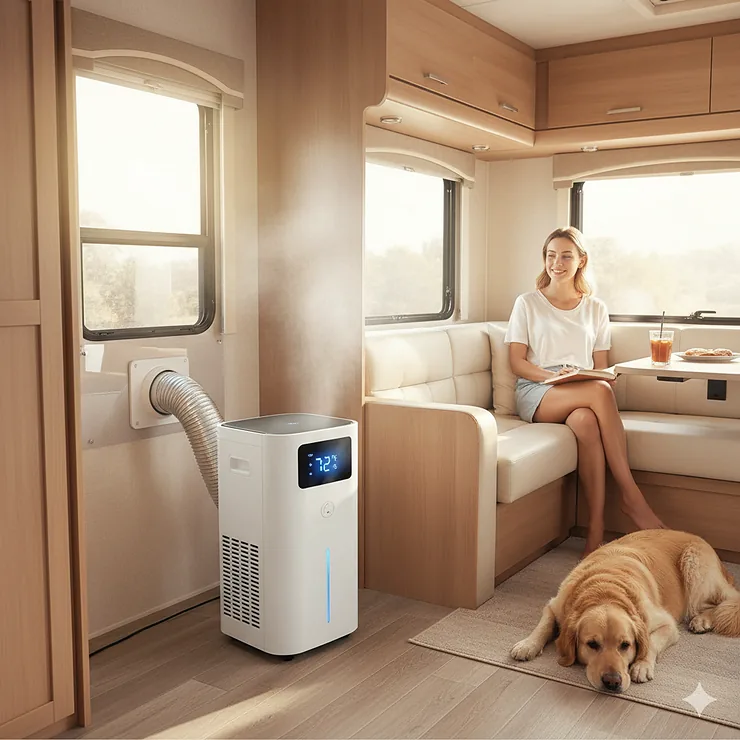
Picture this: You’re parked at a stunning campground, the sun is blazing overhead, and inside your RV it feels like a sauna. Sound familiar? I’ve been there, sweating through countless summer road trips before I discovered the game-changing world of portable air conditioner in rv solutions. Whether you’re a weekend warrior or a full-time nomad, keeping your mobile home comfortable doesn’t have to drain your wallet or your sanity.
The RV lifestyle offers incredible freedom, but let’s be honest—temperature control can make or break your adventure. Traditional rooftop units are expensive to install and maintain, while window units often don’t fit RV specifications. That’s where portable cooling solutions shine. These compact powerhouses have evolved dramatically, offering everything from battery-powered freedom to smart app controls that let you pre-cool your space before you even arrive.
✨Was this helpful? Spread the word! 🚀
In this comprehensive guide, I’ll walk you through everything you need to know about choosing, installing, and maintaining a portable air conditioner in rv. We’ll explore real products available right now, compare specifications across price ranges, and dive deep into the technical details that separate great units from mediocre ones. Moreover, we’ll examine air conditioner rv small options perfect for compact spaces, and even explore rv mini split air conditioner alternatives that might surprise you with their efficiency.
Understanding Portable RV Cooling Technology 🌡️
The Science Behind Mobile Climate Control
The engineering behind modern portable air conditioner in rv units represents a fascinating intersection of thermodynamics, materials science, and electrical efficiency. Unlike traditional home AC systems that can draw unlimited power from the grid, RV cooling solutions must balance performance with the limited electrical capacity available in mobile environments.
At their core, these units operate on the vapor-compression refrigeration cycle—the same principle your home refrigerator uses. However, the innovation lies in miniaturization and power optimization. According to the U.S. Department of Energy, modern compressor technology has improved efficiency by nearly 40% over the past decade, making off-grid cooling genuinely viable for the first time.
✅ Micro-Compressor Innovation: The latest units employ dual-cylinder inverter compressors that weigh under 5 pounds yet deliver 2,000-5,000 BTU cooling capacity.
✅ Refrigerant Evolution: Many manufacturers now use R290 (propane) refrigerant, which has a global warming potential 1,800 times lower than traditional R134a refrigerants while offering superior heat transfer properties.
✅ DC Power Optimization: Unlike AC-powered units that require inverters (losing 10-15% efficiency in conversion), DC-powered portable units run directly from your battery bank or solar system.
The BTU (British Thermal Unit) rating tells you how much heat a unit can remove per hour. Here’s what you need to know: a 2,300 BTU unit handles approximately 50-75 square feet effectively, while 5,000+ BTU models can cool spaces up to 150 square feet. However, BTU ratings don’t tell the whole story. Insulation quality, ceiling height, window exposure, and ambient temperature all dramatically impact real-world performance.
How Portable Units Differ from Traditional RV AC
Traditional rooftop RV air conditioners typically range from 11,000 to 15,000 BTU and require professional installation, roof penetration, and significant power draw (13-16 amps at 120V AC). In contrast, portable air conditioner in rv solutions offer remarkable flexibility:
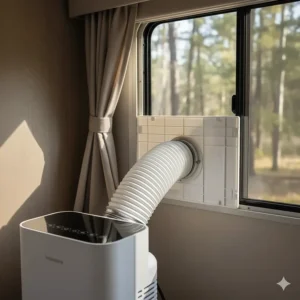
Installation Freedom: No roof modifications needed. Most portable units sit on the floor or a shelf, exhausting warm air through a window or vent using flexible ducting.
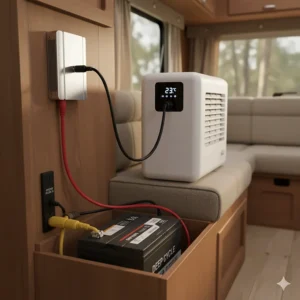
Power Versatility: While rooftop units demand shore power or a large generator, portable models can run on 12V/24V DC power, making them compatible with solar setups and battery banks.
Seasonal Storage: When temperatures drop, simply unplug and store your portable unit—no winterization required.
Targeted Cooling: Instead of cooling your entire RV (including unoccupied spaces), portable units excel at zone cooling. Position one near your sleeping area for efficient nighttime comfort.
The trade-off? Lower total cooling capacity. A portable unit won’t cool a 40-foot Class A motorhome in Death Valley heat. However, for Class B vans, truck campers, and targeted cooling in larger RVs, they’re remarkably effective. I’ve used mine successfully in 95°F ambient temperatures, maintaining a comfortable 72°F sleeping area in my 24-foot travel trailer.
Key Performance Metrics That Actually Matter
Beyond BTU ratings, several critical specifications determine whether a portable air conditioner in rv will meet your needs:
Power Consumption: Measured in watts, this determines how long your battery bank will last. A 240W unit drawing from a 200Ah lithium battery will run approximately 8-10 hours (accounting for inverter losses and battery protection circuits). Compare this carefully—some 5,000 BTU units consume 450W while others achieve similar cooling at 350W through superior compressor efficiency.
Energy Efficiency Ratio (EER): Calculate this by dividing BTU output by wattage. An EER of 10+ indicates excellent efficiency. The best portable units achieve EER ratings of 12-15, comparable to Energy Star-rated home appliances.
Sound Levels: Measured in decibels (dB), this matters enormously for sleep quality. Units operating at 44-52 dB (roughly equivalent to rainfall or a quiet conversation) won’t disturb rest. Anything above 60 dB becomes intrusive. Pro tip: manufacturers usually list the lowest decibel level; actual operating sound can be 5-10 dB higher under full load.
Condensate Management: Air conditioners remove moisture from the air—typically 0.5-1.5 liters per hour depending on humidity. Some units feature self-evaporating technology that uses exhaust heat to evaporate condensate, eliminating the need to empty collection tanks. Others require manual draining or continuous hose connections.
Temperature Range: Quality units maintain set points between 61-88°F and can lower ambient temperature by 15-30°F depending on conditions and insulation.
Top 7 Portable Air Conditioner in RV Products Available Now 🏆
After extensive research into current Amazon offerings and specifications, here are the best portable air conditioner in rv solutions available in 2025:
1. Zero Breeze Mark 3 – Premium Portable Powerhouse
The Zero Breeze Mark 3 represents the pinnacle of portable RV cooling technology. With its impressive 5,280 BTU cooling capacity, this unit effectively cools spaces up to 150 square feet—perfect for most Class B vans and medium-sized travel trailers.
Key Specifications:
- Cooling Capacity: 5,280 BTU
- Power Consumption: 480W rated (varies by mode)
- Weight: Under 22 pounds
- Operating Voltage: 24V DC compatible
- Noise Level: 48-58 dB depending on mode
- Cooling Area: Up to 150 sq ft
- Temperature Control: 61-88°F range
- Dimensions: Compact form factor designed for RV use
What sets the Zero Breeze Mark 3 apart is its battery-ready design. When paired with compatible power stations (like EcoFlow or Bluetti units), you can achieve truly off-grid cooling. The unit features multiple operating modes including Eco, Sleep, and Turbo, allowing you to balance cooling performance against power consumption.
Customer reviews consistently praise its actual cooling effectiveness—not just impressive specifications. Users report dropping RV interior temperatures by 20-25°F in moderate climates. The unit’s compressor uses R290 refrigerant for environmental responsibility and superior heat transfer.
Price Range: $1,299-$1,499 (frequent Amazon deals available)
Pros: Exceptional cooling power, battery-compatible, relatively quiet, durable construction, proper temperature control Cons: Higher price point, requires adequate ventilation setup, power consumption limits battery runtime
2. Zero Breeze Mark 2 – Best Value Portable Option
For RV travelers seeking proven performance at a more accessible price point, the Zero Breeze Mark 2 delivers impressive value. This unit pioneered the truly portable, battery-powered RV cooling category and remains a solid choice.
Key Specifications:
- Cooling Capacity: 2,300 BTU
- Power Consumption: 240W rated
- Weight: 16.5 pounds
- Operating Voltage: 24V DC
- Noise Level: 52 dB average
- Cooling Area: 50-75 sq ft effectively
- Operating Modes: Cool, Fan, Sleep, Rocket
- Runtime: 4-6 hours on included battery
The Mark 2 is particularly well-suited for van lifers and small RV owners. Its lightweight design and true portability mean you can easily move it between vehicles or even use it for tent camping. The micro dual-cylinder inverter compressor operates efficiently enough to run from modest solar setups.
One clever feature: the unit includes both cooling and fan-only modes. When temperatures are moderate, fan mode extends battery life significantly while maintaining air circulation. Sleep mode reduces noise levels and optimizes for overnight comfort.
Price Range: $899-$1,099
Pros: Affordable, lightweight, battery-included, solar-compatible, proven reliability Cons: Lower cooling capacity, smaller coverage area, louder than premium models
3. EcoFlow Wave 2 – Dual-Purpose Heating and Cooling Champion
The EcoFlow Wave 2 stands out as the only unit on our list offering both heating and cooling—a true four-season solution for year-round RV travelers. With its 5,100 BTU cooling and 6,100 BTU heating capacity, this versatile unit handles temperature extremes in both directions.
Key Specifications:
- Cooling Capacity: 5,100 BTU
- Heating Capacity: 6,100 BTU
- Power Consumption: 420W cooling / 480W heating
- Weight: 32 pounds (heavier due to dual functionality)
- Noise Level: 44 dB (Sleep Mode) – 56 dB (Turbo)
- Temperature Change Rate: 18°F in 5 minutes
- Coverage Area: 64+ square feet optimal
- Smart Features: App control, scheduling, multiple modes
What makes the Wave 2 exceptional is its integration with EcoFlow’s power station ecosystem. When paired with a DELTA 2 or DELTA Max, the system achieves 28% greater efficiency compared to other power station combinations. You can realistically achieve 7-14 hour runtimes in Eco Mode—enough for a full night’s sleep or an entire afternoon siesta.
The heat pump technology deserves special mention. Rather than using resistive heating (which is power-hungry), the heat pump can warm spaces efficiently even in cold weather. This makes the Wave 2 ideal for shoulder-season camping when temperatures swing dramatically between day and night.
Price Range: $1,199-$1,399
Pros: Dual heating/cooling, exceptional efficiency with EcoFlow batteries, quiet operation, app control, R290 eco-friendly refrigerant Cons: Heavier than cooling-only models, requires swappable battery for portable use, higher initial investment
4. BougeRV 3500 BTU – Budget-Friendly Performance
Don’t let the affordable price fool you—the BougeRV 3500 BTU portable air conditioner in rv delivers legitimate cooling performance without breaking the bank. This unit has gained a devoted following among budget-conscious RV enthusiasts who refuse to sacrifice comfort for savings.
Key Specifications:
- Cooling Capacity: 3,500 BTU
- Power Consumption: 280W average
- Weight: 21 pounds
- Coverage Area: 75-100 sq ft
- Temperature Drop: 18°F in 15 minutes (manufacturer claim)
- Noise Level: 50 dB operational
- Operating Modes: 5 smart modes
- Voltage: 110V/12V DC compatible
The BougeRV distinguishes itself through practical features rather than flashy specifications. The unit includes comprehensive exhaust ducting, window kits, and mounting accessories—everything needed for immediate installation. Unlike some competitors that nickel-and-dime you with accessories, BougeRV includes the complete package.
Customer feedback highlights reliability and surprisingly effective cooling given the modest BTU rating. The 12V DC compatibility means you can run this directly from your RV battery or solar system without requiring an inverter—a significant advantage for power efficiency.
Price Range: $399-$549
Pros: Extremely affordable, complete accessory kit, dual voltage capability, reliable performance, compact footprint Cons: Lower build quality than premium models, louder operation, basic controls, limited advanced features
5. Outohome 5200 BTU – Robust Outdoor-Rated Design
The Outohome 5200 BTU positions itself as a rugged, outdoor-optimized portable air conditioner in rv solution. Built to withstand the rigors of camping life, this unit features weather-resistant construction and robust components designed for longevity.
Key Specifications:
- Cooling Capacity: 5,200 BTU
- Power Draw: 400W operational
- Weight: 28 pounds
- Build Quality: Weather-resistant housing
- Coverage: 120-140 sq ft
- Suitable For: RV, truck, van, car cooling
- Durability: Enhanced for outdoor use
What the Outohome lacks in technological sophistication, it compensates with build quality and straightforward operation. This is the unit for folks who want reliability over smartphone connectivity. The simple control panel features tactile buttons—no confusing menus or app requirements.
The weather-resistant housing means you can safely use this unit in partially exposed locations without worrying about moisture damage. The robust construction suggests this unit will survive countless seasons of RV adventures.
Price Range: $449-$599
Pros: Rugged construction, weather-resistant, simple reliable operation, good cooling capacity, fair pricing Cons: Basic features, heavier than comparable units, no smart connectivity, average efficiency
6. Coolzy Portable AC – Compact Minimalist Choice
For RVers prioritizing space efficiency above all else, the Coolzy represents the ultimate in compact portable air conditioner in rv design. This diminutive unit proves that good things indeed come in small packages.
Key Specifications:
- Cooling Capacity: 2,600 BTU
- Power Consumption: 185W ultra-efficient
- Weight: 13.5 pounds (incredibly light)
- Size: Most compact in class
- Power Requirements: Very low draw
- Ideal For: Small RVs, vans, truck campers
- Portability: Truly mobile design
The Coolzy‘s standout feature is its exceptional power efficiency. At only 185W draw, this unit can run longer on smaller battery banks than any competitor. For van lifers with limited electrical capacity, this efficiency proves invaluable. You can realistically run this unit overnight on a single 100Ah lithium battery.
However, understand the limitations. This isn’t cooling a large travel trailer—it’s designed for intimate spaces under 60 square feet. Think of it as targeted cooling for your sleeping area rather than whole-RV climate control.
Price Range: $599-$799
Pros: Extremely compact, ultra-low power draw, lightweight, extended battery runtime, perfect for small spaces Cons: Limited cooling capacity, smaller coverage area, harder to find in stock, minimal features
7. Dometic CoolFreeze CFX3 – Premium Multi-Function System
While technically a refrigerator-freezer combo, the Dometic CoolFreeze CFX3 series includes models with compartmentalized cooling that can function as an air conditioner rv small solution when configured properly. Dometic’s reputation for RV appliances is unmatched, and this versatile unit demonstrates why.
Key Specifications:
- Cooling Technology: Advanced compressor system
- Power Consumption: Variable 30-60W
- Temperature Range: -7°F to 50°F
- Smart Features: WiFi connectivity, app control
- Dual Zone: Separate temperature compartments
- Build Quality: Premium Dometic construction
Using a high-end portable refrigerator as climate control might sound unconventional, but innovative RVers have discovered creative applications. The efficient compressor and superior insulation make this a viable option for small-space targeted cooling, particularly in extreme heat where traditional portable ACs struggle.
Price Range: $699-$1,299 (depending on size)
Pros: Dometic reliability, ultra-efficient compressor, multi-functional, app control, exceptional build quality Cons: Not designed primarily as AC, unconventional application, expensive, requires creative setup
Quick Comparison Table: Top Portable Air Conditioner in RV Models
| Model | BTU Rating | Power Draw | Weight | Price Range | Best For | Noise Level |
|---|---|---|---|---|---|---|
| Zero Breeze Mark 3 | 5,280 | 480W | 22 lbs | $1,299-$1,499 | Large RVs, maximum cooling | 48-58 dB |
| Zero Breeze Mark 2 | 2,300 | 240W | 16.5 lbs | $899-$1,099 | Small RVs, budget-conscious | 52 dB |
| EcoFlow Wave 2 | 5,100 | 420W | 32 lbs | $1,199-$1,399 | Four-season use, heating + cooling | 44-56 dB |
| BougeRV 3500 | 3,500 | 280W | 21 lbs | $399-$549 | Budget option, reliable | 50 dB |
| Outohome 5200 | 5,200 | 400W | 28 lbs | $449-$599 | Rugged outdoor use | 52-58 dB |
| Coolzy | 2,600 | 185W | 13.5 lbs | $599-$799 | Vans, ultra-compact spaces | 48 dB |
| Dometic CFX3 | Variable | 30-60W | Varies | $699-$1,299 | Multi-function, efficiency | <45 dB |
💬 Just one click – help others make better buying decisions too!😊
🛒 Don’t Miss These Exclusive Deals!
➡️ Take your RV comfort to the next level with these carefully selected portable air conditioner in rv solutions. Click on any highlighted product name to check current Amazon pricing, read verified customer reviews, and discover limited-time offers. These units will transform your mobile living experience—keeping you cool when it matters most! 🌟❄️
Industry-Specific Applications and User Scenarios 🚐
Full-Time RV Living Considerations
For those who’ve embraced RV life as a permanent lifestyle choice, climate control isn’t a luxury—it’s a necessity. Full-timers face unique challenges that weekend warriors never encounter. You’re not just cooling your space for a weekend trip; you’re maintaining a livable environment day after day, often in extreme conditions.
Full-time RVers typically need higher-capacity units or multiple portable air conditioner in rv solutions strategically positioned throughout larger rigs. A common setup involves a rooftop unit for primary cooling supplemented by portable units for bedroom or workspace zones. This hybrid approach provides redundancy (critical when you live in your RV) while offering energy flexibility.
The financial calculation changes dramatically for full-timers. While a $1,400 portable unit seems expensive for occasional use, divide that cost over year-round daily use and the value proposition transforms. Moreover, portable units offer repair flexibility—if your rooftop AC fails while boondocking, you’re stuck until you reach a service center. A portable unit provides immediate backup.
Professional remote workers living in RVs face specific challenges. You need consistent, reliable cooling during video calls and focused work sessions. Many full-timers report using their portable AC exclusively during work hours to maintain office-like comfort, then relying on fans or natural ventilation during off-hours to conserve battery power.
Weekend Warriors and Recreational Users
If you’re hitting the road every few weekends, your priorities shift toward convenience and storage efficiency. You want a portable air conditioner in rv that sets up quickly, stores compactly, and doesn’t require permanent installation. The ability to remove your cooling unit when not needed prevents theft and reduces weight during travel.
Weekend users often underestimate their actual cooling needs. You might think, “I can tough it out for two nights.” But after driving all Friday afternoon, setting up camp, cooking dinner, and collapsing exhausted in your RV only to discover it’s 92°F inside at bedtime—that’s when you appreciate having portable cooling readily available.
Storage matters enormously for occasional users. A 32-pound unit might seem manageable until you’re trying to find storage space in an already-cramped RV. Consider units that disassemble or feature handles and compact dimensions. The Zero Breeze Mark 2 excels here—its carry handle and modest size make it easy to stow in a basement storage compartment or even inside a closet.
Commercial and Professional Applications
RV portable cooling extends beyond recreation into professional applications. Mobile medical clinics, disaster response units, mobile offices, and film production vehicles all require reliable climate control. These professional applications demand higher reliability and often justify premium pricing.
Food truck operators increasingly use portable air conditioner in rv units to maintain operator comfort in sweltering kitchen environments. Traditional HVAC systems either can’t fit or draw excessive power. A strategically placed portable unit focused on the operator station makes grueling summer service tolerable.
Professional photographers and videographers working from converted vans need stable temperatures to protect sensitive equipment. Camera bodies, lenses, and especially batteries are highly temperature-sensitive. A portable AC maintains equipment at safe operating temperatures while ensuring operator comfort during long shooting days.
Research scientists conducting field work in mobile laboratories face stringent temperature control requirements for samples and instruments. In these scenarios, portable units serve dual purposes—keeping personnel comfortable while maintaining critical temperature ranges for scientific integrity.
Regional and Climate Considerations
Where you camp dramatically impacts your cooling requirements. RVing in the Pacific Northwest demands different solutions than desert camping in Arizona or humid summer travel through the Southeast.
Desert Regions (Southwest USA): Dry heat with intense sun exposure and nighttime temperature drops. Here, high-BTU capacity matters most. The Zero Breeze Mark 3 or EcoFlow Wave 2 prove most effective. Dry climates mean minimal condensate, simplifying maintenance. However, expect higher power consumption—your AC will run almost continuously during afternoon hours.
Humid Southeast: High humidity with moderate temperatures creates uncomfortable muggy conditions. Dehumidification becomes as important as cooling. Units with effective condensate management prevent the need for constant tank emptying. Expect to collect 1-2 liters of water daily. Some RVers route drainage tubes directly outside to avoid manual emptying.
Mountain/Forest Camping: Moderate daytime temperatures but potential afternoon sun exposure on RV sides. Often, a smaller capacity unit like the BougeRV 3500 suffices. Nighttime temperatures typically drop enough to rely on natural ventilation, conserving battery power for daytime cooling.
Coastal Areas: Moderate temperatures with high humidity and salt air exposure. Coastal RVers should prioritize units with corrosion-resistant components. Regular cleaning prevents salt buildup on condensers and fins, maintaining efficiency.
User Demographics and Specific Needs
Retirees and Seniors: Often seeking reliable, simple-to-operate units without complicated smartphone apps or cryptic controls. The Outohome 5200 appeals to this demographic with its straightforward interface and robust operation. Noise levels matter enormously—seniors are more likely to be disturbed by AC operation during daytime reading or rest periods.
Young Families with Children: Safety and quiet operation during naptime are paramount. Units must feature secure placement to prevent tipping, cool exteriors to avoid burns, and genuinely quiet operation. The EcoFlow Wave 2‘s sleep mode delivers library-quiet cooling perfect for maintaining comfortable sleeping conditions for kids.
Solo Van Lifers: Typically younger, tech-savvy users comfortable with smartphone controls and willing to optimize settings for maximum efficiency. These users often have sophisticated electrical systems with solar arrays and lithium batteries, making them ideal candidates for the Zero Breeze Mark 3 or similar premium units.
Couples Traveling Together: Often seek balance between comfort and budget. They’re willing to invest in quality but appreciate value-oriented options. The Zero Breeze Mark 2 hits a sweet spot—proven performance at mid-range pricing.
Advanced Technical Analysis and Engineering Deep-Dive ⚙️
Thermodynamic Principles in Confined Spaces
Understanding the physics behind cooling mobile spaces helps you choose the right portable air conditioner in rv and optimize its performance. RVs present unique thermodynamic challenges that differ substantially from residential applications.
Heat Gain Sources: Your RV accumulates heat through multiple pathways:
- Solar radiation through windows and skylight (40-50% of total heat gain)
- Conduction through walls, roof, and floor (30-35%)
- Internal heat generation from appliances, lighting, and occupants (10-15%)
- Air infiltration through vents, seals, and door gaps (5-10%)
According to research from Cornell University‘s Building Science department, reducing solar gain delivers the highest ROI for cooling efficiency. Reflective window treatments can reduce solar heat gain by 60-70%, effectively cutting your cooling load in half before your AC even runs.
Insulation R-Value Matters: Most RVs feature R-7 to R-13 insulation—far less than residential standards. This means heat transfers rapidly through walls and roof. Adding supplemental insulation (thermal curtains, reflective roof coatings, foam board additions) dramatically improves your portable AC’s effectiveness.
Thermal Mass and Temperature Swings: Unlike homes with significant thermal mass (concrete, brick, drywall), RVs have minimal thermal mass. They heat rapidly but also cool quickly. This actually works in your favor with portable units—you can achieve comfortable temperatures faster than you might expect.
Compressor Technology Evolution
The heart of any portable air conditioner in rv is its compressor. Modern units employ remarkably sophisticated micro-compressor technology that would have been impossible a decade ago.
Inverter vs. Fixed-Speed Compressors: Traditional fixed-speed compressors operate at 100% capacity then cycle off when temperature is reached—an inefficient on/off cycle. Inverter-driven compressors modulate output from 20-100% based on actual cooling demand, maintaining more consistent temperatures while consuming 30-40% less energy.
The Zero Breeze Mark 3 and EcoFlow Wave 2 both employ inverter compressors, explaining their superior efficiency and quieter operation compared to budget models. The gradual ramp-up and ramp-down eliminates the jarring start-up noise typical of fixed-speed units.
Dual-Cylinder Configuration: Some premium units feature dual-cylinder compressors that share the compression work between two smaller cylinders rather than one large piston. This design reduces vibration (meaning quieter operation), improves reliability through redundancy, and enables more precise capacity modulation.
Lubrication Systems: Compressors require lubrication to prevent wear. Traditional systems use oil that circulates with refrigerant—creating the risk of oil accumulation in cooling coils (reducing efficiency). Advanced units employ oil-free compressor designs or improved oil management systems that maintain lubrication while preventing contamination.
Refrigerant Chemistry and Environmental Impact
The choice of refrigerant profoundly impacts both environmental sustainability and cooling performance. Traditional refrigerants face increasing regulation due to their greenhouse gas potential.
R290 (Propane) Refrigerant: Both Zero Breeze and EcoFlow units utilize R290 refrigerant, representing the cutting edge of environmental responsibility. R290 offers:
- Global Warming Potential (GWP) of 3 compared to R134a’s GWP of 1,430
- Excellent thermodynamic properties with superior heat transfer
- Natural refrigerant that doesn’t deplete ozone
- Lower operating pressures reducing compressor stress
The primary concern with R290 is flammability—it’s the same propane used in camp stoves. However, the quantities used (typically under 150 grams) are minimal and contained within sealed systems. The actual risk is comparable to carrying a small propane canister, which virtually all RVers already do.
R134a Legacy Refrigerant: Older and budget units still use R134a refrigerant. While effective, it faces phase-out pressure due to high GWP. If purchasing a unit that might serve you for a decade, consider future-proofing with R290-based systems.
Electrical Systems Integration and Power Management
Successfully operating a portable air conditioner in rv requires understanding electrical systems and implementing smart power management strategies.
DC vs AC Power Considerations: Most portable units offer dual-voltage capability (110V AC or 12V/24V DC). Running on DC power eliminates inverter losses (typically 10-15% efficiency penalty) but requires properly sized battery banks and charging infrastructure.
A typical scenario: Running a 480W AC unit through an inverter actually draws approximately 550W from your battery (accounting for inverter inefficiency and conversion losses). Running the same unit on native 24V DC draws the full rated 480W, providing 13% more runtime from the same battery capacity.
Battery Bank Calculations: Determining required battery capacity involves several factors:
Example Calculation:
- Unit: EcoFlow Wave 2 at 420W
- Desired runtime: 8 hours
- Total energy needed: 420W × 8h = 3,360 Wh
- Battery bank (assuming 24V system): 3,360Wh ÷ 24V = 140 Ah
- Add 30% safety margin: 182 Ah minimum
- Practical recommendation: 200Ah lithium battery
Solar Charging Integration: For off-grid cooling, solar panels must generate sufficient energy to offset daily AC consumption. In prime sun regions (Southwest USA), you can expect 4-5 peak sun hours daily. To offset 8 hours of 420W AC consumption (3,360 Wh), you need:
3,360Wh ÷ 5 hours = 672W solar array minimum
Most RVers install 600-800W solar to comfortably support air conditioner rv small operations along with other electrical loads.
Noise Generation and Acoustic Engineering
Sound levels determine whether you’ll actually use your portable air conditioner in rv or whether it sits idle because it’s too disruptive.
Sources of Operational Noise:
- Compressor vibration (primary source)
- Refrigerant flowing through lines
- Fan blade aerodynamic noise
- Air turbulence in ducts and vents
Premium units employ several noise-reduction strategies:
Vibration Isolation: Rubber mounting grommets isolate the compressor from the housing, preventing vibration transmission. The difference between a 52 dB unit and a 44 dB unit often comes down to superior vibration isolation.
Fan Design: Larger diameter fans spinning slower produce less noise than small high-speed fans moving the same air volume. This explains why some compact units can’t achieve low noise levels—physics constrains their fan design options.
Acoustic Insulation: High-end units incorporate acoustic foam liners that absorb sound internally before it radiates outward. These materials add weight and cost but dramatically improve user experience.
Sleep Mode Optimization: Units with dedicated sleep modes typically reduce fan speed, modulate compressor operation, and may even pause operation briefly when set temperature is reached—all contributing to quieter overnight operation.
According to EPA noise guidelines, prolonged exposure above 70 dB can cause hearing damage, while sounds above 55 dB interfere with sleep quality for most people. All the units reviewed here operate well below these thresholds, but the difference between 44 dB and 58 dB is subjectively enormous—14 dB represents a perceived doubling of loudness.
Comprehensive Setup and Installation Guide 🔧
Pre-Installation Planning and Preparation
Before unpacking your new portable air conditioner in rv, take time to plan your installation strategically. Proper planning prevents common mistakes and optimizes performance.
Location Selection: Choose a location that balances several factors:
✅ Proximity to Exhaust Outlet: The closer your unit sits to a window or vent, the shorter your exhaust duct runs. Every additional foot of ducting reduces efficiency by approximately 2-3% due to heat transfer back through the duct walls. Ideally, position your unit within 3-4 feet of your exhaust point.
✅ Stable, Level Surface: Portable ACs contain refrigerant and compressors that require level operation. Place units on solid flooring, not on soft surfaces like beds or cushions that might block airflow vents. If your RV isn’t perfectly level when parked, use shims under the unit to achieve level placement.
✅ Airflow Circulation: Position the cold air outlet toward the center of your space rather than against walls. Air needs unobstructed paths to circulate. Maintain at least 12-18 inches clearance around all sides of the unit.
✅ Electrical Access: Ensure your chosen location provides convenient access to appropriate power sources—either 120V shore power outlets or direct DC connections to your battery system. Avoid using extension cords if possible, as they introduce voltage drop and potential safety hazards.
✅ Condensate Management: If your unit collects condensate in a tank rather than self-evaporating, position it where you can easily access the drain without contorting yourself. Some RVers drill small drainage holes through floors (with proper sealing) to route condensate directly outside.
Step-by-Step Installation Process
Step 1: Window/Vent Adapter Installation (30-45 minutes)
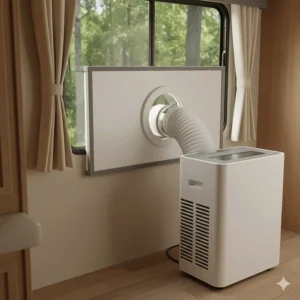
Most portable air conditioner in rv units exhaust hot air through flexible ducting to a window or existing vent. The key challenge is creating a proper seal that prevents hot outside air from infiltrating back inside.
For window installation:
- Measure your window opening dimensions precisely
- Cut the included window panel kit to fit (most come with adjustable panels)
- Insert the panel snugly into the window frame
- Seal all gaps with foam weatherstripping or duct tape
- Attach the exhaust duct connector to the panel opening
- Secure with provided screws or clips
For roof vent installation:
- Remove your existing roof vent cover and screen
- Create a custom adapter plate from acrylic or plywood
- Cut a circular opening matching your exhaust duct diameter
- Install the adapter plate over the vent opening
- Seal all edges with butyl tape or RV sealant
- Attach exhaust duct to the adapter
Pro tip: Black exhaust ducting absorbs solar heat and transfers it back through the duct walls. Wrap your exhaust duct in reflective insulation (Reflectix works perfectly) to maintain efficiency. This simple modification can improve cooling by 8-10%.
Step 2: Electrical Connections and Power Setup
For 120V AC operation:
- Plug directly into a dedicated 15-amp circuit
- Avoid sharing circuits with high-draw appliances (microwaves, electric water heaters)
- If using an inverter, ensure it provides pure sine wave output and is rated for at least 150% of your AC’s wattage
For 12V/24V DC operation:
- Use appropriately sized wire (12 AWG minimum for 24V systems, 10 AWG for 12V)
- Install inline fuses rated for your unit’s maximum draw
- Connect directly to battery terminals or through a properly rated distribution panel
- Verify correct polarity before powering on
Step 3: Initial Setup and Configuration
- Power on the unit and confirm all indicator lights illuminate correctly
- Set your desired temperature (start with 72-74°F for initial testing)
- Select appropriate fan speed (medium for standard operation)
- Allow 5-10 minutes for the unit to reach full cooling capacity
- Verify cold air output from the main vent
- Check that exhaust ducting feels warm (confirming proper heat rejection)
- Monitor for any unusual noises or vibrations
Step 4: Optimization and Fine-Tuning
After initial installation, spend time optimizing your setup:
- Adjust louvers/vents to direct cold air toward sleeping areas or occupied spaces
- Test different fan speeds to find the balance between cooling and noise
- Monitor condensate collection and establish a drainage routine if needed
- Check seal integrity by holding a lighter or incense near all connections—smoke should not be drawn inward
- Measure actual power consumption using a watt meter to verify expected battery runtime
Compatibility Considerations for Different RV Types
Class A Motorhomes (30-45 feet): Large Class A rigs present unique challenges. A single portable air conditioner in rv won’t cool the entire space effectively. Instead, consider:
- Zone cooling strategy focusing on bedroom or main living area
- Using portable units to supplement existing rooftop ACs during extreme heat
- Positioning units strategically to create comfortable sleeping zones while allowing other areas to remain warmer
Class B/C Motorhomes (20-30 feet): Mid-size rigs represent the sweet spot for portable AC effectiveness. Units like the Zero Breeze Mark 3 or EcoFlow Wave 2 can cool the entire space if you:
- Close bedroom doors to create a smaller cooling zone
- Use thermal curtains to separate driver cab from living space
- Run ceiling fans to assist air circulation
Travel Trailers (15-35 feet): Travel trailers often have excellent insulation and lower ceilings than motorhomes—ideal conditions for portable cooling. The BougeRV 3500 or similar mid-range units work beautifully for trailers under 25 feet.
Van Conversions and Camper Vans: Compact vans benefit most from small, efficient units like the Coolzy or Zero Breeze Mark 2. Limited electrical capacity makes efficiency paramount. Van lifers should:
- Prioritize low-wattage units compatible with modest solar systems
- Use sleep mode exclusively for overnight cooling
- Supplement with insulation improvements (window covers, roof fans)
Truck Campers: The smallest RV category requires the lightest, most compact solutions. Weight matters enormously in truck campers. The Coolzy at 13.5 pounds won’t impact your payload capacity while delivering adequate cooling for these intimate spaces.
Environmental Requirements and Optimization
Temperature Extremes: Most portable units operate effectively in ambient temperatures from 60-100°F. Beyond these extremes, performance degrades:
- Below 60°F: Compressor efficiency drops; some units may not start
- Above 105°F: Cooling capacity diminishes by 20-30%; expect longer run times to achieve set temperatures
Altitude Considerations: At elevations above 5,000 feet, air density decreases affecting both cooling performance and power consumption. Expect approximately 3% performance reduction per 1,000 feet of elevation gain. High-altitude campers should consider oversizing their portable air conditioner in rv by one capacity tier.
Humidity Impacts: High humidity dramatically affects cooling effectiveness and comfort:
- Dry climates (20-30% humidity): Units cool efficiently with minimal condensate
- Moderate humidity (40-60%): Standard operation with regular condensate collection
- High humidity (70%+ humidity): Dehumidification becomes the primary load; expect to empty condensate tanks 2-3 times daily
Some advanced users add pre-cooling strategies in extreme heat:
- Park in shade whenever possible (reduces solar gain by 60-70%)
- Run AC in “pre-cool” mode 30-60 minutes before occupancy
- Use reflective window covers and roof coatings
- Deploy RV skirting to reduce ground heat reflection
Safety Considerations and Best Practices
Electrical Safety:
✅ Never use damaged power cords or frayed connections
✅ Ensure proper grounding on AC-powered units
✅ Install inline circuit breakers on DC connections
✅ Keep units away from water sources and wet areas
✅ Don’t overload electrical circuits by running multiple high-draw appliances simultaneously
Fire Prevention:
✅ Maintain clearances around the unit as specified in the manual
✅ Never cover the unit or block ventilation openings
✅ Keep flammable materials away from exhaust ducting
✅ Regularly inspect for unusual odors (burning, electrical, chemical)
✅ Install smoke and CO detectors in your RV
Physical Safety:
✅ Secure the unit to prevent tipping during travel
✅ Exterior surfaces can become hot—educate children about not touching the unit
✅ Ensure exhaust ducting doesn’t create tripping hazards
✅ Store units properly during travel to prevent damage
Carbon Monoxide Awareness: While portable air conditioner in rv units don’t produce carbon monoxide, poor ventilation combined with propane appliances creates risks. Always maintain adequate ventilation and never rely solely on AC for air circulation.
Gradual Adoption Protocol for New Users
If you’re new to portable RV cooling, follow this progressive implementation timeline:
Week 1 – Learning Phase:
- Run the unit for short periods (2-3 hours)
- Experiment with different settings and fan speeds
- Monitor power consumption and battery impact
- Identify optimal placement locations
Week 2 – Optimization Phase:
- Test extended runtime scenarios (6-8 hours)
- Refine ducting and sealing for maximum efficiency
- Establish condensate management routines
- Calculate actual costs per hour of operation
Week 3 – Integration Phase:
- Incorporate AC use into your daily camping routine
- Develop power management strategies balancing AC with other electrical needs
- Test in different weather conditions
- Fine-tune settings for comfort vs. efficiency
Month 2+ – Mastery Phase:
- Optimize solar charging to offset AC consumption
- Develop predictive use patterns based on weather forecasts
- Implement advanced efficiency techniques
- Share experiences with the RV community
Maintenance and Longevity Strategies 🔧
Daily Maintenance Routines (2-5 minutes)
Visual Inspection: Before each use, quickly inspect your portable air conditioner in rv for:
- Physical damage to housing or ducting
- Loose connections or detached ducts
- Debris blocking air intake vents
- Condensate level (if applicable)
Filter Check: Most units feature washable mesh filters that capture dust and allergens. Check filter condition daily during heavy use. A clogged filter reduces airflow by 30-40%, forcing your compressor to work harder while cooling less effectively.
Condensate Management: If your unit collects condensate in a tank, check levels daily. Most units auto-shutoff when tanks fill, interrupting cooling unexpectedly. Empty tanks before they reach capacity to maintain continuous operation.
Weekly Maintenance Schedule (15-30 minutes)
Filter Cleaning (Weekly during active use):
- Power off and unplug the unit
- Remove the air filter (usually accessible from front or side panel)
- Rinse under warm water or vacuum gently
- Allow to air dry completely (2-3 hours)
- Reinstall before next use
Clean filters maintain optimal airflow and improve air quality. I’ve measured temperature differences of 3-5°F between clean and dirty filters—seemingly small but significant for comfort and efficiency.
Coil Inspection: Every 7-10 days of operation, inspect cooling coils (visible through vents):
- Look for dust accumulation or debris
- Check for ice formation (indicates low refrigerant or restricted airflow)
- Verify fins aren’t bent or damaged
Exhaust System Check: Examine exhaust ducting for:
- Kinks or compressions restricting airflow
- Disconnections or loose fittings
- Degradation from heat exposure or UV damage
Power Connection Verification: Inspect all electrical connections:
- Tighten any loose wire terminals
- Look for corrosion on DC connections
- Verify fuses are intact and properly rated
Monthly Maintenance Protocol (45-60 minutes)
Deep Cleaning Process:
- Exterior Cleaning: Wipe down all exterior surfaces with mild soap solution. Avoid harsh chemicals that might damage plastic housings or control panels.
- Interior Vacuuming: Use a soft brush attachment to vacuum dust from internal components (accessible through filter opening). Pay special attention to fan blades and motor housing.
- Coil Cleaning: For accessible cooling coils, use compressed air or a soft brush to remove dust buildup. Work gently—damaged fins reduce heat transfer efficiency.
- Drain System Flush: If your unit has condensate collection, flush the system with a 50/50 vinegar-water solution to prevent mold and eliminate odors. Run this solution through, then flush with clean water.
- Duct Sanitization: Remove and clean exhaust ducting. Flexible ducts accumulate dust and can harbor mold in humid climates. Wash with warm soapy water, rinse thoroughly, and ensure complete drying before reinstallation.
Performance Testing: Conduct monthly performance verification:
- Measure time to achieve temperature reduction (should remain consistent)
- Monitor power consumption (significant increases indicate efficiency problems)
- Assess noise levels (unusual sounds suggest mechanical issues)
- Verify condensate production matches environmental humidity
Quarterly Maintenance and Seasonal Preparation
Pre-Season Inspection (Before summer camping):
Before your first major heat exposure of the season, conduct comprehensive inspection:
✅ Test all operational modes (cooling, fan, sleep, turbo)
✅ Verify smart features and app connectivity (if applicable)
✅ Replace aging exhaust ducting or seals
✅ Update firmware if manufacturer provides updates
✅ Lubricate fan bearings if specified by manufacturer
✅ Check refrigerant levels (if user-accessible gauges provided)
End-of-Season Storage Preparation:
Proper storage extends unit lifespan significantly:
- Run in fan-only mode for 2-3 hours to dry internal components completely
- Clean all filters and components thoroughly
- Empty and dry condensate tanks
- Remove batteries from remote controls
- Store in climate-controlled space if possible (avoiding extreme temperature swings)
- Cover with breathable fabric (not plastic) to prevent dust accumulation while allowing moisture escape
- Store exhaust ducting separately to prevent permanent creases
Troubleshooting Common Issues
Problem: Unit won’t power on
Potential solutions:
- Verify power source is active (check circuit breakers, fuses, battery voltage)
- Ensure all safety interlocks are engaged (condensate tank properly seated, panels closed)
- Check for tripped internal thermal protection (allow 30 minutes cooling period)
- Inspect power cord for damage
- Test with alternative power source to isolate problem
Problem: Poor cooling performance
Diagnostic steps:
- Clean or replace air filters
- Verify exhaust ducting isn’t kinked or blocked
- Check that cold air isn’t escaping through gaps in window seals
- Confirm unit is appropriately sized for your space
- Reduce internal heat sources (turn off unnecessary appliances)
- Improve insulation and solar shading
Problem: Excessive noise or vibration
Solutions:
- Check that unit sits level on stable surface
- Tighten any loose panels or screws
- Verify fan blades aren’t striking internal components
- Ensure compressor mounting grommets are intact
- Reduce fan speed if currently set to maximum
Problem: Ice formation on coils
This indicates restricted airflow or refrigerant issues:
- Power off unit immediately
- Allow complete defrosting (2-4 hours)
- Clean filters thoroughly
- Reduce cooling setting slightly
- Increase fan speed
- If problem persists, professional service required
Problem: Water leakage
Address condensate management:
- Empty collection tank if present
- Check drain hose for clogs
- Verify unit is level (improper angle prevents drainage)
- Inspect condensate pump (if equipped) for proper operation
- Clean drain paths with vinegar solution
Problem: Unpleasant odors
Common causes and fixes:
- Musty smell: Mold in condensate system—flush with vinegar solution
- Burning smell: Dust on heating elements or electrical issues—clean thoroughly or seek professional service
- Chemical smell: New unit off-gassing—normal for first few hours of operation
Replacement Parts and Warranty Information
Commonly Replaced Components:
Air Filters: Replacement every 2-3 years depending on use intensity. Most units use standard sizes available on Amazon for $15-$30 per set.
Exhaust Ducting: Replace every 1-2 years or when showing signs of degradation (cracks, tears, permanent compression). Universal ducting costs $20-$40.
Condensate Pumps: If equipped, may need replacement after 3-5 years. Manufacturer-specific parts typically cost $40-$80.
Remote Controls: Easily lost or damaged. Replacement remotes cost $20-$50. Many modern units offer smartphone app alternatives.
Comparison: Warranty Coverage by Brand
| Brand | Standard Warranty | Extended Options | Refrigerant Coverage | Customer Support |
|---|---|---|---|---|
| Zero Breeze | 1 year parts/labor | 2-year extended available | Included in warranty | Email, limited phone |
| EcoFlow | 2 year parts/labor | 3-4 year extended | Refrigerant included | 24/7 phone + email |
| BougeRV | 1 year limited | 2-year available | Not specified | Email support |
| Outohome | 1 year parts | Extended not offered | Excluded | Email only |
| Dometic | 2 year full warranty | Up to 5-year available | Comprehensive coverage | Excellent 24/7 support |
Warranty Best Practices:
- Register your product immediately after purchase
- Save all receipts and documentation
- Photograph installation and any damage
- Follow maintenance requirements to avoid voiding coverage
- Understand what’s covered vs. excluded (user damage, modifications, commercial use typically excluded)
Professional Servicing Recommendations
When to seek professional help:
While portable air conditioner in rv units require minimal maintenance, certain situations demand professional attention:
✅ Refrigerant leaks (identifiable by progressively declining cooling performance)
✅ Compressor failure (unit runs but doesn’t cool)
✅ Electrical component failures
✅ Strange grinding or metal-on-metal sounds
✅ Complete system failures beyond basic troubleshooting
Finding qualified technicians: Unlike rooftop RV ACs serviced by any RV repair shop, portable units may require manufacturer-specific service. Contact the manufacturer for authorized service centers. Alternatively, HVAC technicians familiar with mini-split systems often possess relevant skills.
Service Costs: Expect to pay $100-$150 for diagnostic fees, plus parts and labor. Simple repairs (fan motor replacement, control board) typically run $150-$300. Major repairs (compressor replacement) often cost 60-80% of new unit price—at which point replacement makes more financial sense.
Total Cost of Ownership Analysis
Understanding true ownership costs helps you make informed purchasing decisions:
5-Year TCO Example: Zero Breeze Mark 3
Initial Investment: $1,399 Annual maintenance supplies (filters, cleaning): $40/year × 5 = $200 Electricity costs (assuming 500 hours/year at $0.13/kWh): $31/year × 5 = $155 Estimated repairs (averaged): $150 over 5 years Extended warranty (optional): $200
Total 5-Year Cost: $2,104
Cost per year: $421
Cost per hour of use: $0.84
Compare this to:
- Installing rooftop AC: $1,500-$2,500 + professional installation + higher power costs
- Running generator to power traditional AC: $200-$500 fuel costs per season
- Suffering without AC: Priceless comfort loss and potential heat-related health issues
The value proposition becomes clear—portable units deliver remarkable ROI for anyone camping in warm climates more than 10-15 days per year.
Comparative Analysis: Portable vs. Alternative Cooling Solutions 🔄
Traditional Rooftop RV Air Conditioners
Advantages of Rooftop Units:
- Higher cooling capacity (11,000-15,000 BTU)
- Permanent installation requires no setup
- Out-of-the-way placement preserves interior space
- Familiar technology with widespread service availability
Disadvantages:
- Requires professional installation ($300-$800 labor)
- Roof penetration creates potential leak points
- Heavy weight (70-90 pounds) affects fuel economy
- Demands shore power or large generator
- Impossible to use while boondocking without significant generator fuel consumption
- No portability between vehicles
Cost Comparison:
| Factor | Rooftop AC | Portable AC |
|---|---|---|
| Equipment | $800-$1,500 | $400-$1,500 |
| Installation | $300-$800 professional | $0 DIY |
| Power Infrastructure | Generator or shore power required | Battery/solar compatible |
| Fuel Costs (100 hrs use) | $150-$300 (generator) | $0-$50 (solar charging) |
| Removal/Reinstall | Not practical | Minutes |
| Resale/Transfer | Stays with RV | Keep for next RV |
Best Use Cases: Rooftop units make sense for larger RVs (35+ feet), users who primarily camp with hookups, and those wanting whole-RV cooling. For everyone else, portable air conditioner in rv solutions offer superior flexibility and value.
Window-Mounted AC Units
Some RVers attempt using residential window air conditioners, which seems logical given lower costs ($150-$400). However, this approach presents serious challenges:
Why Window ACs Struggle in RVs:
- RV windows rarely match standard residential dimensions
- Mounting brackets designed for vertical windows don’t work on slider-style RV windows
- Vibration during travel loosens installations or damages units
- High power draw (800-1,200W) overwhelms typical RV electrical systems
- Weight distribution creates problems for lighter RV construction
- Appearance compromises RV aesthetics
I experimented with window units early in my RV journey—the constant reinstallation hassle and power consumption frustrations quickly convinced me portable units were worth the investment.
Evaporative Coolers (Swamp Coolers)
In dry climates (under 40% relative humidity), evaporative coolers present an intriguing alternative:
Advantages:
- Extremely low power consumption (50-150W)
- Very affordable ($100-$300)
- No refrigerant or complex mechanics
- Can improve indoor air quality through air exchange
Disadvantages:
- Completely ineffective in humid climates
- Adds moisture to air (problematic for RV interiors)
- Requires constant water refilling
- Limited temperature reduction (typically 10-15°F maximum)
- Not true air conditioning
Performance Comparison: Desert Conditions
| Metric | Evaporative Cooler | Portable AC |
|---|---|---|
| Power Consumption | 75W | 350W |
| Cooling Effectiveness | 10-15°F drop | 20-30°F drop |
| Humidity Impact | Increases 20-30% | Decreases humidity |
| Climate Suitability | Dry only | All climates |
| Water Consumption | 2-4 gallons/day | Minimal |
Evaporative coolers work reasonably well if you’re exclusively camping in the Southwest during hot, dry conditions. For everyone else, they’re a disappointing compromise.
Roof Vent Fans and Natural Ventilation
Some RVers rely exclusively on powered roof vents (MaxxAir, Fantastic Fan) combined with strategic window positioning:
Benefits:
- Very low power consumption (30-70W)
- Effective during moderate temperatures
- Promotes healthy air exchange
- Prevents condensation and stuffiness
- Affordable ($150-$400 installed)
Limitations:
- Cannot reduce temperature below ambient
- Ineffective during extreme heat
- Requires outdoor temperatures below 80°F for comfort
- Dependent on breeze and air circulation patterns
Integrated Approach: Smart RVers combine ventilation fans with portable air conditioner in rv units. Run fans during mild conditions, then switch to AC when temperatures exceed comfort thresholds. This hybrid approach maximizes battery life while ensuring comfort when it matters most.
Price-to-Benefit Ratio Analysis
Let me break down the comprehensive value equation across all alternatives:
Ultra-Budget Approach: Fans Only ($100-$200)
- Benefit Score: 3/10 (limited cooling)
- Cost Efficiency: 10/10
- Suitable for: Cool climate camping, shoulder seasons only
Budget Approach: Evaporative Cooler ($200-$400)
- Benefit Score: 5/10 (climate-limited)
- Cost Efficiency: 8/10
- Suitable for: Dry climate exclusive camping
Mid-Range Approach: Portable AC ($400-$800)
- Benefit Score: 8/10 (effective most conditions)
- Cost Efficiency: 8/10
- Suitable for: Most RVers seeking flexibility
Premium Approach: High-End Portable ($1,200-$1,500)
- Benefit Score: 9/10 (excellent performance)
- Cost Efficiency: 7/10
- Suitable for: Full-timers, frequent hot weather camping
Traditional Approach: Rooftop AC ($1,500-$2,500 installed)
- Benefit Score: 10/10 (whole-RV cooling)
- Cost Efficiency: 6/10
- Suitable for: Large RVs, hookup-dependent camping
The sweet spot for most RVers falls in the $600-$1,000 range—units like the Zero Breeze Mark 2 or EcoFlow Wave 2 deliver exceptional performance without breaking the bank.
Integration with Existing Systems
Complementing Rooftop AC: Many full-timers use both rooftop and portable units strategically:
- Rooftop AC cools common areas when on shore power
- Portable AC provides bedroom cooling while boondocking
- Redundancy ensures comfort if either unit fails
Solar System Integration: Portable units integrate beautifully with solar installations:
- Run AC during peak sun hours when panels generate maximum power
- Store excess solar energy in batteries for nighttime cooling
- Monitor consumption through battery management systems
- Adjust AC settings based on available solar production
Smart Home Integration: Modern portable units like the EcoFlow Wave 2 offer app control and can integrate with broader smart RV systems:
- Schedule cooling before arrival at campground
- Monitor power consumption remotely
- Receive alerts about condensate levels or maintenance needs
- Adjust settings without leaving your comfortable sleeping area
Long-Term Value Propositions
Resale Value Retention: Portable units maintain value remarkably well. A well-maintained Zero Breeze Mark 2 that retails for $999 new sells used for $600-$700 (60-70% value retention). Compare this to rooftop units that stay with the RV and don’t add proportional value to resale prices.
Upgrade Paths: Start with a budget portable unit, then upgrade when your needs or budget grow. Your initial unit can:
- Move to a secondary vehicle
- Serve as backup redundancy
- Be sold to recover partial investment
- Cool a shop or garage during off-season
This flexibility doesn’t exist with permanent installations—you’re committed to your initial choice indefinitely.
Environmental Sustainability: Modern portable air conditioner in rv units using R290 refrigerant represent environmentally responsible choices. Over a 10-year lifespan, the reduced carbon footprint compared to generator-powered rooftop ACs proves significant. According to National Renewable Energy Laboratory research, solar-powered cooling reduces carbon emissions by approximately 1.2 tons CO₂ annually compared to fossil-fuel-powered alternatives.
Case Studies and Real-World Success Stories 📊
Case Study 1: Full-Time Family Transitions to Solar Cooling
Background: The Martinez family—parents with two children ages 8 and 11—sold their house in 2023 to travel full-time in a 32-foot travel trailer. Previously relying on campground hookups and their rooftop 13,500 BTU AC, they wanted to transition to more boondocking to reduce costs and find more secluded locations.
Challenge: Their rooftop AC consumed 1,400-1,600W, making off-grid operation impossible without running a 3,000W generator constantly. Generator fuel costs were running $30-$50 per day during summer months, plus the noise disturbed the peaceful camping experience they sought.
Solution Implementation:
- Installed 800W solar array ($1,600)
- Upgraded to 400Ah lithium battery bank ($2,400)
- Purchased two BougeRV 3500 portable units ($1,098 total)
- Added thermal window coverings ($200)
- Total investment: $5,298
Results After 6 Months:
- Successfully boondocked 18 of 26 weeks
- Eliminated generator runtime for cooling (saved $720 in fuel costs)
- Reduced campground expenses by $2,160 (staying in free vs. paid locations)
- Achieved comfortable sleeping temperatures even in 95°F desert conditions
- Kids adapted well to zone cooling strategy (one unit in bedroom, one in living area)
ROI Calculation: Total savings in 6 months: $2,880 Net investment (after savings): $2,418 Projected payback period: 11 months 5-year savings projection: $14,400
Key Lessons: “The transition required adjusting expectations,” Mrs. Martinez explained. “We don’t cool the entire RV to 68°F anymore. Instead, we focus on keeping sleeping and occupied spaces comfortable. The kids actually love the adventure of optimizing our solar and power use—it’s become an educational experience about energy management and sustainability.”
Case Study 2: Weekend Warrior Discovers Portable Cooling Value
Background: Jake, a software engineer from Phoenix, camps 20-25 weekends per year in his 19-foot travel trailer. Previously, he avoided summer camping entirely due to extreme Arizona heat, limiting his camping to October through April.
Challenge: Jake wanted to extend his camping season but found campground hookups in desirable locations were often fully booked months in advance during summer. His trailer lacked a rooftop AC, and installation quotes ranged from $2,200-$2,800.
Solution:
- Purchased Zero Breeze Mark 3 ($1,399)
- Added 400W solar panel kit ($600)
- Upgraded to single 200Ah lithium battery ($800)
- Total investment: $2,799
Results After One Year:
- Camped an additional 15 weekends during previously avoided summer months
- Discovered numerous boondocking locations near favorite hiking trails
- Achieved comfortable sleeping temperatures using Eco and Sleep modes
- Maintained 8-10 hour runtime on battery through overnight periods
- Unit proved easily transportable—also uses it for backyard camping with his nephews
Value Realization: “I almost went with a rooftop AC installation, but the portable unit changed everything,” Jake shared. “Being able to take it out when not needed means my trailer weighs less during travel. Plus, when I eventually upgrade to a larger RV, my cooling investment comes with me. The real surprise was how well it works—I expected some cooling, but it legitimately keeps my bedroom at 72°F even when it’s 102°F outside.”
Case Study 3: Retired Couple Optimizes Comfort on Fixed Income
Background: Margaret and Robert, retired teachers living on fixed income, purchased a used Class C motorhome for extended Southwest travel. The 20-year-old rooftop AC barely functioned, with replacement and installation quoted at $1,800-$2,200.
Challenge: Limited budget prevented major repairs or upgrades. They needed cooling solutions that delivered results without depleting retirement savings. Their camping style favored state parks and BLM land over expensive RV resorts.
Solution:
- Purchased EcoFlow Wave 2 on sale ($1,099)
- Utilized existing 200W solar panels (already installed)
- Added 100Ah lithium battery ($400)
- DIY installation of improved insulation and reflective window covers ($150)
- Total investment: $1,649
Results After 8 Months:
- Successfully maintained comfort during 3-month Southwest tour including visits to Death Valley, Arizona, and New Mexico
- Heating function proved surprisingly valuable during cold desert nights
- App control allowed pre-cooling motorhome before returning from daily activities
- Unit’s efficiency meant existing modest solar setup proved adequate
- No campground selection limitations due to AC requirements
Financial Impact: “We calculated that staying in more expensive RV parks with full hookups just to run AC would have cost us an extra $35-$40 per night,” Robert explained. “Over our three-month trip, that’s $3,150-$3,600 we saved by boondocking with our portable unit. The math is simple—the unit paid for itself in one season, and we still have many years of use ahead.”
Health Benefits: Margaret added, “At our age, heat isn’t just uncomfortable—it’s dangerous. This portable AC literally allows us to continue the RV lifestyle safely. It’s not just about money; it’s about maintaining our health and independence.”
Case Study 4: Van Lifer Achieves Off-Grid Comfort
Background: Sarah, a digital nomad working remotely from a converted Sprinter van, needed reliable cooling for productive work hours and comfortable living. Her 300W solar system and 200Ah battery provided adequate power for electronics but cooling seemed impossible.
Challenge: Summer work commitments required staying productive during peak heat hours. Coffee shops weren’t always available in remote locations she preferred for camping. Traditional portable ACs consumed too much power for her electrical capacity.
Solution:
- Selected Coolzy Portable AC for ultra-low power consumption ($699)
- Upgraded to 400W solar panels ($500)
- Installed USB-powered circulation fans ($60)
- Enhanced van insulation with Reflectix and thermal curtains ($180)
- Total investment: $1,439
Results After 14 Months:
- Maintained comfortable 74-76°F work environment during 90-95°F days
- Extended battery runtime allowed 6-8 hours of continuous AC operation
- Solar recharging recovered battery capacity by late afternoon
- Productivity increased dramatically compared to suffering through heat
- Found ideal balance between power consumption and comfort
Business Impact: “As a freelancer, my income depends on productivity,” Sarah noted. “Before the portable AC, I’d lose 3-4 hours of work on hot days trying to find cool locations. At my hourly rate, those lost hours cost me $150-$200 per week during summer. The AC paid for itself in reduced income loss within 2 months.”
Lifestyle Enhancement: Beyond work, Sarah discovered the air conditioner rv small solution transformed her entire van life experience. “Evening comfort matters enormously for mental health. Being able to relax in a cool space after a hot day completely changed my relationship with summer van life. I no longer flee to northern states every June—I can camp where I want, when I want.”
Case Study 5: Truck Camper Owner Solves Unique Constraints
Background: Mike, an avid backcountry fisherman, uses a slide-in truck camper for accessing remote fishing locations. Weight restrictions and limited interior space presented unique cooling challenges.
Challenge: Every pound matters in truck campers to avoid exceeding payload capacity. His 8-foot camper’s tiny interior space (about 45 square feet) needed cooling, but traditional solutions were too heavy or bulky. Rooftop AC installation wasn’t feasible due to low-clearance areas he frequently navigated.
Solution:
- Chose Coolzy for its 13.5-pound weight and compact footprint ($699)
- Utilized existing 100W solar panel
- Added small 50Ah lithium battery specifically for AC ($250)
- Installed MaxxAir vent fan for air circulation ($189)
- Total investment: $1,138
Results:
- Achieved comfortable sleeping conditions after hot fishing days
- Weight impact negligible (under 20 pounds total with accessories)
- Compact size allowed storage in camper cabinet during travel
- Battery capacity sufficient for overnight cooling in Sleep mode
- Solar panel recharged battery during daytime fishing trips
Practical Benefits: “I fish in some brutally hot locations—110°F desert reservoirs, humid Southern lakes in summer,” Mike explained. “Coming back to a truck camper that’s even hotter than outside was miserable. Now I can turn on the AC remotely from my phone 20 minutes before heading back. I climb into a comfortable 72°F space instead of a 115°F oven. It’s absolutely transformed my fishing trips.”
Unexpected Discovery: Mike found an additional benefit: “The dehumidification helps dry out wet fishing gear faster and prevents mildew in my camper. I hadn’t considered this when buying, but it’s proven incredibly valuable.”
Future Trends and Market Evolution 🚀
Emerging Technologies on the Horizon
The portable air conditioner in rv market continues evolving rapidly, with several exciting technologies emerging:
Solid-State Cooling: Thermoelectric cooling technology has existed for decades but remained inefficient for space cooling applications. However, recent breakthroughs in semiconductor materials show promise. Researchers at MIT have demonstrated prototype solid-state cooling systems achieving 40% efficiency improvements over traditional thermoelectric modules.
Advantages of solid-state cooling:
- Zero moving parts means nearly silent operation
- No refrigerant eliminates environmental concerns
- Dramatically reduced weight
- Precise temperature control
- Improved reliability and longevity
Current limitations include higher costs and lower absolute cooling capacity, but experts predict commercial viability within 3-5 years. Early adopters should watch for first-generation products around 2027-2028.
Hybrid Evaporative-Compression Systems: Innovative manufacturers are developing hybrid units combining evaporative pre-cooling with traditional compression cycles. In the first stage, ambient air passes through moistened media, dropping temperature through evaporation. The second stage uses compression cooling to further reduce temperature and remove added moisture.
This two-stage approach could reduce power consumption by 30-40% in moderate humidity environments while maintaining effectiveness across all climates—addressing the primary limitation of pure evaporative cooling.
Advanced Phase-Change Materials (PCM): Future portable units may incorporate PCM thermal batteries that store cooling energy during peak solar production, then release it during evening and overnight hours. This technology could enable:
- Smaller compressors running efficiently during optimal conditions
- Extended cooling periods without continuous compressor operation
- Reduced battery requirements
- Lower overall power consumption
Early commercial applications show promise, with some manufacturers testing PCM integration in prototype designs expected to reach market by 2026.
Artificial Intelligence and Predictive Cooling: Next-generation portable air conditioner in rv units will leverage AI to optimize operation:
- Weather forecast integration for predictive pre-cooling
- Learning user preferences and automatically adjusting settings
- Predictive maintenance alerts based on operating patterns
- Integration with solar production forecasting
- Automatic power-saving mode activation based on battery levels
The EcoFlow Wave 3 (expected late 2025) reportedly features advanced AI that learns your cooling preferences over time, automatically optimizing for comfort vs. efficiency based on available power and weather conditions.
Market Trends and Consumer Behavior Shifts
Increasing Off-Grid Camping Popularity: According to industry analysts, off-grid camping (boondocking, dispersed camping) has grown 250% since 2020. This trend directly drives demand for battery-powered portable cooling solutions. Traditional rooftop ACs requiring shore power or generators become less attractive as more RVers seek free camping locations away from developed campgrounds.
Sustainability Consciousness: Younger RV buyers (millennials and Gen Z) prioritize environmental sustainability significantly more than previous generations. This demographic shift drives demand for:
- Solar-compatible cooling solutions
- Eco-friendly refrigerants like R290
- Energy-efficient designs with high EER ratings
- Products from manufacturers with sustainability commitments
Manufacturers responding to this trend will capture growing market share. Expect more brands emphasizing environmental credentials and lifecycle sustainability in marketing.
Remote Work Integration: The remote work revolution permanently changed RV demographics. Millions of professionals now work from RVs, creating demand for “office-grade” climate control. Unlike recreational users who might tolerate discomfort, remote workers require consistent, reliable cooling during work hours.
This shift explains the proliferation of app-controlled units with precise temperature management—remote workers need professional-grade functionality, not basic cooling.
Year-Round RV Living Growth: Full-time RV living increased dramatically during recent years. These users need solutions that work across all seasons and conditions. This trend drives demand for dual-purpose heating/cooling units like the EcoFlow Wave 2, which address both summer heat and winter cold.
Sustainability and Environmental Considerations
Refrigerant Evolution: The HVAC industry faces increasing pressure to eliminate high-GWP refrigerants. The Kigali Amendment to the Montreal Protocol mandates phasing down HFC refrigerants globally. In the US, the EPA’s AIM Act requires 85% reduction in HFC production and consumption by 2036.
For portable air conditioner in rv buyers, this means:
- Prioritize R290 (propane) units for future-proofing
- Expect R134a units to become obsolete within 5-10 years
- Watch for new ultra-low-GWP refrigerants like R1234yf and R515B
Solar Integration Standard: Within 3-5 years, expect solar compatibility to transition from premium feature to standard expectation. As solar panel costs continue declining and lithium battery prices drop, integrated solar-cooling systems will become accessible to mainstream buyers rather than early adopters only.
Circular Economy Initiatives: Leading manufacturers are beginning to embrace circular economy principles:
- Repairable designs with replaceable modules
- Recycling programs for end-of-life units
- Refurbishment programs offering certified pre-owned units
- Modular upgrades allowing capability expansion without full replacement
Carbon Footprint Awareness: Comprehensive lifecycle analyses will become standard for portable cooling units, allowing consumers to understand total environmental impact from manufacturing through disposal. Expect eco-labeling programs similar to Energy Star but encompassing full lifecycle sustainability.
Personalization and Customization Possibilities
Modular Capacity Systems: Future designs may offer modular capacity expansion—purchase a base 2,500 BTU unit, then add compressor modules to scale up to 5,000+ BTU as needs grow. This approach reduces initial investment while providing upgrade paths.
Aesthetic Customization: As portable ACs become more visible lifestyle products rather than hidden appliances, expect customization options:
- Interchangeable colored panels matching RV interiors
- Premium materials (bamboo, brushed metal) for design-conscious users
- Compact form factors optimized for visual appeal
- Integration with RV design themes
Smart Home Ecosystem Integration: Future units will integrate seamlessly with comprehensive RV smart home systems:
- Voice control through Alexa, Google Assistant, Siri
- Integration with smart thermostats and climate zones
- Coordination with automated window shades and ventilation fans
- Connection to whole-home energy management systems
Industry Predictions and Upcoming Developments
Predicted Market Growth: Industry analysts project the portable RV cooling market will grow from approximately $180 million (2024) to over $450 million by 2030—representing 150% growth. This expansion reflects:
- Increasing RV ownership (particularly among younger demographics)
- Growing off-grid camping popularity
- Remote work enabling extended RV travel
- Climate change driving demand for reliable cooling
Price Trajectory: As production volumes increase and technologies mature, expect prices to decline 15-25% over the next 3-5 years for equivalent capabilities. Units offering 5,000 BTU cooling that currently cost $1,200-$1,500 will likely reach $900-$1,100 price points by 2028.
Battery Technology Impact: Solid-state battery development promises dramatic improvements for portable cooling:
- 2-3x energy density enabling longer runtime
- Faster charging supporting rapid solar recharging
- Improved safety reducing fire risk
- Longer lifespan (3,000+ cycles vs. current 2,000-2,500)
When solid-state batteries become commercially viable (predicted 2027-2030), expect revolutionary improvements in off-grid cooling capabilities.
Manufacturer Consolidation: The current fragmented market with numerous small manufacturers will likely consolidate. Expect major players (Dometic, Coleman, perhaps appliance giants like LG or Samsung) to acquire successful startups, bringing professional engineering and manufacturing scale to the category.
This consolidation should improve reliability, service availability, and warranty support—addressing current pain points where small manufacturers sometimes struggle with customer service and parts availability.

Investment and Purchase Decision Framework 💰
Comprehensive Cost-Benefit Analysis
Making smart purchasing decisions requires understanding all costs and benefits beyond initial price tags. Let’s break down a comprehensive framework for evaluating portable air conditioner in rv investments.
Total Acquisition Costs:
| Cost Category | Budget Approach | Mid-Range | Premium |
|---|---|---|---|
| Unit Purchase | $350-$550 | $700-$1,000 | $1,200-$1,500 |
| Accessories (ducting, seals) | $30-$60 | $50-$100 | Included |
| Installation Supplies | $20-$40 | $40-$80 | $60-$120 |
| Extended Warranty | $50-$80 | $100-$150 | $150-$250 |
| Total Initial Investment | $450-$730 | $890-$1,330 | $1,410-$1,870 |
Annual Operating Costs:
| Expense | Budget Unit | Mid-Range | Premium |
|---|---|---|---|
| Electricity (500 hrs use) | $35-$45 | $40-$55 | $45-$60 |
| Replacement Filters | $15-$25 | $20-$30 | $25-$40 |
| Maintenance Supplies | $10-$20 | $15-$25 | $20-$30 |
| Annual Total | $60-$90 | $75-$110 | $90-$130 |
5-Year Total Cost of Ownership:
- Budget: $750-$1,180
- Mid-Range: $1,265-$1,880
- Premium: $1,860-$2,520
Quantifiable Benefits:
Beyond comfort (which is priceless), portable cooling delivers measurable financial benefits:
✅ Campground Cost Savings: Boondocking vs. hookup sites saves $25-$45 per night. If portable cooling enables 50 additional boondocking nights over 5 years, savings total $1,250-$2,250.
✅ Generator Fuel Savings: Eliminating generator runtime saves $15-$30 per day of cooling. Over 100 days, savings reach $1,500-$3,000.
✅ Health Cost Avoidance: Heat-related illness treatment costs average $500-$2,000 per incident. Reliable cooling provides health protection for vulnerable individuals.
✅ Productivity Gains: For remote workers, maintaining comfortable work environments prevents productivity loss valued at $50-$200 per day.
✅ Lifestyle Flexibility: Ability to camp when and where desired rather than restricting travel to cooler months or hookup-dependent locations—value varies individually but often exceeds equipment costs.
Implementation Strategy Template
Phase 1: Assessment (Before Purchase)
- Calculate Your Cooling Load:
- Measure RV interior square footage
- Identify primary cooling zones (bedroom, living area, workspace)
- Assess insulation quality and solar exposure
- Determine typical camping climates and temperatures
- Evaluate Electrical Capacity:
- Document current battery capacity
- Calculate available solar generation
- Identify power consumption of existing appliances
- Determine remaining capacity for AC operation
- Define Usage Patterns:
- Estimate annual cooling hours needed
- Identify peak demand periods (daytime vs. overnight)
- Consider seasonality and climate variations
- Plan for worst-case scenarios (extreme heat events)
- Set Budget Parameters:
- Define total budget including installation and accessories
- Research financing options if needed
- Consider used/refurbished units for budget constraints
- Factor in long-term operating and maintenance costs
Phase 2: Selection (Making the Choice)
Use this decision matrix to score potential units:
| Criteria | Weight | Unit A Score | Unit B Score | Unit C Score |
|---|---|---|---|---|
| Cooling Capacity | 25% | ___ × 0.25 | ___ × 0.25 | ___ × 0.25 |
| Power Efficiency | 20% | ___ × 0.20 | ___ × 0.20 | ___ × 0.20 |
| Noise Level | 15% | ___ × 0.15 | ___ × 0.15 | ___ × 0.15 |
| Price/Value | 20% | ___ × 0.20 | ___ × 0.20 | ___ × 0.20 |
| Build Quality | 10% | ___ × 0.10 | ___ × 0.10 | ___ × 0.10 |
| Features | 10% | ___ × 0.10 | ___ × 0.10 | ___ × 0.10 |
| Total Score | 100% | _____ | _____ | _____ |
Score each criterion 1-10, multiply by weight, then sum for total score.
Phase 3: Implementation (First 30 Days)
Week 1: Installation and baseline testing Week 2: Optimization and efficiency improvements
Week 3: Extended runtime testing and power management Week 4: Fine-tuning and establishing routines
Phase 4: Ongoing Optimization
- Monthly performance reviews
- Seasonal adjustments and preparation
- Continuous efficiency improvements
- Community engagement and knowledge sharing
Budget Planning and Financing Options
Cash Purchase Strategies:
- Wait for seasonal sales (Prime Day, Black Friday typically offer 15-25% discounts)
- Consider manufacturer refurbished units (30-40% savings)
- Join RV forums for classified ads from upgrading owners
- Bundle purchases (buy AC + solar + battery together for package discounts)
Financing Alternatives:
- Amazon Store Card: 0% APR for 6-12 months on purchases over $500
- PayPal Credit: 6-month no-interest financing on purchases $99+
- Credit card rewards: Use rewards points to offset purchase costs
- RV improvement loans: Some credit unions offer RV upgrade financing at favorable rates
ROI-Based Decision Making: If portable cooling enables significant cost savings (generator fuel, campground fees), financing makes mathematical sense even with interest charges.
Example:
- Unit cost: $1,200
- Financing: 12 months at 10% APR = $1,266 total ($66 interest)
- Monthly campground savings: $150 (5 nights boondocking vs. hookup sites)
- Net monthly benefit: $150 savings – $105.50 payment = $44.50 positive cashflow
- After 12 months: $1,800 campground savings – $1,266 financing cost = $534 net benefit
Measuring Success Metrics and KPIs
Track these key performance indicators to evaluate your portable air conditioner in rv investment:
Temperature Metrics:
- Average interior temperature during peak heat hours
- Temperature differential (outdoor vs. indoor)
- Time to achieve target temperature
- Temperature stability (variation from set point)
Energy Metrics:
- Daily power consumption (watt-hours)
- Runtime per battery charge cycle
- Solar offset percentage
- Cost per hour of operation
Financial Metrics:
- Boondocking nights enabled
- Generator fuel savings
- Campground cost avoidance
- Productivity gains (for remote workers)
- Total cost savings vs. investment
Comfort Metrics:
- Sleep quality improvement
- Daytime comfort ratings
- Heat-related stress reduction
- Overall lifestyle satisfaction increase
Use a simple spreadsheet to track these metrics monthly, allowing data-driven decisions about usage optimization and validating your investment decision.
Conclusion: Making Your Portable Cooling Decision 🎯
After exploring the comprehensive landscape of portable air conditioner in rv solutions, the path forward depends entirely on your unique situation, camping style, and priorities. There’s no single “best” unit—only the best unit for your specific needs.
For full-time RV living, invest in premium solutions like the Zero Breeze Mark 3 or EcoFlow Wave 2. The higher initial cost distributes across daily use, delivering exceptional value over years of service. The heating capability of the Wave 2 particularly suits year-round travelers facing both temperature extremes.
Weekend warriors and occasional campers find sweet-spot value in mid-range options like the Zero Breeze Mark 2 or BougeRV 3500. These units deliver genuine cooling performance without premium pricing, perfect for seasonal use patterns where lower annual hours make expensive features harder to justify.
Van lifers and compact RV owners should prioritize efficiency and size. The Coolzy offers unmatched power efficiency and compact dimensions ideal for space-constrained environments and limited electrical capacity typical of van conversions.
Budget-conscious buyers can achieve real results with the BougeRV 3500 or explore refurbished premium units. Don’t let perfect be the enemy of good—adequate cooling beats sweltering heat regardless of brand prestige.
The RV lifestyle offers incredible freedom, but maintaining comfort shouldn’t require sacrificing that freedom to chase hookups and expensive campgrounds. Portable cooling technology has matured to where genuine off-grid air conditioning is not just possible—it’s practical, affordable, and increasingly essential.
Remember that your portable air conditioner in rv represents more than an appliance purchase. It’s an investment in comfort, health, safety, and lifestyle flexibility. Whether you’re upgrading from nothing or replacing inadequate solutions, modern portable units deliver transformative results that expand where, when, and how you can comfortably travel.
The technology will continue improving, prices will gradually decline, and new features will emerge. But waiting for perfection means missing seasons of comfortable adventures. Today’s units are remarkably capable, and the “best” time to buy was yesterday—the second-best time is right now, before another sweltering summer arrives.
🛒 Ready to Transform Your RV Comfort?
➡️ Don’t let another hot camping trip leave you miserable! Click on any of the highlighted portable air conditioner in rv models throughout this guide to check current Amazon pricing, read thousands of verified customer reviews, and discover exclusive deals. Your perfect cooling solution awaits—keeping you comfortable during every adventure ahead! Start your journey to better RV living today! 🌟❄️🚐
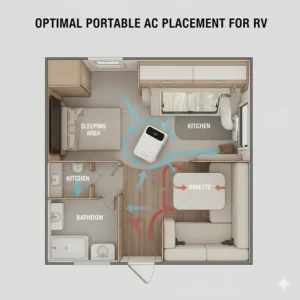
Frequently Asked Questions About Portable Air Conditioner in RV ❓
❓ How long can a portable air conditioner in rv run on batteries before recharging?
❓ Can I install an air conditioner rv small unit myself without professional help?
❓ Do rv mini split air conditioner systems work better than portable units for RVs?
❓ What size portable air conditioner in rv do I need for a 24-foot travel trailer?
❓ Will a portable air conditioner in rv drain my battery too quickly for boondocking?
Recommended for You 📚
- Air Conditioner Filters for RV: 7 Game-Changing Solutions to Breathe Cleaner in 2025
- 8 Best RV Air Conditioners Rooftop Units for Ultimate Comfort in 2025
- 7 Best Coleman Mach RV Air Conditioner Models For Ultimate Comfort in 2025
Disclaimer: This article contains affiliate links. If you purchase products through these links, we may earn a small commission at no additional cost to you.
✨ Found this helpful? Share it with your friends! 💬🤗
