
In This Article
Somewhere in a hot apartment right now, someone is standing in front of two boxes on a store shelf, squinting at the fine print, trying to figure out if an air circulator vs fan decision is really as complicated as it sounds. Short answer: it isn’t, but it also isn’t nothing. Both machines spin blades. Both plug into the wall. And yet one is built to punch a column of air clean across a room while the other is built to wash a gentle current over your skin — and mixing those two jobs up is exactly how people end up with a $40 fan gathering dust in a closet three weeks after they bought it.

This guide exists because most “best fan” roundups skip the part that actually matters: what each design is engineered to do, not just how many speeds it has. We pulled real specs — CFM output, motor type, noise ratings — from seven genuine products currently sold in the US, cross-referenced them against aggregated owner feedback, and built out the kind of comparison that treats you like someone who wants to understand the mechanics, not just click “add to cart.” By the end, you’ll know exactly where an air circulator earns its keep, where a traditional fan still wins, and which of these seven boxes deserves a spot in your home. According to the U.S. Department of Energy, circulating fans create a wind-chill effect that can make a room feel several degrees cooler without touching the thermostat — which is really the whole game here, whichever design you land on.
What Is an Air Circulator vs a Fan?
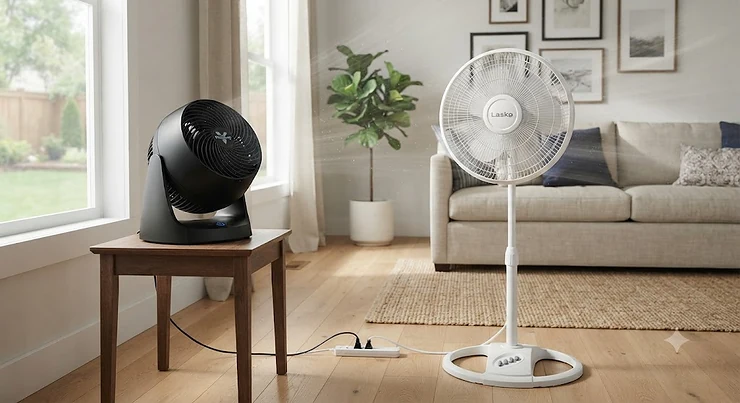
An air circulator is a compact, high-torque fan engineered to project a concentrated, far-reaching air column that mixes an entire room’s air — often 60 to 120 feet — rather than just blowing a breeze at one spot. A traditional fan (box, pedestal, or tower) moves a wider, softer stream of air meant to cool a person directly, not necessarily circulate the whole space.
Quick Comparison Table
| Feature | Air Circulator | Traditional Fan |
|---|---|---|
| Airflow style | Narrow, concentrated jet | Wide, diffuse stream |
| Best for | Whole-room mixing, AC support | Direct personal cooling |
| Typical noise | 20-30 dB on DC models | 35-55 dB |
| Motor type | Often DC/brushless | Usually AC induction |
| Best For | Dreo Falcon S, Vornado 660 | Lasko B20201, Rowenta Turbo Silence Extreme |
The table above sounds simple, but the practical gap between these categories is bigger than the spec sheet suggests. An air circulator’s narrower jet means it can push air the full length of a hallway or basement, effectively acting as a stand-in for central air movement in rooms with poor cross-ventilation. A traditional box or pedestal fan, by contrast, trades that reach for a broader, gentler stream that feels more comfortable sitting a few feet away — which is exactly why box fans still dominate bedrooms despite circulators outperforming them on paper. Neither is strictly “better”; they’re solving different airflow problems, and the difference in cooling efficiency shows up most in rooms larger than about 150 square feet.
Just one click — help others make better buying decisions too!😊
Top 7 Air Circulators and Fans: Expert Analysis
1. Vornado 660 Large Air Circulator — best all-around whole-room mover
The Vornado 660 doesn’t oscillate, and that’s the point — it uses a deep-pitch blade and a signature vortex design to push a dense air column across an entire room instead of sweeping side to side. Real-world testing from outlets like Reviewed clocked it as one of the most powerful circulators available, with airspeed and volume that noticeably outperform typical pedestal fans at the same distance. Based on the spec comparison, this is the pick for anyone with a large living room, finished basement, or open-plan space where a standard oscillating fan leaves dead air pockets in the corners. Reviewers consistently report that the Vornado 660 holds up for years with regular cleaning, and Vornado backs it with an unusually generous five-year warranty — though a handful of owners note the company’s customer service has gotten slower to respond to warranty claims than it used to be.
Pros:
- ✅ Moves air the length of large rooms with ease
- ✅ Five-year warranty beats nearly every competitor
- ✅ Simple, durable three-speed dial control
Cons:
- ❌ No oscillation, so placement matters more
- ❌ Taller footprint can be awkward in small rooms
Expect to pay somewhere in the $90-$110 range at the time of research, and given the airflow output and warranty length, that’s a fair value verdict for anyone circulating a room over 200 square feet.

2. Lasko B20201 20-Inch Box Fan — best budget traditional fan
The Lasko B20201 is the classic box fan reinvented with Save-Smart efficiency tech, and its 1,820 CFM rating on high is genuinely strong for a fan that costs less than a dinner out. What most buyers overlook about box fans like this one is that the flat, wide blade design is actually ideal for window installation — you’re not just cooling a room, you’re exhausting hot air out or pulling cool evening air in. The steel body and Blue Plug safety fuse technology give it a sturdiness that flimsier plastic box fans lack, and aggregated reviews frequently praise how quiet it runs on its lowest setting relative to the volume of air it pushes. This is squarely a budget-conscious buyer’s pick — a renter, a student, or anyone who wants effective airflow without spending on smart features they won’t use.
Pros:
- ✅ Exceptional CFM output for the price point
- ✅ Steel body and safety fuse add real durability
- ✅ Works well in a window for cross-ventilation
Cons:
- ❌ No oscillation or directional targeting
- ❌ Basic three-speed control, no remote or app
At around $25-$35, the Lasko B20201 delivers some of the best cost-per-CFM value on this entire list.
3. Dreo Falcon S Smart Air Circulator — best smart, whisper-quiet circulator
The Dreo Falcon S leans on a brushless DC motor to hit roughly 1,000+ CFM while staying around 25 decibels on its quietest setting, which is the kind of number that sounds like marketing until you actually stand next to one running at night. Here’s what to weigh: the DC motor isn’t just about noise — it also sips far less electricity than the AC motors in older-style circulators, which matters if you’re running this thing for eight hours a night through a whole summer. The 120-degree vertical tilt combined with horizontal oscillation means it can cover more of a room’s vertical air column than most circulators, addressing the classic “cool ankles, warm face” complaint. Reviewers consistently note the app and voice control integration work reliably, though a few mention the companion app occasionally requires a firmware update to reconnect after a Wi-Fi outage.
Pros:
- ✅ Whisper-quiet DC motor even at higher speeds
- ✅ App, remote, and voice control all work smoothly
- ✅ Wide tilt range fixes uneven room cooling
Cons:
- ❌ Premium price versus basic AC-motor circulators
- ❌ App occasionally needs reconnecting after outages
Priced around $80-$110, the Dreo Falcon S earns its premium tag through genuine efficiency gains, not just gimmicks.
4. Honeywell TurboForce HT-904 — best compact personal circulator
The Honeywell TurboForce HT-904 is a small tabletop unit, but don’t let the size fool you — its aerodynamic blade pitch is specifically engineered to punch air further than its footprint suggests, a common trick among compact circulators. The 90-degree pivoting head means you can angle it straight up to cool a loft bed or straight across a desk, and its three-speed motor draws minimal wattage for what it delivers. Based on the spec comparison, this is the pick for dorm rooms, home offices, or anyone who needs targeted personal cooling rather than whole-room circulation. A common complaint in user reviews is that the plastic housing feels a bit lightweight and can vibrate slightly on hard surfaces at top speed, so a rubber pad underneath solves that in seconds.
Pros:
- ✅ Surprisingly strong airflow for its compact size
- ✅ Affordable entry point into circulator technology
- ✅ Pivoting head adds real directional flexibility
Cons:
- ❌ Plastic housing can vibrate at top speed
- ❌ Limited whole-room coverage compared to larger units
At roughly $20-$25, the Honeywell TurboForce HT-904 is arguably the easiest low-risk way to test whether circulator airflow suits your space.
5. Vornado 133 Compact Air Circulator — best small-room premium pick
The Vornado 133 packs the same vortex airflow engineering as its larger siblings into an 8.7-inch desk-friendly frame, and slickdeals forum veterans who’ve owned “pretty much every model” consistently rank its CFM-per-dollar among the best in Vornado’s lineup. What most buyers overlook is that a compact circulator like this one can actually out-circulate a much larger traditional fan in a small bedroom, because the concentrated jet reaches the far wall and bounces air back rather than just blowing past you. The two-speed simplicity keeps it easy to use, though some longtime Vornado owners on enthusiast forums note the brand has shifted more R&D budget toward smart features on newer models rather than motor upgrades. Aggregated reviews still rate the sturdy plastic housing and glide bar highly for stability on a nightstand or desk.
Pros:
- ✅ Outsized airflow for such a compact unit
- ✅ Trusted Vornado build quality and warranty
- ✅ Ideal footprint for desks and small bedrooms
Cons:
- ❌ Only two speed settings
- ❌ Not enough power for large open rooms
Expect a price range around $30-$45, which puts real Vornado engineering within reach for anyone on a tighter budget.
6. Lasko Pro Power B20548 Industrial Box Fan — best heavy-duty box fan
The Lasko Pro Power B20548 takes the familiar box fan shape and reinforces it for genuinely demanding spaces — garages, workshops, job sites — with a Wind Ring system that adds up to 20% more air velocity and a steel body using over 25% more material than a standard box fan. The spec sheet won’t tell you this, but user reports suggest the extra bulk noticeably reduces the wobble and rattle that cheaper box fans develop after a summer or two of daily use. At up to 2,000 CFM, it’s genuinely one of the strongest airflow numbers on this list, and the Weather-Shield motor allows safe use in an open window without worrying about humidity swings. This is the honest pick for anyone circulating air through a workshop, an unfinished basement, or a garage where a delicate smart fan simply wouldn’t survive.
Pros:
- ✅ Near-top CFM output on this entire list
- ✅ Reinforced steel body built for rough use
- ✅ Weather-resistant motor safe for windows
Cons:
- ❌ Noticeably louder than DC-motor circulators
- ❌ Bulkier and heavier than standard box fans
Priced around $50-$65, the Lasko Pro Power B20548 is the clear value pick for anyone who needs serious, no-nonsense airflow.
7. Rowenta Turbo Silence Extreme VU5670 — best premium pedestal fan
The Rowenta Turbo Silence Extreme is the traditional-fan side of this comparison at its best — a metal-grille pedestal fan with one of the sturdiest bases CNN Underscored’s testers found among competitors, plus a clearly labeled control panel that avoids the guesswork of unmarked touch buttons. Its oscillation spans a wide arc, and the “Silent Night” mode drops noise output further as the evening goes on, which is a genuinely useful feature for anyone who’s ever been jolted awake by a fan’s overnight speed change. Based on the spec comparison, this is the premium choice for someone who wants classic personal-cooling airflow rather than whole-room circulation, but doesn’t want to sacrifice quiet operation or build quality to get it. Reviewers consistently highlight the easy-to-clean metal grilles as a standout versus the snap-together plastic grilles common on cheaper pedestal fans.
Pros:
- ✅ Sturdiest base and pole of any pedestal fan tested
- ✅ Silent Night mode reduces noise as it runs
- ✅ Metal grilles are easy to remove and clean
Cons:
- ❌ Premium price for a non-circulator fan
- ❌ Larger footprint needs floor space to swing
At around $90-$110, the Rowenta Turbo Silence Extreme proves a traditional fan can still be worth a premium price tag when the engineering is right.
✨ Don’t Miss These Exclusive Deals!
🔍 Take your home cooling setup to the next level with these carefully selected picks. Click on any highlighted item to check current pricing and availability. These airflow workhorses will help you create a genuinely comfortable home your whole family will love!
Air Circulator vs Box Fan: Which Wins for Your Space?
This is probably the single most common version of the air circulator vs fan question, because box fans are everywhere and cheap, and circulators promise more for roughly the same money. Here’s the honest answer: a box fan like the Lasko B20201 wins on raw CFM-per-dollar and window-exhaust versatility, while a circulator like the Dreo Falcon S wins on reach, noise level, and even air distribution throughout a room rather than just near the unit itself. If your room has one obvious hot spot — say, a bed against a wall that gets sun all afternoon — a box fan blasting directly at that spot solves the actual problem faster than a circulator would. But if the whole room runs stuffy and uneven, a circulator’s concentrated jet is doing something a box fan structurally can’t: bouncing air off the far wall to create a genuine mixing current. Long-time Vornado owners on enthusiast forums put it bluntly — box fans move air, circulators move rooms.
Circulator Fan vs Standing Fan: The Real-World Difference
A standing (pedestal) fan like the Rowenta Turbo Silence Extreme is built around height adjustability and a wide oscillating sweep, which makes it the better choice when multiple people in a room need airflow at roughly head-and-shoulder height — think a shared office or a living room with several seating spots. A circulator fan, on the other hand, generally sits lower and closer to the floor or a tabletop, and instead of sweeping side to side, it relies on raw jet strength to reach across the room in one direction. What most buyers overlook is that pedestal fans, because they oscillate through open air, lose some airspeed compared to a fixed circulator jet of the same wattage — you’re trading peak reach for even coverage. If you’re choosing between the two for a single-person bedroom, the circulator usually wins on efficiency; for a shared living space, the standing fan’s sweep tends to keep more people comfortable at once.
Airflow Pattern Comparison: How Each Moves Air Through a Room
Picture a garden hose versus a sprinkler, and you’ve basically got the airflow pattern comparison in a nutshell. An air circulator behaves like the hose — a tight, high-velocity column that travels a long, defined path and creates a mixing current when it hits a wall and rebounds. A traditional fan behaves more like the sprinkler, spreading a softer, wider stream that covers a shorter distance but touches more surface area near the unit. According to the mechanics of forced convection, fluid motion generated by an external source like a fan is what allows heat energy to be transported efficiently through a space, and the shape of that fluid motion — narrow jet versus broad stream — is exactly what separates these two device categories in practice. This is also why circulators are frequently used alongside air conditioners: their narrow, far-reaching stream helps push already-cooled air into corners the AC vents can’t directly reach, while a standard fan mostly just re-stirs air close to where it’s already circulating.
Cooling Efficiency Difference: Which Actually Makes You Feel Cooler
Neither device lowers the actual temperature of a room — that’s an air conditioner’s job — but the cooling efficiency difference between these two fan types comes down to how effectively each creates a wind-chill sensation on your skin. A circulator’s higher velocity air, even at a lower CFM number on paper, often feels cooler against skin than a wider, slower stream from a traditional fan moving similar total volume. On the flip side, because a traditional fan spreads its stream wider, it cools more of your body surface at once if you’re sitting directly in front of it, which some people simply find more comfortable than a tight jet. The real efficiency gain shows up when circulators are paired with air conditioning: mixing cooled air more thoroughly means your thermostat doesn’t have to work as hard to keep every corner of a room comfortable, which lines up with the Department of Energy’s broader guidance on using circulating fans to stretch AC performance.
Room Coverage Area: Matching Fan Type to Square Footage
Room coverage area is where a lot of buyers get burned, because manufacturers advertise “feet of airflow reach” numbers that sound impressive without context. As a rough framework: compact circulators like the Honeywell TurboForce or Vornado 133 are built for rooms under 150 square feet — bedrooms, dorms, home offices. Mid-size circulators like the Dreo Falcon S handle 150-300 square foot spaces comfortably thanks to their higher CFM and oscillation range. For anything above 300 square feet — open living rooms, finished basements — you want the raw output of something like the Vornado 660 or the sheer volume of the Lasko Pro Power B20548. Traditional standing fans like the Rowenta Turbo Silence Extreme sit in the middle of this range, covering roughly 200-250 square feet effectively thanks to their oscillating sweep, even though their peak reach is shorter than a dedicated circulator’s.
Is an Air Circulator Better Than a Fan? Our Honest Verdict
Is an air circulator better than a fan? Not universally — it’s better for whole-room mixing, AC efficiency, and quiet overnight operation on DC models, but a traditional fan still wins for direct personal cooling, window exhaust duty, and upfront price. The honest verdict, based on the spec and review comparison across all seven products here, is that most households actually benefit from owning one of each: a circulator like the Dreo Falcon S or Vornado 660 for whole-room air mixing, and a simple, cheap unit like the Lasko B20201 for direct cooling when you’re sitting still in one spot. Treating this as an either/or purchase is usually where people go wrong — the two devices solve different problems well enough that the “better” one depends entirely on which problem you actually have.
How to Choose an Air Circulator or Fan
- Measure your room first. Square footage dictates CFM needs more than any marketing claim.
- Decide if you need whole-room mixing or spot cooling. That single distinction points you toward a circulator or a traditional fan immediately.
- Check the noise rating if it’s for a bedroom. DC-motor circulators like the Dreo Falcon S run dramatically quieter than AC-motor box fans.
- Consider window use. A flat-bladed box fan like the Lasko B20201 is built for exhausting or pulling in outdoor air; most circulators aren’t.
- Factor in your climate control setup. If you already run AC, a circulator adds more real value by mixing cooled air than a standard fan does.
- Look at warranty length. Vornado models stand out here with five-year coverage most competitors don’t match.
- Budget for electricity, not just sticker price. DC motors cost more upfront but often use noticeably less power over a summer of nightly use.

Common Mistakes When Buying an Air Circulator or Fan
The most common mistake is buying based on CFM number alone without considering noise — a 2,000 CFM box fan like the Lasko Pro Power B20548 is a poor fit for a bedroom no matter how much air it moves. A close second is placing a circulator in a corner facing a wall too close for the jet to develop reach, which cuts its effective range dramatically. Buyers also frequently skip checking oscillation range on standing fans, then discover the sweep doesn’t actually cover both sides of a shared room. Another overlooked issue: assuming all “quiet” ratings use the same testing distance, when in practice a fan rated 25dB at three feet can sound meaningfully louder up close on a nightstand. Finally, plenty of shoppers ignore warranty length entirely, then find themselves out of luck when a cheaper unit’s motor dies after a single summer.
Long-Term Cost & Maintenance
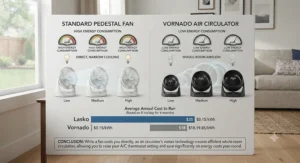
Total cost of ownership tells a different story than the price tag alone. A DC-motor circulator like the Dreo Falcon S, priced higher upfront around $80-$110, typically uses meaningfully less electricity than an equivalent AC-motor unit run for the same hours nightly, which can close much of the price gap over two or three summers. Traditional AC-motor fans like the Lasko B20201 cost less to buy but slightly more to run continuously, though the gap is modest enough that budget shoppers still come out ahead short-term. Maintenance-wise, box fans need blade and grille dusting every few weeks during heavy use to keep airflow from degrading, while circulators with detachable grilles, like several Dreo models, make that cleaning faster and less likely to be skipped. Bearings and motors on well-built units — Vornado’s included — routinely outlast cheaper competitors by several years, which matters more than the sticker price once you calculate cost per year of actual use.
Safety & Placement Guide
Fan safety is easy to overlook because these feel like harmless appliances, but the U.S. Consumer Product Safety Commission specifically advises placing fans securely and keeping cords clear of foot traffic to help prevent tripping injuries at home. Beyond tripping hazards, avoid running any fan, circulator or traditional, on a surface it can tip from, and never route a cord under a rug where fraying can go unnoticed. Circulators with tall, narrow bases like the Vornado 660 benefit from being placed against a wall for stability, while box fans in windows should use a properly sized frame or bracket rather than balancing loosely on the sill. If you’re using a fan alongside a space heater in shoulder-season weather, keep both units several feet apart and never leave either running unattended overnight.
Practical Setup & Maintenance Guide
Getting a new circulator or fan running well takes more than plugging it in. First, unbox and check for any shipping damage to the blades or grille before first use, since a bent blade at high speed can cause vibration that shortens motor life. For circulators, position the unit at least a few feet from the nearest wall so the jet has room to build velocity before it needs to travel across the room. During the first 30 days, resist the urge to run any new fan constantly on its highest setting — most motors, especially AC-driven box fans, benefit from a mixed-speed break-in period. Set a recurring reminder to wipe down the front grille every two weeks during peak season; dust buildup on the blades is the single biggest silent killer of airflow output over a summer. For smart circulators like the Dreo Falcon S, complete any firmware updates in the first week to avoid app connectivity issues down the line. Finally, store units properly in the off-season — standing upright in a dry closet, not lying flat where dust settles directly onto the motor housing.
Real-World Scenarios: Which One Fits Your Life
Consider a college student in a 120-square-foot dorm room with no AC — the Honeywell TurboForce HT-904 or Vornado 133 fits perfectly, delivering strong personal airflow without taking up desk space or blowing the budget. Now picture a family in a 400-square-foot open-plan living and dining area running central air through the summer — the Vornado 660 or Dreo Falcon S genuinely earns its keep here, mixing cooled air into corners the AC vents can’t reach directly and letting the thermostat sit a few degrees higher. Finally, imagine someone working from a home garage workshop with no climate control at all — the Lasko Pro Power B20548 is the honest pick, since its industrial-grade CFM and weather-resistant motor were built for exactly that kind of demanding, un-air-conditioned space where a delicate smart circulator wouldn’t hold up.
Buyer’s Decision Framework
If you’re cooling a single small room under 150 square feet, choose a compact circulator like the Vornado 133 because concentrated airflow beats wide coverage in tight spaces. If you’re running central air and want to stretch its efficiency, choose a whole-room circulator like the Vornado 660 or Dreo Falcon S because mixing cooled air reduces AC strain. If you need budget-friendly window ventilation, choose a traditional box fan like the Lasko B20201 because flat blades exhaust and intake air more effectively than a circulator’s narrow jet. If you’re outfitting a garage, workshop, or uninsulated space, choose an industrial box fan like the Lasko Pro Power B20548 for sheer durability. And if quiet, shared-room comfort matters most, choose a premium standing fan like the Rowenta Turbo Silence Extreme for its wide oscillation and low-noise night mode.

Frequently Asked Questions
❓ Is an air circulator worth it over a regular fan?
❓ Can an air circulator replace air conditioning?
❓ How far can an air circulator actually push air?
❓ Do air circulators use less electricity than fans?
❓ What size room needs a full-power air circulator?
Recommended for You
- Best Air Circulator Fan 2026: 7 Top Rated Picks That Actually Work
- DIY Patio Misting System: 7 Kits That Beat the Heat in 2026
- 7 Best Restaurant Patio Misting Systems That Actually Work in 2026
Disclaimer: This article contains affiliate links. As an Amazon Associate, I earn from qualifying purchases. If you purchase products through these links, we may earn a small commission at no additional cost to you.
✨ Found this helpful? Share it with your friends! 💬🤗
