
In This Article
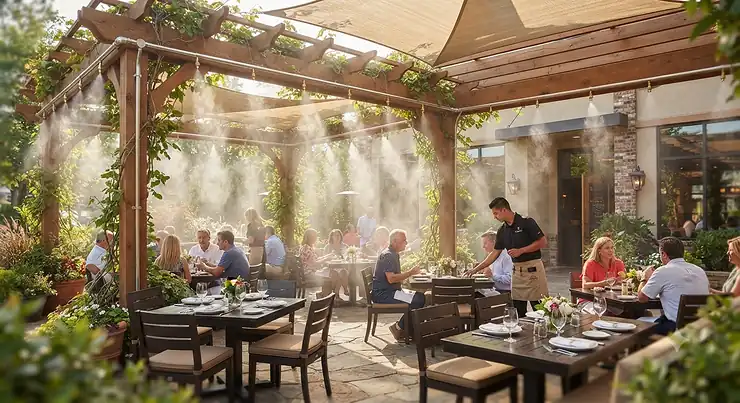
A restaurant patio misting system is an outdoor cooling setup — usually a high-pressure pump, tubing, and fine-orifice nozzles — that turns a hose or plumbing line into a curtain of ultra-fine mist, dropping the ambient temperature on a dining patio by as much as 20-30 degrees Fahrenheit. If you’ve ever watched a hostess turn away a party of four because the patio “feels like a sauna,” you already know the real cost of a hot outdoor section: empty tables during your busiest season. Summer patio season is supposed to be a revenue windfall, not a liability, and a properly sized restaurant patio misting system is one of the few upgrades that pays for itself within a single hot month by keeping seats filled instead of vacant.
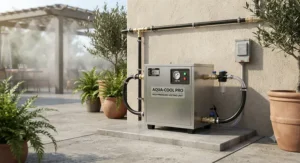
This guide breaks down seven real, currently available systems spanning DIY tripod stands, high-pressure line kits, app-controlled setups, and commercial-grade wall-mount fans — everything from a scrappy sidewalk cafe to a full-service restaurant with a wraparound patio. We researched real specifications, aggregated genuine buyer and reviewer sentiment, and cross-checked manufacturer claims so you’re not just reading a repackaged product listing. Every price mentioned is a range, not a snapshot, because misting system pricing shifts constantly with materials costs and seasonal demand — always check current price before you commit.
We’ll also walk through setup and maintenance, common buying mistakes, health code and safety considerations for outdoor dining spaces, and a decision framework so you land on the right system for your specific patio footprint and budget — not just the one with the flashiest listing photos.
Quick Comparison Table
| System | Type | Price Range | Best For |
|---|---|---|---|
| MistCooling 1500 PSI (10 Nozzle) | High-pressure line kit | Budget-mid | Narrow patios & awnings |
| MistCooling Smart Mist App-Controlled | High-pressure, WiFi | Mid-range | Scheduled automation |
| Patio Misters Pro (100ft/50 nozzle) | High-pressure line kit | Mid-premium | Full-size patios (800+ sq ft) |
| VEVOR 30-Inch Wall-Mount Fan | Misting fan | Premium | Open-air bars, pergolas |
| MistCooling Double Fan Portable | Cart-mounted, tank-fed | Mid-range | Pop-ups, no plumbing access |
| Orbit 10718 Telescoping Mist Tower | Hose-fed tripod | Budget | Sidewalk cafes, single zones |
| Fogco Revolution Misting Fan | Commercial fan | Premium (quote-based) | Large outdoor bars & lounges |
Looking at the spread above, the two Orbit and Patio Misters Pro entries sit at opposite ends of the spectrum: one is a plug-and-play hose accessory, the other is a genuine commercial installation project. The middle of the table — the MistCooling kits and the portable double-fan unit — is where most mid-size restaurants and cafes will land, since they balance real cooling output against a manageable DIY installation. Fan-based options like the VEVOR and Fogco units solve a different problem entirely: covering wide, open areas where running mist lines overhead isn’t practical.
💬 Just one click — help other restaurant owners make smarter cooling decisions too!😊
Top 7 Restaurant Patio Misting Systems: Expert Analysis
| Product | Pressure/Output | Coverage | Price Range | Best For |
|---|---|---|---|---|
| MistCooling 1500 PSI (10 Nozzle) | 1,500 PSI | ~40 linear ft | Budget-mid | Small commercial patios |
| MistCooling Smart Mist | 1,500 PSI, WiFi | ~60 linear ft | Mid-range | Scheduled cooling |
| Patio Misters Pro | 1,000 PSI | ~100 linear ft | Mid-premium | Large full-service patios |
| VEVOR Wall-Mount Fan | 9,500 CFM | ~30 ft radius | Premium | Open-air bars |
| MistCooling Double Fan Portable | 1,500 PSI, tank-fed | Portable zone | Mid-range | Seasonal / no plumbing |
| Orbit 10718 Mist Tower | 160 PSI (hose-fed) | 144 sq ft | Budget | Sidewalk cafes |
| Fogco Revolution Fan | Commercial-grade | ~30 ft dispersal | Premium (quote) | Large outdoor lounges |
This table confirms what most restaurant operators eventually discover the hard way: pressure and coverage don’t scale together in a straight line. The MistCooling Smart Mist covers half again as much linear footage as the base 10-nozzle kit at the same 1,500 PSI simply because it’s rated for double the nozzle count, while the Patio Misters Pro trades some raw pressure for a much larger footprint and a noticeably quieter pump. If your patio is wider than it is deep, a fan-based option like the VEVOR or Fogco unit will likely outperform a line system on a per-dollar coverage basis.
1. MistCooling 1500 PSI High Pressure Misting System — commercial-grade filtration at a budget entry price
This 10-nozzle, 40-foot kit is where a lot of small restaurant patios start, and the standout feature is the built-in 5-micron commercial filter that ships with the base pump. That filtration detail matters more than it sounds: hard water is the single biggest cause of clogged misting nozzles in restaurant settings, and a commercial-grade filter upstream of the pump means fewer service calls down the line.
The 1,500 PSI piston pump pushes water through 0.006-inch stainless steel orifice nozzles, producing a mist fine enough to flash-evaporate before it lands on a tablecloth, and the pump includes a low-water cutoff switch and thermal safety switch as standard, not optional add-ons. Based on the spec comparison with lower-pressure DIY kits, this is one of the few sub-$500 systems that actually earns the word “commercial” in its description rather than borrowing it for marketing.
It’s best suited to restaurant owners covering a single awning, a narrow storefront patio, or a food truck setup rather than a sprawling beer garden. Reviewers consistently note that the stainless nozzles resist the clogging that plagues cheaper brass alternatives, though several also mention that fittings benefit from a re-tightening pass after the first few weeks of thermal expansion and contraction.
Pros:
- ✅ Commercial 5-micron filtration reduces nozzle clogging
- ✅ Expandable design supports up to 40 nozzles total
- ✅ Stainless steel nozzles resist outdoor corrosion
Cons:
- ❌ UV-treated nylon tubing still degrades faster than stainless tubing
- ❌ No smartphone scheduling — manual on/off switch only
Expect a price in the low-to-mid hundreds for the base 10-nozzle configuration; check current price, since nozzle-count variants shift the range considerably. For a first commercial misting purchase on a tight footprint, this is a genuinely defensible value pick.

2. MistCooling Smart Mist App-Controlled System — WiFi scheduling built into a commercial pump
Step up to the 20-nozzle, 60-foot Smart Mist configuration and the headline feature is WiFi control paired with a smartphone app, letting a manager schedule misting cycles around the lunch rush and dinner service without anyone touching a physical switch. Under the hood it’s the same 1,500 PSI platform as the base MistCooling kit, but the manufacturer adds a solenoid valve and pressure switch that work together with the app to automate on/off cycles by time of day or temperature threshold.
What most buyers overlook about this model is that the automation isn’t just a convenience feature; it directly reduces water waste, since the system only runs during service windows instead of continuously through a hot afternoon when the patio is empty. This is the pick for restaurant groups with more than one location, where consistent scheduling across sites matters more than manually training every shift lead on a wall switch.
Aggregated buyer sentiment is largely positive on ease of use, though a recurring theme in reviews is that the app occasionally loses its WiFi pairing after a router reset or firmware update, requiring a quick re-pair.
Pros:
- ✅ App-based scheduling automates on/off cycles by time
- ✅ Thermal safety switch protects the pump from overheating
- ✅ Low-water cutoff prevents dry-run pump damage
Cons:
- ❌ WiFi pairing occasionally drops after firmware updates
- ❌ Costs meaningfully more than the manual-switch base kit
Pricing sits in the mid-hundreds to lower mid-range bracket depending on nozzle count — always check current price before ordering, since WiFi-enabled variants are priced separately from manual models. For multi-shift operations, the labor savings alone can justify the premium.
3. Patio Misters Pro (The Patio Misting System) — the quietest large-coverage system on this list
At 100 linear feet and 50 nozzles, this is the largest single-kit system in this roundup, and its standout feature is a 3-piston pump rated at under 56 decibels — roughly the hum of a household refrigerator. That noise figure matters enormously in a dining setting: a loud compressor cycling on and off every few minutes will annoy guests seated near it, while this pump is quiet enough to run continuously through service without anyone at the table noticing.
The 1,000 PSI pump supports mixed nozzle orifices, so an installer can run finer 0.1mm nozzles directly over seating for a dry, barely-perceptible mist and larger 0.3mm nozzles along the perimeter for more aggressive cooling near a bar or waiting area. Based on the spec sheet, this zone-based flexibility is what separates a genuinely “restaurant-grade” installation from a one-size-fits-all backyard kit.
Independent reviewer commentary (via Bob Vila’s product testing coverage) frames the stainless components as giving the system “a more professional, upscale, commercial look” compared with PVC alternatives, while consistently flagging the higher price as the tradeoff for that polish. Setup is the real cost here: installers need to cut tubing to length and mount 50 individual nozzles, which is a genuine afternoon’s labor rather than a quick DIY job.
Pros:
- ✅ Sub-56 decibel pump barely registers during service
- ✅ Mix-and-match nozzle sizing creates cooling zones
- ✅ Stainless fittings give a commercial, upscale appearance
Cons:
- ❌ Premium price relative to PVC-based competitor kits
- ❌ Cutting and mounting 50 nozzles is a labor-intensive install
Expect this system to sit in the upper-mid price range for a full 100-foot kit — check current price, as stainless tubing upgrades add further cost. For a full-size patio where guest experience is the priority, the quiet operation alone justifies the spend.
4. VEVOR 30-Inch Wall-Mount Misting Fan — commercial-grade airflow for open-air spaces
Where the line-based kits above cool a defined strip of patio, this wall-mounted fan solves a different problem: pushing cooled air across an open bar area, pergola, or lounge where overhead mist lines aren’t practical. The standout number here is 9,500 CFM (cubic feet per minute) of airflow — a measurement of how much air the fan actually moves, not just how “strong” it feels standing next to it.
Higher CFM means the fan projects its cooling effect 30 feet or more rather than only chilling the few feet directly in front of the blades. The IP44 waterproof rating is what makes permanent outdoor mounting realistic; unlike fans that need to be wheeled indoors before a storm, this one is built to stay bolted to an exterior wall year-round, with an all-metal casing that resists rust in humid coastal climates.
What the spec sheet won’t tell you, but buyer reports suggest, is that the 24-pound unit genuinely needs two people for a safe wall installation, and appropriate masonry or stud anchors aren’t always included in the box. This is best suited to restaurants with taller ceiling heights, covered pergolas, or an open-air bar section where floor space is at a premium and a freestanding fan would just get in the servers’ way.
Pros:
- ✅ 9,500 CFM extends cooling well beyond the fan itself
- ✅ IP44 rating allows genuine permanent outdoor mounting
- ✅ All-metal housing resists rust in humid climates
Cons:
- ❌ 24-pound unit requires two people to mount safely
- ❌ Wall anchors are frequently sold separately
Pricing for wall-mount commercial misting fans in this class runs mid-to-upper range — check current price, as it varies with blade size and included mounting hardware. For open-plan patios, this is genuinely the most efficient square-footage-per-dollar cooling option on this list.
5. MistCooling Double Fan Portable Misting System — no plumbing hookup required
This cart-mounted unit solves the single biggest obstacle most restaurant patios face: no accessible water line or hose bib near the seating area. Instead of tapping into plumbing, it carries its own 15-gallon onboard tank feeding two 24-inch oscillating fans through a 1,500 PSI pump, and the whole thing rolls on a wheeled cart to any outdoor-rated outlet.
That portability is the standout feature — a host can physically wheel the unit to wherever a waitlist is forming on a hot Saturday night rather than being locked into a fixed installation point. The system is UL-rated for outdoor electrical use, which matters for insurance and fire-marshal conversations that a generic residential fan wouldn’t survive.
Reviewers most often cite the mobility as the deciding factor in choosing this over a fixed line system, particularly for seasonal patios, sidewalk pop-ups, or restaurants leasing space where drilling into a facade isn’t an option. On the downside, several buyers note the 15-gallon tank needs a mid-service refill during a long, hot Friday or Saturday dinner rush, and running two fans simultaneously draws noticeably more power than a single line-fed pump.
Pros:
- ✅ No plumbing hookup — just fill the tank and plug in
- ✅ Wheeled cart repositions cooling anywhere on demand
- ✅ UL-rated for safe continuous outdoor electrical use
Cons:
- ❌ 15-gallon tank often needs mid-service refilling in extreme heat
- ❌ Draws more power than a single-fan, line-fed system
This portable configuration typically prices in the mid-range bracket — check current price, since cart materials and tank capacity vary by seller. For seasonal or leased patios, the lack of a plumbing requirement alone can make this the only realistic option.
6. Orbit 10718 Telescoping Mist Tower — the lowest-friction setup on this list
This tripod-mounted, 5-nozzle stand is the simplest system here by a wide margin: no pump, no wiring, no smart controller — just a standard garden hose connection feeding mist through nozzles mounted on an adjustable metal tower that telescopes from 42 to 84 inches. Running directly off standard hose pressure (rated to 160 PSI) means there’s genuinely nothing to install beyond screwing on the hose adapter and extending the tripod legs, which is why this is the fastest system on this list to get running the same afternoon it arrives.
Coverage tops out around 144 square feet, so this isn’t a full-patio solution — it’s a targeted cooling zone for a single high-traffic corner, a sidewalk cafe footprint, or a host stand where guests wait for a table. Based on the spec sheet, the tradeoff for that simplicity is clear: without a booster pump, mist quality depends entirely on your building’s incoming water pressure, so results vary by location.
Aggregated reviewer sentiment across retailer and marketplace listings consistently praises how quickly it sets up and describes the metal tripod as sturdier than its price point suggests, though a handful of reviewers report minor leaking at hose connections in buildings with higher-than-average incoming water pressure.
Pros:
- ✅ No pump or electrical wiring required
- ✅ Height adjusts from 42 to 84 inches for flexible placement
- ✅ Lowest cost of entry of any system on this list
Cons:
- ❌ 144 sq ft coverage won’t handle a full-size patio
- ❌ Some reviewers report minor leaks under high hose pressure
This is consistently one of the most affordable options available — check current price, as it’s widely stocked across home-improvement retailers as well as Amazon. For a sidewalk cafe testing the waters before a bigger investment, it’s a low-risk starting point.
7. Fogco Revolution Misting Fan — a 35-year commercial manufacturing track record
Fogco has supplied misting equipment to restaurants, hotels, and resort properties for more than three decades, and the Revolution fan is built around a single standout figure: a mist dispersal radius of up to 30 feet per unit, according to manufacturer specifications. That reach means one properly placed fan can cool an entire outdoor bar section or lounge area, reducing the total number of units — and the wiring complexity — a restaurant needs compared with shorter-throw fans.
Here’s what to weigh: because Fogco sells primarily through a quote-based commercial process rather than a marketplace checkout, buyers won’t find an instant price the way they would with the MistCooling or VEVOR listings above, which makes upfront budgeting a bit less straightforward. On paper, this is the choice for restaurant groups and hospitality operators treating patio cooling as a permanent capital investment rather than a seasonal DIY project — the kind of purchase that goes through a facilities manager and a contractor rather than a next-day Amazon order.
Aggregated commentary from industry sources and buyer discussions consistently credits the company’s decades of commercial-duty manufacturing experience as reassurance for multi-location purchases, while noting that professional installation is typically recommended over a self-install approach.
Pros:
- ✅ 30-foot mist dispersal covers large areas per unit
- ✅ Decades of dedicated commercial misting manufacturing experience
- ✅ Engineered for continuous commercial-duty operation
Cons:
- ❌ Quote-based pricing means no instant checkout price
- ❌ Professional installation is recommended over DIY setup
Because pricing is quote-based, expect a wider range than the marketplace kits above — request current pricing directly rather than assuming a fixed figure. For hospitality groups managing multiple properties, the manufacturer’s track record often outweighs the extra step of requesting a quote.
Setting Up Your Outdoor Dining Misting System
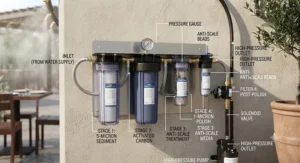
Getting an outdoor dining misting system running correctly on day one prevents most of the service calls that show up in month two. Start by mapping your patio’s actual water source and electrical access before ordering anything — a system rated for 40 linear feet does you no good if your nearest hose bib or GFCI outlet sits 60 feet away. Once the kit arrives, install the filter first, even if it feels like an optional step; skipping the 5-micron pre-filter is the single most common reason nozzles clog within the first month, especially in areas with hard water. Mount the pump in a shaded, ventilated spot away from direct grease exposure from a nearby grill exhaust, since airborne oil residue clogs nozzles just as fast as mineral buildup.
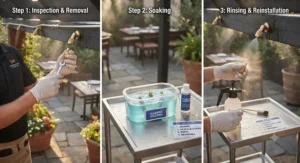
During the first 30 days, run the system on a shorter daily cycle than you eventually plan to use, checking each nozzle connection for drips after the first few thermal cycles, since fittings often need a light re-tightening as tubing settles. A common first-month mistake is running the pump dry when a hose is accidentally shut off — most commercial-grade pumps include a low-water cutoff switch specifically to prevent this, but only if it’s wired in rather than bypassed. For ongoing maintenance, plan on a seasonal nozzle cleaning with an appropriate descaling solution, and a full winterization drain of the tubing and pump housing before the first hard freeze in your region — skipping this step is the most common cause of cracked lines each spring.
Real-World Scenarios: Matching Systems to Customer Comfort Needs
Customer comfort dining needs vary enormously depending on your patio’s size, seating style, and typical guest turnover, so matching the system to the actual use case matters more than chasing the highest PSI number on the spec sheet. Consider a 40-seat neighborhood bistro with a narrow sidewalk patio and no easy hose access — for that setup, a portable, tank-fed cart system solves the plumbing problem entirely while still delivering commercial-grade cooling exactly where the tables are, and it can be wheeled in overnight to avoid vandalism concerns.
Now picture a 200-seat restaurant with a large wraparound patio and an attached open-air bar area. That operation benefits from a hybrid approach: a high-pressure line system with mixed nozzle sizing over the dining tables, paired with a wall-mounted commercial fan projecting cooled air across the open bar section where running mist lines overhead isn’t practical. Budget for this scenario should account for professional installation, since the labor of running lines across a large footprint quickly exceeds the cost of the hardware itself.
Finally, consider a small coffee shop with a six-table sidewalk patio and a modest seasonal budget. A telescoping tripod mister covering a single high-traffic corner near the door is often the right call — it delivers noticeably better guest comfort at a fraction of the cost of a full line system, and it can be stored indoors during the off-season without any disassembly.
Common Problems With Restaurant Patio Misting Systems (And Solutions)
Problem 1: Clogged nozzles from hard water. This is the most frequent complaint across nearly every system on this list. Solution: install (and don’t skip) a 5-micron pre-filter, and schedule a seasonal descaling clean rather than waiting for visible clogging.
Problem 2: Guests complaining about dampness on furniture or menus. Solution: this almost always traces back to oversized nozzle orifices for the pressure available. Downsizing to a 0.006-0.008 inch orifice at higher pressure produces the flash-evaporating dry mist that restaurants need, rather than the visible droplets a low-pressure kit produces.
Problem 3: Pump noise disrupting conversation. Solution: check the pump’s decibel rating before buying — some commercial pumps run at 75 decibels while others, like the Patio Misters Pro line, run under 56. Placement also matters; mounting the pump in an enclosure or further from seating cuts perceived noise significantly.
Problem 4: Increased insect activity around standing water. Solution: ensure tubing drains fully between uses rather than pooling water in low spots, and pair the misting system with proper drainage grading beneath the patio — standing water, not the mist itself, is what attracts pests.
Problem 5: Running the pump dry after a water outage. Solution: confirm the pump you choose includes a functioning low-water cutoff switch, and never bypass it even temporarily, since a single dry run can damage the seals and void the warranty.
How to Choose a Commercial Patio Misting System
- Measure your actual coverage need first. Walk the patio and measure linear footage or square footage before comparing pump PSI — an undersized pump on an oversized patio will never produce commercial-grade cooling, regardless of price.
- Match pressure to nozzle orifice size. Higher-pressure systems (1,000-1,500 PSI) support smaller 0.006-0.008 inch orifices, which produce the flash-evaporating dry mist that restaurant patios need; lower-pressure hose-fed systems are better suited to smaller, single-zone applications.
- Confirm water access and electrical requirements before ordering. A tank-fed portable unit sidesteps plumbing limitations entirely, while a line-fed pump requires a nearby water source and a GFCI-protected outdoor outlet.
- Weigh noise output against your dining atmosphere. A quiet, fine-dining patio benefits from a sub-60 decibel pump; a casual outdoor bar has more tolerance for a louder unit.
- Check for genuinely commercial-grade components. What makes a system truly commercial grade isn’t marketing language — it’s a 5-micron (or finer) filtration stage, a low-water cutoff switch, a thermal safety switch, and stainless steel (not just brass) nozzles rated for continuous-duty cycling rather than occasional residential use.
- Factor in installation labor, not just hardware cost. A 100-foot, 50-nozzle kit costs more in labor to install correctly than a 40-foot starter kit, even when the hardware price difference looks modest on paper.
- Decide whether automation is worth the premium. WiFi scheduling reduces staff labor and water waste over a season, but it also adds a point of potential failure that a simple manual switch avoids.

What to Expect: Real-World Performance on Your Patio
Specs on a listing page rarely translate directly into what a server or guest actually feels standing on a hot patio at 4 p.m. A properly sized 1,000-1,500 PSI system can realistically bring a patio surface temperature down by 15-20 degrees within the first several minutes of operation, though actual guest-perceived comfort depends heavily on humidity, wind, and how much direct sun the seating area gets. In genuinely humid climates, evaporative cooling is less effective simply because the air is already closer to saturation — a factor worth researching further if you’re in a coastal or Gulf Coast market, since the physics of evaporative cooling depend on dry air absorbing moisture efficiently.
Expect a short adjustment period for staff, who need to learn to keep menus and electronics away from the mist zone directly under nozzles, and expect guests near the perimeter of a large patio to notice less cooling effect than those seated directly under the mist line — a detail that should inform table layout during your first season running the system. Restaurant and hospitality operators managing outdoor cooling also increasingly weigh staff comfort alongside guest comfort, since servers working an outdoor section during a heat wave face the same exposure guests do; the OSHA heat exposure guidance for outdoor workers is a useful reference point when building a summer staffing and hydration policy alongside your cooling investment.
✨ Ready to Cool Down Your Patio This Season?
🔍 Compare current pricing on the systems above before your next heat wave hits. A properly matched misting setup turns your slowest summer shift into your busiest one — click through to check availability and current pricing on any option that fits your patio.
Cafe Patio Misters vs Full Commercial Restaurant Systems
A cafe patio mister and a full commercial restaurant misting system solve overlapping but genuinely different problems, and conflating the two leads to either overspending or under-cooling. A small coffee shop or cafe with a handful of sidewalk tables rarely needs a 100-foot line system with 50 individually mounted nozzles; a single telescoping tripod stand or a compact tank-fed unit typically delivers noticeably better comfort per dollar spent, since the coverage area is inherently smaller and the guest dwell time is often shorter than a full sit-down dinner service.
Full-service restaurants with larger patios face a different set of priorities: guest dwell time is longer, turnover expectations are higher, and noise tolerance is often lower given the fine-dining or upscale-casual atmosphere many operators are cultivating. That’s where a full commercial system with zone-based nozzle sizing, WiFi scheduling, and a genuinely quiet pump earns its higher price tag — the investment is spread across many more covers per season than a six-table cafe patio would generate. The practical dividing line sits somewhere around 20-30 seats and roughly 60 linear feet of patio perimeter; below that threshold, a cafe-scale mister usually wins on value, and above it, a full commercial installation starts paying for itself faster.
Restaurant Outdoor Cooling vs Traditional Alternatives
| Cooling Method | Upfront Cost | Ongoing Cost | Guest Comfort | Best For |
|---|---|---|---|---|
| Misting system | Low-mid | Low (water + minor electricity) | High, dry mist | Most outdoor patios |
| Shade structures alone | Low | Minimal | Moderate | Mild climates |
| Standalone patio fans | Low | Low-moderate | Moderate | Small budgets |
| Portable AC / spot coolers | High | High (heavy electricity draw) | High but limited radius | Small enclosed patios |
Comparing restaurant outdoor cooling methods head-to-head, misting systems consistently outperform shade structures and standalone fans on guest comfort because they actively lower ambient temperature rather than simply blocking sun or moving warm air around. Portable spot coolers can match or exceed a misting system’s cooling effect within a small radius, but their electricity draw and limited coverage area make them impractical for anything beyond a tiny, partially enclosed nook. For most open-air restaurant patios, a misting system remains the best balance of upfront cost, ongoing operating expense, and actual guest-perceived comfort across a full service.
Common Mistakes When Buying a Restaurant Patio Misting System
Restaurant owners shopping for a misting system tend to repeat a handful of avoidable errors. The first is buying based on nozzle count alone without checking pump PSI — more nozzles on an underpowered pump produces weaker mist at every single nozzle, not better overall coverage. The second is skipping the pre-filter to save a small amount upfront, which almost always costs more in service calls and replacement nozzles within the first season, particularly in hard-water regions. The third is ignoring noise ratings entirely, only to discover after installation that the pump’s hum competes with dinner conversation on a quiet patio.
A fourth common mistake is underestimating installation labor, assuming a 100-nozzle kit installs in an afternoon the same way a 10-nozzle kit does. And a fifth, more subtle mistake is choosing a system based purely on the lowest listed price without checking whether the components — nozzles, tubing, fittings — are actually rated for continuous commercial-duty cycling rather than occasional residential weekend use; a residential-grade pump run for eight hours a day through a full summer service schedule will fail far sooner than its warranty period suggests.
Long-Term Cost & Maintenance of Commercial Misting Systems
| Cost Factor | Typical Range | Frequency |
|---|---|---|
| Nozzle replacement | Low per nozzle | Annually or as needed |
| Filter cartridge replacement | Low | Seasonally |
| Pump seal replacement | Moderate | Every 1,500+ operating hours |
| Water usage | A few dollars/month added to utility bill | Daily during service hours |
| Electricity (pump only) | Minimal — less than most window AC units | Daily during service hours |
The total cost of ownership for a commercial patio misting system is genuinely modest compared with the revenue it protects. A mid-pressure system running four to six hours a day during service typically uses only one to three gallons of water per hour, adding a few dollars a month to a restaurant’s water bill, while the pump itself draws less electricity than a typical window air conditioning unit. The real long-term cost driver is maintenance discipline rather than the hardware itself: a well-maintained system with regular filter changes and seasonal nozzle cleaning can run reliably for 10 to 20 years, while a neglected one — clogged filters, skipped winterization, bypassed safety switches — can fail within a single season. Budgeting a modest annual maintenance line item, rather than treating the system as a one-time purchase, is what separates operators who get a decade of use from those replacing hardware every year or two.
Health Code Compliance & Safety Guide for Outdoor Dining
Health code compliance for outdoor dining spaces extends well beyond food handling to the physical condition of the patio itself, and a poorly maintained misting system can create violations that have nothing to do with the mist. Standing water pooling from a leaking fitting or poorly graded drainage attracts pests, and pest activity alone accounts for a meaningful share of most health inspection scorecards. The FDA Food Code, which most state and local health departments use as the model for their own regulations, expects food establishments to actively prevent conditions that could harbor insects or rodents — a directly relevant consideration for any outdoor structure with plumbing lines and standing water risk.
Practical compliance steps include grading the patio surface so water drains away from seating and food-service areas, ensuring misting tubing has no low points where water can collect and stagnate, and keeping the pump enclosure sealed against pest entry. Municipal guidance on outdoor dining, including detailed rat-prevention recommendations published for restaurants operating streetside patios, consistently emphasizes daily cleaning and eliminating standing water sources — advice that applies directly to any misting installation. Beyond pest prevention, confirm your electrical installation meets local code for outdoor, wet-location-rated outlets and GFCI protection, since a pump running near water demands the same electrical caution as any other wet-location appliance.
Frequently Asked Questions
❓ How much does a restaurant patio misting system cost?
❓ Do misting systems make outdoor seating too wet?
❓ Can a misting system attract bugs or mosquitoes?
❓ How often does a commercial misting system need maintenance?
❓ Is a misting system worth it for a small cafe patio?
Conclusion
Choosing between these seven systems ultimately comes down to matching your patio’s actual footprint, water access, noise tolerance, and budget to the right category rather than chasing the highest PSI number available. A small sidewalk cafe gains real, immediate value from something as simple as the Orbit tripod stand, while a full-service restaurant with a large wraparound patio justifies the investment in a zone-customized, app-controlled line system or a commercial wall-mount fan. Whatever you land on, the two details that separate a satisfied purchase from a season of service calls are the same across every price point: don’t skip the pre-filter, and don’t buy more nozzle count than your pump can actually support at full pressure.
Summer patio season is short, and every hot, empty table represents lost revenue that a modest cooling investment could have prevented. Whether you start with a budget tripod mister this season and upgrade to a full commercial installation next year, or go all-in on a wall-mount fan and high-pressure line system now, the goal is the same: keep guests comfortable long enough to order dessert instead of asking for the check early because the patio got too hot to enjoy.
✨ Don’t Let Another Hot Weekend Cost You Covers
🔍 Take your restaurant patio misting system from wish list to installed before the next heat wave. Check current pricing and availability on the option that fits your space, and start turning your hottest summer weekends into your most profitable ones.
Recommended for You
- Portable Misting Fan: 7 Top Picks for Cooler Summers in 2026
- Low Pressure Misting Kit: 7 Best Picks & DIY Guide for 2026
- Best Patio Misting System 2026: 7 Top Picks That Actually Cool
Disclaimer: This article contains affiliate links. As an Amazon Associate, I earn from qualifying purchases. If you purchase products through these links, we may earn a small commission at no additional cost to you.
✨ Found this helpful? Share it with your friends! 💬🤗
