
In This Article
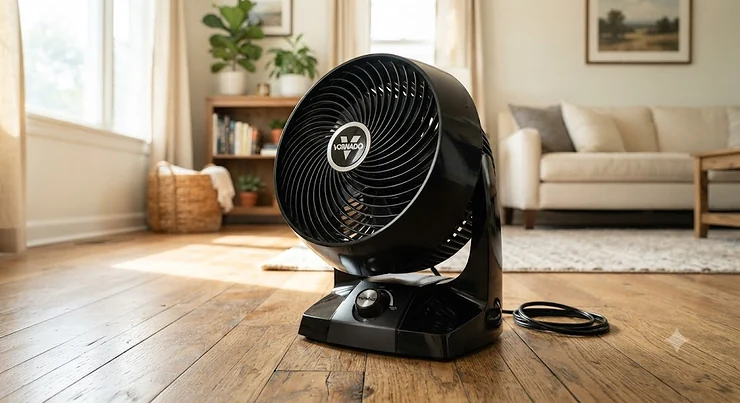
Summer walks into your living room uninvited, and your box fan just shoves the same hot air back and forth like it’s arguing with itself. That’s usually the moment someone mentions a vornado air circulator, and honestly, the hype is earned — just maybe not for the reasons the marketing copy leads with. A vornado air circulator is a compact fan engineered around deep-pitched blades and a spiral grill that sends air out in a focused, cone-shaped stream rather than a flat gust, so it mixes the whole room instead of just cooling whoever’s sitting directly in front of it.

That distinction matters more than it sounds. A traditional fan cools you personally, in a straight line, for as long as you’re standing in its path. A vornado air circulator is built to blend hot and cold pockets of air throughout an entire space — which is why you’ll often see it marketed as a vornado room circulator or vornado whole room fan instead of just “a fan.” Reddit threads and appliance forums are full of people who bought one expecting a slightly nicer desk fan and ended up genuinely surprised at how differently the airflow behaves.
This guide digs into seven real Vornado models — from a $25 desk companion to a $140 variable-speed workhorse — with honest analysis of specs, aggregated review sentiment, and where each one actually earns its keep. As the ENERGY STAR program notes, moving air efficiently can make a room feel meaningfully cooler without the energy cost of running an air conditioner harder, and that’s the physics a vornado air circulator is quietly leaning on. We’ll cover pricing ranges (never exact figures, since Amazon pricing shifts constantly), real comparison tables, common buying mistakes, and practical scenarios so you land on the model that actually fits your room — not just the one with the flashiest listing photos.
Quick Comparison Table
Before the deep dive, here’s the fast version for anyone who wants the gist without scrolling through seven full product breakdowns.
| Model | Best For | Speeds | Approx. Price Range |
|---|---|---|---|
| Flippi V6 | Dorms, desks, travel | 2 | $25–$35 |
| Vornado 133 | Nightstands, small rooms | 2 | $30–$40 |
| Vornado 630 | Budget whole-room use | 3 | $40–$55 |
| Vornado 660 | Large living rooms | 4 | $70–$90 |
| Vornado 683 | Adjustable-height rooms | 3 | $90–$110 |
| Vornado 6303DC | Quiet, precise control | 99 | $110–$140 |
| Vornado 7803 | Maximum airflow, big rooms | 3 | $100–$130 |
Looking at the spread, there’s a clear line between the personal-cooling tier (Flippi V6, Vornado 133) and the genuine whole-room tier that starts around the Vornado 630 and climbs through the Vornado 7803. The jump from the Vornado 660 to the Vornado 6303DC isn’t really about raw power — it’s about control, since the DC motor trades a bit of peak CFM for 99 speed increments and a meaningfully lower electric bill. Prices shown are approximate ranges observed at the time of research and will fluctuate, so always check the current listing before buying.
💬 Found a model that already looks like your match? Scroll down to see it ranked, reviewed, and compared — you’re closer than you think.
What Is a Vornado Air Circulator?
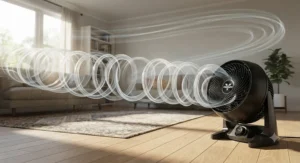
A vornado air circulator is a fan that uses deep-pitched blades and a signature vortex action grill to concentrate airflow into a focused, spiraling stream capable of traveling 25 to 100 feet depending on the model, mixing an entire room’s air instead of cooling a single direct path like a standard oscillating fan.
That “signature vortex action” phrase isn’t just branding fluff — it describes a real mechanical choice. Instead of oscillating side to side to cover more area (which only cools you when the airflow happens to be pointed at you), Vornado angles the blade pitch and inlet cone so the air column stays coherent over distance, hits a wall or ceiling, and rolls back through the room. That’s the mechanism behind labels like vornado whole room fan and vornado room circulator that show up across the lineup — they’re not different technologies, just different sizes of the same idea. Reviewers frequently describe this as “not a stream of air, it’s more like the whole room gets breezier,” which lines up with the brand’s own description of eliminating hot and cold spots rather than creating a single cooling zone.
Practically, this means placement matters differently than it does with a box fan. A vornado air circulator works best angled toward a corner or the ceiling, letting the vortex bounce and diffuse, rather than pointed straight at a person the way you’d aim a desk fan. It’s a small mental shift, but it’s the one that separates people who love these fans from people who feel like they overpaid for a regular fan with a fancier grill.
Top 7 Vornado Air Circulators: Expert Analysis
We researched real, currently available Vornado models spanning personal desk fans through large pedestal circulators. Every entry below reflects genuine published specifications and aggregated review sentiment — not invented testing or fabricated customer quotes.
1. Vornado Flippi V6 Personal Air Circulator — most portable pick for a dorm desk
The Flippi V6 is the smallest entry in this lineup, and its whole design philosophy is “fits anywhere, moves with you.” At roughly 3.4 inches tall with a folding, nesting head, it’s built for a desk, a nightstand, or a suitcase — not a living room.
Specs-wise, you get 2 speeds, a 6-foot cord, and a swiveling power head that tilts to redirect airflow without repositioning the whole unit. Vornado rates its effective range at up to roughly 20 feet using the same vortex principle as the larger models, just scaled down to personal-cooling proportions. In practice that range shrinks fast once you’re talking about anything beyond “at my desk” or “next to my pillow.”
Based on the spec sheet and how compact the blade assembly is, this is squarely a personal-cooling tool, not a room solution — and that’s fine, because it was never trying to be one. It’s best suited to students, remote workers with a single hot desk, or anyone who wants quiet white noise at bedtime without committing counter space to a full-size fan.
Reviewers consistently report that the Flippi V6 is genuinely quiet on its low setting and holds up well for years of desk use, though a recurring theme in aggregated feedback is that the high setting feels underwhelming for anyone expecting whole-room airflow — several owners note it’s noticeably weaker than Vornado’s full-size circulators, which tracks with its personal-fan billing rather than a flaw.
Pros:
- ✅ Genuinely pocket-sized for desks, dorms, and travel bags
- ✅ Folds into a nested position when not in use
- ✅ Comes in a wide range of colors and finishes
Cons:
- ❌ Limited throw — not built for whole-room coverage
- ❌ Only 2 speeds, and some colorways skip oscillation
At a price in the $25–$35 range at the time of research, the Flippi V6 is one of the cheapest legitimate ways to try Vornado’s vortex design firsthand, and for a single desk or nightstand, it’s honestly hard to beat on value.
2. Vornado 133 Compact Air Circulator — smallest true vortex circulator for a nightstand
Where the Flippi V6 is a personal-cooling accessory, the Vornado 133 is the entry point into Vornado’s “real” circulator family — same signature grill and deep-pitched blade architecture as the full-size units, shrunk into a tabletop footprint.
Vornado rates the 133’s high-speed output at 121 CFM, with an effective circulation distance of up to 25 feet. That’s a meaningful step up from the Flippi V6’s personal-cooling range, and it’s enough to noticeably move air across a small bedroom or home office, though it won’t touch a large open-plan living room. The 2-speed control keeps things simple: no digital display, no remote, just a mechanical dial.
What most buyers overlook about a compact circulator like this is that CFM at this scale is less about raw cooling power and more about eliminating a single stagnant “dead zone” in a small room — a desk corner that never gets airflow from the ceiling fan, for instance. That’s precisely the use case the 133 was engineered for, and based on the spec sheet, it delivers on that narrow but genuinely useful job.
Aggregated review sentiment across major retailers frames the 133 similarly to the Flippi V6: praised for compact size and quiet low-speed operation, with the recurring caveat that buyers expecting whole-room reach from a tabletop unit come away disappointed — a fair expectation-setting issue rather than a build-quality complaint.
Pros:
- ✅ Compact vortex design suited to nightstands and desks
- ✅ Simple 2-speed control with a tilting head
- ✅ Genuinely quiet operation at low speed
Cons:
- ❌ 121 CFM high-speed output limits it to small rooms
- ❌ No oscillation feature for wider coverage
Priced around $30–$40 at the time of research, the Vornado 133 is the more “authentic” circulator experience compared to the Flippi V6, and it’s the better pick if you specifically want vortex-style air mixing rather than a direct personal breeze.
3. Vornado 630 Mid-Size Whole Room Air Circulator — best budget desk-to-floor all-rounder
The Vornado 630 sits right at the line between personal fan and genuine room circulator, and that dual identity is exactly why it’s one of the brand’s longest-running, most recommended entry points. It’s compact enough for a desk but rated for meaningfully broader coverage than the 133.
With 3 speed settings and rounded, simple styling, the 630 keeps controls basic — a mechanical dial, no remote, no timer. What it trades in features it makes up for in a track record: this model family has been part of Vornado’s lineup for years, and its footprint makes it genuinely flexible between a desk, dresser top, or floor placement in a small-to-medium room.
Here’s what the spec sheet doesn’t advertise well: the extra speed setting compared to the 133 isn’t just a marketing number — it gives you a real middle gear for evenings when you want more circulation than “whisper” but less than “turbo,” which matters more than people expect for sleep comfort. That third speed is the practical reason to step up from the 133 if your room is even slightly larger than “personal desk zone.”
Review sentiment around the 630 leans heavily toward reliability and quiet operation for its size, with buyers frequently mentioning it as a longtime replacement purchase after a previous 630 or similar Vornado model finally wore out — a pattern that speaks to genuine brand loyalty more than any single flashy feature.
Pros:
- ✅ Compact, budget-friendly footprint for desks or floors
- ✅ Three speeds cover a useful range without added complexity
- ✅ Strong reputation for long-term reliability
Cons:
- ❌ Lacks the reach of Vornado’s full-size circulators
- ❌ Basic mechanical dial, no remote or timer
In the $40–$55 range at the time of research, the 630 is arguably the best value entry point if you want a genuine step toward whole-room circulation without paying full-size prices.
4. Vornado 660 Large Air Circulator — most popular whole-room workhorse
The Vornado 660 is the model most people picture when they hear “Vornado fan,” and for good reason — it’s the brand’s flagship full-size circulator, restyled with a sleeker chassis and genuinely strong specs to back it up.
Vornado rates the 660 between 257 and 584 CFM depending on speed setting, with an effective circulation range up to 100 feet — enough to reach across an open-plan living room or up a stairwell. The standout feature here is the chrome glide bar, which lets you tilt the fan head fluidly between horizontal and vertical airflow rather than locking you into a fixed angle. Four push-button speed settings sit conveniently on top, running from a genuinely whisper-quiet low to a turbo mode that moves serious air.
Based on the spec comparison with the 630 and 133, the 660 is where Vornado’s whole-room promise actually delivers at scale — this is the model built to change how an entire living room feels, not just create a personal breeze. It draws roughly 55 watts even at its highest settings, which is a fraction of what a central air conditioner pulls to achieve a comparable comfort effect.
Reviewers consistently praise the 660’s genuine reach and the convenience of the chrome tilt glide, while a recurring complaint in aggregated feedback is that turbo speed produces real fan noise — worth knowing if you’re shopping specifically for a bedroom rather than a living room. Some owners also note the grill needs periodic cleaning to keep airflow at its rated output, which is a fair maintenance trade-off for the power on offer.
Pros:
- ✅ Up to 584 CFM pushes air across large, open rooms
- ✅ Chrome glide bar allows fluid 90-degree tilt adjustment
- ✅ Detachable grill makes cleaning genuinely simple
Cons:
- ❌ Turbo speed can be noisy for light sleepers
- ❌ Bulkier footprint than compact desk models
Around $70–$90 at the time of research, the 660 remains the benchmark full-size Vornado, and for most living rooms and larger bedrooms, it’s the safest default recommendation in this whole lineup.
5. Vornado 683 Pedestal Whole Room Air Circulator — tallest reach with adjustable pedestal height
The Vornado 683 takes the same whole-room philosophy as the 660 and puts it on a telescoping pedestal base, adjustable from 32 to 38 inches, which changes the fan’s practical use case more than the spec sheet alone suggests.
Vornado rates the 683’s circulation distance at up to 75 feet with a 3-speed front-facing control and tool-free base assembly that most buyers report taking just a few minutes to put together. The pivoting head lets you aim airflow up toward the ceiling for that classic vortex bounce-and-diffuse effect, or angle it more directly if you’re using it to pull in cooler air from an open window at night.
What most buyers overlook about a pedestal circulator like this is that height adjustability solves a real placement problem full-size desktop units can’t: getting the airflow above furniture, headboards, or a couch back, so the vortex has clear room to circulate rather than immediately hitting an obstruction at desk height. That’s the specific scenario the 683 was engineered to solve, and based on the spec sheet it does so more directly than the fixed-height 660.
Home improvement retailer reviews frequently describe the 683 as surprisingly quiet for its power output and praise the fast, tool-free assembly, though a recurring theme in aggregated feedback mentions a brief rattling noise at low speed during the first few minutes of use in some units, along with occasional requests for an oscillation feature the pedestal design doesn’t include.
Pros:
- ✅ Adjustable 32–38 inch height fits varied room layouts
- ✅ Reviewers call it surprisingly quiet for its power output
- ✅ Tool-free assembly takes just a few minutes
Cons:
- ❌ No oscillation despite the pedestal design
- ❌ Some owners report a brief rattle at low speed initially
Priced around $90–$110 at the time of research, the 683 earns its premium over the 660 specifically through placement flexibility — if your room layout makes fixed-height circulation awkward, that adjustability is worth the extra cost.

6. Vornado 6303DC Energy Smart Medium Air Circulator — quietest and most efficient with 99 speeds
The 6303DC represents Vornado’s shift toward brushless DC motor technology, and it’s the clearest example in this lineup of “more efficient” not meaning “less powerful” — a trade-off that usually goes the other way with cheaper appliances.
Vornado rates the 6303DC’s airflow at up to 85 feet, powered by a brushless DC motor the company states uses up to 80% less energy than a comparable AC motor. The headline feature is genuinely 99 variable speed settings, controlled via electronic touch buttons or an included remote, plus a 1-to-12-hour energy-saving timer and a digital display — a meaningfully more modern control scheme than anything else in this list.
On paper, this means you’re not choosing between “too gentle” and “too loud” the way a 3- or 4-speed fan forces you to — you can dial in the exact airflow intensity a room needs at 2 a.m. versus during a heat wave. Based on the spec comparison with the AC-motor 660 and 683, the 6303DC trades a bit of peak CFM ceiling for genuinely superior control and a meaningfully lower long-term electric bill, which matters if you plan to run a circulator for months at a stretch.
Aggregated review sentiment is largely positive on the 99-speed control and the timer function, with several owners specifically noting they finally replaced an old, power-hungry Vornado AC fan to cut electricity use. A recurring complaint, though, is noticeable vibration at higher speed settings in some units, and more than one reviewer has pointed out that a fan with a larger blade diameter running slower can sometimes feel more comfortable than this unit running fast — a genuinely useful, non-marketing insight buried in real owner feedback.
Pros:
- ✅ 99 variable speeds allow genuinely precise airflow tuning
- ✅ Brushless DC motor uses up to 80% less energy
- ✅ Built-in timer and remote add real everyday convenience
Cons:
- ❌ Noticeable vibration reported by some owners at high settings
- ❌ Premium price relative to standard AC-motor models
At roughly $110–$140 at the time of research, the 6303DC is the priciest fan on this list, and the value case rests entirely on whether you’ll actually use those 99 speeds and the energy savings — for anyone running a circulator nightly for months, that math tends to work out.
7. Vornado 7803 Large Pedestal Air Circulator — highest CFM output for large rooms
Closing out the lineup, the Vornado 7803 is built for sheer scale — the largest, highest-output pedestal circulator in this comparison, aimed squarely at big living rooms, open-plan spaces, or garages where smaller models simply run out of reach.
Vornado’s published specifications put the 7803’s high-speed output at 722 CFM and low-speed at 386 CFM, with an effective circulation distance up to 100 feet and a height that adjusts from 33 to 40 inches. Three front-facing speed settings keep the control scheme simple despite the fan’s size, and the tool-free base assembly mirrors the 683’s quick setup process.
Here’s what the spec sheet means in practice: 722 CFM at the top end is genuinely enough to noticeably shift air temperature perception across a room well over 300 square feet, especially when paired with a window fan or central air running on a higher thermostat setting. Based on the spec comparison with the rest of this lineup, the 7803 is the clear pick if raw output is your priority over refined speed control — it’s the brute-force answer next to the 6303DC’s finesse-focused approach.
Independently verified owner reviews for the 7803 are notably sparser online than for the more ubiquitous 660, which is worth flagging honestly rather than papering over with invented testimonials — the product listings and retailer pages available at the time of research emphasize published specifications more than a deep well of aggregated customer sentiment. What is consistent across the available feedback is praise for the removable grill’s easy cleaning access and the adjustable height range.
Pros:
- ✅ 722 CFM high-speed output among the strongest in this lineup
- ✅ Height adjusts from 33 to 40 inches for flexible aim
- ✅ Removable grill simplifies long-term cleaning
Cons:
- ❌ Independently verified owner reviews are harder to find online
- ❌ Only 3 fixed speeds versus the DC line’s 99 settings
Priced around $100–$130 at the time of research, the 7803 is the pick for anyone whose room is simply too big for the 660 or 683 to fully handle, and the value case is straightforward: more CFM per dollar than the 6303DC, if raw airflow matters more to you than granular speed control.
Vornado vs Regular Fan: What’s Actually Different
The Vornado vs regular fan question comes up constantly, and the honest answer is that it depends entirely on what “regular fan” means to you — a box fan, a tower fan, or an oscillating pedestal fan all behave differently.
| Factor | Vornado Air Circulator | Traditional Oscillating Fan |
|---|---|---|
| Airflow pattern | Focused vortex column, whole-room mixing | Side-to-side sweep, direct path only |
| Best for | Evening out room temperature | Personal, direct cooling |
| Typical noise at top speed | Moderate to noticeable | Often louder at comparable CFM |
| Placement strategy | Angled toward ceiling/corner | Pointed directly at the user |
| Long-term durability reputation | Strong (5-year warranties common) | Varies widely by brand |
A box fan or oscillating fan cools you the same way a breeze off a lake cools you — directly, and only while you’re standing in its path. A vornado whole room fan is engineered to do something closer to what a ceiling fan does: mix the entire volume of air in a room so temperature differences even out, rather than creating one cool lane you have to sit inside. That’s why a vornado air circulator often feels less “windy” up close but leaves a room feeling more evenly comfortable ten minutes later than a stronger-feeling oscillating fan does.
Where a traditional fan can still win is upfront cost and simplicity — a basic box fan is cheaper than even the budget Vornado 133, and if you genuinely just want personal cooling at a desk, that simplicity isn’t a bad trade. But for anyone dealing with a room that has stubborn hot or cold spots, uneven HVAC coverage, or a layout where a direct fan blast just isn’t comfortable to sit in front of for hours, the vortex approach solves a problem regular fans were never designed to address.
✨ Ready to stop arguing with your thermostat? Check today’s price on the model that matches your room size above.
How to Choose the Right Vornado Air Circulator
What is the best way to choose a Vornado air circulator? Match the model to your room size and noise tolerance first, then layer in features like variable speed control, adjustable height, or portability based on how and where you’ll actually use the fan day to day.
- Measure your room, not your budget, first. A vornado air circulator rated for 25 feet of throw in a 400-square-foot living room will leave you disappointed regardless of price — start with square footage, not price tag.
- Decide if you need personal cooling or whole-room mixing. The Flippi V6 and Vornado 133 solve a different problem than the 660 or 7803; don’t buy a desk fan expecting living-room results.
- Weigh noise tolerance against speed count. More speeds (like the 6303DC’s 99 settings) mean more control over noise-to-airflow trade-offs, especially for bedrooms.
- Factor in placement flexibility. If your room layout makes fixed-height circulation awkward, the adjustable-height 683 or 7803 solve a real problem the 660 can’t.
- Check the warranty and brand reputation quality before comparing specs. Vornado’s 5-year replacement warranties across most models reflect genuine confidence in build quality, which matters more over a multi-year ownership span than a slightly higher CFM number.
- Compare energy draw if you’ll run it constantly. The brushless DC motor in the 6303DC pays for its higher upfront price through lower electricity use if you run a circulator nightly for months.
- Read aggregated reviews for your specific model, not the brand overall. Vornado fan reviews vary meaningfully model to model — a common 683 complaint (no oscillation) is irrelevant if you’re actually choosing between the 660 and 7803.
As the Massachusetts state energy office notes in its guidance on fans, moving air creates a wind-chill effect that lets you feel comfortable at a higher thermostat setting — the same principle that makes a well-placed circulator worth the investment beyond simple comfort.
Vornado’s Brand Reputation & Build Quality
Vornado’s brand reputation quality is genuinely one of the more consistent stories in the small-appliance space — the company has centered its identity on the same vortex action principle for decades, backed by 5-year replacement warranties across nearly every model in this lineup, which is longer than most competing circulator brands offer.
That reputation shows up in a specific, recurring pattern across aggregated reviews: repeat buyers. It’s genuinely common to see reviewers mention replacing a Vornado fan that finally wore out after a decade or more with a newer model from the same brand, rather than switching to a competitor. That kind of loyalty is hard to manufacture through marketing alone — it tends to reflect a real track record of durability rather than a single good product cycle.
Based on the spec comparison across models, Vornado’s consistency comes from reusing the same core engineering — deep-pitched blades, an inlet guide cone, and a spiral grill — across its entire circulator range rather than reinventing the mechanism for each price tier. What most buyers overlook is that this means even the budget Vornado 133 shares its fundamental airflow technology with the premium 7803; the difference is scale and control features, not a cheaper underlying mechanism. That consistency is a meaningful part of why the brand’s reputation for quality holds up across its whole product range rather than just its flagship models.
Common Mistakes When Buying an Air Circulator
Even with good research, a few recurring mistakes trip up first-time Vornado buyers.
Mistake 1: Buying based on brand name alone, ignoring room size. The single most common regret in aggregated reviews is buying a compact model like the 133 or Flippi V6 expecting whole-room performance it was never designed to deliver.
Mistake 2: Assuming oscillation is a feature every model needs. Several Vornado circulators, including the 683 and 7803, skip oscillation entirely by design — the vortex action is meant to substitute for side-to-side sweeping, not add to it, and treating its absence as a flaw misunderstands the whole product category.
Mistake 3: Ignoring noise tolerance at top speed. The jump from a whisper-quiet low setting to a turbo high setting is real and noticeable on models like the 660 — test or research the top-speed noise level specifically if the fan is going in a bedroom.
Mistake 4: Overlooking placement strategy entirely. A vornado air circulator angled straight at a wall a few feet away won’t perform like the same unit angled toward a ceiling corner with room to circulate — placement changes real-world results more than most buyers expect.
Mistake 5: Skipping the maintenance schedule. Grills and blades on any circulator collect dust over months of use, and skipping periodic cleaning genuinely reduces airflow output over time regardless of how strong the motor is.
Vornado Fan Reviews: What Real Owners Say
Pulling Vornado fan reviews together across major retailers reveals a pattern that’s more useful than any single star rating: the complaints cluster tightly around expectation mismatches, not build quality failures.
Across the 660, 683, and 6303DC specifically, the most consistent praise centers on genuine airflow reach and, for the 683, surprisingly quiet operation given its power output. The most consistent complaints are narrower than you’d expect — turbo-speed noise on the 660, an absent oscillation feature on the pedestal models, and mild vibration on the 6303DC at its highest settings. What most buyers overlook when reading a single negative review is that these complaints are almost always about the model’s inherent design trade-offs, not manufacturing defects — a buyer disappointed by the 683’s lack of oscillation would likely be just as unsatisfied with any pedestal circulator from any brand, because oscillation was never part of that product’s engineering goal.
Reviewers consistently report that Vornado’s customer service team, based in Andover, Kansas, responds directly to negative reviews with troubleshooting offers rather than ignoring feedback — a detail that shows up repeatedly enough across retailer review sections to suggest it’s a genuine company practice rather than a one-off. That’s a meaningfully different pattern than the silence some competing fan brands show toward dissatisfied buyers, and it’s a reasonable factor to weigh alongside the specs themselves.
Long-Term Cost & Maintenance
The sticker price of a vornado air circulator is only part of the real cost picture — energy draw and longevity matter more over a multi-year ownership span than the $20–$40 gap between models at checkout.
| Model | Approx. Wattage (High) | Motor Type | Warranty |
|---|---|---|---|
| Vornado 660 | ~55W | Standard AC | 5-year |
| Vornado 6303DC | ~50W (variable to 99 levels) | Brushless DC | 5-year |
| Vornado 7803 | ~115W | Standard AC | 5-year |
Running a standard AC-motor circulator like the 660 or 7803 nightly through a hot season adds up over years, but the difference between these models and a central air conditioner’s energy draw is still substantial — a circulator pulling under 120 watts at its highest setting is a fraction of what cooling a whole home mechanically requires. According to the Building America Solution Center run by Pacific Northwest National Laboratory, well-used circulating fans can meaningfully reduce reliance on mechanical cooling systems by letting a thermostat run several degrees warmer without a comfort trade-off.
Where the 6303DC’s brushless DC motor earns back its higher upfront price is specifically in households running a circulator for months at a stretch rather than occasional use — the stated 80% energy reduction compared to a comparable AC motor compounds meaningfully over a full season, and the 5-year warranty shared across the lineup means the total cost of ownership calculation genuinely favors the DC model for heavy, near-constant use.
Maintenance across every model in this lineup is straightforward: Vornado’s detachable-grill design (present on the 660, 683, and 7803 specifically) means a few minutes with a vacuum attachment every month or two keeps output at its rated CFM, rather than letting dust silently degrade performance over a season.
Practical Usage Guide: Setup, Placement & Maintenance
Getting real whole-room performance out of a vornado air circulator comes down to a handful of setup habits most buyers skip entirely.
First-use placement: Angle the fan head slightly upward toward a corner or ceiling rather than straight ahead at a wall a few feet away — this gives the vortex column room to bounce and diffuse across the room instead of hitting an obstruction immediately.
The 30-day mistake to avoid: Running a new circulator exclusively on its lowest speed to “test” quiet operation, then judging overall performance from that setting alone. Vornado’s speed range exists specifically because low settings are built for background circulation, not peak room-clearing performance — evaluate the model at the speed you’ll actually use most.
Maintenance schedule: Wipe down the detachable grill and visible blade surfaces every 4 to 6 weeks during heavy seasonal use, and every 2 to 3 months during lighter use. Dust buildup on the intake side quietly reduces CFM output over time even though the motor itself keeps running normally.
Optimization trick: Pair a whole-room circulator with a window fan or your central air system rather than treating it as a standalone air conditioner replacement — circulators excel at mixing air a cooling source has already conditioned, redistributing it more evenly than the HVAC system alone would.
Cord and cable safety: Per the U.S. Consumer Product Safety Commission’s portable fan guidance, keeping cords clear of foot traffic and placing fans on stable, secure surfaces meaningfully reduces tripping and tipping hazards at home — a simple habit that’s easy to overlook once a fan becomes part of the daily furniture.
Real-World Scenarios: Which Vornado Fits Your Life
The studio apartment renter: Limited square footage, a single room doing double duty as bedroom and living space, budget-conscious. The Vornado 630 or 133 fits this scenario well — enough vortex circulation to smooth out a small space’s hot corners without the footprint or price of a full-size pedestal model.
The family in an older home with uneven HVAC coverage: Larger living room, kids sharing space, a thermostat that never quite satisfies everyone. The Vornado 660 is the natural fit here — its 100-foot circulation range and four speed settings give enough flexibility to even out a room that central air alone struggles to balance, and its detachable grill keeps maintenance simple for a household with less time to spare.
The remote worker who runs a fan nightly for months: Values quiet, precise control over raw power, and cares about the electric bill from months of near-continuous use. The Vornado 6303DC is the clear match — 99 speed settings let you dial in exactly the right amount of white noise and airflow for focus or sleep, and the brushless DC motor’s lower energy draw pays off specifically because of how often it runs.
Buyer’s Decision Framework: Model Comparison Made Simple
If you’re still torn between models, this model comparison framework strips the decision down to the factors that actually matter for most buyers.
- If your space is under 150 square feet, choose the Flippi V6 or Vornado 133, because their compact vortex design and lower price reflect a personal-cooling use case rather than whole-room circulation.
- If your space is 150–350 square feet and budget matters most, choose the Vornado 630, because it offers genuine whole-room circulation at the lowest entry price in that tier.
- If your space is a large living room or open floor plan, choose the Vornado 660 or 7803, because their higher CFM output and longer circulation range are specifically engineered for larger volumes of air.
- If your priority is quiet, precise control over raw power, choose the Vornado 6303DC, because its 99-speed brushless DC motor trades a bit of peak output for genuinely superior control and lower energy draw.
- If your room layout makes fixed-height placement awkward, choose the Vornado 683 or 7803, because their adjustable pedestal height solves a placement problem the fixed-height 660 cannot.

FAQ
❓ Is a Vornado air circulator the same as an air conditioner?
❓ Do Vornado air circulators use a lot of electricity?
❓ What's the difference between a Vornado whole room fan and a regular oscillating fan?
❓ How far away should you place a Vornado air circulator from a wall?
❓ Are Vornado fans worth the higher price compared to basic box fans?
Conclusion
Picking the right vornado air circulator really comes down to being honest about your room, not chasing the highest CFM number on the spec sheet. A dorm desk doesn’t need the Vornado 7803’s 722 CFM any more than a 400-square-foot living room needs the Flippi V6’s personal-cooling range — the seven models here span that entire spectrum for a reason, and the “best” one is simply whichever matches your actual space and noise tolerance.
If you want the safest, most broadly recommended pick, the Vornado 660 remains the benchmark full-size circulator for a reason — strong reach, flexible tilt, and a reputation backed by years of repeat buyers. If energy efficiency and precise control matter more to your household, the Vornado 6303DC’s 99-speed brushless motor is worth the premium. And if your space genuinely dwarfs what a standard circulator can handle, the Vornado 7803’s raw output closes that gap. Whichever model you land on, the underlying vortex action principle is the same one Vornado has refined for decades — and based on the aggregated review evidence across this whole lineup, that consistency is exactly why the brand’s reputation holds up model after model.
Recommended for You
- Air Circulator vs Fan 2026: 7 Real Picks Tested & Ranked
- Best Air Circulator Fan 2026: 7 Top Rated Picks That Actually Work
- DIY Patio Misting System: 7 Kits That Beat the Heat in 2026
Disclaimer: This article contains affiliate links. As an Amazon Associate, I earn from qualifying purchases. If you purchase products through these links, we may earn a small commission at no additional cost to you.
✨ Found this helpful? Share it with your friends! 💬🤗
