
In This Article
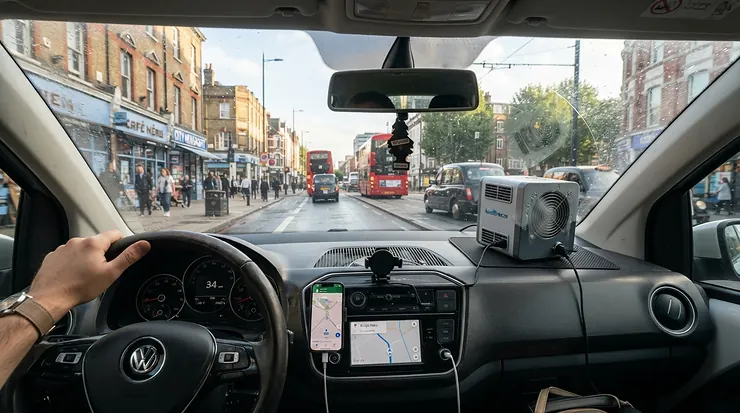
Your dashboard is a griddle. The steering wheel could sear a steak. And you’re staring at a $40 plastic box online that promises “arctic air from your cigarette lighter.”

Here’s the catch most listings skip. A real portable car air conditioner, one with a compressor and refrigerant, can’t run off a standard 12V socket. The things that do plug into that socket are almost always evaporative coolers, which are a different animal. The U.S. Department of Energy says evaporative cooling works in low-humidity areas and shouldn’t be used in humid climates. That one fact decides whether your purchase works or becomes a very expensive desk ornament.
So this guide does something unfashionable: it tells you which is which. I researched seven real products across three categories. One is a compressor-based portable AC for car use with its own battery. One is an ice-chest hybrid. Three are evaporative coolers, including a dead-simple 12V option for a small car AC unit budget. Two are premium units that need extra power gear before they’ll work in a vehicle.
You’ll get real specs, the arithmetic behind the power limits, aggregated review sentiment, and plain-spoken advice on who should buy what. If a data point can’t be verified, I’ll say so instead of dressing it up.
Prices below are ranges from the time of research. Check current prices before you buy.
Quick Comparison: 7 Portable Car Air Conditioner Options at a Glance
| Product | Type | Power Source | Cooling Output | Best For |
|---|---|---|---|---|
| Zero Breeze Mark 3 | Compressor AC | 48V battery; 12V needs a booster | 5,280 BTU | Maximum cooling, parked use |
| EcoFlow Wave 3 | Compressor AC/heater | Add-On Battery, AC, power station | 6,100 BTU | Vans, SUVs, camper builds |
| Zero Breeze Mark 2 Plus | Compressor AC | 24V battery (included) | 2,300 BTU | Lighter true AC for small spaces |
| IcyBreeze V2 Pro | Ice-chest AC | Rechargeable battery or 12V adapter | Ice-water chilled air | Day trips, tailgating |
| MightyKool K2 | Evaporative | 12V plug | Water-evaporation cooling | Plug-and-play personal cooling |
| Evapolar evaCHILL EV-500 | Evaporative | USB (5V) | 100-350W (340-1,190 BTU/hr) | Desk, bedside, light car use |
| Turvysen 12V Dashboard Cooling Fan | Evaporative fan | 12V | Light personal cooling | Tight budgets |
Notice the pattern. As the price climbs, the cooling gets genuinely stronger, but the 12V compatibility gets worse. The Zero Breeze Mark 3 and EcoFlow Wave 3 are true air conditioners, yet neither runs straight from your socket. The MightyKool K2 and Turvysen 12V Dashboard Cooling Fan plug right in, but they only cool air you’re sitting in front of. The Zero Breeze Mark 2 Plus lands in the middle, with a compressor and a battery of its own.
Buy for the climate you live in and the way you actually use your car, not for the biggest number on the box.
💬 Just one click — help others make better buying decisions too!😊
Top 7 Portable Car Air Conditioner Picks: Expert Analysis
Quick note on method. Everything below comes from manufacturer specs plus published reviews and retailer ratings. I haven’t owned or tested these units, and I won’t pretend otherwise. Where review data is thin, I’ll flag it.
1. Zero Breeze Mark 3 — strongest cooling you can carry in one hand
The Zero Breeze Mark 3 is the heavyweight of the compact world. It’s rated at 5,280 BTU of cooling, weighs about 22 lbs, and uses a custom 48V inverter compressor.
Rated input is 500W, which at 12V would mean roughly 40 amps. That’s far beyond any car socket. In a car, you power it from the 1,022Wh Mark 3 battery, which the brand says runs 2-3 hours per battery depending on mode. Zero Breeze also sells a 48V Booster for stepping up 12V, 24V or 36V sources, and the battery can recharge from a cigarette socket.
Based on the spec comparison, this is a parked-car, camping and overlanding tool. The brand pegs it at 100-150 square feet, which is overkill for a sedan cabin but handy for a rooftop tent or van. It also heats.
Independent car-specific review data is thin. One brand-page reply apologizes for delivery delays, so check shipping timelines before you commit.
Pros:
- ✅ 5,280 BTU of real compressor cooling
- ✅ Heating mode and dehumidifying included
- ✅ Stackable batteries extend runtime
Cons:
- ❌ Needs the battery or a 48V booster to run
- ❌ Premium price, and the battery is extra
Expect roughly $1,800-$2,000 for the AC plus a battery. Verdict: superb if you need true AC away from a power outlet, but overbuilt for casual commuters.

2. EcoFlow Wave 3 — smartest app-controlled unit with built-in heating
The EcoFlow Wave 3 delivers 6,100 BTU of cooling and 6,800 BTU of heating through an app. The Add-On Battery sells separately and adds about 21.4 lb to the unit’s roughly 33.7 lb.
That weight matters. One European retail tester called the Wave 3 “decent but not spectacular.” They found 6,100 BTU fine for vans and small motorhomes but strained in larger vehicles, and too heavy for frequent relocation. The numbers back that up: the combined setup weighs about 55 lb.
Car charging exists, but it’s slow. The unit lists a 100W car-outlet input, and the Add-On Battery accepts up to 200W from a 12V/24V auxiliary outlet. Run times with the battery range from 2 to 8 hours depending on settings.
What the spec sheet won’t tell you is that this is a semi-permanent install. Think van, camper or SUV camp setup, not a daily commuter hatchback.
Pros:
- ✅ Cooling and heating in one unit
- ✅ App control with several charging methods
- ✅ Strongest cooling output in this guide
Cons:
- ❌ Heavy, especially with the battery
- ❌ Battery sold separately and adds cost
Expect around $1,500-$2,200 for the unit alone, with the battery on top. Verdict: great for van-lifers and overlanders, poor value for occasional hot-parking relief.
3. Zero Breeze Mark 2 Plus — lighter true AC with its own battery
The Zero Breeze Mark 2 Plus is the older, lighter sibling. It delivers 2,300 BTU, weighs 16.5 lbs, and ships with a rechargeable battery rated for roughly 3-5 hours.
Retailer pages describe the battery at roughly 630-840Wh depending on listing, so verify what’s in the box. Rated input is about 240W, peaking near 260W. The brand claims a drop of up to 30°F in 10 minutes in a small insulated space, measured in a 96°F lab. A car cabin with sun-baked glass is not a lab, so expect less.
It uses a dual-hose system that pulls in outside air and exhausts heat through a second hose. In a car, that means routing a hose out a cracked window, which is a minor fiddle but a real one.
Reviewers on retailer pages rate it between about 4.1 and 4.8 out of 5. That’s a spread worth noting, since different stores collect different review pools.
Pros:
- ✅ Genuine compressor cooling in a lighter body
- ✅ Includes a battery for off-grid use
- ✅ Runs on 24V supplies or the included battery
Cons:
- ❌ Hose routing needs a cracked window
- ❌ Weaker than the Mark 3 in hot cabins
Expect roughly $1,600-$1,800. Verdict: the sweet spot if you want real air conditioning and don’t need the Mark 3’s firepower.
4. IcyBreeze V2 Pro — ice-chest air conditioner that doubles as a cooler
The IcyBreeze V2 Pro pumps ice-cold water through a radiator while a fan pushes air across it. No refrigerant, no compressor. It runs from a rechargeable battery, a 12V car adapter or a wall adapter.
That low-tech design cuts both ways. The brand claims a 35°F drop below ambient for four to six hours. A police-focused field test, however, found the unit cooled a van by only about two degrees using cubed ice, though it added no humidity. Reviewers at GearJunkie noted it cools air quickly but that the ice doesn’t last long when used as AC.
Block ice or frozen jugs last longer than party ice, and one reviewer who tested it in a truck recommends 20 pounds or more for a full day. Plan your ice logistics before you plan your road trip.
On paper this means it behaves more like personal air conditioning than cabin cooling. Aim the duct at yourself.
Pros:
- ✅ No humidity added, unlike evaporative units
- ✅ Doubles as a beverage cooler
- ✅ Multiple power options including a 12V adapter
Cons:
- ❌ Ice melts fast when run as AC
- ❌ Modest cabin-wide cooling in field tests
Expect around $300 for the base model, more with a battery. Verdict: a clever hybrid for tailgates and camping, not a commuter fix.
5. MightyKool K2 — easiest 12V plug-and-play cooler
The MightyKool K2 is the one you can plug into a car socket and forget about. It’s a 12V evaporative cooler with a 120V-to-12V converter for home use.
It pushes about 25 mph of air through dual vents, and its 700 mL tank is claimed to give 6-8 hours of cooling, with an auto dry-off safety feature. The seller positions it for people and pets in non-moving vehicles, which tells you something about its intended use.
An editorial roundup from Air Conditioner Lab named it a top choice for personal cooling in an open-air car. The key phrase is “open-air.” Evaporative cooling needs ventilation and dry air to work.
What most buyers overlook is humidity. In a muggy city, you’ll mostly feel moving air, not chilled air.
Pros:
- ✅ True 12V plug-in, no extra gear
- ✅ Dual vents for driver and passenger
- ✅ Long tank runtime for a small unit
Cons:
- ❌ Weak in humid climates
- ❌ Not meant for use while driving
Expect to land somewhere in the low-to-mid $100s, though retailer pricing moves, so verify before buying. Verdict: the best balance of effort and payoff for dry-climate drivers.
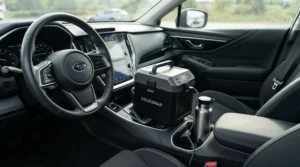
6. Evapolar evaCHILL EV-500 — pocketable personal cooler for desk and car
The Evapolar evaCHILL EV-500 is tiny: 750 g, an 800 mL tank, and just 7.5W of power draw. A Trusted Reviews tester measured 6.2W on full power and found the tank lasts roughly three to five hours.
Cooling is rated at 100-350W (340-1,190 BTU/hr), covering about 2-2.5 m² in the airflow direction. That’s a personal bubble, not a cabin. It runs on USB, and a car outlet works only through an adapter that supplies at least 2A at 5V.
Verified buyer reviews on retailer pages note two quirks: the fill funnel can splash, and you must refill with the unit disconnected. Retailer ratings sit around 4.4 out of 5.
Honest read: this is better as a bedside or desk cooler that occasionally rides along. For serious vehicle portable cooling, step up.
Pros:
- ✅ Whisper-quiet, around 50 dB
- ✅ Very low power draw, so power-bank friendly
- ✅ Replaceable cartridge lasts 3-6 months
Cons:
- ❌ Small cooling zone
- ❌ Tank refills every 3-8 hours
Expect roughly $110-$130. Verdict: an easy buy if you want one gadget for the car, office and bedroom.
7. Turvysen 12V Dashboard Cooling Fan — cheapest way into 12V cooling
The Turvysen 12V Dashboard Cooling Fan is the entry-level option. It plugs into 12V and cools air using water or ice in a reservoir, which one gear guide plainly describes as “not a true AC.”
I couldn’t verify detailed specs such as exact wattage or tank size, and independent review data is thin. Treat listing claims with caution and read the return policy before buying.
Even so, the logic holds. A reservoir-and-fan unit gives modest relief for pennies. In a dry climate with a cracked window, it can take the edge off a hot commute. In a humid one, it mostly moves warm air around.
Think of it as a very good fan with a damp pad, not a miniature AC.
Pros:
- ✅ Lowest cost of every option here
- ✅ Simple 12V plug-in operation
- ✅ Easy to move between vehicles
Cons:
- ❌ Limited, personal-only cooling
- ❌ Specs and reviews are hard to verify
Expect roughly $40-$100, with variation by listing. Verdict: a low-risk experiment, as long as you keep expectations modest.
Head-to-Head: Power, Runtime and Fit
| Product | Cooling Method | Power Draw | Runtime | Best For |
|---|---|---|---|---|
| Zero Breeze Mark 3 | Compressor | 500W rated | 2-3 hrs per battery | Heavy-duty parked cooling |
| EcoFlow Wave 3 | Compressor | 820W max AC input | 2-8 hrs with Add-On Battery | Vans and camper builds |
| Zero Breeze Mark 2 Plus | Compressor | ~240W rated | 3-5 hrs | Lighter true AC |
| IcyBreeze V2 Pro | Ice-water chill | Pump and fan (low) | Up to 4-6 hrs of ice (brand claim) | Tailgates and day trips |
| MightyKool K2 | Evaporative | 12V plug | 6-8 hrs per tank | Dry-climate commuters |
| Evapolar evaCHILL EV-500 | Evaporative | 7.5W | 3-8 hrs per refill | Personal USB cooling |
| Turvysen 12V Dashboard Cooling Fan | Evaporative fan | Check listing | Depends on tank | Budget buyers |
Read this table sideways. The power-hungry compressor units give the strongest cooling but demand batteries. The low-draw evaporative units are easy on your car but depend on dry air. If you run a Zero Breeze Mark 3 from a 12V source, you need the booster. If you pair an EcoFlow Wave 3 with its battery, you’re buying a small power system, not just a cooler.
What Is a Portable Car Air Conditioner?
A portable car air conditioner is a self-contained cooling device you place inside or beside a vehicle, rather than a system built into the dashboard. Some use a compressor and refrigerant like a home AC. Others cool air through evaporating water or melting ice. Power comes from a battery, a 12V socket or USB.
That definition hides a big spread. Compressor units remove heat and dehumidify the air, much like the vapor-compression refrigeration cycle that Wikipedia describes. Evaporative and ice-water units use simpler physics and cost far less, but they can’t match true AC in hot, humid conditions.
Keep that split in mind whenever you see “mobile car air conditioner” on a product page. It can mean a 2,300 BTU compressor or a plastic box with a wet pad.
Portable AC for Car 12V: What Your Power Socket Can Really Handle
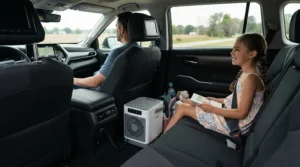
Searching for portable AC for car 12V? Here’s the arithmetic that spoils most marketing. Power equals volts times amps. A Zero Breeze Mark 3 rated at 500W would need roughly 40 amps at 12V. Car accessory sockets are commonly fused around 10-15 amps, or roughly 120-180 watts. Check your owner’s manual for your exact limit.
That’s why the true AC units here use batteries, boosters or power stations, and why 12V operation is realistic only for low-draw evaporative units. The MightyKool K2 and Turvysen 12V Dashboard Cooling Fan are built for it. The Evapolar evaCHILL EV-500 sips so little power that an ordinary USB car adapter handles it.
12 Volt Operation: The Real-World Rules
True 12 volt operation of a compressor unit means wiring directly to a battery, usually a dedicated auxiliary one. That’s an install job, not a plug-in. For portable AC for car 12V shoppers who want simple, stick with evaporative models or battery-based units that recharge from the socket while you drive.
How to Choose a Portable Car Air Conditioner
Follow these steps in order:
- Check your climate. Under 50% humidity, evaporative cooling shines. Above that, lean toward compressor or ice-water units.
- Decide on parked versus driving use. Most portable car air conditioner units aren’t designed for use while the vehicle moves.
- Match power to your setup. Count the amps your socket can supply, or plan a battery.
- Size the cooling to the cabin. A small car AC unit with 2,000-ish BTU suits a tiny space. Bigger vans need more.
- Consider weight and storage. The EcoFlow Wave 3 setup tops 55 lb, so you’ll feel it every time you load the trunk.
- Plan for water, ice or hoses. Each type has its own upkeep.
- Verify the return policy. Several guides note that real-world performance varies widely, so a generous return window protects you.
If you remember one thing, make it step one. Humidity decides everything.
Car Portable Cooling Unit Types vs Traditional Alternatives
A car portable cooling unit comes in three flavors. Compressor units, like the Zero Breeze Mark 2 Plus, cool and dehumidify. Evaporative units, like the MightyKool K2, add moisture. Ice-chest units, like the IcyBreeze V2 Pro, chill water and blow air across it.
| Option | Cooling Strength | Power Needs | Setup | Best For |
|---|---|---|---|---|
| Factory car AC | Strongest | Engine-driven | Built in | Everyday driving |
| Compressor portable (Zero Breeze Mark 3) | High, spot to small space | Battery or booster | Moderate | Parked or camp cooling |
| Ice-chest (IcyBreeze V2 Pro) | Moderate, personal | Low plus ice | Easy | Day trips |
| Evaporative (MightyKool K2) | Light, humidity-dependent | 12V plug | Very easy | Dry-climate comfort |
A mobile car air conditioner can’t replace the factory system on the highway. What it can do is cool you when the engine is off, which is exactly when idling would waste fuel and add exhaust.
For parked cooling, a battery compressor wins on raw performance. For simple relief at low cost, evaporative wins on price. For hauling drinks and cool air together, the ice-chest wins on versatility.
Small Car AC Unit and Compact Car Cooling: Fitting Tight Cabins
A small car AC unit has to solve three problems at once: cooling power, footprint and power draw. Sedans and hatchbacks have smaller cabins, which helps cooling math but hurts placement.
For compact car cooling, the Zero Breeze Mark 2 Plus at 16.5 lbs is the most realistic true-AC option here. Pair it with a window hose and a sunshade, and cooling gets dramatically easier. The Evapolar evaCHILL EV-500 at 750 g fits a cup holder zone.
Placement matters more than you’d think. Aim vents at your torso and face, not the ceiling. Keep hoses clear of the shifter. Never let a unit slide around the footwell.
If your car is a coupe or compact hatch, don’t overbuy. Over 5,000 BTU in a car this small is mostly wasted capacity, while a good small car AC unit at 2,000-ish BTU is plenty for sitting parked in comfort.
Setup Guide: First 30 Days With a Portable Car Air Conditioner
This is the transformation part, the stuff listings skip.
Day 1: Do a dry run at home. Run the unit in your garage before relying on it. Learn the modes and hose routing.
Week 1: Pre-cool strategically. For compressor units, start cooling before you sit down. For evaporative units, crack a window so humid air can escape, as DOE guidance suggests for evaporative systems generally.
Week 2: Build a water and ice routine. Use block ice or frozen jugs with the IcyBreeze V2 Pro. Block ice melts far slower than party ice, according to field reviewers. Refill the Evapolar evaCHILL EV-500 with the unit disconnected.
Week 3: Maintain. Evaporative pads and cartridges need replacing. The Evapolar evaCHILL EV-500 cartridge lasts 3-6 months.
Week 4: Audit your power. Track battery runtime in real heat, then adjust.
Common first-month mistakes: filling tanks while plugged in, forgetting to drain water before storage, and leaving lithium batteries baking in a hot parked car.
Real-World Scenarios: Which Vehicle Portable Cooling Setup Fits You
The Phoenix commuter in a compact hatch. Dry heat, short parked stops. A MightyKool K2 is a smart match, since evaporative cooling thrives in low humidity.
The Houston rideshare driver. Humid air makes evaporative units disappointing. A Zero Breeze Mark 2 Plus gives true dehumidifying cooling during breaks, but budget for the battery.
The weekend overlander with a rooftop tent. A Zero Breeze Mark 3 handles bigger spaces and can chain batteries for longer runtimes.
The van builder. An EcoFlow Wave 3 with Add-On Battery fits when weight and cost are acceptable.
The college student on a tight budget. An Evapolar evaCHILL EV-500 doubles as a dorm cooler. A Turvysen 12V Dashboard Cooling Fan is the cheaper car-only gamble.
For all of them, vehicle portable cooling works best paired with window shades and smart parking.
✨ Don’t Miss These Exclusive Deals!
🔍 Take your summer comfort to the next level with these carefully selected cooling picks. Click on any highlighted product to check current pricing and availability. The right unit will help you stay comfortable on every hot drive and parked break!
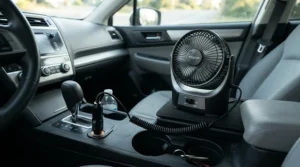
Problem → Solution: Fixing Common Cooling Headaches
Problem: It’s barely cooling. Likely humidity. Switch to a compressor unit or add ventilation.
Problem: The battery dies fast. High modes drain batteries. Use sleep or eco modes. The Zero Breeze Mark 3 brand lists different runtimes by mode.
Problem: Water pools in the footwell. Check hoses and drains. The Mark 3 includes an active drain system, while older units need manual attention.
Problem: My socket keeps blowing fuses. You’re drawing too much. Move to a battery-based unit.
Problem: The unit won’t fit. Measure first, then check weight. A heavy EcoFlow Wave 3 isn’t a front-seat passenger.
Problem: It smells musty. Evaporative cartridges grow stale. Replace them on schedule.
Features That Actually Matter (And Those That Don’t)
Matter: real cooling capacity in BTU, battery capacity in watt-hours, weight, drain handling and return policy.
Don’t matter much: RGB lights, ten fan speeds, mood scents, and “up to 50°F drop” claims without humidity context. That last one, from a retailer page for the Evapolar evaCHILL EV-500, says “depending on the humidity level,” which is the whole story.
A useful rule: if a spec doesn’t change how many hours you stay comfortable, ignore it. The extra apps and modes on the EcoFlow Wave 3 are nice, but its heating capacity and battery pairing are what actually shape your trip.
Common Mistakes When Buying a Portable Car Air Conditioner
- Confusing evaporative with true AC. Check for a compressor and refrigerant.
- Ignoring humidity. It decides evaporative performance.
- Skipping the power math. Amps at 12V add up fast.
- Buying too much BTU. A compact cabin doesn’t need a van-sized unit.
- Forgetting accessories. The Zero Breeze Mark 3 and EcoFlow Wave 3 need batteries or boosters.
- Trusting lab numbers. Brand temperature-drop claims come from controlled environments.
Each mistake costs real money, so slow down before you click.
Long-Term Cost and Power: What Each Option Really Costs
| Product | Upfront Price Range | Ongoing Costs | Best For |
|---|---|---|---|
| Zero Breeze Mark 3 | ~$1,800-$2,000 | Battery wear, optional extras | Frequent camping |
| EcoFlow Wave 3 | ~$1,500-$2,200 + battery | Battery cost, charging | Van life |
| Zero Breeze Mark 2 Plus | ~$1,600-$1,800 | Battery wear | Lighter true AC |
| IcyBreeze V2 Pro | ~$300+ | Ice every trip | Occasional trips |
| MightyKool K2 | Low-to-mid $100s | Water, pads | Dry climates |
| Evapolar evaCHILL EV-500 | ~$110-$130 | Cartridges every 3-6 months | Personal use |
| Turvysen 12V Dashboard Cooling Fan | ~$40-$100 | Water, ice | Budget buyers |
Cost per use tells the story. If you’d run the Zero Breeze Mark 3 only a few days a year, a $1,900 unit is hard to justify. If you live in your vehicle all summer, it can be worth every dollar. Evaporative options look cheap, but if your humidity wrecks their effectiveness, the cheapest option becomes the most wasteful.
Vehicle Portable Cooling: Safety, Idling and Rules
No portable cooler makes it safe to leave a child or pet in a car. The NHTSA’s heatstroke campaign says a child’s body temperature rises three to five times faster than an adult’s, and rolling windows down or parking in the shade does little to change interior temperature. In 2025, 31 children died of heatstroke in vehicles.
Use vehicle portable cooling to make waiting comfortable for you, never as a babysitter. Check the back seat every time you lock up.
A few practical safety notes:
- Secure units so they don’t slide or tip during motion. One reviewer notes cars sway and bounce, so portable ACs shouldn’t run while driving unless properly secured.
- Keep batteries out of sealed hot cars, following manufacturer guidance.
- Never leave water-filled units tipped near electronics.
- Keep a window cracked when using evaporative cooling.
Frequently Asked Questions
❓ Does a portable car air conditioner drain the car battery?
❓ Can a portable AC for car 12V really cool a whole cabin?
❓ Are evaporative coolers worth it in humid states?
❓ How long will a compact car cooling unit run on battery?
❓ Is it safe to run a mobile car air conditioner while driving?
Conclusion: Pick the Tool That Matches Your Air
A portable car air conditioner isn’t one product category. It’s a spectrum, from a $50 damp-pad fan to a $2,000 battery-powered compressor. Where you land depends on your climate, your power setup and how you use your vehicle.
If you want genuine cooling off-grid, the Zero Breeze Mark 3 and EcoFlow Wave 3 lead the pack, with the Zero Breeze Mark 2 Plus as the lighter, cheaper compressor option. For quick, dry-climate relief, the MightyKool K2 is the easiest plug-and-play choice. The IcyBreeze V2 Pro suits tailgating and cooler-plus-AC fans. The Evapolar evaCHILL EV-500 and Turvysen 12V Dashboard Cooling Fan serve personal-use and budget needs.
Know your humidity, do the amp math, and buy the unit that fits both. Do that, and you’ll actually enjoy the thing instead of just owning it.
✨ Ready to beat the heat?
🔍 Click any highlighted product above to check current pricing and availability, and pick the portable car air conditioner that fits your climate and your car. Stay cool out there! 🚗
Recommended for You
- Car Fan For Back Seat: 7 Ultimate Picks For 2026
- Car Seat Cooling Cushion: 7 Best Picks To Beat Heat In 2026
- Best 12V Car Fan: 7 Ultimate Picks To Beat the Heat In 2026
Disclaimer: This article contains affiliate links. As an Amazon Associate, I earn from qualifying purchases. If you purchase products through these links, we may earn a small commission at no additional cost to you.
✨ Found this helpful? Share it with your friends! 💬🤗
