

In This Article
A high volume low speed fan is a large-diameter ceiling fan, generally seven feet or wider, that turns slowly while pushing a huge column of air across a big indoor space. Instead of blasting one worker with a narrow jet, it blankets the floor in a gentle, steady breeze that helps with cooling, heat stress, and air mixing.

Picture a 100,000-square-foot warehouse in July. The dock doors are open, the roof is soaking up sun, and the air at floor level feels like soup. Now add one slow, wide-bladed fan turning overhead. It barely whispers, yet the dead pocket by aisle 14 suddenly moves. That’s the whole pitch. It’s why the HVLS fan has gone from dairy-barn curiosity to standard kit in distribution centers, hangars, and factories.
The physics is friendlier than you’d expect. As Wikipedia’s HVLS overview explains, a three-foot fan’s air column has more than six times the friction per unit of air moved compared with a 20-foot fan’s. Bigger and slower isn’t a compromise. It’s the efficient route to massive air movement.
This guide covers seven real models, from the HVLS industrial fan workhorses to premium direct-drive designs. We’ll also look at the energy efficient industrial angle, what a big ceiling fan industrial buyer should actually weigh, and how a warehouse ceiling fan large enough to matter protects worker comfort in a large space. A heads-up: most of these fans are sold through dealers on a quote basis, so prices below are ranges, and every spec is the manufacturer’s published figure. Check current price and availability before you buy.
Quick Comparison: 7 High Volume Low Speed Fan Models at a Glance
| Fan | Diameters | Drive | Headline Spec (Maker-Published) | Best For |
|---|---|---|---|---|
| Big Ass Fans Powerfoil D | 8–24 ft | Direct drive | 186,716 CFM at 20 ft | Quiet premium installs |
| Hunter Titan | 14–24 ft | Direct drive | 15,625 sq ft at 20 ft | Max coverage per dollar |
| MacroAir AirVolution-D3 | 12–24 ft | Gearless | 17,000 sq ft at 24 ft | Lightweight value builds |
| Hunter ECO | 8–24 ft | Direct drive | 10,000 sq ft at 20 ft | Weight-limited roofs |
| Rite-Hite Revolution | 8–24 ft | Geared | Up to 22,000 sq ft | Very tall buildings |
| MacroAir AirVolution | 8–24 ft | Gear drive | Up to 20,000 sq ft | Rugged, humid, outdoor-adjacent |
| Big Ass Fans Powerfoil X4 | 12–30 ft | See maker’s spec sheet | IP56 full-fan rating | Harsh environments |
Look at the table by buyer type rather than by brand. The Hunter Titan and MacroAir AirVolution-D3 chase the “most floor for the fewest watts” crowd, while the Big Ass Fans Powerfoil D is the pick if noise matters. Coverage numbers are best-case claims, so racking, ceiling height, and obstructions will shave them. Treat them as a ceiling, not a promise.
💬 Just one click — help others make better buying decisions too!😊
Top 7 High Volume Low Speed Fan Models: Expert Analysis
Every fan below is real, currently marketed, and described using the maker’s published specs. Where independent customer-review data is thin (common for quote-based commercial gear), I say so instead of inventing ratings.
1. Big Ass Fans Powerfoil D — quietest premium direct-drive pick
The headline here is acoustics: the maker lists sound at 35 dBA, which is quieter than a typical office.
The Powerfoil D is a brushless direct-drive fan with six aluminum airfoils and winglets, offered from 8 to 24 feet. A retailer listing for the 20-foot version shows 186,716 CFM at 1,290 W and 82 RPM maximum, while the 12-foot model shows 83,637 CFM at 955 W. Do the division: roughly 145 CFM per watt at 20 feet versus about 88 at 12 feet. Bigger genuinely means more efficient. The catch is headroom, since the 20-foot version lists a 25-foot minimum mounting height.
Based on the spec comparison, this fits showrooms, food facilities, and mixed-use spaces where people work near the fan all day. A 2026 industry roundup credits the brand’s hardware polish and controls integration, though it’s written by a competitor, so weigh it accordingly. I couldn’t verify a meaningful pool of independent owner reviews.
Pros:
- ✅ Very low published sound level
- ✅ Direct drive means no gearbox to service
- ✅ Wide 8–24 ft size range
Cons:
- ❌ Premium pricing versus most rivals
- ❌ Tall minimum mounting heights at larger sizes
Pricing: listings for 12–20 ft models sit around $10,000 per fan before freight and installation, so check current price. Verdict: strong value if quiet matters, overkill if it doesn’t.

2. Hunter Industrial Titan — most coverage per watt in the 14–24 ft class
The Titan is Hunter’s flagship, built around a direct-drive permanent-magnet motor, and it spans 14 to 24 feet.
Published figures for the 14-foot model: 715 W max, 103 RPM, under 55 dB, 168 lb, and 7,744 sq ft of maximum affected area. That works out to about 11 square feet of coverage per watt. The 16-foot version claims 10,000 sq ft and the 20-foot 15,625 sq ft. The adjustable downrod telescopes from 2 to 10 feet, which matters when your trusses don’t cooperate.
My read: this is the model for large, open buildings where coverage per dollar and per watt drives the decision. A 2026 buyer’s roundup says Hunter often returns the most per dollar, though that source sells competing fans, so verify with quotes. Warranty details conflict across sources (a retailer cites 15 years non-prorated, Hunter’s catalog says limited lifetime), so confirm in writing. Verified independent reviews were sparse.
Pros:
- ✅ Strong published coverage at every diameter
- ✅ Telescoping downrod simplifies tricky ceilings
- ✅ Direct-drive motor with long warranty claims
Cons:
- ❌ Warranty terms vary by source and need confirming
- ❌ Priced above Hunter’s own ECO line
Pricing is quote-based, so request current pricing. Verdict: the value benchmark for large, high-ceiling floors.
3. MacroAir AirVolution-D3 — lightest gearless option for budget-minded builds
MacroAir pitches the AirVolution-D3 as its most cost-effective gearless fan, and it’s offered in 12- to 24-foot sizes.
The catalog highlights extruded anodized aluminum airfoils, wash-down duty for outdoor use, and “no gearbox,” which means quiet running and nothing to service. A dealer listing for the 24-foot model claims 17,000 sq ft of coverage and ceilings as low as 13 feet. Warranty terms are 10 years mechanical and 7 years electrical, with a shorter labor period, per MacroAir’s warranty overview.
The “lightest on the market” and “best ROI” lines are marketing claims measured against an unnamed competitor, so treat them as hypotheses. Still, a lighter fan is easier to hang and kinder to older roof structures. This suits car dealerships, light manufacturing, and distribution floors with modest ceilings. Public independent reviews were limited.
Pros:
- ✅ Gearless design with no gearbox maintenance
- ✅ Wash-down rating widens placement options
- ✅ Low published minimum ceiling clearance
Cons:
- ❌ “Best ROI” claim is the maker’s own
- ❌ Warranty periods are shorter than older AirVolution terms
Pricing: quote-based, typically positioned as the value tier. Verdict: a smart pick when weight and budget both pinch.
4. Hunter Industrial ECO — lightweight pick for weight-limited roofs
The ECO earns its name by shedding pounds: Hunter markets it as one of the lightest HVLS fans available.
It uses the same direct-drive philosophy as the Titan, with aerospace-style blades. Published coverage claims: 4,900 sq ft at 14 feet, 6,400 at 16 feet, and 10,000 at 20 feet, where it weighs about 145 lb. Compare that 10,000 to the Titan’s 15,625 at the same diameter: the ECO covers roughly 64% as much floor.
So what does that mean for you? If a structural engineer says your roof can’t take much dead load, the ECO removes the problem. If you need every square foot covered with fewer fans, the Titan wins. A 2026 roundup suggests Hunter’s lighter lines suit modest air-volume demands well, though again from a competitor’s pen. I couldn’t verify independent owner reviews.
Pros:
- ✅ Very low hanging weight for its diameter
- ✅ Direct-drive motor keeps maintenance minimal
- ✅ Lower coverage claims offset by lower cost tier
Cons:
- ❌ Roughly one-third less coverage than Titan at 20 ft
- ❌ Fewer premium controls out of the box
Pricing: quote-based, generally below the Titan. Verdict: ideal when the roof, not the budget, is the limiting factor.
5. Rite-Hite Revolution — built for very tall buildings
If your ceiling sits closer to 60 feet than 20, the Revolution deserves a look.
Rite-Hite lists mounting heights from 15 to 80 feet, four Propell-Aire aluminum blades shaped with tilt, taper, and twist, and reach up to 85 feet from the fan’s center. Coverage is claimed at up to 22,000 sq ft. Those blade contours aim to prevent the stagnant “dead spot” under the hub. The original geared model lists 40–63 dBA depending on speed, while Rite-Hite’s newer direct-drive Revolution 75/150 siblings list 38–42 dBA and up to 31,000 sq ft.
Translation: the geared Revolution trades a little noise for proven, simple construction. For aircraft hangars, big-box distribution, and manufacturing bays, the tall-mount range is the differentiator. Its Fan-Commander touchscreen controller, per Rite-Hite, can manage up to 24 fans. A roundup notes Rite-Hite treats fans as one product line among dock and safety systems. I found no independent review sets worth summarizing.
Pros:
- ✅ Exceptional mounting-height range
- ✅ Wide published reach and coverage claims
- ✅ Centralized control for multi-fan layouts
Cons:
- ❌ Geared models run louder at top speed
- ❌ Direct-drive siblings may suit quiet spaces better
Pricing: quote-based, so request current pricing. Verdict: the tall-building specialist.
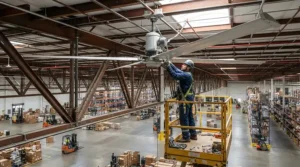
6. MacroAir AirVolution — rugged gear-drive workhorse
Where the AirVolution-D3 went gearless, the original AirVolution keeps an integrated gearmotor and leans on toughness.
MacroAir lists 8–24 ft diameters, six clear-coat anodized airfoils, up to 20,000 sq ft of coverage, a variable frequency drive with fire-alarm integration, and a 15-year mechanical / 7-year electrical warranty. The company’s own figure for running cost is about $2.79 per eight hours, a manufacturer estimate that depends on your fan size and electric rates. The digital wall controller is indoor-only, which matters for semi-outdoor installs.
Based on the spec comparison, a gearmotor adds one component that direct-drive fans eliminate, but the long mechanical warranty suggests MacroAir stands behind it. It’s marketed for barns, warehouses, and hangars, where moisture and dust punish lesser gear. Independent reviews were hard to verify.
Pros:
- ✅ Long 15-year mechanical warranty
- ✅ Built for humid, dusty environments
- ✅ VFD with fire-alarm integration
Cons:
- ❌ Gearbox adds a serviceable component
- ❌ Controller is rated for indoor use only
Pricing: quote-based. Verdict: a safe, durable choice for punishing conditions.
7. Big Ass Fans Powerfoil X4 — flagship for harsh environments
At the top of the range sits the Powerfoil X4, which the maker calls the best-selling big fan in the world.
Treat that as marketing, but the engineering notes are concrete: seven diameters from 12 to 30 feet, a full-fan IP56 rating, a redesigned airfoil system, a double safety cable, and airfoil retainers. IP56 means serious protection against dust and powerful water jets, which is rare in this category. A 30-foot diameter is also the largest option in this roundup.
Who benefits? Food processing, wash-down areas, outdoor-adjacent docks, and mega-facilities with 40-foot-plus ceilings. For a standard dry warehouse, you may be paying for protection you’ll never use. Check the spec sheet for the drive type and current warranty terms, since I couldn’t verify them here, and I found no reliable independent review set.
Pros:
- ✅ Sizes up to 30 ft for massive spaces
- ✅ IP56 rating handles harsh conditions
- ✅ Double safety cable system
Cons:
- ❌ Likely premium cost for dry-warehouse use
- ❌ Largest sizes need substantial structural support
Pricing: quote-based, expect the premium tier. Verdict: buy it for the conditions, not the badge.
Top 7 Spec & Warranty Comparison
| Fan | Drive | Published Warranty | Price Approach | Best For |
|---|---|---|---|---|
| Powerfoil D | Direct | Confirm with seller | Around $10,000 per fan (listings) | Quiet spaces |
| Titan | Direct | Sources conflict; confirm | Quote-based | Big open floors |
| AirVolution-D3 | Gearless | 10 yr mech / 7 yr elec | Quote-based, value tier | Light structures |
| ECO | Direct | Confirm with seller | Quote-based, lower tier | Weak roofs |
| Revolution | Geared | Confirm with seller | Quote-based | Tall buildings |
| AirVolution | Gear | 15 yr mech / 7 yr elec | Quote-based | Humid or dusty sites |
| Powerfoil X4 | See maker | Confirm with seller | Quote-based, premium | Harsh conditions |
The warranty column is the sleeper. The AirVolution carries the longest mechanical term in the verified data, which partly offsets its gearbox. If you want gearless simplicity, the AirVolution-D3 and Titan are the closest matches, while the Powerfoil X4 wins only when the environment, not the budget, calls the shots.
How to Choose a High Volume Low Speed Fan
Selecting the right model comes down to seven decisions, in this order:
- Measure ceiling height first. Every maker lists minimum and maximum mounting heights, and a 20-foot fan can need a 25-foot ceiling.
- Calculate floor area and obstructions. Racking, mezzanines, and machinery bend airflow, so shave coverage claims by a healthy margin.
- Pick diameter before brand. Larger diameters move more air per watt, so one 20-foot fan usually beats several 12-footers.
- Decide gear drive or direct drive. Direct drive removes the gearbox and typically runs quieter; gear drive often brings long mechanical warranties.
- Check structural capacity. Hanging weight matters, which is where the ECO shines.
- Match environment to rating. Wet, dusty, or washed-down areas call for models like the Powerfoil X4 or AirVolution-D3.
- Confirm controls and warranty in writing. Ask about HVAC and fire-alarm integration, labor coverage, and who handles installation.
If you only remember one rule, remember this: a high volume low speed fan is sized by the building, not by the budget. An undersized fan runs at max speed and disappoints, whereas a correctly sized one idles at 40% and keeps everyone comfortable.

Features That Actually Matter (and Those That Don’t)
Marketing sheets love superlatives. Here’s the filter I’d apply.
Matter: Mounting range and weight, because physics beats branding. Motor drive type, because it determines long-term maintenance. Published sound levels, since a noisy HVLS industrial fan defeats the purpose. Safety hardware such as cables, guy wires, and blade retainers. Control integration with your HVAC and fire-alarm systems.
Don’t matter as much: Superlative claims like “lightest” or “best ROI,” which compare against unnamed rivals. Custom powder-coat colors, unless branding counts. Maximum coverage numbers taken at face value, since they assume an empty room.
A useful sanity check is CFM per watt. The Powerfoil D figures above show 87–145 CFM/W depending on size, and that kind of division, not adjectives, reveals which fan is truly energy efficient industrial equipment. Ask every vendor for the same numbers on the same diameter and you’ll cut through the haze quickly.
High Volume Low Speed Fan vs Traditional Industrial Fans
| Option | Airflow Pattern | Noise | Energy Use | Best For |
|---|---|---|---|---|
| Pedestal / drum fans | Narrow, focused jet | Often loud | Needs many units | One workstation |
| High-velocity wall fans | Directional blast | Moderate to loud | Moderate | Spot cooling |
| HVLS fan | Wide horizontal column | Very quiet | Low per area | Whole-floor circulation |
| HVAC alone | Conditioned zones | Varies | High in big spaces | Offices, tight rooms |
The key difference is how the air arrives. A drum fan creates a hurricane at arm’s length and nothing ten feet away, while a big ceiling fan industrial buyer gets a slow, even floor jet that travels to the walls and loops back. That slow loop is also why HVLS fans can mix stratified air in winter, pushing trapped heat back down. Vendors often claim one large fan replaces 20–30 smaller ones, which is plausible in open spaces but not guaranteed around racking.
Looking at the table, HVLS wins on coverage and quiet but loses at spot cooling, since it moves air gently rather than aiming it. The smart move in most warehouses is HVLS for general comfort plus a few targeted fans where heat sources concentrate.
What to Expect: Real-World Performance
Specs describe what a fan can do in a lab. Here’s what changes on your floor.
Expect a breeze, not a gale. One safety-industry write-up on reducing heat stress with HVLS fans notes that an 84-degree warehouse can feel like 73 degrees with air moving at about three miles per hour. That’s a feel-based effect, since the thermometer won’t drop. Moving air helps sweat evaporate, so people feel cooler even when the thermostat reads the same.
Expect uneven results near obstructions. Tall racking breaks the floor jet, which is why layouts matter more than diameter alone.
Expect lower noise than your old fans. Published sound levels for these models sit roughly between 35 and 63 dBA, depending on size, speed, and drive.
Expect a ramp-up. Large fans spool slowly by design. Give them a full shift before judging.
If workers report that things feel “better but not perfect,” the usual fixes are speed adjustments, a second fan for overlap, or reorienting aisles. Rarely is the answer a bigger motor.
Price Range & Value Analysis
| Tier | Models | Buying Route | Best For |
|---|---|---|---|
| Value | ECO, AirVolution-D3 | Dealer quote | Light structures, tighter budgets |
| Mid-range | Titan, AirVolution, Revolution | Dealer quote | Large floors, long warranties |
| Premium | Powerfoil D, Powerfoil X4 | Dealer or retail listing | Quiet or harsh environments |
Pricing across this category is genuinely opaque. The only public anchor I found was retail listings around $10,000 per Powerfoil D, before freight and installation, so treat every other number as unknown until you request a quote.
Looking at the tiers, value-tier models trade coverage or warranty for lower entry cost, mid-range models chase coverage per dollar, and premium models sell on noise, durability, or environmental protection. For most dry warehouses, the mid-range tier is the sweet spot. Notice also that installation, electrical work, and controls can rival the fan’s own cost, so compare total installed quotes, not sticker prices.
✨ Don’t Miss These Exclusive Deals!
🔍 Take your warehouse climate to the next level with these carefully selected fans. Click on any highlighted product name to check current pricing and availability. The right high volume low speed fan can create a calmer, cooler floor your whole crew will
notice!
Long-Term Cost & Maintenance of a High Volume Low Speed Fan
The sticker price is the smallest part of the story. Ongoing costs are electricity, inspection, and eventual parts.
On electricity, vendor claims run high. Rite-Hite cites typical payback of six months to two years and annual energy savings around 20–30%, while another vendor claims up to 30% savings on HVAC heating costs. Those are vendor figures, so request a site-specific estimate. For independent context, a University of Nebraska–Lincoln industrial assessment program evaluated HVLS fans as an energy recommendation, reporting a payback on the order of a couple of years.
On maintenance, direct-drive fans like the Titan and Powerfoil D remove the gearbox. Geared units like the AirVolution compensate with long mechanical warranties. Either way, schedule a periodic visual inspection of mounts, cables, blade retainers, and hardware torque, since a fan this large deserves routine checks.
Total cost of ownership is a simple formula: installed cost plus annual power plus inspection time, minus HVAC savings. Do that math for 10 years, and the cheapest fan rarely stays the cheapest.
Safety, Heat Stress & Worker Comfort in Large Spaces
Comfort isn’t a luxury in a hot building. It’s a risk-management issue.
The United States has no single national rule for every indoor heat situation, but employers face the General Duty Clause, which requires a workplace free of recognized hazards. OSHA’s heat exposure guidance on personal risk factors outlines who’s most vulnerable. OSHA also advanced a proposed heat standard in recent rulemaking. I can’t confirm its current status as of this writing, so check OSHA directly.
For indoor work, air movement is a basic control. A fan overhead keeps the floor moving, and Rite-Hite cites OSHA’s Safety Pays calculator in estimating one serious heat-related incident can cost up to $50,000, a vendor-reported figure worth verifying.
HVLS fans also help with worker comfort in a large space by cutting condensation risk on concrete, though results depend on humidity and ventilation. Pair fans with hydration breaks, shade, and acclimatization plans. Moving air supports a heat-illness program but never replaces one.
Practical Usage Guide: Setup, First 30 Days, and Maintenance
Before installation: Have a licensed electrical contractor confirm voltage, phase, and breaker needs. MacroAir’s warranty, for example, only covers installs done by a qualified contractor per its instructions.
At commissioning: Start at a low speed and raise it gradually. Walk the floor, checking that papers don’t fly and that light-weight shrink wrap isn’t fluttering.
First 30 days:
- Re-check mounting hardware and safety cables after the first week.
- Log speed settings by season and shift, then adjust.
- Watch for pallets of loose material that create blowing hazards.
Seasonal tuning: In summer, run forward at a comfortable speed. In winter, run in reverse at low speed to gently mix warm air from the ceiling, subject to your model’s controls.
Common first-month mistakes: Running everything at full speed, ignoring clearance from sprinklers and lights, and skipping the written maintenance schedule. A five-minute monthly inspection, plus a deeper annual one, prevents most problems before they start.
Real-World Scenarios: Matching a High Volume Low Speed Fan to Your Space
Scenario 1: The 80,000 sq ft distribution center (30-ft ceilings, no AC). Heat stress is the main concern. Large 20–24 ft fans like the Titan or Powerfoil D make sense, with overlap planned around racking. Budget goes toward multiple units and controls.
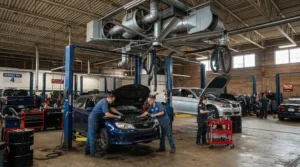
Scenario 2: The auto dealership service bay (18-ft ceilings, customers present). Noise matters. A Powerfoil D or AirVolution-D3 gives low sound and a low clearance requirement. A 12–16 ft fan fits the footprint better than a giant.
Scenario 3: The old building with a weak roof. Structural limits dominate. The ECO or AirVolution-D3 prioritize lightness, but get an engineer’s sign-off first.
Scenario 4: The wash-down food plant. Moisture and cleaning chemicals change the equation. The Powerfoil X4’s IP56 rating or the AirVolution-D3’s wash-down duty rating deserve first looks.
Scenario 5: The 60-foot hangar. Height wins. The Revolution’s 80-foot mounting range is the relevant spec.
The pattern across all five: start with the building’s constraint (height, weight, moisture, noise), then pick the fan. A massive air movement fan is only as good as its fit.
Problem → Solution Guide for HVLS Installations
Problem 1: “My floor still feels stuffy.” Likely culprit: undersized fan or heavy racking. Solution: raise speed modestly, or add a second fan with overlap.
Problem 2: “Papers and light materials blow around.” Solution: lower the speed and keep loose goods away from the jet. Use covers on open pallets.
Problem 3: “Winter heating bills haven’t improved.” Solution: confirm the fan is running in reverse at low speed to mix stratified air, and check your thermostat strategy.
Problem 4: “Workers complain about noise.” Solution: choose direct-drive models with low published sound levels, like the Powerfoil D, and verify speed settings rather than running at max.
Problem 5: “It wobbles or hums.” Solution: stop use and have the installer inspect mounting, balance, and blade hardware immediately. Never ignore vibration on a fan this large.
These fixes mirror a simple truth about HVLS industrial fan ownership: most complaints come from layout and settings, not defective fans. Treat the first month as tuning, document what works, and adjust by season.
FAQ
❓ How many HVLS fans do I need for a 50,000 sq ft warehouse?
❓ Can a big ceiling fan industrial buyer use HVLS without air conditioning?
❓ How high should ceilings be for a warehouse ceiling fan large enough to matter?
❓ Do HVLS industrial fans work in winter?
❓ Are direct-drive HVLS fans better than gear-drive?
Conclusion
The best high volume low speed fan isn’t the biggest or the most expensive. It’s the one that fits your ceiling, your roof, your budget, and your environment. For quiet spaces, the Big Ass Fans Powerfoil D earns its premium. For large open floors, the Hunter Titan and MacroAir AirVolution-D3 chase coverage and value. The Hunter ECO rescues weight-limited roofs, the Rite-Hite Revolution owns tall buildings, the MacroAir AirVolution brings rugged durability, and the Powerfoil X4 is the answer for harsh conditions.
Start by measuring ceiling height and floor area. Then request installed quotes for two or three finalists, ask for CFM per watt on the same diameter, and get warranty terms in writing. A well-chosen HVLS fan improves comfort, supports a heat-safety plan, and can trim energy waste. Just remember that moving air complements, never replaces, hydration, breaks, and sound safety practices.
✨ Ready to cool down your big space?
🔍 Click any highlighted product name above to check current pricing and availability, and bring gentle, quiet air to every corner of your floor!
Recommended for You
- Warehouse Cooling Solutions: 7 Best Picks To Beat the Heat In 2026
- Best Spot Cooler: 7 Ultimate Picks Ranked For 2026
- Greenhouse Evaporative Cooler: 7 Best Picks For 2026
Disclaimer: This article contains affiliate links. As an Amazon Associate, I earn from qualifying purchases. If you purchase products through these links, we may earn a small commission at no additional cost to you.
✨ Found this helpful? Share it with your friends! 💬🤗
