

In This Article
Walk into a sealed grow tent with no moving air and you can feel the problem before you see it. The air hangs there, warm and damp, like a gym locker room in August. Leaves go limp. A thin film of humidity settles on the undersides of the canopy. Mold spores, which need almost nothing, start moving in.

An oscillating fan for grow tent use fixes this with a simple trick: it never blows in one spot for long. A steady sweep breaks up the pockets of stagnant, humid air that gather around leaves. It also mimics the gentle breeze plants evolved with, and a breeze is what builds thick, sturdy stems. Botanists call that response thigmomorphogenesis. In short, plants change how they grow when they are moved by wind or touch.
Your exhaust fan does not do this job. An inline fan pulls air out of the tent, but it does not stir the canopy. A grow tent circulation fan, usually a small clip-on unit, does that work.
I can’t claim hands-on testing of these fans. What I can offer is a close read of the manufacturers’ published specs and the review sentiment I could verify, with plain-English analysis on top. Below you’ll find seven real models, a clear framework for choosing, placement guides, and the mistakes that quietly wreck canopies. Let’s get the air moving.
Quick Comparison: 7 Best Oscillating Fan for Grow Tent Picks
| Model | Motor / Speeds | Oscillation | Price Range* | Best For |
|---|---|---|---|---|
| AC Infinity CLOUDRAY S6 | EC motor, dynamic modes | Auto | Around $50 | Controller-based automation |
| VIVOSUN AeroWave E6 | EC motor, smart WiFi | Patented auto | Mid-$40s to $60s | Smart-tent growers |
| VIVOSUN AeroWave A6 | 2 speeds (1400/2200 RPM) | Roughly 80-90° auto | Under $30 each | Budget multi-fan setups |
| Spider Farmer 6″ Clip Fan | EC motor, 10 speeds | 90° auto, 100° manual tilt | $30s to $40s | Quiet, flexible all-rounder |
| Mars Hydro 6″ Clip Fan | 10 speeds, up to 2100 RPM | Auto | $30s to $40s | App-connected Mars kits |
| Simple Deluxe 6-Inch | 2 speeds | Clip, manual | Under $30 | Thick tent poles |
| BLESSNY Oscillating Clip Fan | Clip-on | 90° left-right | Under $30 | Corners, thin poles |
*Prices are approximate ranges at the time of research and may vary. Check current price before buying.
Spec-sheet shopping can mislead, so read the table in layers. The AC Infinity CLOUDRAY S6, VIVOSUN AeroWave E6, and Spider Farmer 6″ Clip Fan all use efficient EC motors, which generally means lower noise and less heat inside the tent. The VIVOSUN AeroWave A6 is the value play: it gives up fine speed control, but its low price lets you run several fans for the cost of one premium unit. The Simple Deluxe 6-Inch and BLESSNY Oscillating Clip Fan are best treated as practical, low-cost supplements, with pole diameter as the main thing to check.
💬 Just one click — help others make better buying decisions too!😊
Top 7 Oscillating Fan for Grow Tent Models: Expert Analysis
1. AC Infinity CLOUDRAY S6 — best for controller-based automation
The CLOUDRAY S6 earns its spot by plugging into the AC Infinity ecosystem, where airflow can follow temperature and humidity.
This 6-inch clip fan uses a brushless EC motor with several dynamic wind modes. In practice, “dynamic” means the fan varies its strength to mimic natural gusts, which gives plants varied mechanical stimulation instead of a monotone push. The metal-reinforced clip grips poles firmly, and rubber padding protects the tent frame from scuffs.
Based on the spec comparison, this is the model for growers who already run, or plan to run, a controller. Climate triggers let the fan ramp up when the canopy heats up. One retail listing’s buyer reviews describe it covering a 5×5 tent with sturdy oscillation, though I could not verify a deep pool of independent reviews beyond that.
Pros:
- ✅ Efficient EC motor suited to long runtimes
- ✅ Padded, metal-reinforced clip protects tent poles
- ✅ Automation-ready with compatible controllers
Cons:
- ❌ Costs more than basic two-speed clip fans
- ❌ Automation features need extra controller purchase
Price: around $50, a fair value if you want automation and a quiet, efficient motor.

2. VIVOSUN AeroWave E6 — smartest fan for app-driven grows
The E6 swaps knobs for WiFi, which matters if you want the fan to follow a schedule while you’re away.
It uses an EC motor, patented auto-oscillation, and an IP54 weatherproof rating. IP54 is the number to notice: it means the fan is protected against splashes and dust, which matters in a space where humidity runs 50-70% and a spray bottle sometimes goes rogue. The “5-level” oscillation described in one 2026 roundup lets you tune how wide the sweep is.
Here’s what to weigh: smart control is only valuable if you will actually use schedules. A grower with a vacation, a night-time light cycle, and a spare outlet will love it. A casual hobbyist may never open the app. Review roundups rate the E6 highly for quiet strength, but I can’t verify individual customer reviews and won’t invent any.
Pros:
- ✅ WiFi control with schedule flexibility
- ✅ IP54 rating tolerates splashes and humidity
- ✅ Quiet EC motor for night runs
Cons:
- ❌ Premium price over basic clip fans
- ❌ App features unnecessary for simple grows
Price: mid-$40s to $60s range, worthwhile only if you’ll use the smart features.
3. VIVOSUN AeroWave A6 — best budget fan you can buy in pairs
Think of the A6 as the “buy two, stop worrying” option.
It offers two speeds (about 1400 and 2200 RPM) and auto oscillation. Sources differ on the exact sweep, reporting roughly 80° to 90° horizontally, so treat the angle as “wide enough for a corner clip.” Two speeds means less fine-tuning than a 10-speed fan, but for a seedling tent, low and high is often all you need. The 2-pack version is popular for tent-wide coverage.
My take: this fan suits growers who prefer redundancy over refinement. Two A6 units on opposite corners create cross-canopy motion for the price of one premium fan. The caveat is the one roundups raise about budget fans generally: watch longevity. If one dies mid-grow, you still have a second.
Pros:
- ✅ Very low cost per fan
- ✅ Auto oscillation without controller
- ✅ Available in 2-packs for symmetric placement
Cons:
- ❌ Only two speed settings
- ❌ Long-term durability less proven than EC models
Price: under $30 per fan, excellent value for multi-fan layouts.
4. Spider Farmer 6″ Clip Fan — most balanced mix of quiet and control
The Spider Farmer unit pairs ten speeds with a strong EC motor, a rare combination at this price.
It tops out around 2100 RPM, with a 90° horizontal auto sweep and a 100° vertical manual tilt. That vertical tilt matters more than people think. It lets you aim airflow upward at the underside of the canopy, where moisture hides, instead of only blasting the tops. One roundup also notes an obstacle-response feature that helps prevent motor jams if a leaf or tie gets in the way.
Why does that matter? In a crowded tent, leaves drift into the fan path as the plants fill out. A fan that stalls on contact is a fan that quietly stops moving air. For a typical 4×4 grow, I would call this the safe pick: flexible enough for seedlings, strong enough for flower.
Pros:
- ✅ Ten speeds allow fine tuning
- ✅ Wide vertical tilt for under-canopy aim
- ✅ Obstacle protection reduces jam risk
Cons:
- ❌ Less proven app or automation ecosystem
- ❌ Reviews I could verify were limited
Price: $30s to $40s range, strong value for the control you get.
5. Mars Hydro 6″ Clip Fan — ideal for app-connected Mars setups
If your tent already runs Mars Hydro gear, this fan slots right in.
Mars Hydro lists 315 CFM maximum airflow, 0-2100 RPM across 10 speeds, adjustable head tilt, and automatic oscillation, with app control through its Marspro ecosystem (iTime, iControl, iHub-Pro). Treat that 315 CFM figure as a peak-spec marketing number. The manufacturer’s own stated coverage is only about 1.5′ x 1.5′, which tells you what the fan is truly sized for: close-range canopy work, not whole-room mixing.
That’s the honest read. It is a canopy-stirring tool for small or medium tents, best deployed in pairs in anything larger than 2×2. Pair it with an exhaust and you have a decent system. I could not verify a robust set of independent buyer reviews, so assess recent ones yourself.
Pros:
- ✅ Ten speeds and adjustable tilt
- ✅ Works with Mars app ecosystem
- ✅ Fits small-tent kits neatly
Cons:
- ❌ Stated coverage is modest
- ❌ Ecosystem benefit shrinks without other Mars gear
Price: $30s to $40s range, good value inside a Mars setup.
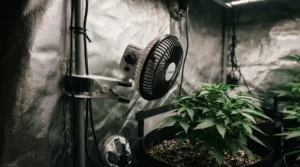
6. Simple Deluxe 6-Inch Clip Fan — handles thick tent poles
The standout is the clamp: it’s built to grip poles from about 0.8 to 2 inches.
That is a bigger range than many rivals, which tend to fit narrower poles. If your tent uses chunky frame tubing or a wall bar, many clip fans simply won’t hold, and a fan that slides down during the night is an annoyance you’ll notice by morning. The anti-slip design aims to prevent exactly that.
It also has two speeds and a compact body. On paper, that makes it a straightforward pick for a secondary, supplemental fan, such as a low-level unit aimed at the stems or pot surface. Think of it as the reliable teammate, not the star. Verified review depth was thin, so check the latest buyer feedback on clamp durability before you commit.
Pros:
- ✅ Wide clamp range for thick poles
- ✅ Anti-slip design stays put
- ✅ Compact enough for tight tents
Cons:
- ❌ Only two speed settings
- ❌ Manual aiming, no smart features
Price: under $30, a sensible add-on for low-level airflow.
7. BLESSNY Oscillating Clip Fan — best fit for corners and slim poles
The BLESSNY is the corner specialist, with a 90° left-to-right sweep designed for exactly that geometry.
Corners are where air stagnates. A fan clipped to a corner pole and sweeping 90° covers two walls at once, pushing air along the edges and into the center. It clips to poles between about 0.59 and 1 inch, which suits many standard tents. Note the limit: slimmer poles only, so measure before you buy.
My read is that this is a budget-minded way to fix a dead corner. It will not outmuscle the 10-speed EC models, but it doesn’t have to. Used as a second or third fan in a larger tent, it fills the gaps. I could not verify enough independent reviews to summarize sentiment, so I won’t pretend otherwise.
Pros:
- ✅ 90° sweep suits tent corners
- ✅ Inexpensive for multi-fan layouts
- ✅ Fits common slim pole sizes
Cons:
- ❌ Narrow pole-size compatibility
- ❌ Fewer speed and tilt options
Price: under $30, a smart pick for filling dead corners.
What Is an Oscillating Fan for Grow Tent Use?
An oscillating fan for grow tent use is a compact fan, usually clip-on, that sweeps side to side to circulate air around plants inside a sealed grow space. Unlike an exhaust fan, which swaps tent air with outside air, it keeps interior air moving to even out temperature, lower humidity pockets, and strengthen stems.
Hydrobuilder’s category notes make a sound point: oscillating clip fans sweep across a set arc, spreading air over the canopy and avoiding the constant direct blast that can cause wind burn on leaves in the airflow’s path. That is the whole logic of oscillation. It trades raw force for coverage, and for plants, coverage is what counts.
How to Choose an Oscillating Fan for Grow Tent Spaces
Use these seven steps in order. Each one narrows the field.
- Measure your tent poles first. Clamp range is the quiet dealbreaker. A fan that fits 0.59-1 inch poles is useless on 1.5-inch tubing.
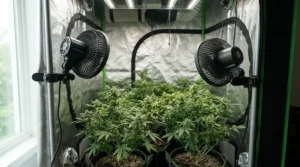
- Size the fan count to the tent. One source suggests a 4×4 tent benefits from two clip fans on opposite sides, and a 4×8 or larger tent generally needs three to four. More small fans beat one big one.
- Prioritize motor type. EC motors are generally efficient and quiet, which matters when a fan runs 24/7.
- Pick the speed control you’ll use. Two speeds works for simple grows. Ten speeds helps when seedlings, veg, and flower need different airflow.
- Check the oscillation range. Look for around 90° horizontal. Adjustable vertical tilt is a bonus for under-canopy aim.
- Decide on smart control. WiFi or controller integration pays off only if you will use schedules and triggers.
- Plan for redundancy. Two inexpensive fans often outperform one expensive one, and give you a backup.
Grow Tent Circulation Fan Placement: A Practical Setup Guide
Here is where Amazon listings stop and real value begins. Most fans arrive with a clamp and a flimsy instruction card. Placement is what separates a good result from a wasted purchase.
Step 1: Clip at mid-canopy height. One supplier guide advises positioning clip fans at mid-canopy so air moves across the widest leaf surface area. Too high, and you only rustle the tops. Too low, and you skim pots.
Step 2: Aim for motion, not a hurricane. Set the speed so leaves flutter gently, never so strongly that they lean and stay bent. If leaves curl away and stay that way, you’ve gone too far.
Step 3: Use opposite corners. Two fans on diagonal corners create a cross-flow pattern that chases air through the full canopy. This is the logic behind a grow tent circulation fan layout: overlap the sweeps, so no spot gets missed.
Step 4: Add a low fan in flower. As plants stretch, the lower zone gets dense. A small fan aimed beneath the canopy dries damp spots at the stem base.
Step 5: Schedule the first 30 days carefully. New growers often start fans at full blast on seedlings. Begin low, then step up as stems thicken. A weekly check of the clamp tightness avoids the dreaded 3 a.m. clatter.
Stem Strengthening Airflow: How Gentle Wind Builds Sturdier Plants
This is the most fascinating reason to own an oscillating fan for grow tent work, and it’s grounded in real plant science. When wind or touch flexes a plant, the plant responds by thickening its stem and growing shorter. In a Washington State University extension paper, researchers note that mechanical stimulation was seen to decrease stem elongation and increase stem thickness across crops like peas, beans, corn, and sunflowers.
So how does this translate to your tent? Stem strengthening airflow means the gentle sway your fan provides signals the plant to invest in sturdier tissue. Heavy flowers and fruiting branches need that support. Without it, you often end up staking everything.
There is a nuance worth knowing. A study on sunflowers in the Journal of Experimental Botany separated two effects: air flow alone increased height and reduced stem strength, while physical stem flexure reduced height and increased strength. In other words, wind that merely blows past is not the same as wind that actually bends the stem. So aim for visible, gentle swaying of stems and branches, and don’t be satisfied with a faint breeze across leaf surfaces.
Practical translation: run your fan so the upper stems move slightly, not violently. Oscillation helps because the changing direction avoids bending the plant in one direction all the time.
Even Air Distribution: Why Oscillation Beats a Fixed Blast
Even air distribution is the real job of an oscillating fan for grow tent layouts. A fixed fan makes a jet. Plants in the jet get hammered, and plants outside it sit in dead air. Oscillation turns that jet into a sweep, so every leaf gets some motion over time.
Think of it as a lighthouse versus a floodlight. The lighthouse beam isn’t on everything at once, but over a minute, it touches everything.
| Fan Type | Coverage Pattern | Wind-Burn Risk | Best For |
|---|---|---|---|
| Oscillating clip fan (e.g., Spider Farmer 6″ Clip Fan) | Sweeping arc | Lower | Canopy-level mixing |
| Fixed clip fan | Single jet | Higher | Spot cooling |
| Wall-mount / pedestal | Wide, from one side | Medium | Larger rooms |
| Inline duct fan | Whole-tent exchange | N/A | Exhaust and odor control |
Looking at the comparison, an oscillating clip fan offers the best balance of canopy coverage and plant safety for most tents. The Spider Farmer 6″ Clip Fan and AC Infinity CLOUDRAY S6 are good examples because of their EC motors and adjustable control. Fixed fans work as targeted spot-coolers, but they can stress leaves in their path.
Plant Health Circulation: Common Problems and Practical Fixes
Good plant health circulation prevents a chain of ugly problems. Here are five, with what to do about each.
Problem 1: Powdery mildew or mold on lower leaves. Stagnant, humid air is the cause. Aim a low fan under the canopy and raise speed in lights-off periods, when humidity often spikes. For background on why damp conditions fuel growth, the EPA’s mold resources explain that controlling moisture is the key to controlling mold.
Problem 2: Leaves curling or “windburned” on one side. The fan is too strong or too close. Dial down speed on a model like the Spider Farmer 6″ Clip Fan or Mars Hydro 6″ Clip Fan, and widen the sweep.
Problem 3: A fan that creeps down the pole. Thick or slick poles defeat narrow clamps. The Simple Deluxe 6-Inch Clip Fan is built for thicker poles, so this is where it earns its keep.
Problem 4: Hot spots near the light. Heat pools at the canopy top. Clip a fan slightly above mid-canopy and let it sweep toward the light, with the exhaust pulling the heat out.
Problem 5: Dead corners and weak stems. Add a corner fan like the BLESSNY Oscillating Clip Fan, and keep stems gently swaying to encourage thickening, as explained earlier.
Real-World Scenarios: Matching Fans to Your Grow
Scenario thinking beats spec thinking. Here are three profiles.
The apartment hobbyist (2×2 tent, tight budget). One fan, mid-canopy, run low. The VIVOSUN AeroWave A6 is the obvious fit, and a second unit for later costs little. Budget: under $60 total for two. Frequency: always on during lights, lower at night.
The 4×4 veg-to-flower grower. Two fans on opposite diagonals. The Spider Farmer 6″ Clip Fan pair gives you ten speeds to raise airflow as flowers dense up. Budget: under $100 for two. Add a low fan if lower leaves yellow.
The automation fan (5×5 tent, travels often). Here the AC Infinity CLOUDRAY S6 with a controller, or the VIVOSUN AeroWave E6 with its WiFi schedule, makes sense. You can let humidity or temperature steer fan speed while you’re away. Budget: $100 to $200 including a controller.
Grow Room Oscillating Fan vs Clip Fan: When a Clip Isn’t Enough
A grow room oscillating fan, meaning a wall-mount or pedestal unit, serves a different purpose than a tent clip fan. It moves air across a whole room, which helps when you run multiple tents or an open space. Inside a single tent, though, clips win.
The reasoning is simple. A tent is a small, enclosed volume where poles are everywhere and a floor stand has nowhere to go. Clips attach to the frame and sit where air is needed. One supplier notes that larger tents may combine clip fans with a wall-mount oscillating fan for broader coverage, and that is a sensible hybrid.
Rule of thumb: tents under 4×4 stay with clips alone. For 4×8 and up, or a multi-tent room, consider adding a room-level unit so the intake air itself is well mixed before it reaches the tents. Also remember that a plant oscillating fan placed outside the tent doesn’t help the canopy. The airflow has to happen where the leaves are.
Features That Actually Matter (And Those That Don’t)
Marketing loves big numbers. Here’s how to filter them.
Matters: motor type. EC motors are efficient and quiet for 24/7 operation. This is why the AC Infinity CLOUDRAY S6, VIVOSUN AeroWave E6, and Spider Farmer 6″ Clip Fan appeal for long runtimes.
Matters: clamp quality. A fan that slips is a useless fan. Metal reinforcement and padding, as on the AC Infinity CLOUDRAY S6, protect both fan and poles.
Matters: speed range. Seedlings and flowering plants need very different airflow. Ten speeds gives room to adapt.
Doesn’t matter much: peak CFM. The Mars Hydro 6″ Clip Fan lists 315 CFM, yet states a coverage of about 1.5′ x 1.5′. Peak numbers rarely describe real canopy conditions, so use them only to compare fans loosely.
Doesn’t matter for everyone: WiFi. The VIVOSUN AeroWave E6 shines for schedules, but if you will never open the app, you’ve paid for features you won’t use.
Long-Term Cost & Maintenance for Your Grow Tent Fans
A fan isn’t a one-time purchase, because running costs and longevity both count. EC motors tend to be efficient, so ongoing electricity costs are small for fans this size. The real long-term expense is replacement, which is why durability matters.
| Fan | Upfront Range | Cost Logic | Best For |
|---|---|---|---|
| VIVOSUN AeroWave A6 | Under $30 | Cheap to replace, easy redundancy | Budget growers |
| Spider Farmer 6″ Clip Fan | $30s-$40s | Mid-priced with fine control | All-rounders |
| AC Infinity CLOUDRAY S6 | Around $50 | Higher upfront, built for long runs | Automation fans |
The analysis is straightforward: a cheap fan that dies in a year still costs less per month than a premium fan that lasts two, but only if it fails gracefully. Redundancy changes the math. Two inexpensive units protect your harvest if one fails, which is a value the spec sheet won’t show.
Maintenance is easy. Wipe the grille every few weeks, since many designs let you remove it for cleaning. Check the clamp tension regularly, and clear dust from the blades. A dusty fan is a noisy, weaker fan.

FAQ
❓ How many fans do I need in a 4x4 tent?
❓ Can a clip fan replace my exhaust fan?
❓ Should the fan run when the lights are off?
❓ What is the best tent oscillating clip fan for beginners?
❓ Will airflow really make my stems stronger?
Conclusion
The best oscillating fan for grow tent use is the one that fits your tent, your poles, and your habits. If you love automation, the AC Infinity CLOUDRAY S6 and VIVOSUN AeroWave E6 lead the way. If you want a balanced, quiet performer, the Spider Farmer 6″ Clip Fan is hard to ignore. Mars Hydro growers get a natural match in the Mars Hydro 6″ Clip Fan, while budget builders can lean on the VIVOSUN AeroWave A6. And for stubborn poles and awkward corners, the Simple Deluxe 6-Inch Clip Fan and BLESSNY Oscillating Clip Fan solve specific problems for very little money.
Whatever you choose, remember the big picture. Even air distribution prevents damp pockets. Stem strengthening airflow builds plants that carry their own weight. And steady plant health circulation is the quiet insurance policy behind every clean harvest.
✨ Ready to give your plants the breeze they deserve?
🌿 Click any highlighted product name above to check current pricing and availability, then clip, aim, and let your canopy thank you!
Recommended for You
- Inline Fan For Grow Tent: 7 Best Proven Picks In 2026
- Greenhouse Exhaust Fan: 7 Best Picks To Beat The Heat (2026)
- Best Greenhouse Fan: 7 Proven Picks That Actually Work (2026)
Disclaimer: This article contains affiliate links. As an Amazon Associate, I earn from qualifying purchases. If you purchase products through these links, we may earn a small commission at no additional cost to you.
✨ Found this helpful? Share it with your friends! 💬
