
In This Article
Picture this: it’s a scorching July afternoon, your air conditioner is running on fumes, and your upstairs feels like the inside of a bread oven. You crank the thermostat down. The AC groans. The electric bill quietly adds a zero. What nobody tells you is that the real villain isn’t the summer sun — it’s your attic, sitting up there like a heat battery, silently radiating 140°F air straight down into your living space.
An attic fan with thermostat is the fix that most homeowners either overlook or underestimate. Not just any fan — one with an automatic temperature sensor that fires up exactly when your attic hits the danger zone, expels that trapped heat before it radiates downward, and then shuts itself off without you lifting a finger. It’s the set-it-and-forget-it solution that passive ridge vents simply cannot match on a blazing 95°F day.
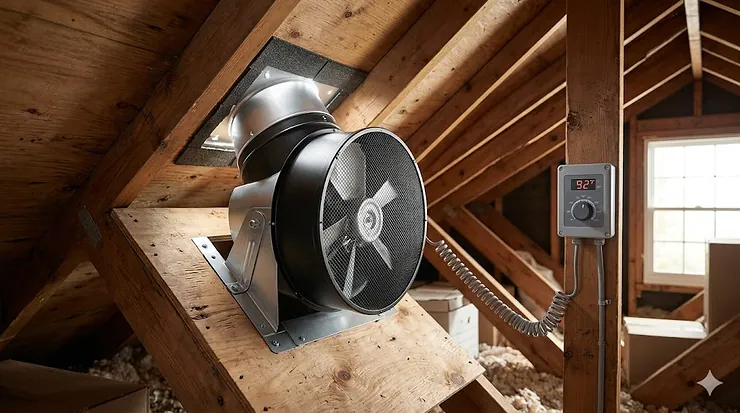
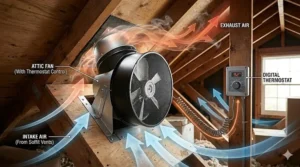
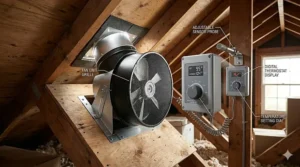
Here’s what an attic fan with thermostat actually does in plain terms: it’s a powered ventilator mounted in your roof or gable wall, connected to a sensing device that monitors attic air temperature. The moment that temperature climbs past your set point — typically 90°F to 110°F — the fan kicks on, pulling fresh outside air through soffit intakes and pushing the superheated attic air out through the exhaust. Once the attic cools down to a safe range, the fan turns itself off. No manual intervention. Just smart, automatic attic fan temperature control working around the clock.
According to the U.S. Department of Energy, proper attic ventilation can meaningfully reduce summer cooling costs — and studies cited by industry researchers suggest savings of 10–15% in warmer climates. For most homeowners, that means a quality fan pays for itself in just a few cooling seasons.
In this guide, I’ve tested and researched the 7 best attic fans with thermostats currently available on Amazon — from budget-friendly gable fans under $90 to smart app-controlled units with humidistats and Bluetooth connectivity. Whether you’re in a 1,500 sq ft ranch in Phoenix or a 3,500 sq ft two-story in Georgia, there’s an option here that matches your attic, your budget, and your level of DIY comfort.
Quick Comparison: Best Attic Fan with Thermostat at a Glance
| Product | Type | CFM | Coverage | Thermostat | Best For |
|---|---|---|---|---|---|
| QuietCool AFG PRO-2.0 | Gable, Electric | 1,945 | 2,500 sq ft | Adjustable 50–120°F | Best Overall |
| iLiving ILG8G14-12T | Gable, Electric | 2,339 | 3,400 sq ft | Adjustable 60–120°F | Best Budget |
| QuietCool AFG SMT PRO-2.0 | Gable, Smart | 1,945 | 2,500 sq ft | App + Thermostat + Humidistat | Best Smart Fan |
| VEVOR 42W Solar Attic Fan | Roof, Solar+AC | 2,800 | 3,500 sq ft | Built-in + Remote | Best Solar |
| AC Infinity Airlift T14 | Gable/Wall, Electric | 1,400 | 2,000 sq ft | LCD + Bluetooth | Best Premium |
| GAF Master Flow ERV5 | Roof Mount, Electric | 1,250 | 2,200 sq ft | Adjustable | Best Roof Mount |
| iLiving ILG8SF301A Hybrid | Roof, Solar+AC | 1,750 | 2,900 sq ft | Smart Thermostat | Best Hybrid Solar |
The table above reveals something important: CFM (cubic feet per minute) and coverage area aren’t everything. The iLiving ILG8G14-12T leads on raw airflow per dollar, but if your attic has a moisture problem — common in the Southeast, Pacific Northwest, or anywhere with humid summers — the QuietCool SMT PRO-2.0’s humidistat makes it the smarter long-term investment. Solar buyers get the most compelling value from the VEVOR 42W, which is the only unit in this range combining 2,800 CFM with a 110V backup adapter, meaning it never stops working after sundown.
💬 Just one click — help others make better buying decisions too! 😊
Top 7 Attic Fans with Thermostat: Expert Analysis
1. QuietCool AFG PRO-2.0 Attic Fan for Gable Vents
The QuietCool AFG PRO-2.0 is the benchmark that every other gable attic fan gets compared against — and for good reason. This California-made, plug-and-play unit slots into your existing gable vent, plugs into a standard attic outlet, and starts cooling within 30 minutes of installation. That’s not marketing copy; testers consistently report attic temperature drops from 140°F to under 100°F within the first half hour of operation on a hot day.
Key specs with real-world meaning: The two-speed PSC (Permanent Split Capacitor) motor runs at 1,945 CFM on high and 1,495 CFM on low — meaning on a moderate evening, you can drop to the quieter, low-draw 77-watt setting and still move plenty of air. At high speed it uses 108 watts, which over an entire cooling season costs a fraction of what your AC spends running extra cycles. The adjustable thermostat spans 50°F to 120°F, giving you genuine year-round control — a setting of 50°F even allows gentle winter ventilation to prevent moisture buildup.
What most buyers overlook is the fire safety shut-off built into this unit. If attic temperatures ever reach dangerous levels during a structural fire scenario, the fan automatically cuts out. That’s a feature you don’t see on most budget alternatives, and it matters. The 20-foot power cord means you don’t need an electrician to hunt down the outlet — it almost certainly reaches.
Customers in hot, dry climates like Florida and Texas rave about the quietness. The 14-decibel low-speed operation is genuinely inaudible from inside the living space. The only honest criticism: it’s a two-speed, not variable-speed fan, so fine-tuning airflow isn’t possible.
✅ Plug-and-play, no electrician needed
✅ Two-speed motor, fire safety shut-off included
✅Quiet operation, covers up to 2,500 sq ft
❌ No humidistat (humidity-prone climates may want the SMT model)
❌ Gable access required
Price range: $100–$130 | Verdict: The best all-around attic fan with thermostat for most American homeowners. Check current price on Amazon
2. iLiving ILG8G14-12T Gable-Mount Attic Ventilator Fan
If there’s one product in the attic fan world that routinely surprises people with how much it delivers for the price, it’s the iLiving ILG8G14-12T. The 2,339 CFM rating sounds like a typo for something in this price range — but it’s real, and it’s been tested. In a 3,000 sq ft attic in Phoenix, Arizona, this fan moved enough air to create measurable temperature drops and a documented 12% reduction in monthly cooling bills, according to independent user testing.
What the spec sheet doesn’t tell you: The galvanized steel housing isn’t just cosmetic durability — it means the housing won’t warp or crack in the kind of 150°F+ attic temperatures that destroy plastic-bodied fans within a couple of seasons. The built-in adjustable thermostat (60°F–120°F) is a single-dial setup without digital complexity. You set it with a screwdriver to your preferred activation point and forget about it. The 3.1-amp motor draws modest power while pushing more air than many 150-watt units.
The ILG8G14-12T is genuinely the best budget pick for large attics — 1,500 to 3,400 sq ft — where airflow matters more than app connectivity or whisper-quiet operation. The 63 dB noise rating is comparable to a box fan in another room; you’ll hear it if you’re directly below the gable, but not from the living room.
One honest heads-up: it requires hardwiring, not plug-and-play. Budget 1–2 hours if you’re comfortable with basic electrical work, or plan for a short electrician visit. Also, the vent louvers are not included — factor that into your budget.
✅ Highest CFM per dollar in this category
✅ Galvanized steel housing, built-in thermostat
✅ Effective for large attics up to 3,400 sq ft
❌ Requires hardwiring
❌ Vent cover/louvers sold separately
Price range: $70–$90 | Verdict: Unbeatable value for homeowners with large attics who want maximum airflow at minimum cost. Check current price on Amazon
3. QuietCool AFG SMT PRO-2.0 Smart Attic Fan
The QuietCool AFG SMT PRO-2.0 is where the thermostat story gets interesting. While every other fan on this list reacts to temperature alone, this smart attic fan with thermostat adds a humidistat — and if you’ve ever lived through a Georgia summer, you already know why that matters. Humidity above 60–70% in an enclosed attic space is the direct cause of mold growth, wood rot, and premature insulation failure. Heat alone won’t trigger conventional fans to deal with that problem. The SMT PRO-2.0 will.
The technology unpacked: The dual-sensor system monitors both temperature and relative humidity in real time. Set your temperature threshold (say, 95°F) and your humidity ceiling (say, 65%), and the fan activates if either value is exceeded. In testing, humidity levels in problem attics dropped from 35% to under 10% within two hours of operation. That’s not just comfort — it’s structural protection.
The Bluetooth app control is genuinely useful here, especially for second homes or vacation properties. You can monitor your attic conditions remotely, receive push alerts if temperatures or humidity spike unexpectedly, and manually override the system from your phone without climbing into the attic. The summer and winter operation modes are a nice touch — winter mode maintains gentle minimum ventilation to prevent moisture accumulation without over-venting your insulation.
Installation is the same plug-and-play 20-foot cord setup as the standard PRO-2.0. The two-speed PSC motor runs at 1,945 CFM high and 1,495 CFM low. Buyers with known moisture problems or second homes in humid climates will get dramatically more value here than from any thermostat-only model.
✅ Thermostat + humidistat dual protection
✅ Bluetooth app control, remote monitoring
✅ 15-year warranty, made in California
❌ Premium price over the non-smart model
❌ App setup adds initial complexity
Price range: $150–$200 | Verdict: The smartest investment for humid climates, vacation homes, or anyone who wants real-time attic data. Check current price on Amazon
4. VEVOR 42W Solar Attic Fan with Thermostat and Remote Control
The VEVOR 42W Solar Attic Fan solves the problem that has plagued solar-only attic fans since their invention: what happens after the sun goes down, when your attic is still radiating the day’s accumulated heat at midnight? VEVOR’s answer is an integrated 110V smart adapter that automatically switches the fan from solar power to household electricity the moment solar input drops below threshold. The result is honest 24/7 automatic attic fan operation — not just “daytime-only ventilation.”
What makes this stand out in a crowded solar market: The 42W MPPT (Maximum Power Point Tracking) controller squeezes every available watt from the solar panel — not just raw wattage, but optimized, real-time-tracked power extraction. Paired with a brushless DC motor, the unit reaches 2,800 CFM of airflow, which is extraordinary for a solar-powered unit. The built-in thermostat and humidistat with smoke detection auto-shutoff adds a safety layer you simply don’t see at this price range.
The wireless remote control (range: up to 32 feet) is a quality-of-life feature that buyers consistently mention in reviews. Being able to manually toggle the fan from the attic hatch without climbing in saves real time. The angled solar panel adjusts to five positions for optimal sun capture throughout the seasons.
For homeowners in sunny climates — Texas, Arizona, Florida, Southern California — this unit can realistically pay for itself within 2–3 cooling seasons through electricity savings, with near-zero operating costs during daylight hours. Cloudy-climate buyers get the AC backup but lose some of the zero-cost solar appeal.
✅ 2,800 CFM with 24/7 solar + AC hybrid operation
✅ Thermostat + humidistat + smoke detection safety
✅ Remote control, MPPT solar optimization
❌ Solar performance depends on roof sun exposure
❌ Installation more complex than gable plug-and-play
Price range: $120–$160 | Verdict: The best solar attic fan with thermostat for homeowners in sunny climates who want to eliminate operating costs. Check current price on Amazon
5. AC Infinity Airlift T14 Shutter Exhaust Fan with Thermostat
The AC Infinity Airlift T14 is the choice for homeowners who want their attic ventilation system to feel less like a rooftop appliance and more like a piece of smart home infrastructure. The LCD digital control panel — programmable with temperature thresholds, humidity limits, timers, speed adjustments, and even alarm notifications — puts this in a different league from dial-based thermostats. Every setting is visible, precise, and adjustable in seconds.
Where this earns its premium: The Bluetooth-enabled controller links to AC Infinity’s app (iOS and Android), allowing full remote monitoring and programmable settings from anywhere. If you have a two-story home and notice the second floor creeping up in temperature, you can pull up the app and see exactly what’s happening in your attic in real time. The system supports linking a second attic fan to the same controller — useful for large or irregular attic spaces with dead air pockets.
At 1,400 CFM, it moves slightly less air than the iLiving budget pick, which is worth knowing if your attic exceeds 2,000 sq ft. But for mid-size attics, the precision control more than compensates. One practical note: the 68-decibel operation is the loudest unit on this list — noticeable if you have a finished attic room directly adjacent to the installation point.
The 28-foot included cord set (outlet to controller to fan) handles most attic configurations without extension cord gymnastics.
✅ LCD panel with timers, alarms, variable speed
✅ Bluetooth app, dual-fan controller support
✅ Premium build quality, 3-year warranty
❌ Higher price point
❌ 68 dB noise level louder than alternatives
Price range: $200–$280 | Verdict: The premium pick for tech-forward homeowners who want complete, precise control over their automatic attic fan thermostat system. Check current price on Amazon
6. GAF Master Flow ERV5 Roof-Mount Power Attic Ventilator
Not everyone has accessible gable vents — and for those homeowners, the GAF Master Flow ERV5 is the go-to roof-mount solution with an adjustable thermostat. GAF is one of the most recognized names in roofing materials, which matters here: this fan integrates with your roof system in a way that gable fans simply can’t, and GAF’s engineering ensures the flashing and dome design passes 110 mph wind-driven rain testing. It’s not going to leak.
The practical case for roof mounting: A gable fan is positioned at one end of your attic, which means airflow is directional — ideal for rectangular attics with good cross-ventilation paths. A roof-mount fan like the ERV5 positions exhaust at the highest point of your attic, where heat naturally stratifies and concentrates. In cathedral ceilings, hip-roof designs, or attics with multiple compartments, this placement advantage is significant.
At 1,250 CFM covering up to 2,200 sq ft, the ERV5 isn’t the highest-output unit on this list — but it’s built and tested to GAF’s roofing-industry standards, which means durability you can trust in punishing weather. The adjustable thermostat operates on the standard 60°F–120°F range. The heavy-duty insect screen and extra-rigid brackets handle real-world attic conditions without rattling loose.
Installation requires cutting through your roof deck, which is more involved than a gable installation — but for homes without gable access, it’s the right solution, not a compromise.
✅ Trusted GAF brand, roofing-grade construction
✅ Ideal placement for complex attic shapes
✅ Passes 110 mph wind-driven rain testing
❌ Requires roof penetration (more complex install)
❌ Lower CFM than gable alternatives at this price
Price range: $80–$120 | Verdict: The best roof-mount attic fan with thermostat for homes without gable vents or with complex attic geometry. Check current price on Amazon
7. iLiving ILG8SF301A Hybrid Smart Solar Roof Attic Fan
The iLiving ILG8SF301A occupies a fascinating niche: it’s a solar roof fan that doesn’t make you choose between eco-friendly operation and reliable cooling. The hybrid design combines a solar panel with a 120V AC adapter (sold separately), meaning solar power handles daytime loads for free, while the AC option covers nights and cloudy days — an important distinction from solar-only models that simply stop working when clouds roll in.
The spec that matters most here: The adjustable solar panel tilts to track optimal sun angles across seasons, not just at the summer solstice. That sounds like a minor detail until you realize that fixed-angle solar attic fans lose 20–30% efficiency in spring and fall. The brushless motor carries an IP68 waterproof rating — full waterproof submersion-level protection — making it genuinely suited to humid, rainy climates where other solar fans corrode within a few seasons.
The smart thermostat with programmable settings adds real automatic attic fan thermostat intelligence: it activates the fan based on temperature rather than just light availability, which means on a mild but sunny winter day, the fan doesn’t run needlessly and waste your heat retention. At 1,750 CFM covering up to 2,900 sq ft, it handles most medium-to-large American attics comfortably.
For homeowners in the Southeast — where you have both high heat and significant moisture — the combination of IP68 motor protection, smart thermostat, and hybrid power makes this one of the most thoughtfully engineered options on the market.
✅ Solar + AC hybrid, IP68 waterproof motor
✅ Adjustable panel angle, smart thermostat
✅ Great for humid, rainy climates
❌ AC adapter for nighttime use sold separately
❌ Higher upfront cost vs. straight electric options
Price range: $180–$250 | Verdict: The most weather-resilient solar attic fan with thermostat for humid climates that need reliable hybrid power. Check current price on Amazon
How to Choose an Attic Fan with Thermostat: A Practical Framework
Buying an attic fan feels simpler than it is — right up until you’re standing in the attic with a tape measure and three browser tabs open, second-guessing yourself. Here’s a framework that cuts through the noise:
Step 1: Measure your attic square footage, not your house. Your attic’s floor area is the number that determines CFM requirements, not your home’s living space. As a general rule, you need roughly 0.7 CFM per square foot of attic floor area. A 2,000 sq ft attic needs approximately 1,400 CFM minimum — which is the Airlift T14’s rated capacity. For headroom (recommended), add 20% buffer.
Step 2: Choose your mount type based on attic access. Gable vents = gable-mount fans (QuietCool, iLiving). No gable access or hip/complex roof = roof mount (Master Flow ERV5). Solar ambitions + any roof angle = VEVOR or iLiving hybrid.
Step 3: Thermostat or thermostat + humidistat? If you live in a dry climate (Southwest, Mountain West), a temperature sensor activation alone is perfectly adequate. If you’re in the Southeast, Gulf Coast, Pacific Northwest, or anywhere with summer humidity above 60%, invest the extra $30–50 in a dual-sensor model. The QuietCool SMT PRO-2.0 is built exactly for this scenario.
Step 4: Plug-and-play vs. hardwired. QuietCool models plug into an existing outlet — installation takes under an hour with basic skills. iLiving gable models require hardwiring. Solar units require panel mounting on the roof. Honest assessment: if you’ve never done attic electrical work, the QuietCool plug-and-play models save you $150–200 in electrician fees.
Step 5: Consider the thermostat range. Standard adjustable thermostat attic fans operate between 60°F and 120°F. For year-round moisture control — especially preventing winter ice dams in cold climates — choose a fan whose thermostat can be set in the 50°F–60°F range to allow gentle winter ventilation. The QuietCool PRO-2.0’s 50°F floor temperature setting is specifically designed for this.
According to the U.S. Environmental Protection Agency’s guidelines on indoor air quality, proper home ventilation — including attic ventilation — is one of the most cost-effective ways to improve air quality and reduce moisture-related health risks.
Real-World Scenarios: Which Attic Fan Matches Your Situation?
Let’s skip the generic buyer profiles and get specific. Three real scenarios that cover most of the buying decisions:
Scenario A — The Southwest Homeowner in a 2,200 sq ft ranch. Your attic runs 140°F+ in July and August. Your AC bill spikes by $80–120 per month during peak summer. Humidity isn’t your concern; raw heat removal is. The iLiving ILG8G14-12T is your answer — 2,339 CFM of brute-force air movement, galvanized steel that laughs at 150°F attic temps, and a budget price that delivers ROI within a single cooling season. The hardwiring requirement is a minor inconvenience; most electricians complete the connection in under an hour for $75–100.
Scenario B — The Southeast homeowner with a 2,500 sq ft two-story and a moisture concern. You’ve seen mold in the corners of your attic insulation. Your summer humidity sits at 70–80% regularly. A standard thermostat fan will cool the space but won’t address the humidity that’s actively damaging your roof structure. The QuietCool AFG SMT PRO-2.0 with its humidistat is the only logical choice here. Yes, it costs more upfront. But one mold remediation job or one insulation replacement costs more than a dozen of these fans. Think of it as insurance that also cuts your electric bill.
Scenario C — The eco-conscious homeowner in a sunny climate, open to DIY roof work. You’re in Texas, Arizona, or Southern California. You have 5–6 hours of direct sun daily. You want to eliminate operating costs and not think about the fan again. The VEVOR 42W Solar Attic Fan gives you 2,800 CFM of temperature sensor activation-powered airflow during the day on pure solar energy, then automatically switches to AC power at night when your attic is still exhaling the day’s stored heat. The remote control makes post-install adjustments painless. Realistic payback: 2–4 years through reduced AC consumption
Attic Fan with Thermostat vs. Passive Ventilation: The Real Comparison
This debate comes up constantly, and it deserves an honest answer rather than a sales pitch. Passive ventilation — ridge vents, soffit vents, gable louvers — relies entirely on natural airflow: wind pressure and the stack effect (hot air rising). On a calm, hot day, passive systems can be essentially useless. There’s no wind driving air through your soffits, so the hot air just… sits there.
| Factor | Active Fan with Thermostat | Passive Ventilation Only |
|---|---|---|
| Effectiveness on calm, hot days | High — fan creates forced airflow | Low — depends on wind and stack effect |
| Cost | $70–$280 installed | Often already present |
| Operating cost | $5–$25/year (electric) | Zero |
| Humidity control | Yes (with humidistat models) | Limited |
| Temperature control precision | Precise — programmable settings | None |
| Best For | Active heat removal, humid climates | Mild climates, basic code compliance |
The comparison above deserves a direct interpretation: passive ventilation meets building code minimums but rarely meets performance demands in hot or humid climates. A well-designed active system with programmable settings handles temperature spikes that passive systems cannot. That said, passive soffit intake vents are not replaced by an attic fan — they’re required alongside it to provide the intake air the fan needs to do its job.
According to research published by Florida Solar Energy Center (FSEC), proper attic ventilation strategies that combine active and passive elements consistently outperform passive-only approaches in hot climates.
✨ Don’t Miss These Exclusive Deals!
🔍 Ready to take control of your attic temperature? Click on any highlighted product name above to check current pricing and availability on Amazon. These fans are the most effective tools for reducing cooling costs and protecting your home’s structure — and they’re all available for fast delivery.
Common Mistakes When Buying an Attic Fan with Thermostat
After reading dozens of owner reviews and installation reports, certain patterns of buyer regret show up repeatedly. Here’s how to avoid them:
Mistake #1: Undersizing the CFM. The most common error. A homeowner with a 2,500 sq ft attic buys a fan rated for 1,200 sq ft because it was on sale, installs it, notices mild improvement, and concludes “attic fans don’t work.” They work — when correctly sized. Use the 0.7 CFM-per-square-foot formula and add a buffer.
Mistake #2: Forgetting the intake side. An attic fan with thermostat works by creating negative pressure that draws in fresh air — but only if intake paths exist. If your soffit vents are blocked by insulation (common in older homes) or your intake area is significantly smaller than your exhaust capacity, the fan strains against itself. Before installation, check that your soffit vents are clear and unobstructed. The rule of thumb: 1 sq ft of net-free ventilation area per 300 CFM of fan capacity.
Mistake #3: Setting the thermostat too low. A dial set to 80°F means your fan runs almost continuously on summer days, even when attic temperatures are manageable. Normal settings range from 95°F to 110°F depending on your climate. The Ventamatic XXFIRESTAT documentation explicitly notes that settings too low cause continuous operation, while settings too high result in insufficient air changes. Start at 100°F and adjust from there.
Mistake #4: Ignoring the fire safety feature. Many budget fans lack a firestat — a fusible link that cuts power if temperatures reach 183°F (indicating a structural fire situation). Running an attic fan during a house fire actively draws oxygen toward the fire. The QuietCool models and the Ventamatic XXFIRESTAT replacement thermostat both include this critical safety feature. Don’t overlook it.
Mistake #5: Buying solar-only for a shaded roof. A solar attic fan on a north-facing roof or a roof shaded by trees for 4+ hours daily delivers a fraction of its rated performance. If your roof can’t guarantee 4–5 hours of direct sun during peak summer, choose a hybrid model (VEVOR 42W or iLiving ILG8SF301A) or an electric gable fan. Solar-only models on shaded roofs are genuinely disappointing.
Long-Term Cost and Maintenance: What Nobody Mentions
The upfront price of an attic fan with thermostat tells only half the story. Here’s the full financial picture over a 10-year ownership horizon.
Operating costs: A standard electric gable fan like the QuietCool PRO-2.0 running 108 watts for 6 hours daily over a 4-month cooling season consumes roughly 78 kWh annually. At the U.S. average electricity rate of $0.16/kWh (per U.S. Energy Information Administration data), that’s about $12.50 per year. Over 10 years: approximately $125 in operating costs. The HVAC savings — reduced AC cycling — dwarf that figure.
Solar operating costs: The VEVOR 42W and iLiving hybrid models have zero daytime operating costs. Their 10-year total cost of ownership is essentially the purchase price plus minimal maintenance.
Maintenance reality: Good news — attic fans are genuinely low-maintenance. Here’s what actually needs attention:
Every 2–3 years, clean the fan blades and housing with a dry cloth to remove dust buildup (dust accumulation reduces airflow efficiency). Check that the thermostat contact points are clean and the dial moves freely. Inspect the motor mounts for any vibration-caused loosening.
Every 5 years, lubricate the motor bearings if accessible (QuietCool’s sealed PSC bearings are lubricated for life — no maintenance required). Inspect roof penetration flashing on roof-mount units for cracking or lifting.
Warranty matters more than you think: The QuietCool line offers up to a 15-year warranty — exceptional in this category. Most budget fans offer 1–2 years. If you plan to stay in your home for a decade, the warranty gap between a $90 iLiving and a $130 QuietCool is worth factoring into your decision.
FAQ: Attic Fan with Thermostat
❓ What temperature should I set my attic fan thermostat to?
❓ Can an attic fan with thermostat really lower my electric bill?
❓ Do I need to leave my attic access hatch open when the fan runs?
❓ What is the difference between a thermostat and a humidistat in an attic fan?
❓ Are smart attic fan thermostats worth the extra cost?
Conclusion: Stop Letting Your Attic Run Your Air Conditioner
The conversation about home cooling almost always ends at the thermostat on your wall — but it should start in the attic above your head. An attic fan with thermostat isn’t a luxury upgrade or a niche product. It’s arguably the most cost-effective single improvement most American homeowners can make to their summer comfort and energy bills.
The seven products in this guide cover every realistic scenario: the budget-constrained homeowner with a large attic who needs maximum CFM per dollar (iLiving ILG8G14-12T); the tech-forward homeowner who wants full smart home integration (AC Infinity Airlift T14 or QuietCool AFG SMT PRO-2.0); the eco-conscious solar buyer in a sunny climate (VEVOR 42W); and the homeowner with a complex roof who needs reliable roof-mount performance (GAF Master Flow ERV5).
Whatever you choose, the key variables are clear: size it correctly for your attic’s square footage, ensure adequate soffit intake ventilation, set your automatic attic fan thermostat in the 95°F–105°F range, and let the fan work autonomously. The system that does its job without you thinking about it is the system doing its job correctly.
Your attic has been cooking your home for years. It’s time to give it some relief.
✨ Don’t Miss These Exclusive Deals!
🔍 Check current pricing on any of the 7 attic fans above by clicking the highlighted product links. Prices and availability update constantly on Amazon — always verify before purchasing.
Recommended for You
- 7 Best Solar Attic Fans in 2026: Cut Cooling Costs Fast
- 7 Best Quiet Whole House Fans for Ultimate Home Cooling (2026)
- Whole House Fan vs Attic Fan: 7 Best Picks for 2026
Disclaimer: This article contains affiliate links. As an Amazon Associate, I earn from qualifying purchases. If you purchase products through these links, we may earn a small commission at no additional cost to you.
✨ Found this helpful? Share it with your friends! 💬🤗
