
In This Article
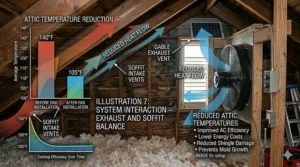
Climb into your attic on a July afternoon and you’ll understand why your air conditioner sounds like it’s training for a marathon. According to the U.S. Department of Energy’s Building America program, an unventilated attic can run 40 to 50 degrees hotter than the outdoor air — which means a 95-degree day up top can easily become a 140-degree oven. That heat doesn’t politely stay in the attic. It soaks through your ceiling insulation, radiates into your living space, and quietly tortures your HVAC system into an early grave.
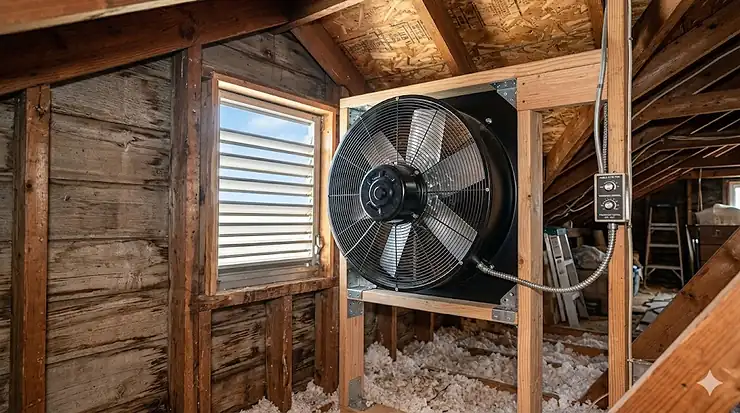
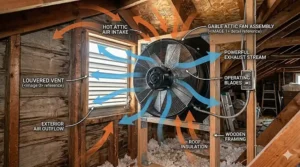
A gable attic fan is one of the simplest fixes for this problem, and it’s the one most homeowners overlook because it doesn’t involve cutting a hole in the roof. Instead, it mounts through the triangular gable wall at the end of your attic — the spot where a louvered vent already exists on most houses built after the 1960s — and pushes hot, stale air out horizontally instead of straight up.
I’ve spent the last few weeks digging through spec sheets, manufacturer pages, and the kind of grumpy-but-honest forum threads where DIYers compare actual wattage readings instead of marketing claims. What follows are seven real gable attic fan models you can buy right now, ranging from a $70 bare-bones workhorse to a smart, app-controlled unit that costs as much as a decent mattress. No invented products, no rounded-up “best of” filler — just the machines, what they’re good at, and who should skip them entirely.
What Is a Gable Attic Fan?
A gable attic fan — also called an end-wall or gable-mount attic fan — is an electric or solar-powered exhaust fan installed in the gable vent at the peak of your attic’s end wall. A built-in thermostat switches the fan on once attic temperatures climb past a set point (usually 80–100°F), pulling fresh air in through soffit vents and pushing superheated attic air out the side of the house.
Quick Comparison: 7 Gable Attic Fans at a Glance
| Fan | Power | CFM | Coverage | Best For |
|---|---|---|---|---|
| iLiving ILG8G14-12T | Electric, hardwired | ~2,339 | Up to 3,400 sq ft | Biggest CFM per dollar |
| Air Vent 53315 | Electric, hardwired | 1,050 | Up to 1,500 sq ft | Small/simple attics |
| Cool Attic CX1500 | Electric, hardwired | 1,300 | Up to 1,850 sq ft | No-frills mid-size homes |
| Maxx Air Professional Grade | Electric, hardwired | 1,300 | Up to 1,850 sq ft | Buyers who want a backup brand |
| QuietCool AFG SMT PRO-3.0 | Electric, plug-and-play | ~2,860–2,940 | Up to 3,750 sq ft | Largest attics, smart control |
| QuietCool AFG SMT ES-3.0 | Electric, plug-and-play | Up to 2,801 | Up to 3,750 sq ft | Lowest operating cost |
| Broan 345GOBK | Solar, 28W panel | 537 | ~2,300–3,200 cu ft | Zero electric bill |
A quick read on the numbers: if pure airflow-per-dollar is your goal, the iLiving wins outright — it edges out fans costing three times as much. But CFM isn’t the whole story. The QuietCool ES-3.0 moves less peak air than the PRO-3.0 yet costs less to run every single day thanks to its motor design, and the Broan trades airflow entirely for a $0 electric bill. We’ll get into exactly why below.
✨ Don’t Miss These Exclusive Deals!
🔍 Take your attic ventilation project to the next level with the picks below. Click any highlighted model to check current pricing and availability — availability shifts fast on these, so it’s worth a look before you commit to a size.
💬 Just one click — help others make better buying decisions too! 😊
Top 7 Gable Attic Fans: Expert Analysis
1. iLiving ILG8G14-12T — Best Overall Value
The iLiving ILG8G14-12T is the fan I’d point a budget-conscious neighbor toward first. It’s rated at roughly 2,339 CFM on a 2.85-amp motor, which — in plain English — means it can fully exchange the air in a 3,400-square-foot attic, more coverage than most of the premium fans on this list claim at double the price. The galvanized steel housing and adjustable thermostat are standard fare, but the airflow-to-cost ratio is what earns it the top spot.
What most buyers overlook: this is a hardwired fan with no shutter or louver vent cover included, so budget an extra $15–30 and maybe an hour with an electrician (or a confident DIYer) before it’s actually running. Owners on retail sites consistently mention straightforward bracket-based mounting and note that the thermostat wiring arrives pre-connected, which shaves real time off installation.
✅ Massive airflow for the price
✅ Covers attics most single fans can’t touch
✅ Pre-wired thermostat simplifies setup
❌ Hardwiring required — no plug-and-play option
❌ Vent cover/shutter sold separately
Price range: around $70–$100. For sheer cooling capacity per dollar, nothing else here touches it.
2. Air Vent 53315 — Best for Smaller, Simpler Attics
Air Vent 53315 is the fan version of a flathead screwdriver: unglamorous, reliable, and exactly what most starter projects actually need. At 1,050 CFM and a 1,500-square-foot rating, it’s sized for ranch homes and smaller two-story builds rather than sprawling McMansions, with a simple analog thermostat adjustable between 60° and 120°F.
In practice, that modest CFM number is a feature, not a limitation, for the right house. Oversizing a gable fan without matching soffit intake just means your fan works harder pulling air from somewhere it shouldn’t — usually your living space. For a tight, well-sealed 1,200–1,500-square-foot attic, the 53315’s lower draw and simpler mechanics mean less to break, fewer amps pulled, and a part you can find at nearly any hardware store decades from now if it fails.
✅ Proven, decades-old design
✅ Easy to source replacement parts later
✅ Lower amp draw than oversized alternatives
❌ Undersized for larger or multi-zone attics
❌ Basic analog thermostat only, no humidistat
Price range: around $90–$130.
3. Cool Attic CX1500 — The Quiet Workhorse
The Cool Attic CX1500 sits squarely in the middle of this list: a 1,300 CFM, 14-inch-blade gable fan rated for attics up to 1,850 square feet on a 2.6-amp motor. It’s manufactured by Ventamatic, a Texas-based company that’s been making attic ventilation hardware for decades, and the build quality reflects it — precision-balanced blades and an engineered bracket system that genuinely cuts down on vibration noise.
Here’s the insider detail spec sheets won’t tell you: Cool Attic and the next fan on this list, Maxx Air, share the same 1,300 CFM, 2.6-amp, 14-inch-blade specifications almost line for line. Both brands are produced by Ventamatic out of Mineral Wells, Texas — same engineering, different paint and packaging. If you see one in stock and not the other, you’re not really losing anything by switching.
✅ Quiet operation thanks to vibration-dampened mounting
✅ Solid mid-tier coverage for 3–4 bedroom homes
✅ Long manufacturing track record
❌ Hardwired installation only
❌ No smart features or multi-speed control
Price range: around $110–$150.
4. Maxx Air Professional Grade Gable Mount — The Reliable Twin
The Maxx Air Professional Grade Gable Mount matches the Cool Attic CX1500 spec for spec — 1,300 CFM, 2.6-amp motor, 1,850-square-foot rating — because, as noted above, both come off the same Ventamatic production line. So why list it separately? Because real-world buying isn’t theoretical: when one model is backordered or priced oddly on a given week, knowing its functional twin exists saves you from overpaying out of brand loyalty to a name you don’t actually need.
Maxx Air backs its gable lineup with a company help line out of its Mineral Wells plant, which is a small but genuinely useful perk if you’re installing this solo and hit a wiring question at 7 p.m. on a Saturday.
✅ Functionally identical to the CX1500
✅ Manufacturer support line available
✅ Same proven 14-inch blade design
❌ No meaningful upgrade over Cool Attic
❌ Hardwired only, no app or remote control
Price range: around $120–$180.
5. QuietCool AFG SMT PRO-3.0 — Best for Big Attics & Smart Control
The QuietCool AFG SMT PRO-3.0 is where this list jumps up a tier. Rated for attics up to 3,750 square feet at nearly 2,900 CFM on a two-speed motor, it’s built for genuinely large homes — and it ships plug-and-play with a 20-foot cord, meaning no electrician visit unless you lack a nearby outlet.
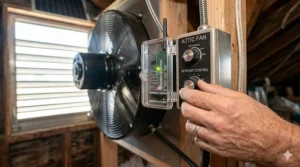
The real selling point is the Smart Control app, which lets you check attic temperature and humidity from your phone and schedule seasonal presets instead of just an on/off thermostat. For anyone who’s ever wondered “is my attic fan even doing anything,” that visibility alone is worth something. The built-in humidistat also means it can run quietly in winter to combat condensation, not just summer heat — a feature the budget fans on this list simply don’t offer.
✅ Massive coverage for large or multi-story attics
✅ Plug-and-play — skip the electrician
✅ App-based temperature/humidity monitoring
❌ Premium price for the feature set
❌ Two-speed only (see the ES-3.0 below for more granularity)
Price range: around $250–$380.
6. QuietCool AFG SMT ES-3.0 — Best for Lowest Operating Cost
The QuietCool AFG SMT ES-3.0 covers the same 3,750-square-foot ground as the PRO-3.0 but swaps the motor type — from a PSC motor to an ECM (electronically commutated) motor — which is the difference between a fan that’s always running at full draw and one that scales its power use to what’s actually needed. One attic-renovation forum poster swapped a decade-old 391-watt-rated fan (pulling roughly 245 measured watts) for this model and reported drawing as little as 23 watts on its lowest of three speeds, while moving comparable or greater airflow on high.
What that means for you: this is the fan to choose if you plan to run it most of the day during summer rather than in short bursts, since the wattage savings compound every single hour it’s active. It includes the same smart app, thermostat, and humidistat as the PRO-3.0.
✅ Three-speed ECM motor cuts electricity use dramatically
✅ Same large coverage area as the PRO-3.0
✅ Smart app, thermostat, and humidistat included
❌ Costs more upfront than the PRO-3.0
❌ Slightly lower peak CFM than the PRO-3.0
Price range: around $300–$420.
7. Broan 345GOBK — Best Solar / Zero-Bill Option
The Broan 345GOBK is the odd one out on this list, and that’s exactly why it’s here. Its 28-watt solar panel and fan unit mount separately — the panel can sit anywhere on the roof that gets full sun, while the fan body installs in the gable, even on a wall that’s shaded most of the day. That split design solves a real problem solar attic fans usually can’t: a north-facing or tree-shaded gable that would otherwise rule solar out entirely.
At 537 CFM max, it moves far less air than anything else on this list, so it’s not the right call for a large, hot Southern attic on its own. But for moderate climates, secondary attics, detached garages, or as a supplement alongside passive ridge ventilation, paying $0 in electricity for the life of the unit is hard to argue with — especially paired with the 30% federal solar tax credit most installations qualify for.
✅ Zero ongoing electricity cost
✅ Panel and fan mount independently — works on shaded gables
✅ Qualifies for federal solar tax credit
❌ Lowest CFM of any fan on this list
❌ Output drops on cloudy days; no battery backup
Price range: around $200–$300.
Benefits vs. Traditional Ventilation Alternatives
| Ventilation Type | Active Cooling | Install Difficulty | Ongoing Cost | Best For |
|---|---|---|---|---|
| Gable attic fan | Yes (powered) | Low–moderate | Low (or $0 solar) | Most existing homes with a gable vent |
| Roof-mounted fan | Yes (powered) | Moderate–high | Low | No usable gable vent, hip roofs |
| Static ridge/box vents | No (passive) | Low | None | New construction, supplemental airflow |
| Whirlybird turbine | Partial (wind-driven) | Moderate | None | Windy climates, budget passive option |
A gable attic fan wins on the install-difficulty column specifically because it skips roof penetration entirely — no flashing, no shingle cutting, no leak risk down the line. Static and turbine vents are cheaper and maintenance-free, but they’re passive: on a dead-calm 95-degree afternoon, a whirlybird simply isn’t spinning fast enough to matter. If your home already has a gable louver sitting there doing nothing, a powered gable fan is usually the highest-impact upgrade for the lowest installation hassle.
Practical Sizing & Installation Guide
Getting the size right matters more than picking a brand. ENERGY STAR’s attic ventilation guidance is blunt about the risk of skipping this step: an attic fan with blocked or undersized soffit intake vents won’t pull fresh outdoor air — it’ll pull air-conditioned air straight out of your living space instead, which raises your cooling bill rather than lowering it.
A few rules of thumb that actually hold up:
- Match intake to exhaust. Most manufacturers specify a required net free area (NFA) of soffit intake — commonly 1.5–2x the fan’s exhaust opening. Check your fan’s spec sheet before assuming your existing soffit vents are sufficient.
- Don’t just chase the highest CFM. Oversizing relative to your attic’s actual square footage wastes electricity and can create excess noise without meaningfully better cooling.
- Confirm your gable opening size first. Most fans here fit a 14–16-inch housing; measure your existing louver before buying.
- Budget for the shutter separately if needed. Several budget models (iLiving included) don’t bundle the automatic shutter/louver — factor that into your real total cost.
- Plug-and-play models skip the electrician visit. If hardwiring intimidates you, the QuietCool models’ 20-foot cords are worth the price premium alone.
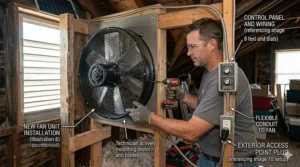
Real-World Scenarios: Which Fan Fits Your House
The starter homeowner with a 1,400-square-foot ranch: the Air Vent 53315 or Cool Attic CX1500 covers this easily without paying for capacity you’ll never use.
The family in a 2,800-square-foot two-story with a hot upstairs: the iLiving ILG8G14-12T’s outsized CFM-per-dollar makes it the practical pick, paired with verified soffit intake.
The owner of a sprawling 3,500+ square foot home who wants to monitor things from their phone: the QuietCool PRO-3.0 or ES-3.0 — choose ES-3.0 specifically if the fan will run most summer days, since the ECM motor’s lower draw pays for the price difference over a few seasons.
The garage or detached workshop with no electrical run nearby: the Broan 345GOBK sidesteps wiring entirely, as long as the gable itself doesn’t sit in permanent shade.
How to Choose a Gable Attic Fan
- Measure your attic’s square footage first. Every spec on this list is tied to a coverage rating — guessing wastes money in either direction.
- Inspect your existing soffit intake vents. If they’re painted shut or insulation-blocked, fix that before buying any fan.
- Decide hardwired vs. plug-and-play. Hardwired models cost less upfront but may need an electrician; plug-and-play units cost more but install in an afternoon.
- Consider your climate’s humidity, not just heat. A humidistat-equipped model (both QuietCool picks here) earns its keep in winter condensation control, not just summer heat.
- Check your gable’s sun exposure if considering solar. The Broan’s split panel/fan design helps, but full shade all day will still limit any solar option’s output.
- Confirm the housing fits your existing louver opening. Don’t assume — measure.
- Factor in the shutter/vent cover cost separately if it’s not included.
Gable Mount vs. Roof Mount: Which Wins for Your Home?
Gable-mount fans install through the existing vertical louver at your attic’s end wall, pushing air out horizontally — no roof penetration required. Roof-mount fans cut through the shingles and deck, pulling air upward from whatever point they’re centered on. Building America’s Solution Center notes that both function as exhaust-only systems pulling fresh air through soffit or gable intake vents, so the core mechanics are identical.
Where they actually differ: gable mounts are dramatically easier DIY installs with zero leak risk down the line, but they only make sense if a usable gable vent already exists and sits roughly centered relative to the attic’s heat pockets. Roof mounts can be placed exactly where heat collects — useful on hip roofs or oddly shaped attics with no gable at all — but every penetration is a potential future leak point and typically needs a roofer or experienced installer. For the vast majority of homes with a standard gable vent already in place, the gable option is the lower-risk, lower-cost choice.
Common Mistakes When Buying a Gable Attic Fan
- Ignoring intake vent capacity. This is the single most common and most expensive mistake — see the sizing section above.
- Buying based on CFM alone. A 2,900 CFM fan in a 1,200-square-foot attic is overkill that adds noise and electrical draw for no real benefit.
- Skipping the shutter cost. Several models list a lower price specifically because the automatic louver/shutter ships separately.
- Choosing solar for a shaded gable without checking the panel-mount flexibility. Not every solar model lets you separate the panel from the fan the way the Broan does.
- Forgetting local electrical code requirements. Hardwired fans typically need a dedicated thermostatically-controlled circuit — check before assuming a standard outlet circuit will do.
Features That Actually Matter (And Those That Don’t)
Matters a lot: net free area compatibility with your soffit intake, motor type (ECM vs. PSC) if you’ll run the fan for hours daily, and a humidistat if you live somewhere genuinely humid.
Matters somewhat: plug-and-play vs. hardwired — purely a question of your installation budget and comfort with electrical work.
Matters less than the marketing suggests: smartphone app control is genuinely convenient but doesn’t change how well the fan actually ventilates your attic; brand name recognition between Cool Attic and Maxx Air, as covered above, is close to meaningless given they’re built by the same manufacturer.
Long-Term Cost & Maintenance
Run-time cost is simple math: watts × hours run × your local electricity rate, divided by 1,000 for kilowatt-hours. A basic 230-watt hardwired fan running eight hours on a hot day costs only a few cents to a quarter or so depending on your rate — but it adds up over a full cooling season, which is exactly where the ECM-motor QuietCool ES-3.0 earns back its higher purchase price.
One important caveat from the Department of Energy’s home insulation guidance: ventilation and insulation work as a system, not separately. A powered attic fan in a poorly sealed attic can pull conditioned air up from your living space rather than fresh air from outside, which increases your AC’s workload instead of reducing it. Seal and insulate first; let the fan handle what’s left.
Maintenance is minimal across every model here: an annual blade dusting, a check that the thermostat/humidistat still triggers correctly, and a glance at the gable louver for nesting insects or debris before each summer.
🔍 Ready to Stop Fighting Your Attic?
✨ Whichever model fits your square footage and budget, pairing it with properly sealed soffit intake vents is what actually determines whether you see real comfort and energy gains — not just a spinning fan.
FAQ
❓ Do gable attic fans really lower your cooling bill?
❓ How much does it cost to run a gable attic fan per month?
❓ Do I still need roof vents if I install a gable fan?
❓ Can I install a gable attic fan myself?
❓ What size gable attic fan do I need for a 2,000 sq ft attic?
Conclusion
Seven fans, three price tiers, and one consistent truth: the “best” gable attic fan depends entirely on your attic’s square footage, your soffit intake capacity, and how much you want to spend keeping it running. If you just want maximum airflow for the least money, the iLiving wins outright. If you want to never think about electricity again, the Broan’s solar setup is hard to beat for moderate-sized spaces. And if you’ve got a genuinely large attic and want to monitor it from your couch, the QuietCool ES-3.0’s efficient motor will quietly pay for its higher price tag over a few summers.
Whatever you choose, don’t skip the sizing math — it’s the difference between a fan that actually cools your home and one that just spins expensively.
✨ Found Your Match?
🔍 Take your attic from sauna to sane with whichever pick fits your square footage best. Click through to check current pricing before stock or prices shift.
Recommended for You
- Best Attic Fan with Thermostat: 7 Top Picks for 2026
- 7 Best Solar Attic Fans in 2026: Cut Cooling Costs Fast
- 7 Best Quiet Whole House Fans for Ultimate Home Cooling (2026)
Disclaimer: This article contains affiliate links. As an Amazon Associate, I earn from qualifying purchases. If you purchase products through these links, we may earn a small commission at no additional cost to you.
✨ Found this helpful? Share it with your friends! 💬🤗
