
In This Article
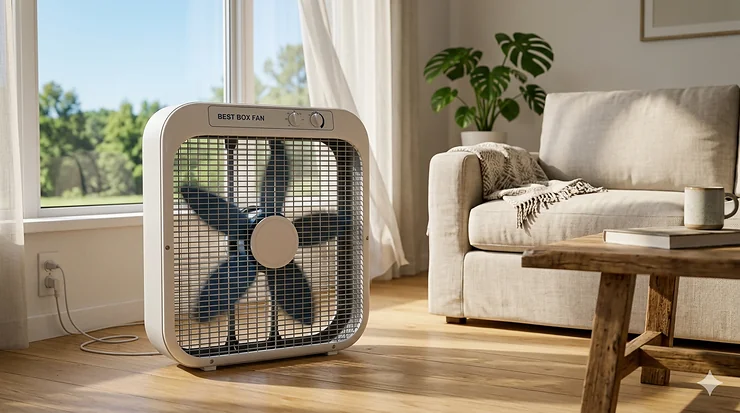
Somewhere around the third night of a heat wave, every homeowner has the same epiphany: the box fan you’ve been ignoring in the garage is suddenly the most important appliance in the house. A box fan is a square, blade-driven fan housed in a flat frame, built to push large volumes of air across a room rather than at a single target — the workhorse of home cooling since your grandparents’ generation, and somehow still undefeated on price-per-CFM. No app, no Bluetooth, no nonsense. Just a motor, five plastic blades, and a job to do.

2026 has already delivered a string of record-breaking hot stretches, and air conditioning bills have followed right along with the mercury. That’s the real appeal of a good box fan: it won’t replace your AC, but it will let you raise the thermostat a few degrees and still feel comfortable, for a fraction of the running cost. Outlets that stress-test cooling gear every summer, including CNN Underscored, have put dozens of fans through their paces this year, and the pattern holds: the best box fan for your space depends less on flashy marketing and more on three boring-but-important numbers — airflow, noise, and watts.
We spent real hours cross-referencing manufacturer specs, retailer listings, and verified buyer feedback to land on seven models actually sitting on Amazon’s shelves right now. No invented products, no rounded-up review scores. Just the fans worth your money, broken down by who they’re actually built for.
Quick Comparison Table
| Fan | Best For | Speeds | Airflow | Noise |
|---|---|---|---|---|
| Vornado Model 80 | Whole-room power | 5 | Up to 3,179 CFM | Moderate |
| Lasko 3720 Weather-Shield | Window use | 3 | ~2,000 CFM | Quiet (43–50 dB) |
| Hurricane Classic 20″ | Budget airflow | 3 | 2,400 CFM | Moderate |
| PELONIS 20″ | All-purpose | 3 | 2,295 CFM | Loud on high |
| Comfort Zone CZ200ABK | Sleep / white noise | 3 | Moderate-high | Loud (64–68 dB) |
| BLACK+DECKER BFB09W | Desks & dorms | 3 | Low (9″ blade) | Quiet |
| Amazon Basics 20″ | Tightest budget | 3 | ~1,800 CFM | Moderate |
A few things jump out once you put these side by side. The Vornado Model 80 isn’t just the priciest fan here — its 3,179 CFM rating outpaces the next-closest competitor by nearly 800 cubic feet per minute, which matters if you’re trying to cool an open-concept living room instead of a bedroom. On the flip side, the Hurricane Classic proves you don’t need a premium badge to hit serious airflow numbers; at 2,400 CFM, it beats fans costing twice as much. If quiet matters more than raw power, the Lasko 3720 and BLACK+DECKER BFB09W are the only two that won’t compete with your TV at full speed.
💬 Just one click — help others make better buying decisions too! 😊
Top 7 Box Fans: Expert Analysis
1. Vornado Model 80 High-Velocity Box Fan — Best Overall
The Vornado Model 80 is the one fan on this list that earns the word “investment.” Its five speed settings and rated output of up to 3,179 CFM mean it doesn’t just stir air near it — it pushes a current across an entire room, which is the difference between “the fan is on” and “I can actually feel it from the couch.” The metal shroud and removable grille aren’t cosmetic touches; they’re why this is one of the only box fans backed by a 5-year warranty instead of the usual one-year afterthought.
What most buyers overlook is that the extra wattage buys you something a cheap fan can’t: consistency at low speeds. Budget fans often get weak and rattly once you drop below speed two. The Model 80 stays smooth the whole way down, which is exactly what you want for overnight use. Reviewers consistently point to the removable grille as the unsung hero — pop it off, wipe the blade, done, no Q-tip excavation required.
Pros: Exceptional airflow for the size; 5-year warranty; tool-free grille cleaning
Cons: Pricier than standard box fans; no oscillation
Best for anyone cooling a living room, open loft, or a space where one fan needs to do the work of two. Typically priced in the $55–$75 range, it’s the clear pick if airflow-per-dollar over the fan’s lifespan matters more than the sticker price today.

2. Lasko Weather-Shield Performance Box Fan 3720 — Best for Windows
If you’ve ever set a regular box fan in a window and watched a light rain short it out, the Lasko 3720 solves a problem you didn’t know had a name. Its patented Weather-Shield motor is sealed for window use, so you can leave it propped in the sill through a passing drizzle without panicking every time the sky changes. Pair that with the Wind Ring System — a shaped grille that Lasko claims adds up to 30% more air velocity without drawing more power — and you get a fan that punches above its 20-watt motor.
Here’s the part the spec sheet undersells: at less than two cents an hour to run, leaving this fan on all night costs you pocket change, not a line item. Lasko has been building box fans for over a century, and the snap-on stabilizing feet and wider base here reflect a brand that’s fixed every wobbly-fan complaint by now.
Pros: Window-safe motor; ultra-low operating cost; quiet at 43–50 dB
Cons: Only 3 speeds; plastic housing feels basic for the price
Best for renters or anyone pulling outside air through a window during the cooler night hours. Expect to pay somewhere in the $25–$35 range.
3. Hurricane Classic 20″ Floor Box Fan — Best High-CFM Value
The Hurricane Classic is the fan equivalent of a Toyota Hilux: nothing fancy, everything functional. At 2,400 CFM and 1,100 RPM on high, it actually out-airflows the pricier Pelonis and Comfort Zone fans on this list, while staying in budget territory. The polypropylene blades keep the unit light at around 7 pounds, and the recessed cord-storage compartment means you’re not staring at a tangle of cable every time you put it away.
What the listing won’t tell you: that 2,400 CFM figure is genuinely useful for garages, basements, and workshops where you need serious ventilation, not just a personal breeze. The slim 3.5-inch depth also makes it one of the easier fans here to wedge into a closet or behind a door when it’s not in use.
Pros: Best CFM-to-price ratio tested; slim, storable frame; ETL-listed
Cons: Only 3 speeds; motor hum noticeable on speed three
Best for garages, basements, and anyone who wants maximum air movement without paying a premium-brand markup. Usually found in the $25–$35 range.
4. PELONIS 20″ Box Fan — Best All-Purpose Pick
The PELONIS box fan splits the difference between the Hurricane’s raw output and the Vornado’s refinements. At 2,295 CFM and a claimed 25 feet-per-second air throw, it holds its own against fans that cost considerably more, and the recessed cord storage plus reversible stabilizing feet mean it adapts to floor, window, or tabletop placement without buying a second fan for each room type.
Independent testers have flagged one honest tradeoff: on its highest setting, this fan gets loud enough that conversation requires raising your voice. That’s the price of the air it’s pushing. Drop it to speed two, though, and most people find the noise-to-airflow balance genuinely pleasant.
Pros: Versatile floor/window/table use; strong airflow for the price; recessed cord storage
Cons: Noticeably loud on high; lightweight plastic construction
Best for buyers who want one fan that can move between rooms and use cases. Typically priced around $28–$38.
5. Comfort Zone CZ200ABK 20″ Box Fan — Best for Sleep
Counterintuitively, the Comfort Zone earns its spot here because it’s loud — in the specific, useful way that makes it a sleep aid rather than an annoyance. Independent decibel testing put it at 64–68 dB on high, which lands squarely in steady white-noise territory rather than a sharp, distracting whir. If you’ve been running a phone app for ocean sounds, this fan does the same job and also cools the room.
The tradeoff is power draw: testers measured it pulling 68 to 84 watts, noticeably more than the Lasko or BLACK+DECKER on this list. That’s the cost of the airflow and the noise profile both. The removable grille makes cleaning straightforward, and the carry handle means moving it bedroom-to-bedroom doesn’t require a Tetris-level grip.
Pros: Excellent white-noise profile for sleepers; removable grille; sturdy carry handle
Cons: Higher energy draw than competitors; stabilizing feet feel flimsy
Best for light sleepers who want consistent background noise alongside the cooling. Generally found in the $20–$30 range.

6. BLACK+DECKER BFB09W 9″ Frameless Box Fan — Best Compact Pick
Every fan on this list so far has been a 20-inch floor unit. The BLACK+DECKER BFB09W breaks that mold entirely — a 9-inch, frameless square fan built for desks, nightstands, and dorm rooms where a full-size box fan would eat half the available surface. At just 2.73 pounds and 40 watts, it’s the lightest and most efficient fan here by a wide margin.
What buyers consistently note: the front-mounted dial is genuinely easier to reach than the top-mounted switches on bigger box fans, especially when the fan is sitting on a desk at chest height instead of the floor. Don’t expect this one to cool a bedroom on its own — its 9-inch blade simply can’t move the volume of air a 20-inch fan can — but for personal, close-range cooling, it’s hard to beat.
Pros: Extremely lightweight and efficient; easy-access front dial; fits tight spaces
Cons: Limited room coverage; not a substitute for a full-size fan
Best for desks, dorms, RVs, and anyone who needs a personal breeze, not whole-room circulation. Typically priced $20–$28.
7. Amazon Basics 3-Speed Box Fan — Best Ultra-Budget
The Amazon Basics box fan exists to answer one question: how cheap can a fan be before it stops working well? The answer, surprisingly, is “not nearly as cheap as you’d guess.” At 67 watts and roughly 1,800 CFM in independent testing, it covers a standard bedroom competently, and its 5-blade design produces smoother airflow than its price tag suggests.
It won’t out-muscle the Hurricane Classic or PELONIS, and the housing flexes more than the pricier options if you lean on it. But for a guest room, a kid’s bedroom, or a first apartment where every dollar is accounted for, this is the fan that does the job without complaint.
Pros: Lowest price point tested; surprisingly smooth 5-blade airflow; lightweight and portable
Cons: Housing feels less sturdy; lacks any premium features
Best for tight budgets and secondary rooms. Usually sits in the low-to-mid $30s.
✨ Don’t Miss These Exclusive Deals!
🔍 Take your cooling setup to the next level with these carefully selected box fans. Click on any highlighted model above to check current pricing and availability — a 20 inch box fan or compact desk model could be exactly what your room needs this summer.
Practical Usage Guide
Buying the right fan only solves half the problem; running it well solves the other half. A box fan creates a wind-chill effect — it doesn’t actually drop the air temperature, it speeds up sweat evaporation off your skin, which is why the Department of Energy notes that circulating fans work best alongside natural ventilation or air conditioning rather than as a total replacement for either.
For window use, point the fan to exhaust hot air outward during the day and pull cooler air in at night, and close off rooms you’re not actively cooling so the airflow doesn’t dissipate uselessly. If you’re running two fans, set one as intake on the cooler side of the house and one as exhaust on the warmer side — this cross-breeze setup measurably outperforms a single fan working alone. Wipe down the blades monthly; dust buildup on a fan blade is the single most common (and most ignored) cause of reduced airflow over time. And check the cord and plug each season — a slightly warm plug after hours of use is normal, but a hot one means it’s time to replace the fan, not push your luck.
Real-World Scenarios
The night-shift sleeper. If white noise matters as much as cooling, the Comfort Zone’s louder 64–68 dB profile becomes an asset instead of a flaw — set it to medium and let the steady hum do double duty.
The apartment with no AC. A single Hurricane Classic or Vornado Model 80 placed for cross-ventilation between two open windows will outperform two weaker fans split across the same space, simply because of the CFM difference.
The college dorm. Space is the enemy here, not budget. The BLACK+DECKER BFB09W’s 9-inch frameless design and 2.73-pound weight solve the real problem — fitting a fan on a desk that’s already crowded with a laptop, lamp, and mini-fridge.

How to Choose the Best Box Fan
- Match CFM to room size. A 2,000+ CFM fan suits an open living area; smaller bedrooms do fine with 1,500–1,800 CFM.
- Check the noise rating before buying for a bedroom. Anything above 60 dB on high is noticeable; under 50 dB blends into the background.
- Confirm window safety if that’s the plan. Not every box fan has weatherproofing — the Lasko 3720 does, most don’t.
- Count the speeds, but don’t overweight them. Three speeds covers 90% of real use; five speeds is a nice-to-have, not a necessity.
- Factor in storage. A slim, foldable-foot design like the Hurricane Classic stores far easier than a bulkier metal-shroud fan.
- Look at the warranty. Most box fans offer one year; a multi-year warranty (like Vornado’s five) signals genuine confidence in durability.
- Decide floor vs. window vs. desk before you shop, since that single choice eliminates half the field instantly.
Box Fan vs. Tower Fan vs. Pedestal Fan
A box fan wins on pure airflow-per-dollar and whole-room circulation; a tower fan wins on footprint and quiet oscillation; a pedestal fan wins on height-adjustable, targeted cooling for one person. If you’re cooling a whole room cheaply, the box fan is almost unbeatable. If you want something that looks intentional in a living room and won’t dominate the corner, a tower fan earns its higher price. Pedestal fans sit in between — better aim than a box fan, less raw output than either alternative.
Common Mistakes When Buying a Box Fan
The most frequent misstep is buying based on speed count instead of CFM — a 5-speed fan with weak output is still a weak fan. The second is ignoring noise ratings entirely and discovering on night one that “quiet enough” wasn’t. The third is skipping the window-safety question; not every fan tolerates a window sill, and a non-weatherproof motor left out in a storm is a real fire and shock hazard, not just a warranty voided. Finally, buyers often assume bigger is always better, when a 9-inch desk fan genuinely outperforms a 20-inch floor fan for personal, close-range cooling in a small space.
What to Expect: Real-World Performance
CFM numbers on a box of marketing copy and CFM numbers in your actual bedroom rarely match exactly — airflow drops with distance, and a fan rated at 2,400 CFM doesn’t deliver that volume directly at your face from across the room. In practice, that means a “2,400 CFM” floor fan and a “1,800 CFM” budget fan feel more similar at 10 feet away than the spec sheets suggest, though the difference becomes obvious again once you’re cooling a larger or more open space. Treat CFM as a relative ranking tool between fans, not a literal promise of wind speed at your couch.
Box Fan Sizes and Room Coverage
Most general-purpose box fans run 20 inches, which suits bedrooms, home offices, and standard living rooms up to roughly 300 square feet. Compact 9- to 12-inch models, like the BLACK+DECKER BFB09W, are built for personal range — a desk, a nightstand, a single chair — not whole-room circulation. If you’re cooling anything larger than an open studio or a combined living/dining space, a single 20-inch fan starts to lose effectiveness, and two smaller fans working in a cross-breeze pattern will outperform one large fan working alone.
Where to Place Your Fan for Maximum Airflow
Floor placement near a doorway creates the best whole-room circulation, since it pulls cooler air from adjoining rooms. Window placement works best at night or in shaded windows, exhausting hot indoor air outward rather than drawing in midday heat. Avoid pointing a box fan directly into a corner — it kills airflow efficiency by bouncing the current right back at the motor housing. And keep at least six inches of clearance behind any fan with a rear-intake design, since blocked intake airflow is one of the quiet, common reasons a fan underperforms its rated CFM.
Long-Term Cost & Maintenance
This is where box fans separate themselves from air conditioning in a way spec sheets rarely emphasize. Most models on this list draw between 20 and 85 watts; at the national average electricity rate, that’s roughly $1 to $4 a month running eight hours a day — pennies compared to central air, which can run $100 to $300 a month over the same stretch. The Lasko 3720’s claimed two-cents-an-hour cost is the standout here, translating to under $5 a month even running continuously.
Maintenance costs are close to zero if you stay ahead of dust. A monthly wipe-down of the blades and grille keeps airflow at its rated capacity; skip it for a full season and you’ll notice a real, measurable drop in output. Fans with removable grilles, like the Vornado Model 80 and Comfort Zone CZ200ABK, make this five-minute task painless. Fans without one require a slower cotton-swab approach between the slats — annoying, but not a dealbreaker.
Features That Actually Matter (And Those That Don’t)
CFM rating, noise level in decibels, and motor wattage are the three numbers worth your attention — everything else is largely decoration. “Wind Ring” systems, proprietary grille shapes, and named airflow technologies (Lasko’s Wind Ring, Genesis’s “Max Cooling Technology,” and similar marketing terms across the category) can genuinely improve airflow efficiency, but they’re incremental gains layered on top of the core motor-and-blade design, not magic. Carry handles and recessed cord storage matter more in daily life than they get credit for — anyone who’s tripped over a dangling cord or wrestled a 7-pound fan with no handle understands why instantly. Stabilizing feet sound trivial until one is missing and the whole fan rattles on high.
Safety, Heat Risk, and When a Fan Isn’t Enough
A box fan is comfort equipment, not emergency cooling. The CDC’s heat and health guidance is direct on this point: fans are useful when indoor temperatures stay below 90°F, but above that threshold, a fan can actually raise body temperature rather than lower it, because it’s circulating air that’s now hotter than your skin. The EPA echoes the same caution, noting that portable fans don’t cool air at all — they only move it, helping sweat evaporate faster, which is a meaningfully different mechanism than air conditioning. On dangerously hot days, treat your box fan as a comfort layer on top of shade, hydration, and access to an air-conditioned space, not a substitute for any of them. From a pure equipment-safety standpoint, stick to ETL- or UL-listed models (every fan on this list qualifies), avoid extension cords rated below the fan’s draw, and never leave a non-weatherproof fan exposed to rain or direct window moisture.

FAQ
❓ How many CFM is good for a box fan?
❓ Is a 20 inch box fan better than a smaller fan?
❓ Can you leave a box fan in a window during rain?
❓ How much electricity does a box fan use per month?
❓ Do box fans actually cool a room down?
Conclusion
If there’s one takeaway after comparing all seven of these side by side, it’s that the “best box fan” question doesn’t have one answer — it has seven, depending on what you’re actually solving for. Want raw whole-room power and don’t mind paying for it? The Vornado Model 80 earns its price. Need something that survives a cracked-open window through a summer storm? The Lasko 3720 was built for exactly that. Tight on cash but unwilling to suffer through a hot night? The Hurricane Classic and Amazon Basics both prove that budget doesn’t have to mean weak. And if your whole problem is a desk that’s already out of room, the BLACK+DECKER BFB09W solves a question none of the 20-inch fans on this list can answer.
Whichever you land on, the math stays the same: a few dollars a month against a box fan beats a few hundred against your air conditioner, every single time the temperature climbs.
✨ Don’t Miss These Exclusive Deals!
🔍 Ready to beat the heat? Check current pricing on any of these seven box fans above and find the one that matches your room, your budget, and your noise tolerance.
Recommended for You
- 7 Best Gable Attic Fans of 2026: Real Models, Ranked
- Best Attic Fan with Thermostat: 7 Top Picks for 2026
- 7 Best Solar Attic Fans in 2026: Cut Cooling Costs Fast
Disclaimer: This article contains affiliate links. As an Amazon Associate, I earn from qualifying purchases. If you purchase products through these links, we may earn a small commission at no additional cost to you.
✨ Found this helpful? Share it with your friends! 💬🤗
