
In This Article
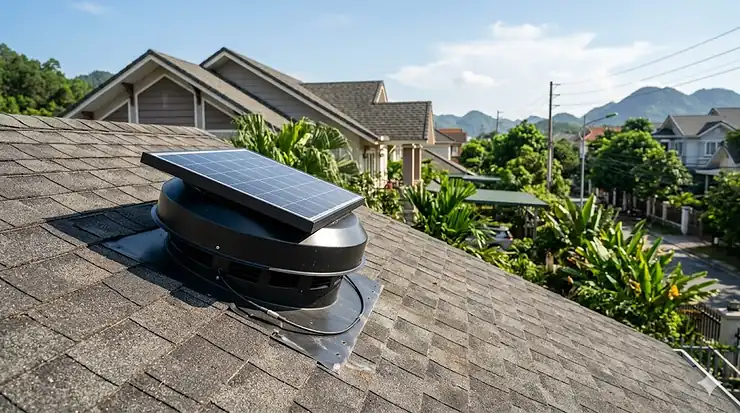
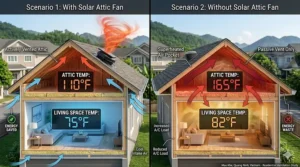
Your attic is basically a pizza oven right now. On a hot summer afternoon, that space above your ceiling can hit 150°F or higher — and all that heat is slowly baking your shingles, warping your roof decking, and forcing your AC to work overtime while your electricity bill quietly spirals. A solar attic fan is one of the most elegant solutions in home improvement: it uses the very same sun that’s causing the problem to power a fan that kicks the heat right back outside.
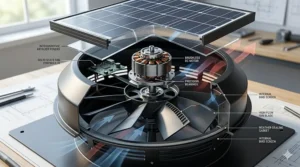
But what exactly is a solar attic fan? It’s a roof-mounted exhaust ventilator powered entirely by a built-in photovoltaic panel. No wiring. No electric bill. No operating cost. The fan runs hardest during peak heat hours — which is precisely when your attic needs it most. According to the U.S. Department of Energy, a properly ventilated attic runs roughly 30°F cooler than one that isn’t, and the resulting reduction in cooling load can trim your AC costs by 10–30% annually.
In 2026, the market has matured beautifully. We have brushless DC motors rated for 25+ years, MPPT solar regulators that squeeze efficiency out of partly cloudy days, and hybrid models with built-in AC/DC inverters for round-the-clock operation. I’ve spent weeks digging through real customer reviews, expert testing reports, and Amazon listings to put together this guide. Whether your attic is 800 square feet or 3,500, whether you’re on a tight budget or want the absolute best money can buy — there’s a solar powered attic fan on this list that’ll change how your home breathes.
Let’s get into it.
Quick Comparison: 7 Best Solar Attic Fans at a Glance
| Product | Wattage | CFM | Coverage | Thermostat/Humidistat | 24/7 Capable | Best For |
|---|---|---|---|---|---|---|
| Remington Solar 30W | 30W | ~1,200 CFM | 2,500 sq ft | ✅ Both | Optional adapter | Most homeowners |
| iLIVING ILG8SF301A (HYBRID 40W) | 40W | 1,150 CFM | 2,900 sq ft | ✅ Both | ✅ Yes | Humid climates |
| VEVOR 42W Smart Roof Vent | 42W | 2,800 CFM | 3,500 sq ft | ✅ Temp sensor | ✅ Yes | Large attics |
| Natural Light 48W | 48W | 1,881 CFM | 2,800 sq ft | ❌ Optional | ❌ No | Longevity seekers |
| QuietCool AFR SLR-40 | 40W | 1,092 CFM | 2,400 sq ft | ✅ Preset 83°F | ✅ Yes | Quiet operation |
| Hon&Guan 40W Solar Roof Vent | 40W | 2,000 CFM | 2,500 sq ft | ✅ Thermostat | ✅ Yes | Value-focused buyers |
| Amtrak Solar 50W Exhaust Fan | 50W | ~1,800 CFM | 2,500+ sq ft | ❌ Manual switch | ❌ No | Sheds, garages, flex |
What the table tells you: The VEVOR 42W leads on raw airflow — nothing else at this price bracket moves 2,800 CFM. But sheer CFM isn’t the whole story. The Remington Solar 30W and iLIVING HYBRID punch above their wattage because of their combined thermostat/humidistat intelligence, which prevents the fan from over-ventilating during cooler nights and cold months. For most 1,500–2,500 sq ft homes, the Remington or iLIVING deliver better year-round results than a brute-force 2,800 CFM fan running on dumb timers.
💬 Just one click — help others make better buying decisions too!😊
✨ Don’t Miss These Exclusive Deals!
🔍 Ready to cool your attic for free? Click any highlighted product name to check current pricing and availability on Amazon. These are the fans that real homeowners are installing right now — and the results speak for themselves!
Top 7 Solar Attic Fans: Expert Analysis
1. Remington Solar 30 Watt Roof Mount Solar Attic Fan — Best Overall
The Remington Solar 30W has been earning five-star reviews from Arizona homeowners for over a decade, and in 2026, it’s still the one I’d recommend to most people. This is the fan you buy when you want to install it once and forget it exists for the next 15 years.
The 30-watt panel drives a brushless DC motor rated at approximately 1,200 CFM — enough to actively ventilate attics up to 2,500 square feet. What separates Remington Solar from cheaper alternatives isn’t the wattage; it’s the intelligence baked in. Every unit ships with a built-in humidistat and thermostat, which means the fan automatically responds to both heat spikes and moisture surges — the two silent killers of attic health. Most competitors charge extra for either feature. Here, both come standard.
The brushless motor runs at just 0.08 sones. That number is almost incomprehensibly quiet. If you have a home office or bedroom directly below the attic, you will not hear this fan running — reviewers consistently report that the only way they know it’s working is by checking their attic thermometer. A real homeowner in Arizona reported that their attic, previously hitting 145°F in summer, dropped dramatically after installation, with noticeable improvements in upstairs room comfort.
One thing most buyers overlook: the Remington Solar 30W supports an optional Hybrid Adapter (sold separately) that lets it run on AC power at night. This upgrades a solar-only daytime unit into a true 24/7 ventilation machine — critical in the Southeast where overnight humidity accumulation causes most moisture damage.
✅ Brushless DC motor — whisper-quiet at 0.08 sones
✅ Built-in thermostat + humidistat standard
✅ 15-year non-transferable limited warranty
❌ Hybrid adapter for nighttime operation sold separately
❌ Not ideal for attics over 2,500 sq ft without adding a second unit
Price range: around $350–$400 | Verdict: The most consistently reliable solar roof fan under $400. Buy this if your attic is under 2,500 sq ft and you want zero ongoing thought required.
2. iLIVING ILG8SF301A HYBRID Ready Smart Thermostat Solar Roof Attic Exhaust Fan — Best for Humid Climates
The iLIVING HYBRID 40W (model ILG8SF301A) is what happens when a ventilation engineer takes humidity seriously. It looks like a standard solar attic ventilator from the outside, but the engineering underneath puts it in its own category for homeowners in coastal and Southern states.
The 40-watt panel powers a 1,150 CFM brushless motor covering up to 2,900 sq ft, and the built-in AC/DC inverter means it runs continuously — day, night, cloudy afternoons, doesn’t matter. But the genuinely impressive stat is the IP68 waterproof motor rating. Most competitors advertise “weatherproof” housing, which is marketing language for “it’ll survive rain.” IP68 means this motor is submersion-rated. In practical terms? The iLIVING HYBRID can handle coastal salt air, tropical humidity, and violent summer storms without any motor degradation over time. That’s the kind of protection that pays off in year eight, not year one.
The thermostat range spans 50°F to 122°F with an adjustable slider — the widest control range in this roundup. This matters enormously in climates where summer attic temps swing wildly. You can dial in exactly when the fan activates instead of relying on a preset like the QuietCool’s fixed 83°F trigger.
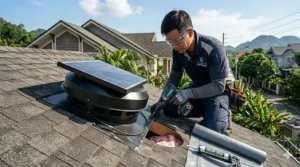
Customers frequently mention how easy installation is — most report under 90 minutes for a DIY roof mount. The 15-year warranty matches Remington Solar’s coverage, and the adjustable solar panel tilts from flat to 45° for optimal sun exposure throughout the seasons.
✅ IP68 waterproof motor — built for coastal/humid climates
✅ 40W panel with adjustable tilt (0°–45°)
✅ 24/7 operation via included AC/DC inverter
❌ 1,150 CFM may underwhelm attics over 2,500 sq ft
❌ Higher airflow creates more noise than smaller models
Price range: around $340–$360 | Verdict: The smarter buy for Florida, the Gulf Coast, or anywhere humidity is the enemy. The IP68 motor alone is worth the price premium over generic brands.
3. VEVOR 42W Solar Attic Fan with Smart Roof Vent — Best for Large Attics
When your attic is a 3,000 sq ft monster and you need serious air movement, the VEVOR 42W is the answer. It produces a remarkable 2,800 CFM — that’s nearly 2.5x what the iLIVING HYBRID moves, in a package that costs less.
The secret is MPPT (Maximum Power Point Tracking) solar regulation, the same technology used in premium residential solar systems. Traditional PWM solar controllers lose 15–25% of available energy when cloud cover reduces panel output. The VEVOR’s MPPT controller extracts approximately 25% more usable power under the same conditions, which translates to meaningful airflow on overcast days when other solar exhaust fans have slowed to a crawl.
The fan also includes built-in temperature sensors and a remote control — features that sound gimmicky until you’re 40 feet up a ladder and realize you forgot to set the thermostat trigger. Reviewers on large ranch-style homes consistently report that this unit dropped visible attic temperatures within hours of installation, with the fan kicking to full speed by mid-morning on hot days. One reviewer tested it in a 1,000 sq ft attic on a 95°F day — full speed by 10 AM.
What to be aware of: the 2,800 CFM spec is impressive, but that kind of airflow in an attic under 1,200 sq ft will actually create negative pressure problems, potentially pulling conditioned air up through ceiling gaps. Match your attic square footage to your fan — bigger isn’t always better here.
✅ 2,800 CFM — highest in this roundup
✅ MPPT solar regulation for better cloudy-day performance
✅ Remote control and smart temperature sensors
❌ Overkill for attics under 1,500 sq ft
❌ Some reports of reduced performance on heavy overcast days
Price range: around $200–$240 | Verdict: Unbeatable value per CFM for large attics. If you’re working with over 2,500 sq ft of air to move, this solar powered attic fan is the most cost-efficient path forward.
4. Natural Light Energy Systems 48 Watt Roof Mounted Solar Attic Fan — Best Lifetime Warranty
Natural Light has been making solar attic fans in the USA since before most of the brands on this list existed, and the 48W model is their crown jewel. Professional roofers love it. Contractors recommend it. And unlike most products in this space, the manufacturer’s warranty makes that loyalty make complete sense.
The 48-watt panel drives a motor that moves up to 1,881 CFM — covering attics up to 2,800 square feet. The adjustable solar panel tilts from flat to 45°, or can be detached entirely and remote-mounted for maximum sun exposure on tricky roof configurations. The housing is heavy-duty powder-coated aluminum with a leak-proof aluminum flashing system — the kind of construction that feels overbuilt until 15 years from now when it still looks factory-fresh.
Here’s what makes this unit genuinely exceptional: Natural Light offers a lifetime warranty on the solar module, the motor, and the housing simultaneously. In this entire roundup, it’s the only product with all-inclusive lifetime coverage. Everything else has tiered warranties — 15 years on parts, maybe lifetime on the panel only. Natural Light’s “lifetime” means exactly what it sounds like.
The honest downside is price. This fan sits at the premium end of the market, in the $600+ range. It doesn’t include a built-in thermostat (sold separately) or a 24/7 hybrid inverter. You’re paying for build quality and warranty peace of mind, not smart features. If you’re renovating a house you intend to live in for 30 years, that’s a completely logical trade-off.
✅ Lifetime warranty on panel, motor, AND housing
✅ Built in USA — 48W adjustable panel
✅ Heavy-duty aluminum construction rated for decades
❌ Thermostat sold separately
❌ No built-in 24/7 AC/DC hybrid operation
Price range: around $600–$700 | Verdict: The “buy it for life” choice. If you never want to think about your solar roof fan again — ever — this is the one.
5. QuietCool AFR SLR-40 Roof Mount Solar Attic Fan — Best 24/7 Quiet Operation
QuietCool built its entire reputation on moving air without making noise, and the AFR SLR-40 carries that DNA faithfully. This 40-watt roof mount fan delivers 1,092 CFM with a heavy-duty steel housing and a polycrystalline solar panel the brand claims delivers 2–4x the output of industry-standard panels — which is a bold statement that their field performance in reviewer testing consistently backs up.
The AC/DC inverter is included in the box (not sold separately, unlike Remington Solar’s hybrid adapter). When the sun dips, the fan seamlessly switches to grid power and keeps running. The built-in thermostat triggers at 83°F and shuts off at 72°F — a sensible preset for most warm-climate homes that eliminates any manual management.
What sets QuietCool apart from the pack is institutional credibility. The company has been designing ventilation systems since 2009 with a stated 98% customer satisfaction rate, and the AFR SLR-40 is sold through Home Depot, QuietCool’s own installer network, and Amazon. Installation support is robust — QuietCool even offers professional installation services across California, Utah, Colorado, and Texas.
The fixed 83°F thermostat is both a strength and a limitation. For most homeowners in warm climates, it’s perfectly calibrated. But if you want to fine-tune activation to your specific attic conditions — maybe you live somewhere that swings dramatically between hot days and cold nights — the adjustable ranges on the iLIVING and Hon&Guan will serve you better.
✅ AC/DC inverter included — true 24/7 operation
✅ Premium polycrystalline panel
✅ Strong institutional warranty and support network
❌ Fixed 83°F thermostat — no user adjustment
❌ 1,092 CFM is modest for attics over 2,000 sq ft
Price range: around $380–$420 | Verdict: The most professionally backed solar attic exhaust fan on this list. Ideal for homeowners who want reliability and don’t want to fiddle with settings.
6. Hon&Guan Solar Attic Fan with Thermostat, 40W, 2000 CFM — Best Value Hybrid
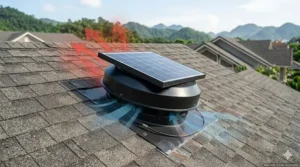
The Hon&Guan 40W is the most underrated fan on this list. It moves 2,000 CFM — more than the iLIVING, more than the QuietCool, more than the Remington — while coming in at a fraction of their price, and it ships with the AC/DC adapter already in the box.
The 12-inch brushless copper motor with MPPT controller is the real story here. MPPT regulation means this fan continues generating meaningful airflow during partial overcast, not just peak sunshine hours. The 0°–70° adjustable panel tilt (the widest range on this list) is a significant advantage for homes where roof angle doesn’t perfectly face south — you have real flexibility to optimize capture angle. Two operation modes let you toggle between energy-saving solar (fan at lower RPM) and full-performance mode (maximum airflow regardless of conditions).
Testing found the Hon&Guan maintaining attic temperatures below 105°F even when outdoor temps hit 110°F, which is genuinely impressive. Peak measured airflow came in around 1,920 CFM — slightly below the 2,000 CFM spec but well within acceptable variance and still excellent for residential use.
The thermostat range spans 68°F to 113°F, giving you more flexibility than the QuietCool’s fixed preset. Weight at 26.5 lbs is on the heavier side for solo installation — plan on a helper for the roof mount portion.
✅ 2,000 CFM + MPPT controller at a budget price
✅ AC/DC adapter included in box ($50 value)
✅ Widest panel tilt range (0°–70°)
❌ Heavier than average — helper recommended for install
❌ Brand is newer with less long-term durability data than Remington/Natural Light
Price range: around $150–$200 | Verdict: The overachiever of the group. If budget is your primary constraint but you don’t want to sacrifice features, this is where you start.
7. Amtrak Solar 50W Solar Attic Exhaust Fan — Best for Garages, Sheds & Flexible Mounting
The Amtrak Solar 50W plays a fundamentally different game than everything else on this list. It’s not trying to be your whole-home attic ventilation solution — it’s trying to be the most flexible, deployable solar exhaust fan you’ve ever owned.
The 15-foot pre-wired cable separating the fan from the panel means you can mount the panel where the sun hits best and the fan where the airflow is needed most. That’s a genuinely useful design choice for garages, workshops, greenhouses, sheds, chicken coops, and RVs where roof geometry rarely cooperates with a typical integrated-panel design. The USA-made construction and whisper-quiet operation (Amtrak’s “plug & play” branding is earned) make it a legitimate option even for smaller residential attics.
The 50-watt panel is generously oversized relative to the fan load, which means it maintains meaningful airflow even in partially overcast conditions. The manual on/off switch — absent on most competitors — is an underappreciated feature. In winter, you can simply shut it down to retain warm attic air rather than exhausting it, solving a real problem that thermostat-free fans create for cold-climate homeowners who forget about them in October.
Where it falls short: no thermostat, no humidistat, no 24/7 hybrid operation. You’re buying flexibility and quality construction, not smart automation.
✅ 15-foot cable for flexible panel-fan placement
✅ USA-made, whisper-quiet, 50W panel
✅ Manual on/off — great for seasonal climates
❌ No thermostat or humidistat
❌ Not ideal as primary ventilation for large residential attics
Price range: around $170–$200 | Verdict: The best choice for detached garages, workshops, sheds, and anyone with a non-standard mounting situation. Also worth considering as a targeted supplement to a whole-attic ventilation strategy.
How to Choose the Right Solar Attic Fan: A Practical Framework
This is where most buying guides wave their hands and say “it depends.” I’m going to be more specific than that.
Step 1: Measure Your Attic Square Footage
The industry standard calculation: you need at least 1 CFM per 150 cubic feet of attic space. For a simpler rule of thumb, take your attic square footage and multiply by 0.7 to get your minimum CFM target. A 2,000 sq ft attic needs at least 1,400 CFM for effective ventilation.
Step 2: Identify Your Climate Challenge
Are you fighting heat (Desert Southwest, Texas, Deep South summers) or moisture (Gulf Coast, Pacific Northwest, Florida)? If it’s moisture, prioritize models with built-in humidistats — the Remington Solar 30W and iLIVING HYBRID are your best options. If heat is the enemy and your attic is large, go for maximum CFM: the VEVOR 42W at 2,800 CFM is hard to beat.
Step 3: Decide on 24/7 vs. Solar-Only Operation
Pure solar-only fans (Natural Light, Amtrak) work exclusively when the sun shines — which aligns well with peak heat hours, but leaves nighttime humidity unaddressed. Hybrid models with included AC/DC inverters (QuietCool AFR SLR-40, iLIVING HYBRID, Hon&Guan, VEVOR) run around the clock. In the Southeast U.S., 24/7 operation isn’t a luxury — it’s a necessity.
Step 4: Factor in Warranty Math
A $200 fan with a 3-year warranty that fails in year four has cost you $200 for nothing. The Natural Light 48W’s lifetime warranty and Remington Solar’s 15-year warranty are genuine long-term value propositions. For a product that’s going on your roof and largely forgotten, warranty coverage is the ultimate spec.
Step 5: Match Your Roof Type
Most fans on this list are optimized for fiberglass-asphalt shingle roofs on 3/12 to 12/12 pitches. Tile and metal roofs require additional mounting hardware (typically sold separately). If your home has a low-pitch or flat roof, check compatibility before ordering — most roof mount fans specify minimum pitch requirements.
Real-World Scenario Guide: Which Fan for Which Homeowner?
Not everyone shops from the same starting point. Here are three specific scenarios that match the real buyers I see in forums and review sections constantly.
The Hot-State Homeowner (Arizona, Texas, Georgia)
You’re in Phoenix. Your upstairs bedrooms hit 82°F before noon even with the AC running. Your attic has been hitting 148°F on hot July days and your energy bill shows it. You need maximum airflow and smart automation.
Best match: VEVOR 42W Smart Roof Vent — the 2,800 CFM and MPPT controller handle brutal desert heat better than anything else in this price range. Pair it with the included AC backup for nighttime runs, and you’ll notice a meaningful difference in upstairs comfort within days of installation.
The Gulf Coast Homeowner (Florida, Louisiana, Mississippi)
You’re in Pensacola. Heat isn’t your only problem — 80% humidity year-round is quietly rotting your roof decking and growing mold in your insulation. You need smart humidity management more than raw airflow.
Best match: iLIVING ILG8SF301A HYBRID 40W — the IP68 waterproof motor and built-in humidistat make this the coastal specialist. The 24/7 AC/DC inverter means it fights moisture overnight, when your passive vents are letting in humid evening air. This is insurance against a $15,000 roof remediation bill.
The Budget-Conscious Practical Buyer (Midwest, Mid-Atlantic)
You’re in Ohio. Your attic gets hot but not Phoenix hot. You want a meaningful upgrade from passive vents without spending $600. You’ll do the installation yourself on a weekend.
Best match: Hon&Guan 40W, 2,000 CFM — delivers MPPT efficiency, 24/7 capability, and 2,000 CFM at a fraction of the premium brands’ cost. The included AC/DC adapter saves you a separate purchase. The 0°–70° adjustable panel suits the varied roof pitches common in Midwest housing stock. Install it in an afternoon, enjoy the results all summer.
Solar Attic Fan vs. Electric Attic Fan: The Case Is Already Closed
Let’s settle this once and for all. Electric attic fans — the kind wired into your home’s electrical system — have been the default choice for decades. They’re powerful, they run day and night, and they cost $100–$200 at any hardware store. Why would you pay more for solar?
| Factor | Solar Attic Fan | Electric Attic Fan |
|---|---|---|
| Operating cost | $0 per month | $5–$15/month ongoing |
| Wiring required | None | Licensed electrician required |
| Peak performance | Highest at peak solar (hottest time) | Consistent but adds to bill |
| Lifespan | 15–25+ years | 10–15 years |
| Winter use | Passive venting continues | Must be manually shut off |
| Environmental impact | Zero grid energy use | Draws from grid |
| 20-year ownership cost | Cost of unit only | Cost of unit + $1,200–$3,600 electricity |
The analysis: Electric attic fans can actually consume more electricity than they save if your attic insulation is inadequate, because they pull conditioned air up from the living space. This is documented in research from the Florida Solar Energy Center — a critical finding that flipped the industry’s thinking. A solar attic exhaust fan avoids this trap entirely: since its energy is free, any reduction in AC load is a net win. Over 20 years, the operating cost difference between a solar unit and an electric unit commonly exceeds $2,000.
Common Mistakes Buyers Make (And How to Avoid Them)
Mistake 1: Sizing by Panel Wattage Instead of CFM
A 50W solar panel doesn’t automatically move more air than a 30W panel. Wattage determines how hard the fan can run in various light conditions; CFM tells you how much air it actually moves. The Amtrak Solar 50W moves less air than the VEVOR 42W at full sun. Always compare CFM first.
Mistake 2: Closing Ridge Vents Before Installing
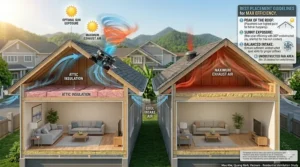
This is surprisingly common and genuinely damaging. IRC Section R806 requires passive minimum ventilation regardless of powered supplementation. Your solar powered attic fan needs intake air — usually through soffit vents. Blocking passive exhaust vents while adding a powered fan creates unbalanced pressure and reduces effectiveness.
Mistake 3: Ignoring the Thermostat in Winter
A solar attic fan without thermostat control running in January is exhausting warm air you paid to heat. The Remington Solar 30W, iLIVING HYBRID, and QuietCool all have built-in thermostat controls that prevent this. Budget models without thermostats require manual management in cold months — easy to forget, expensive when you do.
Mistake 4: One Fan for a Multi-Zone Attic
Many homes, especially in the 2,500+ sq ft range, have attics broken up by structural elements, HVAC ductwork, or dropped ceilings. A single fan in one corner will leave dead zones of hot, stagnant air. Manufacturer coverage specs assume unobstructed airflow. When in doubt, two modest fans (one on each side of a long attic) outperform one powerful fan in the center.
Mistake 5: Buying on Price Alone
The $80 solar attic fan you found from an unknown brand with a 1-year warranty will be landfill in two summers. Brushed motors fail. Cheap panel enclosures crack in UV exposure. Savings on the front end can easily turn into full replacement costs on the back end. The $200–$400 range from established brands like Remington Solar, iLIVING, QuietCool, and Natural Light represents the true “budget” for this category.
Long-Term Cost & Maintenance: What Ownership Actually Looks Like
Let’s talk real numbers. The Florida Solar Energy Center study measured a 6% reduction in space-cooling energy at a Central Florida test home after installing photovoltaic attic ventilator fans — approximately 460 kWh saved over a single summer. At 2026 national average electricity rates, that’s roughly $65–$80 per summer in hard savings, plus deferred HVAC wear. For larger homes and hotter climates, the savings scale dramatically — some homeowners in Phoenix and Houston report 20–30% reductions in cooling costs, translating to $150–$400 annually.
On the cost side: most quality solar attic fans require essentially zero maintenance. Brushless DC motors have no brushes to replace. Quality solar panels degrade only about 0.5% per year in output efficiency. The primary maintenance task is clearing debris from the protective screen once or twice a year — a five-minute task.
Estimated ROI timeline by product:
- Budget models (Hon&Guan, Amtrak ~$170–$200): Payback in 2–3 cooling seasons
- Mid-range (Remington Solar, iLIVING ~$340–$400): Payback in 4–6 seasons
- Premium (Natural Light 48W ~$650+): Payback in 8–10 seasons, but lifetime operation with zero replacement cost
Over 20 years, a quality solar roof fan commonly saves $3,000–$6,000 in combined energy savings and avoided repair costs (moisture damage, premature shingle replacement, mold remediation). That’s not marketing language — that’s the math when you add $0 monthly operating cost to avoided HVAC strain over two decades.
FAQ
❓ How do I know what size solar attic fan I need?
❓ Will a solar attic fan work on cloudy days?
❓ Can I install a solar powered attic fan myself?
❓ Will a solar attic fan reduce my air conditioning bill?
❓ Do solar attic fans work in winter?
Conclusion
Your attic has been a passive liability for years — baking in the summer, accumulating moisture in the winter, shortening the life of your shingles, and draining your AC bill in ways that don’t show up on any single line item. A solar attic fan is one of the cleanest fixes available to a homeowner: zero wiring, zero operating cost, and real measurable returns in energy savings and structural protection.
For most homeowners, the Remington Solar 30W remains the most balanced choice — proven technology, built-in automation, whisper-quiet operation, and a price that’s easy to justify. Humid-climate homeowners should seriously consider the iLIVING ILG8SF301A HYBRID for its IP68 motor and 24/7 coverage. Large attic owners get the best CFM-per-dollar with the VEVOR 42W. And if you want a truly set-it-and-forget-it investment backed by a lifetime warranty, the Natural Light 48W is the one you’ll still be talking about in 2046.
The best time to install a solar powered attic fan was five summers ago. The second-best time is this weekend.
✨ Check Current Prices & Availability on Amazon
🔍 Every product in this guide is linked directly to its Amazon listing. Click any highlighted product name to see real-time pricing, current reviews, and shipping availability. Your attic’s best summer starts with one click!
Recommended for You
- 7 Best Quiet Whole House Fans for Ultimate Home Cooling (2026)
- Whole House Fan vs Attic Fan: 7 Best Picks for 2026
- Best Whole House Fan 2026: 7 Top Rated Picks Reviewed
Disclaimer: This article contains affiliate links. As an Amazon Associate, I earn from qualifying purchases. If you purchase products through these links, we may earn a small commission at no additional cost to you.
✨ Found this helpful? Share it with your friends! 💬🤗
