
In This Article
You’ve probably stood in your sweltering living room at 9 p.m., AC blasting, electricity meter spinning like a roulette wheel, and thought: there has to be a better way. There is. But here’s where most homeowners get tangled — the whole house fan vs attic fan debate seems simple until you start digging, and suddenly you’re drowning in CFM numbers, installation angles, and conflicting Reddit threads.
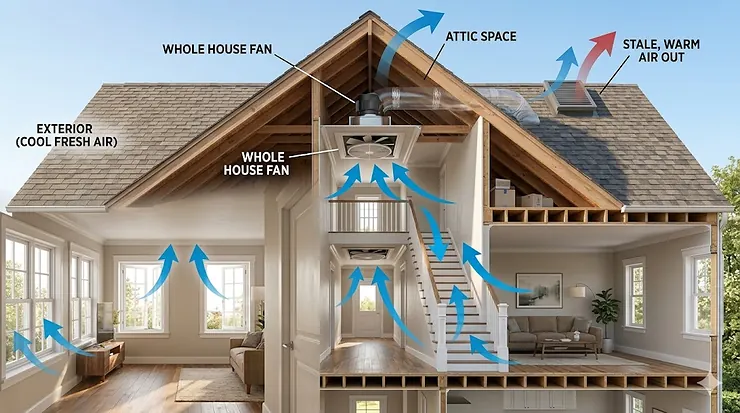
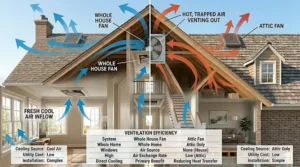
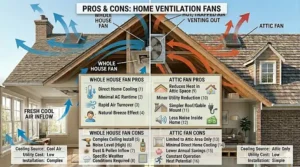
Let’s cut through that. Whether you’re researching a whole house fan vs attic fan for the first time or trying to figure out which is better, attic or whole house fan, for your specific situation — this guide has you covered. The short answer: a whole house fan actively cools your living space by pulling fresh outdoor air through your windows and blasting hot attic air out through vents. An attic fan, on the other hand, focuses exclusively on the attic — exhausting trapped heat to reduce the burden on your AC system. Same general category. Totally different purpose.
According to the U.S. Department of Energy, whole house fans can cut air conditioning energy use by 50–90% in climates where outdoor evening temperatures drop below 83°F. That’s not a minor footnote — that’s a potential $300–$500 off your summer electricity bill. Attic fans, meanwhile, tackle a different villain: attic air that routinely hits 150°F on hot days, radiating heat down through your ceiling like a pizza oven in reverse.
Understanding the ventilation purpose difference between these two systems is the key to spending your money wisely. Read on.
Quick Comparison: Whole House Fan vs Attic Fan
| Feature | Whole House Fan | Attic Fan |
|---|---|---|
| Primary Purpose | Cool living spaces directly | Cool the attic only |
| Installation Location | Ceiling (between living area & attic) | Gable, roof, or soffit mount |
| Airflow (CFM) | 1,200–7,000+ CFM | 800–2,800 CFM |
| Cooling Method | Draws fresh outdoor air inside | Exhausts attic heat outside |
| Energy Use | 150–800W | 50–400W |
| Best For | Homes in mild-to-moderate climates | Hot climates with AC-heavy usage |
| Avg. Price Range | $200–$900 | $60–$400 |
| Noise Level | 40–65 dBA | 45–70 dBA |
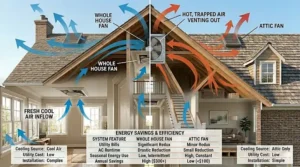
Looking at this table, the attic fan whole house fan comparison reveals a fundamental split in strategy: one cools you directly, the other cools the structure around you. If your main gripe is stuffy bedrooms and high AC bills, a whole house fan is the obvious choice. If your AC can’t keep up because your attic is radiating heat like a furnace all day, an attic fan addresses the root problem first. Many savvy homeowners eventually run both — and that’s not overkill, that’s smart layered ventilation.
💬 Found this comparison helpful? Share it with friends who are comparing their options too! 😊
Top 7 Whole House Fan and Attic Fan Picks: Expert Analysis
1. QuietCool QC CL-3100 RF Classic Advanced Whole House Fan
If there’s one whole house fan that keeps showing up in conversations among HVAC-savvy homeowners, it’s the QuietCool QC CL-3100 RF. And for good reason.
This fan moves up to 3,126 CFM on high and 2,847 CFM on low, covering homes up to 1,608 sq ft — which makes it the sweet spot for the average American single-story home. The 299-watt PSC motor is the real story here: it delivers serious airflow without turning your electric bill into a horror story. Compare that to running central AC, which easily pulls 3,000–5,000 watts, and the math is embarrassingly one-sided.
What most buyers overlook is the R-5 insulated damper box that seals the ceiling opening when the fan isn’t running. Cheap whole house fans skip this entirely, and in winter, you basically have a hole in your ceiling pumping heat into your attic. QuietCool solved that a long time ago. The wireless RF controller includes a 12-hour countdown timer, which means you can run it through the cool nighttime hours and have it shut off before the morning heats up. Installation requires no joist cutting — just a 14″ × 22″ ceiling cutout, about 1–2 hours of work.
Best for: Homeowners with 1,200–1,600 sq ft homes who want a reliable, mid-range whole house fan without smart-home complexity.
✅ R-5 insulated damper — crucial for winter energy savings
✅ No joist cutting required — real 2-hour install
✅ 10-year warranty backed by a solid brand
❌ Single-room ceiling mount limits some multi-story home configurations
❌ Higher wattage than energy-saver series models
Price range: Around $280–$340 | Check on Amazon
2. QuietCool QC CL-6000 RF Classic Advanced Whole House Fan
The QC CL-6000 RF is the big brother in the QuietCool Classic lineup — and it’s built for homes that don’t mess around. This unit pushes 5,665 CFM on high, with a 769-watt motor that can replace every cubic foot of air in a 2,800 sq ft home in about 3–4 minutes. That’s not cooling. That’s purging.
The practical implication: on a 90°F day, you open the windows after sunset, flip this on, and within five minutes the musty, hot indoor air is gone. Completely replaced with cool evening air. No AC running at all. The fan motor head hangs from attic rafters, and the 14″ × 36″ ceiling grille is the only interior footprint you’ll notice.
What I find compelling about the 6000 series specifically is the dual-speed operation. Running on low (4,289 CFM, 560W), it handles most spring and fall nights when you just want a light refresh. Kick it to high on the genuinely hot days when you need air moving fast. That flexibility means it earns its place across the whole shoulder season, not just July heat waves.
Best for: Large homes (2,500–2,800 sq ft), families who run AC heavily and want to slash that habit, and anyone who’s ever felt their current fan was “just not enough.”
✅ 5,665 CFM — handles large open-plan homes with ease
✅ Two speeds for flexibility across seasons
✅ R-5 damper + 10-year warranty
❌ 769W on high isn’t the most efficient in the lineup
❌ Requires larger 14″ × 36″ ceiling cutout
Price range: Around $680–$790 | Check on Amazon
3. AC Infinity CLOUDWAY T10 Whole House EC Fan
AC Infinity built its reputation in grow-tent ventilation before bringing that same precision-engineering ethos to whole house fans — and the CLOUDWAY T10 is where smart-home obsessives will feel right at home.
At 1,200 CFM, it’s sized for smaller homes or individual zones (up to about 800–1,000 sq ft), but what it lacks in raw power it makes up for in intelligence. The built-in WiFi controller connects to the AC Infinity app, where you can set temperature and humidity triggers — the fan activates automatically when your indoor temp climbs past, say, 78°F, then shuts off when it drops below your target. This isn’t gimmick territory. When programmed properly, you genuinely forget the fan exists because it just… handles things.
The PWM-controlled EC motor is the unsung hero. EC motors are fundamentally more efficient than the PSC motors in most whole house fans — at lower speeds, the power draw drops dramatically rather than linearly. Running at medium speed, this fan is whisper-quiet and sips electricity. The dual ball bearings give it a 50,000-hour lifespan, and the 2-door damper shutter keeps attic drafts out when idle.
Customer feedback frequently highlights the app integration — “I set it up once and my summer energy bills dropped noticeably” is the kind of review you see repeatedly.
Best for: Tech-forward homeowners, smart-home setups (Alexa/Google Home compatible), and anyone cooling a smaller home or bedroom wing who wants set-it-and-forget-it automation.
✅ WiFi + app control with temperature/humidity triggers
✅ EC motor — significantly more energy-efficient at variable speeds
✅ 50,000-hour motor lifespan
❌ 1,200 CFM limits coverage to smaller homes
❌ App setup has a learning curve for non-tech users
Price range: Around $250–$300 | Check on Amazon
4. AC Infinity CLOUDWAY S10 Whole House EC Fan
Think of the CLOUDWAY S10 as the CLOUDWAY T10’s more straightforward sibling — same EC motor, same 1,201 CFM airflow, same damper shutter, but controlled via a 10-speed wireless remote instead of a WiFi app. No app required. No setup headaches.
That remote is surprisingly capable — 10 distinct speed settings with backup memory, so the fan returns to your preferred speed after a power outage. At noise levels around 48 dBA, you’re in library-quiet territory at lower speeds. The dual ball bearings and 50,000-hour lifespan are identical to the T10.
Where the S10 genuinely shines is value. You get the same core EC motor technology and build quality as the WiFi model, but at a lower price point. For homeowners who don’t want their ventilation system on their phone, this is the smarter buy. The simplicity is the point.
Best for: Homeowners who want energy-efficient whole house ventilation without app dependency — excellent value in the AC Infinity lineup.
✅ 10-speed remote with memory backup
✅ 48 dBA — one of the quietest in this price tier
✅ EC motor efficiency at a lower cost than the T10
❌ No smart/app features
❌ 1,201 CFM requires multiple units for larger homes
Price range: Around $200–$250 | Check on Amazon
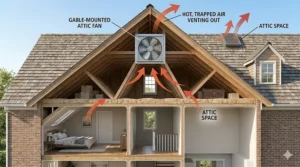
5. Centric Air Gable Attic Fan (1,580 CFM)
Now we shift to the attic side of the whole house fan or attic fan comparison — and the Centric Air Gable Attic Fan immediately stands out for one reason most listings bury in the fine print: it’s manufactured in Germany.
That’s not marketing fluff. German manufacturing standards translate directly to build quality you can feel, and the 15-year warranty Centric Air backs this fan with is industry-leading — most attic fans offer 2–5 years. The motor draws just 1.5 amps (roughly 180 watts), moving 1,580 CFM quietly enough that reviewers consistently describe it as “nearly silent.” For an attic fan, that’s exceptional.
Here’s what the spec sheet won’t tell you: attic fans fail most often because of motor burnout from the intense heat inside attics (regularly 130–150°F). The German-made motor in this unit is specifically rated for continuous operation in high-heat environments. That’s why the warranty is 15 years. Centric Air knows it’ll last. Installation is straightforward for existing gable vent openings, and the thermostat-controlled operation means you don’t think about it — it kicks on when the attic heats up, turns off when it doesn’t need to run.
Best for: Homeowners primarily focused on reducing attic heat (and thus AC load), especially those who want a long-lasting, quiet, install-and-forget solution.
✅ 15-year warranty — exceptional in the attic fan category
✅ German-made motor rated for high-heat environments
✅ Near-silent operation at 1.5 amps
❌ Gable-mount only — not suitable for all attic configurations
❌ 1,580 CFM is better for attics under 2,000 sq ft
Price range: Around $210–$260 | Check on Amazon
6. QuietCool AFG SMT ES-3.0 Smart Attic Fan for Gable Vents
The QuietCool AFG SMT ES-3.0 is what happens when a company decides an attic fan should be as smart as your thermostat. It moves up to 2,801 CFM on three speeds, draws as little as 22 watts at low speed (yes, you read that right — less power than a light bulb), and connects directly to the QuietCool Smart App for phone-based control.
The built-in thermostat and humidistat is the combination that separates this from competitors. Most attic fans only respond to temperature. This one also monitors humidity — critical if you live in a humid climate where moisture in the attic contributes to mold, wood rot, and insulation degradation. The fan activates when either humidity or temperature exceeds your set thresholds, running targeted ventilation rather than just brute-force airflow.
At 22 watts on low, running this fan 24/7 for a full month costs you under $2 in electricity. Even on high speed, it’s a fraction of what your AC pays to fight the same attic heat. The plug-and-play design with 20-foot power cord means you don’t need an electrician for installation — it plugs into a standard attic outlet.
Best for: Tech-savvy homeowners in humid climates who want the absolute best smart attic fan, and anyone concerned about attic moisture as much as heat.
✅ Thermostat + humidistat — tackles both heat and moisture
✅ As low as 22 watts — negligible operating cost
✅ App control via QuietCool Smart App
❌ Higher upfront cost than basic attic fans
❌ Requires WiFi signal in attic for app features
Price range: Around $300–$390 | Check on Amazon (search “QuietCool AFG SMT ES-3.0” on Amazon)
7. Air Vent 53315 Gable Mount Power Attic Ventilator
Sometimes the right answer is the straightforward one. The Air Vent 53315 has been selling on Amazon for years for a reason — it works, it’s cheap, and it installs in under an hour. This is the budget entry point of the attic fan whole house fan comparison, and it earns its place honestly.
Moving 1,050 CFM and covering attics up to 1,500 sq ft, it fits standard gable vent openings with a 15-inch blade and a thermostat that triggers automatic operation. Air Vent claims it runs 30% quieter than comparable units — modest praise, but buyers generally confirm the noise levels are acceptable for an attic application. The motor carries a 2-year labor warranty, which reflects its position as a workhorse rather than a premium product.
Here’s the honest take: if you have a smaller home, a modest attic, and just want to stop heat from radiating through your ceiling into the AC-cooled rooms below, this fan does that job without drama or complexity. Don’t overthink it. It’s about $60–$80, it installs in an afternoon, and it’ll shave measurable degrees off your attic temperature on hot days.
Best for: Budget-conscious homeowners with smaller attics who want a simple, reliable, no-frills solution to attic heat buildup.
✅ Budget-friendly — lowest upfront cost on this list
✅ Simple installation into existing gable vent
✅ Thermostat-controlled automatic operation
❌ 1,050 CFM limits it to smaller attics
❌ 2-year warranty is short compared to premium options
Price range: Around $60–$85 | Check on Amazon
Top 7 Products: Quick Specs Overview
| Product | Type | CFM | Coverage | Price Range | Best For |
|---|---|---|---|---|---|
| QuietCool QC CL-3100 RF | Whole House Fan | 3,126 | 1,608 sq ft | ~$280–$340 | Mid-size homes |
| QuietCool QC CL-6000 RF | Whole House Fan | 5,665 | 2,833 sq ft | ~$680–$790 | Large homes |
| AC Infinity CLOUDWAY T10 | Whole House Fan | 1,200 | ~800 sq ft | ~$250–$300 | Smart home users |
| AC Infinity CLOUDWAY S10 | Whole House Fan | 1,201 | ~800 sq ft | ~$200–$250 | Value + quiet |
| Centric Air Gable Fan | Attic Fan | 1,580 | ~2,000 sq ft | ~$210–$260 | Long-term durability |
| QuietCool AFG SMT ES-3.0 | Smart Attic Fan | 2,801 | Large attics | ~$300–$390 | Smart + humid climates |
| Air Vent 53315 | Attic Fan | 1,050 | 1,500 sq ft | ~$60–$85 | Budget/small attics |
The table above reveals something important about attic fan vs whole house fan differences at the product level: whole house fans dominate the upper end of both CFM and price, while attic fans offer a wider budget range with the Centric Air and QuietCool SMT options punching well above their price point in terms of build quality and features.
✨ Don’t Miss These Exclusive Deals!
🔍 Ready to take your home’s cooling to the next level? Click any highlighted product link to check current pricing and availability on Amazon. These fans can save you hundreds of dollars in AC costs this summer alone!
Which Is Right for You? A Real-World Buyer’s Guide
This is where generic articles fail you. They list products and disappear. Let’s actually match you to a solution based on your situation.
Profile 1: The “My AC Bill Is Out of Control” Homeowner
You live in a climate with warm-to-hot summers but evenings that cool off — think Pacific Northwest, Northern California, the Intermountain West, or the Midwest. Your AC runs from noon to midnight and your summer bills are painful. You need a whole house fan, not an attic fan.
The ventilation purpose difference is everything here: a whole house fan replaces your indoor air with cool outdoor air, eliminating the heat source entirely. An attic fan just makes your AC work slightly less hard. For this profile, the QuietCool QC CL-3100 RF for homes under 1,600 sq ft or the QC CL-6000 RF for larger homes are the natural choices. Run the fan from sunset until the outdoor temperature matches your indoor target, then close windows and let the now-cool house coast until afternoon.
Profile 2: The “My AC Works Fine But My House Stays Hot” Homeowner
You’re in a hot, humid climate — Texas, Florida, the Southeast. Your AC runs all day, but your rooms still feel stuffy and your energy bills never drop. The culprit is likely your attic hitting 140–150°F and radiating that heat through your ceiling insulation. An attic fan is your first move.
The QuietCool AFG SMT ES-3.0 handles this best if budget allows — the humidistat feature is non-negotiable in humid climates where moisture management is as important as heat removal. The Centric Air Gable Fan is the value choice for a drier-heat setup where you just need reliable, quiet attic ventilation without the smart features.
Profile 3: The “Both Problems Apply” Homeowner
Congratulations, you’ve described about 40% of U.S. homeowners. The solution here is layered: install an attic fan first to deal with the heat-radiating attic, then add a whole house fan for evening and morning ventilation. This combination approach, according to the EPA’s Energy Star program, represents one of the highest-ROI home upgrades available. The Air Vent 53315 makes a cheap attic-side entry point, leaving budget for a mid-tier whole house fan like the AC Infinity CLOUDWAY T10.
How to Choose the Right Fan: 7 Criteria That Actually Matter
Walk into this decision with eyes open. Here’s what separates a smart purchase from buyer’s remorse.
1. CFM vs. Your Home’s Square Footage The standard rule: multiply your home’s square footage by 2–3 for whole house fans (you want to exchange your entire air volume in 3–4 minutes). For attic fans, the Home Ventilating Institute recommends 0.7 CFM per square foot of attic space as a baseline. Undersizing is the single most common mistake — a fan that’s too small for your space will run constantly without making a meaningful dent.
2. Climate Compatibility Whole house fans work best where outdoor nighttime temperatures drop below 83°F. If your nights stay hot and humid, a whole house fan just pumps warm, muggy air into your home. Be honest about your climate before committing. Check historical nighttime lows for your region using Weather.gov climate data.
3. Motor Type EC (electronically commutated) motors — found in the AC Infinity lineup — are noticeably more efficient at variable speeds and have longer lifespans. PSC motors (QuietCool) are proven workhorses. Both are far better than the induction motors in cheap bargain fans that burn hot and die young.
4. Damper/Insulation Quality A whole house fan without an insulated damper is a liability in winter. Cold air infiltration through an uninsulated opening in your ceiling ceiling will cost you more in heating than you saved on cooling. The R-5 dampers on QuietCool products are the benchmark.
5. Noise Level The 40–52 dB range is the sweet spot for bedroom use. Anything above 60 dB will wake light sleepers. The AC Infinity S10 (48 dBA) and Centric Air gable fan are among the quietest options per dollar in their respective categories.
6. Smart Features vs. Simplicity Smart app control is genuinely useful if you travel or have irregular schedules — automated temperature triggers mean the fan runs when conditions are ideal, not just when you remember to flip a switch. But for most homeowners, a reliable RF remote like QuietCool’s is all the “smart” you need.
7. Warranty Length This is a longer-term investment. The 15-year warranty on Centric Air and 10-year on QuietCool products are signs of manufacturer confidence. Budget products with 1–2 year warranties in an application this demanding are telling you something.
Common Mistakes Homeowners Make Buying Ventilation Fans
A few costly patterns come up again and again.
Mistake 1: Buying the cheapest whole house fan without checking CFM. A 1,000 CFM fan in a 2,000 sq ft home is like trying to cool a swimming pool with a desk fan. Check the math before you buy. Every manufacturer lists the square footage coverage for their products — use it.
Mistake 2: Installing an attic fan without checking soffit ventilation. An attic fan exhausting hot air needs a place to pull replacement air from. If your soffit vents are blocked, undersized, or nonexistent, the fan will create negative pressure and start pulling conditioned air out of your living space through gaps and recessed lights. According to Energy.gov ventilation guidelines, attic fans require adequate intake ventilation equal to roughly 150% of the fan’s exhaust capacity.
Mistake 3: Running a whole house fan when outdoor temps are higher than indoor temps. This sounds obvious but happens constantly. You want to ventilate when outdoor air is cooler — typically from sunset through morning. Many smart fans handle this automatically via temperature triggers, which is one concrete reason to consider the AC Infinity T10 or QuietCool SMT ES-3.0.
Mistake 4: Ignoring humidity in the attic fan decision. If you’re in a humid climate and buy an attic fan with thermostat-only control, you’re missing half the equation. A fan that runs only on temperature can actually pull humid outside air into your attic on cool but humid nights, accelerating moisture damage. The QuietCool SMT ES-3.0’s humidistat protection isn’t optional in climates like Florida or Louisiana — it’s essential.
Mistake 5: Forgetting fire safety codes. Whole house fans in garages and certain multi-unit configurations may require integrated fire dampers. The QuietCool GA PRO series for garages includes this by default. Always verify your local building codes before installation.
Long-Term Cost & Maintenance: What You’re Really Signing Up For
The upfront price of any ventilation fan is only part of the story. Let’s talk total cost of ownership.
Operating Costs: A 300W whole house fan running 8 hours per night at the U.S. average electricity rate of about $0.16/kWh costs roughly $14 per month. Compare that to a 3-ton central AC system running the same hours at 3,500W — that’s $134 per month. The math for whole house fans is genuinely compelling in the right climate. Attic fans cost even less to run: the Air Vent 53315 draws about 250W; the QuietCool SMT ES-3.0 draws as little as 22W on low.
Maintenance Reality: Good whole house fans need almost nothing. Wipe the grille once or twice a year. Check the damper doors before each season. That’s it. Attic fans are similarly low-maintenance, though motors in cheaper units tend to accumulate dust and can seize in high-heat environments after 3–5 years. Premium motors (QuietCool, Centric Air) are built to last a decade or more with zero intervention.
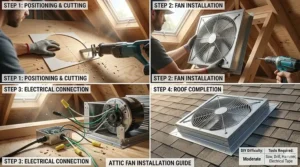
Installation Costs: DIY installation for both fan types is well within reach for handy homeowners. Professional installation adds $200–$500 to your total cost — a reasonable investment if you’re not comfortable with ceiling work or attic wiring. The plug-and-play designs from QuietCool’s attic fan line and the AC Infinity units specifically reduce or eliminate electrical work for most setups.
ROI Timeline: Most homeowners in warm climates recoup a mid-range whole house fan investment in one to two cooling seasons through reduced AC usage. The Air Vent 53315 at $60–$85 pays for itself in about three weeks of typical summer AC savings. Premium whole house fans earning $200–$300/summer in savings reach payback in 2–3 years.
FAQ: Whole House Fan vs Attic Fan
❓ What is the main difference between a whole house fan and an attic fan?
❓ Which is better for cooling my home — an attic fan or whole house fan?
❓ Can I use a whole house fan and attic fan together?
❓ How many CFM do I need for a whole house fan in a 2,000 sq ft home?
❓ Do whole house fans work in humid climates?
Conclusion
The whole house fan vs attic fan debate isn’t really a competition — it’s a question of which problem you’re solving. If you want to cool your living spaces directly and dramatically cut your AC bill, a whole house fan is the answer. If your main issue is heat radiating through your ceiling from a superheated attic, tackle that attic first.
For most homeowners in moderate climates, the QuietCool QC CL-3100 RF is the standout value in whole house fans — proven technology, proper insulation, easy installation. In humid climates where you need intelligent attic management, the QuietCool AFG SMT ES-3.0 earns its premium price through features that budget options can’t match. And if you want a smart, app-connected whole house fan for a smaller home, the AC Infinity CLOUDWAY T10 is genuinely impressive engineering at a reasonable price.
Whichever direction you go, the key takeaway from this attic fan whole house fan comparison is this: any of these products beats running your AC at full blast all summer. The payback is real, the installation is manageable, and the comfort improvement is immediate.
✨ Don’t Miss These Exclusive Deals!
🔍 Click any product link in this article to check current pricing and availability. Cooling season doesn’t wait — start saving on your energy bills this summer!
Recommended for You
- Best Whole House Fan 2026: 7 Top Rated Picks Reviewed
- Best Cooling Towel for Construction Workers 2026 — 7 Tested Picks
- Best Extra Large Cooling Towel: 7 Top Picks for 2026
Disclaimer: This article contains affiliate links. As an Amazon Associate, I earn from qualifying purchases. If you purchase products through these links, we may earn a small commission at no additional cost to you.
✨ Found this helpful? Share it with your friends! 💬🤗
