

In This Article
If you’ve ever worked through a July construction shift or pushed through a summer training session, you know that standard cooling methods—fans, ice packs, cold towels—only scratch the surface. The reality is that when your core body temperature climbs above 100.4°F (38°C), your body’s natural cooling system starts failing, and that’s when heat exhaustion becomes a genuine risk rather than just discomfort.
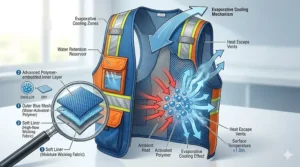
What most people don’t realize is that the best cooling vest isn’t just about feeling cooler for an hour—it’s about maintaining a stable core temperature that keeps your body functioning optimally throughout your entire work shift or activity. I’ve tested various cooling technologies over the years, from simple ice pack vests to NASA-inspired circulatory systems, and what stands out is how dramatically different these technologies perform in real-world conditions. A vest that works brilliantly for a motorcyclist might be completely wrong for a warehouse worker, and understanding these distinctions before you buy can save you from wasting money on a product that doesn’t match your specific heat exposure pattern.
The cooling vest market has evolved significantly since 2020, with manufacturers finally moving beyond one-size-fits-all solutions. Today’s options range from $30 gel-pack systems to $300 battery-powered circulatory units, each designed for specific use cases. This guide cuts through the marketing hype to show you exactly what works, who each product serves best, and what practical considerations matter more than the spec sheets reveal.
Quick Comparison: Top Cooling Vest Technologies at a Glance
| Cooling Technology | Duration | Best For | Price Range | Recharge Time |
|---|---|---|---|---|
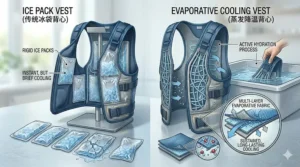
| Ice Pack Vests | 2-3 hours | Construction, outdoor work | $30-$60 | 2-4 hours freezer |
| Evaporative Cooling | 5-10 hours | Dry climates, motorcycling | $60-$120 | 2-3 min soak |
| Phase Change Material | 2-3 hours | Medical conditions, athletics | $120-$200 | 30-60 min |
| Circulatory Systems | 3-6 hours | Industrial, emergency response | $200-$400 | Continuous with ice |
Looking at this comparison, the sweet spot for most buyers is either evaporative cooling for extended outdoor exposure in dry conditions or ice pack vests for shorter work cycles where you have regular freezer access. The phase change vests justify their higher price when you need precise temperature control—that 58-59°F consistency matters if you’re managing heat-sensitive medical conditions like multiple sclerosis. Circulatory systems represent the premium tier, and they’re worth it if your work involves sustained heat exposure beyond what passive cooling can handle, but they’re overkill for casual outdoor activities or intermittent heat exposure.
💬 Just one click — help others make better buying decisions too! 😊
Top 7 Best Cooling Vest Products: Expert Analysis
1. Cooling Vest with 8 Reusable Water-Fill Ice Packs
This straightforward ice pack vest represents the most accessible entry point into active cooling technology. The system includes eight refreezable ice packs that work as two complete sets of four, designed specifically for rotation—you wear one set while the other recharges in the freezer. What the marketing doesn’t tell you is that this rotation system only works if you have freezer access during your workday, which makes this ideal for construction crews with on-site facilities or outdoor workers who can swap packs during lunch breaks.
The vest itself uses extended side straps with generous adjustment range, fitting chest sizes 32-48 inches comfortably over a T-shirt or under a jacket. At 22 inches in length, it’s a compact rib-cage cut rather than a full-torso design—this isn’t a weakness, it’s actually strategic. By focusing cooling on your core rather than trying to cool your entire torso, the vest delivers more effective temperature regulation with less bulk. Each ice pack rotation gives you 2-3 hours of active cooling in 80-90°F weather, which translates to roughly one work cycle if you’re doing moderate physical labor.
Customer feedback consistently praises the vest’s durability and the quality of the ice pack seal—no leakage issues reported even after months of daily use. The main complaint is that 2-3 hours isn’t enough for all-day wear without refreezing access, but that’s actually the intended design. This vest was built for breaks and work shifts, not continuous marathon sessions.
Pros:
✅ Two complete ice pack sets enable continuous rotation
✅ Compact design focuses cooling where it matters most
✅ Durable construction holds up to daily professional use
Cons:
❌ Requires regular freezer access for pack rotation
❌ Not suitable for situations requiring 6+ hours continuous cooling
Best for: Construction workers, landscapers, and anyone with periodic breaks and freezer access during their workday. This vest shines when you can swap packs every 2-3 hours rather than needing uninterrupted cooling.
Price range: Around $40-$55
2. PANGTIKU Cooling Vest with 20 Gel Ice Packs
The PANGTIKU takes the ice pack concept and scales it up significantly—20 gel packs versus the typical 8, with 6 pockets strategically placed for 360-degree cooling coverage. This is the vest you choose when you need all-day cooling capability without access to refreezing facilities. The math is simple: with 20 packs included, you can run two complete rotations (using 6 packs at a time) with 8 spare packs remaining as reserve, or you can pack extra frozen packs in the included thermal bag for mid-shift swaps.
The vest features reinforced PP buckles instead of Velcro for side adjustments—a seemingly minor upgrade that matters enormously in practice. Velcro deteriorates quickly with repeated use and can scratch your skin or snag clothing, while these buckles maintain consistent tension adjustment even after hundreds of cycles. The high-visibility reflective strips provide genuine 360-degree visibility for night work or low-light conditions, and the vest accommodates body weights up to 250 pounds comfortably.
What sets this apart from cheaper gel-pack vests is the material quality. The polyester-cotton canvas blend is softer and more breathable than 100% polyester competitors, and it’s actually more durable—polyester alone tends to develop stress tears at adjustment points after 6-12 months of regular use. Customers report maintaining 60°F body temperature even when ambient conditions hit 110°F, though these measurements vary based on activity level and pack rotation discipline.
Pros:
✅ 20 gel packs provide extensive all-day cooling capacity
✅ PP buckle adjustment system outlasts traditional Velcro
✅ High-vis reflective strips for safety in low-light work
Cons:
❌ Heavier when fully loaded with all 6 packs inserted
❌ Initial cost higher due to expanded pack quantity
Best for: Outdoor workers without mid-shift freezer access, road construction crews, utility workers, or anyone needing portable all-day cooling with the flexibility to pre-freeze multiple pack sets.
Price range: Around $55-$75
3. TechNiche HyperKewl 6529 Evaporative Cooling Vest
Evaporative cooling represents a completely different approach—instead of carrying frozen weight, this vest uses polymer-embedded fabric that absorbs water and releases it slowly through evaporation over 5-10 hours. The HyperKewl 6529 is the gold standard in this category, and once you understand how it works, you’ll recognize why it’s dominated the motorcycle and outdoor work markets for over a decade.
Here’s the key insight most buyers miss: evaporative cooling effectiveness depends entirely on humidity levels. In dry climates (below 60% humidity), this vest delivers 15-20°F temperature reduction below ambient air temperature and keeps working for 8-10 hours per soaking. In high humidity (above 80%), the fabric can’t evaporate water efficiently, and cooling performance drops to marginal levels unless you have significant airflow—which is why motorcyclists love these vests even in humid conditions, but stationary workers find them disappointing when humidity is high.
The vest activates in just 2-3 minutes of water soaking, and the waterproof nylon liner keeps your underclothes dry despite the saturated cooling fabric. At under 2 pounds when wet, it’s substantially lighter than ice pack alternatives, and there’s no need to carry spare cooling elements or worry about refreezing—just re-soak when cooling diminishes. The quilted nylon outer shell is genuinely comfortable, and the simple V-neck with zipper closure fits a wide range of body types without complex adjustment systems.
Pros:
✅ 5-10 hours of cooling from a single 2-3 minute soaking
✅ Lightweight design (under 2 lbs wet) with no bulk
✅ No freezing required—just add water anywhere
Cons:
❌ Performance drops significantly in high humidity (80%+)
❌ Requires airflow for optimal cooling in humid conditions
Best for: Motorcyclists, outdoor workers in dry climates, athletes in low-humidity regions, or anyone who needs extended cooling without access to freezers but has access to water sources for periodic re-soaking.
Price range: Around $70-$95
4. Glacier Tek Sports Cool Vest with 8 Non-Toxic Cooling Packs
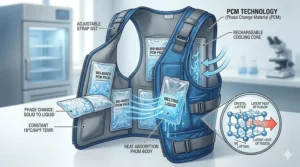
Phase Change Material (PCM) technology operates on a completely different principle than ice packs—instead of freezing at 32°F like water, Glacier Tek’s proprietary PureTemp PCM maintains a consistent 59°F temperature for up to 2.5 hours. This isn’t just marketing speak; that steady temperature makes a meaningful difference for users managing heat-sensitive medical conditions like multiple sclerosis, where precise temperature control matters more than maximum cooling power.
The science is straightforward: PCM absorbs heat as it transitions from solid to liquid at a specific temperature (59°F in this case), and it maintains that temperature throughout the phase change process. Unlike ice, which drops quickly from 32°F toward ambient temperature, PCM stays at 59°F until all the material has completed the phase transition. The practical result is cooling that feels less intense but lasts longer and more consistently than ice-based alternatives.
The Sports Vest uses dual side elastic straps and over-the-shoulder adjustability to fit chest sizes 29-52 inches—one of the widest size ranges in the market. At just under 5 pounds including cooling packs, it’s heavier than evaporative vests but lighter than water-filled circulation systems. Each vest includes 8 cooling packs (4 large, 4 small), and you can choose how many to use based on conditions—using fewer packs reduces weight without sacrificing cooling quality per pack.
Recharge time is notably faster than ice pack vests: 30 minutes in ice water, 1 hour in a standard freezer, or 2 hours in a refrigerator. This flexibility is crucial when you need to recharge between events but don’t have freezer access. Customer feedback from MS patients consistently highlights the vest’s ability to extend outdoor activity time by 45-90 minutes compared to no cooling intervention.
Pros:
✅ Consistent 59°F temperature prevents cold shock while maintaining cooling
✅ Fast recharge (30 min ice water, 1 hr freezer)
✅ Adjustable pack configuration lets you customize cooling vs. weight
Cons:
❌ Higher initial investment than ice pack alternatives
❌ 2.5-hour duration shorter than evaporative options
Best for: Athletes needing pre-competition and post-exercise cooling, individuals with heat-sensitive medical conditions (MS, dysautonomia), gym users who want consistent cooling that won’t cause cold burns or excessive temperature shock.
Price range: Around $140-$180
5. TechKewl Phase Change Cooling Vest
The TechKewl Phase Change vest competes directly with Glacier Tek but targets a different user profile—industrial and emergency response applications where the vest needs to work under heavy protective gear. The cooling inserts maintain 58°F (14°C) for 2-3 hours regardless of outside temperature or humidity, which is the key differentiator from evaporative systems that struggle in humid conditions or ice packs that struggle with extreme ambient heat.
The vest features a scoop neck with front zipper and elastic side panels that provide snug fit without strings or ties—critical for workers who risk catching loose adjustments on equipment or in confined spaces. Front pockets include zippered closures so the CoolPax inserts can’t shift or fall out during active work, and the 100% cotton vest outer with mesh ventilation keeps the whole package breathable despite the sealed cooling inserts.
What makes this vest particularly valuable for hazmat workers or first responders is its performance under layered protective gear. When you’re wearing a hazmat suit or firefighting turnout gear, external cooling methods become useless—the protective layer blocks airflow and creates its own heat trap. PCM vests worn under protective gear continue cooling your core directly, and that 58°F temperature is cold enough to provide meaningful relief without causing the cold-induced vasoconstriction that can reduce heat dissipation.
The included cooler bag is surprisingly useful—it keeps recharged inserts cold during transport and protects them from damage. Total weight is 4.4 pounds including PCM inserts, and the CoolPax inserts are compatible with other TechKewl vest models if you want to upgrade or expand your cooling system later.
Pros:
✅ Works effectively under protective gear where other cooling fails
✅ Zippered pockets prevent insert shifting during active work
✅ Includes protective cooler bag for transport and storage
Cons:
❌ 2-3 hour duration requires recharge for full-day coverage
❌ Elastic side panels may lose tension after 12-18 months heavy use
Best for: Emergency responders, hazmat workers, industrial workers in extreme heat environments, or anyone who needs reliable cooling under additional protective clothing layers that block external cooling methods.
Price range: Around $130-$170
6. M PAIN MANAGEMENT SubZero Water Circulating Cooling Vest
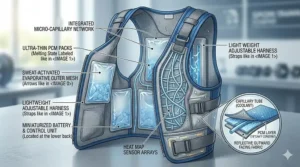
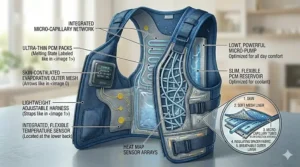
Circulatory cooling represents the most advanced technology in personal cooling systems, borrowed directly from NASA astronaut cooling suits. The SubZero system uses a 20,000mAh battery-powered pump to circulate ice water continuously through tubing embedded in the vest mesh, actively pulling heat away from your core rather than relying on passive cooling methods.
The practical difference is dramatic: while ice packs cool only the areas they directly contact, circulating water covers your entire torso with active cooling. The system maintains cold circulation for 2-5 hours depending on ice quantity and ambient temperature, and because the battery and water reservoir hide in a rear pocket rather than hanging off the vest, the design remains surprisingly sleek for a powered system.
What the specifications don’t convey is how much more effective active circulation is compared to passive cooling when ambient temperatures exceed 100°F. At those extremes, ice packs reach ambient temperature quickly, and even PCM struggles to maintain consistent cooling. Circulating systems continuously move fresh cold water to heat-stressed areas and return warmed water to the reservoir where remaining ice continues cooling it. The result is cooling that feels more intense and lasts longer at temperature extremes where other systems become marginal.
The 20,000mAh battery provides 2-3.5 hours of continuous operation, and the system is compatible with universal 5V-12V power banks if you need extended runtime. Users in motorsports and first responder applications report that the vest makes previously intolerable conditions manageable—specifically, the ability to function effectively for 2-3 hours in environments where passive cooling would fail within 30-45 minutes.
Pros:
✅ Active circulation delivers superior cooling at temperature extremes (100°F+) \
✅ Wireless design keeps battery and water hidden in rear pocket
✅ Compatible with external power banks for extended runtime
Cons:
❌ Higher initial cost than passive cooling alternatives
❌ Requires battery charging and ice maintenance
Best for: Motorsports competitors, professional athletes in extreme heat, first responders working in disaster recovery conditions, industrial workers in extremely high-temperature environments where passive cooling becomes ineffective.
Price range: Around $280-$350
7. Alphacool 7V Rechargeable Circulatory Cooling Vest
The Alphacool 7V represents the practical middle ground in circulatory cooling—less expensive than premium systems but still delivering active water circulation with a 3L freezable bladder and 7.4V 2200mAh rechargeable battery. The system provides 2-4 hours of cooling with the frozen bladder or 1-3 hours using ice cubes, giving you flexibility based on preparation time and ice availability.
The mini pump circulates cold water through a mesh liner with embedded liquid channels, and the outer fabric remains waterproof and breathable simultaneously—a combination that prevents both external water intrusion and internal moisture buildup. The 3L quick-release bladder system is notably easier to clean and refill than sealed reservoir systems, and the mesh inner with double-line stitching on the cooling channels ensures the tubing won’t kink or create uneven cooling zones.
What makes this vest particularly practical for industrial applications is the 7.4V battery compatibility—you can use the included 2200mAh battery for portable cooling, or connect to 12V vehicle power with an optional adapter for unlimited runtime during mobile work. The adjustable sizing accommodates different body types comfortably, and the compact outer fabric stays relatively low-profile compared to bulkier circulation systems.
Customers in construction and warehouse work consistently note the vest’s reliability—the pump maintains consistent flow without failure even after months of daily use in dusty conditions. The quick-release bladder means you can swap in a fresh frozen bladder during breaks rather than waiting for ice to recharge, which effectively doubles your cooling capacity if you prepare two bladders beforehand.
Pros:
✅ Quick-release bladder enables fast swaps for extended cooling
✅ 7.4V battery system compatible with 12V vehicle power
✅ Compact design with reliable pump performance
Cons:
❌ 2200mAh battery provides shorter runtime than premium systems
❌ Mesh liner requires careful washing to prevent tube damage
Best for: Construction workers, warehouse personnel, utility workers, or anyone needing reliable circulatory cooling with the flexibility to switch between battery and vehicle power based on work environment.
Price range: Around $180-$240
Real-World Application: Matching Cooling Technology to Your Work Environment
Choosing the right cooling vest isn’t about finding the “best” product—it’s about matching cooling technology to your specific heat exposure pattern. Let me break down three common scenarios to illustrate how this works in practice.
Scenario 1: Residential Construction Crew (Morning-Afternoon Shifts)
Your work involves 4-6 hour shifts, moderate to heavy physical activity, regular access to a job site trailer with refrigeration. You’re working in 85-95°F temperatures with variable humidity. For this situation, an ice pack vest with 8-12 packs provides the ideal balance. You can rotate packs during lunch break, the cooling duration (2-3 hours) aligns perfectly with your work cycles, and the lower cost makes sense when you’re buying vests for multiple crew members. The PANGTIKU with 20 gel packs would be my specific recommendation—the extra packs ensure you can maintain cooling through two complete rotations even if a few packs are still freezing during lunch.
Scenario 2: Long-Distance Motorcycle Rider (3-4 Hour Rides)
You’re riding in variable conditions, humidity ranging from 40-70%, ambient temperatures 80-100°F. You have no access to freezers during rides but can soak in water at gas stations. An evaporative cooling vest is your only practical option here. The TechNiche HyperKewl 6529 specifically, because it works brilliantly with the natural airflow from riding and can be re-soaked in any bathroom sink or gas station. The 5-10 hour cooling duration means you’ll complete most rides on a single soaking, and the lightweight design won’t add fatigue during long sessions.
Scenario 3: Outdoor Event Coordinator with Heat-Sensitive Medical Condition
You’re managing outdoor events lasting 4-6 hours, moderate walking activity, temperatures 85-100°F. You need consistent cooling that won’t quit midway through an event, but you can’t access freezers once the event starts. A phase change vest (Glacier Tek or TechKewl PCM) is the strategic choice. The 2.5-3 hour cooling window isn’t quite enough for your full event, so you’d pack a second set of PCM inserts that you pre-freeze and keep in a small cooler. Swap inserts during a mid-event break, and you’re covered for the full duration. The consistent 58-59°F temperature prevents cold shock while maintaining therapeutic cooling—important when managing medical conditions that make temperature stability as important as cooling power.
How to Choose the Right Cooling Vest: Decision Framework
The vest market’s complexity intimidates many buyers, but the decision tree is actually straightforward once you prioritize the right factors. Here’s the framework I use when consulting with buyers:
Step 1: Identify Your Cooling Duration Requirement
Not how long you want cooling—how long you need uninterrupted cooling before you can recharge or refresh. If you work in 2-3 hour shifts with breaks, don’t overpay for 8-hour cooling capacity. If you’re doing 8-hour shifts with no freezer access, don’t buy a 3-hour vest and hope for the best.
Step 2: Assess Your Recharge Infrastructure
Do you have freezer access during your workday? Can you recharge during lunch breaks? Do you have vehicle power available? These infrastructure questions eliminate entire technology categories. No freezer access eliminates ice pack and PCM vests unless you’re willing to prep multiple complete sets beforehand. No access to water eliminates evaporative vests as primary cooling unless you carry significant water reserves.
Step 3: Check Your Climate Conditions
Humidity above 75% makes evaporative cooling marginal unless you have continuous strong airflow. Ambient temperatures above 100°F stress passive cooling systems and favor active circulation. Dry climates favor evaporative cooling which becomes dramatically more effective as humidity drops below 50%.
Step 4: Calculate Total Cost of Ownership
A $180 circulatory vest that lasts 3-4 years with reliable daily performance costs less per cooling hour than a $50 ice pack vest that needs replacement after 12-18 months. Factor in replacement ice packs, battery replacements for powered systems, and the realistic lifespan based on your usage intensity.
Step 5: Try Before You Buy If Possible
Many industrial suppliers offer rental programs or demo units for cooling vests. If you’re buying for a whole crew, rent several different types for a week and let your workers test them in actual conditions. The best spec sheet loses to real-world comfort and practicality every time.
Common Mistakes When Buying Cooling Vests (And How to Avoid Them)
Mistake #1: Assuming More Cooling Packs Means Better Cooling
Vests with 24+ ice packs sound impressive, but they’re often marketing overkill. Your body can only absorb so much cooling before vasoconstriction kicks in—your blood vessels constrict to preserve heat, which paradoxically reduces your body’s ability to release core heat. Six properly positioned ice packs cool you more effectively than 12 packs if the placement is strategic. What matters is contact area with major blood vessels (underarms, sides of torso) and distribution across your core, not absolute pack count.
Mistake #2: Ignoring Climate-Technology Mismatch
I’ve watched dozens of workers buy evaporative vests because they heard they’re “the best,” then wonder why they barely work in 90% humidity conditions. Evaporative cooling is phenomenal in dry climates and worthless in saturated humidity without significant airflow. Match the technology to your actual working conditions, not to marketing claims or internet reviews from people in completely different climates.
Mistake #3: Buying for Peak Heat Instead of Average Conditions
You don’t need a $300 circulatory system if you’re only exposed to extreme heat 2-3 times per summer. Buy for your average heat exposure, and have a backup plan (extra ice packs, modified work schedule) for the occasional heat wave. Overbuying cooling capacity makes no more sense than buying a snowblower in Florida because you might visit Maine in February.
Mistake #4: Neglecting Weight Considerations for Active Work
A fully loaded ice pack vest can weigh 8-12 pounds. If you’re doing physically demanding work—climbing ladders, moving materials, operating equipment—that extra weight compounds fatigue significantly over an 8-hour shift. Athletes and active workers should prioritize cooling effectiveness per pound of vest weight, not absolute maximum cooling capacity.
Mistake #5: Forgetting the Recharge Logistics
You found a vest with 4-hour cooling duration for your 8-hour shift—perfect, right? Except you have no way to recharge the packs at the 4-hour mark. The cooling duration specification is meaningless if you can’t practically recharge when needed. Map out your entire workday before buying: when can you access freezers, water, or power? Does your recharge access align with your cooling duration requirements?
Understanding Phase Change Materials vs Traditional Ice Packs
The phase change versus ice pack debate confuses many buyers because both involve “freezing something,” but they work fundamentally differently. Traditional ice packs freeze water (or water-based gel) at 32°F, then gradually warm toward ambient temperature. The temperature constantly changes—it starts very cold, provides intense cooling initially, then becomes progressively less effective as it warms.
Phase change materials engineer a different transition point—typically 58-59°F for body cooling applications. The PCM stays at that consistent temperature throughout the entire phase transition from solid to liquid. Once all the PCM has melted, it then begins warming toward ambient temperature, but you’ve already gotten 2-3 hours of steady cooling at the target temperature.
Why does this matter practically? If you’re managing a heat-sensitive medical condition or need precise temperature control, PCM’s consistency is valuable. For general cooling where you just want to not be miserable in the heat, ice packs’ more intense initial cooling often feels more satisfying even though it doesn’t last as long at consistent temperature. Neither is “better”—they serve different priorities.
The other critical difference is cold burn risk. Ice at 32°F can cause tissue damage with extended skin contact, especially through thin fabric. PCM at 58-59°F is cold enough to cool effectively but warm enough to eliminate cold burn concerns. For users who wear cooling vests directly against skin or under thin clothing, this safety margin is meaningful.
Recharge time also differs significantly. Ice packs need 3-5 hours in a standard freezer to freeze completely. PCM cooling inserts typically recharge in 30-60 minutes in a freezer or ice bath because the phase change point is higher. If you’re working a job where you can recharge during lunch break, PCM’s faster recharge can provide cooling for both morning and afternoon shifts where ice packs would still be partially frozen when you need them.
Cooling Vests and OSHA Heat Stress Compliance
If you’re an employer considering cooling vests as part of your heat stress prevention program, understand what vests can and cannot do from a regulatory compliance perspective. OSHA’s heat stress guidance, updated in their technical manual, identifies cooling garments as an engineering control that can help reduce heat strain—but cooling vests alone don’t constitute a complete heat illness prevention program.
According to OSHA’s inspection guidance, cooling vests work most effectively under high temperature and low humidity conditions, but employers must be aware that cooling vests can become insulators once they reach body temperature. This is why vest rotation and recharge protocols matter—a vest that’s reached equilibrium with body temperature no longer cools, and it may actually trap heat against the wearer’s core.
The Centers for Disease Control and the National Institute for Occupational Safety and Health (NIOSH) have published extensive research showing that cooling interventions reduce core body temperature elevation by an average of 0.8-1.2°F during heat exposure. That might sound modest, but in the context of heat stress where even a 1-2°F core temperature elevation increases heat illness risk significantly, this reduction is clinically meaningful.
If you’re implementing cooling vests as an engineering control, OSHA expects you to monitor their effectiveness as part of your heat illness prevention program. This means tracking core temperature changes (using oral thermometers or temp monitoring patches), monitoring for heat illness symptoms, and having clear protocols for when workers must take cooling breaks regardless of vest use.
For employers, the key insight is this: cooling vests reduce heat stress but don’t eliminate it. You still need water, rest, shade, acclimatization schedules, and supervisor training. The vests are one tool in a comprehensive program, not a standalone solution that removes your obligation to address other heat stress factors.
Best Cooling Vest Options by Industry and Application
Construction and Outdoor Work
The harsh reality of construction cooling is that you need cheap, tough, and effective—in that order. You’re buying vests for multiple crew members, they’re taking rough handling, and you need something that performs reliably without complex charging or maintenance. Ice pack vests (specifically the PANGTIKU with 20 gel packs or the 8-pack water-fill vest) hit this sweet spot. They’re affordable enough to outfit a whole crew, durable enough to survive the job site, and simple enough that workers actually use them correctly.
Athletics and Training
Athletes need pre-cooling before competition and recovery cooling afterward more than during-event cooling. PCM vests (Glacier Tek Sports or TechKewl Phase Change) are ideal here because the 2-3 hour cooling window aligns with typical warm-up and cool-down periods. The consistent 58-59°F temperature provides therapeutic cooling without the excessive cold that triggers vasoconstriction—your blood vessels stay dilated, which actually improves heat dissipation during the subsequent activity.
Medical Applications (MS, Heat Intolerance)
Heat-sensitive medical conditions require reliable, consistent cooling with zero cold burn risk. PCM vests are the clear choice here, with Glacier Tek slightly preferred over TechKewl for the medical market due to longer established history with MS patient feedback. The 59°F temperature maintains therapeutic cooling without temperature shock, and the fast recharge (30 min in ice water) means patients can cool down before outdoor activities, recharge during a mid-day break, and have cooling for afternoon activities.
Motorcycling and Powersports
Evaporative cooling was practically invented for motorcyclists—the natural airflow makes evaporative vests work brilliantly even in moderate humidity. The TechNiche HyperKewl 6529 is the industry standard here. It’s lightweight enough not to cause fatigue, provides 5-10 hours of cooling from a single soaking (longer than most rides), and can be refreshed at any gas station bathroom. Ice packs don’t work for motorcycling (no freezer access en route), and circulatory systems are overkill for the airflow you’re already getting.
Industrial and Emergency Response
When you’re working under protective gear in extreme conditions, passive cooling becomes marginal and active circulation becomes worth its premium cost. The M PAIN MANAGEMENT SubZero or Alphacool 7V systems make sense here because they continue cooling even when covered by hazmat suits, turnout gear, or heavy protective clothing. The investment is justified by the performance gap—passive cooling struggles under protective layers, while circulating water continues pulling heat directly from your core.
❓ Frequently Asked Questions About Cooling Vests
❓ How long does a cooling vest stay cold in 100 degree weather?
❓ Can you wear a cooling vest all day at work?
❓ Do cooling vests work in high humidity conditions?
❓ Are cooling vests safe for people with heart conditions?
❓ How do you clean and maintain a cooling vest?
Conclusion: Choosing Your Ideal Cooling Solution
The best cooling vest for your specific needs exists somewhere in the spectrum between a $40 ice pack system and a $350 circulatory setup, but “best” only matters if the vest actually matches your work pattern, climate conditions, and infrastructure access. I’ve watched too many workers spend $200 on premium cooling vests that sit unused because the technology didn’t align with their practical recharge opportunities or climate conditions.
My recommendation is straightforward: start with understanding your infrastructure—freezer access, water availability, battery charging capability—then eliminate technologies that don’t match your recharge reality. From there, choose based on your actual cooling duration requirement, not what sounds impressive or what someone recommended for their completely different situation.
For most outdoor workers in standard conditions, an ice pack vest with 12-20 gel packs provides the most practical balance of cost, effectiveness, and ease of use. For motorcyclists and dry-climate outdoor enthusiasts, evaporative cooling delivers unmatched convenience. For medical applications and athletics, PCM vests justify their premium cost with consistent therapeutic cooling. For extreme industrial applications, circulatory systems are expensive but irreplaceable.
Whatever you choose, remember that cooling vests reduce heat stress but don’t eliminate it. Stay hydrated, take regular breaks, monitor for heat illness symptoms, and treat the vest as one tool in your heat stress management strategy rather than a magic solution that removes all heat risk. Your body’s heat tolerance varies day to day based on acclimatization, hydration, sleep, and overall health—respect those variables, and the right cooling vest will extend your capacity to work and play safely in conditions that would otherwise force you indoors.
Recommended for You
- 7 Best Cooling Sheets for Hot Sleepers 2026
- 7 Best Cooling Pillows for Hot Sleepers in 2026
- 7 Best Bed Fan for Hot Sleepers in 2026 (Finally Sleep Cool!)
Disclaimer: This article contains affiliate links. As an Amazon Associate, I earn from qualifying purchases. If you purchase products through these links, we may earn a small commission at no additional cost to you.
✨ Found this helpful? Share it with your friends! 💬🤗
