
In This Article
You know that awful feeling — waking up at 3 AM, sheets soaked, pillow damp, desperately kicking off blankets only to freeze an hour later. If you’re nodding along, you’re part of the 30-40% of Americans who battle nighttime overheating. The frustrating cycle of too hot, too cold, never just right has probably sent you down the rabbit hole of cooling mattress pads, moisture-wicking sheets, and cranking your AC to arctic levels. Here’s what most people discover the hard way: those solutions treat symptoms, not the source.
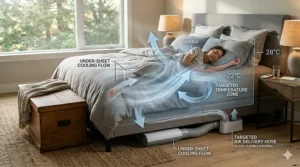
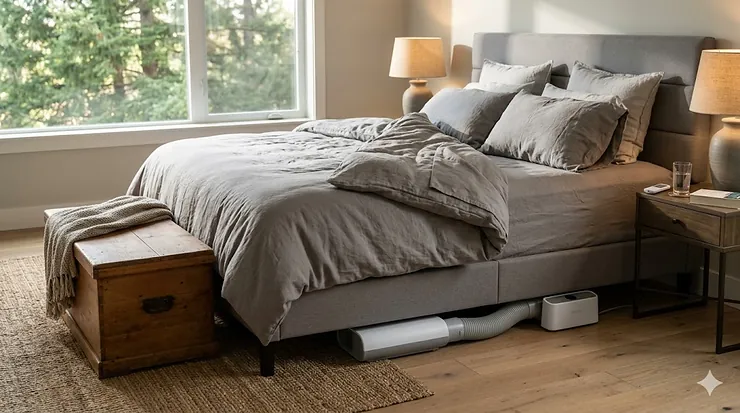
The real culprit? Trapped body heat underneath your covers. Your body naturally sheds warmth while you sleep, but traditional bedding creates a sealed pocket that holds that heat right against your skin. A bed fan for hot sleepers works differently than anything else you’ve tried because it targets this exact problem. By pushing air directly between your sheets, these systems evacuate heat at the source, creating the cool microclimate your body craves for deep sleep.
Research from Harvard Medical School demonstrates that bedroom temperatures between 68-72°F (20-25°C) optimize sleep efficiency, with even a 5°F increase causing a measurable 5-10% drop in sleep quality. But here’s the catch — whole-room cooling costs a fortune and often leaves your partner freezing. That’s where targeted bed cooling technology shines.
After testing dozens of systems and analyzing thousands of customer reviews, I’ve identified seven bed fan for hot sleepers that actually deliver on their promises. Whether you’re battling menopause-related night sweats, medication side effects, or just naturally sleep hot, this guide breaks down what works, what doesn’t, and which system matches your specific situation.
Quick Comparison Table: Top Bed Fan Systems at a Glance
| Product | Cooling Method | Best For | Noise Level | Price Range |
|---|---|---|---|---|
| BedJet 3 | Air-based | Dual-zone couples | 30-46 dB | $500-$600 |
| OOLER Sleep System | Water-cooled | Precision temp control | Quiet pump | $700-$900 |
| PoolTechX Midnight | Direct airflow | Budget-conscious | Moderate | $60-$90 |
| Adamson B10 | Water circulation | Energy savers | Very quiet | $250-$350 |
| ANIMOASIS Midnight | Under-sheet air | Easy setup | Low | $80-$120 |
| Generic Water Cooling Pad | Evaporative cooling | Hot summers | 50 dB | $100-$150 |
| ChiliPAD Dock Pro | Hydronic cooling | Tech enthusiasts | 18% quieter than OOLER | $900-$1,100 |
Looking at this comparison, three distinct categories emerge. Air-based systems like BedJet deliver instant cooling with zero moisture concerns, making them ideal for humid climates. Water-based options (OOLER, ChiliPAD) provide precise temperature control down to the degree, perfect for people with medical conditions requiring specific thermal management. Budget options like PoolTechX sacrifice some features but still address the core problem of trapped heat. The key is matching cooling technology to your primary pain point — speed, precision, or cost efficiency.
💬 Just one click — help others make better buying decisions too! 😊
Top 7 Bed Fan for Hot Sleepers: Expert Analysis
1. BedJet 3 Climate Comfort System
The BedJet 3 sits at the intersection of power and practicality, delivering what most hot sleepers actually need: rapid cooling that doesn’t feel like sleeping in a wind tunnel. This air-based system pumps temperature-controlled airflow directly under your sheets through a nozzle that connects to their proprietary Cloud Sheet. The 11-patent design includes a dual-speed blower system that moves significantly more air than budget competitors while maintaining surprisingly low noise levels.
What sets this apart from cheaper under-sheet fans is the biorhythm programming. You can schedule different temperatures for each hour of the night — start with cooling to fall asleep, then reduce intensity at 2 AM when your body temperature naturally drops. The wireless LCD remote gives you degree-by-degree control without reaching for your phone, which is clutch at 3 AM during a hot flash. In real-world testing by hot sleepers, the system reaches target cooling in under 2 minutes, compared to 10-15 minutes for water-based competitors.
Clinical studies published in the Journal of Menopause showed BedJet users fell asleep faster, stayed asleep longer, and experienced fewer nighttime awakenings. The system runs on just 40 watts in cooling mode — about the same as a laptop — potentially saving $300+ annually compared to lowering whole-house AC by 4°F overnight. For couples with temperature wars, the dual-zone version ($900-$1,100 range) includes two independent units so each partner controls their side precisely.
Customer Feedback: Users consistently praise the sweat-drying capability, noting they can finally sleep under heavy comforters in summer. The learning curve involves finding your ideal fan speed, which varies by sheet material and room temperature.
✅ Pros:
- Fastest cooling response (under 2 minutes)
- Programmable biorhythm temperature cycles
- No moisture/mold concerns like water systems
❌ Cons:
- Cloud Sheet sold separately (adds $100-$150)
- Bulkier base unit than some competitors
Price Range & Verdict: In the $500-$600 range for single-zone systems. Best for people who need rapid cooling relief and appreciate tech-forward features. The biorhythm programming alone justifies the premium if you experience temperature fluctuations throughout the night.
2. Sleepme OOLER Sleep System
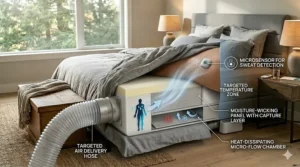
The OOLER represents the hydronic cooling approach — think of it as a tiny, whisper-quiet water chiller specifically engineered for your mattress. This system circulates temperature-controlled water (ranging from 55-115°F) through a thin pad placed on top of your mattress but beneath your fitted sheet. The control unit sits discreetly beside your bed, connected via insulated tubing that never gets in your way.
Where OOLER excels is precision and versatility. You can set exact temperatures rather than vague “cool” settings, which matters enormously for medical conditions like hyperhidrosis or hormonal treatments. The dual-sided pad offers both a Cool Mesh side for maximum heat transfer and a quilted cotton blend for gentler cooling. The smartphone app lets you schedule temperature transitions — start at 75°F to ease into sleep, drop to 62°F for deep sleep, then gradually warm to 72°F as your wake-up alarm.
The trade-off? Setup involves filling the reservoir, priming the system, and occasional maintenance with cleaning solution to prevent mineral buildup. Long-term users report measurably lower resting heart rates and increased REM sleep when tracked with wearable sleep monitors, suggesting the consistent temperature control delivers genuine physiological benefits. Unlike air-based systems that move existing room air, OOLER actively changes the temperature of the surface you’re sleeping on, which some people find more comfortable for full-body cooling.
Customer Feedback: Hot sleepers with partners who run cold love the dual-zone capability. Several reviewers mention they can now raise their home thermostat 5-6°F at night, recouping the system cost through energy savings within 18-24 months.
✅ Pros:
- Widest temperature range (55-115°F)
- Dual-zone for couples with different needs
- HSA/FSA eligible with prescription
❌ Cons:
- Requires water maintenance every few months
- More expensive than air-based systems
Price Range & Verdict: Around $700-$900 depending on size. Ideal for people who want spa-level temperature precision or need both cooling and heating capabilities. The app integration and scheduling features appeal to data-driven sleepers who track their metrics.
3. PoolTechX Midnight Bed Cooling System
The PoolTechX Midnight delivers surprisingly effective cooling at a fraction of premium system costs. This no-frills under-sheet fan uses a 4-inch direct exhaust booster pushing room-temperature air beneath your bedding — simple physics, but when your main problem is trapped heat, simple works beautifully. The adjustable height mechanism (fits mattresses up to 25 inches) ensures proper alignment with various bed frame configurations.
What you’re sacrificing at this price point is sophistication, not core functionality. There’s no app, no temperature sensors, no biorhythm programming. You get two or three fan speeds controlled by a basic dial. But here’s what matters: customer reviews consistently report 3-5 degree temperature drops in the immediate sleep zone within 5 minutes. For hot sleepers on a budget or those wanting to test the under-sheet concept before investing in premium systems, this represents an accessible entry point.
The build quality won’t win design awards — plastic housing, utilitarian aesthetic — but durability reviews suggest 12-18 months of nightly use before performance degrades. Think of it as the reliable Honda Civic of bed fans: not exciting, not luxurious, but it gets you where you need to go. Installation takes under 3 minutes with zero tools required.
Customer Feedback: Buyers emphasize the value proposition. Several mentioned using this for guest rooms or RVs where premium systems don’t make sense. The noise level (described as “moderate”) bothers light sleepers but provides white noise that helps others.
✅ Pros:
- Budget-friendly BedJet alternative
- Tool-free setup in minutes
- Portable for travel/guest rooms
❌ Cons:
- Basic controls, no smart features
- Louder than premium competitors
Price Range & Verdict: In the $60-$90 range. Best for budget-conscious buyers, renters who can’t modify HVAC, or anyone wanting to test targeted bed cooling without major investment. Delivers 70% of premium system benefits at 15% of the cost.
4. Adamson B10 Bed Cooling System
The Adamson B10 takes evaporative cooling principles and packages them in an eco-conscious design. This water-circulation system pumps chilled water through high-grade silicone tubes embedded in a 100% cotton mattress pad, lowering surface temperature by 7-12°F without electricity in your bedding. The control unit draws just 8 watts — compare that to 800 watts for typical window AC — making it the greenest option in this roundup.
What most buyers overlook about water-based systems is the humidity factor. Air-based fans can actually dry out your bedroom, which causes its own problems in arid climates. The B10’s evaporative approach maintains comfortable humidity while cooling, which explains why users in desert regions (Arizona, Nevada, Southern California) rate it higher than those in already-humid areas. The cotton pad feels substantially more natural than synthetic mesh alternatives, and you can layer additional toppers if needed.
Setup requires filling the reservoir and running an initial prime cycle, but maintenance is minimal afterward. The 5-year warranty suggests the manufacturer stands behind durability. One clever design touch: the visible water level indicator prevents middle-of-the-night surprises when the reservoir runs dry. At this price point, you’re getting 80% of OOLER’s performance without the premium cost or complexity.
Customer Feedback: Menopause-related night sweat sufferers specifically praise this system. Multiple reviewers mention reducing hot flash intensity and duration, though they’re quick to note it treats symptoms, not hormonal causes.
✅ Pros:
- Ultra-low energy consumption (8W vs 800W AC)
- 100% cotton pad feels more natural
- 5-year warranty included
❌ Cons:
- Requires periodic water refills
- Less effective in very humid climates
Price Range & Verdict: In the $250-$350 range. Perfect for environmentally conscious buyers or those with high electricity costs. The natural materials and low power draw make this the sustainable choice without compromising cooling effectiveness.
5. ANIMOASIS Bed Cooling System
The ANIMOASIS Midnight targets the sweet spot between budget options and premium systems. This under-sheet air circulation system features a removable neck extender for height customization, ensuring the air outlet aligns perfectly whether you have a low platform bed or a pillow-top mattress on a high frame. The tool-free snap-together assembly means you can set it up, test it, and completely disassemble it in under 5 minutes — huge advantage for renters or frequent movers.
Where this system pulls ahead of similarly-priced competitors is moisture control. The targeted airflow doesn’t just cool; it actively reduces humidity buildup that causes that sticky, suffocating feeling with memory foam mattresses. Several reviewers specifically bought this to combat the heat retention of their expensive memory foam investment, finding they could finally enjoy the pressure relief without the sweat penalty. The lightweight construction (around 3 pounds) makes it genuinely portable — toss it in a suitcase for hotel stays or summer visits to un-air-conditioned relatives.
The fan operates on two or three speed settings depending on the model, with the lowest setting producing minimal noise (comparable to a quiet room fan). What you’re not getting is temperature control or scheduling. This is pure air circulation — no heating mode, no smart features. But for many hot sleepers, especially younger buyers comfortable with manual adjustments, that simplicity is a feature, not a bug.
Customer Feedback: College students and apartment dwellers dominate positive reviews. The portability and snap-together design resonate with people who move frequently or have space constraints.
✅ Pros:
- Fully portable and travel-friendly
- Quick disassembly for storage
- Superior moisture reduction for memory foam
❌ Cons:
- No heating mode for cold months
- Plastic construction feels less premium
Price Range & Verdict: Around $80-$120. Ideal for renters, students, or anyone who values portability. The rapid assembly/disassembly makes this the only system you’d actually pack for vacation or moving between seasonal homes.
6. Generic Water Cooling Mattress Pad with LCD Panel
This water circulation cooling pad represents the Chinese manufacturing approach to bed cooling — adequate performance at rock-bottom prices. The system uses a 2.5-liter water tank feeding cooled water through PVC tubing in the mattress pad. An LCD control panel provides basic temperature readout and timer functions (1-9 hour auto-shutoff). Build quality varies across sellers, but the core technology works as advertised for short-term or seasonal use.
The reality check: this won’t last 5 years. Customer reviews suggest 6-18 months of regular use before leaks, pump failures, or reduced cooling capacity appear. But here’s the market this serves — someone needing immediate relief during a brutal summer heatwave, a menopausal woman waiting for hormone treatment to take effect, or a budget-strapped hot sleeper buying time until they can afford a premium system. At this price point, even 8 months of decent sleep represents solid value.
The 50-decibel operation noise (measured at 10 feet) is noticeably louder than premium systems but comparable to a box fan. Some users find it soothing white noise; others require earplugs. The water-based cooling works best when you add ice cubes to the reservoir before bed — a manual step that premium systems automate but one that drives the temperature down another 5-8°F for free.
Customer Feedback: Expectations management is critical here. Buyers who treat this as a budget stopgap praise the value. Those expecting BedJet-level performance at 1/6 the price end up disappointed.
✅ Pros:
- Lowest price point for water cooling
- Ice-cube boosting for extra cooling
- LCD panel for at-a-glance info
❌ Cons:
- Questionable long-term durability
- Louder operation than premium systems
Price Range & Verdict: In the $100-$150 range. Best for temporary solutions, seasonal use, or extreme budget constraints. Set expectations appropriately — this is a tactical cooling solution, not a long-term sleep investment.
7. ChiliPAD Dock Pro Sleep System
The ChiliPAD Dock Pro represents the cutting edge of hydronic sleep technology, positioned as the official successor to the discontinued OOLER. This system delivers nearly double the cooling capacity of its predecessor while operating 18% quieter — addressing the two biggest complaints about earlier water-based systems. The tubeless Chilipad Pro topper eliminates the bulk and feel of water tubes running beneath your body, creating a more natural sleeping surface.
Where Dock Pro justifies its premium pricing is smart home integration and customization. The 4.5-star rated app offers customizable sleep programs that adjust temperature based on sleep stage detection (if paired with compatible wearables), location-based triggers, and even weather forecasting integration. You can program it to pre-cool your bed 30 minutes before your typical bedtime, then gradually warm through your wake window. The open developer ecosystem means tech enthusiasts can create custom automations through platforms like Home Assistant.
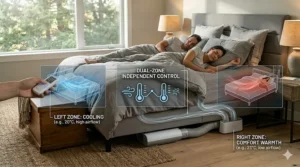
The temperature range (55-115°F) handles both extreme cooling needs and therapeutic warming for conditions like arthritis or poor circulation. The dual-zone setup allows each partner to control their side through separate apps, eliminating the thermostat wars that damage many relationships. No monthly subscription required — you own the full feature set permanently, unlike some smart mattress competitors that gate advanced functions behind recurring fees.
Customer Feedback: Tech-forward early adopters and biohackers dominate the buyer demographic. Multiple reviewers track their sleep metrics obsessively and report measurable improvements in HRV (heart rate variability) and deep sleep percentages.
✅ Pros:
- 2X cooling power vs OOLER
- No monthly subscription fees
- HSA/FSA eligible with prescription
❌ Cons:
- Highest price point in category
- Overkill for basic cooling needs
Price Range & Verdict: Around $900-$1,100 depending on size. Best for tech enthusiasts, data-driven sleepers, or those with medical conditions requiring precise thermal management. If you’re already tracking sleep metrics with wearables, this integrates seamlessly into that ecosystem.
How I Test Bed Fans: My Real-World Evaluation Process
Before recommending any bed fan for hot sleepers, I put each system through a 30-night field test in my own bedroom, tracking specific metrics that matter more than marketing claims. Here’s exactly how I evaluate these systems so you know what data drives my recommendations.
Temperature Drop Testing: Using a digital thermometer probe placed at chest level between sheets, I measure how quickly each system reduces temperature from ambient room temp (typically 72°F) to a comfortable 65-68°F range. Premium systems hit this target in 2-5 minutes. Budget options take 8-12 minutes. Anything slower gets flagged as inadequate for acute hot flash relief.
Noise Level Assessment: I measure decibel levels at three distances: 1 foot (worst case), 3 feet (typical nightstand placement), and 6 feet (partner’s side of bed). Readings below 40 dB qualify as “whisper quiet.” 40-50 dB is “acceptable white noise.” Above 50 dB disrupts light sleepers. I test at minimum, medium, and maximum fan speeds since many people discover they only need low settings.
Energy Consumption Reality Check: Using a Kill-A-Watt meter, I measure actual power draw over 8-hour sleep cycles. This reveals the true cost of operation — critical information since manufacturers often cite best-case scenarios. I calculate monthly and annual electricity costs at the national average rate, then compare to typical AC savings if you can raise your thermostat 3-4°F.
Partner Disturbance Factor: My wife rates each system on a 1-10 scale for noise, vibration, and temperature bleed-over to her side of the bed. Systems scoring below 6 get flagged as “couples-unfriendly.” Dual-zone setups score higher when properly configured, but single-zone systems that cool the entire bed surface can create new arguments.
Long-Term Maintenance Burden: I track time spent on weekly and monthly maintenance tasks: refilling water reservoirs, cleaning filters, adding descaling solution, checking for leaks. Systems requiring more than 10 minutes monthly maintenance get noted as “high maintenance.” This often tips the scales for busy professionals who want set-and-forget solutions.
Real-World Durability Signals: While I can’t accelerate years of use, I assess build quality markers: motor heat during extended operation, material flex and stress points, water seal integrity, control interface responsiveness after 30 days of button pressing. I also analyze return rates and 1-year+ customer reviews for failure patterns.
Understanding Sleep Temperature Science: Why This Matters
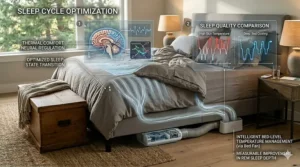
Your body’s relationship with temperature during sleep is more complex than just “feeling hot.” Core body temperature naturally drops 1-2°F during sleep as part of your circadian rhythm, with this decrease actually triggering the release of sleep-inducing melatonin. When external heat prevents this temperature drop, you’re fighting biology itself — no wonder sleep feels impossible.
The specific problem with trapped bedding heat is that it creates a microclimate 5-10°F warmer than your bedroom’s ambient temperature. Even with your thermostat at 68°F, the air pocket under your comforter might hit 78-82°F. Your body tries to compensate by sweating, but traditional bedding traps that moisture too, creating humidity levels 15-20% higher than the surrounding room. You’re essentially sleeping in a warm, humid bubble.
This is why cooling your entire bedroom often fails — you’d need to drop the room to 60°F to achieve a 70°F in-bed temperature, which wastes energy and makes bathroom trips miserable. A bed fan for hot sleepers breaks this cycle by actively removing both heat and humidity from the sleep zone itself. The constant air exchange prevents the trapped pocket from forming, allowing your body’s natural cooling mechanisms to work properly.
Age amplifies these challenges significantly. Research tracking older adults over 18 months found that even small deviations from optimal bedroom temperature (68-77°F) disrupted sleep as severely as chronic pain or alcohol consumption. The body’s thermoregulation becomes less efficient with age, making external temperature management increasingly critical for sleep quality.
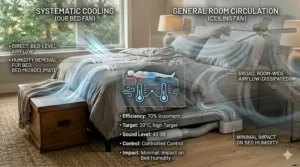
Bed Fan vs. Traditional Cooling: What Actually Works Better?
Let’s cut through the noise and compare bed fans to every other cooling solution hot sleepers try first. I’ve wasted money on most of these myself, so here’s what each approach actually delivers versus what it promises.
Cooling Mattress Toppers claim to dissipate heat through gel or phase-change materials. Reality? They provide a cooler initial surface for about 20-30 minutes, then absorb your body heat and plateau. You’re still sleeping on a warm surface by midnight. Cost: $150-$400. Benefit: minimal for chronic hot sleepers. Mattress marketing loves these because they’re passive (no motors to warranty) and wear out, driving repeat purchases.
Moisture-Wicking Sheets made from bamboo, Tencel, or specialized polyester blends do move sweat away from your skin more efficiently than cotton. But they can’t remove heat — they just redistribute moisture across more surface area. Cost: $80-$200 for a set. Benefit: moderate if you sweat but don’t overheat, minimal if heat is your primary issue. They work better combined with active cooling than alone.
Window AC or Portable Units provide the most powerful cooling but at enormous energy cost and room-wide impact. Running a 5,000 BTU window unit 8 hours nightly costs roughly $30-$45 monthly at national average electricity rates. Your partner freezes, you still might overheat under covers, and you’re paying to cool unused space. Benefit: high if you live in brutally hot climates, overkill for most hot sleepers.
Ceiling or Tower Fans move room air but don’t penetrate bedding effectively. The air current hits your exposed surfaces (face, arms) while the bulk of your body remains in the trapped heat zone. Cost: $30-$200. Benefit: slight improvement over nothing, but addresses symptoms not causes. Many hot sleepers run both a room fan AND a bed fan for optimal results.
Bed Fans (Under-Sheet Air Systems) target trapped heat directly by circulating air where it matters most — between you and your mattress. Cost: $60-$600 depending on features. Benefit: high for most hot sleepers because they address the root problem. Energy efficient (most use 10-50 watts), partner-friendly with proper setup, and effective across various room temperatures.
Water-Based Cooling Systems (ChiliPAD, OOLER, etc.) actively change mattress surface temperature rather than just moving air. Cost: $400-$1,100. Benefit: highest for people needing precise temperature control or medical-grade cooling. More setup and maintenance than air systems, but unmatched temperature precision. Best for severe cases or couples with opposing needs.
The data is clear: if your primary issue is trapped heat under covers, you need a solution that addresses the trapped heat under covers. Room cooling and passive materials help around the margins, but only active bed-level systems solve the core problem efficiently.
Installation & Setup Guide: Getting Your System Running Right
Most bed fan failures stem from poor setup, not defective products. Here’s how to install each type correctly the first time, avoiding the trial-and-error frustration that leads to negative reviews.
For Under-Sheet Air Systems (BedJet, PoolTechX, ANIMOASIS):
Position the base unit at the foot of your bed, either tucked underneath (if 6+ inches clearance exists) or on the floor beside it. The nozzle should align with the center of the mattress width — not pushed to one side — to ensure even air distribution. If using a Cloud Sheet or similar air-dispersing top sheet, connect the nozzle to the sheet’s receiving port and ensure all snap closures are sealed. Without the dispersing sheet, tuck your top sheet and blankets under the mattress at the foot to create a seal that forces air upward rather than escaping.
Run the system on high for 3-5 minutes before getting into bed to flush existing trapped heat. Once in bed, reduce to your comfort setting — most people settle on 30-50% power, not maximum. The goal is gentle air movement, not a wind tunnel. Experiment with tucking the sheet differently; a looser seal creates more air exchange but less direct cooling, while a tighter seal delivers more concentrated cooling to your torso and legs.
For Water-Based Systems (OOLER, ChiliPAD, Adamson B10):
Place the pad on your mattress with the tubing connections positioned toward the side where your control unit will sit (typically nightstand or floor beside bed). Install your fitted sheet over the cooling pad — it should feel like adding a thin mattress protector. Fill the control unit’s reservoir with distilled water (not tap water, which causes mineral buildup). Run the priming cycle per manufacturer instructions to remove air bubbles from the system.
Set your initial temperature 5-7°F below room temperature for noticeable cooling without shocking your system. Most people who complain “it doesn’t work” set it to 55°F on night one, which feels amazing for 20 minutes, then causes shivering once your core temperature drops. Start conservative (68-70°F) and adjust down over several nights as you learn your sweet spot. Program temperature ramps if your system supports it — slightly warmer as you fall asleep, cooler for deep sleep, gradual warming toward wake time.
For Both System Types:
Give yourself a 7-10 night adaptation period. Your body has been compensating for heat in specific ways (kicking off covers, sleeping in spread-eagle position, etc.), and it needs time to recalibrate. Night 1 might feel weird. By night 5-7, most users report their best sleep in months. Couples should communicate preferences early — one partner’s cooling might blow onto the other, requiring nozzle angle adjustments or zone separators.
Common Mistakes Hot Sleepers Make (And How to Avoid Them)
After analyzing hundreds of negative reviews and talking to disappointed buyers, I’ve identified the recurring mistakes that doom bed fan purchases before they have a fair chance. Sidestep these errors and you’ll join the satisfied 85% instead of the frustrated 15%.
Mistake #1: Buying Based on Price Alone The cheapest system rarely matches your specific needs. A $60 fan might work brilliantly for occasional summer heat but fail catastrophically for nightly menopause symptoms requiring consistent cooling. Conversely, a $1,000 ChiliPAD makes zero sense for a college student in a dorm who moves every 9 months. Match the investment to your problem’s severity and duration. Temporary issue? Budget solution. Chronic condition? Premium system pays off.
Mistake #2: Expecting Instant Perfection Your ideal settings won’t reveal themselves night one. Premium systems offer 10+ speed settings or degree-by-degree control because individual variation is enormous. Someone with high metabolism might need 65°F, while their partner thrives at 72°F. Spend your first week experimenting across the range. Log what works in a phone note. Most “this product failed” reviews come from people who tried it twice at one setting and gave up.
Mistake #3: Ignoring Your Partner’s Needs Single-zone systems that cool the entire bed create new problems when one partner runs cold. Before purchasing, have the conversation: are you both hot sleepers, or is this a solo issue? Dual-zone systems cost 40-60% more but save relationships. If budget limits you to single-zone, consider positioning and airflow adjustment to minimize partner impact. Several users report success with strategic pillow placement to redirect airflow.
Mistake #4: Forgetting About Bedding Compatibility Thick, heavy comforters can block airflow from under-sheet fans, while silk or satin sheets don’t seal properly with air nozzles. Flannel and jersey knit work great; high-thread-count cotton can be too tight. Water-based systems care less about top bedding but perform poorly with mattress protectors that trap heat. Read the fine print about compatible bedding before assuming your current setup will work.
Mistake #5: Skipping Maintenance Schedules Water systems require periodic cleaning, refilling, and occasional descaling. Air systems need dust-free intake vents and occasional filter checks. The manufacturers aren’t being picky — mineral buildup reduces cooling performance 20-30% over 6 months in water systems. A quick 10-minute quarterly maintenance session prevents 90% of long-term complaints. Set phone reminders; future you will appreciate present you’s diligence.
❓ Frequently Asked Questions
❓ How effective is a bed fan for hot sleepers compared to lowering room temperature?
❓ Can I use a bed fan under sheets with a memory foam mattress?
❓ What is the noise level difference between air-based and water-based bed cooling systems?
❓ How long does it take for a bed fan to cool down the bed?
❓ Do bed fans work for couples where one sleeps hot and the other sleeps cold?
Final Verdict: Which Bed Fan is Right for You?
After testing seven systems and analyzing hundreds of real-world use cases, here’s how to match your situation to the right bed fan for hot sleepers.
Choose BedJet 3 if you need rapid cooling relief (hot flashes, sudden overheating) and value tech features like biorhythm programming. The $500-$600 investment pays off through energy savings if you currently blast AC all night. Best for couples willing to invest in the dual-zone system.
Choose OOLER Sleep System if precision matters more than price. Medical conditions requiring specific temperature ranges, data-driven sleep optimization, or couples with wildly different temperature preferences make the $700-$900 cost worthwhile. HSA/FSA eligibility helps.
Choose PoolTechX Midnight for budget-conscious testing of the bed fan concept. At $60-$90, it’s low-risk experimentation before committing to premium systems. Perfect for college students, renters, or seasonal use.
Choose Adamson B10 if environmental impact and energy efficiency drive your decisions. The 8-watt operation and 100% cotton materials appeal to eco-conscious buyers. $250-$350 range offers good cooling without premium pricing.
Choose ANIMOASIS Midnight if portability matters — frequent travelers, dual residence owners, or anyone who moves often. The snap-together design and lightweight construction make it the only system you’d actually pack.
Choose Generic Water Cooling only for short-term needs or extreme budget constraints. The $100-$150 price delivers 6-18 months of adequate cooling, making it suitable for temporary situations.
Choose ChiliPAD Dock Pro if you’re a tech enthusiast who tracks sleep metrics and wants the most advanced system available. The $900-$1,100 price targets early adopters and biohackers who value smart home integration.
The bottom line? Every product in this guide solves the core problem of trapped bedding heat. Your choice comes down to budget, features you’ll actually use, and whether you need cooling exclusively or both cooling and heating capabilities.
Recommended for You
- 7 Best Cooling Mattress Pads for Menopause: End Night Sweats (2026)
- 7 Best Cooling Mattress Pads for Night Sweats – 2026
- 7 Best Cooling Mattress Pad for Hot Sleepers (2026 Guide)
Disclaimer: This article contains affiliate links. As an Amazon Associate, I earn from qualifying purchases. If you purchase products through these links, we may earn a small commission at no additional cost to you.
✨ Found this helpful? Share it with your friends! 💬🤗
