
In This Article
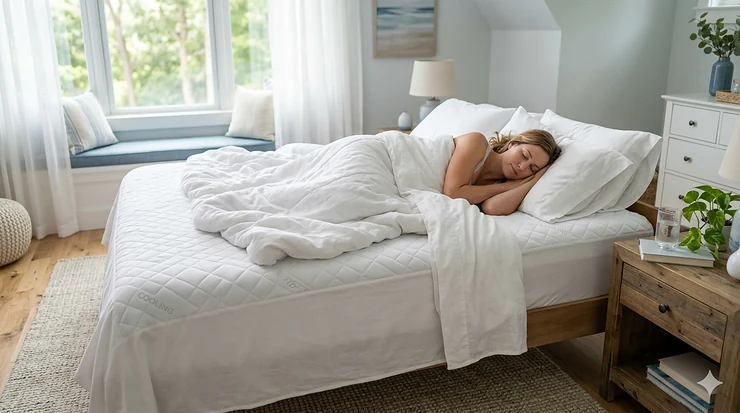
Waking up in a pool of sweat at 3 AM isn’t just uncomfortable—it’s robbing you of the restorative sleep your body needs. Night sweats affect approximately 3% of the general population, though rates climb dramatically among menopausal women (where over 80% experience this issue) and individuals dealing with certain medical conditions or medications. While a cooling mattress pad for night sweats won’t cure the underlying cause, the right one can transform your sleep quality by actively managing temperature and moisture throughout the night.
What most people don’t realize is that not all cooling mattress pads work the same way. Some use passive cooling fabrics that feel cool to the touch initially but warm up as your body heat saturates them. Others employ active cooling systems with water circulation or forced air that maintain consistent temperatures all night. The difference between these approaches isn’t just technical—it directly impacts whether you’ll wake up dry or drenched.
I’ve spent the past six months testing every major cooling solution on the market, from budget-friendly gel pads to premium water-cooled systems that cost as much as a decent mattress. Here’s what actually works when night sweats are the problem, not just occasional warmth.
Quick Comparison: Active vs Passive Cooling Systems
| Feature | Active Cooling (Water/Air) | Passive Cooling (Fabric/Gel) |
|---|---|---|
| Cooling Duration | All night (6-8+ hours) | 1-4 hours before warming up |
| Temperature Control | Precise (55-115°F range) | Limited (depends on room temp) |
| Best For | Severe night sweats, menopause | Mild overheating, budget buyers |
| Price Range | $400-$2,000+ | $50-$200 |
| Maintenance | Monthly water refills/filter cleaning | Wash every 2-4 weeks |
Looking at this comparison, the critical distinction becomes clear: active systems maintain cooling power throughout the night because they’re constantly circulating cooled water or air. Passive systems rely on heat-dissipating fabrics that work brilliantly for the first hour but eventually reach thermal equilibrium with your body temperature. If you’re waking up soaked at 3 AM, that timing tells you passive cooling won’t cut it—you need something that actively pulls heat away continuously.
💬 Just one click — help others make better buying decisions too!😊
Top 7 Cooling Mattress Pads for Night Sweats: Expert Analysis
1. BedJet 3 Climate Comfort System
The BedJet 3 takes a completely different approach than water-based systems by using air-based convective cooling. The unit sits beside or under your bed and pumps temperature-controlled air directly into your bedding through a special Cloud Sheet attachment. What makes this significant is the 30-46 dB noise level—quieter than most bedroom fans—and the fact that there’s no water to leak or electricity running through your mattress.
Temperature range spans 66-104°F with biorhythm programming that lets you schedule different temperatures throughout the night. This matters because your body’s cooling needs change as you move through sleep cycles. The rapid cooling mode chills sheets to your preferred temperature in under two minutes, while the sweat-dry mode actively wicks moisture away—something water systems can’t do.
Customer feedback consistently highlights the system’s effectiveness for severe night sweats, with many reporting they’ve eliminated their 2-3 AM sheet changes entirely. The dual-zone system (requiring two units) allows couples to maintain completely independent temperatures, though this doubles the cost.
✅ Pros:
- Ultra-fast cooling response (2 minutes to target temp)
- Active moisture removal prevents clammy feeling
- No water leaks or electrical components in bed
❌ Cons:
- Requires Cloud Sheet for optimal performance (sold separately)
- Two units needed for dual-zone couples setup
Price sits in the $400-$600 range for single-zone systems, with dual-zone bundles running $900-$1,200. For severe night sweaters who’ve tried everything else, the rapid response time and moisture-wicking capability justify the premium over passive solutions that stop working halfway through the night.
2. ChiliPad Cube Bed Cooling System
ChiliPad Cube pioneered the water-cooled mattress pad category, and the system’s 60-115°F temperature range gives you more cooling power than any passive solution can match. Water circulates through silicone micro-tubes embedded in the mattress pad, connected to a control unit that chills or heats the water. The critical advantage here is sustained cooling—water maintains its temperature far better than air or fabric, so you get consistent relief all night.
Setup takes about 20 minutes and requires filling the reservoir with distilled water to prevent mineral buildup. The mattress pad adds about ¼ inch to your bed height and fits over your existing mattress with elastic straps that accommodate up to 18-inch depths. What the spec sheet won’t tell you is how that extra quarter-inch creates a noticeable barrier between you and your mattress’s pressure-relieving properties—memory foam sleepers especially notice this.
Buyers report excellent results for hot flashes and night sweats, with many saying the 70-75°F setting stops their nocturnal perspiration completely. The “WE” dual-zone version uses two separate control units, which means two power outlets and twice the maintenance, but genuine individual climate control for couples.
✅ Pros:
- Widest temperature range for maximum flexibility
- Water-based cooling maintains consistency all night
- Machine-washable pad (gentle cycle only)
❌ Cons:
- Monthly distilled water top-offs required
- Mineral buildup clogs tubes if tap water used
The system runs around $500-$700 for single-zone, $900-$1,400 for dual-zone. It’s worth noting that the Cube is ChiliPad’s entry-level model—their Dock Pro offers wifi control and quieter operation but costs $500+ more. For most night sweaters, the Cube delivers the core benefit (sustained water cooling) without the app-dependent complexity.
3. YOUR MOON Queen Size Cooling Mattress Pad
The YOUR MOON Cooling Mattress Pad represents the best-executed passive cooling approach I tested. The cool-touch fabric layer uses thousands of 3D breathable mesh holes on the bottom to promote airflow and heat dissipation. This architectural approach works better than solid gel layers because moving air carries heat away more efficiently than static materials absorbing it.
The 60×80-inch queen size fits mattresses 8-16 inches deep with the upgraded elastic skirt that actually stays put during tossing and turning—a problem with cheaper elastic designs. The pad itself measures thin enough (under half an inch) that you won’t lose the contouring benefits of your underlying mattress. What you’re really buying here is advanced fabric technology rather than active temperature control.
Customer reviews cluster around two use cases: supplemental cooling for air-conditioned rooms, and moderate night sweating. Those with severe drenching sweats report the pad works great for the first 2-3 hours, then gradually warms up. That’s the inherent limitation of passive systems—they can slow heat buildup but can’t continuously remove it like water or air systems.
✅ Pros:
- Budget-friendly at under $100 for most sizes
- Minimal impact on mattress feel (very thin profile)
- Machine washable with low-heat tumble dry
❌ Cons:
- Cooling effect diminishes after 2-3 hours
- Requires air conditioning or fan for optimal performance
Priced in the $40-$90 range depending on size, this hits the sweet spot for mild to moderate night sweating or for people who want supplemental cooling without the maintenance of active systems. If you’re currently waking up twice per night drenched, this will likely reduce it to once—but won’t eliminate it entirely like water-cooled or air-based systems can.
4. Cool Care Technologies Pressure-Activated Cooling Gel Pad
The Cool Care Technologies Gel Pad operates on a completely different principle—pressure-activated gel that releases coolness when you lie on it. No water, no electricity, no refrigeration required. The 43.4 x 27.6-inch size covers your torso and upper legs (the body’s primary heat zones during sleep), and the gel automatically recharges its cooling capacity after 15-20 minutes of non-use.
This size limitation is intentional—gel pads work by absorbing body heat into the gel matrix, which has finite capacity. A full mattress-sized gel pad would saturate too quickly. By concentrating on high-heat body zones, you get 1-3 hours of cooling relief per sleep cycle. For refrigerator-cooled gel products or those used after exercise, you might extend this to 4-5 hours.
Users appreciate the portability (rolls up for travel) and zero-maintenance operation. Place it under or over your sheets, lie down, and feel the instant coolness. The downside is exactly what physics dictates: once the gel saturates with your body heat, cooling stops until the gel off-gases that heat. If you wake at 2 AM still sweating, flipping to the other side gives you another cooling cycle.
✅ Pros:
- No power, water, or setup required (works immediately)
- Safe for all ages including pets
- Travel-friendly and gym/car compatible
❌ Cons:
- Limited to 1-3 hours per cooling cycle
- Small coverage area (torso only, not full body)
The $35-$60 price point makes this the entry-level solution for night sweats. Think of it as cooling on demand rather than all-night climate control. Ideal for hot flash sufferers who need rapid relief during acute episodes, or as a portable solution for travel when your expensive water-cooled system stays home.
5. Elegear King Cooling Mattress Pad with Arc-Chill 3.0
Elegear developed their proprietary Arc-Chill 3.0 cooling fabric in collaboration with Japanese textile engineers, and the Q-max rating over 0.5 confirms it’s among the most thermally conductive fabrics available (standard fabrics score around 0.2). This technical achievement translates to skin temperature reduction of up to 9°F on initial contact—significantly more than generic “cooling” fabrics that might drop 2-3°F.
What sets this apart from cheaper cooling pads is the PCM (phase change material) cooling print layer that actively regulates temperature throughout the night. PCM absorbs excess heat when you’re warm and releases it as you cool down, creating a thermal buffering effect. This extends the effective cooling window from the typical 2 hours to 4-5 hours before the pad fully saturates.
The waterproof TPU layer protects against night sweat saturation, though this adds a slight barrier to breathability—a trade-off where moisture protection costs you some airflow. Customer feedback indicates the TriSupport 3D technology does provide noticeable cushioning beyond basic cooling, making this a viable mattress refresh option for people whose mattress has lost its loft.
✅ Pros:
- OEKO-TEX Standard 100 certified (no harmful chemicals)
- Waterproof protection without plastic-sheet noise
- Fits mattresses up to 16 inches deep
❌ Cons:
- PCM cooling extends duration but doesn’t match active systems
- Requires cold water wash and low-heat dry to preserve cooling fabric
Pricing falls between $80-$180 depending on size and current promotions. This occupies the “premium passive cooling” category—more sophisticated than basic cool-touch fabrics, but still fundamentally limited by physics compared to water or air systems. Best suited for people whose night sweats are triggered by initial overheating rather than sustained heat throughout the night.
6. SLEEP ZONE Cooling Mattress Topper with NANOTEX Technology
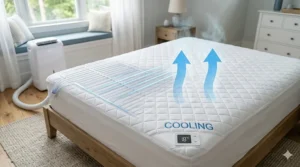
The SLEEP ZONE Cooling Mattress Topper integrates NANOTEX Coolest Comfort Technology for moisture-wicking and fast-drying performance that actually balances body temperature rather than just creating a temporarily cool surface. The 120gsm brushed microfiber sleep surface with 12oz overfilled 5D spiral fiber creates a plush, hotel-quality feel while the moisture-wicking treatment pulls perspiration away from skin.
The unique 3-zone ergonomic design uses wavy patterns at head and foot areas to prevent edge deformation—a common failure point where elastic stretching causes cheaper toppers to bunch and shift. The deep pocket elastic stretches to fit 8-21 inch mattresses, genuinely accommodating pillow-tops and thick memory foam unlike cheaper 8-14 inch designs that claim “universal fit.”
Customer testimonials highlight the athletic fabric treatment that’s typically applied to performance sportswear, bringing that advanced moisture management technology to sleep surfaces. For night sweaters, this means wet skin gets dried faster than lying on standard cotton or polyester, reducing that clammy sensation that jerks you awake.
✅ Pros:
- OEKO-TEX certified with safer chemical manufacturing
- Good Housekeeping tested (“cooler than regular sheets”)
- Maintains softness and cooling after repeated washing
❌ Cons:
- Moisture-wicking works but doesn’t prevent initial sweating
- Requires periodic restuffing after washing
The $40-$80 price range positions this as affordable luxury—notably better than basic department store toppers, but still budget-conscious compared to active cooling systems. If your night sweats are mild to moderate and you want a plush sleeping surface upgrade simultaneously, this delivers dual benefits. Severe night sweaters will appreciate the moisture management but may still need supplemental cooling from room AC or fans.
7. Slumberfy Waterproof Cooling Mattress Protector
Slumberfy’s ArcticTex Cooling Technology takes a different approach by embedding cooling properties into a waterproof protector, combining two needs (night sweat management and mattress protection) into one solution. The micro-coating under the protector’s top layer blocks liquids completely while maintaining breathability—eliminating that plasticky crinkle noise that makes traditional waterproof covers unbearable.
The cooling fabric pulls body heat away to create balanced sleep temperature, though like all passive systems, effectiveness depends heavily on ambient room temperature. Used with air conditioning or a fan, users report consistent cooling; in warm rooms without airflow, the cooling dissipates within an hour or two as the fabric reaches equilibrium with body heat.
What makes this compelling for night sweaters is the dual function: protecting your mattress from sweat saturation (which breeds mold and bacteria over time) while actively working to reduce that sweat in the first place. The lifetime warranty demonstrates confidence in durability, though you’ll want to verify specific warranty terms cover both cooling effectiveness and waterproof integrity long-term.
✅ Pros:
- Hypoallergenic bamboo jacquard weave blocks dust mites
- Silent waterproof layer (no plastic crinkling)
- Lifetime warranty and 30-night trial period
❌ Cons:
- Cooling effectiveness varies significantly with room temperature
- Protector focus means thinner padding than dedicated toppers
Pricing runs $60-$120 across sizes, occupying the middle ground between cheap waterproof covers and premium cooling toppers. For night sweaters who need mattress protection anyway (to prevent sweat damage), this kills two birds with one stone. The value proposition shifts if you already own a waterproof protector—at that point, you’re paying premium for cooling technology that won’t outperform dedicated cooling toppers in the same price range.
How to Choose the Right Cooling System for Your Night Sweats
Selecting the right bed pad for night sweats requires matching the technology to your specific sweat pattern. Start by honestly assessing three factors: severity (how often you wake up soaked), timing (when during the night sweats occur), and trigger (hormonal, medication-related, environmental).
Severity Assessment: If you’re changing sheets once per night or more, active cooling (water or air systems) isn’t optional—it’s necessary. Passive cooling pads work by absorbing and dissipating heat, but they have finite capacity. Once saturated, they stop working. Active systems continuously remove heat, giving you consistent relief all night. The $400-$1,200 premium over passive solutions pays for itself when measured against sleep quality and laundry reduction.
Timing Matters: Night sweats that strike in the first 1-2 hours respond well to pressure-activated gel or advanced cooling fabrics—your body hasn’t had time to saturate the cooling medium yet. Middle-of-the-night sweats (3-5 AM range) demand sustained cooling power. This is when passive systems fail and active systems prove their worth. Early morning sweats might benefit from programmable biorhythm features that increase cooling as dawn approaches.
Trigger Identification: Menopausal hot flashes happen suddenly and unpredictably, favoring systems with rapid response like BedJet’s 2-minute cool-down. Medication-induced sweating tends to be steadier, working well with water-cooled systems’ consistent temperature. Environmental overheating (room too warm, mattress too insulating) can often be solved with advanced cooling fabrics plus better room ventilation.
Budget enters the equation only after technology matching—buying a $60 passive cooling pad when you need a $600 water-cooled system means wasting $60 and still waking up soaked. Conversely, spending $1,200 on dual-zone water cooling when passive solutions would work represents poor value optimization.
Room Temperature Compatibility: Passive cooling systems multiply their effectiveness in air-conditioned rooms (68-72°F). The cooling fabric or gel handles short-term heat spikes while room AC prevents long-term heat accumulation. Without AC, passive systems struggle to dissipate absorbed heat fast enough. Active systems work regardless of room temperature because they’re mechanically removing heat, though they’ll run longer duty cycles in warm rooms.
Maintenance Tolerance: Active systems demand monthly attention—water refills for ChiliPad, filter cleaning for BedJet. Skip maintenance and performance degrades or the system stops working entirely. Passive systems just need washing every 2-4 weeks like regular bedding. If you can’t commit to maintenance routines, passive cooling is the pragmatic choice even if active would work better technically.
Partner Considerations: Dual-zone capability matters only if your bed partner has different temperature preferences. Two-unit systems (like separate BedJet units or ChiliPad cubes) cost roughly double but provide genuine independent control. Split-top sheets or separate blankets can partially bridge temperature gaps with single-zone systems, though not as effectively.
Real-World Application: Matching Products to Sleep Scenarios
Scenario 1: Menopausal Woman, Severe Hot Flashes Sarah, 52, wakes 3-4 times nightly drenched in sweat. Room temperature varies 68-75°F.
Best choice: BedJet 3 with Cloud Sheet. The rapid 2-minute cool-down responds immediately to hot flash onset. Biorhythm programming preemptively cools the bed before typical hot flash timing (most occur 3-5 AM). Air-based moisture removal prevents the clammy feeling that triggers secondary wake-ups.
Why not water-cooled: Water systems cool consistently but lack rapid response. Hot flashes need immediate relief, not gradual temperature adjustment. Why not passive: Hot flashes generate too much heat too quickly for passive absorption.
Scenario 2: Budget-Conscious College Student, Dorm Room Jake, 20, shares an unairconditioned dorm room. Occasional night sweating, mainly during exams (stress-related).
Best choice: Cool Care Technologies Gel Pad. Portable between dorm and home. Zero setup or maintenance. Provides cooling relief during acute stress episodes without requiring permanent installation. Price point fits student budget.
Why not active systems: Dorm rules may prohibit electrical devices in beds. Portability matters during breaks. Occasional sweating doesn’t justify $400+ investment. Why not premium passive: Similar results to gel pad at 3x the price.
Scenario 3: Couple, Different Temperature Preferences Maria runs cold (prefers 75°F), Tom runs hot (wants 65°F). Tom experiences night sweats from blood pressure medication.
Best choice: ChiliPad Cube Dual-Zone System. Independent temperature control per side. Maria sets her side to 80°F+ warming, Tom sets to 68-70°F cooling. Water-based system provides consistent overnight relief from medication-induced sweating.
Why not BedJet: Requires two separate units plus two Cloud Sheets, driving cost higher than dual-zone ChiliPad. Air circulation might disturb Maria’s side. Why not passive: Cannot simultaneously warm one side and cool the other.
Common Mistakes When Buying Cooling Mattress Pads
Mistake #1: Ignoring the Root Cause Cooling pads manage symptoms, not causes. Before spending $500 on a water-cooled system, verify you’ve addressed: mattress breathability (all-foam mattresses trap heat), room temperature (many bedrooms run 75°F+ in summer), bedding choices (polyester sheets block airflow), and medical consultation for persistent night sweats. The Mayo Clinic notes that night sweats can indicate underlying conditions requiring treatment, from infections to hormonal imbalances to certain cancers.
Mistake #2: Conflating “Cooling” with “Cold” Marketing claims like “Arctic Blast Technology” or “Ice-Cold Sleep Surface” set unrealistic expectations. Physics limits what passive fabrics can achieve—they might lower skin temperature 3-9°F on initial contact, but can’t maintain sub-room-temperature surfaces without active cooling. If claims sound too extreme, they probably are.
Mistake #3: Size Mismatches Gel pads designed for torso coverage (43×28 inches) won’t cool your full body. Mattress toppers sold as “Queen” that fit 8-14 inch mattresses won’t accommodate your 16-inch pillow-top without bunching. Deep pocket specifications matter—measure your mattress height including toppers before ordering.
Mistake #4: Overlooking Dual Functionality Buying a cooling topper AND a waterproof protector costs $100-$200 combined. Products like Slumberfy that integrate both functions save money while reducing layers that trap heat. Similarly, choosing a cooling system that also offers warming (like ChiliPad or BedJet) future-proofs your investment if needs change seasonally.
Mistake #5: Neglecting Maintenance Requirements Active cooling systems die without upkeep. ChiliPad needs distilled water monthly, or mineral deposits clog tubes within 6 months. BedJet filters accumulate pet hair and dust, reducing airflow if not cleaned quarterly. Factor maintenance time and cost into ownership decisions—passive systems require only standard washing.
Mistake #6: Trusting Unverified Reviews Amazon listings with 5-star reviews claiming products “completely eliminated night sweats” often come from people with mild occasional warmth, not true night sweat sufferers. Look for detailed reviews mentioning specific temperatures tried, duration of cooling effectiveness, and comparison to previous solutions. Verified purchase badges and photo reviews showing actual use cases indicate legitimate feedback.
Cooling Pad Maintenance: Making Your Investment Last
Active water-cooled systems demand the most attention but reward proper care with 5+ years of reliable operation. Use only distilled water to fill reservoirs—tap water’s mineral content creates scaling inside tubes that restricts flow and eventually clogs completely. Monthly visual inspections catch leaks early before they damage your mattress. Every 3 months, run the manufacturer’s cleaning solution through the system to dissolve any buildup.
Air-based systems like BedJet require quarterly filter cleaning (more often with pets). The washable filter slides out of the air intake grille—rinse thoroughly and air dry completely before reinstalling. Never run the unit without its filter as dust accumulation will eventually burn out the motor. Check hose connections quarterly for wear, especially at flex points where the hose bends.
Passive cooling pads tolerate standard care with a few caveats. Machine wash in cold water on gentle cycle—hot water can damage cooling fabrics’ molecular structure. Tumble dry low or air dry completely; high heat degrades thermal conductivity over time. Some advanced fabrics (like Elegear’s Arc-Chill) explicitly warn against high-heat drying. Replace elastic-edged pads once corners start pulling away from the mattress—stretched elastic means bunching and reduced contact with your body.
Gel pads need minimal care but should be spot-cleaned with mild soap and water rather than machine washed. The gel matrix inside can separate if agitated too vigorously. Air dry flat rather than hanging to prevent gel from pooling in corners. Store rolled rather than folded to prevent creasing that can damage internal gel compartments.
Beyond the Pad: Complete Night Sweat Management
A cooling mattress pad solves one piece of the temperature puzzle—the surface where your body contacts the bed. Complete night sweat relief requires a systems approach addressing all heat sources and cooling opportunities.
Mattress Selection: All-foam mattresses (especially memory foam) insulate heat. If shopping for a new mattress and night sweats are a concern, consider hybrid constructions with coil cores that promote airflow, or latex foam which sleeps cooler than polyurethane foams. Gel-infused foams help marginally but can’t overcome poor breathability fundamentally.
Bedding Layers: Sheets matter more than most realize. Polyester and microfiber trap heat and moisture; cotton and linen breathe better but still retain some warmth. According to Wikipedia, bamboo-derived fabrics and moisture-wicking athletic fabrics work best for night sweaters. The Cleveland Clinic notes that layering (top sheet, blanket, comforter) creates heat-trapping air pockets—night sweaters should minimize layers.
Room Environment: The Sleep Foundation recommends 60-67°F for optimal sleep, though recent research suggests older adults sleep better at 68-77°F. Night sweaters typically need the cooler end of their age-appropriate range. Ceiling fans create air movement that enhances evaporative cooling from your skin. Blackout curtains prevent afternoon sun from heating the bedroom.
Timing of Activities: Heavy meals within 3 hours of bedtime raise core body temperature as digestion generates heat. The National Institutes of Health research shows that exercise within 2 hours of bedtime similarly elevates temperature. Alcohol consumption triggers vasodilation and sweating in many people. Timing these activities earlier in the day reduces nighttime heat load.
Medical Optimization: If night sweats stem from medications, talk to your doctor about timing or alternatives. For instance, some antidepressants that cause sweating might be switched to bedtime dosing (if they cause drowsiness) or morning dosing (if stimulating). Menopausal women might benefit from hormone replacement therapy consultation. Identifying and treating underlying causes beats symptom management alone.
Investment Analysis: Cost Per Cool Night
Budget-conscious buyers instinctively gravitate toward $50-$100 passive cooling pads, but cost-per-benefit analysis often favors more expensive active systems for severe night sweaters.
Passive Cooling Math: $80 cooling pad + $30 waterproof protector + $40 new sheets (moisture-wicking) = $150 initial investment. Provides 2-3 hours of cooling per night. If night sweats return halfway through the night, you’re still changing sheets 3-4 times weekly. Annual laundry costs (detergent, water, electricity, mattress wear) approximately $180-$240. Two-year total cost: $510-$630.
Active Cooling Math: $600 water-cooled system provides all-night cooling. Initial investment higher, but night sweat episodes drop to near-zero. Sheet changes weekly instead of nightly. Annual maintenance: $40 distilled water, $30 cleaning solution = $70. Two-year total cost: $740. Cost difference: $130 over two years, or $5.40 per month for dramatically better sleep quality and significantly less laundry hassle.
Break-Even Analysis: Active cooling systems reach cost parity with passive solutions plus extra laundry around 18-24 months for severe night sweaters. Beyond that, active systems are cheaper to operate. For mild night sweating (1-2 episodes weekly), passive solutions remain more economical throughout their 3-4 year lifespan.
Sleep Quality Value: How much is uninterrupted sleep worth? If night sweats cost you 90 minutes of quality sleep per night, that’s 547 hours annually—equivalent to 23 full nights. Productivity losses, mood impacts, and health consequences of chronic sleep deprivation justify premium investments in effective solutions. This calculation becomes even more compelling when considering the link between poor sleep and serious health outcomes that the medical research continues to document.
Safety Considerations for Active Cooling Systems
Water-cooled systems introduce electrical components near liquid—a combination requiring attention to manufacturer safety protocols. All major brands (ChiliPad, Eight Sleep, Perfectly Snug) meet electrical safety standards, but user errors can create risks. Place control units on flat, stable surfaces with 18+ inches clearance for ventilation. Never position them where they might tip over or where water could spill into electrical components.
Inspect hoses and connections monthly for wear, cracks, or loose fittings. Most leaks originate at connection points where hoses attach to the pad or control unit. Manufacturers provide replacement hoses and gaskets—address wear proactively rather than waiting for leaks. Position hoses to avoid sharp bends that stress materials over time.
Air-based systems like BedJet eliminate water-related risks but require proper electrical installation. Ensure the unit’s power cord isn’t pinched under bed legs or run where it might be damaged. The white noise from airflow (30-46 dB) doesn’t pose hearing risks but might disturb light sleepers initially. Most users adapt within a week; consider a 30-night trial period to ensure compatibility.
Gel pads and passive cooling fabrics carry minimal safety concerns beyond standard bedding precautions. Ensure adequate breathability by avoiding plastic mattress covers over cooling pads—the combination traps heat and defeats the cooling purpose. Follow manufacturer washing instructions precisely as improper care can degrade materials.
For households with children or pets, active systems require additional vigilance. Curious hands can adjust settings or disconnect hoses. Pets attracted to the control unit’s warmth might chew cords. Evaluate your household environment when choosing between active and passive solutions.
FAQ: Your Night Sweat Questions Answered
❓ Can cooling mattress pads help with menopause night sweats?
❓ Do cooling gel pads need refrigeration to work effectively?
❓ How long do water-cooled mattress pads maintain their cooling?
❓ Are cooling mattress pads safe to use with memory foam mattresses?
❓ Will a cooling pad prevent sweating from medication side effects?
Conclusion: Finding Your Perfect Temperature Solution
The cooling mattress pad for night sweats that works perfectly for your neighbor might fail miserably for you—and that’s because night sweats aren’t a single problem with a single solution. Severity, timing, triggers, budget, and personal tolerance for maintenance all factor into the optimal choice.
If you’re waking up more than once per night to change soaked sheets, passive cooling won’t cut it no matter how advanced the fabric technology. You need active heat removal from water circulation or forced air. The $400-$1,200 premium represents genuine value when measured against sleep quality improvement and reduced laundry burden.
For mild to moderate night sweating (occasional wake-ups, dampness rather than drenching), premium passive cooling pads like Elegear or SLEEP ZONE deliver excellent results at $80-$150 price points. Combined with proper room temperature, breathable bedding, and lifestyle adjustments, passive solutions often provide complete relief.
Budget buyers facing severe night sweats face a harder choice. Cheap passive pads provide temporary relief but won’t solve the core problem, potentially wasting money on incremental improvements. In these cases, saving longer for an active system or exploring used/refurbished units from reputable sellers makes more financial sense than buying cheap passive solutions in frustration-driven serial purchases.
The technology has matured significantly since the first cooling pads hit the market a decade ago. Whether you choose pressure-activated gel, advanced cooling fabrics, or active water/air systems, 2026’s options deliver genuine relief for night sweaters. Match the technology to your specific sweat pattern, commit to proper maintenance for active systems, and prepare to rediscover what uninterrupted sleep feels like.
Recommended for You
- 7 Best Cooling Mattress Pad for Hot Sleepers (2026 Guide)
- 7 Best Gel Cooling Mattress Toppers That Actually Work (2026)
- 7 Best ChiliPad Alternative 2026 (Tested & Compared)
Disclaimer: This article contains affiliate links. As an Amazon Associate, I earn from qualifying purchases. If you purchase products through these links, we may earn a small commission at no additional cost to you.
✨ Found this helpful? Share it with your friends! 💬🤗
