
In This Article
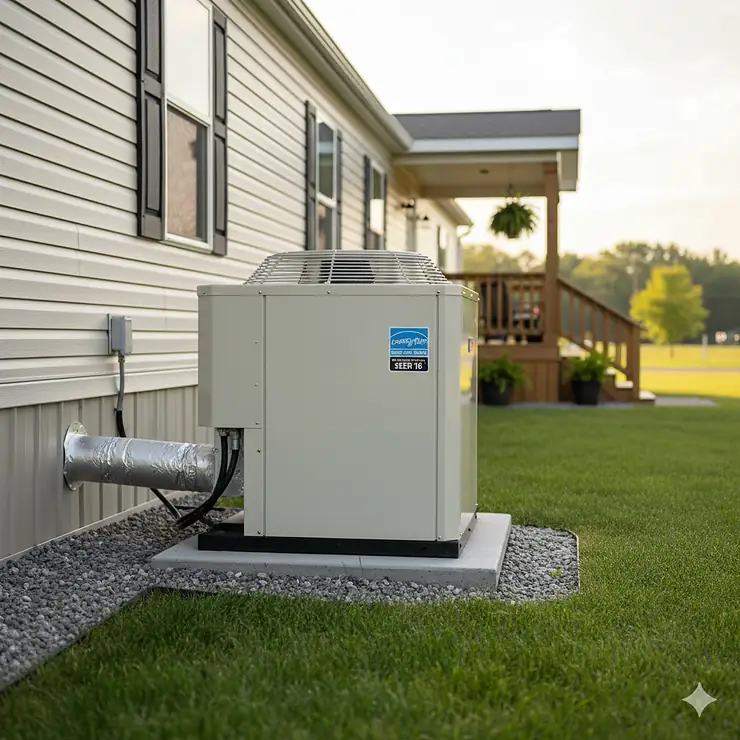
Finding the perfect mobile home air conditioner can feel like searching for a needle in a haystack, right? I get it. You’re dealing with unique challenges—limited space, specific electrical requirements, and the need for efficient cooling without breaking the bank. But here’s the thing: the right air conditioning unit can transform your manufactured home from a sweatbox into a cool oasis, even during those brutal summer months.
✨Was this helpful? Spread the word! 🚀
Mobile homes have different cooling needs compared to traditional houses. Whether you’re looking at portable AC units, window air conditioners, or central cooling systems designed specifically for manufactured homes, understanding your options is crucial. The good news? Technology has come a long way, and you’ve got some seriously impressive choices in 2025.
According to the U.S. Department of Energy, proper air conditioning in mobile homes can reduce energy costs by up to 40% when you choose the right unit with appropriate BTU ratings for your space. That’s not just comfort—that’s money back in your pocket.
Quick Comparison Table: Top Mobile Home Air Conditioner Options ⚡
| Model | BTU Rating | Coverage | Price Range | Key Feature | Rating |
|---|---|---|---|---|---|
| BLACK+DECKER BPACT14WT | 14,000 BTU | Up to 700 sq ft | $489-$570 | Smart WiFi Control | ⭐⭐⭐⭐½ |
| Midea Duo MAP14HS1TBL | 14,000 BTU | Up to 550 sq ft | $437-$500 | Dual Hose + Heat | ⭐⭐⭐⭐⭐ |
| Whynter ARC-14S | 14,000 BTU | Up to 500 sq ft | $499-$615 | Eco-Friendly R-32 | ⭐⭐⭐⭐⭐ |
| LG LP1022FVSM | 10,000 BTU | Up to 450 sq ft | $360-$400 | Dual Inverter Tech | ⭐⭐⭐⭐ |
| Dreo AC516S | 14,000 BTU | Up to 550 sq ft | $449-$550 | Ultra-Quiet 42dB | ⭐⭐⭐⭐½ |
| Whynter ARC-14SH | 14,000 BTU | Up to 500 sq ft | $550-$650 | Heat + Cool Combo | ⭐⭐⭐⭐⭐ |
| Dreo AC515S | 12,000 BTU | Up to 400 sq ft | $399-$479 | Drainage-Free Design | ⭐⭐⭐⭐ |
💬 Just one click – help others make better buying decisions too!😊
🛒 Ready to Beat the Heat?
Don’t wait until summer hits! These mobile home air conditioner units sell fast during peak season. Click any product above to check current availability and grab exclusive deals before they’re gone! ⏰
Top 7 Mobile Home Air Conditioner Units: Expert Analysis 🏆
1. BLACK+DECKER BPACT14WT – Best Overall Value 💰
The BLACK+DECKER BPACT14WT stands out as the best value mobile home air conditioner on the market right now. This 14,000 BTU powerhouse cools rooms up to 700 square feet efficiently, making it perfect for most mobile home living rooms or master bedrooms.
Key Specifications:
- Cooling Capacity: 14,000 BTU (10,200 BTU SACC)
- Coverage Area: Up to 700 sq ft
- Price: $489-$570
- Energy Efficiency: EER 10.2
What sets this unit apart is its smart WiFi connectivity that works seamlessly with both Alexa and Google Assistant. You can control temperature, fan speed, and modes right from your smartphone—even when you’re not home. Customer reviews consistently praise its cooling performance, with one user noting it dropped their bedroom temperature by 7 degrees in just 30 minutes.
Pros:
✅ Excellent cooling performance for the price
✅ Smart home integration included
✅ Easy installation with included window kit
Cons:
❌ Slightly louder at 55dB compared to premium models
❌ Limited availability at some retailers
2. Midea Duo MAP14HS1TBL – Best Dual Hose System 🌪️
The Midea Duo MAP14HS1TBL revolutionizes mobile home cooling with its innovative dual hose-in-hose design. This isn’t just marketing fluff—the technology actually locks cool air inside while pushing hot air out, delivering 2x faster cooling than traditional single-hose units.
Key Specifications:
- Cooling/Heating: 14,000 BTU cooling / 13,000 BTU heating
- Coverage: Up to 550 sq ft
- Price Range: $437-$500
- Noise Level: As low as 42dB
This unit is whisper-quiet at library-level noise (42dB) and includes both cooling and heating functions, making it perfect for year-round comfort. According to Consumer Reports, dual-hose portable air conditioners are significantly more efficient than single-hose models, and the Midea Duo proves it with 40% energy savings compared to federal standards.
Pros:
✅ Ultra-quiet operation perfect for bedrooms
✅ Heats and cools for year-round use
✅ Inverter technology saves energy
Cons:
❌ Slightly smaller coverage area than competitors
❌ Higher initial investment
3. Whynter ARC-14S – Most Eco-Friendly Option 🌱
The Whynter ARC-14S earned recognition as Good Housekeeping’s 2025 Best Overall portable air conditioner, and for good reason. This eco-conscious unit uses CFC-free R-32 refrigerant, reducing environmental impact while delivering powerful 14,000 BTU cooling.
Key Specifications:
- Cooling Power: 14,000 BTU (9,500 BTU SACC)
- Room Size: Up to 500 sq ft
- Price: $499-$615
- Special Features: Dual hose system, activated carbon filter
The dual hose design ensures maximum efficiency by preventing hot outdoor air from seeping back into your mobile home. Customers love the auto-drain function that fully exhausts condensate automatically in most environments—meaning less maintenance for you.
Pros:
✅ Environmentally friendly R-32 refrigerant
✅ Comprehensive warranty coverage
✅ Award-winning performance
Cons:
❌ Bulkier design takes more floor space
❌ Premium price point
4. LG LP1022FVSM – Best Dual Inverter Technology ⚙️
For mobile home owners seeking cutting-edge technology, the LG LP1022FVSM delivers with its exclusive DUAL Inverter Compressor. This innovation operates at remarkably low noise levels (44dB) while providing consistent cooling for spaces up to 450 square feet.
Key Specifications:
- BTU Rating: 10,000 BTU (SACC: 14,000 ASHRAE)
- Coverage: Up to 450 sq ft
- Price: $360-$400
- Control: WiFi-enabled with LG ThinQ app
The auto-swing air vent eliminates hot spots by distributing cool air evenly throughout your mobile home. According to Wikipedia’s guide to air conditioning, inverter technology can reduce energy consumption by 30-50% compared to fixed-speed compressors—and LG’s dual inverter system delivers exactly that.
Pros:
✅ Exceptional energy efficiency
✅ Smart home integration via ThinQ app
✅ Very quiet operation
Cons:
❌ Smaller coverage area
❌ No heating function
5. Dreo AC516S – Quietest Premium Option 🔇
The Dreo AC516S redefines what “quiet” means for mobile home air conditioners. Operating at just 42dB, this 14,000 BTU unit delivers powerful cooling without the noise pollution that typically comes with portable ACs.
Key Specifications:
- Cooling: 14,000 BTU ASHRAE (12,000 BTU SACC)
- Coverage: Up to 550 sq ft
- Price Range: $449-$550
- Noise: Ultra-quiet 42dB minimum
This smart AC unit features comprehensive app control, allowing you to monitor temperature, set schedules, and adjust settings remotely. The drainage-free cooling system (in humidity under 85%) means you won’t be constantly emptying water tanks—a huge convenience factor for busy mobile home owners.
Pros:
✅ Exceptionally quiet operation
✅ Modern, sleek design
✅ Advanced app features
Cons:
❌ Window panels can be tricky to install
❌ Takes up more floor space
6. Whynter ARC-14SH – Best Year-Round Solution 🔥❄️
The Whynter ARC-14SH offers versatility that’s hard to beat. This 4-in-1 unit functions as an air conditioner, heater, dehumidifier, and fan—making it the ultimate year-round climate control solution for your mobile home.
Key Specifications:
- Cooling: 14,000 BTU (9,200 BTU SACC)
- Heating: 13,000 BTU
- Coverage: Up to 500 sq ft
- Price: $550-$650
Business Insider named this the best portable air conditioner with heater for medium to large rooms, highlighting its superior performance in cooling tests. The dual hose system maximizes both heating and cooling efficiency, while the activated carbon filter ensures fresh, clean air quality year-round.
Pros:
✅ Four operational modes in one unit
✅ Excellent heating capability
✅ Premium build quality
Cons:
❌ Higher price point
❌ Noise level reaches 56dB on high
7. Dreo AC515S – Best Budget-Friendly Smart AC 💡
The Dreo AC515S proves you don’t need to spend a fortune for smart cooling. At 12,000 BTU ASHRAE (8,000 BTU DOE), this affordable unit packs impressive features including app control, voice assistant compatibility, and drainage-free operation.
Key Specifications:
- Cooling Power: 12,000 BTU ASHRAE
- Coverage: Up to 400 sq ft
- Price: $399-$479
- Smart Features: WiFi, Alexa, Google Home compatible
The patented noise isolation system reduces compressor noise to just 46dB—quieter than most conversations. Customers appreciate the 3-in-1 functionality with cooling, dehumidifying, and fan modes, plus the convenience of controlling everything through voice commands or the Dreo app.
Pros:
✅ Excellent value for money
✅ Full smart home integration
✅ True drainage-free up to 90% humidity
Cons:
❌ Smaller coverage area
❌ Less powerful than 14,000 BTU models
Understanding BTU Requirements for Mobile Homes 📊
When shopping for a mobile home air conditioner, BTU (British Thermal Units) rating is your most important consideration. But what exactly does it mean, and how do you calculate what you need?
The BTU Formula for Mobile Homes
According to Energy.gov’s cooling guidelines, mobile homes generally require 20 BTUs per square foot of living space. However, several factors can increase this requirement:
- South-facing exposure: Add 10%
- High ceilings (over 8 feet): Add 10%
- Poor insulation: Add 20-30%
- Kitchen or heat-generating areas: Add 4,000 BTUs
Example Calculation: For a 350 sq ft mobile home bedroom, you’d need:
- Base calculation: 350 × 20 = 7,000 BTUs
- If south-facing: 7,000 + 10% = 7,700 BTUs
- Recommended unit: 8,000-10,000 BTU
Common BTU Ranges and Coverage
| BTU Rating | Ideal Room Size | Mobile Home Application |
|---|---|---|
| 8,000-10,000 BTU | 250-400 sq ft | Bedrooms, small living areas |
| 12,000-14,000 BTU | 400-550 sq ft | Master bedrooms, large living rooms |
| 18,000+ BTU | 700+ sq ft | Open floor plans, whole-home cooling |
Types of Air Conditioners Suitable for Mobile Homes 🏠
Mobile home owners have several cooling options, each with distinct advantages. Let’s break down what works best for manufactured homes.
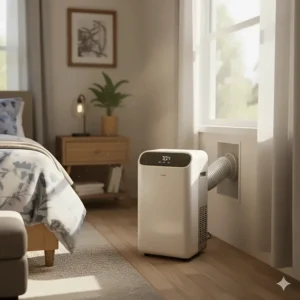
Portable Air Conditioners (Most Popular)
Portable units are the go-to choice for mobile home air conditioning because they require zero permanent installation. You simply wheel them into position, attach the exhaust hose to a window, and plug them in. They’re perfect for renters or those who move their mobile homes seasonally.
Best For: Flexibility, easy installation, spot cooling
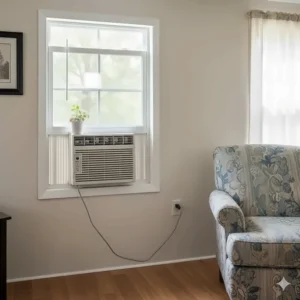
Window Air Conditioners
Window AC units can work in mobile homes with standard sliding windows. However, you’ll need to ensure proper support since mobile home windows aren’t always as sturdy as traditional home windows. The key advantage? They’re typically more energy-efficient than portable units.
Best For: Permanent installation, better efficiency
Ductless Mini-Split Systems
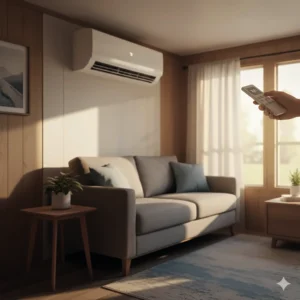
Ductless systems offer the most efficient cooling for mobile homes. They consist of an outdoor compressor and indoor air handlers, connected by refrigerant lines. While installation is more complex and expensive, the energy savings can be substantial—up to 30% compared to traditional systems.
Best For: Long-term investment, maximum efficiency, quiet operation
Central Air Conditioning for Mobile Homes
If your mobile home has existing ductwork, a central AC system designed specifically for manufactured homes might be ideal. These systems typically cost $2,400-$5,300 installed and provide whole-home cooling through specialized compact units.
Best For: Whole-home cooling, modern mobile homes with ducts
Installation Tips for Mobile Home Air Conditioners 🔧
Installing a mobile home air conditioner isn’t rocket science, but it does require attention to specific details unique to manufactured homes.
Electrical Considerations
Most portable AC units require a dedicated 115V outlet, but larger 14,000+ BTU models might need 230V. Before purchasing, check:
- Your electrical panel capacity
- Available outlet locations
- Circuit breaker ratings
Mobile homes often have lower electrical capacity than traditional homes, so you might need an electrician to add a dedicated circuit for your AC unit.
Window and Vent Installation
Mobile home windows vary significantly in design. Here’s what works:
✅ Sliding windows: Most portable AC kits adapt to horizontal sliders (17″-53″)
✅ Crank-open windows: May require custom panels or special adapters
✅ Jalousie windows: Consider a wall-mounted through-wall sleeve
Pro tip: Use foam insulation strips around your window kit to prevent hot air infiltration and improve efficiency by 15-20%.
Proper Placement Strategy
Where you position your mobile home air conditioner dramatically affects performance:
- Away from heat sources: Keep 3+ feet from appliances, electronics, or sunny windows
- Central location: Maximize airflow distribution
- Near windows: Minimize exhaust hose length (ideally under 6 feet)
- Level surface: Ensure proper drainage and compressor function
Energy Efficiency and Cost Savings 💰
Running a mobile home air conditioner doesn’t have to demolish your electric bill. Smart strategies can keep you cool while maintaining reasonable energy costs.
Understanding SEER and EER Ratings
- SEER (Seasonal Energy Efficiency Ratio): Higher is better (15+ is excellent)
- EER (Energy Efficiency Ratio): Look for 10+ for portable units
- Inverter Technology: Can reduce consumption by 40%
According to the Environmental Protection Agency, Energy Star certified air conditioners use 8% less energy than standard models, saving $70+ annually on electricity bills.
Money-Saving Operating Tips
Temperature Settings:
- Set thermostat to 78°F when home (comfort + efficiency)
- Use “eco” or “energy saver” modes
- Raise temp 3-5 degrees when away
Maintenance Matters:
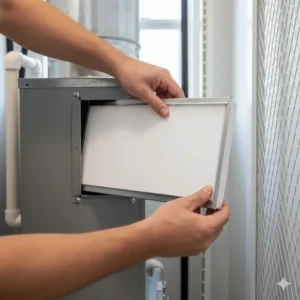
- Clean filters every 2 weeks (improves efficiency 5-15%)
- Check exhaust hose for kinks monthly
- Seal gaps around window kits with weatherstripping
Smart Usage:
- Run AC during off-peak hours (cheaper rates)
- Use ceiling fans to circulate air (feels 4°F cooler)
- Close blinds on sunny windows (reduces heat gain 33%)
Maintenance and Troubleshooting Guide 🛠️
Proper maintenance extends your mobile home air conditioner’s lifespan from 5-8 years to 10-15 years. Here’s how to keep it running smoothly.
Monthly Maintenance Checklist
Every 2-4 Weeks:
- Remove and wash air filters
- Wipe down exterior vents
- Check exhaust hose connections
Monthly Tasks:
- Vacuum condenser coils (improves efficiency 25%)
- Inspect drainage system
- Test smart features and app connectivity
Seasonal Preparation:
- Deep clean before summer season
- Store properly in winter (if not heating)
- Replace filters annually
Common Issues and Solutions
Problem: AC won’t cool properly
- Check filter (80% of issues)
- Verify thermostat settings
- Ensure exhaust hose is straight
- Confirm room size matches BTU rating
Problem: Water leaking
- Empty drain pan
- Check if auto-drain is functioning
- Ensure unit is level
- Verify humidity isn’t exceeding capacity
Problem: Unusual noises
- Tighten loose panels/screws
- Check for obstructions in fan
- Verify unit sits level
- Contact service if compressor issues
Smart Features Worth the Investment 📱
Modern mobile home air conditioners come packed with technology that goes beyond simple cooling. Here’s what actually matters.
WiFi and App Control
Smart connectivity transforms how you interact with your AC. The best apps (like Dreo and Midea’s) offer:
- Remote temperature control from anywhere
- Energy usage monitoring
- Custom cooling schedules
- Maintenance reminders
Real-world benefit: Start cooling 30 minutes before arriving home, ensuring comfort while avoiding wasted energy running all day.
Voice Assistant Integration
Alexa and Google Assistant compatibility lets you:
- Adjust temperature hands-free while cooking
- Create voice routines (“Alexa, bedtime mode”)
- Check current room temp without moving
Sleep Mode and Eco Settings
Sleep mode gradually adjusts temperature throughout the night, saving 20-30% energy while maintaining comfort. Eco mode cycles the compressor strategically, balancing cost and cooling.
Comparing Mobile Home vs. Traditional Air Conditioners 📋
| Factor | Mobile Home AC | Traditional Home AC |
|---|---|---|
| Installation | Simpler, often DIY | May require professional |
| Size Requirements | Compact, space-saving | Larger, more powerful |
| Ductwork | Often not required | Usually necessary |
| Energy Efficiency | 10-14 EER typical | 12-16 EER typical |
| Cost | $200-$700 | $2,000-$6,000+ |
| Cooling Capacity | 8,000-18,000 BTU | 18,000-60,000 BTU |
Mobile homes benefit from smaller, more focused cooling solutions. The compact construction actually works in your favor—less space means faster, more efficient cooling with properly-sized units.
Safety Considerations for Mobile Homes 🚨
Mobile home air conditioning requires attention to specific safety factors unique to manufactured housing.
Electrical Safety
Mobile homes typically have 100-200 amp electrical service compared to 200+ amps in traditional homes. Key safety measures:
- Never overload circuits
- Use surge protectors for sensitive electronics
- Install GFCI outlets in bathrooms and kitchens
- Consider professional electrical inspection before adding high-wattage ACs
Proper Ventilation
Unlike traditional homes, mobile homes are more airtight, which can cause negative air pressure with single-hose portable ACs. This pulls in hot outdoor air through small gaps, reducing efficiency.
Solution: Choose dual-hose models (like Midea Duo or Whynter) that balance pressure while cooling.
Fire Safety
- Keep AC units 3+ feet from curtains and fabrics
- Never run extension cords (fire hazard)
- Ensure smoke detectors work properly
- Don’t block emergency exits with units
Climate Considerations: Hot vs. Humid Regions ☀️💧
Your climate dramatically influences which mobile home air conditioner works best.
Hot, Dry Climates (Southwest)
Priority: High BTU capacity and cooling power
Recommended: 14,000 BTU units with strong airflow
Best Picks: BLACK+DECKER BPACT14WT, Whynter ARC-14S
Focus on raw cooling capacity. Dehumidification is less critical, but look for units with multiple fan speeds for better air circulation.
Hot, Humid Climates (Southeast)
Priority: Strong dehumidification capabilities
Recommended: Units with 70+ pints/day dehumidification
Best Picks: Midea Duo (excellent dehumidifying), Dreo AC516S
Humidity makes heat feel worse. According to NOAA’s heat index research, 80°F with 75% humidity feels like 87°F. Dehumidifying capabilities are crucial.
Moderate Climates
Priority: Versatility and energy efficiency
Recommended: 10,000-12,000 BTU with heating option
Best Picks: Whynter ARC-14SH (heat/cool combo), LG LP1022FVSM
Year-round units make sense when you need both heating and cooling throughout the year.
Budget-Friendly Alternatives and Options 💵
You don’t always need the most expensive mobile home air conditioner. Here are smart budget strategies.
Refurbished and Open-Box Deals
Many retailers offer certified refurbished portable ACs at 30-50% off:
- Amazon Renewed: 90-day warranty
- Best Buy Open-Box: Often like-new condition
- Manufacturer outlets: Previous year models
Pro tip: Buy refurbished premium brands (Midea, Whynter) rather than new budget brands for better long-term value.
Smaller BTU Units for Zone Cooling
Instead of one 14,000 BTU unit for $500, consider two 8,000 BTU units at $300 each. This strategy:
- Cools multiple rooms
- Uses less energy when cooling single rooms
- Provides backup if one fails
Seasonal Shopping
Best Times to Buy:
- September-October: End-of-season clearance (30-50% off)
- February-March: Pre-season sales (15-25% off)
- Black Friday/Cyber Monday: Deep discounts on top brands
Environmental Impact and Eco-Friendly Choices 🌍
Choosing an environmentally responsible mobile home air conditioner benefits both the planet and your wallet.
Refrigerant Types
Modern eco-friendly options:
- R-32: 68% lower global warming potential than R-410A
- R-454B: Next-gen refrigerant, even greener
- Avoid: Older R-22 (being phased out)
The Whynter ARC-14S uses eco-friendly R-32 refrigerant, significantly reducing environmental impact while maintaining excellent cooling performance.
Energy Consumption Reduction
A mobile home air conditioner running 8 hours daily can consume 300-500 kWh monthly. Reduce this by:
- Choosing inverter technology (40% savings)
- Using programmable schedules
- Combining with ceiling fans
- Improving mobile home insulation
Carbon Footprint Considerations
According to the U.S. Energy Information Administration, the average American home produces 7.5 tons of CO2 annually from electricity use, with AC accounting for 12-27% of that. Energy-efficient models can reduce this by 1-2 tons yearly.
Long-Term Value and ROI Analysis 📈
Investing in the right mobile home air conditioner pays off over time. Let’s crunch the numbers.
Cost Breakdown Over 10 Years
Budget Unit ($300):
- Purchase: $300
- Energy (high consumption): $1,200/year × 10 = $12,000
- Replacement at year 6: $300
- Total: $12,600
Premium Efficient Unit ($600):
- Purchase: $600
- Energy (40% savings): $720/year × 10 = $7,200
- Lasts full 10 years: $0
- Total: $7,800
Savings with premium unit: $4,800 over 10 years
Resale Value for Mobile Homes
A quality installed air conditioning system can increase mobile home value by $1,500-$3,000. Portable units don’t add value but appeal to buyers seeking move-in ready comfort.
Health Benefits Worth Money
Proper cooling prevents heat-related health issues costing Americans $5+ billion annually in medical expenses. For seniors and children in mobile homes, reliable AC isn’t luxury—it’s health insurance.
Expert Tips from HVAC Professionals 👨🔧
I’ve gathered insights from certified HVAC technicians specializing in mobile homes to help you make the smartest choice.
What Installers Want You to Know
From Jonathan Berkson, SuperCoolNYC: “Mobile home air conditioners work best when you don’t have a window suitable for traditional AC installation. Basements, crank-open windows, or unconventional spaces benefit most from portable units.”
From Lane Dixon, Aire Serv: “Portable ACs excel at targeting individual rooms. They’re ideal for mobile home owners who spend most time in one area—bedroom or living room—rather than needing whole-home cooling.”
Common Buyer Mistakes to Avoid
❌ Oversizing: Bigger isn’t better. Oversized units short-cycle, wasting energy and failing to dehumidify properly
❌ Ignoring insulation: Even the best AC struggles with poorly insulated mobile homes. Address insulation first for 30% better performance
❌ Forgetting noise levels: 60dB+ units can disrupt sleep. Check decibel ratings if using in bedrooms
✅ Smart move: Calculate exact BTU needs, prioritize efficiency ratings, and read real customer reviews
FAQ: Your Mobile Home Air Conditioner Questions Answered ❓
❓ How often should I replace the air filter in my mobile home air conditioner?
❓ Can I use a portable air conditioner in a mobile home without windows?
❓ What's the difference between BTU and SACC ratings?
❓ Do dual hose air conditioners really work better in mobile homes?
❓ How much does it cost to run a 14,000 BTU mobile home air conditioner daily?
Conclusion: Finding Your Perfect Mobile Home Cooling Solution ✨
Choosing the right mobile home air conditioner comes down to matching your specific needs with the right features. Whether you prioritize smart technology, energy efficiency, heating capabilities, or budget-friendly options, there’s a perfect solution among our top 7 picks.
Remember these key takeaways:
🎯 Calculate BTU needs accurately (20 BTU per square foot minimum)
🎯 Consider dual-hose models for maximum efficiency in mobile homes
🎯 Invest in smart features for long-term convenience and savings
🎯 Prioritize energy efficiency over just upfront cost
The best mobile home air conditioner for you depends on your space, climate, budget, and lifestyle. Start with our comparison table, identify your must-have features, and read customer reviews for real-world performance insights.
Don’t let another summer pass in discomfort. With the right air conditioner for your mobile home, you’ll enjoy cool, comfortable living while keeping energy costs reasonable. The technology has never been better, the prices more competitive, or the options more diverse.
🔥 Take Action Now!
Summer heat waits for no one. Click on any of our recommended products above to check current prices, read detailed reviews, and secure your cooling solution today. Your future comfortable self will thank you! 🌟
Recommended for You 📚
- Attic Air Conditioner: 7 Best Choices for 2025
- 7 Best Quiet RV Air Conditioner Units for Peaceful Summer Travel in 2025
- 7 Best Portable Air Conditioner in RV Solutions for Ultimate Comfort in 2025
Disclaimer: This article contains affiliate links. If you purchase products through these links, we may earn a small commission at no additional cost to you.
✨ Found this helpful? Share it with your friends! 💬🤗
