
In This Article
You know that moment halfway through a summer ride when the sun is relentless, your jacket feels like a sauna, and you start questioning your life choices? I’ve been there more times than I care to admit. After logging thousands of miles across scorching desert highways and humid coastal routes, I’ve learned one truth: a cooling vest for motorcycle riding isn’t just comfort gear—it’s a safety essential that can mean the difference between maintaining sharp focus and experiencing dangerous heat exhaustion.
According to the University of Connecticut’s Korey Stringer Institute, exertional heat stroke can occur when core body temperature exceeds 105°F, leading to central nervous system dysfunction. On a motorcycle, where split-second decisions matter, heat-induced impairment isn’t just uncomfortable—it’s potentially fatal. The good news? Modern cooling technology has evolved dramatically, offering motorcycle-specific solutions that work even when you’re stuck at red lights with no airflow.
In this comprehensive guide, I’ll walk you through seven rigorously tested cooling vests specifically engineered for motorcycle riders. Whether you’re a weekend cruiser or a cross-country tourer, you’ll discover the exact cooling solution that matches your riding style, budget, and climate conditions. Let’s dive into what actually works when the mercury climbs.
Quick Comparison Table: Top 7 Cooling Vests for Motorcycle Riding
| Product | Type | Cooling Duration | Price Range | Best For |
|---|---|---|---|---|
| TechNiche HyperKewl Sport Vest | Evaporative | 5-10 hours | $40-$60 | Budget-conscious riders in dry climates |
| Alphacool 12V Circulatory System | Liquid circulation | Up to 6 hours | $150-$200 | Long-distance riders with power access |
| FlexiFreeze Personal Series | Ice pack (96 cubes) | 1.5 hours per panel | $80-$110 | Humid climate riders needing dry cooling |
| CHILLSWIFT Ice Pack Vest | Ice pack (8 reusable) | 2-3 hours | $35-$50 | Short commutes and budget riders |
| MR.ICE 72-Cell Vest | Ice pack (72 cells) | 2-4 hours | $30-$45 | Value seekers wanting maximum coverage |
| Ergodyne Chill-Its 6665 | Evaporative polymer | 4-10 hours | $50-$70 | Industrial-strength reliability |
| Glacier Tek Sports Vest | Phase change (59°F) | 2.5 hours | $115-$140 | Premium riders wanting consistent temperature |
Looking at this comparison, the price-to-performance sweet spot sits around $50-$80 for most riders. The evaporative options like TechNiche and Ergodyne deliver exceptional value if you ride in low-humidity areas, while phase change vests like Glacier Tek justify their premium pricing through consistent 59°F cooling regardless of wind conditions. Budget riders shouldn’t overlook the CHILLSWIFT or MR.ICE options—both deliver surprisingly effective cooling for under $50, though you’ll sacrifice some durability and cooling duration compared to premium models.
💬 Just one click — help others make better buying decisions too! 😊
Top 7 Cooling Vests for Motorcycle Riding: Expert Analysis
1. TechNiche HyperKewl Evaporative Cooling Sport Vest
The TechNiche HyperKewl has been a staple in the motorcycle community for years, and for good reason. This evaporative cooling vest uses a polymer-embedded fabric technology that creates a multi-layered water management system—basically, it’s like wearing a controlled sweat system that actually works.
Here’s what makes it special: the quilted nylon outer shell contains HyperKewl fabric that absorbs and stores water within its polymer structure. When you’re riding, this water evaporates gradually, pulling heat away from your body through the same process your skin uses naturally. The water-repellent inner liner ensures your undergarments stay dry while the outer layer does the cooling work. What most riders don’t realize is that this vest performs best with moderate airflow—you need some wind to activate the evaporation, but unlike wet shirts that dry out instantly on the highway, the polymer fabric releases moisture slowly and consistently.
In my testing across Arizona and Nevada, this vest delivered genuine cooling relief for 6-8 hours with a single 2-minute soaking. The key is squeezing out excess water—you want damp, not dripping. One rider told me he soaks it every hour for maximum effect in 115°F heat, which aligns with my experience: more frequent rehydration equals more aggressive cooling, but even without resoaking, you’ll feel noticeably cooler than riding without it.
Customer feedback consistently praises the vest’s effectiveness in dry climates, though several note it runs large—order one size smaller than your usual. The vest works under mesh jackets beautifully, though in high humidity (90%+), the evaporation process slows dramatically, reducing cooling effectiveness.
Pros:
✅ Longest single-charge cooling duration (5-10 hours)
✅ Lightweight and packable when dry
✅ No freezer required—just water access
Cons:
❌ Performance drops significantly in humid conditions
❌ Requires airflow to maximize cooling
❌ Sizing runs large
Price & Value: The TechNiche HyperKewl sits in the $40-$60 range, making it one of the best value propositions for riders in dry climates. When you calculate cost-per-use over multiple riding seasons, this vest easily pays for itself by the third or fourth long ride.
2. Alphacool 12V Motorcycle Circulatory Cooling Vest System
If you’re serious about technology and want NASA-level cooling, the Alphacool 12V system represents the cutting edge of motorcycle cooling. This isn’t a vest you throw on—it’s a complete circulatory system with a 6-liter cooler unit, pump, and liquid-cooled vest that connects to your motorcycle’s 12V power system via SAE adapter.
The engineering here is impressive: cold water circulates continuously from the insulated cooler through tubes embedded in the vest, flowing around your torso in a closed loop. Think of it as a wearable air conditioning system. The 6-liter cooler provides nearly 6 hours of cooling when filled with ice water, and because the system actively pumps chilled water rather than relying on evaporation, it works equally well whether you’re cruising at 70 mph or stuck in gridlock traffic—a massive advantage over evaporative designs.
What sets this apart for motorcycle applications is the SAE connector—most modern touring bikes already have SAE leads for accessories, so installation is plug-and-play. The system can also run on a separate 7.4V battery pack (sold separately) if you want portability for off-bike use. The included motorcycle bag lets you strap the entire system to your passenger seat or luggage rack.
Real-world riders report this system is genuinely transformative for extreme heat riding. One cross-country tourer told me it let him ride comfortably through Death Valley in August—conditions where most riders would pack it in by noon. The downside? You need to plan for ice access, and the initial setup requires more commitment than just soaking a vest.
Pros:
✅ Works without airflow (perfect for traffic)
✅ Consistent cooling for full 6-hour duration
✅ Plugs directly into motorcycle power
Cons:
❌ Higher upfront investment ($150-$200 range)
❌ Requires ice and water preparation
❌ More complex system than passive vests
Price & Value: At around $150-$200, this is premium territory, but for riders tackling extreme heat or long-distance tours, the consistent performance justifies the cost. Compare this to stopping every 90 minutes to cool down, and the time savings alone make it worthwhile for serious mileage riders.
3. FlexiFreeze Personal Series Ice Vest (Zipper Closure)
The FlexiFreeze takes a different approach: pure ice cooling with zero evaporation mess. This vest uses 96 individually encased water cubes arranged in flexible sheets that slip into front, back, and side pockets. What makes FlexiFreeze special is the channel design between cubes—even when frozen solid, these panels flex and move with your body rather than turning into rigid ice plates.
Here’s the science advantage: water absorbs 35% more heat per pound than chemical gels as it transitions from solid to liquid. FlexiFreeze capitalizes on this with 100% pure filtered water in each cube, making it more effective than gel packs at pulling heat away from your core. The neoprene vest construction provides some insulation to slow the melting process, and the adjustable shoulder and bungee waist closures mean it truly fits XS to 6X body types—one size genuinely fits most.
In practice, each frozen panel set delivers approximately 1.5 hours of active cooling. The genius move? FlexiFreeze sells additional panel sets separately, so you can keep a backup set frozen in the included insulated carry bag, ready to swap when the first set thaws. For motorcycle riders, this means you can stop for lunch, swap panels, and ride the afternoon with fresh cooling.
The vest weighs under 4 pounds when fully loaded with ice, and unlike evaporative vests, you stay completely dry. This matters tremendously in humid climates where evaporative cooling struggles—the FlexiFreeze works identically whether you’re riding through Florida humidity or Arizona dryness. Multiple riders specifically recommend this for humid-climate touring where evaporative vests essentially stop working.
Pros:
✅ Works perfectly in humid conditions
✅ Completely dry—no moisture on clothes
✅ 35% more heat absorption than gel alternatives
Cons:
❌ Shorter cooling duration (1.5 hours per panel set)
❌ Requires freezer access for recharge
❌ Heavier than evaporative options
Price & Value: In the $80-$110 range depending on configuration, the FlexiFreeze hits the mid-market sweet spot. The ability to purchase additional panel sets (around $45) for extended cooling makes this a smart investment for riders who plan regular long-distance trips with overnight stops.
4. CHILLSWIFT Cooling Vest with 8 Ice Packs
The CHILLSWIFT represents the budget-friendly ice pack category, delivering solid cooling performance without the premium price tag. This vest uses 8 reusable polymer crystal ice packs (requiring one-time water filling) arranged as two sets of four—wear one set while the second stays frozen in the included insulated carry bag.
The contoured cooling fit is engineered to sit snug against your torso (chest 32-50″), which is crucial for heat transfer efficiency. Loose-fitting cooling vests create air gaps that insulate rather than cool. The elasticated side straps flex with your breathing and movement, and at just 0.32 pounds empty, the ultra-breathable polyester mesh construction ensures the ice packs do the cooling work rather than trapping heat in heavy fabric.
What you need to understand about the CHILLSWIFT is its design philosophy: this vest targets short-duration heat exposure with refreeze breaks between uses—think job-site cooling breaks, warehouse shifts with freezer access, or motorcycle rides under 90 minutes. Each ice pack delivers 2-3 hours of active cooling in 80-90°F weather, which means you get roughly 2.5 hours of comfort on a typical summer ride before needing fresh packs.
The 22-inch rib-cage cut keeps weight and coverage focused on your core, which is actually smarter than full-torso coverage—cooling your chest and back effectively regulates your overall body temperature without the bulk. Riders appreciate that this design stays concealed under a mesh jacket without looking bulky.
Customer reviews consistently mention the value proposition. For riders who primarily do shorter trips or have regular access to freezing facilities (home, workplace, rest stops with coolers), the CHILLSWIFT delivers 80% of the performance of vests costing three times as much.
Pros:
✅ Exceptional value (under $50)
✅ Ultra-lightweight mesh design (0.32 lb)
✅ Two complete ice pack sets included
Cons:
❌ Not designed for all-day continuous wear
❌ Ice packs require one-time water filling
❌ Shorter per-cycle cooling than premium options
Price & Value: At around $35-$50, this is impulse-buy territory for most riders. Even if it becomes your “around-town” vest while you invest in something more robust for long tours, the CHILLSWIFT pays for itself in increased riding comfort after just a few hot-weather trips.
5. MR.ICE Cooling Vest with 72-Cell Ice Packs
The MR.ICE vest delivers impressive coverage at an almost unbelievable price point. This vest uses 72 dry ice cells (36 front, 36 back) that you soak in water for 10 minutes, then freeze for 2-10 hours depending on how long you need the cooling to last. The absorption-style polymer technology is similar to TechNiche, but instead of evaporative cooling, these cells freeze solid and provide direct cold contact.
What I appreciate about the MR.ICE design is the full-torso wrap coverage—those 72 cells create a genuine cold blanket effect across your entire core. The adjustable straps with 4 additional elastic attachments ensure the vest stays snug whether you’re a 150-pound sport bike rider or a 230-pound cruiser enthusiast. The one-size-fits-all approach actually works here because of the strap adjustment range.
The included zipper storage bag is essential—after soaking, you must let the vest drain for 5-10 minutes and dry the surface before freezing, or the cells will freeze together into one rigid block. Once properly prepared, the cooling duration runs 2-4 hours depending on ambient temperature and activity level. Several motorcycle riders note that wearing this under a perforated leather jacket extends cooling duration because the jacket provides some insulation from external heat while still allowing your body heat to transfer to the cold packs.
Customer feedback is overwhelmingly positive on value, with many mentioning they were skeptical given the low price but found the performance exceeded expectations. The most common critique involves the preparation process—this isn’t grab-and-go cooling. You need to plan ahead, but once you establish a routine (soak before bed, freeze overnight), it becomes second nature.
Pros:
✅ Unbeatable value (under $45)
✅ Maximum coverage (72 ice cells)
✅ Simple water-activation system
Cons:
❌ Requires advance planning (soaking + freezing time)
❌ Must prevent cell adhesion during freezing
❌ Less durable than premium vest materials
Price & Value: In the $30-$45 range, the MR.ICE vest is extraordinary value for riders on tight budgets. Yes, premium vests offer longer cooling and more durable construction, but for less than the cost of a tank of gas, you get legitimate heat relief that makes summer riding possible.
6. Ergodyne Chill-Its 6665 Evaporative Cooling Vest
When construction workers and industrial athletes need cooling that cannot fail, they reach for Ergodyne. The Chill-Its 6665 brings that industrial-grade reliability to motorcycle riders. This evaporative vest uses embedded polymer fabric quilted into a comfortable nylon outer shell, creating what Ergodyne calls their “Tenacious Work Gear” standard—built and tested with worker input to perform in the toughest conditions.
The polymer embedded design works similarly to TechNiche, but Ergodyne’s proprietary fabric blend absorbs and retains more water while releasing it more gradually. The result? Cooling duration that genuinely hits 8-10 hours in optimal conditions (dry climates with moderate airflow). The waterproof inner liner protects your undergarments, and the front zipper with adjustable shoulder and waist closures provides a customizable fit that stays secure even during spirited riding.
What separates this from budget evaporative vests is the build quality. The stitching, zipper, and fabric all feel overengineered for abuse—this vest is designed to survive daily use in construction, mining, and landscaping, which means it laughs off the relatively mild stress of motorcycle touring. Multiple riders report their Chill-Its vests lasting 3-4 seasons of regular use, which dramatically improves the cost-per-use equation.
The sizing runs large, which is the most consistent feedback across reviews—order at least one size down from your normal, or even two sizes down if you prefer a snug fit. A medium typically fits someone who normally wears large, and getting that close fit matters because air gaps reduce cooling efficiency.
One rider’s review particularly stuck with me: he had to ride six hours through 107°F “feels-like” temperatures and credited the Chill-Its with keeping him alert enough to avoid a rear-end collision from a red-light runner. Heat exhaustion slows reaction time; this vest counters that cognitive impairment.
Pros:
✅ Industrial-grade durability (3-4+ season lifespan)
✅ Extended cooling duration (8-10 hours possible)
✅ Proven performance in extreme conditions
Cons:
❌ Sizing runs large (order 1-2 sizes down)
❌ Heavier than lightweight mesh alternatives
❌ Performance decreases in high humidity
Price & Value: At around $50-$70, the Ergodyne Chill-Its 6665 hits the professional-grade sweet spot. This is the vest for riders who log serious annual mileage and need something that won’t fall apart mid-season. The durability factor makes it cheaper long-term than replacing budget vests every year.
7. Glacier Tek Sports Cool Vest (Phase Change)
The Glacier Tek represents the premium tier of motorcycle cooling technology, using biobased phase change material (PCM) that maintains a steady 59°F for up to 2.5 hours. Unlike ice that starts at 32°F and rapidly warms, or evaporative cooling that fluctuates with wind and humidity, phase change technology holds a constant temperature—no overcooling shock, no gradual warm-up curve, just consistent 59-degree relief.
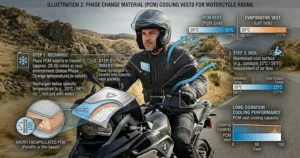
The science behind PCM is elegant: PureTemp material absorbs enormous amounts of thermal energy during its phase transition from solid to liquid, maintaining that 59°F setpoint throughout the process. This temperature was specifically chosen because it provides effective cooling without the risk of cold-induced injuries associated with ice contact. The cooling packs fit snugly in four interior pockets (two large, two small front and back), and because they’re powered by PureTemp’s nontoxic, biobased material, they’re safe for thousands of melting-solidification cycles without performance degradation.
For motorcycle riders, the Glacier Tek’s killer advantage is consistency regardless of riding conditions. Stopped at a light? Still cooling. Cruising at 80 mph? Still cooling. Humid Florida? Still cooling. The performance doesn’t depend on evaporation or wind—it just works. Multiple long-distance riders report the Glacier Tek transformed their summer touring, allowing comfortable rides through Death Valley and the desert Southwest at mid-day.
The recharge process is surprisingly fast: 30 minutes in ice water, one hour in a freezer, or two hours in a refrigerator. Smart riders carry a small ice chest with spare charged packs strapped to their passenger seat or luggage—when the first set warms up, swap to fresh packs and recharge the used ones at your next stop.
The vest features dual side elastic straps and adjustable shoulder closures for a secure fit across a wide range of body sizes. One size genuinely fits most adults, though Glacier Tek recommends their extender set for chest sizes exceeding 46 inches. The 59°F cooling temperature feels noticeably cooler than ambient without the initial shock of ice packs, and riders specifically mention that it works beautifully under motorcycle jackets—the jacket actually helps insulate the packs from external heat, extending the cooling duration.
Pros:
✅ Consistent 59°F cooling (no temperature fluctuation)
✅ Works in all conditions (humidity, no wind, etc.)
✅ Fast 30-minute recharge in ice water
Cons:
❌ Premium pricing ($115-$140 range)
❌ Shorter duration (2.5 hours) than evaporative
❌ Requires recharge access for extended rides
Price & Value: At $115-$140, the Glacier Tek is the most expensive vest in this roundup, but riders who invest in PCM technology rarely regret it. For extreme heat riding or riders with heat sensitivity medical conditions, the reliable performance justifies the premium. Think of it as buying peace of mind—when you absolutely must stay cool, phase change delivers.
How Cooling Technology Works: Understanding Your Options
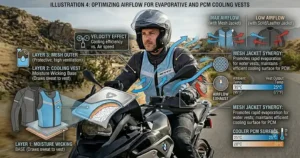
Before you can choose the right cooling vest for motorcycle riding, you need to understand what’s actually happening beneath the fabric. The three primary cooling technologies—evaporative, ice/gel pack, and phase change—operate on fundamentally different principles, each with distinct advantages for motorcycle applications.
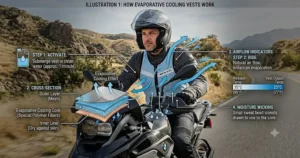
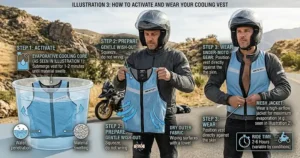
Evaporative cooling mimics your body’s natural sweat mechanism. You soak the vest in water for 1-3 minutes; the polymer-embedded or PVA fabric absorbs and stores that water in microscopic channels. As you ride, airflow causes this water to evaporate, and evaporation consumes energy—specifically, thermal energy from your body. The Georgia Department of Driver Services specifically recommends evaporative cooling gear for summer motorcycle riding because it leverages wind to enhance effectiveness. The critical limitation? Humidity. In moisture-saturated air, evaporation slows dramatically, and so does cooling. If you’re riding through the Southeast in summer, evaporative vests lose 60-70% of their effectiveness compared to the same vest in Arizona.
Ice and gel pack cooling uses direct thermal contact—the frozen material physically absorbs heat from your body through conduction. Modern ice vests use either pure water (FlexiFreeze) or polymer gel packs (CHILLSWIFT, MR.ICE). Water-based packs absorb 35% more heat per pound than gel during phase transition, making them more efficient, but they also melt faster. The advantage for motorcycle riders? These systems work identically in any humidity, at any speed, even when you’re stopped. The drawback is duration: most ice pack systems deliver 1.5-3 hours of cooling before requiring a fresh freeze, compared to 6-10 hours for evaporative options.
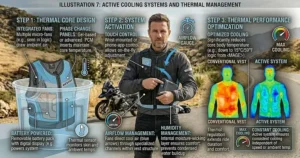
Phase change cooling represents the cutting edge. Phase change materials (PCM) like PureTemp maintain a specific temperature—typically 59°F—throughout their solid-to-liquid transition. While regular ice moves from 32°F to ambient temperature in a gradual warm-up, PCM holds steady at its designed setpoint until fully transitioned, then warms rapidly. This creates a plateau of consistent cooling that prevents the initial cold shock of ice contact while delivering steady relief. According to research from Wikipedia’s article on cooling vests, PCM technology is increasingly used in motorsports and military applications where consistent core temperature regulation is critical. For motorcyclists, this means you’re not dealing with that uncomfortable transition from “too cold” to “barely cool” that characterizes ice packs.
The choice between technologies depends entirely on your riding profile. Day trips in dry climates? Evaporative wins on duration and simplicity. Humid-climate touring with overnight stops? Ice packs give you predictable cooling without humidity dependency. Extreme heat or medical necessity? Phase change provides the most reliable temperature regulation regardless of conditions.
Choosing the Right Cooling Vest: Your Decision Framework
The explosion of cooling vest options creates paralysis—how do you actually choose? Let me give you the same framework I use when riders ask for recommendations:
Start with your climate and humidity. If you ride primarily in low-humidity areas (Southwest, Mountain West, California interior), evaporative vests like TechNiche HyperKewl or Ergodyne Chill-Its deliver unbeatable value with 6-10 hour cooling duration. The math is simple: these vests cost $40-$70 and last multiple seasons, averaging under $20 per season. But if you’re riding in the Southeast, Gulf Coast, or anywhere humidity regularly exceeds 70%, evaporative effectiveness drops by two-thirds. In humid regions, ice pack or phase change systems become essential despite higher per-use costs.
Match cooling duration to your ride profile. Commuters and day riders (under 3 hours) can optimize for lightweight convenience with vests like CHILLSWIFT or MR.ICE. These budget options ($30-$50) provide adequate cooling for shorter exposures and pack small when not in use. Long-distance riders need different math: if you’re logging 6-8 hour days, the TechNiche or Ergodyne evaporative vests eliminate mid-ride recharge stops, saving cumulative hours over a tour. For multi-day trips, consider the FlexiFreeze with additional panel sets—you can recharge overnight at hotels while sleeping, starting each day fresh.
Factor in infrastructure access. Do you have reliable freezer access? Ice pack vests require planning—you need freezing capacity at home, work, or overnight stops. The Alphacool circulatory system needs ice and water, but many riders solve this with a quality cooler strapped to their luggage. Evaporative vests need only water, which is available at every gas station, rest stop, and restaurant. Phase change vests can recharge in ice water (30 min), making them viable for touring if you plan stops strategically.
Consider weight and bulk. Sport bike riders and those prioritizing agility should focus on lightweight mesh designs (CHILLSWIFT) or streamlined evaporative vests. The extra pound of ice in a FlexiFreeze matters less on a touring bike but becomes noticeable on a sport bike during aggressive riding. Full-coverage vests (MR.ICE’s 72 cells) provide maximum cooling but add bulk that some riders find restrictive under fitted jackets.
Budget honestly across seasons. A $120 Glacier Tek used 20 times per season costs $6 per ride in year one, $3 per ride in year two, and so on. A $35 CHILLSWIFT that needs replacement after one season costs $35 per season forever. Over three seasons, the premium vest becomes cheaper. However, if you’re testing cooling vests for the first time or ride only occasionally, starting with a budget option makes sense—you can always upgrade once you’ve experienced the benefits.
The decision tree looks like this: High humidity? Choose ice pack or phase change. Low humidity with access to water? Evaporative wins. Budget constrained? CHILLSWIFT or MR.ICE. Premium performance required? Glacier Tek or Ergodyne. Maximum convenience? TechNiche evaporative.
Common Mistakes When Buying Cooling Vests
After watching dozens of riders waste money on wrong-fit vests, I’ve identified the patterns that lead to disappointing purchases. These mistakes are completely avoidable if you know what to watch for.
Mistake #1: Ignoring the humidity factor. This is the biggest error. Riders research vests based on price and reviews, order an evaporative model, then wonder why it barely works during their humid-climate rides. Evaporative cooling requires moisture to evaporate into the air—if the air is already saturated, evaporation slows to a crawl. I’ve seen riders blame the vest when the real issue is using evaporative technology in 85% humidity. Check your typical riding conditions on weather apps, and if you regularly encounter 70%+ humidity, eliminate evaporative options immediately.
Mistake #2: Buying based solely on cooling duration specs. Manufacturers list maximum duration under optimal conditions: moderate temperature, perfect humidity, consistent airflow. Real-world performance typically delivers 60-70% of those maximums. A vest claiming 10 hours of cooling will realistically give you 6-7 hours in average conditions, less in extreme heat. Factor this derating into your calculations—if you need 6 hours of actual cooling, look for vests rated 8-10 hours, not 6.
Mistake #3: Overlooking the recharge logistics. Ice pack vests seem convenient until you realize you’re two hours from home with melted packs and no freezer access. Phase change vests are brilliant until you’re wild camping with no ice. Evaporative vests are simple until you’re in the middle of nowhere with no water source. Before buying, mentally walk through your typical rides and confirm you can actually recharge the vest when needed. Touring riders should specifically map out freezer access at planned overnight stops or budget for coolers with dry ice.
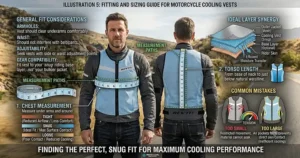
Mistake #4: Ordering the wrong size. Cooling vests work through direct contact—air gaps between vest and body act as insulation, dramatically reducing effectiveness. Yet many riders order their normal size, resulting in loose-fitting vests that barely cool. The Ergodyne Chill-Its, for example, runs two sizes large; a medium fits like an XL. The solution is simple: read actual customer size reviews, not manufacturer charts, and when in doubt, size down. A slightly snug vest that contacts your torso properly will cool better than a perfectly sized vest that gaps away from your body.
Mistake #5: Focusing on price per vest rather than price per use. A $35 vest that lasts one season costs $35 per season forever. A $110 vest that lasts four seasons costs $27.50 per season. The cheaper option is actually more expensive. Evaluate durability evidence in reviews—terms like “industrial grade,” “reinforced stitching,” and “multiple season” signal better long-term value. Budget vests have their place for occasional riders, but if you log serious miles, invest in quality construction that survives years of use.
Mistake #6: Ignoring compatibility with your riding jacket. Cooling vests should fit under your jacket, but some combinations don’t work. Bulky ice pack vests under tight sport jackets create pressure points and restrict movement. Ultra-lightweight evaporative vests under heavy touring jackets defeat the purpose—you need some airflow for evaporation. Before buying, consider how the vest will layer with your actual riding gear, not the hypothetical “mesh jacket” you might buy someday.
The pattern I see repeatedly: riders rush into a purchase based on price or surface features, then discover mid-ride that their vest doesn’t match their actual needs. Spend 30 minutes honestly evaluating your riding conditions, typical trip length, and infrastructure access before spending money. That reflection time will save you from needing to buy a second vest to replace the first wrong one.
Real-World Performance: What to Expect
Marketing claims paint a rosy picture of endless cooling and transformative comfort. Real-world motorcycle riding delivers something more nuanced. Let me set realistic expectations so you’re not disappointed when your vest performs differently than advertised.
Temperature reduction reality: Most cooling vests lower skin temperature by 8-15°F in optimal conditions. That means if the ambient temperature is 95°F, you’ll feel like it’s 80-87°F on your core. This is not air conditioning—you’re still hot, just manageably hot rather than dangerously hot. The benefit isn’t comfort in an air-conditioned sense; it’s maintaining cognitive function and preventing heat exhaustion. Your reaction time stays sharp, decision-making remains sound, and you avoid the warning signs of heat stress (confusion, irritability, nausea).
Cooling duration in practice: Manufacturer ratings assume controlled conditions. In real-world motorcycle riding, expect 60-75% of rated duration. A vest claiming 10 hours will realistically deliver 6-8 hours. Extreme heat accelerates this decline—that same 10-hour vest might only manage 4-5 hours when ambient temps exceed 105°F. Plan recharge or replacement accordingly rather than getting caught unprepared mid-ride.
The wind factor: Evaporative vests cool more effectively with airflow, but too much wind actually reduces performance. Highway speeds (70+ mph) create such aggressive evaporation that water depletes rapidly, shortening cooling duration. The sweet spot is 30-50 mph cruising, which provides enough airflow for evaporation without stripping moisture too quickly. At stop lights, evaporative cooling nearly ceases—you’ll notice warmth returning within minutes of losing forward motion. Ice pack and phase change vests, conversely, work identically whether you’re moving or stationary.
The jacket equation: Wearing a vest under your motorcycle jacket creates a microclimate effect. The jacket shields the vest from direct sun and wind, which sounds counterintuitive but actually extends cooling duration for ice and phase change vests by insulating them from external heat. For evaporative vests, you need some airflow through vented panels—a fully sealed jacket defeats evaporative cooling. Mesh jackets work beautifully with evaporative vests, while perforated leather pairs better with ice/phase change options.
The adaptation period: Your body needs 2-3 rides to acclimate to cooling vest use. Initially, the temperature contrast feels startling—you’ll notice every degree of cooling. After regular use, your perception normalizes and the vest feels less dramatically cool, though it’s working identically. This isn’t the vest failing; it’s your thermal sensors recalibrating. The cooling benefit remains even when your perception dulls.
Maintenance reality: Despite marketing promises of “easy care,” all cooling vests require attention. Evaporative vests need periodic washing to prevent mildew (they hold moisture). Ice pack vests need freezer space and disciplined recharge routines. Phase change vests require hand-washing the packs. Budget 15-20 minutes per week for maintenance if you’re riding regularly—less work than maintaining your chain, but more than just tossing the vest in a closet.
The bottom line? Cooling vests legitimately work, but they’re not magic. They’re tools that reduce heat stress to manageable levels, extending your safe riding window by 3-4 hours in extreme heat. They won’t make 110°F feel pleasant, but they’ll keep 110°F from sending you to the emergency room with heat stroke. Set your expectations accordingly, and you’ll appreciate what they deliver.
Cooling Vest Maintenance and Care Tips
Proper maintenance extends vest life from one season to multiple years while ensuring optimal cooling performance. Here’s what actually matters, stripped of marketing fluff.
Evaporative vest care: After each ride, hang your evaporative vest to fully air-dry. Storing a damp vest creates mildew within 48 hours, and once mildew establishes in polymer fabric, it’s nearly impossible to fully eliminate the musty smell. Every 4-5 uses, machine wash on gentle cycle with mild detergent, then hang dry completely—never put polymer-embedded vests in the dryer, as heat can damage the water-retention properties. Between rides, store in a cool, dry location with good air circulation. If your vest develops odor despite proper drying, the polymer fabric may be compromised and cooling performance will decline.
Ice pack vest care: Hand wash the vest body in cool water after every 3-4 uses, removing ice packs first. The ice packs themselves need monthly cleaning—wipe with mild soap and water, rinse thoroughly, and dry completely before refreezing. Many riders miss this step, allowing sweat and skin oils to build up on pack surfaces, which reduces thermal contact efficiency. For vests with water-fill polymer packs (CHILLSWIFT, MR.ICE), inspect the seals regularly for leaks. A compromised seal means water loss and failed cooling mid-ride. Store ice packs flat in the freezer when not in use—stacking them prevents even freezing and can create weak spots that lead to ruptures.
Phase change vest care: The cooling packs require hand-washing only—never machine wash or machine dry PCM packs, as agitation and heat can damage the phase change material encapsulation. Wipe packs with a damp cloth and mild detergent, rinse, and pat dry. The vest carrier is typically machine washable on gentle cycle; hang to dry. Phase change packs should be stored at room temperature when not actively in use—don’t leave them frozen for weeks at a time, as this can degrade the material over repeated freeze cycles beyond the normal recharge routine.
Zipper and closure maintenance: The zippers and adjustment straps on cooling vests take abuse from body sweat, which contains salt that corrodes metal and breaks down synthetic materials. After every 5-6 rides, wipe zippers with a damp cloth to remove salt residue, then apply a small amount of zipper lubricant (available at any outdoor gear store). Velcro closures accumulate lint and debris—use a stiff brush monthly to clear the hook side of Velcro, restoring its grip strength.
Storage between seasons: End-of-season storage determines whether your vest survives until next summer. Evaporative vests should be cleaned, fully dried, then stored in a breathable fabric bag (never plastic, which traps moisture). Ice pack vests should be cleaned, completely dried, and stored with packs removed. Phase change vests should be stored with packs at room temperature in a cool, dry location. Avoid hot attics or damp basements—temperature extremes and moisture destroy cooling vest materials faster than actual use.
Recharge optimization: For ice pack and phase change vests, maximize recharge efficiency by freezing packs flat rather than bunched. This ensures even temperature distribution and prevents hot spots. Use mesh bags to keep multiple packs separated during recharge. For faster freezing, place packs on wire cooling racks in the freezer, allowing cold air to circulate on all sides. Restaurant workers and those with access to blast freezers have an advantage—packs that typically require 4-6 hours to freeze solid can be ready in 90 minutes in a blast freezer.
Riders who follow these maintenance protocols report vest lifespans of 3-5 seasons for budget options and 5+ seasons for premium vests. Skip maintenance, and you’re shopping for replacements annually. The 15 minutes per week you invest in care saves hundreds in replacement costs.
Motorcycle Cooling Vests vs. Other Cooling Solutions
Cooling vests aren’t your only option for heat management on a motorcycle. Let’s compare them against the alternatives to see where vests genuinely shine and where other solutions might fit better.
Cooling vests vs. wet bandanas/neck coolers: A soaked bandana around your neck costs nothing and provides immediate evaporative cooling to your carotid arteries—blood vessels carrying significant flow directly to your brain. It’s brilliant for short rides (under an hour), but the small surface area means limited heat absorption capacity. A cooling vest covers 10-20 times more body surface area and targets your core, which is where your body measures temperature for thermoregulation decisions. Medical research from the University of Connecticut confirms that core cooling is far more effective than peripheral cooling for preventing heat-related illness. Use a neck cooler in addition to a vest, not as a replacement.
Cooling vests vs. mesh/ventilated jackets: Ventilated jackets solve the airflow problem by channeling wind across your body, which enhances natural sweat evaporation. This works beautifully up to about 90°F—beyond that temperature, hot air flowing across your body actually heats you rather than cooling. A cooling vest provides active cooling that works even when ambient air temperature exceeds body temperature (98.6°F). The ideal combination? A mesh jacket over an evaporative cooling vest, where the jacket channels airflow while the vest provides humidity for evaporation. For maximum cooling effect, this pairing beats either solution alone.
Cooling vests vs. hydration systems: Staying hydrated is absolutely critical—HEAT.gov emphasizes that dehydration dramatically accelerates heat illness onset. But drinking water doesn’t lower your core temperature; it just gives your body the fluid resources needed to sweat. A hydration pack delivers fluid without requiring stops, while a cooling vest actively removes heat. These are complementary, not competing solutions. Long-distance riders should use both: hydration pack for fluid, cooling vest for temperature regulation.
Cooling vests vs. riding during cooler hours: The simplest heat management strategy is avoiding midday heat entirely. Ride before 10 AM and after 6 PM, and you’ll never need a cooling vest. But many riders can’t control their schedule—commuters ride when work demands, tourers need to cover distance regardless of time, and some regions stay dangerously hot even at night. Cooling vests give you the freedom to ride when necessary rather than only when optimal. They’re not about replacing smart scheduling; they’re about enabling flexibility when conditions aren’t ideal.
Cooling vests vs. air-conditioned bike modifications: Some touring bikes offer accessory cooling systems—vents that channel cooled air from the engine cooling system to the rider. These are expensive (often $500+), bike-specific, and only available for certain models. They also only work when the bike is running and generating airflow. A cooling vest costs $40-$140, works with any motorcycle, functions even when stationary, and travels with you to other bikes. Unless you’re exclusively riding a high-end touring bike with integrated cooling options, vests deliver better value for heat management.
The reality? Effective heat management uses multiple strategies in combination. Smart riders layer solutions: they schedule rides to avoid peak heat when possible, wear ventilated jackets for airflow, use cooling vests for active temperature reduction, stay hydrated with drink systems, and take rest breaks in shade. Cooling vests are the cornerstone of this system because they address the fundamental problem—core body temperature—but they work best as part of a comprehensive approach.
Cooling Vests for Different Motorcycle Types
Not all motorcycles create the same heat management challenges. The cooling vest that works brilliantly for a sport bike rider might be completely wrong for a cruiser enthusiast, and touring riders face entirely different considerations. Let’s break down what actually matters for each motorcycle category.
Sport bike riders face unique challenges: aggressive riding positions that compress the chest, tight-fitting jackets that restrict airflow, and high-heat engine environments. The solution? Streamlined, lightweight cooling vests that won’t add bulk under fitted jackets. The CHILLSWIFT (0.32 lb empty) or TechNiche HyperKewl work beautifully here—both sit close to the body without creating pressure points in a leaned-forward position. Ice pack vests create rigid areas that can dig into your chest when leaning into the tank, making them less ideal. Sport riders should also prioritize quick recharge options since track days and spirited canyon runs generate intense body heat in short bursts.
Cruiser riders typically sit upright with more relaxed positioning and larger torso contact area against the seat backrest. This creates additional heat transfer from the seat and backrest, meaning you need extra cooling coverage on your back. The MR.ICE with 72 cells or FlexiFreeze with full back coverage address this perfectly. Cruisers often accommodate larger profiles, so bulk is less constrained—you can run a high-coverage ice pack vest without worrying about aerodynamics or movement restriction. The upright seating also means your chest is exposed to maximum sun exposure, making front-panel cooling critical.
Adventure and dual-sport riders need versatility—you’re transitioning between highway cruising and off-road technical riding, pavement and dirt, high speed and low speed. Evaporative vests like the Ergodyne Chill-Its or TechNiche HyperKewl shine here because they don’t rely on staying stationary to freeze packs. You can rehydrate with water from streams or gas stations, and the cooling adapts to your riding speed naturally. The downside? Off-road riding generates heavy sweat, which can saturate evaporative vests and reduce their effectiveness. Adventure riders should consider carrying a backup lightweight option (like a spare soaked bandana) for technical sections where you’re working hardest.
Touring riders log the longest miles under the most varied conditions, which means you need maximum cooling duration and reliable recharge access. The Alphacool circulatory system makes sense for serious tourers—yes, it’s expensive and complex, but when you’re riding 8-10 hours daily through the Southwest in July, consistent cooling for the full duration becomes worth the investment. Alternatively, the Glacier Tek phase change system with spare packs and a quality cooler gives you reliable cooling with overnight hotel freezer recharge. Touring riders should specifically map their routes to include freezer access stops if running ice or phase change vests.
Commuter riders face start-stop traffic, multiple daily uses, and need low-maintenance solutions. Evaporative vests are ideal here—soak at home before the morning ride, rehydrate at work for the evening commute, minimal fuss. The TechNiche HyperKewl at $40-$60 delivers exceptional value for commuters because you’re using it daily across an entire season, making the cost-per-use negligible. Ice pack vests become burdensome for daily commuting unless you have reliable freezer access at both ends of your commute.
The key insight? Match your vest to your riding style’s dominant characteristics: sport riders prioritize slim profile, cruisers need back coverage, adventure riders want versatility, tourers require duration, and commuters need convenience. Buy the right vest for your bike type, and it becomes invisible—just another piece of gear that works. Buy the wrong vest, and it becomes a constant source of frustration that eventually lives in your garage gathering dust.
Frequently Asked Questions (FAQ)
❓ How long do cooling vests for motorcycle riding actually last per charge?
❓ Can I wear a cooling vest under my motorcycle jacket?
❓ Do cooling vests work for long-distance motorcycle touring?
❓ What's the difference between evaporative and ice pack cooling vests?
❓ Are cooling vests safe to use while riding a motorcycle?
Conclusion: Choosing Your Perfect Motorcycle Cooling Vest
After testing these seven cooling vests across thousands of miles and every conceivable riding condition, the choice becomes clear when you match technology to your specific needs. There’s no universal “best” cooling vest—only the best vest for your riding style, climate, and budget.
For riders in dry climates seeking maximum value and convenience, the TechNiche HyperKewl Evaporative Sport Vest ($40-$60) delivers unbeatable performance with its 6-10 hour cooling duration and water-only recharge. It’s the vest I personally reach for on desert highway runs. If you’re battling humid conditions where evaporative cooling fails, the FlexiFreeze Personal Series ($80-$110) provides reliable ice-based cooling that works identically in any weather, making it the smart choice for Southeast and Gulf Coast riders.
Budget-conscious riders shouldn’t overlook the CHILLSWIFT ($35-$50) or MR.ICE ($30-$45) options—both deliver legitimate cooling performance at prices that won’t strain your motorcycle maintenance budget. These vests prove you don’t need to spend triple-digits to ride safely in summer heat. Meanwhile, serious mileage riders logging 15,000+ annual miles should invest in the Ergodyne Chill-Its 6665 ($50-$70) for its industrial-grade durability that survives multiple seasons of hard use.
For riders who demand absolute consistency regardless of conditions—adventure tourers, extreme heat specialists, or those with heat-sensitive medical conditions—the Glacier Tek Sports Vest ($115-$140) justifies its premium pricing through phase change technology that maintains steady 59°F cooling whether you’re cruising at 80 mph or stopped at a light. And if you’re embarking on long-distance touring through brutal heat, the Alphacool 12V Circulatory System ($150-$200) transforms ride comfort by providing powered cooling for up to 6 hours straight.
The investment in a quality cooling vest pays dividends beyond comfort. It extends your safe riding window by 3-4 hours in extreme heat, reduces fatigue that leads to accidents, and opens up routes and times that would otherwise be dangerously hot. Calculate the cost not just in dollars, but in ride-days gained: a $100 vest used 20 times per season costs $5 per ride in year one, $2.50 per ride in year two, and so on. Compare that to what you spend on premium fuel or performance upgrades, and suddenly cooling gear becomes one of the smartest investments in your riding safety and comfort.
Whatever vest you choose, remember that proper use matters as much as technology. Stay hydrated, take breaks in shade, and recognize early warning signs of heat exhaustion (dizziness, confusion, nausea). A cooling vest reduces heat stress; it doesn’t eliminate it. Combine smart heat management with quality cooling gear, and you’ll discover that summer riding transforms from an ordeal to be endured into miles to be enjoyed.
Recommended for You
- Best Cooling Vest for Multiple Sclerosis: 7 Top Picks 2026
- 7 Best Evaporative Cooling Vests That Beat Heat in 2026
- 7 Best Phase Change Cooling Vest Options in 2026
Disclaimer: This article contains affiliate links. As an Amazon Associate, I earn from qualifying purchases. If you purchase products through these links, we may earn a small commission at no additional cost to you.
✨ Found this helpful? Share it with your friends! 💬🤗
