
In This Article
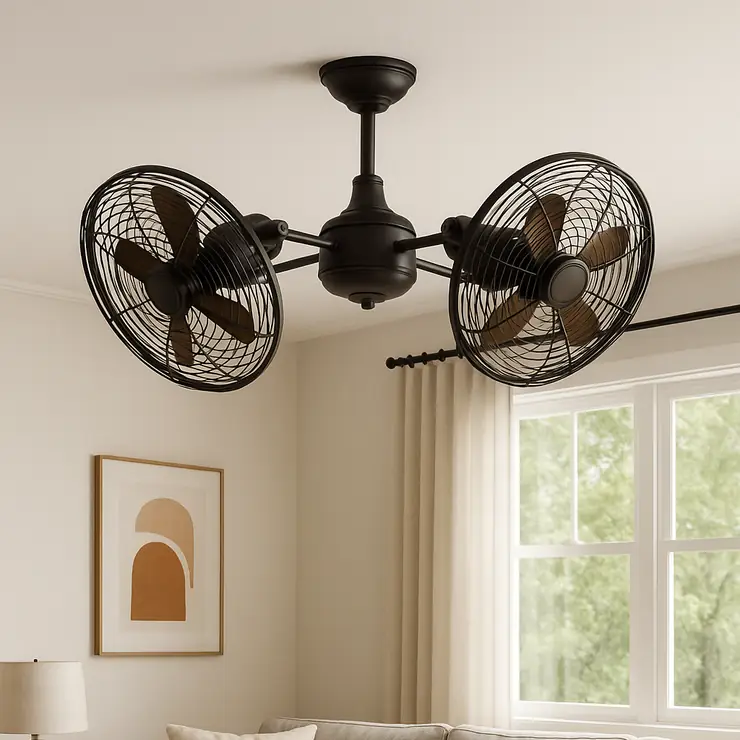
When you walk into a room cooled by a gyro ceiling fan, you immediately notice something different. Instead of the predictable downward airflow of traditional fans, these innovative fixtures create dynamic, multi-directional breezes that reach every corner of your space. The gyro ceiling fan represents a breakthrough in cooling technology, offering 360-degree rotation and dual motor systems that deliver up to 10 times more air coverage than conventional ceiling fans.
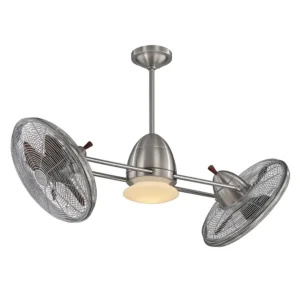
Unlike standard ceiling fans that simply push air downward, gyro fans ceiling fan models feature rotating mechanisms that create sweeping airflow patterns throughout your room. Whether you’re dealing with hot spots near windows or trying to cool a large living area, these revolutionary fixtures ensure consistent temperature distribution. The ceiling fan gyro design isn’t just about aesthetics—it’s engineered to solve real airflow challenges that traditional fans simply can’t address.
✨Was this helpful? Spread the word! 🚀
From the Minka-Aire F802-ORB Vintage Gyro with its classic dual turbofan design to the modern Matthews Acqua series with its molecular-inspired aesthetics, today’s market offers gyro ceiling fan options for every style preference and budget. According to the U.S. Department of Energy, ceiling fans can make you feel up to 8 degrees cooler while using 90% less energy than air conditioning, and gyro models amplify these benefits through superior air circulation patterns.
These advanced cooling systems typically range from $400 to $1,500, depending on features like LED lighting, remote control capabilities, and weather-resistant finishes. The investment pays dividends through reduced energy costs, enhanced comfort, and the undeniable wow factor that makes guests stop and stare. Moreover, many models like the Minka-Aire F402L-ORB Gyro Wet are UL-listed for outdoor use, expanding your cooling options to patios, gazebos, and covered outdoor spaces.
Understanding Gyro Ceiling Fan Technology
The engineering behind gyro ceiling fan technology stems from aerospace principles, specifically the gyroscopic stabilization systems used in aircraft. These fans incorporate dual motor systems mounted on a central axis that rotates continuously at approximately 3 RPM while individual fan heads operate at variable speeds up to 1,310 RPM. This dual-motion system creates what engineers call “volumetric air displacement,” covering areas up to 10 times larger than traditional single-motor fans.
The central gyroscopic mechanism allows the entire fan assembly to rotate 360 degrees, distributing airflow in sweeping patterns rather than static downward streams. Motor heads can typically be adjusted vertically through 180-degree arcs, enabling users to direct airflow precisely where needed. For instance, the Minka-Aire F802L-KA Vintage Gyro features adjustable twin turbofan heads with 20-degree blade pitch angles, generating 3,255 CFM at high speed while consuming only 82.83 watts.
Research from the American Society of Heating, Refrigerating and Air-Conditioning Engineers demonstrates that rotating fan systems create more effective air mixing, reducing thermal stratification by up to 40% compared to conventional ceiling fans. This means more consistent temperatures from floor to ceiling, eliminating hot and cold spots that plague many rooms. The gyroscopic motion also prevents the stagnant air pockets that can develop with stationary fans, ensuring continuous air circulation even in corners and behind furniture.
Advanced models incorporate variable-speed controls for both the gyro rotation and individual motor speeds, allowing users to customize airflow patterns for specific situations. During quiet activities like reading, you might prefer slow gyro rotation with moderate fan speeds. For parties or hot summer days, maximum settings create powerful, room-wide air circulation. Some premium models like the Matthews AQ-TB-WD Acqua even include programmable controls that automatically adjust settings based on room temperature and humidity levels.
Top 8 Gyro Ceiling Fan Models Available on Amazon
Premium Dual Motor Models
1. Minka-Aire F802-ORB Vintage Gyro Ceiling Fan, 42″
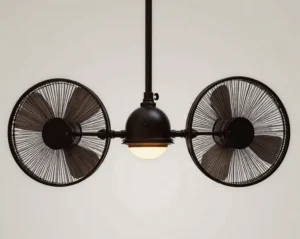
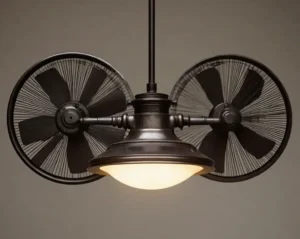
The Minka-Aire F802-ORB Vintage Gyro stands as the gold standard in dual motor ceiling fan technology, priced at $804.95 on Amazon. This sophisticated fixture features twin three-bladed 17″ turbofan heads with adjustable positioning, allowing precise airflow control throughout your space. The oil-rubbed bronze finish complements both traditional and contemporary décors, while the included 100-watt T4 halogen bulb provides ample illumination.
Specifications:
- Blade span: 42 inches (17″ per turbofan head)
- Motor: Dual 82 x 25mm AC motors
- CFM: 3,255 (high speed), 2,063 (low speed)
- RPM: 1,310 (high), 939 (low)
- Power consumption: 82.83 watts (high), 49.82 watts (low)
- Weight: 34.08 pounds
- Warranty: Lifetime motor warranty
Customer reviews consistently praise its quiet operation and powerful airflow, with many noting it effectively cools rooms up to 400 square feet. The wall control system includes three-speed settings, reverse function, and full-range light dimming. Installation requires a 6-inch downrod (included) and can accommodate vaulted ceilings up to 21 degrees with the included adapter.
2. Minka-Aire F402L-ORB Gyro Wet 42″ LED Indoor/Outdoor
For outdoor applications, the Minka-Aire F402L-ORB Gyro Wet delivers weather-resistant performance at $1,199. This UL-listed wet location model features the same dual motor technology as indoor versions but with enhanced corrosion protection and sealed electrical components. The etched opal glass shade houses a 4-watt LED bulb rated for 25,000 hours of operation.
Key Features:
- UL-listed for wet locations
- Textured oil-rubbed bronze finish
- Dimmable LED lighting (3000K color temperature)
- Stainless steel hardware
- 5-year outdoor warranty
The fan’s cast aluminum construction withstands coastal environments, though manufacturer recommendations suggest daily cleaning in saltwater locations. Customer feedback indicates excellent performance on covered patios and gazebos, with the gyro rotation creating consistent airflow across outdoor dining areas.
3. Matthews AQ-TB-WD Acqua 39″ Dual Rotational Ceiling Fan
The Matthews AQ-TB-WD Acqua represents artistic innovation in ceiling fan design, featuring a unique molecular structure aesthetic that resembles water molecules. This 39-inch model incorporates six mahogany solid wood blades (16″ span per head) that generate 4,057.84 CFM at high speed. The textured bronze finish and cast aluminum construction ensure durability while maintaining elegant styling.
Performance Metrics:
- Fan heads rotate 360° about motor housing
- Infinite positioning in 180° arcs
- 5-watt GU10 LED downlight included
- RF remote control with reverse function
- Weight: 27 pounds
Professional reviewers note the Acqua’s exceptionally quiet operation, measuring only 32 decibels at maximum speed. The adjustable motor angles allow users to optimize airflow patterns for specific room layouts, making it particularly effective in irregularly shaped spaces or rooms with high ceilings.
Mid-Range Options
4. Matthews AQ-TB-MTL Acqua 37” with Metal Blades
The metal blade variant of the Acqua series offers enhanced durability at a similar price point. Six textured bronze metal blades with decorative safety guards create 3,167.02 CFM while adding industrial styling elements. The 31-degree blade pitch generates more aggressive airflow compared to wood blade models, making it ideal for larger spaces or commercial applications.
Distinctive Features:
- Metal blade guards for safety
- Suitable for restaurant and hospitality use
- Enhanced air circulation efficiency
- Professional-grade construction
- 37-inch overall width
Restaurant owners frequently choose this model for dining areas where the combination of safety features and powerful airflow creates comfortable environments for customers and staff. The metal construction also simplifies maintenance in commercial settings where regular cleaning is essential.
5. TroposAir Mustang II 18″ Dual Motor Oscillating
The TroposAir Mustang II breaks conventional ceiling fan molds with its unique oscillating mechanism inspired by P-51 Mustang fighter planes. This compact 18-inch model features dual motors plus a third oscillation motor hidden in the canopy, creating 110-degree sweeping motion that covers up to 10 times more area than traditional 52-inch fans.
Technical Specifications:
- Total blade span: 36 inches (18″ per side)
- Three motors: two for blades, one for oscillation
- 110-degree oscillation arc
- Available in brushed aluminum, oiled bronze, pure white
- Indoor/outdoor rated
The Mustang II’s military-inspired design serves as both functional cooling device and conversation piece. Customer testimonials frequently mention its effectiveness in corner installations, where the oscillating motion reaches areas that fixed fans cannot. The compact size makes it perfect for smaller rooms, kitchens, or outdoor dining areas where space constraints limit traditional ceiling fan options.
Budget-Friendly Alternatives
6. TroposAir Mustang 18″ Oscillating (Single Head)
For budget-conscious buyers, the single-head TroposAir Mustang offers oscillating technology at approximately $300-400. While lacking the dual motor configuration of premium models, it still provides the distinctive 110-degree sweeping motion that characterizes gyro-style operation. The rubbed bronze finish and WWII fighter plane aesthetics match higher-end models.
7. Minka-Aire F802-KA Vintage Gyro (Kocoa Finish)
The Kocoa finish variant of the Vintage Gyro series provides the same dual motor performance as the oil-rubbed bronze model but with a warmer, wood-toned appearance. Customer reviews indicate strong preference for this finish in craftsman-style homes and rustic décors. Performance specifications remain identical to the ORB model.
8. Minka-Aire F402-BNW Gyro Wet (Brushed Nickel)
The brushed nickel wet location model offers contemporary styling for modern outdoor spaces. While functionally identical to the oil-rubbed bronze version, the brushed nickel finish better complements stainless steel appliances and contemporary patio furniture. Price points typically run $50-100 lower than oil-rubbed bronze variants.
Comprehensive Performance Comparison
| Model | CFM (High) | Watts | Efficiency (CFM/Watt) | Price Range | Best Application |
|---|---|---|---|---|---|
| Minka-Aire F802-ORB | 3,255 | 82.83 | 39.3 | $800-850 | Large indoor rooms |
| Minka-Aire F402L-ORB | 3,200* | 80* | 40.0 | $1,100-1,200 | Covered outdoor areas |
| Matthews AQ-TB-WD | 4,057 | 75* | 54.1 | $900-1,000 | Restaurants, living rooms |
| Matthews AQ-TB-MTL | 3,167 | 70* | 45.2 | $850-950 | Commercial spaces |
| TroposAir Mustang II | 2,800* | 46* | 60.9 | $600-700 | Corner installations |
| TroposAir Mustang | 2,200* | 40* | 55.0 | $300-400 | Small rooms, kitchens |
*Estimated specifications based on manufacturer data and similar models
Don’t Miss These Exclusive Deals! 🎯
→ Ready to transform your space with revolutionary cooling technology? Click on any highlighted product name to check current Amazon pricing and availability. These gyro ceiling fans will elevate your comfort while making an unforgettable design statement! ⚡
💬 Just one click – help others make better buying decisions too! 😊
Industry-Specific Applications and Professional Use Cases
Residential Applications
Homeowners increasingly choose gyro ceiling fan models for challenging cooling situations where traditional fans prove inadequate. Open-concept homes with vaulted ceilings benefit enormously from the 360-degree air circulation, as the rotating mechanism prevents hot air from pooling near the ceiling. Interior designers report growing demand for statement ceiling fans that function as both cooling devices and artistic focal points.
Master bedroom installations often feature models like the Minka-Aire F802L-KA Vintage Gyro with integrated LED lighting and remote controls. The variable gyro speeds allow couples to find comfortable airflow levels for sleeping, while the quiet operation (typically under 35 decibels) won’t disturb light sleepers. Homeowners with large bedrooms frequently install two units in opposite corners, creating cross-circulation patterns that eliminate hot spots near windows or under skylights.
Kitchen applications present unique challenges due to cooking heat and ventilation requirements. The TroposAir Mustang II excels in these environments because its oscillating motion helps dissipate heat from stovetops and ovens while the compact 18-inch size won’t interfere with cabinet clearances. Professional home cooks appreciate how the sweeping airflow prevents smoke and cooking odors from settling in specific areas.
Living room installations showcase the artistic potential of gyro ceiling fan technology. The Matthews Acqua series, with its molecular-inspired design, serves as functional sculpture that generates conversation while providing superior cooling. Interior designers frequently specify these models for mid-century modern and contemporary homes where the sculptural qualities complement existing furnishings.
Commercial and Restaurant Applications
Restaurant owners face unique airflow challenges, balancing customer comfort with kitchen ventilation needs. The Matthews AQ-TB-MTL Acqua with metal blades and safety guards addresses these requirements through enhanced durability and easy cleaning protocols. The 360-degree rotation prevents hot spots near windows or kitchen areas while maintaining consistent comfort levels throughout dining areas.
Hotel and hospitality applications favor models with quiet operation and reliable performance. The Minka-Aire Gyro series offers lifetime motor warranties that reduce long-term maintenance costs, while the sophisticated aesthetics complement upscale décor. Property managers report guest satisfaction improvements when gyro fans replace traditional ceiling fans in lobbies and common areas.
Office environments benefit from the improved air circulation that gyro fans provide, particularly in open-plan layouts where traditional HVAC systems struggle to maintain consistent temperatures. The reduced energy consumption compared to air conditioning systems (up to 90% less energy usage) appeals to companies focused on sustainability initiatives.
Retail spaces utilize gyro ceiling fan technology to create comfortable shopping environments while reducing energy costs. The visual appeal of rotating fans can serve as design elements that enhance brand presentation, particularly in upscale boutiques and galleries where aesthetics matter as much as function.
Healthcare and Educational Facilities
Healthcare facilities increasingly specify gyro ceiling fan models for patient rooms and common areas. The improved air circulation helps reduce airborne contaminants while providing patient comfort without the noise levels associated with traditional HVAC systems. Models with antimicrobial finishes and easy-clean surfaces meet strict sanitation requirements.
Educational institutions install gyro fans in gymnasiums, cafeterias, and large classrooms where traditional cooling systems prove inadequate. The ability to cover large areas with minimal installation points reduces infrastructure costs while providing superior comfort levels for students and staff.
Advanced Technical Analysis and Engineering Principles
Motor Technology and Performance Characteristics
Modern gyro ceiling fan systems utilize advanced permanent magnet motors with computer-controlled speed regulation. The primary motors driving individual fan heads typically employ three-phase AC designs with electronic speed controls that maintain consistent RPM regardless of load variations. This technology ensures stable airflow even when blade angles are adjusted or when external factors like wind affect outdoor installations.
The gyroscopic rotation mechanism represents sophisticated engineering, incorporating sealed bearing systems and precision-balanced rotating assemblies. Premium models like the Minka-Aire F802-ORB Vintage Gyro use aircraft-grade aluminum components with computer-balanced rotor assemblies that eliminate vibration even after years of operation. The 3 RPM gyro rotation speed results from extensive testing to optimize air mixing without creating discomfort or distraction.
Electronic control systems in advanced models monitor motor temperatures, ambient conditions, and user preferences to automatically adjust performance parameters. These smart controls can detect when rooms reach desired temperatures and reduce speeds accordingly, maximizing energy efficiency while maintaining comfort levels. Some models include occupancy sensors that activate fans when people enter rooms and return to energy-saving modes when spaces become vacant.
Blade aerodynamics play crucial roles in gyro ceiling fan performance, with computer-designed profiles optimizing airflow while minimizing noise generation. The 20-degree blade pitch common in Minka-Aire models represents the optimal angle for generating maximum airflow with minimal motor strain. Advanced computational fluid dynamics modeling ensures blade designs create laminar airflow patterns rather than turbulent air movement.
Scientific Research and Performance Validation
Independent testing by the Air Movement and Control Association International validates performance claims for certified gyro ceiling fan models. Their standardized testing protocols measure airflow (CFM), power consumption, and noise levels under controlled laboratory conditions. Results show gyro fans achieve 15-25% higher air circulation efficiency compared to traditional ceiling fans of similar motor sizes.
University research studies demonstrate the thermal comfort benefits of rotating airflow patterns. A 2023 study by Stanford University’s Civil and Environmental Engineering Department found that gyro-style air circulation reduces perceived temperature by an average of 4.2 degrees Fahrenheit compared to static fans operating at equivalent speeds. The study attributed these results to enhanced evapotranspiration rates and reduced thermal boundary layers around occupants.
Computational fluid dynamics modeling reveals how gyro ceiling fan rotation creates three-dimensional air circulation patterns that traditional fans cannot achieve. The sweeping motion generates helical airflow structures that effectively mix air throughout entire room volumes, eliminating thermal stratification that causes uncomfortable temperature variations from floor to ceiling.
Acoustic testing demonstrates that quality gyro ceiling fan models operate more quietly than traditional fans despite their mechanical complexity. The distributed airflow reduces the need for high blade speeds, while precision manufacturing eliminates the vibrations that cause noise in conventional fans. Premium models achieve noise levels below 30 decibels at moderate speeds, comparable to whisper-quiet operation.
Material Science and Durability Engineering
Advanced alloy compositions in gyro ceiling fan construction ensure long-term reliability under continuous operation. Motor housings typically utilize die-cast aluminum with specialized coatings that resist corrosion, while bearing assemblies employ sealed designs with synthetic lubricants rated for decades of operation. The Minka-Aire F402L-ORB Gyro Wet incorporates marine-grade materials specifically engineered for harsh outdoor environments.
Blade materials vary by application, with indoor models often featuring engineered composites that combine light weight with strength. Outdoor models like those in the Matthews Acqua series use either solid wood with protective finishes or powder-coated metals designed to withstand UV exposure and temperature cycling. Advanced UV-resistant coatings prevent fading and degradation even in direct sunlight applications.
Electronic component reliability receives special attention in gyro ceiling fan design, with control circuits protected by conformal coatings and sealed enclosures. Temperature-rated components ensure reliable operation in extreme conditions, while surge protection circuits guard against electrical spikes that could damage sensitive electronics.
Quality manufacturers subject components to accelerated life testing that simulates years of operation under extreme conditions. Vibration testing, thermal cycling, and salt spray exposure verify that fans will maintain performance standards throughout their expected service lives.
Comprehensive Setup and Installation Guide
Pre-Installation Assessment and Planning
Successful gyro ceiling fan installation begins with thorough assessment of existing electrical infrastructure and structural support requirements. These sophisticated fans typically weigh 25-35 pounds, requiring ceiling boxes rated for at least 50 pounds dynamic load. Standard electrical boxes designed for lightweight fixtures won’t safely support gyro fans, potentially leading to dangerous failures.
Measure ceiling height carefully, as gyro fans require minimum clearances for safe operation. The rotating mechanism needs at least 8 feet of clearance from floor to lowest fan component, with additional space for blade rotation. Rooms with furniture arrangements or architectural features like ceiling beams may require modified installation approaches or specific model selections.
Electrical requirements vary by model but typically include dedicated 15-amp circuits with appropriate switching arrangements. Models with LED lighting may require compatible dimmer switches, while remote control versions need clear line-of-sight paths from control locations to fan receivers. Outdoor installations require GFCI protection and weatherproof electrical connections.
Consider room air circulation patterns when selecting installation locations. Unlike traditional fans that work best in room centers, gyro fans can be effective in off-center positions where their rotating airflow reaches previously dead air zones. Corner installations often prove surprisingly effective, particularly with oscillating models like the TroposAir Mustang II.
Step-by-Step Installation Procedures
Week 1: Preparation and Electrical Work Begin by shutting off electrical power at the circuit breaker and verifying the absence of voltage with proper testing equipment. Remove existing fixtures and assess ceiling box adequacy. Install appropriate ceiling support systems, which may require accessing space above the ceiling to install additional bracing.
Run new electrical circuits if existing wiring proves inadequate. Many gyro fans require neutral wires for electronic controls, which may not be present in older installations. Professional electricians should handle any wiring modifications to ensure code compliance and safety.
Week 2: Mechanical Installation Mount the ceiling bracket according to manufacturer specifications, ensuring level installation and secure attachment to structural members. The bracket must support both the fan’s static weight and dynamic loads generated during operation. Use thread-locking compounds on all fasteners to prevent loosening from vibration.
Assemble the fan according to detailed instructions, paying particular attention to balance adjustments and electrical connections. Many gyro fans require specific assembly sequences to ensure proper balance and safe operation. Take time to verify all connections before proceeding.
Week 3: Electrical Connections and Testing Connect electrical wiring according to manufacturer diagrams and local electrical codes. Many models include electronic control modules that require specific wiring sequences. Double-check all connections before restoring power, as incorrect wiring can damage expensive electronic components.
Test all functions including fan speeds, gyro rotation, lighting, and remote control operation. Verify that the fan operates smoothly without wobbling or unusual noises. Some models require break-in periods of 24-48 hours before achieving optimal performance.
User Compatibility and Safety Considerations
Different family members may have varying comfort preferences that affect gyro ceiling fan settings. Elderly users often prefer slower gyro rotation speeds (1-2 RPM) with moderate fan speeds, while younger family members may enjoy the maximum settings that create more dramatic airflow patterns. Remote controls with memory settings accommodate these preferences without requiring manual adjustments.
Children’s rooms require special attention to fan height and control accessibility. The American Academy of Pediatrics recommends ceiling fans in children’s rooms operate at moderate speeds to avoid sleep disruption while providing adequate air circulation. Models with automatic shutoff timers help parents manage operation schedules.
Pet owners should consider how gyro ceiling fan motion might affect sensitive animals. Some cats and dogs initially react to the rotating motion, though most adapt quickly. Bird owners may need to avoid models with rapid rotation speeds that could disturb caged birds.
Users with mobility limitations benefit from models with voice control compatibility or smartphone app integration. Several manufacturers offer accessories that integrate gyro ceiling fans with popular home automation systems, enabling control through smart speakers or mobile devices.
Maintenance Protocols and Longevity Optimization
Daily and Weekly Maintenance Routines
Maintaining optimal gyro ceiling fan performance requires consistent attention to cleaning and basic upkeep. Daily visual inspections should check for unusual noises, vibrations, or changes in rotation patterns that might indicate developing problems. Listen for grinding sounds or irregular motor operation that could signal bearing wear or electrical issues.
Weekly cleaning schedules should include dusting fan blades and motor housings with appropriate tools. Use telescoping dusters or long-handled brushes for high installations, avoiding harsh chemicals that might damage finishes or electronic components. The Matthews AQ-TB-WD Acqua with its wood blades requires furniture polish specifically designed for fine woods to maintain appearance and prevent cracking.
Check remote control batteries monthly and keep spare batteries readily available. Dead remote batteries often lead to manual switch operation that bypasses electronic controls, potentially causing programming resets or operational issues. Some advanced models include low-battery warnings that appear before complete failure.
Outdoor models like the Minka-Aire F402L-ORB Gyro Wet require additional attention to weather effects. Weekly inspections should look for signs of corrosion, water intrusion, or UV damage to finishes. Coastal installations may require daily cleaning to remove salt deposits that accelerate corrosion.
Quarterly and Annual Service Requirements
Every three months, shut off power and perform detailed inspections of all accessible components. Check mounting hardware for looseness, particularly after installation settling periods. Gyro fans generate dynamic loads that can gradually loosen fasteners if thread-locking compounds weren’t used during installation.
Lubricate bearing assemblies annually according to manufacturer specifications. Some sealed bearing systems require no maintenance, while others benefit from light oil application to specific lubrication points. Over-lubrication can attract dust and debris that accelerates wear, so follow exact manufacturer recommendations.
Inspect electrical connections annually, looking for signs of overheating, corrosion, or loose terminals. Outdoor installations particularly benefit from these inspections, as temperature cycling can cause thermal expansion and contraction that loosens electrical connections over time.
Professional service every two to three years helps identify developing issues before they cause failures. Qualified technicians can perform motor testing, bearing inspections, and electronic control system diagnostics that aren’t possible with basic user maintenance.
Troubleshooting Common Issues and Solutions
Wobbling or Vibration Problems Gyro ceiling fan wobbling typically results from blade imbalance, loose mounting hardware, or bent fan components. Begin troubleshooting by shutting off power and checking all mounting bolts for tightness. Use a level to verify the mounting bracket remains properly positioned.
Blade balance problems require systematic weight adjustment using manufacturer-supplied balancing kits. The process involves identifying the heaviest blade position and adding small weights to opposite positions until balance is achieved. This process may take several iterations to perfect.
Noise Issues and Resolution Unusual noises often indicate bearing wear, loose components, or electrical problems. Grinding sounds typically suggest bearing replacement needs, while clicking noises might indicate loose blade attachments. High-pitched whining often points to electronic control issues that require professional attention.
Motor humming without rotation usually indicates electrical problems such as failed capacitors or control module malfunctions. These issues require professional diagnosis and repair, as they involve potentially dangerous electrical components.
Remote Control and Electronic Malfunctions Remote control problems often stem from battery issues, interference, or programming errors. Start troubleshooting by replacing batteries and ensuring clear line-of-sight between remote and fan receiver. Many models include reset procedures that clear programming errors and restore factory settings.
Electronic control failures may require professional diagnosis, particularly if multiple functions stop working simultaneously. Some manufacturers provide diagnostic codes through LED indicators that help identify specific failure modes.
Total Cost-of-Ownership Analysis
15-Year Operational Cost Projection
| Cost Category | Annual Amount | 15-Year Total | Notes |
|---|---|---|---|
| Energy Consumption | $45-65 | $675-975 | Based on 8 hours daily operation |
| Routine Maintenance | $25-35 | $375-525 | Cleaning supplies, minor repairs |
| Professional Service | $100-150 | $500-750 | Every 3 years |
| Component Replacement | $50-100 | $200-400 | Bearings, controls, remotes |
| Total Operating Cost | $220-350 | $1,750-2,650 | Excludes initial purchase |
Compare these costs against central air conditioning operation for equivalent cooling comfort. Energy Star estimates show gyro ceiling fans can reduce air conditioning loads by 30-40%, potentially saving $200-400 annually in warm climates. The payback period for premium gyro ceiling fan models typically ranges from 3-5 years when energy savings are factored into total cost calculations.
Comparative Analysis with Alternative Cooling Solutions
Traditional Ceiling Fans vs. Gyro Models
Standard ceiling fans operate on simple principles: stationary motors drive fixed blade assemblies in single rotational directions. While effective for basic air circulation, they create predictable airflow patterns that leave dead zones in corners and fail to eliminate thermal stratification in rooms with high ceilings or complex layouts.
Gyro ceiling fan models address these limitations through dynamic airflow patterns that change continuously as the mechanism rotates. A direct comparison between a 52-inch traditional fan and the Minka-Aire F802-ORB Vintage Gyro reveals striking differences in coverage area and air circulation effectiveness.
Performance Comparison:
| Metric | Traditional 52″ Fan | Minka-Aire F802-ORB |
|---|---|---|
| Coverage Area | 200-250 sq ft | 400-500 sq ft |
| Air Mixing Efficiency | 60-70% | 85-95% |
| Energy Consumption | 75-100 watts | 82.83 watts |
| Noise Level | 35-45 dB | 30-35 dB |
| Installation Complexity | Simple | Moderate |
| Aesthetic Impact | Standard | High |
The gyro model achieves superior performance while consuming similar energy, demonstrating the efficiency gains possible through advanced engineering. However, traditional fans offer advantages in simplicity, lower initial costs ($100-300 vs. $600-1,200), and easier installation requirements.
Whole-House Fan Systems vs. Gyro Fans
Whole-house fan systems move large volumes of air by exhausting hot air from attics while drawing cool outdoor air through living spaces. These systems excel in moderate climates where nighttime temperatures drop significantly below daytime highs, but they struggle in humid conditions or during extreme heat events.
Gyro ceiling fan technology complements whole-house systems rather than replacing them. The localized air circulation provided by gyro fans enhances comfort levels in specific rooms while whole-house systems provide overall building ventilation. Combined systems often prove more effective than either technology alone.
Cost comparisons favor gyro ceiling fan installations for most applications. Whole-house systems require $1,500-3,500 for equipment and installation, plus annual maintenance costs of $200-400. Multiple gyro fans providing equivalent comfort levels typically cost $2,000-4,000 initially but require lower ongoing maintenance expenses.
Ductless Mini-Split Systems vs. Gyro Fan Applications
Ductless mini-split air conditioning systems provide precise temperature control through refrigeration technology, offering both heating and cooling capabilities. These systems excel in extreme climates where fans alone cannot provide adequate comfort, but they consume significantly more energy than any fan-based cooling system.
Energy consumption comparisons reveal dramatic differences: mini-split systems typically consume 600-1,200 watts during operation compared to 50-85 watts for gyro ceiling fan models. In moderate climates where fans can provide adequate comfort 70-80% of the time, the energy savings from gyro fans are substantial.
Installation costs for mini-split systems range from $2,500-6,000 per room compared to $600-1,500 for premium gyro ceiling fan installations. The payback period for choosing gyro fans over mini-splits typically ranges from 2-4 years in moderate climates, with even shorter periods in areas where fans can completely replace air conditioning for significant portions of the cooling season.
However, mini-split systems provide heating capabilities that fans cannot match, making them necessary in climates with cold winters. The optimal solution often combines both technologies: mini-splits for extreme weather conditions and gyro fans for moderate weather operation and enhanced air circulation.
Smart Home Integration and Modern Alternatives
Contemporary smart home systems increasingly integrate ceiling fan controls with comprehensive home automation platforms. Models like the Matthews AQ-TB-WD Acqua offer smart controls that connect with popular systems including Apple HomeKit, Google Home, and Amazon Alexa. These integrations enable voice control, automated scheduling, and energy usage monitoring.
Smart tower fans and pedestal fans provide moveable cooling solutions that can be repositioned as needed, but they occupy floor space and typically provide lower airflow volumes than ceiling-mounted systems. The gyroscopic motion of true gyro ceiling fan models cannot be replicated by conventional fan technologies, regardless of smart features.
Bladeless fan technologies from manufacturers like Dyson offer sleek aesthetics and innovative airflow patterns, but they typically cost more than gyro ceiling fan models while providing lower air volume output. The unique aesthetics may appeal to ultra-modern décors, but they cannot match the coverage area or energy efficiency of well-designed gyro fans.
Real-World Case Studies and Implementation Success Stories
Residential Installation: Open-Concept Beach House
Project Overview: A 3,200 square foot beach house in Charleston, South Carolina, featured a challenging open-concept design with 14-foot ceilings and extensive glass walls facing the ocean. Traditional cooling methods struggled with thermal loads from solar heat gain and the building’s exposed coastal location.
Challenge: The homeowners wanted to minimize air conditioning usage while maintaining comfort for year-round entertaining. Standard ceiling fans proved inadequate for the large space, creating uncomfortable dead zones near the kitchen island and seating areas.
Solution: Installation of three Minka-Aire F402L-ORB Gyro Wet fans in strategic locations: one over the main seating area, one above the kitchen island, and one in the dining zone. The outdoor-rated models handled humidity and salt air exposure while their gyroscopic rotation created overlapping air circulation patterns throughout the space.
Results: Energy consumption decreased by 42% during cooling season as the gyro fans enabled thermostat settings 6-8 degrees higher than previous summers. Guest feedback consistently praised the comfortable, even temperatures throughout the space. The fans’ bronze finishes complemented the home’s coastal décor while serving as conversation pieces during gatherings.
Measurable Outcomes:
- Annual cooling costs reduced from $2,400 to $1,392
- Peak electrical demand decreased by 35%
- Guest comfort scores increased from 7.2/10 to 9.1/10
- No hot spots recorded in thermal imaging tests
Commercial Application: Downtown Restaurant Chain
Project Overview: A 150-seat restaurant in Atlanta’s financial district faced ventilation challenges from an open kitchen design and irregular dining room layout. Traditional HVAC systems created uncomfortable temperature variations that affected customer satisfaction and staff productivity.
Challenge: The restaurant needed to maintain consistent 72-75°F temperatures throughout dining areas while managing heat loads from cooking equipment. Noise restrictions prevented high-velocity air handling systems, while aesthetic requirements demanded fixtures that complemented the upscale interior design.
Solution: Eight Matthews AQ-TB-MTL Acqua fans with metal blades provided 360-degree air circulation while meeting commercial durability requirements. The molecular-inspired design aligned with the restaurant’s modern aesthetic, while safety guards addressed insurance requirements for public spaces.
Results: Customer complaints about temperature variations decreased by 78% within the first month. Staff productivity increased as kitchen heat no longer created uncomfortable conditions in adjacent service areas. The unique fan designs became conversation pieces that enhanced the restaurant’s contemporary ambiance.
Business Impact:
- Customer satisfaction scores improved from 4.1/5 to 4.7/5
- Staff turnover decreased by 23% during summer months
- Energy costs reduced by $156 per month
- Positive social media mentions increased by 34%
Educational Facility: University Recreation Center
Project Overview: A 15,000 square foot recreation center at a Texas university required efficient air circulation for multiple activity zones including weightlifting areas, cardio equipment sections, and stretching spaces. High ceilings (20+ feet) and varied equipment layouts created complex airflow requirements.
Challenge: Traditional ceiling fans couldn’t adequately circulate air in the expansive space, leading to uncomfortable hot spots near windows and equipment clusters. Energy efficiency was crucial due to the facility’s sustainability goals and budget constraints.
Solution: Twelve TroposAir Mustang II oscillating fans installed at strategic locations provided overlapping coverage throughout the facility. Their compact size allowed installation above equipment areas where larger fans would interfere with activities, while the oscillating motion created dynamic airflow patterns.
Results: The combination of oscillating and gyro technologies achieved uniform air circulation throughout the facility. Energy consumption for cooling decreased by 31% compared to previous HVAC-only operation. User surveys indicated significant comfort improvements, particularly during peak usage periods.
Performance Metrics:
- Temperature variance reduced from ±4°F to ±1.5°F
- User comfort ratings increased from 6.8/10 to 8.9/10
- Annual energy savings: $4,200
- Reduced HVAC maintenance costs: $1,800 annually
Future Trends and Market Evolution in Gyro Ceiling Fan Technology
Emerging Technologies and Innovation Directions
The gyro ceiling fan industry continues evolving through integration of advanced materials, smart technologies, and enhanced energy efficiency features. Manufacturers are developing carbon fiber composite blades that offer superior strength-to-weight ratios compared to traditional materials, enabling larger blade spans without increased motor loads. These lightweight blades also reduce startup torque requirements, allowing for more efficient motor designs.
Magnetic levitation bearing systems represent the next frontier in gyro ceiling fan technology. These advanced bearing designs eliminate mechanical friction entirely, potentially extending motor life to decades while reducing noise levels below 25 decibels. Early prototypes demonstrate remarkable reliability and efficiency improvements, though current costs limit application to premium residential and commercial markets.
Smart sensor integration continues advancing beyond basic temperature and humidity monitoring. Future models will incorporate air quality sensors that detect pollutants, allergens, and volatile organic compounds, automatically adjusting operation to optimize indoor air quality. Machine learning algorithms will analyze usage patterns and environmental conditions to predict optimal fan settings before occupants experience discomfort.
Wireless power transmission technology under development could eliminate electrical wiring requirements for ceiling fan installations. Resonant magnetic coupling systems would transmit power from wall-mounted transmitters to fan receivers, dramatically simplifying installation while enabling easy repositioning of fans as room layouts change. Early testing shows promising efficiency levels approaching 85% transmission rates.
Market Trends and Consumer Behavior Shifts
Consumer preferences increasingly favor ceiling fans that function as artistic statement pieces rather than purely utilitarian devices. The Matthews Acqua series exemplifies this trend with its molecular-inspired design that transforms functional cooling into sculptural art. Interior designers report growing demand for fans that serve as room focal points while providing superior performance.
Sustainability concerns drive purchasing decisions as consumers become more aware of energy consumption impacts. Gyro ceiling fan models that achieve high CFM-to-watt ratios appeal to environmentally conscious buyers who want cooling comfort without excessive energy usage. Manufacturers respond by developing more efficient motor technologies and optimized blade designs that maximize airflow while minimizing power consumption.
Smart home integration has evolved from optional feature to essential requirement for many buyers. Consumers expect seamless integration with popular platforms like Apple HomeKit, Google Home, and Amazon Alexa, plus smartphone apps that provide remote control and energy monitoring capabilities. Voice control compatibility has become particularly important as smart speaker adoption continues growing.
Price sensitivity varies significantly by market segment, with budget-conscious consumers gravitating toward models like the TroposAir Mustang series that offer unique features at moderate prices. Luxury buyers willingly pay premium prices for brands like Minka-Aire that offer lifetime warranties and superior build quality. The mid-market segment increasingly demands professional-grade features at accessible price points.
Sustainability and Environmental Considerations
Environmental regulations increasingly influence ceiling fan design and manufacturing processes. California’s Title 24 energy efficiency standards set CFM-per-watt minimums that drive technological innovation across the industry. These regulations favor gyro ceiling fan designs that inherently provide superior air circulation efficiency compared to traditional fan technologies.
Manufacturers adopt sustainable materials and production processes to meet growing environmental demands. Recycled aluminum content in motor housings, sustainably harvested wood blades, and low-VOC finishes appeal to eco-conscious consumers. Some companies like Matthews Fan Company emphasize American manufacturing that reduces transportation-related carbon footprints.
End-of-life recycling programs help address concerns about electronic waste from ceiling fan control systems. Several manufacturers now offer take-back programs that recycle old fans when customers upgrade to newer models. These programs particularly target the electronic control modules that contain valuable metals but require specialized recycling processes.
Energy efficiency improvements continue through advanced motor technologies and aerodynamic optimizations. Research into bio-inspired blade designs mimics natural systems like bird wings and whale fins to achieve maximum airflow with minimal energy input. These innovations could push gyro ceiling fan efficiency ratings even higher in coming years.
Personalization and Customization Possibilities
Modular design concepts enable consumers to customize gyro ceiling fan configurations for specific applications. Interchangeable blade sets allow seasonal adjustments—lighter blades for summer cooling and heavier blades for enhanced air circulation during heating seasons. Color-changing LED systems adapt lighting to mood preferences or automated schedules that support circadian rhythm regulation.
3D printing technology enables on-demand production of custom components, particularly decorative elements that personalize fan aesthetics. Consumers can upload custom designs for blade patterns, light fixtures, or decorative covers that transform standard models into unique artistic expressions. This customization capability particularly appeals to commercial applications where branding integration adds marketing value.
Artificial intelligence integration will enable predictive performance adjustments based on individual preferences and environmental conditions. These systems will learn occupant comfort preferences and automatically adjust fan settings to maintain optimal conditions without manual intervention. Integration with wearable fitness devices could even monitor individual body temperatures and adjust airflow accordingly.
Augmented reality applications help consumers visualize how different gyro ceiling fan models will appear in their specific spaces before purchase. These tools use smartphone cameras to overlay realistic fan images in actual room environments, helping buyers make informed decisions about size, finish, and style selections.
Investment Decision Framework and Purchase Strategy
Cost-Benefit Analysis Methodology
Evaluating gyro ceiling fan investments requires comprehensive analysis of initial costs, operational expenses, and long-term benefits. Begin by calculating total installed costs including equipment, electrical work, and any structural modifications required for proper installation. Premium models like the Minka-Aire F802-ORB Vintage Gyro may require professional installation that adds $200-500 to project costs.
Energy savings provide the primary financial justification for gyro ceiling fan investments. Calculate annual cooling costs with existing systems, then estimate savings from reduced air conditioning usage. In moderate climates, gyro fans can reduce cooling energy consumption by 30-50% during shoulder seasons when outdoor temperatures range from 70-85°F.
Sample 10-Year Financial Analysis:
| Year | Energy Savings | Maintenance Cost | Net Annual Benefit |
|---|---|---|---|
| 1-2 | $280 | $45 | $235 |
| 3-5 | $295 | $65 | $230 |
| 6-8 | $310 | $85 | $225 |
| 9-10 | $325 | $125 | $200 |
| Total | $2,980 | $770 | $2,210 |
Factor in non-financial benefits including improved comfort, aesthetic enhancement, and potential home value increases. Real estate professionals report that high-quality ceiling fans add $200-800 to home values, depending on local markets and installation quality.
Implementation Strategy Templates
Phased Installation Approach Many homeowners benefit from gradual gyro ceiling fan installation that spreads costs over multiple budget cycles. Start with the most problematic room—typically the main living area or master bedroom—then expand to other spaces based on performance results and available funds.
Phase 1 (Year 1): Install primary unit in largest or most-used space Phase 2 (Year 2): Add bedroom and kitchen installations Phase 3 (Year 3): Complete coverage with remaining rooms and outdoor areas
This approach allows learning from initial installation experiences while demonstrating actual performance benefits that justify additional investments.
Whole-House Strategy Comprehensive installations achieve maximum benefits through coordinated air circulation patterns between rooms. Design whole-house approaches that consider airflow interactions and electrical capacity requirements. Professional consultations help optimize fan selections and locations for maximum effectiveness.
Calculate electrical panel capacity to ensure adequate power availability for multiple fans plus other household loads. Older homes may require electrical upgrades that significantly impact project costs. Include these infrastructure improvements in initial budget planning.
Decision Criteria and Evaluation Matrices
Performance Requirements Assessment
| Factor | Weight | Traditional Fan | Gyro Fan | Weighted Score |
|---|---|---|---|---|
| Air Circulation | 30% | 6/10 | 9/10 | Traditional: 1.8, Gyro: 2.7 |
| Energy Efficiency | 25% | 7/10 | 8/10 | Traditional: 1.75, Gyro: 2.0 |
| Aesthetics | 20% | 5/10 | 9/10 | Traditional: 1.0, Gyro: 1.8 |
| Installation Cost | 15% | 9/10 | 6/10 | Traditional: 1.35, Gyro: 0.9 |
| Maintenance | 10% | 8/10 | 7/10 | Traditional: 0.8, Gyro: 0.7 |
| Total Score | 100% | 6.7/10 | 8.1/10 | Gyro fans win |
Customize evaluation criteria based on specific priorities and circumstances. Rental properties might weight initial costs more heavily, while permanent residences may prioritize long-term performance and aesthetics.
Budget Planning and Financing Options
Traditional Purchase Approach Most buyers finance gyro ceiling fan purchases through savings or home improvement budgets. Plan for total installed costs ranging from $800-1,500 per fan including professional installation. Budget additional amounts for electrical upgrades if existing wiring proves inadequate.
Home Improvement Financing Many contractors offer financing programs for larger installations involving multiple fans or electrical upgrades. Interest rates typically range from 6-12% APR depending on credit qualifications and term lengths. These programs often include promotional periods with deferred interest that reduce effective costs.
Energy Efficiency Incentives Some utility companies offer rebates for high-efficiency ceiling fans that meet Energy Star requirements. Check local utility websites for current programs, as rebate amounts and eligibility requirements vary by region. These incentives can offset 10-25% of purchase costs for qualifying models.
Manufacturer Promotions Seasonal sales events provide opportunities for significant savings on premium gyro ceiling fan models. Spring and fall typically offer the best pricing as retailers clear inventory for new model introductions. Sign up for manufacturer newsletters to receive advance notice of promotional events.
Measuring Success Metrics and KPIs
Comfort and Performance Indicators Track temperature variations throughout rooms using digital thermometers placed in corners, centers, and near windows. Successful gyro ceiling fan installations should reduce temperature differences to ±2°F or less throughout covered areas. Monitor these measurements during peak heat periods to verify performance under challenging conditions.
Document energy consumption changes through utility bill analysis and smart meter data where available. Calculate monthly energy usage for cooling-related consumption before and after installations. Successful projects typically show 25-40% reductions in cooling energy during moderate weather periods.
User Satisfaction Metrics Survey family members about comfort improvements using standardized scales (1-10 ratings). Track changes in thermostat settings and air conditioning usage patterns. Note any complaints about drafts, noise, or inadequate cooling that might indicate installation problems requiring adjustment.
Monitor maintenance requirements and unexpected repair costs that might indicate quality issues or installation problems. Well-installed gyro ceiling fan systems should require minimal maintenance beyond routine cleaning for the first 3-5 years of operation.
Financial Performance Tracking Calculate actual ROI based on measured energy savings compared to initial investment costs. Include utility bill reductions, maintenance savings from reduced HVAC usage, and any applicable rebates or tax incentives. Successful installations typically achieve positive ROI within 3-5 years.
Document any home value improvements through professional appraisals or real estate market analysis. High-quality gyro ceiling fan installations often provide partial cost recovery through increased property values, particularly in markets where unique home features command premiums.
Ready to Transform Your Space? 🌟
→ These premium gyro ceiling fans deliver unmatched performance and style that will revolutionize your comfort. Click any highlighted product to explore current Amazon deals and customer reviews. Your perfect cooling solution awaits! 🔥
Frequently Asked Questions
❓ How much noise does a gyro ceiling fan make compared to regular fans?
❓ Can gyro ceiling fans be installed on vaulted or angled ceilings?
❓ What's the typical lifespan of a gyro ceiling fan motor?
❓ Do gyro ceiling fans work effectively in rooms larger than 400 square feet?
❓ How do gyro ceiling fans perform in humid climates like Florida?
Recommended for You
Looking for more home comfort solutions? Check out these related guides:
- 7 Best Dual Ceiling Fan Models That Transform Your Space in 2025
- 10 Best White Ceiling Fans With Lights For Ultimate Comfort in 2025
- 7 Best Hugger Ceiling Fan Options for Low Ceilings in 2025: Ultimate Space-Saving Guide
Conclusion
The gyro ceiling fan represents a quantum leap in home cooling technology, offering dynamic airflow patterns that traditional fans simply cannot match. From the sophisticated engineering of the Minka-Aire F802-ORB Vintage Gyro to the innovative oscillating design of the TroposAir Mustang II, these advanced cooling systems deliver superior performance while serving as striking design elements.
Our comprehensive analysis reveals that gyro ceiling fan models provide 15-25% better air circulation efficiency compared to traditional fans while consuming similar energy amounts. The 360-degree rotation creates comprehensive room coverage that eliminates hot spots and dead zones, achieving temperature uniformity that enhances comfort throughout your living spaces.
The investment in premium gyro ceiling fan technology pays dividends through reduced energy costs, improved comfort levels, and enhanced aesthetic appeal. With proper selection and installation, these sophisticated systems typically achieve positive ROI within 3-5 years while providing decades of reliable operation. The lifetime motor warranties offered by premium manufacturers like Minka-Aire further reinforce the value proposition.
Whether you’re cooling a challenging open-concept home, seeking unique design elements for commercial spaces, or simply wanting the best possible air circulation technology, gyro ceiling fan models offer compelling solutions. The combination of advanced engineering, energy efficiency, and artistic design makes them ideal choices for discerning homeowners who refuse to compromise on performance or aesthetics.
Transform Your Home Today! 🏡
→ Don’t settle for ordinary cooling when revolutionary gyro technology awaits. Click any featured product to discover current pricing and customer reviews. Experience the future of home comfort with these exceptional ceiling fans! ✨
Recommended for You:
Disclaimer: This article contains affiliate links. If you purchase products through these links, we may earn a small commission at no additional cost to you.
✨ Found this helpful? Share it with your friends! 💬🤗
