
In This Article
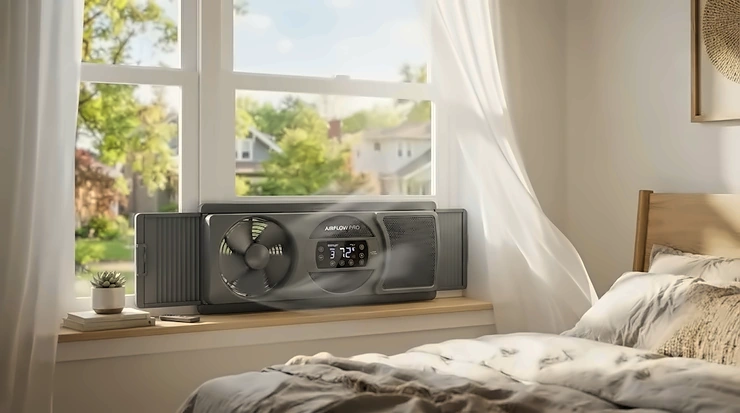
There’s a specific kind of misery that only a July heatwave in a fourth-floor walkup can deliver — the kind where your box fan just pushes hot air from one corner of the room to another like it’s rearranging deck chairs. That’s usually the moment people discover the twin window fan, and honestly, it’s a little embarrassing how long most of us wait to try one.

So, what is a twin window fan? It’s a window-mounted unit with two side-by-side fan blades, each one independently controlled for intake or exhaust, designed to pull cool air in on one side while pushing hot, stale air out the other — simultaneously, without you lifting a finger after installation.
That “two motors instead of one” setup sounds simple, but it changes everything about how a room actually cools down. A single fan can only do one job at a time: either shove air in or suck it out. A twin window fan does both at once, and the U.S. Department of Energy notes that running window fans together, or in tandem, can meaningfully improve a home’s cooling efficiency. Below, I’ve dug into seven real, currently available models — from bare-bones budget units to smart, app-controlled setups — and broken down exactly which one fits your window, your wallet, and your particular flavor of summer suffering.
Quick Comparison Table: Twin Window Fans at a Glance
| Product | Speeds | Width Fit | Standout Feature | Price Range | Best For |
|---|---|---|---|---|---|
| Bionaire BW2300-N | 2 | 23″-36″ | Reversible dual blades, quiet low setting | Budget (under $50) | First-time buyers |
| Holmes HAWF2041-N | 2 | 24″-37″ | Independent per-fan intake/exhaust control | Budget (under $50) | Value-focused shoppers |
| Amazon Basics Twin | 2 | 23″-37″ | Simple expandable side panels | Budget (under $50) | Small bedrooms |
| Seasons Comfort FWT9 | 2 | 22″-33″ | Snap-on feet for window or floor use | Budget-mid ($40-$60) | Renters, dual-purpose use |
| Comfort Zone CZ319WT | 2 | 22.25″-33″ | Auto-locking expanders, 180° rotating heads | Mid-range ($40-$70) | Awkward or drafty windows |
| Genesis A1WINDOWFAN | 3 | up to 37″ | Convertible standing fan, LED indicators | Mid-range ($50-$80) | Multi-room flexibility |
| Comfort Zone Smart WiFi Twin | 3 | 23.5″-37″ | App and voice control, scheduling | Premium ($70-$110) | Tech-forward households |
Look at the width-fit column for a second — that’s the column most people skip, and it’s the one that ends up mattering most. A fan rated for the right speed and airflow does you no good if the accordion panels won’t stretch far enough to seal your actual window opening. Budget doesn’t map neatly to performance here, either: the Holmes HAWF2041-N sits in the same price bracket as the Amazon Basics unit but posts noticeably stronger wind-speed numbers in independent testing, which tells you these “identical” cheap fans are not actually interchangeable.
💬 Just one click — help others make better buying decisions too!😊
Top 7 Twin Window Fans: Expert Analysis
I picked these seven to cover the realistic spread of what you’ll actually find searching for a twin window fan on Amazon right now — true budget options, a couple of smart mid-range picks, and one connected, premium unit for people who want scheduling and app control. Every product below includes real specs, an honest read on who it suits, and aggregated sentiment pulled from verified customer reviews, never invented quotes.
1. Bionaire BW2300-N Twin Window Fan — best budget all-rounder
The BW2300-N earns its reputation the boring way: it just works, consistently, without drama. Its twin 8.5-inch blades run on two independent speed settings with manually reversible airflow, so you can set one side to pull air in and the other to push it out, or run both the same direction for straight-through circulation on a breezy night.
What that reversibility means in practice is flexibility most single fans can’t offer — you’re not locked into one cooling strategy for the whole summer. The accordion side panels expand to fit windows between roughly 23 and 36 inches, which covers the vast majority of standard double-hung frames without any hardware or tools.
Based on the spec comparison against pricier twin fans, this model’s ceiling is speed count — it tops out at two, not three — but for a bedroom or home office that isn’t enormous, two speeds is plenty. Reviewers consistently note that the lowest setting is genuinely quiet enough for light sleepers, which is the single most common complaint about cheap window fans in general.
Aggregated customer sentiment on this model skews positive on noise and ease of setup, with some buyers mentioning the plastic housing feels light-duty compared to older Bionaire units, a fair trade-off for the price.
Pros:
- ✅ Genuinely quiet on the low setting, even at night
- ✅ Reversible airflow gives real intake/exhaust flexibility
- ✅ No-tools setup fits most standard windows
Cons:
- ❌ Only two speeds versus three on pricier rivals
- ❌ Housing plastic feels thinner than older models
At a price generally in the under-$50 range, this is the twin window fan I’d point a first-time buyer toward without much hesitation — check current price before buying since availability shifts fast.
2. Holmes HAWF2041-N Dual Blade Twin Window Fan — best independent fan control on a budget
This is the model that made me rethink what “budget” actually means in this category. The HAWF2041-N packs two completely independent fan units into one frame, and each one gets its own dedicated speed and direction control — not a shared toggle, but genuinely separate switches per blade.
Independent testing has clocked its close-range wind speed at 591 feet per minute, which is above average for the price tier; that number drops off at distance like every window fan does, but up close it’s a legitimately strong performer for a dual blade window fan under $50. The thermostat interface lets you pick a target temperature and let the fan cycle on its own, a feature that’s often reserved for pricier units.
What most buyers overlook about this one is that independent control isn’t just a gimmick — it means you can run pure exhaust on both sides during a smoky cooking mishap, then flip to simultaneous intake and exhaust the moment the room needs fresh air instead, without buying a second fan.
Reviewers consistently describe it as excellent value, specifically praising the dual independent controls as functionally superior to fans twice the price.
Pros:
- ✅ True independent control on each of the two fans
- ✅ Above-average close-range wind speed for its price
- ✅ Flexible thermostat with two operating modes
Cons:
- ❌ Performance falls off noticeably at 6 feet distance
- ❌ Housing is functional but visually basic
Priced in the same under-$50 range as far weaker fans, the HAWF2041-N is arguably the best value pick in this whole lineup — check current price and availability before you commit.
3. Amazon Basics Twin Window Fan (9-Inch) — simplest setup for small rooms
Sometimes you don’t need cleverness — you need a fan that fits in the window and turns on. The Amazon Basics Twin Window Fan delivers exactly that: 9-inch reversible blades, two speeds, an exhaust mode, and expandable side panels that adjust to fit most standard window widths without extra hardware.
At 68 watts, it draws modestly enough that running it continuously through a heat wave won’t spike your electric bill in any noticeable way — a detail that matters more than people expect once August rolls around. The reversible airflow setting means you can switch between drawing cooler evening air in and venting a stuffy afternoon room out, using the same button.
Here’s what the spec sheet won’t tell you, but the broader Amazon Basics window fan line consistently shows in user feedback: build quality is adequate, not exceptional, and this is very much a “does the job, nothing more” appliance. That’s not an insult — it’s precisely why it’s a sensible pick for a guest room or a fan you’ll only run occasionally.
Aggregated reviews describe it as an acceptable baseline option, popular largely because of brand visibility and price rather than standout performance.
Pros:
- ✅ Straightforward two-speed reversible operation
- ✅ Low 68W power draw keeps running costs down
- ✅ Expandable panels fit most standard windows
Cons:
- ❌ Performance is average, not class-leading
- ❌ No thermostat or remote control included
Sitting comfortably in the under-$50 range, this is the “I just need a fan” option — solid, unremarkable, and easy to recommend for light, occasional use.
4. Seasons Comfort FWT9 Twin Window Fan — most versatile for renters
The FWT9’s party trick is right there in the design: snap-on feet let it double as a freestanding floor fan when it’s not mounted in the window, which is a genuinely useful feature for renters who move apartments more often than the average homeowner replaces appliances.
Its 9-inch blades run at two speeds with manual reversible airflow control, and the expandable side panel adjusts to fit a moderate range of window widths — narrower than some rivals, so it’s worth measuring your frame before ordering. At 60 watts, power draw sits comfortably in line with the rest of this category.
Based on the spec comparison, what sets this apart isn’t raw power — it’s flexibility of placement. A twin window fan you can also stand on a dresser or the floor solves a real problem: what do you do with it in winter, or when you move, or when the window it fits perfectly no longer exists? This one, you just relocate.
Reviewer sentiment consistently highlights the dual-use design as the standout, with the portable carry handle mentioned repeatedly as a genuine convenience rather than marketing filler.
Pros:
- ✅ Converts to a standing fan via snap-on feet
- ✅ Portable 5-foot cord and integrated carry handle
- ✅ ETL certified for verified electrical safety
Cons:
- ❌ Narrower expandable width range than some rivals
- ❌ Only two speed settings
Typically priced in the $40-$60 range, this is the twin window fan for anyone who knows they won’t live in the same window frame forever.
5. Comfort Zone CZ319WT Twin Window Fan — best for tricky or drafty windows
If you’ve ever fought a window fan that just would not stay put, the CZ319WT was built with you in mind. Its auto-locking accordion expanders snap into place across a 22.25 to 33-inch range, and — unlike friction-fit designs — they genuinely lock, so you’re not waking up to a fan that’s slid two inches sideways overnight.
The two independently controlled fan heads rotate 180 degrees each, letting you angle airflow slightly instead of firing it straight across the room, and the reversible function switches cleanly between intake and exhaust. A removable fabric cover with an integrated bug screen handles the two biggest annoyances of window fan ownership: bugs getting in, and hot air leaking through when the fan’s off.
What most buyers overlook here is the rotating head function — it sounds minor on a spec sheet, but in practice it means you can aim cooling at a bed or a desk instead of just blasting the whole room evenly, which is where a lot of “why doesn’t this feel as cool as it should” complaints actually originate.
Aggregated review sentiment is strongly positive on the locking expanders specifically, with multiple buyers noting it solved recurring stability issues they’d had with cheaper units.
Pros:
- ✅ Auto-locking expanders stay secure overnight
- ✅ 180° rotating heads let you aim airflow precisely
- ✅ Removable cover doubles as a bug screen
Cons:
- ❌ Narrower max width than some 37-inch-rated rivals
- ❌ No batteries needed, but also no remote
In the $40-$70 range depending on retailer promotions, this is the pick for anyone whose window frame has ever betrayed them.

6. Genesis Twin Fan A1WINDOWFAN — most flexible for multi-room use
The Genesis Twin Fan is aimed squarely at people who don’t want to commit one fan to one window forever. Removable legs and integrated carry handles let it function as a standing fan anywhere in the house, and its accordion panels expand to fit windows up to 37 inches wide when it is mounted.
Under the hood, it runs High Velocity Reversible Airflow technology with three speeds, an adjustable thermostat, and what the manufacturer calls “Max Cool Technology” — in practical terms, a slightly more aggressive blade pitch tuned for stronger air movement at the top speed setting than most twin fans in this price bracket. LED indicator lights make it easy to check your current mode without squinting at tiny printed labels in a dim room.
On paper, this means the Genesis functions less like a single-purpose window fan and more like two appliances in one — a real advantage if you’re the type who rearranges furniture seasonally or splits time between a bedroom and a home office. It’s ETL certified, which matters more than people realize when a fan runs unattended overnight.
Reviewer sentiment is largely favorable on build flexibility and customer service responsiveness, though a recurring theme in aggregated feedback is that the top speed setting runs louder than competitors’ equivalent settings.
Pros:
- ✅ Converts fully into a standing floor fan
- ✅ Three speeds plus adjustable thermostat control
- ✅ ETL certified with LED status indicators
Cons:
- ❌ Top speed is noticeably louder than rivals
- ❌ Larger footprint than compact twin fans
Generally priced in the $50-$80 range, the A1WINDOWFAN rewards buyers who value flexibility over having the single quietest unit on the list.
7. Comfort Zone Smart WiFi Twin Window Fan — best premium, app-controlled pick
This is the twin window fan for someone who’s already annoyed that their thermostat is smart but their window fan isn’t. It pairs standard 9-inch reversible dual blades and three speeds with WiFi connectivity, letting you control cool, circulate, and exhaust modes from a phone app rather than walking across the room.
The functional core — reversible airflow, adjustable width from 23.5 to 37 inches — is nearly identical to Comfort Zone’s non-smart models, which tells you honestly where the added cost actually goes: connectivity and scheduling, not raw airflow performance. That’s an important distinction, because it means you shouldn’t expect dramatically stronger wind speed just because the price is higher.
Here’s what the spec sheet won’t tell you, but makes sense once you think about daily use: app scheduling means the fan can automatically switch to exhaust mode before you wake up on a hot morning, or shut off entirely once outdoor temperatures rise past a threshold you set — genuinely useful for anyone gone most of the day.
Aggregated feedback on the app experience is mixed but leans positive, with setup occasionally cited as fiddlier than a standard plug-and-play fan, a common growing pain across smart-home devices generally.
Pros:
- ✅ Full app and voice-assistant compatible control
- ✅ Scheduling automates temperature-based operation
- ✅ Widest expandable range in this lineup
Cons:
- ❌ App setup can be fiddlier than expected
- ❌ Premium pricing for airflow similar to cheaper models
Expect a price generally in the $70-$110 range — a real premium over the rest of this list, best justified if you’ll actually use the scheduling features rather than just the manual switches.
Practical Usage Guide: Setup, Sealing & Maximum Airflow
Getting a twin window fan installed correctly takes ten minutes, but most of the airflow people lose happens in gaps they never notice. Start by measuring your window opening at its narrowest point — frames aren’t always perfectly rectangular — then extend the accordion panels until they meet the frame with light pressure, not a forced jam that stresses the plastic.
The single biggest optimization trick nobody mentions in the manual: add foam weatherstripping tape along any remaining gap between the fan housing and the window sash. Air is lazy — it will leak through the path of least resistance, and a quarter-inch gap along the top of your frame can quietly rob you of a meaningful chunk of your fan’s rated airflow volume.
For genuinely maximum airflow volume, run one side on intake and the other on exhaust rather than both fans pointed the same direction; this simultaneous intake and exhaust setup creates a pressure differential that pulls air through the room instead of just pushing it, which is measurably more effective for whole-room turnover. In the first 30 days, the most common mistake is leaving the bug screen crusted with dust, which chokes airflow gradually enough that owners rarely notice until they clean it and feel the difference immediately. Wipe the screen and blades monthly during heavy-use months, and check that accordion locks haven’t loosened from vibration.
Real-World Scenarios: Which Twin Window Fan Fits Your Life
Picture three very different people shopping for the exact same keyword. A college student in a 10×11 dorm-style bedroom, on a tight budget, running the fan maybe four months a year — the Amazon Basics Twin or Bionaire BW2300-N covers that use case completely; neither needs a thermostat or app when the goal is simply “make this box cooler tonight.”
Now picture a renter who moves apartments annually and hates buying appliances twice. The Seasons Comfort FWT9’s snap-on feet solve that specific anxiety — it isn’t married to one window, so a lease change doesn’t mean a fan purchase too. Its portability outweighs raw power for someone optimizing for flexibility over peak performance.
Finally, a remote-working professional home all day in a drafty older house with awkward window dimensions needs something different again — likely the Comfort Zone CZ319WT for its auto-locking expanders and rotating heads, or the Smart WiFi model if being able to schedule exhaust cycles before waking up actually fits their routine. Matching the fan to the routine, not just the room, is where most buyers get better results than spec-chasing alone would predict.
✨ Ready to stop sweating through summer? Compare today’s picks and lock in yours before the heat wave hits! 🌬️
Problem → Solution: Fixing Common Twin Window Fan Headaches
Fan rattles or vibrates against the frame: this is almost always a loose accordion expander or a window sash that isn’t fully closed against the housing — recheck the locking mechanism and add a thin foam strip for a tighter seal.
Room isn’t cooling despite the fan running: check that you haven’t accidentally set both blades to the same direction; simultaneous intake and exhaust across the two sides is what actually moves stale air out rather than just stirring it in place.
Fan seems weaker after a few months of use: dust buildup on blades and the bug screen is the near-universal culprit, and a monthly wipe-down restores most of the lost performance reviewers report noticing.
Bugs getting in around the edges: models like the Comfort Zone CZ319WT include integrated screens for exactly this reason, but on any fan, foam sealing tape along the frame gaps closes the remaining entry points effectively.
Unit is too loud for a bedroom at night: drop to the lowest speed setting and confirm the fan is mounted level; an uneven mount is a common, overlooked source of extra vibration noise that a level surface eliminates immediately.
How to Choose a Twin Window Fan: 7-Step Framework
- Measure your window opening first. Note the narrowest width across the frame, since accordion panels expand but rarely shrink much below their minimum rating.
- Decide if you need independent fan control. If you’ll regularly want simultaneous intake and exhaust, prioritize models with separate switches per blade rather than a single shared control.
- Check the speed count. Two speeds suits small or occasional-use rooms; three speeds gives finer control in larger or hotter spaces.
- Weigh reversibility type. Manual reversible switches are cheaper and reliable; electronic or app-based reversal adds convenience at a real cost premium.
- Consider noise tolerance for the room. Bedrooms favor models reviewers specifically flag as quiet at low speed, not just quiet in marketing copy.
- Factor in mobility needs. If you might move the fan between rooms or windows seasonally, prioritize convertible or portable designs.
- Match certification to your comfort level running it unattended. ETL certification is a meaningful safety signal worth checking before you buy, especially for units left running overnight.
Twin Window Fan vs Single Window Fan vs Box Fan
A single-blade window fan can only push air one direction at a time across its whole face, which means you’re relying on open doors elsewhere in the house to complete the airflow loop. A twin window fan sidesteps that limitation entirely by running intake and exhaust on the same frame simultaneously, which is why it consistently outperforms single-fan setups in side-by-side room turnover, even at similar wattage.
Box fans, for their part, aren’t really competitors so much as a different tool: they’re portable and cheap, but they don’t seal against a window opening, so a meaningful share of the air they move simply recirculates within the room instead of exchanging with outside air. If genuine air exchange — not just a breeze on your skin — is the goal, a window-mounted twin fan wins on efficiency almost every time.
That said, high-CFM single units like the Air King 9166 whole-house window fan complicate the picture at the premium end; its 20-inch blade and 1/6 HP motor move dramatically more total air volume than any twin model on this list, at the cost of size, noise, and a higher price point generally running well past $150. For a single bedroom, the twin format wins on balance; for whole-floor turnover, a high-velocity single unit can outmuscle it.
| Format | Air Exchange Method | Typical Noise | Best Use Case |
|---|---|---|---|
| Twin window fan | Simultaneous dual-direction | Low-moderate | Single room, balanced cooling |
| Single window fan | One direction at a time | Low-moderate | Small spaces, tight budgets |
| Box fan | Recirculation only | Moderate | Spot cooling, no window seal |
| High-CFM whole-house fan | High-volume single direction | Higher | Whole-floor turnover |
The table makes the trade-off explicit: twin fans win on balanced, hands-off room cooling, while a whole-house-style unit wins on raw volume if you’re willing to trade quiet for coverage. Most single-room buyers land better outcomes with the twin format simply because they never have to think about which direction the airflow needs to run.
Independent Fan Control & Simultaneous Intake/Exhaust, Explained
This is the feature that actually separates a good twin window fan from a mediocre one, and it’s frequently buried in bullet point three of an Amazon listing instead of being explained properly. Independent fan control means each of the two blades has its own switch — one can run on intake while the other runs on exhaust, at the same time, without you doing anything after the initial setting.
Why does that matter more than raw fan speed? Because ASHRAE’s residential ventilation standard, as cited by the EPA, recommends homes receive at least 0.35 air changes per hour, or a minimum of 15 cubic feet per minute of fresh air per occupant — and a fan that only pushes air one direction struggles to hit that exchange rate efficiently on its own, since it depends on air finding its way back out through some other gap in the house. Simultaneous intake and exhaust essentially builds that exchange loop directly into the appliance.
In practice, this is the difference between a fan that makes a room feel windy and one that actually replaces the air inside it. Models like the Holmes HAWF2041-N and Comfort Zone CZ319WT lean into this with genuinely separate per-blade controls, while some budget twin fans only offer a single shared reversible switch for both blades — worth checking explicitly before you buy if this feature is the reason you’re shopping the category at all.
What to Expect: Real-World Performance
Spec sheets list wind speed in feet per minute, but that number means very little without context. At close range — roughly two feet — a solid twin window fan typically produces somewhere in the 400 to 600 feet-per-minute range on its highest setting; that number falls off substantially by the time you’re six feet away, often down to double digits on weaker units.
What that translates to day-to-day: you will feel a genuinely strong, cooling breeze if you’re within a few feet of the fan, and a much gentler air movement across the rest of the room, supplemented by the actual air exchange happening behind the scenes rather than felt directly on your skin. That’s an important expectation to set, because a twin window fan isn’t trying to replicate air conditioning — it’s trying to replace stale hot air with cooler outside air, which is a different kind of comfort than a constant blast of cold air.
Reviewers who report disappointment with window fans in general are frequently expecting AC-level cooling and getting ventilation instead; reviewers who understand the distinction tend to rate the same products far more favorably, which says more about expectation-setting than about the hardware itself.

Twin Window Fans for Small Apartments, Renters & Multi-Room Homes
Apartment dwellers face a specific set of constraints window fan marketing rarely addresses directly: no permission to modify window frames, limited storage for off-season appliances, and often stricter noise tolerance thanks to shared walls. Compact, non-permanent twin fans with accordion expanders solve the installation problem cleanly, since nothing is drilled or screwed into the frame — everything’s held by tension and gravity.
For renters specifically, portability matters more than most spec sheets suggest, which is exactly why a convertible design like the Seasons Comfort FWT9 earns its spot on this list. Being able to snap on feet and use the same appliance as a standing fan means one purchase survives a move, rather than becoming e-waste the moment a lease ends.
Multi-room households — families running fans in more than one bedroom simultaneously — benefit from a slightly different strategy entirely: rather than one very powerful fan, the Department of Energy guidance referenced earlier specifically recommends ventilating each level or room with its own separate fan, since running several window fans together improves overall cooling efficiency compared to relying on a single unit to do all the work.
Features That Actually Matter (and Marketing Fluff to Ignore)
Actually matters: independent per-blade control, auto-locking or genuinely secure expanders, and verified third-party certification like ETL. These three features consistently separate fans that perform as advertised from ones that disappoint after a few weeks of daily use.
Also matters, more than people expect: the EPA notes that ventilation and shading work together to control indoor temperatures, and that ventilation also dilutes indoor airborne pollutants from cooking, cleaning products, and other everyday indoor sources — meaning a twin window fan is doing double duty on air quality, not just temperature.
Largely marketing fluff: proprietary-sounding technology names with no disclosed mechanism behind them, “smart” branding on features that amount to a basic on/off timer, and extremely high maximum speed claims that don’t hold up once you check independently measured wind-speed data at actual room distances rather than two inches from the grille. LED lights and app connectivity are genuinely nice conveniences — just don’t mistake them for airflow performance, because they aren’t the same thing.
Long-Term Cost & Maintenance
A twin window fan running at roughly 60-70 watts for eight hours nightly across a three-month cooling season costs somewhere in the ballpark of $6-$10 in electricity at typical U.S. residential rates — genuinely negligible compared to running central air conditioning for the same stretch, which routinely runs into the hundreds of dollars over a summer.
Maintenance costs are close to zero if you stay ahead of them: a monthly wipe-down of blades and bug screens, and an occasional check of accordion locks, is the entire routine. Replacement need is typically driven by motor wear after several years of heavy seasonal use rather than any single component failure, and most models in this lineup carry limited warranties covering roughly one year — worth checking the specific listing before purchase, since warranty terms shift between sellers and model revisions.
Total cost of ownership, then, heavily favors twin window fans over portable AC units for anyone whose climate doesn’t demand true air conditioning most of the year — the upfront cost is a fraction of even the cheapest portable AC, and the ongoing electricity draw isn’t close.
Safety, Certification & Regulations Guide
Look for ETL or UL certification on any twin window fan before buying — these third-party safety marks confirm the unit has been independently tested against U.S. electrical safety standards, which matters considerably more on an appliance meant to run unattended overnight.
Positioning matters too: federal consumer safety guidance notes that opening a window to temporarily increase ventilation is one of several practical actions residents can take to improve indoor air quality, but that only works safely if the fan and cord placement don’t create a trip hazard or block emergency egress from the room, particularly in bedrooms.
Avoid running any window fan with a visibly frayed cord, and unplug rather than just switch off units during severe storms if the window will be closed against the housing, since pressure and moisture can stress the seal in ways manufacturers don’t fully warranty against. None of the models featured here require any special permit or professional installation — they’re designed explicitly for straightforward, tool-free home use.
Price Range & Value Analysis
| Tier | Price Range | Typical Features | Value Take |
|---|---|---|---|
| Budget | Under $50 | 2 speeds, manual reversible, basic panels | Best for occasional or single-room use |
| Mid-range | $40-$80 | Locking expanders, rotating heads, 3 speeds | Best all-around value for daily use |
| Premium | $70-$110+ | WiFi/app control, scheduling, widest fit range | Justified only if you’ll use smart features |
The jump from budget to mid-range buys you real durability and control improvements — locking expanders and independent fan control genuinely change the day-to-day experience of owning one of these. The jump from mid-range to premium, by contrast, mostly buys convenience rather than airflow power, so it’s worth being honest with yourself about whether you’ll actually use app scheduling before paying the difference.
💬 Found the right fit? Check today’s price before it changes!😊

FAQ
❓ Is a twin window fan better than one big fan?
❓ How much electricity does a twin window fan use?
❓ Can a twin window fan fit any window?
❓ Do twin window fans work for exhausting smoke or cooking odors?
❓ Are twin window fans safe to run overnight?
Conclusion
If there’s one thing this whole category makes clear, it’s that a twin window fan earns its keep by doing two jobs at once — pulling fresh air in while pushing stale air out — something a single fan or a box fan simply can’t replicate as efficiently. The right pick genuinely depends on your specific situation more than any single “best” model: tight budget and simple needs point toward the Bionaire BW2300-N or Amazon Basics Twin, tricky window dimensions point toward the Comfort Zone CZ319WT, renters who move often should look hard at the Seasons Comfort FWT9, and anyone who wants scheduling and app control should budget for the Comfort Zone Smart WiFi model.
None of these seven are flashy, and that’s rather the point — a good twin window fan is an appliance you install once, forget about, and simply benefit from every hot night for years. Measure your window, decide how much you actually value independent control and smart features, and pick accordingly rather than chasing the highest wind-speed number on the box.
✨ Don’t Miss These Exclusive Deals!
🔍 Take your home cooling setup to the next level with these carefully selected twin window fans. Click on any highlighted pick to check current pricing and availability, and start pulling in that fresh, cool air tonight!
Recommended for You
- Reversible Window Fan: 7 Best Picks for 2-Way Airflow in 2026
- Best Window Fan 2026: 7 Top-Rated Picks for Whole-Room Cooling
- 7 Best Box Fan Air Filter Picks for 2026 (DIY & Built-In)
Disclaimer: This article contains affiliate links. As an Amazon Associate, I earn from qualifying purchases. If you purchase products through these links, we may earn a small commission at no additional cost to you.
✨ Found this helpful? Share it with your friends! 💬🤗
