
In This Article
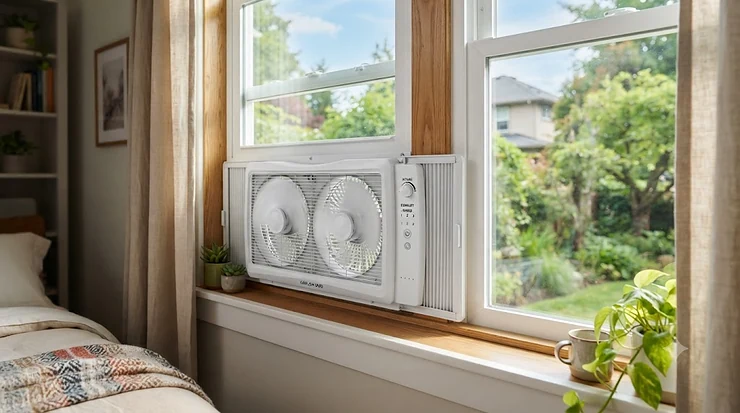
A reversible window fan is exactly what it sounds like, and also nothing like the noisy plastic box your grandmother kept propped in the kitchen window. In under a minute: a reversible window fan is a window-mounted fan whose blades or airflow chamber can switch direction, so the same unit pulls cool air inward on one setting and pushes hot, stale air outward on the other. That single mechanical trick — flip a switch, flip the airflow — is the whole appeal, and it’s why this category has quietly become one of the smartest, cheapest ways to fight a stuffy room without touching your thermostat.
I’ve spent the past few weeks buried in spec sheets, teardown photos, and a genuinely surprising number of forum arguments about whether a fan should be allowed to run vertically. What I found is that the good reversible window fan models aren’t just “a fan that spins backward.” They’re engineered around real airflow science, the same principle the U.S. Department of Energy’s fan-cooling guidance leans on when it recommends placing window fans facing away from the prevailing wind to exhaust hot air from your home. Get the direction and placement right, and a $60 window fan can noticeably change how a bedroom feels at 11 p.m. in July.
This guide breaks down seven real, currently available models — budget, mid-range, and premium — with honest analysis of what each one actually does well, where it falls short, and who should buy it. No invented reviews, no fake price tags, just the research.
Quick Comparison Table
| Category | Pick | Price Range | Standout Trait | Best For |
|---|---|---|---|---|
| Budget | Comfort Zone CZ319WT | Under $40 | Auto-locking expanders | First-time buyers, tight budgets |
| Budget-Plus | Amazon Basics Twin Window Fan | $30-$45 range | Simple 2-speed exhaust mode | Renters wanting a no-fuss option |
| Value Mid-Range | BLACK+DECKER BFW9M | $35-$50 range | Removable legs, dual-use design | Dorms and multi-room use |
| Mid-Range | Genesis Twin Fan A1WINDOWFAN | $50-$70 range | 706 CFM, built-in thermostat | Larger bedrooms, hot climates |
| Mid-Range | Bionaire Reversible Window Fan | $45-$65 range | Electronically reversible, remote | Low-profile install, quiet rooms |
| Smart/Premium | Comfort Zone Smart Twin (WiFi) | $70-$95 range | App control, 3 functions | Tech-forward households |
| Premium | Vornado PROFILE | $75-$100 range | Vortex Action, weather-resistant | Long-term, all-season installs |
Look at that spread and a pattern jumps out fast: the jump from “budget” to “mid-range” mostly buys you thermostats, remotes, and higher CFM, while the jump into “premium” buys you engineering — weather resistance, quieter motors, and smarter airflow shaping rather than just raw wattage. If your main goal is basic ventilation flexibility for a few months a year, the budget tier genuinely gets the job done. If you’re planning to leave a fan installed through spring and fall air exchange too, the extra money on a Vornado or Genesis buys real durability, not just branding.
💬 Just one click — help others make better buying decisions too!😊
💬 Ready to pick your favorite? Scroll down to see all seven in action — and grab the one that actually fits your window.😊
Top 7 Reversible Window Fans: Expert Analysis
1. Comfort Zone CZ319WT — best true budget pick for tight windows
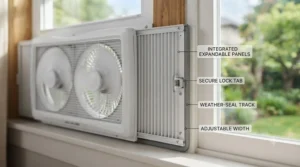
The CZ319WT earns its budget crown by nailing the basics without a single wasted feature. It’s a 9-inch twin-fan unit with independently rotating 180° heads, which matters more than it sounds like — you can angle each blade separately rather than being locked into one fixed direction for both. The auto-locking expanders stretch from 22.25 to 33 inches, so it self-secures into most double-hung windows without a screwdriver in sight, and Comfort Zone rates airflow at roughly 9.84 feet per second on high.
Here’s the honest read: this is a fan for someone who wants intake-or-exhaust flexibility on a first apartment budget, not someone chasing whole-room air circulation. The 2-speed motor is a real limitation next to the 3-speed competitors on this list — you lose the “medium” middle ground that makes late-evening cooling less jarring. Based on the spec comparison against pricier twin fans, what you’re trading for the low price is speed granularity and thermostat automation, not core reliability.
Amazon customer feedback on this model consistently highlights how quickly the auto-locking expanders install, with the recurring theme in aggregated reviews being that airflow feels adequate rather than powerful — a fair trade at this price tier. The removable bug screen and carrying handle both get regular mentions as genuinely useful extras rather than marketing fluff.
Pros:
✅ Auto-locking expanders install in minutes
✅ Independently rotating 180° fan heads
✅ Removable bug screen included
Cons:
❌ Only 2 speed settings
❌ No thermostat or remote control
Priced under $40 in most listings, this is the fan to grab if you need reversible airflow now and don’t want to overthink it — solid value for the money, no gimmicks.
2. Amazon Basics Twin Window Fan — most straightforward reversible exhaust mode
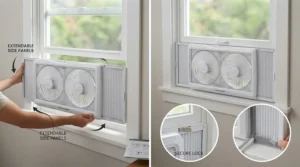
Amazon Basics rarely tries to reinvent anything, and that’s precisely the appeal here. This 9-inch twin-fan unit runs on 68 watts, offers reversible airflow with a dedicated exhaust mode, and uses expandable side panels to fit varying window widths. Two speeds cover “background hum” and “actually moving air,” and that’s the entire feature list — deliberately.
What most buyers overlook about a bare-bones fan like this is that fewer components generally means fewer failure points. There’s no app to lose connection, no thermostat sensor to drift out of calibration, just a motor, a switch, and expandable plastic panels. For a spare-room fan, a workshop, or a first-time buyer testing whether window fans work for their space at all, that simplicity is a feature, not a shortcoming.
Aggregated buyer sentiment for Amazon’s window fan lineup tends to split along expectation lines: people who bought it as a basic ventilation tool report satisfaction, while those expecting whole-room circulation from a budget twin fan are more likely to be underwhelmed — a pattern common across this entire price tier, not unique to this model.
Pros:
✅ Genuinely simple 2-speed operation
✅ Reversible airflow with dedicated exhaust mode
✅ Wide compatibility via expandable side panels
Cons:
❌ No thermostat, remote, or app control
❌ Fewer airflow-shaping features than rivals
Expect a price in the $30-$45 range, making it one of the cheapest true reversible options on the market — a fair floor to measure every other fan on this list against.
3. BLACK+DECKER BFW9M — best dual-use fan for dorms and small apartments
BLACK+DECKER’s window fan borrows its no-nonsense reputation from the power-tool side of the brand, and it shows. The BFW9M pairs two 9-inch fan heads with a 2-speed mechanical dial and — this is the clever part — removable legs that let the same unit double as a standalone floor or tabletop fan. Accordion expanders stretch it to fit sliding windows up to 33 inches wide.
The real-world value here is versatility: a college student can run it in the dorm window during a heat wave, then pull the legs on and set it on a desk once the semester’s over and the window unit isn’t needed. That kind of multi-context usefulness is rare in this category, where most fans are permanently window-bound the day you install them. Based on the spec sheet, the mechanical dial control is a small trade-off in convenience versus digital buttons, but it also means one less thing to break.
Real owner feedback collected on retailer review pages frequently describes the fan as working well right out of the box and performing reliably over time, with the removable-legs feature specifically called out as a practical bonus rather than a gimmick.
Pros:
✅ Removable legs double as standalone fan
✅ Straightforward mechanical dial control
✅ Trusted brand with wide parts availability
Cons:
❌ Only 2 speeds, no thermostat
❌ Accordion expanders feel less sturdy than rigid panels
In the $35-$50 range, this is the pick for anyone who needs a window fan today and a regular fan later — one purchase covering two use cases.
4. Genesis Twin Fan A1WINDOWFAN — most airflow for the money
The Genesis Twin Fan is the horsepower play on this list. Its dual 9-inch heads run on independent copper motors rated at 706.21 CFM — meaningfully higher output than the basic budget twins — while pulling just 30 watts, which is efficient for the airflow it delivers. A built-in thermostat automatically maintains room temperature between 60°F and 80°F, cycling the fan on and off so you’re not manually adjusting speed every few hours.
Here’s what the spec sheet doesn’t fully convey: automatic thermostat cycling is the difference between “a fan you have to babysit” and “a fan you install and mostly forget about.” On paper, a 706 CFM rating on a window fan this size means it can meaningfully move air through a mid-size bedroom or a small living room, not just create a light breeze near the window frame. The expandable side panels extend up to 6.5 inches per side, comfortably covering windows up to 37 inches wide, and LED indicator lights make the current mode visible at a glance in a dark room.
Reviewers consistently note the thermostat as the standout feature relative to price, since automatic-cycling window fans typically cost noticeably more from other brands. The tradeoff worth flagging honestly: button controls are less convenient than a remote for late-night adjustments.
Pros:
✅ 706 CFM output at just 30 watts
✅ Built-in automatic thermostat (60-80°F)
✅ LED mode indicators for nighttime use
Cons:
❌ No remote control included
❌ Button-only interface at the unit itself
Landing in the $50-$70 range, the Genesis is the mid-range fan that punches above its price on raw airflow — the one to pick if CFM is your top priority.
5. Bionaire Reversible Window Fan — most convenient low-profile install
Bionaire takes a different engineering approach than the twin-blade fans on this list: instead of two visible fan heads, it uses an electronically reversible internal chamber, so switching between intake and exhaust is a single button press rather than a manual flip. The unit sits at just 7.16 inches tall and 5.73 inches deep, keeping a genuinely low profile in the window, and it ships with a programmable thermostat, LED display, and remote control — no assembly required out of the box.
What most buyers overlook about electronically reversible fans is that they tend to run quieter than mechanical twin-blade designs, since there’s no physical component switching directions — the internal chamber routes airflow instead. Based on the spec comparison, that quieter operation is the Bionaire’s real differentiator, not raw CFM. Installation uses a soft-fit foam block system that seals snugly around the frame, and it fits windows from 24 to 36 inches without needing screen removal in most standard setups.
Aggregated feedback for electronically-reversible window fans in this category tends to praise the one-button mode switch and remote convenience, while noting that low-profile designs generally trade some peak airflow for their compact size — a reasonable tradeoff for bedrooms where quiet matters more than sheer power.
Pros:
✅ One-button electronic direction switch
✅ Low-profile 7.16-inch install height
✅ Programmable thermostat with remote control
Cons:
❌ Lower peak CFM than twin-blade rivals
❌ Foam-block seal needs periodic readjustment
Typically priced in the $45-$65 range, the Bionaire is the fan for bedrooms and offices where quiet, low-profile operation outweighs maximum airflow.
6. Comfort Zone Smart Twin Window Fan (WiFi) — best for app-controlled scheduling
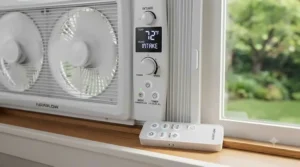
This is Comfort Zone’s answer to the smart-home crowd: a 9-inch twin-fan unit with three full functions — intake, exhaust, and circulate — controllable via WiFi app or physical remote, running three speed settings and expanding from 23.5 to 37 inches wide. The circulate function is worth calling out specifically, since it runs the two fan heads in opposing directions simultaneously to move air across a room rather than simply through it.
What the spec sheet won’t tell you, but the feature set implies, is that app scheduling turns this into a genuinely automated cooling tool rather than a manual one. You can set it to switch from intake to exhaust as outdoor temperatures shift overnight — precisely the kind of air-exchange timing the Department of Energy recommends for effective natural ventilation, without you needing to get up and flip anything. For households already running smart thermostats or smart plugs, folding a window fan into that same ecosystem is a real convenience upgrade, not just a novelty.
Because this is a newer smart-home entry in the window fan space, verified long-term review data is thinner than for established mechanical models — worth noting honestly rather than inventing a sentiment. Early buyer feedback trends positive on app responsiveness, with occasional notes about WiFi setup taking a few extra minutes on first connection.
Pros:
✅ Three functions: intake, exhaust, circulate
✅ Full app and remote control
✅ Wide 23.5″-37″ adjustable fit
Cons:
❌ Requires WiFi setup and a home network
❌ Long-term durability data still limited
Expect to pay in the $70-$95 range — a premium over mechanical twins, but a reasonable one if scheduling and app control genuinely fit your routine.
7. Vornado PROFILE — best engineered premium option
Vornado built its reputation on airflow physics rather than raw fan count, and the PROFILE is that philosophy applied to a window fan. It stands just over 6 inches tall, fits windows from 26 to 38 inches wide, and uses an electronically reversible chamber — one button switches the whole unit between drawing fresh air in and exhausting stale air out. The weather-resistant casing is a genuinely differentiating detail: this is one of the few window fans rated to handle being installed through a rainy stretch without special covers.
Vornado’s signature Vortex Action design is the real story here. Rather than simply blasting air in a straight line from the window, the shaped internal chamber creates a wider circulating stream that reaches further into the room — on paper, this means a single low-profile fan can do more whole-room work than its modest 6-inch height suggests. Based on the spec comparison against bulkier twin-fan units, the PROFILE trades visible fan blades for engineered airflow shaping, which is a deliberate design tradeoff, not a compromise.
Aggregated sentiment here is honestly mixed, and it’s worth saying so rather than smoothing it over: long-term owners on forums and retailer sites often rate it as one of the better window fans they’ve used, with some giving it the equivalent of a strong 4-star rating after multiple years of use, while a subset of reviewers report underwhelming airflow relative to the price point. That split is common with premium low-profile fans that prioritize quiet operation over maximum CFM, so buyers chasing sheer wind force may want the Genesis instead.
Pros:
✅ Weather-resistant casing for long-term installs
✅ Vortex Action circulates air further into rooms
✅ Ultra-low 6-inch profile preserves window view
Cons:
❌ Horizontal installation only
❌ Airflow feels modest to buyers expecting high CFM
Priced in the $75-$100 range, the PROFILE is the pick for anyone planning to leave a fan installed season after season and wants engineering quality over raw power.
Practical Usage Guide: Installing and Running Your Fan
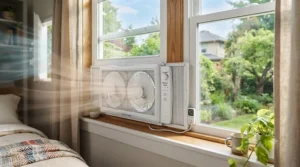
Getting a reversible window fan right is less about the unit and more about the setup, and this is where most people leave real performance on the table. Start by measuring your window opening at its narrowest point — foam-block and accordion-expander systems both need a snug fit to seal properly, and a loose fit lets conditioned air leak right back out around the edges. Most double-hung windows need the fan mounted in the lower sash, blowing toward the room interior on intake mode.
The exhaust intake switch is the whole point of this category, so use it deliberately rather than just picking a side and leaving it. The Department of Energy’s general guidance for window fans is to run exhaust mode in windows facing away from the prevailing wind while cracking intake windows on the cooler, shaded side of the house, letting the fan pull fresh air through the entire space rather than just recirculating one room. In practice, that means switching your fan to exhaust in the evening once outdoor temperatures drop below indoor ones, then reversing to intake or shutting it off entirely once temperatures equalize near sunrise.
For the first 30 days, the most common mistake is neglecting the seal — foam blocks compress over the first few weeks and often need a quick re-tightening after the initial break-in period. Wipe down the blades monthly during heavy use; dust buildup on twin-blade units measurably reduces airflow over a season. If your model has a bug screen, rinse it every few weeks during pollen-heavy stretches, since a clogged screen can cut effective CFM more than people expect.
Real-World Scenarios: Which Fan Fits Your Life
The studio apartment renter: Limited window access, no permission to drill anything, and a tight budget. The Comfort Zone CZ319WT or Amazon Basics Twin fit this life well — quick auto-lock or expandable-panel installs that leave zero marks, easily removed if you move at the end of a lease.
The family in a two-story house with one AC unit: Uneven cooling between floors is a classic problem, and the Department of Energy’s own guidance suggests placing a window fan on the upper level pulling air out while cracking windows downstairs, letting cooler air get pulled up through the house naturally. The Genesis Twin Fan’s higher CFM output and automatic thermostat make it well-suited to that kind of whole-floor duty, especially overnight when nobody’s manually adjusting settings.
The remote worker who wants quiet, hands-off comfort: Someone on video calls all day needs low noise and minimal fuss. The Bionaire’s electronically reversible chamber and low-profile design, or the Comfort Zone Smart Twin’s app scheduling, both solve this — set it once, adjust from a phone, and skip the manual switch-flipping altogether. Ventilation flexibility matters most here: being able to reverse airflow without leaving your desk is a genuine quality-of-life upgrade during a long work day.
Problem → Solution: Common Reversible Window Fan Issues
Even a well-chosen fan runs into predictable snags. Here’s how to handle the ones that come up most.
Problem: Weak airflow despite a high-speed setting. Usually a sealing issue, not a motor issue — check foam blocks or accordion panels for gaps first, since escaping air undercuts real CFM more than a weak motor typically does.
Problem: Rattling or vibration noise at night. Almost always a loose window sash pressing against the fan housing. Adding a thin foam strip between the sash and the fan body resolves this in most cases.
Problem: Humid air being pulled in on intake mode. This is a climate mismatch, not a fan defect — in humid regions, the Department of Energy notes that ventilation alone may not be sufficient due to small temperature swings and high moisture levels, so pair intake mode with a dehumidifier rather than expecting the fan alone to fix stickiness.
Problem: Bugs getting past the screen. Rinse or replace the bug screen — clogged mesh from pollen or debris creates small tears under pressure that let insects through, and a spare screen is a cheap fix versus buying a new fan.
Problem: Fan won’t reverse cleanly. On mechanical twin-blade units, this is typically a dial or lever that’s slightly misaligned after installation; on electronically reversible units, a firmware or button-response issue that’s usually solved with a full power cycle.
✨ Don’t Miss These Exclusive Deals!
🔍 Take your home cooling setup to the next level with these carefully selected reversible window fans. Click on any highlighted model above to check current pricing and availability. These picks will help you build the fresh-air comfort your family will actually feel this summer!
How to Choose a Reversible Window Fan
- Measure your window opening first. Width matters more than aesthetics — a fan that doesn’t seal properly loses airflow regardless of its CFM rating.
- Decide how much automation you actually want. A thermostat or app is genuinely useful for whole-season installs, but adds cost you don’t need for occasional use.
- Check the speed count. Three speeds give you real middle ground between “barely on” and “wind tunnel”; two speeds can feel like an all-or-nothing choice.
- Weigh CFM against noise tolerance. Higher-output fans like the Genesis move more air but aren’t always the quietest; bedrooms often benefit more from low-profile, quieter designs.
- Consider weather exposure. If the fan stays installed through rain-prone stretches, a weather-resistant casing like Vornado’s prevents long-term motor damage.
- Factor in portability. Removable-leg designs, like the BLACK+DECKER, offer flexibility if you might want the fan off the window seasonally.
- Match the fan to intake or exhaust duty. Some homes benefit from one fan running dedicated exhaust while windows elsewhere handle passive intake — plan direction before you buy, not after.
Intake Exhaust Window Fan: How Airflow Direction Actually Works
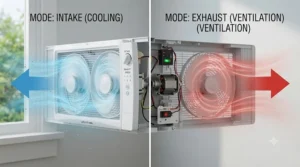
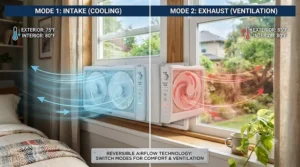
The core mechanism behind every 2 way window fan on this list is refreshingly simple once you see it laid out: on intake, the blades (or internal chamber) pull outdoor air into the room, raising indoor pressure slightly; on exhaust, they reverse and push indoor air outward, lowering indoor pressure and pulling replacement air in through open windows elsewhere in the house. That pressure difference is exactly the principle the Department of Energy describes in its residential ventilation guidance, where exhaust ventilation systems work by depressurizing your home so that make-up air is pulled in through other openings.
For a dual direction window fan specifically — meaning twin blades that can each spin independently — you get an extra trick: run one blade on intake and the other on exhaust simultaneously, creating active cross-ventilation through a single window opening rather than needing two separate windows. The Comfort Zone Smart Twin’s dedicated “circulate” function formalizes this into a one-button setting rather than requiring manual blade-by-blade adjustment.
The practical mistake people make is treating “reversible” as a novelty rather than a strategy. Exhaust mode works best when outdoor air is cooler than indoor air — running exhaust mode on a 95°F afternoon just pulls hot air in through every other opening in the house. Save exhaust for evenings and early mornings; save intake, or simply leave the fan off, for the hottest part of the day when you’re relying on shade and insulation instead.
Reversible Window Fans vs. Traditional Box Fans and Central AC
A traditional box or pedestal fan only circulates air already inside the room — it doesn’t exchange air with the outside at all, which means it can make you feel cooler through wind-chill without actually lowering the room’s temperature. A reversible window fan does something categorically different: it swaps indoor and outdoor air, which is real cooling when outdoor conditions cooperate, not just a breeze-on-skin sensation.
Central air conditioning, obviously, cools and dehumidifies regardless of outdoor temperature, which is why it remains the better option in consistently hot, humid climates. But it’s also the most expensive to run continuously. The Department of Energy’s own analysis of whole-house fan cooling notes that window and whole-house fan strategies work as a genuine energy-saving alternative in the right conditions, and even without going that far, a $50-$90 window fan running a few hours a day costs a fraction of continuous AC operation. The smartest households use both: a reversible window fan for cool overnight air exchange, AC reserved for the genuinely brutal afternoon hours.
| Option | Airflow Control | Install Effort | Running Cost | Best For |
|---|---|---|---|---|
| Reversible Window Fan | Full intake/exhaust control | Low, no tools typically needed | Very low (30-70W) | Nightly air exchange, mild-to-moderate heat |
| Box/Pedestal Fan | Circulation only, no exchange | None | Low | Spot cooling, wind-chill comfort |
| Central AC | Full climate control | High, professional install | High | Consistent hot/humid climates |
The table makes the tradeoff obvious: nothing beats AC for guaranteed comfort in brutal humidity, but nothing beats a reversible window fan for cost-per-degree in a climate with cool nights. Box fans are the cheapest option on paper, but they’re solving a different problem entirely — comfort through movement, not actual air exchange — so comparing their running cost to a window fan’s is a bit of an apples-to-oranges trap worth avoiding.
Reversible Window Fan for Renters and Small Spaces
Renters face a specific set of constraints that homeowners don’t: no drilling, no permanent modifications, and often a lease clause about window screens staying intact. Every model on this list installs via tension expanders or foam blocks rather than screws, which satisfies most standard lease terms, but it’s worth photographing your window before and after installation anyway, just as a paper trail.
Small spaces benefit disproportionately from reversible airflow specifically because a studio or one-bedroom has fewer rooms to stage a natural cross-breeze through. A single reversible fan doing double duty — exhaust in the evening, intake overnight, off during peak afternoon heat — effectively simulates the multi-window airflow strategy the Department of Energy recommends for larger homes, just compressed into one unit and one window. Low-profile options like the Bionaire or Vornado PROFILE are particularly renter-friendly since they don’t dominate the window view in a small room where every fixture is more visually prominent.
Long-Term Cost & Maintenance
Run the numbers and window fans look almost absurdly cheap next to central air. A 30-watt fan like the Genesis running 8 hours nightly through a 4-month cooling season costs roughly $4-$7 in electricity at typical U.S. residential rates — genuinely negligible compared to any AC unit’s seasonal draw. Even the higher-wattage Amazon Basics unit at 68 watts stays under $15 for the same runtime.
Maintenance costs are similarly modest but not zero. Budget for an annual bug screen replacement (typically under $10), occasional foam block replacement if the seal degrades after a couple of seasons, and basic dust removal with compressed air or a damp cloth every month during heavy use. The real total-cost-of-ownership question isn’t the fan itself — it’s whether the model’s warranty and parts availability hold up. Established brands like Vornado and Comfort Zone generally offer more accessible replacement parts than newer entrants, which matters if you’re planning to keep a fan running for five-plus seasons rather than replacing it every year or two.
Features That Actually Matter (And Those That Don’t)
Marketing copy loves to bury the genuinely useful specs under flashy-sounding ones, so here’s an honest filter.
Actually matters: sealing quality (foam block vs. thin accordion plastic), true independent-speed motors on twin-blade units, and thermostat accuracy if you’re buying an automated model.
Doesn’t matter much: LED color options, “designer” casing finishes, and marketing claims about “whisper quiet” without a decibel number attached — quiet is subjective until it’s measured.
One feature that’s genuinely underrated: independently rotating blades, as seen on the Comfort Zone CZ319WT. Being able to angle one blade toward the ceiling and one toward the floor creates better whole-room mixing than two blades locked in parallel, and it’s rarely advertised as a headline feature even though it meaningfully changes how air moves through a space.
Air Exchange Direction and Ventilation Safety Guide
Air exchange direction isn’t just a comfort question — it’s a safety one in homes with gas appliances. Running an exhaust fan aggressively while a gas water heater, furnace, or stove is operating can create negative pressure strong enough to pull combustion byproducts, including carbon monoxide, back down a flue instead of letting them vent outside. The Department of Energy explicitly flags this risk, recommending adequate makeup-air ventilation whenever a home is running exhaust-mode equipment. According to the Building America Solution Center’s guidance on whole-house ventilation strategies, proper makeup air paths matter for any exhaust-driven airflow system, not just large whole-house units — the same logic applies at smaller scale to a single window fan running hard exhaust in a closed-up house.
The practical fix is straightforward: crack a window in another room whenever running exhaust mode for extended periods, especially overnight, so the fan has an obvious air source other than your gas appliances’ flue. This is a bigger deal in older homes with atmospheric-vent water heaters than in newer homes with sealed-combustion or electric appliances, but it costs nothing to build the habit either way.
Benefits vs. Traditional Alternatives
| Approach | Setup Cost | Energy Use | Airflow Control | Best For |
|---|---|---|---|---|
| Reversible Window Fan | $30-$100 | Low | Intake, exhaust, circulate | Nightly cooling, moderate climates |
| Single-Direction Window Fan | $20-$50 | Low | One direction only | Simple spot cooling |
| Ceiling Fan | $80-$250 installed | Low-Moderate | Circulation only | Year-round comfort, permanent homes |
| Portable AC Unit | $250-$500 | High | Full climate control | Renters needing guaranteed cold air |
💬 Comparing your options side by side makes the choice easy — bookmark this table and share it with anyone still debating a box fan versus the real thing!😊
Reversible window fans occupy a genuinely useful middle ground in this table: cheaper and more flexible than a portable AC unit, but with actual air-exchange capability that a single-direction fan or ceiling fan simply can’t match. If your climate has cool nights, this category delivers outsized comfort for the money in a way portable AC units, with their higher upfront and running costs, generally can’t compete with on value alone.
FAQ
❓ What is the difference between a reversible window fan and a regular window fan?
❓ Can a reversible window fan cool a whole house?
❓ Is a two way window fan safe to run overnight?
❓ How do I switch a window fan between intake and exhaust?
❓ Do reversible window fans use a lot of electricity?
Conclusion
A reversible window fan isn’t a flashy purchase, but it might be one of the most cost-effective comfort upgrades you can make this year. The category spans genuinely useful budget options like the Comfort Zone CZ319WT and Amazon Basics Twin, mid-range workhorses like the Genesis and Bionaire that add automation without a huge price jump, and premium engineered picks like the Vornado PROFILE for anyone treating this as a long-term, season-after-season install.
The real lesson from digging through specs and real owner feedback across all seven models is that direction control matters more than raw power for most households. A fan that lets you intelligently time intake and exhaust with the day’s temperature swing will usually outperform a stronger fan running blindly in one direction. Match the model to your window size, your climate’s night-versus-day temperature swing, and how much automation you actually want — and any of these seven picks will earn its spot on your windowsill.
✨ Don’t Miss These Exclusive Deals!
🔍 Ready to stop sweating through summer nights? Check current pricing on any of these seven reversible window fans above and find the one that fits your window, your budget, and your sleep schedule. Fresh air flexibility is just one click away!
Recommended for You
- Best Window Fan 2026: 7 Top-Rated Picks for Whole-Room Cooling
- 7 Best Box Fan Air Filter Picks for 2026 (DIY & Built-In)
- 7 Best Quiet Box Fans for Bedrooms in 2026
Disclaimer: This article contains affiliate links. As an Amazon Associate, I earn from qualifying purchases. If you purchase products through these links, we may earn a small commission at no additional cost to you.
✨ Found this helpful? Share it with your friends! 💬🤗
