
In This Article
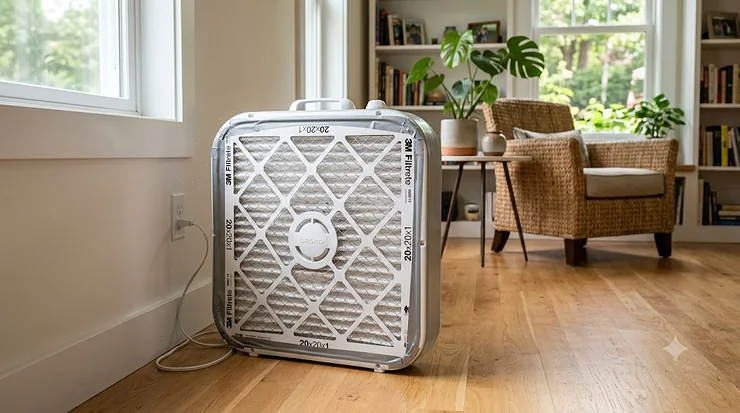
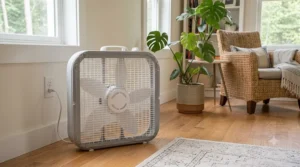
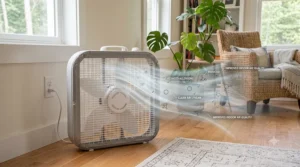
A box fan air filter is a homemade or hybrid air-cleaning setup that pairs a standard box fan with a pleated HVAC filter to pull smoke, dust, pollen, and other fine particles out of room air. The concept took off during wildfire seasons and the COVID-19 pandemic as a low-cost stand-in for a commercial air purifier, and it’s stuck around because, done right, it genuinely works.
If you’ve searched “box fan air filter,” you’ve probably landed in one of two camps: people who want to build their own setup with a basic fan and a furnace filter, and people who’d rather buy a fan that’s already built for the job. Both are reasonable. This guide covers seven real products that cover both approaches, plus the practical details — filter ratings, fire-safety quirks, and maintenance costs — that the product listings themselves tend to skip over.
A quick gut-check before we go further: a standard box fan was designed to move air, not to fight the back-pressure of a thick filter. That’s the single biggest thing people get wrong, and it’s why a couple of the picks below exist specifically to solve it.
✨ Don’t Miss These Exclusive Deals!
🔍 Take your indoor air quality to the next level with the picks below. Click through to check current pricing and availability — these are the same fans and filters DIY clean-air communities have been recommending for years.
Quick Comparison Table
| Product | Type | Filter Rating | Best For | Approx. Price Range |
|---|---|---|---|---|
| Lasko Air Flex FF305 | All-in-one fan + filter | MERV 10 (upgradable to 13) | No-DIY buyers | $40–$60 |
| Air King 9723 | Bare box fan | N/A (BYO filter) | Serious DIY builds | $30–$45 |
| Hurricane Classic Floor Mount | Bare box fan | N/A (BYO filter) | Max-airflow budget builds | $25–$35 |
| Filtrete 20x20x1 MERV 13 (2-pack) | Filter only | MERV 13 / MPR 1900 | Best tested performance | $25–$35 |
| Aerostar 20x20x1 MERV 13 (6-pack) | Filter only | MERV 13 | Bulk/Corsi-Rosenthal builds | $45–$60 |
| Amazon Basics 20x20x1 MERV 11 (6-pack) | Filter only | MERV 11 | Light dust/pollen, budget | $25–$35 |
| ZYRELYNX Filter Clips (2-pack) | Accessory | N/A | Tool-free, tape-free mounting | $10–$15 |
Looking at the table, the clearest split is between people who want a single purchase that just works (the Lasko FF305) and people assembling their own rig from a bare fan plus a filter. If you’re going the DIY route, the filter you pick matters more than the fan — a MERV 13 filter on a cheap fan will outperform a premium fan with a weak MERV 8–11 filter every time. Budget builders should also note that bare fans need a second purchase (filter, tape or clips) before they actually clean anything.
💬 Just one click — help others make better buying decisions too!😊
Top 7 Box Fan Air Filter Picks: Expert Analysis
1. Lasko Air Flex 20″ 2-in-1 Box Fan & Air Purifier (FF305)
The Air Flex stands out because it’s an actual engineered exception to the “box fans aren’t built for filters” rule. Most 20-inch box fans will run hot and strain their motors if you tape a dense filter to the back; Lasko built this one with a steel body and a weather-shield motor specifically so it can run continuously with a filter attached. It ships with a MERV 10 / CADR 42 pleated filter, and the back accepts any standard 20x20x1 filter up to MERV 13 if you want to upgrade the filtration later.
What this means in practice: you get a 2,000 CFM fan that won’t void itself by doing the one thing most box fans struggle with. For someone who doesn’t want to mess with duct tape and cardboard shrouds, that’s the whole appeal.
Owner feedback tends to praise the steel construction and the “set it and forget it” simplicity, with the most common complaint being that the included MERV 10 filter is fine for dust but underwhelming for wildfire smoke — which is exactly why the MERV 13 upgrade path matters.
✅ Pros: Purpose-built motor for filter use · Upgradeable to MERV 13 · Steel body, safety-fused plug
❌ Cons: Pricier than a bare fan · Stock filter is only MERV 10
Verdict: Best for people who want one purchase, no assembly, and room to upgrade filtration later. Typically priced in the $40–$60 range.
2. Air King 9723 20″ 3-Speed Box Fan
Air King built its reputation on commercial and shop fans, and that shows here — the housing is flatter and sturdier than most discount box fans, which matters a lot when you’re taping a filter to the back. A warped or flexing fan face creates gaps that let unfiltered air sneak around the filter instead of through it.
The practical upside: a flat, rigid mounting surface means your seal holds, your filter actually does its job, and you’re not refortifying the tape every few days. This is the fan DIY clean-air communities gravitate toward for exactly that reason.
It’s sold both on its own and bundled with a 6-pack of Aerostar MERV 13 filters, which is worth checking since the bundle often costs less than buying both separately.
✅ Pros: Rigid, flat face for a tight filter seal · 3 speeds · Bundle option with filters
❌ Cons: No built-in filter mount, so tape or clips are required · Basic styling
Verdict: Best for people building their own Corsi-Rosenthal-style setup who want a fan that won’t fight the filter seal. Typically $30–$45 for the fan alone.
3. Hurricane Classic Floor Mount Box Fan (2,400 CFM)
If raw airflow is your priority, this is the highest-CFM option on this list at 2,400 CFM. That number matters more than people realize once you add a filter: every filter you tape on creates resistance, and a high-output fan compensates for that resistance better than a weaker one.
In real-world terms, this is the fan to pick if you’re stacking multiple filters into a four-sided Corsi-Rosenthal cube, where airflow loss is the biggest performance killer. A lower-CFM fan in that same cube configuration will feel noticeably weaker.
✅ Pros: Highest CFM here, good for multi-filter cubes · 3 quiet speeds · Budget price
❌ Cons: Plastic housing flexes more than the Air King · No filter included
Verdict: Best for budget multi-filter builds where airflow loss is the main concern. Typically $25–$35.
4. Filtrete 20x20x1 MERV 13 Air Filter, MPR 1900 (2-pack)
Independent community testing from clean-air groups has repeatedly pointed to this specific filter as the one that actually performs at its rated MERV 13 level in real-world particle counts, not just on the box. That distinction matters because not every filter labeled MERV 13 measures the same in practice — pleat density and media quality vary by brand even at the same nominal rating.
The 3-month lifespan and “certified asthma and allergy friendly” rating are nice, but the real-world takeaway is simpler: if you only buy one filter for a single-filter box fan build, owner and tester consensus points here first.
✅ Pros: Best-tested real-world particle capture at MERV 13 · 3-month rated lifespan
❌ Cons: Costs more per filter than generic MERV 13 · Sold in small packs, so 4-filter cubes get pricey
Verdict: Best filter if performance is your top priority and you’re running a single-filter setup. Typically $25–$35 for two.
5. Aerostar 20x20x1 MERV 13 Air Filter (6-pack)
This is the practical choice for anyone building a 4-filter cube or who just wants enough filters on hand to swap every two to four weeks during smoke season without reordering constantly. Six filters at MERV 13 for a bulk price brings the per-filter cost down meaningfully compared to buying name-brand filters one at a time.
The trade-off is one worth knowing about generic-brand bulk filters generally: rated MERV 13 doesn’t always translate to identical real-world performance across brands, so if you’re filtering for wildfire smoke specifically, it’s worth keeping one Filtrete-style high-performer in rotation alongside the bulk pack.
✅ Pros: Lowest cost per filter at MERV 13 · Enough for a full 4-filter cube · USA-made media
❌ Cons: Bulkier to store · Real-world performance can vary slightly batch to batch
Verdict: Best for cube builds and stocking up ahead of smoke season. Typically $45–$60 for six.
6. Amazon Basics 20x20x1 MERV 11 Air Filter (6-pack)
MERV 11 sits a meaningful step below MERV 13 in fine-particle capture, and that gap is the whole story with this filter. It’s a solid, inexpensive choice for everyday dust, pet hair, and pollen — the kind of filtration most households actually need most of the year — but it’s not the filter to reach for during a smoke event or flu season, where the smaller MERV 13 particle range matters.
The honest take: this is the right pick if your goal is general air freshening on a tight budget, and the wrong pick if you bought a box fan filter specifically because of wildfire smoke or allergy severity.
✅ Pros: Cheapest option here · Wide availability, easy reorders · Fine for general dust/pollen
❌ Cons: Noticeably weaker than MERV 13 on smoke and ultrafine particles
Verdict: Best for light, everyday filtration on a budget — not a smoke-season pick. Typically $25–$35 for six.
7. ZYRELYNX Box Fan Filter Clips (2-set)
This one’s an accessory, not a fan or filter, but it solves a genuinely annoying problem: duct tape residue, slipping filters, and the mess of re-taping every time you swap a filter. The clips snap onto a flat-faced box fan and hold the filter in place without tools or adhesive.
For anyone changing filters every two weeks during heavy smoke or allergy season — which is the recommended cadence for catching the most ultrafine particles — not having to fight with tape every time is a real quality-of-life upgrade.
✅ Pros: Tool-free, mess-free filter swaps · Reusable · Works with most flat-front box fans
❌ Cons: Needs a flat fan face to grip properly · Doesn’t seal edges as tightly as a full tape wrap
Verdict: Best add-on for anyone doing frequent filter changes. Typically $10–$15.
How to Build a Box Fan Air Filter (Practical Usage Guide)
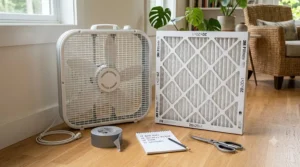
The simplest version takes about 10 minutes and roughly $25–$40 in materials:
- Pick your filter. A single 20x20x1 MERV 13 filter (like the Filtrete or Aerostar picks above) is enough for a basic build.
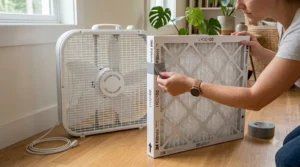
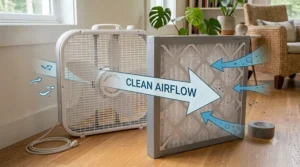
- Check the airflow arrow printed on the filter frame — it needs to point toward the fan, not away from it.
- Tape or clip the filter to the intake side of the fan, sealing all four edges so air can’t sneak around the filter unfiltered.
- Run it on a low or medium speed at first. Higher speeds move more air but also strain an unmodified fan harder against the filter’s resistance.
- Mark the install date on the filter or a piece of tape so you know when to swap it.
For a more powerful build, the four-sided “cube” version tapes four filters into a box shape with the fan sitting on top blowing air upward — this roughly quadruples the filtration surface area and is the configuration most associated with the original Corsi-Rosenthal box concept. 3M’s own Filtrete team publishes a similar step-by-step for both the single-filter and cube versions if you want a second reference.
One maintenance habit worth building in: check filters every two weeks during heavy smoke or allergy season, since electrostatic filters lose efficiency as they load up with particles, and a visibly gray filter is already past its useful life.
Real-World Scenarios: Which Setup Fits You
The wildfire-season renter: You need something that works now, doesn’t require tools, and won’t violate a no-modifications lease clause. The Lasko Air Flex FF305 is the cleanest fit — no tape, no cube, no visible DIY rig, and it accepts a MERV 13 upgrade filter when smoke rolls in.
The allergy household with pets: You’re swapping filters often and want low hassle plus solid fine-particle capture. Pair the Air King 9723 with the Filtrete MERV 13 filters and a set of ZYRELYNX clips — frequent swaps without the tape mess, at a performance level that actually handles dander and pollen.
The budget-conscious smoke-season prepper: You want maximum filtration per dollar and don’t mind a visible DIY rig. Build a 4-filter cube with the Hurricane Classic fan (for the airflow headroom) and the Aerostar MERV 13 6-pack (for the per-filter cost), keeping one Filtrete filter in reserve for the worst air-quality days.
Common Problems and How to Fix Them
Filter keeps falling off: Tape loses grip with heat and humidity. Switch to clips like the ZYRELYNX set, which hold mechanically instead of relying on adhesive.
Fan feels weaker after adding a filter: This is filter resistance, not a defective fan. Either move to a higher-CFM fan like the Hurricane Classic, or spread the load across multiple filters in a cube instead of one filter on a single fan face.
Fan runs hot or smells faintly of burning plastic: Stop using it immediately. Standard box fans — especially older ones — aren’t all rated for the back-pressure of a filter running continuously. This is the exact problem the Lasko FF305 was engineered to solve; if you’re using a bare fan, give it breaks and never run an aging fan unattended.
Odors linger even with a MERV 13 filter: Pleated filters trap particles, not gases or odors. A thin layer of activated-carbon cloth taped over the filter can help with smoke smell specifically, since carbon adsorbs odor molecules that pleated media passes right through.
How to Choose the Right MERV Rating
- MERV 8–10 — Fine for everyday household dust and larger pollen. Budget-friendly, low airflow resistance.
- MERV 11–12 — A step up for pet dander and finer pollen; still fairly easy on fan motors.
- MERV 13 — The community-recommended floor for wildfire smoke and fine particulate, including particles in the same size range research has linked to respiratory irritation. This is what most box fan air filter guides target.
- MERV 14+ — Higher capture but meaningfully more airflow resistance; only worth it on a fan engineered for it, like the Lasko FF305, or in a multi-filter cube that spreads the resistance out.
- Match it to your fan, not just your goal. A bare, unmodified box fan struggling under a MERV 14 filter can overheat; a cube spreads that load across four filters and handles it far better.
MERV ratings themselves come from an ASHRAE-developed standard, so the number means the same thing across brands — but as the Filtrete pick above shows, real-world performance at a given MERV number can still vary by manufacturer.
Built-In Purifier Fan vs. DIY Filter-and-Tape Setup
| Factor | Built-In (Lasko FF305) | DIY (Bare Fan + Filter) |
|---|---|---|
| Upfront cost | Higher ($40–$60) | Lower ($30–$45 fan + $25–$60 filter) |
| Setup time | None | 10 minutes to 1 hour (cube) |
| Filtration ceiling | MERV 13 (upgrade required) | MERV 13+ depending on filter |
| Motor safety margin | Engineered for it | Depends on fan age/quality |
| Aesthetics | Looks like a normal fan | Visible tape/cube setup |
The built-in option wins on convenience and motor safety margin — you’re not gambling on whether your specific fan can handle a filter long-term. The DIY route wins on raw filtration ceiling per dollar, especially in a multi-filter cube, but it puts more responsibility on you to pick a sturdy fan and maintain the seal. Neither is objectively “better” — it’s a convenience-versus-cost-per-filtration trade-off.
Common Mistakes When Buying or Building a Box Fan Air Filter
- Using an old, worn box fan. Aging motors are more prone to overheating under filter load, and the U.S. Consumer Product Safety Commission has flagged older fan models as a fire-risk category worth routine inspection.
- Skipping the edge seal. A filter that’s taped loosely lets air bypass it entirely, which defeats the purpose no matter how good the filter rating is.
- Buying MERV 13 and assuming “more is always better.” Higher ratings restrict airflow more; pairing a high MERV filter with a weak fan can do more harm (overheating, reduced output) than good.
- Forgetting replacement cadence. A loaded filter loses efficiency well before it looks visibly dirty in good lighting — set a reminder rather than eyeballing it.
- Assuming any flat surface filter is interchangeable. Actual filter dimensions are usually a hair under the labeled size (closer to 19.5–19.75 inches), which matters for a tight seal.
Safety Considerations: Fire Risk and Motor Strain
This is the part most product listings skip entirely. Running a box fan continuously with a filter attached changes its operating conditions from what it was designed for, and that’s worth taking seriously rather than ignoring.
A few concrete precautions: avoid using older box fans for continuous filtered operation, since aging motors and insulation are more failure-prone under load. Don’t run an unattended fan-filter rig overnight if you’re using a bare, non-purpose-built fan. Check that the cord and plug aren’t damaged before plugging in, and never overload the outlet it’s plugged into. If a fan ever smells warm, hot, or like burning plastic, unplug it and stop using it — that’s not normal operation.
This is exactly the gap the Lasko FF305 was built to close, since its motor and housing are rated for continuous filtered use. If you’re going the DIY route with a bare fan instead, treat it as a system you monitor periodically rather than a “set and forget” appliance.
Long-Term Cost and Maintenance
A single-filter DIY build runs roughly $50–$80 total to assemble, with ongoing filter costs of about $15–$30 every one to three months depending on which filter you choose and how heavy your air-quality season is. A four-filter cube costs more upfront (often $90–$140 in fan plus filters) but each filter set typically lasts longer per square inch of media since the airflow load is spread across more surface area.
The Lasko FF305 sits in between: a higher single purchase price, but you’re only ever replacing one filter at a time, and the engineered motor means you’re not risking a $30 fan burning out after a single smoke season of heavy use.
Whichever route you pick, the real long-term cost driver is filter replacement frequency — running a loaded, gray filter well past its useful life doesn’t save money, it just quietly reduces how much your setup is actually filtering.
Frequently Asked Questions
❓ Is a box fan air filter as good as a real air purifier?
❓ What MERV rating is best for a box fan filter?
❓ Can any box fan be used as an air filter?
❓ How often should I change a box fan air filter?
❓ How much does a DIY box fan air filter cost to build?
Conclusion
There’s no single “best” box fan air filter — there’s a best fit for your situation. If you want zero assembly and a fan that’s actually engineered to run with a filter long-term, the Lasko Air Flex FF305 is the easiest recommendation here. If you’re comfortable with a little DIY and want the lowest cost per unit of filtration, pairing the Air King 9723 or Hurricane Classic with a Filtrete or Aerostar MERV 13 filter gets you there for less money, especially in a four-filter cube. And if tape and mess are the dealbreaker, the ZYRELYNX clips fix that for under $15 no matter which fan or filter you land on.
Whatever you choose, the two things that actually move the needle on performance are filter rating (MERV 13 for smoke and fine particles) and seal quality (no gaps for air to sneak around). Get those two right and the rest is mostly personal preference.
✨ Don’t Miss These Exclusive Deals!
🔍 Ready to clean up your indoor air? Check current pricing on any of the seven picks above — availability and prices shift often, so it’s worth a quick look before you commit.
Recommended for You
- 7 Best Quiet Box Fans for Bedrooms in 2026
- Best Box Fan 2026: 7 Top Picks That Actually Move Air
- 7 Best Gable Attic Fans of 2026: Real Models, Ranked
Disclaimer: This article contains affiliate links. As an Amazon Associate, I earn from qualifying purchases. If you purchase products through these links, we may earn a small commission at no additional cost to you.
✨ Found this helpful? Share it with your friends! 💬🤗
