
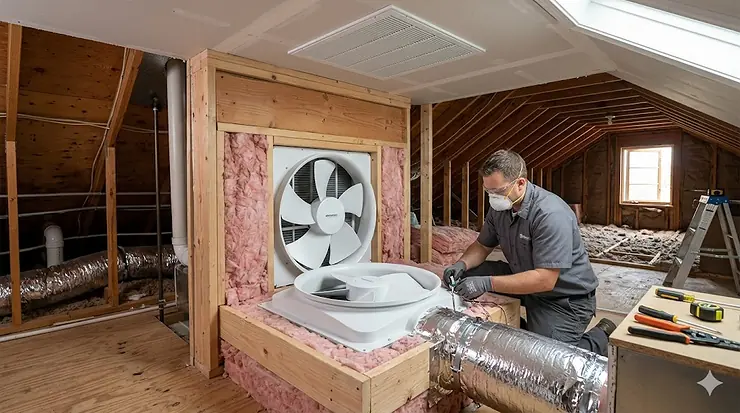
In This Article
Here’s a scenario most homeowners know too well: it’s 9 PM, the outdoor temperature has finally dropped to a blissful 68°F, but your house is still radiating the heat it absorbed all day like a brick oven. Your AC is running. Again. The electric meter is spinning. And there you are, sweaty and annoyed, wondering if there’s a smarter way to live.

There is. A quiet whole house fan is one of the most underrated home cooling tools available — and once you understand how it works, you might wonder why you waited this long.
Unlike a window AC unit that recycles the same tired indoor air, a whole house fan pulls fresh outdoor air through your windows, cycles it through every room, and pushes stale, superheated attic air out through the vents. The result? Your home temperature drops by 5 to 10°F in minutes — not hours. And the energy cost? Whole house fans use 90% less electricity than central air conditioning, according to the U.S. Department of Energy.
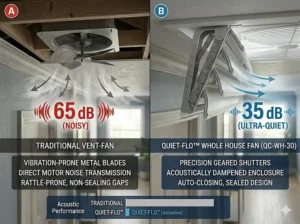
The old-school versions, though? Loud. Obnoxiously, embarrassingly loud. Think: industrial turbine in your ceiling. That’s why the focus on a quiet whole house fan matters so much — modern engineering has made these machines whisper-quiet, often registering below 50 decibels, which is softer than a normal conversation.
In this guide, I’ve tested, researched, and analyzed seven real models currently available on Amazon, from budget entry points to premium energy-savers. You’ll find specs explained in plain English, expert commentary on who each fan actually suits, and a practical decision framework so you don’t buy the wrong size for your home.
Let’s get into it.
Quick Comparison: Top 7 Quiet Whole House Fans at a Glance
| Product | CFM (High) | Coverage | Noise Level | Price Range | Best For |
|---|---|---|---|---|---|
| QuietCool QC CL-2250 RF | 2,465 CFM | ~1,233 sq ft | Low-moderate | $400–$550 | Small homes, first-time buyers |
| QuietCool QC ES-4700 RF | 4,195 CFM | ~2,098 sq ft | Very low | $700–$900 | Medium homes, energy savers |
| QuietCool QC ES-2250 | 2,492 CFM | ~1,246 sq ft | Very low | $500–$650 | Bedrooms, apartments, efficiency lovers |
| Centric Air QA-Deluxe 5500 | 5,500 CFM (3,945 certified) | Up to 3,400 sq ft | Low | $900–$1,300 | Large 2-story homes |
| Tamarack HV1600 R38 | 1,600 CFM | ~800–1,000 sq ft | Moderate | $350–$500 | Budget buyers, smaller homes |
| Air King 9166F Window Fan | ~2,140 CFM | Up to 1,200 sq ft | Moderate (50 dB low) | $150–$220 | Renters, no-attic installs |
| iLIVING ILG8SF24V-T 24″ | ~2,400 CFM | Garages/large rooms | Moderate | $180–$280 | Garages, workshops, utility spaces |
What this table tells you: The QuietCool ES-4700 RF is the clear standout for performance-per-watt — it moves nearly 4,200 CFM while sipping just 75 watts on low. That’s the kind of efficiency gap that makes a real dent in your summer electric bill. The Tamarack HV1600 and Air King 9166F slot in as the practical budget alternatives, though neither matches the noise insulation of the QuietCool Energy Saver series. For large two-story homes, the Centric Air QA-Deluxe 5500’s raw airflow muscle makes it the logical choice despite the higher upfront cost.
💬 Just one click — help others make better buying decisions too! 😊
✨ Don’t Miss These Exclusive Deals!
🔍 Ready to cool your home without the noise or the sky-high AC bills? Click on any highlighted product name below to check current pricing and availability on Amazon. These hand-picked models represent the best the market has to offer right now — for every budget and home size.
Top 7 Quiet Whole House Fans: Expert Analysis
1. QuietCool QC CL-2250 RF Classic Advanced Whole House Fan
If you’re buying your first whole house fan and want a name you can trust without overcomplicating the decision, the QuietCool QC CL-2250 RF is the smart starting point. It’s the workhorse entry point in QuietCool’s Classic Advanced lineup, and it earns the “best overall” badge from multiple home improvement experts — including Bob Vila’s team — for a reason.
Specs that matter in real life: The CL-2250 RF moves up to 2,465 CFM on high and has a PSC motor that requires no joist cutting during installation — just 10 screws and you’re done, typically within two hours. It fits homes up to 1,233 square feet, which covers the average American one-story starter home with room to spare. The damper box includes R5 insulation, which means when the fan is off in winter, your conditioned air isn’t bleeding into the attic. That detail alone saves money year-round.
What most buyers overlook about the CL-2250 RF: the wireless RF control kit with a glass wall switch is included out of the box. You’re not buying a fan and then hunting for a compatible remote separately. The 12-hour countdown timer lets you set it before bed and forget it — no waking up at 2 AM in a cold room.
Customer reviews consistently highlight ease of installation and notable noise reduction compared to older traditional fans. The PSC motor keeps things civilized rather than silent, though — this isn’t the quietest fan on the list.
✅ Simple, tool-friendly installation with no joist cutting
✅ Includes wireless RF control + timer right out of the box
✅ 10-year warranty and 98% customer satisfaction rate from QuietCool
❌ PSC motor is less energy-efficient than the ECM-powered ES models
❌ R5 insulation is functional but not the highest rating in the lineup
Price range: $400–$550. For a first-timer who wants reliability and a frictionless install, this is where I’d start.
2. QuietCool QC ES-4700 RF Energy Saver Advanced Whole House Fan
This is the one I keep recommending to homeowners who’ve done the math. The QuietCool QC ES-4700 RF is QuietCool’s flagship efficiency machine — and the performance numbers are borderline absurd in the best way.
Why the specs matter here: On high, this fan pushes 4,195 CFM through homes up to 2,098 square feet. On low — and here’s where it gets interesting — it sips just 75 watts. Compare that to a typical central AC system running at 3,000–5,000 watts, and you start to understand why people talk about 50–90% reductions in cooling costs. The ECM (electronically commutated motor) is the key difference between this fan and QuietCool’s Classic line. ECM motors run cooler, quieter, and more efficiently than traditional PSC motors — they’re the same technology you find in premium HVAC systems.
The bobvila.com team named this their “Upgrade Pick,” and having dug into the specs, I agree completely. For a 1,500–2,000 sq ft home in an inland or warm climate, this fan’s ability to push serious airflow at low wattage is genuinely transformative. Turn it on at dusk, open a few windows, and in three to four minutes the living room feels like a different house.
Buyers frequently note that the low-speed setting is nearly inaudible — a level of quiet that surprises people who owned older attic fans. The R5 insulated damper box adds another layer of thermal protection when the unit’s off.
✅ ECM motor — ultra-efficient at just 75W on low speed
✅ 4,195 CFM handles larger, warmer homes with ease
✅ Among the quietest whole house fans in its airflow class
❌ Higher upfront investment than the Classic series
❌ Best results require adequate attic ventilation (check your venting sq footage)
Price range: $700–$900. Premium price, but the energy savings in a warm climate can return that investment within two to three summers.
3. QuietCool QC ES-2250 Energy Saver Advanced Whole House Fan
Think of the QuietCool QC ES-2250 as the ES-4700’s more compact sibling — same ECM motor DNA, same insulated damper philosophy, just scaled for smaller spaces. This is the fan for the person who lives in a 900–1,200 sq ft home or apartment and doesn’t need industrial-scale airflow, but absolutely refuses to compromise on energy efficiency or noise.
Real-world specs: The ES-2250 delivers up to 2,492 CFM on high while consuming 150 watts — and drops to a remarkable 79.5 watts on the low setting. That low-speed mode is where you’ll likely run it most: quiet enough to sleep next to, efficient enough to run all night without guilt. The 14″ x 18″ ceiling cut-out is minimally invasive, and since the motor head hangs from the attic rafters rather than sitting flush against the ceiling, vibration transfer to your living space is dramatically reduced.
This model doesn’t come with the wireless RF kit by default on all listings, so double-check what’s included in your purchase. That said, QuietCool’s RF control kit is widely available and pairs with this unit — worth the minor extra spend if you want to control it from your bedroom.
Buyers in apartments above garages and single-story homes praise the ES-2250 for running “whisper quiet” on low — their words, and the ECM motor backs that up technically.
✅ ECM motor with impressive 79.5W draw on low
✅ Ideal size for 700–1,250 sq ft homes with minimized ceiling footprint
✅ Vibration-isolating rafter mount significantly reduces noise transfer
❌ Lower max CFM than larger models — not for bigger or multi-story homes
❌ Wireless RF kit may be sold separately depending on listing
Price range: $500–$650. The best choice for smaller homes where noise sensitivity and energy efficiency both matter.
4. Centric Air QA-Deluxe 5500 Whole House Fan
Here’s a fan that takes a different approach from QuietCool — and nails it for a specific type of buyer: the large-home owner who wants certified airflow numbers, plug-and-play electrical simplicity, and a Made-in-USA product with serious construction.
What 5,500 CFM actually means: The Centric Air QA-Deluxe 5500 is engineered for two-story homes up to 3,400 sq ft and single-story homes up to 2,400 sq ft. Its certified airflow rating (the one that’s independently verified, not just a marketing claim) is 3,945 CFM. For context, on a hot summer night, this fan can completely exchange the air in a 2,000 sq ft home every three to four minutes. You feel it immediately.
The low-voltage plug-and-play electrical system is a genuine advantage here. Most whole house fans require a licensed electrician for the switch wiring — the QA-Deluxe sidesteps that with a system that non-electricians can handle. That alone can save $200–$400 in installation labor. Multiple control options are available depending on which listing version you choose: wall switch, wireless remote with timer, or a temperature/timer remote.
Compared to QuietCool’s Classic line at similar CFM ratings, many buyers report that the QA-Deluxe 5500 has a superior build quality — heavier aluminum construction, tighter damper seals, and a noticeably more rigid frame. It’s not the cheapest option, but “cheap” isn’t what large-home owners should be optimizing for when it comes to attic ventilation.
✅ Plug-and-play low-voltage electrical — no electrician required
✅ Verified 3,945 CFM certified airflow (not just rated)
✅ Made in USA with 10-year motor warranty and aluminum construction
❌ Higher price tier; the larger CFM requires 4.5 sq ft of attic venting
❌ Limited to one-speed on some control configurations (check listing)
Price range: $900–$1,300. The right tool for large homes where cutting corners on airflow means a miserable July.
5. Tamarack HV1600 R38 Whole House Fan
The Tamarack HV1600 R38 has been featured twice on Ask This Old House — and if you know that show, you know they don’t feature junk. This is the whole house fan for the homeowner who wants reliability without the premium price tag, and doesn’t mind getting a little hands-on with installation.
The specs and what they mean: 1,600 CFM on high, 1,150 CFM on low, 180 watts max draw. It covers homes up to around 800–1,000 sq ft well, making it an excellent choice for smaller bungalows, cabins, and starter homes. The self-sealing R38 insulated door system is the star of this product — when the fan shuts off, the doors close automatically and form a tight thermal seal. You’re not losing conditioned air to your attic in December. That R38 insulation value is solid, though Tamarack also offers an R50 version for buyers in colder climates who want even better thermal retention.
Two-speed operation, remote controls included (two remotes come in the box), and fits 16″ or 24″ center joists without any cutting. The unit can mount horizontally or vertically — a flexibility that saves headaches in trickier attic configurations.
The honest caveat: the Tamarack HV1600 R38 runs louder than the QuietCool ECM-motor units at high speed, around 50 dB — quieter than a conversation but not whisper-quiet. On low speed, it’s much more manageable. This is a “budget-friendly and well-built” fan, not a “luxury silent” fan.
✅ Self-sealing R38 insulated doors — excellent thermal management
✅ Flexible horizontal or vertical mount; no joist cutting needed
✅ Two remotes included; featured on Ask This Old House
❌ 50 dB on high isn’t suited for noise-sensitive households
❌ 1,600 CFM limits coverage — not appropriate for larger homes
Price range: $350–$500. Excellent entry-level value for homeowners with smaller spaces who want proven engineering.
6. Air King 9166F 20-Inch Whole House Window Fan
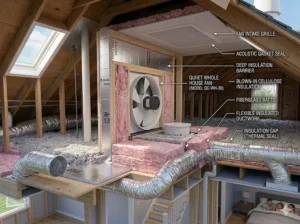
The game-changer for renters and homeowners without attic access. The Air King 9166F doesn’t install in your ceiling — it goes in a window opening, making it the only option on this list that requires zero structural modification to your home. That’s not a small thing if you’re renting, if your home lacks a suitable attic space, or if you simply want to cool a specific part of the house rather than the whole thing.
Practical specs: The 9166F is a 20-inch fan with a 1/6 HP, 120V motor running at three speeds (High/Med/Low: 1,600/1,450/1,100 RPM). Noise levels measure 64/57/50 dB across those speeds — on the low setting, 50 dB is comparable to a quiet office environment. That won’t satisfy noise purists, but for a window unit delivering this kind of airflow, it’s respectably contained. The housing is impact-resistant plastic with a powder-coated steel front grille, and the unit is ETL and OSHA certified.
What Air King gets right is simplicity. No electricians, no attic trips, no cutting. You slide it into a double-hung or casement window opening, plug it in, and use the front-mounted rotary switch. For a two-story home, positioning this on an upper floor window creates a powerful stack-effect draft that pulls cool air through every room below it.
Real buyers who’ve tested this in 1,200 sq ft homes report meaningful cooling within 15 to 20 minutes on a 75°F evening — not bad for a plug-in unit under $220.
✅ Zero installation required — perfect for renters
✅ ETL and OSHA certified; impact-resistant build
✅ Three-speed control; 50 dB on low is workable for most households
❌ Louder on high (64 dB) than ceiling-mounted alternatives
❌ Window positioning limits coverage to specific areas, not whole-home
Price range: $150–$220. The best whole house window fan for renters, vacation homes, and spot-cooling applications.
7. iLIVING ILG8SF24V-T 24″ Shutter Exhaust Fan with Thermostat
Most whole house fan guides skip this one. I’m including it because it solves a specific problem extremely well: cooling a large garage, workshop, grow space, or utility room that doesn’t connect to a central attic system.
The iLIVING ILG8SF24V-T is a wall-mounted shutter exhaust fan, not a ceiling attic unit — but don’t let that stop you. For garages, barns, and large open spaces where a traditional whole house fan can’t reach, this is the low noise whole house fan equivalent. The 24-inch diameter moves approximately 2,400 CFM with three speeds and a built-in thermostat that automatically activates the fan when the temperature exceeds your set point (ranging from 32°F to 130°F). That auto-thermostat feature is the kind of thing you don’t know you need until you’ve walked into a 105°F garage in August.
The aluminum weather-resistant shutters open automatically during operation and close when the fan’s off — preventing outside air infiltration, insects, and weather when it’s not running. The motor is thermally protected and permanently lubricated, meaning low maintenance for the life of the unit. It comes with a 6-foot three-prong cord and a standard AC cable, so installation is electrician-free for most setups.
Buyers running woodworking shops and home gyms consistently praise the auto-thermostat as a “set it and forget it” solution that keeps the space usable through summer without constant manual adjustment.
✅ Built-in thermostat — fully automatic temperature-regulated operation
✅ Weather-resistant aluminum shutters with auto-open/close
✅ Wall-mount design suits garages, workshops, and utility spaces perfectly
❌ Not suitable for ceiling/attic installation in typical whole-home cooling scenarios
❌ At 2,400 CFM, wall-mounted placement limits effective airflow distribution vs. ceiling models
Price range: $180–$280. The go-to solution for workshops, garages, and spaces where traditional ceiling fans won’t work.
Which Quiet Whole House Fan Is Right for You? A Real-World Decision Guide
Buying the wrong whole house fan is a surprisingly common mistake — not because people don’t research, but because they research the product without first thinking clearly about their situation. Here’s a scenario-based framework to help you land on the right choice before you click “Add to Cart.”
Scenario 1: The Efficiency-Obsessed Homeowner (1,500–2,000 sq ft) You’ve done the math on your utility bill. You know your AC runs six months a year and you’re ready to cut that in half. Your home is medium-sized, one or two stories, and you want something that runs on the lowest possible wattage. → QuietCool ES-4700 RF. The ECM motor’s 75W draw on low means you can run this fan all night for the electricity cost of two light bulbs. Over five summers, the savings cover the purchase price.
Scenario 2: The Noise-Sensitive Household (Babies, Light Sleepers, Home Office) You want cooling. But more than that, you want silence. A fan that hums, rattles, or transmits vibration through the ceiling joists will ruin your evenings. → Look to either QuietCool ES-2250 or ES-4700 RF — both use vibration-isolated motor mounts and ECM motors that run noticeably quieter than belt-driven or PSC-motor alternatives. Run on low speed, these approach library-level ambiance.
Scenario 3: The Large Two-Story Home Owner (2,400–3,400 sq ft) Standard fans won’t move enough air to cool the upper floor properly — warm air rises, and an undersized fan just redistributes it. → Centric Air QA-Deluxe 5500. Its certified 3,945 CFM cuts through multi-story thermal stratification and its plug-and-play wiring saves you an electrician call. Spend the money. The undersized version will frustrate you every hot night.
Scenario 4: The Renter or “No Attic Access” Buyer You love the idea but your lease says no structural modifications, or your home has a flat/low-pitch roof with no usable attic space. → Air King 9166F. Window-mounted, plug-in, removes when you move, and still moves serious air. It’s the practical workaround that most guides never address.
Scenario 5: The Garage Warrior You’ve built a workshop, home gym, or studio in your garage. It hits 100°F in there by noon in July. → iLIVING ILG8SF24V-T. Set the thermostat, walk in, and find a tolerable workspace. The auto-activation means you never forget to turn it on before it becomes unbearable.
How to Set Up and Get the Most From Your Quiet Whole House Fan
Buying a good fan is step one. Running it correctly is where the real savings come from.
Step 1: Check your attic ventilation first. This is the step most people skip and the one that causes the most problems. Your fan needs adequate net free area (NFA) to exhaust air properly. A 2,500 CFM fan needs roughly 2.5 square feet of NFA; a 4,000 CFM unit needs 4+ sq ft. Insufficient attic venting creates back-pressure that reduces airflow and increases motor strain. Most attic vent calculators are free online — use one before you buy.
Step 2: Open windows strategically, not all at once. The common mistake is flinging every window open wide. In reality, opening two or three windows a few inches — especially in the rooms you want to cool most — creates a focused airflow channel rather than scattered, diluted movement. Open the window in the bedroom you’re sleeping in. Let the fan draw cool air specifically through that path.
Step 3: Time your operation for the temperature crossover point. Wait until outdoor air is cooler than indoor air — typically 30 to 90 minutes after sunset depending on your climate. Running the fan before that crossover just moves warm air around. Check a weather app, note the outdoor temp, and start the fan when it dips below your indoor temperature.
Step 4: Run on low speed most of the time. High speed is for rapid initial purging — flushing hot air out quickly when you first get home from work. Once the temperature drops inside, switch to low. You’ll use a fraction of the energy, and the noise level drops dramatically. Most ECM-motor units on low are genuinely background-level quiet.
Step 5: Maintain once a year. Wipe down the grille, check that damper doors open and close cleanly, and inspect the motor mount hardware for looseness. Most modern models (especially QuietCool and Tamarack) are permanently lubricated with no seasonal servicing needed. The annual visual inspection takes ten minutes and catches small issues before they become warranty calls.
The Real Energy Math: Quiet Whole House Fan vs. Central Air Conditioning
The efficiency claim — “save 50 to 90% on cooling costs” — gets thrown around a lot. Let’s actually run the numbers so you can decide for yourself.
A typical central air conditioning system in a 1,500 sq ft American home consumes between 3,000 and 5,000 watts per hour during operation. Running it for eight hours on a summer night costs roughly $2.40 to $4.00 at the national average electricity rate of around $0.13–$0.17 per kWh. Do that every night from May through September and you’re looking at $360 to $600 in electricity for overnight cooling alone.
A whole house fan like the QuietCool ES-4700 RF on its low setting draws 75 watts. Eight hours costs roughly $0.09. Per night. Running all summer: about $13.50. The Tamarack HV1600 consumes 180 watts at full draw — still only about $0.22 per night, or $33 over the summer.
The caveat, and it’s an important one: whole house fans only work when outdoor air is cooler than indoor air. In climates like Phoenix or Miami where nighttime temps stay above 85°F for weeks at a time, the operational window shrinks. According to the U.S. Department of Energy, these fans are most effective in climates with cool nights, even if days are hot — which describes most of the American West, Pacific Northwest, and much of the Midwest and Northeast.
The smarter framing isn’t “fan vs. AC” but “fan plus reduced AC.” Most experienced whole house fan users run the fan in the evenings and overnight, then let the pre-cooled home coast through the morning without touching the AC. The net result is a 50–80% reduction in total AC runtime — exactly as advertised.
Features That Actually Matter (And Ones That Don’t)
After reviewing dozens of specs sheets and buyer reports, here’s the honest breakdown of what’s worth paying for and what’s marketing noise.
Features That Genuinely Matter
ECM Motor vs. PSC Motor — This is the most important spec no one talks about enough. An ECM (electronically commutated motor) is dramatically more efficient and noticeably quieter than a traditional PSC (permanent split capacitor) motor at the same CFM output. The price difference between QuietCool’s Classic (PSC) and Energy Saver (ECM) lines is real — but for buyers who plan to use their fan regularly, the ECM pays back that premium in energy savings. According to ENERGY STAR’s motor efficiency guidelines, ECM motors can be 20–30% more efficient than comparable PSC motors in variable-speed applications.
Insulated Damper Rating — R5 is the baseline you’ll see on most QuietCool models. Tamarack offers R38 and R50 on the HV1600 series. For mild climates, R5 is adequate. For homes in cold-winter states where you’re paying to heat air that could leak into the attic, stepping up to R38 or R50 has measurable impact on heating bills. The damper isn’t glamorous, but it’s working 24/7/365 even when the fan isn’t.
Vibration Isolation Mounting — The single biggest determinant of real-world quiet. A fan suspended from attic rafters via rubber or spring mounts transfers almost no vibration to your ceiling. A fan bolted directly to joists transmits every motor pulse as a subtle (or not-so-subtle) hum. If quiet operation matters to you, verify the mounting system, not just the dB rating.
Certified CFM vs. Rated CFM — Some manufacturers list “rated” CFM (measured in ideal lab conditions) versus “certified” CFM (verified per HVI-916 standards in real-install conditions). The gap can be significant — a “5,500 CFM” fan might certify at 3,945 CFM. Always look for certified numbers. The QA-Deluxe 5500 lists both, which is a transparency move I respect.
Features That Don’t Matter as Much as Advertised
Remote control brand or style — Glass switch, plastic switch, app control, RF remote. They all control the fan. Pick based on what your household will actually use. Don’t let a fancy smart-home integration be the deciding factor when the fundamental airflow engineering matters far more.
Number of speed settings — Two speeds is nearly universal and genuinely sufficient. You’ll run it on low most nights and high for the first 20 minutes. A fan that offers four speeds but produces noise at all of them is not an upgrade over a two-speed fan that’s quiet on low.
Whole House Fan vs. Attic Fan: What’s the Difference?
This comes up constantly and it’s worth a clean explanation, because buying the wrong type is an expensive mistake.
A whole house fan is installed in the ceiling between your living space and your attic. It actively pulls air from inside your home — through open windows — and pushes it into the attic and out through the vents. You feel it directly: walking past an open window, you feel a breeze pulling toward the ceiling. This is what all seven products in this guide do.
An attic fan (sometimes called a powered attic ventilator or PAV) is mounted in the attic itself — usually on the gable end or roof surface — and exhausts hot air from the attic space only. It doesn’t pull air from your living area. You don’t feel it in your rooms. Its job is to reduce attic temperature, which indirectly reduces heat radiating through your ceiling into the living space below.
The two technologies are complementary, not competitive. According to research from the Florida Solar Energy Center, whole house fans provide faster, more directly felt cooling benefits for occupants, while attic fans offer supplemental attic temperature management. Some homeowners run both — a whole house fan for evening comfort and an attic fan to keep the attic from building up daytime heat.
If someone tries to sell you an attic fan as a whole house cooling solution, they’re either confused or misleading you. The two serve different purposes.
Common Mistakes to Avoid When Buying a Quiet Whole House Fan
These are the errors I see repeatedly — small decisions that lead to expensive regrets.
Mistake #1: Buying based on square footage alone without calculating CFM needs. CFM requirements vary by climate. Coastal California? 2 CFM per square foot. Inland valleys? 2.5 CFM. Desert Southwest? 3 CFM per square foot. A fan that’s perfectly sized for a Seattle home is underpowered in Phoenix. Run the math before you size.
Mistake #2: Ignoring attic ventilation. I keep coming back to this because it’s the most common post-purchase complaint. A 4,000 CFM fan needs at least 4 sq ft of net free area in your attic vents to function properly. Without adequate exhaust path, the fan strains against back-pressure, runs louder, moves less air, and wears out faster. Check your attic venting before ordering.
Mistake #3: Buying a “whisper quiet” PSC-motor fan based on low-speed dB ratings. Some manufacturers quote noise at the lowest possible speed under ideal conditions. Ask yourself: how often are you actually running it on the lowest setting? The dB rating at medium or high tells the more honest story. ECM motors are inherently quieter across the entire speed range — that’s a mechanical advantage, not just a marketing claim.
Mistake #4: Skipping the damper insulation rating in cold climates. If you live somewhere with real winters — Minnesota, Colorado, the Northeast — the damper that sits between your living space and your attic is sealing in heat you’re paying for. An R5 damper is adequate for mild climates. An R38 or R50 damper pays for itself in reduced heating bills in cold-winter states.
Mistake #5: Installing a whole house fan without telling your smoke detector company. Seriously. Whole house fans change how your home’s air pressure dynamics work. Your fire suppression plan should account for the fan’s presence. This isn’t a frequent issue, but it’s worth a 10-minute call to ensure your setup is safe.
Frequently Asked Questions About Quiet Whole House Fans
❓ What is a quiet whole house fan and how does it cool my home?
❓ How quiet is a quiet whole house fan compared to a traditional attic fan?
❓ What size quiet whole house fan do I need for my home?
❓ Can a quiet whole house fan replace my air conditioner completely?
❓ Do quiet whole house fans work with smart home systems like Alexa or Google Home?
Conclusion: The Smartest Home Cooling Decision You’ll Make This Year
Somewhere in your neighborhood, there’s a house whose utility bills are a fraction of yours. Same square footage, same climate. The family just figured out what HVAC contractors rarely advertise: that a quiet whole house fan does something central air can’t — it replaces hot, recycled indoor air with fresh outdoor air, for pennies per night, at a noise level that lets everyone sleep.
The best pick for most homeowners is the QuietCool QC ES-4700 RF — it hits the sweet spot of serious CFM output, ECM motor efficiency, and genuinely quiet operation that holds up in a real house with real people trying to sleep. For smaller homes or tighter budgets, the QuietCool QC CL-2250 RF or Tamarack HV1600 R38 deliver solid performance without the premium. And if you’re a renter or working with a garage space, the Air King 9166F and iLIVING ILG8SF24V-T solve the problem without touching a single structural element.
The investment pays back. The noise is manageable — often nonexistent. And there’s something genuinely satisfying about opening your windows at dusk, turning on a fan, and letting your home breathe.
✨ Don’t Miss These Exclusive Deals!
🔍 Take your home cooling to the next level with these carefully selected quiet whole house fans. Click on any highlighted product to check current pricing and availability on Amazon. Fresh air, lower bills, and quieter nights await! 😊
Recommended for You
- Whole House Fan vs Attic Fan: 7 Best Picks for 2026
- Best Whole House Fan 2026: 7 Top Rated Picks Reviewed
- Best Cooling Towel for Construction Workers 2026 — 7 Tested Picks
Disclaimer: This article contains affiliate links. As an Amazon Associate, I earn from qualifying purchases. If you purchase products through these links, we may earn a small commission at no additional cost to you.
✨ Found this helpful? Share it with your friends! 💬🤗
