
In This Article
Picture this: it’s 9 PM, the outside temperature has finally dipped to a gorgeous 68°F, and your house is still radiating the heat of a pizza oven from a full day of sun. Your air conditioner has been running non-stop since noon. The electricity bill? Let’s not talk about it.
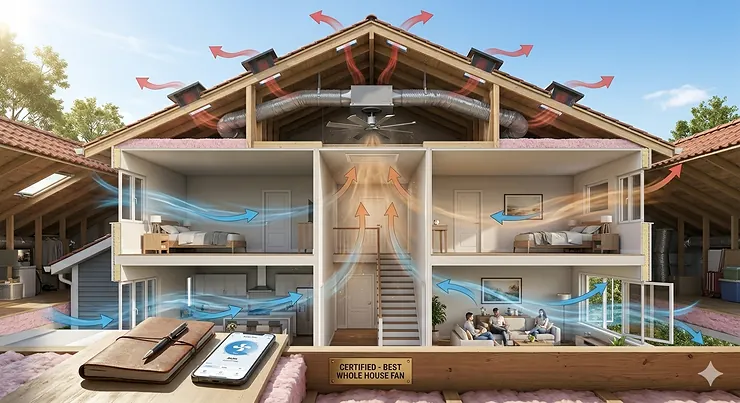
This is exactly the problem a best whole house fan was built to solve. Unlike a portable box fan or even a ceiling fan, a whole house ventilation fan works at a structural level — pulling cool evening air in through open windows, pushing scorching attic air out through your vents, and essentially pressure-washing your home with fresh outdoor air in a matter of minutes. Studies from the U.S. Department of Energy confirm that properly sized whole house fans can cut air conditioning energy use by 50–90%, a number that becomes very real when you see your July electricity bill shrink by $150 or more.
But here’s the catch: not every home ventilation system delivers on that promise. Size it wrong, pick the wrong motor type, or ignore your attic’s venting capacity, and you’ve got an expensive, noisy box in your ceiling that barely moves the needle. I’ve spent hours digging through specs, customer reviews, and real-world performance data so you don’t have to.
Below you’ll find seven of the best whole house fan models currently available on Amazon — from budget-friendly smart fans to powerhouse units built for 3,400-square-foot homes. I’ll break down what each one actually does in practice, who it’s best for, and where it falls short. Let’s get into it.
Quick Comparison Table: Best Whole House Fan at a Glance
| Product | CFM (High) | Home Coverage | Motor Type | Best For |
|---|---|---|---|---|
| QuietCool QC CL-7000 RF | 6,924 CFM | Up to 3,462 sq ft | PSC | Large homes, power users |
| QuietCool QC ES-4700 RF | 4,195 CFM | Up to 2,098 sq ft | ECM | Energy efficiency seekers |
| QuietCool QC CL-3100 RF | 3,126 CFM | Up to 1,608 sq ft | PSC | Mid-size homes, budget conscious |
| AC Infinity CLOUDWAY T12 | 1,600 CFM | Up to ~800 sq ft | EC | Smart home integration |
| AC Infinity CLOUDWAY S10 | 1,200 CFM | Up to ~600 sq ft | EC | Apartments, small homes |
| Tamarack HV1600 R50 | 1,600 CFM | Up to ~1,200 sq ft | PSC | Cold/mixed climates |
| QuietCool RM WHF-4.0-DG1 | 3,543 CFM | Up to ~1,770 sq ft | Multi-speed | Flat roofs, no-attic homes |
Looking at these numbers, the split between PSC and ECM/EC motors tells you a lot about where your money goes. The QuietCool Energy Saver line (ECM motor) uses as little as 75 watts at full speed — roughly the same as an old incandescent lightbulb — while the Classic PSC motors pull 400–770 watts. The trade-off? ECM motors cost more upfront and move slightly less raw air. For most suburban homes where cooling happens in the evening, the Energy Saver line wins on total cost of ownership. Go Classic if you need to cool down fast and often.
💬 Just one click — help others make better buying decisions too! 😊
Top 7 Best Whole House Fans: Expert Analysis
1. QuietCool QC CL-7000 RF — The Powerhouse Pick for Large Homes
If your home has more than 2,800 square feet and you’re tired of your AC running from noon to midnight, this is the machine built for you. The QC CL-7000 RF pumps out 6,924 CFM on high — enough to completely flush the air in a 3,462 square foot home in under five minutes. That’s not marketing language; that’s physics.
The 769-watt PSC motor drives a ducted system with an R5 insulated damper box, meaning the unit seals off your living space from the attic when it’s not running. This is more important than most buyers realize. Old-style whole house fans left a gaping thermal hole in your ceiling all winter. The R5 damper doors close automatically and keep conditioned air in your home when you’re not ventilating.
What most buyers overlook about this model is the ceiling cutout requirement: just 14″ × 36″. For a fan moving nearly 7,000 CFM, that’s a surprisingly compact footprint. Installation typically runs 1–2 hours without cutting into joists, and it fits standard 16″ or 24″ on-center framing.
Customer reviews consistently praise the speed of the whole-home temperature drop — most users report feeling the difference within 3–4 minutes of startup. The wireless RF controller includes a 12-hour countdown timer, which is genuinely useful for running the fan through the night without worrying about morning cold air flooding in.
The honest downside: this is a PSC motor. At 769 watts on high, it’s not sipping electricity — it’s gulping it. For humid climates where outdoor air isn’t always cooler than indoor air, you may not run it as often, which reduces the ROI compared to a smaller, more targeted unit.
✅ Massive 6,924 CFM airflow for large homes
✅ R5 insulated damper doors — no thermal leakage in winter
✅ Compact 14″×36″ ceiling cutout, fits standard framing
❌ PSC motor draws 769W — not ideal for hourly all-night use
❌ Overkill (and overspend) for homes under 2,000 sq ft
Price range: $900–$1,100 | Value verdict: Justified investment for large homes where summer AC bills regularly exceed $300/month.

2. QuietCool QC ES-4700 RF — The Smart Play for Energy-Conscious Homeowners
Here’s where things get interesting from a value standpoint. The QC ES-4700 RF moves 4,195 CFM using as little as 75 watts — that’s a ratio that would make an electrical engineer smile. For comparison, a standard window AC unit pulls 1,000–1,500 watts to cool a single room. This fan cools your whole 2,098-square-foot home for less electricity than keeping a bathroom light on.
The ECM (Electronically Commutated Motor) technology is the key differentiator from the Classic line. ECM motors adjust speed digitally with precision, which translates to lower noise, less heat generation, and dramatically longer motor life compared to PSC alternatives. Think of the difference between a carbureted engine and modern fuel injection — both get you moving, but one is just smarter about it.
The RF wireless controller handles two speeds and a 12-hour countdown timer. Some buyers wish it had a variable-speed dial, and that’s a fair critique — the two-speed setup is simple and practical, but it doesn’t give you the granular control of the AC Infinity units further down this list.
Where the ES-4700 shines brightest is for the mixed-climate or budget-savvy homeowner who wants to run their whole house fan several hours every night. At 75 watts, you can run it 8 hours and spend about 6 cents in electricity at average U.S. rates. That math compounds beautifully over a cooling season.
✅ Ultra-efficient ECM motor — as low as 75 watts at full speed
✅ R5 insulated damper, 10-year manufacturer warranty
✅ Covers up to 2,098 sq ft — ideal for the average American home size
❌ Two-speed only — no variable speed control
❌ Higher upfront cost than Classic series for similar CFM
Price range: $750–$950 | Value verdict: Best long-term ROI of any ducted fan in this roundup if you plan to run it nightly.
3. QuietCool QC CL-3100 RF — The Goldilocks Fan for Mid-Size Homes
The CL-3100 RF occupies that sweet spot where most American homeowners live — a home between 1,400 and 1,600 square feet, a moderate budget, and a desire for meaningful cooling without overthinking it. At 3,126 CFM on high, it covers up to 1,608 square feet comfortably, and the two-speed wireless RF controller keeps operation genuinely simple.
The PSC motor here draws more than the ECM-based ES series, but it’s still a reasonably efficient unit for evening ventilation. Where QuietCool consistently earns its reputation is in the build quality: the R5 insulated damper box is standard across the line, and a 10-year warranty backs the whole assembly. That’s a level of confidence you rarely see from ventilation manufacturers.
In my assessment, this is the right fan for someone who’s upgrading from an old attic fan and wants a meaningful quality jump without spending four digits. The CL-3100 installs in a standard ceiling cut of 14″ × 24″, and most moderately handy homeowners can complete the job in an afternoon.
Customer feedback highlights the noticeably quieter operation compared to traditional belt-driven whole house fans — a common concern that QuietCool’s ducted design effectively addresses by physically separating the motor from the ceiling opening.
✅ Right-sized airflow for 1,400–1,600 sq ft homes
✅ Trusted 10-year warranty, R5 insulated damper doors
✅ Simpler installation than larger models — 14″×24″ ceiling cut
❌ PSC motor — less efficient than ES series over long nightly runs
❌ Limited to two speeds; no app or smart home integration
Price range: $600–$750 | Value verdict: Excellent value for straightforward mid-size home cooling without over-engineering the solution.
4. AC Infinity CLOUDWAY T12 — The Smart Home Fan That Actually Earns Its Wi-Fi Price Tag
Let’s be honest: “smart” home products often feel like they added Wi-Fi to something and doubled the price. The AC Infinity CLOUDWAY T12 is a genuine exception. This 1,600 CFM ceiling-mount whole house attic vent fan runs on a PWM-controlled EC motor — 50,000-hour rated lifespan, IP-44 dust/moisture resistance — and pairs it with a temperature/humidity controller that connects to the AC Infinity app via Wi-Fi.
What does that mean practically? You can set the fan to activate automatically when indoor temperature exceeds 78°F and outdoor humidity drops below 60%. You can view historical climate charts, export CSV data (yes, really), schedule cooling windows around your sleep schedule, and receive notifications on your phone. For the data-driven homeowner, this is genuinely useful. You’re not just cooling your house — you’re learning how it breathes.
The 12″ duct size moves 1,600 CFM at peak, which the spec sheet treats as a limitation but is actually quite intentional. The CLOUDWAY is designed for smaller homes and apartment-adjacent applications, or as a supplementary unit alongside a larger primary system. At 48 dBA operating noise, it’s quieter than most conversations.
The gravity-fed insulated damper shutters close automatically when the fan cuts off, preventing attic air from drifting back in. Dual ball bearings and the IP-44 rating mean this unit handles humid attic environments without degrading quickly — a real concern with cheaper alternatives.
The spec sheet won’t tell you this, but the AC Infinity app is genuinely one of the better pieces of software in the home ventilation space. It’s stable, regularly updated, and gives you control that most dedicated HVAC controllers can’t match at this price.
✅ Full Wi-Fi smart control with automation, scheduling, historical data
✅ EC motor — energy efficient, extremely long service life
✅ IP-44 rated, dual ball bearing construction — built for attic conditions
❌ 1,600 CFM limits it to smaller homes or supplemental use
❌ Requires smartphone for advanced features — not ideal for tech-averse buyers
Price range: $200–$280 | Value verdict: Outstanding smart home value; pair two of them in a larger home for full-house coverage with app-controlled zoning.
5. AC Infinity CLOUDWAY S10 — The Entry Point That Doesn’t Compromise on Quality
For renters converting a suitable attic access, small homeowners, or anyone wanting to test the whole house fan concept before committing to a major installation, the CLOUDWAY S10 delivers 1,200 CFM with a 10-speed wireless remote controller and the same EC motor DNA as its bigger sibling — without the Wi-Fi overhead.
The 10-inch duct size and 9.8″ × 15.1″ × 11.3″ form factor make this one of the easier whole house fan installations you’ll find. The 10-speed wireless remote lets you dial from a whisper-quiet trickle (great for sleeping) all the way up to full 1,200 CFM throughput. At 48 dBA max, it’s comparable to library noise levels.
What impresses me most about the S10 is the build spec relative to price. The IP-44 moisture resistance, dual ball bearings, 50,000-hour motor life, and backup memory on the remote controller (it remembers your last setting after a power outage) — these are features you’d expect on units costing twice as much. AC Infinity clearly builds to a higher standard than the price suggests.
Honest caveat: 1,200 CFM is the right size for roughly 600 square feet of living space in a moderate climate, or up to 900 square feet in a cooler coastal region. Don’t expect this to cool a 2,000-square-foot inland desert home. Used appropriately — for a smaller home or as zone ventilation for a master bedroom suite — it’s excellent.
✅ 10-speed wireless remote — genuine speed versatility
✅ Premium EC motor construction at an accessible price point
✅ Compact form factor for easier attic installation
❌ 1,200 CFM is insufficient as a whole-home solution for larger spaces
❌ No Wi-Fi or app integration (upgrade to T10/T12 for that)
Price range: $130–$170 | Value verdict: Best entry-level whole house fan on the market; exceptional build quality for the price.

6. Tamarack Technologies HV1600 R50 — The Cold-Climate Specialist
Here’s a fan that most online “best of” lists overlook — and that omission costs some homeowners real money. Tamarack’s HV1600 R50 solves a problem that every other fan on this list handles with varying degrees of mediocrity: what happens in winter?
Standard whole house fans — even those with insulated dampers — lose significant heat through their ceiling openings during cold months. Tamarack’s solution is their patented self-sealing insulated door design with R50 insulation (compared to the R5 dampers on QuietCool’s units). R50 is the insulation level you’d find in a well-built attic floor. When the fan is off, those doors snap shut and you essentially get a thermally sealed attic floor, preventing the cold-air infiltration that undermines energy efficiency all winter long.
The fan itself moves 1,600 CFM on high and 1,150 CFM on low — modest by large-home standards, but entirely appropriate for homes up to about 1,200 square feet in mild climates or 800 square feet in hotter inland regions. The two-speed setup is simple and reliable.
Where the HV1600 R50 earns its stripes is in four-season climates — the Midwest, Northeast, Pacific Northwest — where you’re cooling in summer but paying serious heating bills in winter. The R50 doors pay for themselves in heating energy savings alone, and they’ve been featured on “Ask This Old House” for that reason.
✅ R50 insulated self-sealing doors — exceptional winter thermal performance
✅ Featured on national home improvement media — independently validated quality
✅ Mounts horizontally or vertically — flexible attic installation
❌ 1,600 CFM limits whole-home cooling to smaller or cooler-climate homes
❌ Pricier per CFM than QuietCool alternatives — you’re paying for the insulation premium
Price range: $350–$500 | Value verdict: The only logical choice for homeowners in cold-winter climates who run their heating system seriously.
7. QuietCool RM WHF-4.0-DG1 — The Fix for Homes Without an Attic
About 10% of American homes have flat roofs, cathedral ceilings, or structural configurations that make standard attic-mount whole house fans impossible to install. Until recently, those homeowners were stuck with window ACs and wishful thinking. The QuietCool RM WHF-4.0-DG1 Roof Mount Whole House Fan changes that equation.
Installed directly through the roof rather than the attic floor, this unit pushes up to 3,543 CFM using a three-speed motor at as low as 219 watts on its most efficient setting. The included 24″ damper grille sits flush with the roofline, and the wireless RF controller handles everything from inside the home. Coverage extends to approximately 1,770 square feet — respectable for a specialty unit in this category.
The practical installation reality: you’ll need a roofing professional for the penetration, which adds cost compared to standard attic fans. Factor in $300–$600 for professional installation on top of the unit price. But for homes where the alternative is no whole house ventilation at all, that’s a cost worth paying. QuietCool’s quality control and 10-year warranty back up the investment.
Customer reviews from flat-roof homeowners in California and Arizona — exactly the demographic this product targets — consistently emphasize how dramatically the unit changes their home’s feel during evening ventilation hours. Several reviewers noted a move from running AC until 11 PM to shutting it off by 8 PM.
✅ Purpose-built for flat roofs and no-attic configurations
✅ 3,543 CFM — serious airflow despite the specialty mounting
✅ Three-speed wireless RF control, 10-year QuietCool warranty
❌ Requires professional roof penetration — higher total installation cost
❌ Single price tier with no size variation — larger flat-roof homes may need two units
Price range: $700–$900 (unit only; add $300–$600 for professional installation) Value verdict: The only premium option for flat-roof homes; consider it a non-negotiable if your home fits the profile.
How to Choose the Right Whole House Fan: A Practical Sizing Guide
This is where most buyers go wrong — and where a $600 fan can either be the best investment you made this decade or a dust collector in your attic. Here are the numbers that actually matter:
Step 1 — Calculate your CFM requirement. Multiply your home’s square footage by the appropriate CFM multiplier: 2x for coastal or mountain climates, 2.5x for moderate inland regions, 3x for hot desert climates. A 1,500 sq ft home in Phoenix needs 4,500 CFM. The same home in Portland needs 3,000 CFM. Undersizing by even 1,000 CFM can add 15–20 minutes to your cooldown time and reduce the whole-home exchange effect.
Step 2 — Check your attic venting. The U.S. Environmental Protection Agency recommends adequate ventilation to maintain healthy indoor air quality, and whole house fans depend on it structurally. You need roughly 1 square foot of net free vent area (NFVA) for every 750 CFM of fan capacity. A 4,500 CFM fan needs 6 square feet of NFVA. If your attic is under-vented, the fan creates negative pressure and backdrafts — defeating the whole purpose.
Step 3 — Choose your motor type. ECM motors (QuietCool ES series, AC Infinity CLOUDWAY) cost more upfront and draw less power — ideal if you plan to run the fan every night. PSC motors (QuietCool CL series) cost less upfront and draw more power — better for occasional use or when raw CFM capacity matters more than efficiency.
Step 4 — Consider your winter climate. Cold-climate homeowners (below 40°F in winter) should strongly prioritize R50 insulated dampers like the Tamarack HV1600 R50 or confirm their chosen QuietCool model’s R-value before purchasing.
Step 5 — Confirm ceiling framing. Most fans fit 16″ or 24″ on-center joists without modification. Verify before ordering — some larger fans require a ceiling opening that may land across a joist.
Step 6 — Factor in controls. Do you want Wi-Fi automation? Go AC Infinity T-series. Simple wireless timer? Any QuietCool RF model. A built-in thermostat that runs the fan automatically? Look at models with integrated temperature controllers.
Step 7 — Budget total cost of ownership. Unit price + installation labor ($200–$600 for standard installs) + estimated annual electricity cost (calculate: watts × hours per day × 365 × $0.16/kWh) gives you the real five-year number.
Real-World Scenarios: Which Fan Fits Your Life?
Abstract specs are one thing. Let’s make this concrete.
Scenario 1: The Energy Bill Fighter. You own a 1,800-square-foot home in Sacramento. Summer electric bills hit $380 monthly. You run your AC from 2 PM to midnight. The right call: QuietCool QC ES-4700 RF. At 75 watts minimum draw and 4,195 CFM, you start the fan at 8 PM, open the bedroom windows, and let it run until 6 AM. Your AC comes on two hours later instead of noon. Annual savings: $800–$1,200. Payback period: under 12 months.
Scenario 2: The Tech-Forward Renter. You’re in a 650-square-foot apartment above a garage with attic access. You want smart automation, quiet operation, and nothing that requires an electrician. The play: AC Infinity CLOUDWAY T12. Set an automation rule: fan on when indoor temp exceeds 76°F and outdoor humidity is below 65%. Wake up to a cooled space without touching your thermostat.
Scenario 3: The Cold-Climate Homeowner. You have a 1,100-square-foot Cape Cod in Vermont. You need summer cooling but you also spend $1,800 a year on heating. A fan that leaks cold air through an R5 damper all winter is a false economy. Tamarack HV1600 R50 is the obvious answer. The R50 insulated doors pay for themselves in heating savings within two winters, completely independent of the summer cooling benefit.
Scenario 4: The Large-Home Commitment. You own a 3,200-square-foot suburban home in Atlanta. You’re spending $500+ monthly on AC in summer. This is a whole house fan problem worth solving at scale. QuietCool QC CL-7000 RF is the only unit in this roundup with enough CFM to actually pressure-flush a home this size. At 6,924 CFM, it exchanges the air in 3,462 square feet in under five minutes. Pair it with strategic window placement (open upstairs windows more than downstairs) and you’re cooling the whole structure, not just circulating air.
Scenario 5: The Flat-Roof Challenge. You have a mid-century modern with a low-slope roof and no traditional attic. Your neighbors with conventional homes have whole house fans; you have envy. QuietCool RM WHF-4.0-DG1 solves this. Budget for professional installation but don’t overthink it — this is a purpose-built solution for an underserved home type.

Whole House Fan vs. Air Conditioning: The Honest Comparison
Let’s not pretend this is a competition without nuance. Here’s what actually matters when deciding how these two technologies fit together.
| Factor | Whole House Fan | Central Air Conditioning |
|---|---|---|
| Purchase & Installation | $300–$1,500 | $5,000–$12,000 |
| Operating Cost (8 hrs/day) | $0.06–$0.99/day | $3–$8/day |
| Works When: | Outdoor air < Indoor air | Any outdoor temperature |
| Improves Indoor Air Quality | ✅ Yes — constant fresh air exchange | ❌ Recirculates indoor air |
| Effective in Humid Climates | ⚠️ Partially | ✅ Yes — dehumidifies |
| Installation Complexity | Moderate DIY | Professional only |
The takeaway from this table: these aren’t competing systems — they’re complementary ones. According to the U.S. Department of Energy’s ventilation guidelines, whole house fans work best when outdoor temperatures are cooler than indoor temperatures, typically in evenings and early mornings. In humid Southern climates (think Florida, Louisiana, coastal Texas), outdoor humidity can make whole house fans uncomfortable even when temperatures drop — for those regions, use the fan selectively and rely on AC during humid peak periods.
In California, the Pacific Northwest, the high desert Southwest, Colorado, and much of the Midwest and Northeast, whole house fans are transformatively effective. Whole house ventilation fans are now required by California’s Title 24 energy code in new construction — regulatory endorsement that speaks to their real-world performance.
Features That Actually Matter (And Three That Don’t)
Features that genuinely affect your experience:
- CFM rating — The single most important spec. Get this wrong and nothing else matters.
- Motor type (ECM vs PSC) — ECM wins on long-term cost; PSC wins on raw airflow per dollar.
- Damper insulation R-value — Critical in cold climates; matters less in Phoenix.
- Noise level (dBA) — Anything above 55 dBA will wake light sleepers; aim for 48–52 dBA or lower.
- Warranty length — 10 years (QuietCool) vs. 1–3 years (budget alternatives) is a meaningful difference.
Features that sound impressive but rarely matter:
- Number of speeds — Two speeds covers 95% of real-world use cases. Ten speeds is nice but not game-changing for a fan you’re either running or not running.
- Exact CFM marketing numbers — Published CFM is measured in ideal lab conditions. Real-world attic resistance and window opening positions affect actual airflow. Think of advertised CFM as a ceiling, not a guarantee.
- Color of the grille — Seriously, it’s in your hallway ceiling. White or off-white works for everyone.
Long-Term Cost & Maintenance: What the 5-Year Picture Looks Like
A whole house fan is a remarkably low-maintenance appliance. Here’s the honest maintenance reality:
Annual tasks: Clean the ceiling grille (remove, wash, reinstall — 10 minutes). Inspect damper doors for dust buildup that could prevent full closure. In dusty climates, spray compressed air into the motor housing annually.
Every 3–5 years: For PSC motors, inspect and lubricate bearings if accessible. ECM and EC motors are sealed bearing designs — they require no lubrication.
Replacement parts: Damper doors, grille assemblies, and remote controllers are available for all QuietCool and Tamarack models. AC Infinity offers controller replacements as well. This matters at year 8 when a controller fails — a $40 replacement beats a full unit swap.
Cost of running a whole house fan for 5 years (assuming 4 months of nightly 8-hour operation):
- AC Infinity CLOUDWAY S10 at 48W: ~$55 total electricity over 5 years
- QuietCool ES-4700 at 75W: ~$90 total electricity over 5 years
- QuietCool CL-7000 at 769W: ~$900 total electricity over 5 years
The ECM/EC motor advantage compounds dramatically over time. A CL-7000 owner running their fan every night pays roughly 10x more in electricity than an ES-4700 owner — which is worth knowing before you default to the most powerful unit.
Common Mistakes When Buying a Whole House Fan
1. Buying for square footage alone, ignoring climate. A 2,000-square-foot home in Tucson needs 6,000 CFM. The same home in Seattle needs 4,000 CFM. The multiplier matters enormously — don’t skip Step 1 of the sizing guide above.
2. Ignoring attic venting before installation. I’ve seen homeowners install a powerful whole house fan only to find it creates backdrafts through their water heater and furnace flues — a genuine carbon monoxide risk when combustion appliances are present. Before installing any whole house fan, confirm your attic has adequate NFVA, and consult ASHRAE’s ventilation standards if you have gas appliances in an attached space.
3. Choosing a fan that’s too powerful for a sealed modern home. Homes built after 2005 are typically well-sealed with vapor barriers and tight construction. Oversized fans can create enough negative pressure to pull backdrafts. Match CFM to your home’s actual leakage characteristics — when in doubt, size down slightly and open more windows.
4. Installing without opening enough windows. A whole house fan requires airflow intake through open windows. Too few windows open means too little intake, which creates excessive negative pressure and strain on the motor. Rule of thumb: open at least 2 square feet of window area per 1,000 CFM of fan capacity.
5. Buying the cheapest unit without checking the warranty. Generic whole house fans from unfamiliar brands often carry 1-year warranties and use low-grade bearings that fail in 3–5 years. The QuietCool 10-year warranty and Tamarack’s track record exist for a reason — this is an appliance you’re literally building into your ceiling, and longevity matters.
Frequently Asked Questions
❓ What size whole house fan do I need for a 2,000 square foot home?
❓ Can a whole house fan replace air conditioning completely?
❓ How much attic venting do I need for a whole house fan?
❓ Are whole house fans noisy?
❓ Can I run a whole house fan all night while sleeping?
Conclusion
Choosing the best whole house fan comes down to three numbers and one honest question about your climate. The three numbers: your home’s square footage, the CFM you need to match it, and the R-value of the insulated dampers you need to prevent winter heat loss. The honest question: are your evenings reliably cooler than your house? If yes, a whole house fan is one of the smartest dollars-per-degree-of-cooling investments you can make.
For most homeowners in moderate climates, the QuietCool QC ES-4700 RF is the pick — it’s right-sized for the average American home, runs on near-nothing electricity thanks to its ECM motor, and carries a 10-year warranty that backs up its quality claims. Large-home owners should go straight to the QC CL-7000 RF without overthinking it. Cold-climate buyers in the Midwest and Northeast owe it to themselves to look hard at the Tamarack HV1600 R50 before committing to anything with thinner insulation. And if you’re a flat-roof homeowner who’s felt left out of the whole house fan conversation — the QuietCool RM WHF-4.0-DG1 was made for you.
Every one of these models is a legitimate alternative to running central AC for two hours of evening cooling. Your electricity bill will notice. Your lungs — breathing genuinely fresh outdoor air instead of recirculated indoor air — will notice too. According to the EPA’s Indoor Air Quality resource center, indoor air can be 2–5 times more polluted than outdoor air. A whole house fan doesn’t just cool your home. It flushes it.
✨ Don’t Miss These Exclusive Deals!
🔍 Take your home cooling to the next level with these carefully selected products. Click on any highlighted item to check current pricing and availability on Amazon. These fans will help you create a cooler, fresher, and more energy-efficient home your family will actually love.
Recommended for You
- Best Cooling Towel for Construction Workers 2026 — 7 Tested Picks
- Best Extra Large Cooling Towel: 7 Top Picks for 2026
- Best Cooling Towel for Running in 2026: 7 That Actually Work
Disclaimer: This article contains affiliate links. As an Amazon Associate, I earn from qualifying purchases. If you purchase products through these links, we may earn a small commission at no additional cost to you.
✨ Found this helpful? Share it with your friends! 💬🤗
