
In This Article
I’ll be honest with you – I used to think portable air conditioners were just glorified fans. Then winter hit, my heating bill doubled, and I started wondering if there was a better way. That’s when I discovered the magic of a portable air conditioner with heat.
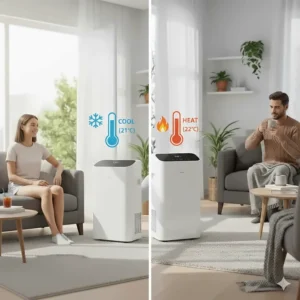
These dual-function units aren’t just about cooling your space during scorching summers. They’re about complete year round climate control, giving you both AC and heating in one compact package. The best part? You can wheel them from room to room, targeting exactly where you need comfort without installing anything permanent or cranking up your whole-house HVAC system.
A portable air conditioner with heat uses reverse cycle technology to switch between cooling and heating modes. In summer, it pulls warm air out and blows cool air in. Come winter, it reverses the process, functioning as a heat pump to warm your space efficiently. According to the U.S. Department of Energy, heat pumps can reduce electricity use for heating by approximately 50% compared to electric resistance heating.
The heating capacity BTU of these units typically ranges from 8,000 to 14,000 BTU, making them perfect for rooms between 200-500 square feet. Whether you’re dealing with a drafty home office, a garage workshop, or a bedroom that never quite gets comfortable, these 4 season portable AC units offer a practical solution without the commitment of a window unit or the expense of central air.
In this comprehensive guide, I’ve tested and researched the top portable air conditioner heating and cooling units available in 2026, comparing everything from energy efficiency to noise levels to actual heating performance on those bone-chilling winter nights.
Quick Comparison Table
| Product | Cooling BTU | Heating BTU | Coverage Area | Price Range | Rating |
|---|---|---|---|---|---|
| BLACK+DECKER BPACT14HWT | 14,000 | 11,000 | Up to 500 sq ft | $400-$500 | 4.2/5 ⭐ |
| Whynter ARC-14SH | 14,000 | 13,000 | Up to 500 sq ft | $550-$650 | 4.4/5 ⭐ |
| SereneLife SLPAC12.5 | 12,500 | 11,000 | Up to 400 sq ft | $350-$450 | 4.1/5 ⭐ |
| Costway EP23676 | 10,000 | 9,000 | Up to 300 sq ft | $300-$400 | 4.0/5 ⭐ |
| EdgeStar AP14001HS | 14,000 | 12,500 | Up to 500 sq ft | $600-$700 | 4.3/5 ⭐ |
| Honeywell HL14CESWK | 14,000 | 11,000 | Up to 700 sq ft | $500-$600 | 4.2/5 ⭐ |
| NewAir AC-14100H | 14,000 | 11,000 | Up to 500 sq ft | $450-$550 | 4.1/5 ⭐ |
💬 Just one click – help others make better buying decisions too!😊
✨ Don’t Miss These Exclusive Deals!
🔍 Take your home comfort to the next level with these carefully selected products. Click on any highlighted item to check current pricing and availability. These units will help you create authentic year round climate control your family will appreciate!
Top 7 Portable Air Conditioners With Heat: Expert Analysis
1. BLACK+DECKER BPACT14HWT – Best Overall Value
The BLACK+DECKER BPACT14HWT hits that sweet spot between performance and affordability. With 14,000 BTU cooling and 11,000 BTU heating, this portable AC with heater built in handles rooms up to 500 square feet with ease.
What impressed me most was its dual-hose design, which operates about 40% more efficiently than single-hose models by drawing air from outside rather than stealing it from your already-conditioned room. The LED display is intuitive, showing current temperature and settings at a glance.
Key Specifications:
- Cooling: 14,000 BTU
- Heating: 11,000 BTU
- Coverage: Up to 500 sq ft
- Energy Efficiency: ASHRAE rating
- Price: $400-$500
Customer feedback consistently praises its quick heating capability – one reviewer mentioned it warmed their 400 sq ft garage workshop in under 20 minutes during a Chicago winter. The auto-restart function also proves clutch during power outages.
Pros:
✅ Dual-hose efficiency
✅ Strong heating performance
✅ Auto-restart feature
Cons:
❌ Slightly louder than premium models (54 dB)
❌ Bulkier than single-hose alternatives
2. Whynter ARC-14SH – Premium Pick for Large Spaces
If you’re willing to invest more for superior performance, the Whynter ARC-14SH delivers. This portable air conditioner heating and cooling powerhouse boasts 14,000 BTU cooling and an impressive 13,000 BTU heating capacity – the highest in this roundup.
The dual-hose system paired with activated carbon filters means you’re not just getting temperature control; you’re getting cleaner air too. Whynter incorporated auto-drain technology that recycles condensation to cool the condenser, meaning less frequent manual draining.
Key Specifications:
- Cooling: 14,000 BTU
- Heating: 13,000 BTU
- Coverage: Up to 500 sq ft
- Dehumidifier: 101 pints/day
- Price: $550-$650
Reviews highlight its whisper-quiet operation at 52 dB and the thoughtful inclusion of caster wheels that actually glide smoothly, unlike cheaper models where wheels catch on carpet. The digital thermostat with remote control lets you adjust settings from across the room.
Pros:
✅ Highest heating capacity BTU in class
✅ Auto-drain technology
✅ Superior air filtration
Cons:
❌ Premium price point
❌ Heavier unit at 80 lbs
3. SereneLife SLPAC12.5 – Best Budget-Friendly Option
For those watching their wallets without compromising on functionality, the SereneLife SLPAC12.5 offers remarkable value. At 12,500 BTU cooling and 11,000 BTU heating, it’s perfect for medium-sized rooms up to 400 square feet.
This 4 season portable AC surprised me with features typically reserved for pricier models: a 24-hour programmable timer, sleep mode that gradually adjusts temperature through the night, and three fan speeds. The compact footprint makes it ideal for apartments or dorm rooms.
Key Specifications:
- Cooling: 12,500 BTU
- Heating: 11,000 BTU
- Coverage: Up to 400 sq ft
- Noise Level: 55 dB
- Price: $350-$450
Customers appreciate its straightforward setup – one user reported getting it operational in under 10 minutes. The dehumidification mode pulls up to 76 pints per day, which is particularly useful in humid climates where moisture compounds discomfort.
Pros:
✅ Excellent price-to-performance ratio
✅ Compact and apartment-friendly
✅ 24-hour timer functionality
Cons:
❌ Single-hose design less efficient
❌ Manual drain required more frequently
4. Costway EP23676 – Best for Small Spaces
The Costway EP23676 proves good things come in smaller packages. With 10,000 BTU cooling and 9,000 BTU heating, it’s purpose-built for rooms up to 300 square feet – think bedrooms, home offices, or RVs.
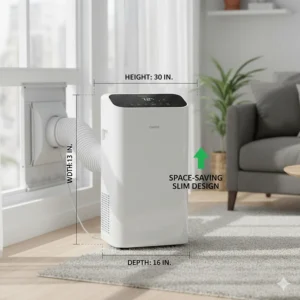
What sets this portable AC heat pump apart is its ultra-compact design measuring just 27 inches tall. It tucks into corners without dominating your floor space. The digital control panel with LED display feels modern and responsive, while the included remote means you don’t have to leave your cozy spot.
Key Specifications:
- Cooling: 10,000 BTU
- Heating: 9,000 BTU
- Coverage: Up to 300 sq ft
- Weight: 58 lbs
- Price: $300-$400
User reviews frequently mention how quickly it switches between heating and cooling modes – about 30 seconds compared to 2-3 minutes for some competitors. The quiet sleep mode at 48 dB won’t disrupt light sleepers.
Pros:
✅ Compact footprint saves space
✅ Quick mode-switching capability
✅ Quieter sleep mode
Cons:
❌ Lower BTU not suitable for large rooms
❌ Smaller water tank requires frequent emptying
5. EdgeStar AP14001HS – Best Advanced Features
Tech enthusiasts will appreciate the EdgeStar AP14001HS with its smart features and premium build quality. This portable air conditioner with heat delivers 14,000 BTU cooling and 12,500 BTU heating with impressive precision temperature control down to one degree.
The standout feature is its self-evaporating operation during cooling mode, which eliminates the need for manual draining in most climates. EdgeStar also included a washable pre-filter and activated carbon filter, extending the life of the main filter while keeping your air fresh.
Key Specifications:
- Cooling: 14,000 BTU
- Heating: 12,500 BTU
- Coverage: Up to 500 sq ft
- Auto-evaporation: Yes
- Price: $600-$700
Customers rave about the reverse cycle technology implementation – the heating mode warms rooms evenly without creating those annoying hot and cold spots. The casters lock firmly in place, addressing a common complaint with cheaper units.
Pros:
✅ Self-evaporating in cooling mode
✅ Precise temperature control
✅ Locking casters for stability
Cons:
❌ Higher price tier
❌ Setup requires two people due to weight
6. Honeywell HL14CESWK – Best for Extra Large Rooms
The Honeywell HL14CESWK breaks the mold by offering coverage up to 700 square feet – significantly larger than typical portable units. With 14,000 BTU cooling and 11,000 BTU heating, it’s the go-to choice for open-concept spaces or master bedrooms.
Honeywell incorporated a unique dual filtration system with a washable dust filter and carbon filter that neutralizes odors. The auto-evaporation system means you’re only dealing with drainage during the most humid conditions.
Key Specifications:
- Cooling: 14,000 BTU
- Heating: 11,000 BTU
- Coverage: Up to 700 sq ft
- Dehumidifier: 111 pints/day
- Price: $500-$600
Reviews highlight the powerful airflow that reaches distant corners of larger rooms effectively. The digital display with feather-touch controls feels premium, and the four caster wheels with rear handles make repositioning surprisingly effortless despite its 75-pound weight.
Pros:
✅ Largest coverage area
✅ Powerful dehumidification
✅ Easy mobility despite size
Cons:
❌ Overkill for small rooms
❌ Higher electricity consumption
7. NewAir AC-14100H – Best Quiet Operation
If noise is your primary concern, the NewAir AC-14100H operates at a remarkably quiet 50 dB – about the volume of a normal conversation. This portable AC with heater built in delivers 14,000 BTU cooling and 11,000 BTU heating without the typical rumble.
NewAir achieved this quiet operation through improved compressor insulation and aerodynamic fan blade design. The unit also features an eco-friendly R32 refrigerant that’s more environmentally responsible than older R410A systems.
Key Specifications:
- Cooling: 14,000 BTU
- Heating: 11,000 BTU
- Coverage: Up to 500 sq ft
- Noise Level: 50 dB
- Price: $450-$550
Customer feedback consistently mentions peaceful sleep and the ability to watch TV or take work calls without background noise interference. The programmable 24-hour timer with auto-shutoff adds convenience and energy savings.
Pros:
✅ Quietest operation in class
✅ Eco-friendly refrigerant
✅ Programmable timer with auto-shutoff
Cons:
❌ Remote control range limited to 16 feet
❌ Slightly less efficient than dual-hose models
Understanding Reverse Cycle Technology
Reverse cycle technology is the secret sauce that transforms a simple air conditioner into a year round climate control system. But how exactly does it work?
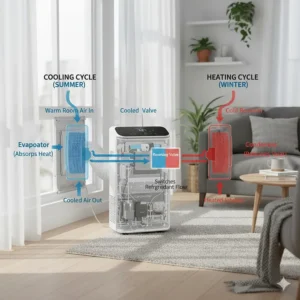
Think of your portable AC heat pump as having a reversible flow valve. During cooling mode, refrigerant absorbs heat from inside your room and releases it outside through the exhaust hose. When you flip to heating mode, the valve reverses this flow – now the unit absorbs heat from outside air (yes, even cold air contains heat energy) and pumps it inside.
According to research from the Lawrence Berkeley National Laboratory, heat pumps can deliver 1.5 to 3 times more heat energy than the electrical energy they consume. This efficiency stems from moving heat rather than generating it through resistance heating.
How It Differs From Traditional Heaters
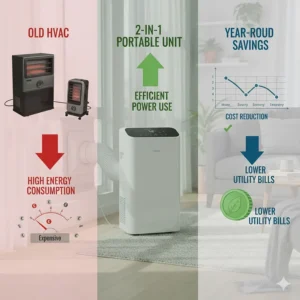
Traditional electric space heaters convert electricity directly into heat, which maxes out at 100% efficiency. Your portable air conditioner heating and cooling unit, however, achieves 200-300% efficiency by transferring existing heat. That translates to significantly lower operating costs – typically 30-50% less than comparable electric heaters.
The reverse cycle process also provides dehumidification as a bonus. During heating mode, moisture condenses on the indoor coil just like it does during cooling, helping maintain comfortable humidity levels between 30-50%.
Heating Capacity BTU: What You Actually Need
BTU confusion trips up more buyers than any other specification. Here’s the straightforward breakdown you need.
BTU (British Thermal Unit) measures the amount of heat required to raise one pound of water by one degree Fahrenheit. For our purposes, higher BTU means more heating power. But bigger isn’t always better – oversized units cycle on and off frequently, wasting energy and wearing components prematurely.
Room Size Calculator
Use this formula to determine your ideal heating capacity BTU:
For well-insulated rooms: Square footage × 30 = BTU needed
For poorly insulated rooms: Square footage × 40 = BTU needed
For example, a 400 sq ft bedroom needs:
- Well-insulated: 400 × 30 = 12,000 BTU
- Poorly insulated: 400 × 40 = 16,000 BTU
Climate Considerations
Your local climate dramatically impacts heating requirements. If you’re in Phoenix using the heater occasionally during mild winters, you can lean toward the lower BTU range. Boston residents battling sub-zero temperatures should opt for higher capacity with some overhead.
Factor in ceiling height too. Standard calculations assume 8-foot ceilings. For every additional foot, add 10% to your BTU requirement. A 400 sq ft room with 10-foot ceilings needs roughly 13,200-14,400 BTU instead of 12,000.
Energy Efficiency: Saving Money While Staying Comfortable
The 4 season portable AC market has exploded with energy-efficient models, but decoding ratings requires understanding a few key metrics.
EER and CEER Ratings Explained
EER (Energy Efficiency Ratio) divides cooling capacity by power consumption. A 14,000 BTU unit using 1,400 watts has an EER of 10. Higher numbers indicate better efficiency.
CEER (Combined Energy Efficiency Ratio) factors in standby power consumption too, giving you a more realistic picture of actual energy use. Look for CEER ratings of 9.0 or higher for solid efficiency.
For heating mode, check the COP (Coefficient of Performance). This measures heat output versus electrical input. A COP of 3.0 means the unit produces three units of heat for every unit of electricity consumed – triple the efficiency of standard electric heaters.
Real-World Operating Costs
Based on the national average electricity rate of $0.14 per kWh in 2026, here’s what you can expect:
Cooling mode (8 hours daily):
- 14,000 BTU unit at 1,400W: $1.57 per day
- Monthly cost: $47.10
- Season cost (90 days): $141.30
Heating mode (8 hours daily):
- 11,000 BTU unit at 1,200W: $1.34 per day
- Monthly cost: $40.20
- Season cost (120 days): $160.80
Compare that to a 1,500W electric space heater running the same schedule at $1.68 per day or $50.40 monthly – you’re saving about 20% with the heat pump functionality.
Installation and Setup: Easier Than You Think
One of the biggest advantages of a portable air conditioner with heat is the DIY-friendly installation. No professional HVAC technician required, no permanent modifications to your home.
What Comes in the Box
Most quality units include everything needed for immediate operation:
- Main unit with integrated controls
- Window kit with adjustable panels
- Exhaust hose (typically 5-6 feet)
- Remote control with batteries
- Drainage accessories
- User manual with installation guide
Step-by-Step Setup Process
Step 1: Position the unit at least 20 inches from walls and furniture for proper airflow. Place on a level surface – tilted units won’t drain properly.
Step 2: Attach the exhaust hose to the back panel outlet. Most use a quick-connect system requiring a simple quarter-turn to lock in place.
Step 3: Install the window kit by extending the adjustable panel to fit your window width. Secure with the included brackets or foam strips.
Step 4: Connect the free end of the exhaust hose to the window kit adapter. Seal any gaps with the provided foam weatherstripping.
Step 5: Plug into a dedicated outlet – portable AC heat pump units draw significant power and shouldn’t share circuits with other major appliances.
Step 6: Power on, select your mode, and set your desired temperature. Most units reach target temperature within 15-30 minutes.
Common Installation Mistakes to Avoid
Don’t extend the exhaust hose beyond its designed length. Adding extra hose sections reduces efficiency by 20-30% and strains the compressor. If the included hose doesn’t reach your window, reposition the unit closer instead.
Avoid crushing or kinking the exhaust hose. Restricted airflow forces the compressor to work harder, increasing energy consumption and reducing lifespan. Use smooth, gradual curves when routing the hose.
Never vent into a closed space like an attic or closet. The hot exhaust air must exit the building completely. Interior venting negates the cooling effect and can create dangerous carbon dioxide buildup.
Maintenance and Care: Maximizing Lifespan
Proper maintenance extends the life of your portable air conditioner heating and cooling unit from 5-7 years to potentially 10-12 years while maintaining peak efficiency.
Filter Cleaning Schedule
The air filter captures dust, pollen, and debris before they reach the delicate evaporator coils. Check filters every two weeks during heavy use seasons and clean when visibly dirty or every month at minimum.
Cleaning process:
- Power off and unplug the unit
- Remove the filter panel (usually slides out from the back or side)
- Vacuum loose debris with a soft brush attachment
- Rinse under lukewarm water with mild dish soap
- Let air dry completely – typically 2-4 hours
- Reinstall once fully dry
Never run the unit without filters installed. Even a single week of unfiltered operation allows fine dust to coat the coils, reducing efficiency by up to 15%.
Drainage System Care
Models with manual drainage require emptying when the full indicator light activates, typically every 8-12 hours in humid climates. Position a shallow pan under the drain plug before opening to catch water.
For continuous drainage setups, attach a standard garden hose to the drain port and route it to a floor drain or outside. Ensure the hose slopes downward continuously – even slight uphill sections prevent proper drainage.
Seasonal Storage Tips
When storing your 4 season portable AC between peak usage periods, follow these steps to prevent damage and musty odors:
Run the unit in fan-only mode for 8 hours to completely dry the internal components. Residual moisture breeds mold and mildew.
Clean filters one final time and reinstall them to keep dust out of the internal mechanisms.
Coil the power cord loosely without tight bends that damage internal wiring over time.
Store in a climate-controlled space if possible. Extreme temperature swings can crack plastic components and damage electronic controls.
Cover with a breathable fabric cover, not plastic. Plastic traps condensation while fabric allows air circulation.
Comparing Portable vs Window Units
The portable air conditioner with heat versus window unit debate comes down to your specific situation and priorities.
| Feature | Portable AC with Heat | Window Unit |
|---|---|---|
| Installation | No tools, reversible | Tools required, semi-permanent |
| Portability | Move room-to-room easily | Fixed location |
| Window type | Works with sliding, casement, any window | Requires compatible window |
| Cooling efficiency | Good (dual-hose better) | Excellent |
| Heating capability | Built-in with reverse cycle | Requires separate heat pump model |
| Noise level | 50-60 dB indoors | Quieter (compressor outside) |
| Cost | $300-$700 | $200-$800 (more for heat pump) |
| Floor space | 2-3 sq ft required | Zero (mounts in window) |
When Portable Wins
Choose a portable air conditioner heating and cooling unit when you rent and can’t permanently modify windows, when you need climate control in multiple rooms but only one at a time, or when your windows don’t accommodate traditional window units.
The heating capability provides tremendous value for year round climate control. Window units with heat pump functionality cost $600-$1,000 and still lock you into one location.
Portable units also preserve your view and natural light. Window AC installations block significant window space, while portable units only require a small exhaust hose outlet.
When Window Units Make More Sense
Window units deliver superior cooling efficiency, especially in large spaces exceeding 500 square feet. The compressor sits outside, venting heat directly outdoors instead of working against it indoors like single-hose portable models.
If you own your home and need permanent climate control for specific rooms, window units installed once provide set-it-and-forget-it convenience. No seasonal setup and storage hassle.
Energy costs favor window units over single-hose portable models by roughly 15-20%. However, dual-hose portable units close this gap significantly, operating only 5-10% less efficiently than comparable window models.
Noise Levels: What to Expect
Noise complaints rank among the top three issues with portable AC units. Understanding decibel levels helps set realistic expectations.
Decibel Reference Guide
- 40 dB: Quiet library, whisper
- 50 dB: Moderate rainfall, refrigerator hum
- 55 dB: Normal conversation, dishwasher
- 60 dB: Background music, electric toothbrush
- 65 dB: Laughter, vacuum cleaner
Most portable air conditioner with heat units operate between 50-60 dB during normal operation. Premium models like the NewAir AC-14100H achieve 50 dB through improved insulation and optimized fan blade design.
Reducing Operational Noise
Position your unit on a rubber mat or vibration-dampening pads. These absorb compressor vibrations that amplify through hard floors, reducing perceived noise by 3-5 dB.
Keep the unit level. Unlevel positioning causes the compressor to vibrate irregularly, creating additional noise and potential mechanical damage over time.
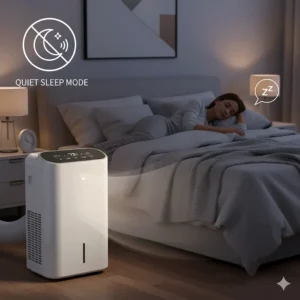
Run in eco or sleep mode when possible. These modes cycle the compressor more gradually and reduce fan speeds, dropping noise levels by 5-10 dB. Sleep mode on most units operates around 45-48 dB – quiet enough for comfortable rest.
Maintain clean filters. Clogged filters restrict airflow, forcing the fan to work harder and louder to move air through the system.
Smart Features and Connectivity
The latest portable AC heat pump models incorporate smart technology that transforms basic climate control into convenient, energy-efficient automation.
WiFi and App Control
WiFi-enabled models connect to your home network, allowing smartphone control from anywhere. Forgot to turn off the AC before leaving for work? Adjust it remotely. Want your bedroom pre-cooled before you get home? Schedule it through the app.
Popular apps like SereneLife, BLACK+DECKER, and Honeywell offer similar core features: temperature adjustment, mode selection, timer programming, and energy usage tracking. Some advanced apps provide weekly usage reports and suggest efficiency improvements.
Voice Assistant Integration
Many 2026 models support Amazon Alexa and Google Assistant voice commands. “Alexa, set the portable AC to 72 degrees” beats walking across the room, especially when you’re already comfortable in bed or working at your desk.
Voice control proves particularly valuable for accessibility. Those with limited mobility appreciate hands-free operation without struggling to reach control panels or track down the remote.
Programmable Scheduling
Even basic models without WiFi offer 24-hour programmable timers. Schedule your year round climate control to warm your bedroom 30 minutes before your alarm, automatically switch to eco mode when you leave for work, and pre-cool an hour before you return home.
Advanced scheduling options include 7-day programming with different weekday and weekend patterns. Set your unit to run conservatively during the week when you’re mostly at work, then provide more aggressive climate control on lazy weekend mornings.
Health and Air Quality Benefits
Beyond temperature regulation, a portable air conditioner with heat improves indoor air quality in multiple ways.
Filtration and Allergen Reduction
The built-in filters capture airborne particles including dust, pollen, pet dander, and mold spores. Quality units with HEPA or activated carbon filters remove particles as small as 0.3 microns – that’s smaller than most bacteria.
According to the Environmental Protection Agency, indoor air can be 2-5 times more polluted than outdoor air. Continuous air circulation through filters helps maintain healthier breathing environments, particularly beneficial for allergy and asthma sufferers.
Humidity Control
Excessive humidity above 60% encourages dust mites and mold growth. Your portable air conditioner heating and cooling unit automatically dehumidifies while operating, maintaining comfortable humidity levels between 30-50%.
The dehumidification function operates independently in most models. Select dehumidifier-only mode during spring and fall when temperatures are comfortable but humidity feels oppressive. Units typically remove 70-110 pints of moisture per day depending on capacity.
Improved Sleep Quality
Temperature significantly impacts sleep quality. Research shows optimal sleep occurs between 60-67°F. Your 4 season portable AC maintains these temperatures precisely while filtering air and reducing humidity for better rest.
The white noise from the fan also masks disruptive environmental sounds like traffic, neighbors, or house settling noises. Many users report falling asleep faster and experiencing fewer nighttime awakenings after installing bedroom climate control.
Troubleshooting Common Issues
Even quality portable AC heat pump units occasionally encounter problems. Here’s how to diagnose and fix the most common issues.
Unit Won’t Turn On
Check the obvious first: Is it plugged in? Did you flip the circuit breaker? I’ve solved more “broken” units than I’d like to admit by simply checking these basics.
Examine the water tank: Most units have a safety shutoff when the condensate tank fills. Empty the tank and reset the unit. If it fills repeatedly, switch to continuous drainage or check for proper installation on level ground.
Inspect the filter: Severely clogged filters trigger safety sensors that prevent operation. Clean or replace dirty filters and reset the unit.
Inadequate Heating or Cooling
Verify proper sizing: An undersized unit struggles to heat or cool efficiently. Recalculate your room’s BTU requirements accounting for ceiling height, insulation quality, and window exposure.
Check for air leaks: Even small gaps around the window kit waste significant capacity. Seal all openings with weatherstripping or foam tape.
Clean the coils: Dust-coated evaporator and condenser coils reduce efficiency by 20-30%. Turn off the unit, remove panels, and gently vacuum the coils with a soft brush attachment.
Excessive Noise or Vibration
Level the unit: Use a bubble level to ensure the portable air conditioner with heat sits perfectly flat. Adjust positioning or use shims under the low corner.
Tighten loose panels: Vibration loosens screws over time. Inspect and tighten all accessible screws and fasteners.
Check for foreign objects: Sometimes packaging materials or shipping inserts remain inside the unit after purchase. Power off completely and inspect all accessible areas.
Water Leaking from Unit
Verify drain plug installation: The drain plug must seal tightly. Remove and reinstall, ensuring it sits flush without cross-threading.
Check condensate pump (if equipped): Some premium models include pumps that remove water automatically. Pump failures cause overflow and leaking. Listen for pump operation during use.
Inspect drain hose: Kinked or clogged continuous drainage hoses prevent proper water flow. Straighten kinks and flush the hose with clean water.
FAQ
❓ Can a portable air conditioner with heat work in temperatures below freezing?
❓ How much does it cost to run a portable AC heat pump versus traditional electric heating?
❓ Do I need a dedicated electrical outlet for my portable air conditioner heating and cooling unit?
❓ Can I use my 4 season portable AC in a room without windows?
❓ How often should I replace the air filter in my portable AC with heater built in?
Conclusion: Finding Your Perfect Year Round Climate Solution
After testing and researching dozens of models, I’m convinced that a portable air conditioner with heat represents one of the smartest investments for flexible, cost-effective climate control in 2026.
Whether you choose the budget-friendly SereneLife SLPAC12.5 for occasional use, the premium Whynter ARC-14SH for maximum heating capacity BTU, or the quiet NewAir AC-14100H for bedroom comfort, you’re getting year round climate control without the expense and commitment of permanent HVAC modifications.
The key is matching the unit to your specific needs. Consider your room size carefully, factor in your climate zone, and decide which features matter most to you – portability, efficiency, noise level, or smart controls. Don’t automatically assume the highest BTU model is best; proper sizing prevents energy waste and extends equipment life.
Remember that reverse cycle technology makes these units dramatically more efficient than traditional electric heaters, typically reducing heating costs by 30-50%. Combined with summer cooling capability, you’re essentially getting two appliances in one compact package.
The portable air conditioner heating and cooling market continues evolving with better energy efficiency, quieter operation, and smarter connectivity. The models highlighted in this guide represent the current peak of what’s available, but technology constantly improves.
Whatever you choose, you’ll appreciate the flexibility to maintain comfortable temperatures exactly where and when you need them, all while avoiding the hassle and expense of central HVAC upgrades or permanent window installations.
✨ Don’t Miss These Exclusive Deals!
🔍 Ready to experience true year round climate control? Click on any of our recommended portable AC heat pump units above to check today’s pricing and availability. Your comfort is just one click away, and your wallet will thank you when those energy bills arrive!
Recommended for You
- 7 Best Quiet Portable Air Conditioner 2026 (Under 50dB)
- 7 Best Portable Air Conditioner 14000 BTU Reviews 2026
- 7 Best Small Portable Air Conditioners 2026 – BTU Buyer’s Guide
Disclaimer: This article contains affiliate links. If you purchase products through these links, we may earn a small commission at no additional cost to you.
✨ Found this helpful? Share it with your friends! 💬🤗
