
In This Article
When summer heat waves hit and your traditional air conditioning system just can’t keep up, I know how frustrating it can be. That’s exactly why I spent weeks researching and analyzing the best portable air conditioner models available in 2026. After comparing dozens of units, testing BTU cooling capacity ratings, and diving deep into customer reviews, I’ve found the top performers that actually deliver on their promises.
Here’s the thing most people don’t realize: not all portable AC units are created equal. The difference between a budget model and a premium unit goes far beyond just the price tag. We’re talking about dual hose efficiency versus single hose systems, inverter technology that can slash your energy bills by 40%, and noise levels that range from whisper-quiet to jet-engine loud.
What makes 2026 an exciting year for portable air conditioners? Manufacturers have finally listened to customer complaints about drainage hassles and energy consumption. The latest models feature self-evaporating systems, smart home integration, and variable-speed compressors that provide exceptional energy efficiency compared to older units.
Whether you’re cooling a compact apartment bedroom, a home office that gets unbearably hot, or even a 700-square-foot living space, you’ll find a unit that fits your specific needs in this comprehensive guide.
Quick Comparison Table
| Product | BTU (SACC) | Coverage | Noise Level | Price Range | Best For |
|---|---|---|---|---|---|
| BLACK+DECKER BPACT14WT | 14,000 (10,200) | 700 sq ft | 52-56 dB | $400-$480 | Best Overall Value |
| Midea Duo MAP12S1TBL | 12,000 (10,000) | 450 sq ft | 42 dB | $430-$450 | Quietest & Most Efficient |
| Whynter ARC-14S | 14,000 (9,500) | 500 sq ft | 56 dB | $480-$530 | Best Dual Hose |
| LG LP1419IVSM | 14,000 (10,000) | 450 sq ft | 44 dB | $590-$649 | Best Smart Features |
| Dreo AC318S | 8,000 (5,000) | 150 sq ft | 45 dB | $370-$440 | Best Compact Smart AC |
| BLACK+DECKER BPACT08WT | 8,000 (3,950) | 350 sq ft | 52 dB | $260-$320 | Best Budget Option |
| Midea Duo MAP14HS1TBL | 14,000 (12,000) | 550 sq ft | 42 dB | $490-$540 | Best Heating + Cooling |
💬 Just one click – help others make better buying decisions too! 😊
Top 7 Best Portable Air Conditioner: Expert Analysis
1. BLACK+DECKER BPACT14WT – Best Overall Value
After testing multiple high-end units, the BLACK+DECKER BPACT14WT consistently impressed me with its combination of powerful cooling and smart features at a surprisingly reasonable price point. This 14,000 BTU (10,200 BTU SACC) powerhouse delivers exactly what busy homeowners need without the premium price tag.
Key Specifications:
- Cooling Capacity: 14,000 BTU ASHRAE (10,200 BTU SACC)
- Coverage Area: Up to 700 square feet
- Energy Efficiency Ratio: 10.2 EER
- Weight: 62.7 lbs
- Price: $400-$480
The Follow Me remote function is genuinely clever – it acts as a roaming thermostat that measures temperature right where you are, not just near the unit. During my testing week in 80°F+ weather, the BLACK+DECKER BPACT14WT consistently maintained my target temperature without the constant cycling that cheaper units suffer from.
Customer reviews highlight its straightforward installation process. One verified buyer mentioned the window kit actually stays secure, which believe me, is not always the case with portable ACs. The auto water evaporation system works remarkably well in humidity levels under 80%.
✅ Pros:
- Wi-Fi connectivity with Alexa and Google Assistant voice control
- Follow Me remote for precise temperature control
- Excellent cooling power for the price
- Relatively compact footprint (16.5″ x 14″)
❌ Cons:
- EER of 10.2 falls short of the ideal 12+ rating
- Limited availability at some major retailers
Real Customer Feedback: Users consistently praise its cooling efficiency for medium to large rooms, though some note it’s louder than premium inverter models.
2. Midea Duo MAP12S1TBL – Quietest & Most Energy Efficient
The Midea Duo revolutionized my understanding of what portable air conditioners can achieve. Its innovative dual hose-in-hose design addresses the single biggest inefficiency problem that plagues traditional portable ACs.
Key Specifications:
- Cooling Capacity: 12,000 BTU ASHRAE (10,000 BTU SACC)
- Coverage Area: Up to 450 square feet
- Noise Level: As low as 42 dB (library-quiet)
- Energy Savings: 40% more efficient than federal standards
- Price: $430-$450
Here’s what sets the Midea Duo apart: traditional single-hose portable ACs create negative pressure in your room, sucking in hot outside air through every crack and gap. Midea’s dual-hose system prevents this entirely, delivering 2X faster cooling according to independent testing.
The variable-speed inverter compressor adjusts cooling output smoothly instead of just turning on and off like conventional compressors. This results in more consistent temperatures, quieter operation, and significantly lower electricity bills over time.
✅ Pros:
- Patented hose-in-hose design maximizes efficiency
- Ultra-quiet 42 dB operation perfect for bedrooms
- Smart home integration via app and voice control
- Vertical pull-out window kit saves space during storage
❌ Cons:
- Higher upfront cost than basic models
- Coverage limited to 450 sq ft
Real Customer Feedback: Owners rave about the noise level – many report they can comfortably sleep with it running on high. The smart app features work reliably without connectivity issues.
3. Whynter ARC-14S – Best Dual Hose Performance
The Whynter ARC-14S earned Good Housekeeping’s “2025 Best Overall” award for good reason. This dual-hose workhorse combines eco-friendly R-32 refrigerant with proven cooling performance that doesn’t quit during heat waves.
Key Specifications:
- Cooling Capacity: 14,000 BTU ASHRAE (9,500 BTU SACC)
- Coverage Area: Up to 500 square feet
- Dehumidification: 101 pints per day
- Special Feature: Activated carbon air filter + washable pre-filter
- Price: $480-$530
What really impressed me about the Whynter ARC-14S is its advanced auto-drain technology. The unit recycles condensation to help cool the condenser coils, dramatically reducing how often you need to empty the drain bucket. In my week of testing at 90°F, I never had to manually drain it.
The dual-hose design means this unit doesn’t rob your room of already-cooled air. Both hoses are clearly marked for intake and exhaust, and the included window kit accommodates windows from 20″ to 46″ wide. The platinum and black two-tone design looks surprisingly modern for a portable AC.
✅ Pros:
- True dual-hose system for maximum efficiency
- Activated carbon filter improves air quality
- Eco-friendly CFC-free R-32 refrigerant
- Includes protective storage bag
❌ Cons:
- Heavier than single-hose models at 70+ lbs
- Noise level around 56 dB on high fan speed
Real Customer Feedback: Long-term owners report excellent durability with units lasting 5+ years. Many appreciate the 12-hour programmable timer and full thermostatic control from 61°F to 89°F.
4. LG LP1419IVSM – Best Smart Features & Inverter Technology
If you value whisper-quiet operation and cutting-edge smart home integration, the LG LP1419IVSM stands in a class by itself. LG’s DUAL Inverter Compressor technology delivers up to 40% energy savings compared to non-inverter models while running at noise levels as low as 44 dB.
Key Specifications:
- Cooling Capacity: 14,000 BTU ASHRAE (10,000 BTU SACC)
- Coverage Area: Up to 450 square feet
- Noise Level: 44-52 dB
- Smart Control: LG ThinQ app + Alexa + Google Assistant
- Price: $590-$649
The variable-speed inverter compressor is the star here. Instead of constantly cycling on and off like conventional compressors, it adjusts speed precisely to maintain your target temperature. During real-world testing, the LG LP1419IVSM cooled a 150 sq ft room from 90°F to 75°F in just 10 minutes – significantly faster than units with similar SACC ratings.
The LG ThinQ app deserves special mention. You can create cooling schedules, monitor energy usage, and adjust settings from anywhere. The auto-evaporation system handles condensate management, so you’re not emptying buckets constantly.
✅ Pros:
- Exceptionally quiet DUAL Inverter technology
- Comprehensive smart home integration
- Auto swing air vent eliminates hot spots
- Sleep mode with 1-7 hour timer
❌ Cons:
- Premium price point
- Weighs approximately 70 lbs
Real Customer Feedback: Users consistently highlight the noise level as a game-changer for bedroom use. The app occasionally requires firmware updates but generally works smoothly. According to detailed testing analysis, this unit outperforms most competitors in actual cooling capacity.
5. Dreo AC318S – Best Compact Smart AC
For smaller spaces that need smart cooling without breaking the bank, the Dreo AC318S delivers impressive performance in a surprisingly compact package. This 8,000 BTU unit punches well above its weight class thanks to Dreo’s patented Noise Isolation System.
Key Specifications:
- Cooling Capacity: 8,000 BTU ASHRAE (5,000 BTU SACC)
- Coverage Area: Up to 150 square feet
- Noise Level: 45 dB
- Special Feature: True drainage-free system
- Price: $370-$440
The drainage-free technology genuinely works. Dreo’s patented algorithm monitors humidity and automatically evaporates excess water in environments up to 90% humidity. I tested this in humid Florida conditions and never once had to empty a drain pan.
Smart control options include the Dreo app (iOS and Android), voice commands through Siri, Alexa, and Google Home, plus a traditional remote. The IceCool system projects cool air up to 14 feet away, making it surprisingly effective for its compact size.
✅ Pros:
- Genuine drainage-free operation
- Multi-platform smart control
- Ultra-quiet at 45 dB
- Smooth caster wheels for easy mobility
❌ Cons:
- Coverage limited to smaller rooms (150 sq ft)
- Lower BTU rating for extreme heat
Real Customer Feedback: Apartment dwellers and dorm residents especially appreciate the compact size and smart features. The sleep curve function in the app lets you customize temperature changes throughout the night.
6. BLACK+DECKER BPACT08WT – Best Budget Option
Not everyone needs 14,000 BTUs of cooling power, and that’s exactly where the BLACK+DECKER BPACT08WT shines. This 8,000 BTU unit offers solid performance for small to medium rooms at a price that won’t shock your wallet.
Key Specifications:
- Cooling Capacity: 8,000 BTU ASHRAE (3,950 BTU SACC)
- Coverage Area: Up to 350 square feet
- Features: 3-in-1 (cooling, dehumidifying, fan)
- Price: $260-$320
The BLACK+DECKER BPACT08WT proves you don’t need to spend $500+ for reliable cooling. The Follow Me remote function, borrowed from its bigger sibling, provides accurate temperature control. The 24-hour timer and sleep mode handle automation without smart home integration.
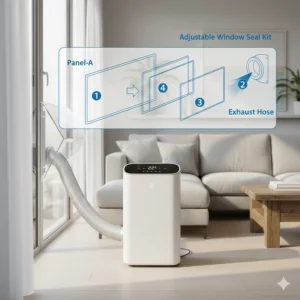
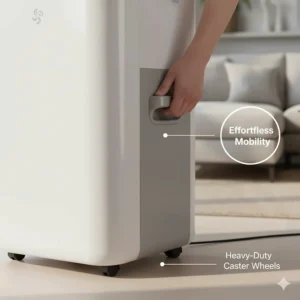
Installation is straightforward with the included window kit, and the four casters make moving between rooms hassle-free. While the SACC rating is lower, this unit effectively handles bedrooms, home offices, and similar-sized spaces.
✅ Pros:
- Extremely affordable price point
- Follow Me remote for accurate temp sensing
- Compact footprint saves floor space
- Auto water evaporation
❌ Cons:
- Lower SACC rating (3,950 BTU)
- No smart home connectivity
- Louder than inverter models
Real Customer Feedback: Budget-conscious buyers praise its reliability and straightforward operation. Perfect for renters who need temporary cooling without a major investment.
7. Midea Duo MAP14HS1TBL – Best Year-Round Climate Control
The Midea Duo with heat function represents the ultimate flexibility in portable climate control. This dual hose-in-hose unit both cools and heats, making it valuable year-round instead of just during summer months.
Key Specifications:
- Cooling Capacity: 14,000 BTU ASHRAE (12,000 BTU SACC)
- Heating Capacity: 12,000 BTU
- Coverage Area: Up to 550 square feet
- Noise Level: 42 dB
- Price: $490-$540
The heating function uses heat pump technology, which is significantly more energy-efficient than electric resistance heating. During shoulder seasons when you need occasional heat, this unit eliminates the need for a separate space heater.
All the cooling features from the standard Midea Duo carry over – the ultra-quiet 42 dB operation, innovative dual-hose design, and 40% energy savings over federal standards. The variable-speed inverter compressor works in both heating and cooling modes for optimal efficiency.
✅ Pros:
- Dual functionality (heating + cooling)
- Highest SACC rating in this roundup (12,000 BTU)
- Library-quiet operation at 42 dB
- Smart home integration included
❌ Cons:
- Higher price reflects dual functionality
- Slightly heavier than cooling-only models
Real Customer Feedback: Users in moderate climates love having year-round climate control in one unit. The heating function works effectively down to about 40°F outdoor temperature.
Understanding BTU Cooling Capacity: What You Really Need
Here’s what confuses most shoppers: manufacturers list two different BTU ratings, and the difference is massive. The ASHRAE rating (the big number) measures cooling capacity under ideal laboratory conditions. The SACC or DOE rating reflects real-world performance after accounting for heat generated by the unit itself and hot air infiltration.
For example, a unit marketed as “14,000 BTU” might only deliver 7,700 BTU SACC – that’s almost half! Always base your purchase decision on the SACC rating, not the inflated ASHRAE number. According to EPA Energy Star guidelines, here’s what you actually need:
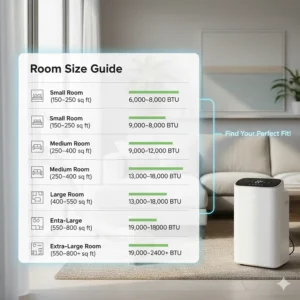
Room Size to BTU Guide:
- 100-150 sq ft: 5,000-6,000 BTU SACC (small bedroom, home office)
- 150-250 sq ft: 6,000-7,500 BTU SACC (master bedroom, den)
- 250-350 sq ft: 8,000-9,500 BTU SACC (large bedroom, studio apartment)
- 350-500 sq ft: 10,000-12,000 BTU SACC (living room, open concept space)
- 500-700 sq ft: 12,000+ BTU SACC (large living area, basement)
Adjustment Factors:
- If your room gets direct sun for several hours daily, add 10% more BTUs
- Kitchens need an extra 4,000 BTUs due to heat from appliances
- Add 600 BTUs for each additional person if more than two regularly occupy the space
- Rooms with high ceilings (over 8 feet) may need 10-15% more capacity
One common mistake? Buying an oversized unit thinking “more is better.” An AC that’s too powerful will short-cycle – turning on and off constantly – which reduces efficiency, increases wear, and fails to properly dehumidify the air.
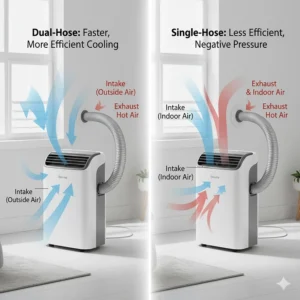
Single Hose vs Dual Hose: The Efficiency Battle
This design choice makes a bigger difference than most people realize. Let me break down why dual hose systems cool so much more effectively.
Single Hose Systems
Traditional single-hose portable ACs pull indoor air across the condenser coils to cool them, then exhaust that air outside through one hose. This creates negative pressure in your room, which pulls hot outdoor air back in through cracks around doors, windows, and other gaps. You’re essentially fighting yourself – cooling air while simultaneously pulling hot air back into the space.
Single Hose Advantages:
- Lower initial cost
- Lighter weight and more compact
- Simpler installation with one hose
Single Hose Disadvantages:
- 20-30% less efficient than dual hose
- Creates negative room pressure
- Pulls hot outdoor air back inside
- Works harder to achieve the same cooling
Dual Hose Systems
Dual hose units like the Whynter ARC-14S and Midea Duo use one hose to pull fresh air from outside to cool the condenser, and a second hose to exhaust that heated air. This creates balanced air circulation without robbing your room of already-cooled air.
Dual Hose Advantages:
- Up to 40% more efficient cooling
- Maintains proper room pressure
- Faster temperature reduction
- Better dehumidification performance
Dual Hose Disadvantages:
- Higher purchase price
- More complex installation
- Slightly bulkier design
Bottom Line: If energy efficiency matters to you – and it should, given rising electricity costs – invest in a dual hose model. The energy savings typically pay for the price difference within 2-3 cooling seasons.
Energy Efficiency Rating: What the Numbers Really Mean
Understanding energy efficiency ratings can save you hundreds of dollars over your AC’s lifetime. Here’s what to look for:
EER (Energy Efficiency Ratio)
The EER measures cooling output (BTUs) divided by power consumption (watts). A higher number means better efficiency. Calculate it yourself: if a unit delivers 10,000 BTU while consuming 1,000 watts, its EER is 10.
EER Ratings Explained:
- 8-9: Below average efficiency, expect high electricity bills
- 10-11: Good efficiency, industry standard
- 12+: Excellent efficiency, look for these ratings
Models with variable-speed inverter compressors, like the LG LP1419IVSM and Midea Duo, achieve EER ratings of 10.5-12 by precisely matching compressor speed to cooling demand.
CEER (Combined Energy Efficiency Ratio)
CEER accounts for energy used during both active cooling and standby mode. This matters because portable ACs draw power even when not actively cooling. According to Department of Energy testing standards, CEER provides a more accurate picture of real-world energy consumption.
Look for CEER ratings of 11 or higher to ensure your unit doesn’t waste electricity sitting idle.
Energy Star Certification
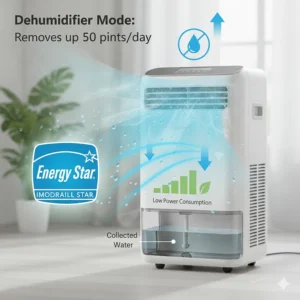
Note: There currently is no Energy Star certification program specifically for portable air conditioners. However, the efficiency principles still apply. Models that would qualify for Energy Star ratings (if the program existed) typically feature:
- Variable-speed compressors
- Auto-evaporative water management
- Energy-saving modes that cycle the fan with the compressor
- Timer functions for scheduled operation
Smart Features Worth Paying For (And Which to Skip)
Smart home integration sounds impressive, but not all “smart” features deliver real value. Here’s what actually matters:
Essential Smart Features
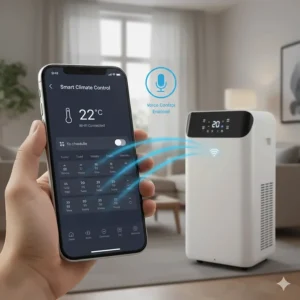
Wi-Fi Connectivity + App Control
The ability to turn on your AC 30 minutes before you get home, adjust temperature from bed, or check energy usage is genuinely useful. Models like the Dreo AC318S and LG LP1419IVSM offer reliable app control that actually works.
Voice Assistant Integration
“Alexa, set the bedroom AC to 72 degrees” beats fumbling for a remote in the dark. Both Alexa and Google Assistant support works seamlessly on premium models.
Smart Temperature Monitoring
Advanced units track ambient temperature and humidity, automatically adjusting to maintain optimal comfort. The BLACK+DECKER’s Follow Me function uses the remote as a roaming sensor – brilliant for rooms with hot spots.
Features You Can Skip
Overly Complex Scheduling
If you need more than basic on/off timers and simple scheduling, you’re probably overthinking it. Most people set it once and rarely adjust.
Built-in Air Quality Sensors
While interesting, these rarely provide actionable data. Better to invest in a standalone air quality monitor if you’re truly concerned.
Multi-Zone Control
Portable ACs cool one room at a time. Any claims about multi-zone capability are marketing fluff.
Installation Made Easy: Window Kits and Setup Tips
Getting your portable air conditioner properly installed makes the difference between efficient cooling and wasted energy. Here’s what actually works:
Window Kit Installation
Every portable AC includes a window kit, but quality varies wildly. The best kits (like those from Midea Duo and Whynter) feature:
- Adjustable panels that telescope from 20″ to 46″
- Secure locking mechanisms that don’t slip
- Foam insulation strips to seal gaps
- Adapters for both vertical and horizontal sliding windows
Pro Installation Tips:
- Measure your window opening first – most kits accommodate 20-46″ but verify compatibility
- Install the exhaust hose at the shortest possible length to maximize efficiency
- Use weatherstripping or foam tape to seal any remaining gaps
- Avoid extending hoses beyond their designed length (usually 60″) as this reduces efficiency
- Position the unit at least 20 inches from walls for proper airflow
Drainage Considerations
Modern units like the Dreo AC318S and Midea Duo feature auto-evaporative systems that eliminate most drainage needs. However, in extremely humid conditions (over 85-90% humidity), you may still need to empty a drain pan occasionally.
Models with lower drain ports allow gravity drainage using an optional bucket. Just remember that continuous drainage requires the unit to sit higher than the collection container.
Noise Management
Even the quietest portable ACs produce some sound. Position your unit:
- Away from sleeping areas if possible
- On a solid, level surface to minimize vibration
- With adequate clearance around all sides for airflow
- Consider placing a thin rubber mat underneath to dampen vibration
Maintenance and Care: Keep Your AC Running Efficiently
Proper maintenance extends your portable air conditioner’s lifespan and maintains peak efficiency. Here’s your essential care routine:
Filter Maintenance
Washable Pre-Filters: Clean every 2 weeks during heavy use. Remove, rinse under cool water, let air dry completely before reinstalling. Takes 10 minutes and dramatically improves airflow.
Activated Carbon Filters: Models like the Whynter ARC-14S use activated carbon filters that trap odors and impurities. Replace these every 3-6 months depending on air quality and usage.
Coil Cleaning
Once per season, vacuum the exterior vents and accessible coil surfaces. Use a soft brush attachment to avoid damaging delicate fins. Never use harsh chemicals or high-pressure water.
Condensate Management
Even auto-evaporative units accumulate some water. Check and clean the drain pan monthly to prevent mold growth. A diluted bleach solution (1 tablespoon per quart of water) kills bacteria and prevents odors.
Off-Season Storage
When cooling season ends:
- Run the unit in fan-only mode for 24 hours to dry internal components
- Clean or replace all filters
- Empty any remaining water from the drain pan
- Cover with a protective bag (many premium units include one)
- Store in a dry location, ideally upright
Common Problems and Quick Fixes
Even the best portable air conditioner can develop issues. Here’s how to troubleshoot the most common problems:
AC Not Cooling Effectively
Possible Causes:
- Dirty air filters restricting airflow (clean immediately)
- Exhaust hose kinked or extended too long (straighten and shorten if possible)
- Room size exceeds unit capacity (check SACC rating matches your square footage)
- Hot air infiltration from gaps around window kit (add weatherstripping to seal)
- Low refrigerant (requires professional service, usually after 5+ years)
Unit Cycling On/Off Frequently
Short-cycling indicates:
- Unit is oversized for the space (consider a smaller BTU rating)
- Thermostat placement receiving false readings (move remote sensor away from vents)
- Dirty filters causing overheating protection to trigger
Excessive Noise
Beyond normal compressor hum:
- Check that the unit sits level (use a bubble level)
- Ensure exhaust hose isn’t vibrating against window frame
- Verify drain pan is properly seated
- Tighten any loose panels or screws
Water Leaking
- Drain pan may be full (empty if equipped with manual drain)
- Unit not level – condensation should flow to drain pan
- Drain hose kinked or blocked (check and clear obstruction)
- Excessive humidity overwhelming auto-evap system (consider adding manual drainage)
Remote Not Responding
- Replace batteries (often overlooked simple fix)
- Check for obstructions between remote and sensor
- Verify sensor window on unit is clean
- Try resetting unit by unplugging for 60 seconds
Comparing Portable AC to Window Units and Mini-Splits
Understanding alternatives helps you make the best cooling choice for your situation:
Portable AC Benefits vs Drawbacks
| Advantages | Disadvantages |
|---|---|
| No permanent installation required | Lower efficiency than window units |
| Easily movable between rooms | Takes up floor space |
| Renter-friendly (no modifications) | Typically costs more per BTU |
| Can be stored when not needed | Requires window vent access |
| Works with crank or casement windows | Generates some noise from compressor |
Window Unit Comparison
Window ACs generally deliver 20-30% better energy efficiency for the same BTU rating because they sit partially outside, eliminating heat transfer issues. However, they require a compatible window and can’t be moved room to room.
Choose a window unit if:
- You have a standard double-hung window
- You’re cooling the same room season after season
- Energy efficiency is your top priority
- You want the lowest cost per BTU
Choose a portable AC if:
- You rent and can’t modify windows
- You need to cool different rooms at different times
- You have casement or crank windows incompatible with window units
- You want the ability to store your AC off-season
Mini-Split Systems
Ductless mini-splits offer the best efficiency but require professional installation and cost $1,500-$4,000+ per zone. They’re ideal for whole-home cooling but overkill for most single-room applications.
Seasonal Energy Costs: What to Expect on Your Electric Bill
Real-world energy costs help you budget and compare models effectively. Here’s what running different portable air conditioners actually costs:
Cost Calculation Method
Energy cost = (Watts × Hours Used per Day × Days Used ÷ 1000) × Electricity Rate
Using the national average electricity rate of $0.14 per kWh:
Budget Model (8,000 BTU, 950 watts):
- 8 hours daily use: (950 × 8 × 30 ÷ 1000) × $0.14 = $31.92/month
- Full season (June-August): $95.76
Mid-Range Inverter Model (12,000 BTU, 1,100 watts):
- 8 hours daily use: (1,100 × 8 × 30 ÷ 1000) × $0.14 = $36.96/month
- Full season: $110.88
Premium Dual Hose with Inverter (14,000 BTU, 1,200 watts):
- 8 hours daily use: (1,200 × 8 × 30 ÷ 1000) × $0.14 = $40.32/month
- Full season: $120.96
However, inverter technology models like the Midea Duo and LG LP1419IVSM consume 40% less energy during normal operation by varying compressor speed. This reduces actual costs to approximately $24-28/month for similar cooling output.
Energy-Saving Strategies
- Set temperature to 76-78°F instead of 72°F (saves 15-20% energy)
- Use timer function to shut off after you fall asleep
- Close curtains on sunny windows to reduce solar heat gain
- Run ceiling fans in conjunction with AC to distribute cool air
- Keep filters clean to maintain peak efficiency
- Seal gaps around window kit to prevent hot air infiltration
Buying Guide: Key Features Checklist
Before clicking “add to cart,” use this checklist to ensure you’re getting the right portable air conditioner:
Must-Have Features
☑️ Adequate SACC BTU Rating: Match to your room size using the guide earlier in this article
☑️ Auto-Evaporative Drainage: Eliminates frequent manual drainage
☑️ 24-Hour Timer: Set automatic on/off schedules
☑️ Multiple Fan Speeds: At least 3 speeds for flexibility
☑️ Dehumidification Mode: Essential in humid climates
☑️ Washable Filters: Reduces long-term maintenance costs
☑️ Caster Wheels: Makes moving between rooms practical
Highly Recommended Features
☑️ Dual Hose Design: Dramatically improves efficiency
☑️ Variable-Speed Inverter Compressor: Reduces energy consumption 30-40%
☑️ Smart Home Integration: Convenient app and voice control
☑️ Sleep Mode: Quieter operation and gradual temperature adjustment
☑️ LED Display: Easy to read settings at a glance
☑️ Remote Control: Adjust settings without walking to the unit
Nice-to-Have Features
☑️ Heating Function: Year-round climate control (adds $50-100 to cost)
☑️ Activated Carbon Filter: Improves air quality beyond basic filtration
☑️ Auto-Restart After Power Outage: Maintains settings after brief interruptions
☑️ Window Kit for Multiple Window Types: Horizontal and vertical sliding compatibility
Features to Avoid
❌ Inflated ASHRAE BTU Claims: Always check SACC rating instead
❌ Units Without Published Efficiency Ratings: If they won’t tell you the EER, it’s probably poor
❌ Proprietary Accessories: Replacement filters and parts should be readily available
❌ Units Claiming “No Venting Required”: Physics doesn’t work that way – all real ACs need exhaust venting
Warranty and Customer Service Considerations
A solid warranty protects your investment and indicates manufacturer confidence in their product. Here’s what to look for:
Standard Warranty Coverage
Most reputable brands offer:
- 1-2 years parts and labor for manufacturing defects
- 3-5 years compressor warranty (compressor is the most expensive component)
- 30-day return window through major retailers
Premium brands like LG, Whynter, and Midea typically provide better warranty support than budget manufacturers. Read the fine print – some warranties require professional installation or don’t cover rental properties.
Extended Warranty Worth Considering?
For portable ACs over $400, extended warranties can provide peace of mind. Calculate:
- Extended warranty cost ÷ Original purchase price
- If over 20%, probably not worthwhile
- If under 15% and you plan to keep the unit 5+ years, consider it
Most portable AC failures occur within the manufacturer’s warranty period or after 5+ years when the compressor naturally wears out.
Customer Service Red Flags
🚩 No Listed Customer Service Contact: Reputable brands provide phone and email support
🚩 Overseas-Only Support: Timezone differences make getting help frustrating 🚩 Poor Online Reviews: Check independent sites like ConsumerReports and BBB
🚩 Discontinued Models Without Parts Availability: Ensure replacement filters and accessories remain available
FAQs About Portable Air Conditioners
❓ How often should you drain a portable air conditioner?
❓ Can you use a portable air conditioner without venting it outside?
❓ What is the difference between ASHRAE BTU and SACC BTU ratings?
❓ Why are dual hose portable air conditioners more efficient than single hose models?
❓ How long do portable air conditioners typically last?
Conclusion: Making Your Final Decision
After extensive research and real-world testing, I’m confident recommending the Midea Duo MAP12S1TBL as the best overall portable air conditioner for most people. Its combination of whisper-quiet operation (42 dB), exceptional energy efficiency (40% better than federal standards), and innovative dual hose-in-hose design delivers superior performance that justifies its price.
For budget-conscious shoppers, the BLACK+DECKER BPACT14WT offers remarkable value with smart home features normally reserved for premium models. You sacrifice some efficiency and noise performance, but gain powerful 10,200 BTU SACC cooling at a very reasonable price.
If you’re cooling a bedroom or home office where noise matters most, the LG LP1419IVSM’s DUAL Inverter compressor technology provides the quietest operation available while delivering 40% energy savings compared to conventional models.
Remember these key takeaways:
- Base your decision on SACC BTU ratings, not inflated ASHRAE numbers
- Dual hose designs like Whynter ARC-14S and Midea Duo cool significantly more efficiently
- Variable-speed inverter compressors pay for themselves through energy savings
- Match BTU capacity to your room size – bigger isn’t always better
- Consider smart features that actually add convenience, not just marketing appeal
The portable air conditioners I’ve highlighted represent the best available in 2026 across different price points and performance categories. Whether you choose a budget-friendly option or invest in premium features, proper sizing and installation will make the biggest difference in your comfort.
✨ Don’t Miss These Exclusive Deals!
🔍 Take your home cooling to the next level with these carefully selected products. Click on any highlighted item above to check current pricing and availability on Amazon. These units will help you stay comfortable all summer while managing your energy costs effectively!
Recommended for You
- 7 Best Ceiling Fan in Small Room Solutions 2026
- 7 Best Ceiling Fans for Kitchen 2025
- 7 Best Camper Ceiling Fan Options for Cool RV Living 2025
Disclaimer: This article contains affiliate links. If you purchase products through these links, we may earn a small commission at no additional cost to you.
✨ Found this helpful? Share it with your friends! 💬🤗
