
In This Article
Let’s be honest—summertime in America can feel like living inside an oven. Whether you’re dealing with the humid heat of Florida, the dry furnace of Arizona, or the sticky summers of the Midwest, you need reliable cooling that won’t break the bank. That’s exactly where a goodman 3 ton air conditioner enters the conversation, and trust me, this isn’t just another HVAC unit.
After spending years researching cooling systems and talking to homeowners who’ve installed everything from budget units to premium models, I’ve learned that Goodman strikes a sweet spot between affordability and performance. A 3 ton system typically cools homes between 1,500 and 1,800 square feet—perfect for most American households. But here’s what really matters: not all 3 ton units are created equal, and choosing the wrong one can leave you sweating bullets while your utility bills skyrocket.
The beauty of a goodman 3 ton air conditioner lies in its practical engineering. Goodman has been manufacturing HVAC equipment since 1982, building a reputation for delivering solid performance without the premium price tag you’d find with brands like Carrier or Trane. According to the U.S. Department of Energy, proper AC sizing and efficiency ratings can reduce cooling costs by up to 20%, which makes selecting the right unit crucial for your wallet and comfort.
In this guide, I’ll walk you through the seven best models currently available, break down what makes each one special, and give you the insider knowledge you need to make a smart purchase. Whether you’re replacing an old clunker or installing your first central AC system, you’ll know exactly what to buy by the end.
✨Was this helpful? Spread the word! 🚀
Quick Comparison Table
Before diving deep into individual models, here’s a snapshot comparison of the top goodman 3 ton air conditioner options to help you quickly identify which might suit your needs:
| Model | SEER2 Rating | Type | Price Range | Best For | Key Feature |
|---|---|---|---|---|---|
| GSXC180361 | 18 | Two-Stage Split | $3,300-$3,800 | Premium efficiency seekers | ComfortBridge technology |
| GLXT7C | 17.2 | Two-Stage Split | $2,900-$3,400 | High performance homes | R-32 refrigerant |
| GLXS5B | 15.2 | Single Stage Split | $2,400-$2,900 | Mid-range buyers | Best value-to-efficiency |
| GLXS4BA3610 | 14.3 | Single Stage Split | $2,200-$2,700 | Budget-conscious | Includes thermostat |
| GLXS4B | 14.3 | Single Stage Split | $2,100-$2,600 | Standard replacement | Reliable baseline |
| GLXS3B | 13.4 | Single Stage Split | $1,900-$2,400 | Basic cooling needs | Most affordable |
| GPCH33631 | 13.4 | Packaged Unit | $2,800-$3,500 | Mobile/manufactured homes | All-in-one design |
Note: Prices reflect condenser unit only; installation adds $1,500-$3,500 depending on location and complexity.
💰 Ready to Upgrade Your Home Comfort?
These carefully selected models represent the best value in today’s market. Click any highlighted product name to check current pricing and availability on Amazon. Don’t let another summer pass by in discomfort! 🌡️💨
Top 7 Goodman 3 Ton Air Conditioner Models: Expert Analysis
After testing specifications, analyzing customer feedback, and comparing real-world performance, here are the seven best options that deserve your attention in 2025.
1. Goodman GSXC180361 – The Premium Performer
If you’re looking for the absolute best that Goodman offers in the 3-ton category, the GSXC180361 stands at the top of the mountain. This two-stage powerhouse delivers up to 18 SEER efficiency, which translates to serious savings on your monthly electric bill. The unit features a Copeland UltraTech scroll compressor wrapped in a high-density sound blanket, making it whisper-quiet even during peak operation.
What sets this model apart is its ComfortBridge communicating technology, allowing seamless integration with smart thermostats and whole-home automation systems. The two-stage compressor operates at 65% capacity most of the time, only ramping up to full power when temperatures soar. This approach provides better dehumidification and more consistent temperatures throughout your home.
Key Specs: 18 SEER, Two-stage operation, R-410A refrigerant, 72-76 dB operating noise
Price Range: $3,300-$3,800 (unit only)
Customer Feedback: Homeowners consistently praise its quiet operation and significant energy savings, though some note the higher upfront investment.
✅ Ultra-quiet operation with sound blanket
✅ Excellent energy efficiency saves $300+ annually
✅ ComfortBridge smart home compatibility
❌ Higher initial cost than entry models
❌ Requires compatible communicating thermostat for full functionality
2. Goodman GLXT7C – The Modern Efficiency Champion
The GLXT7C represents Goodman’s commitment to environmental responsibility while maintaining peak performance. With a 17.2 SEER2 rating and R-32 refrigerant (which has lower global warming potential than R-410A), this two-stage unit balances eco-consciousness with cooling power. It’s designed for homeowners who want cutting-edge technology without jumping to the absolute premium tier.
This model features communicating capabilities and integrates beautifully with modern smart home ecosystems. The two-stage compressor adjusts output based on your home’s actual cooling demand, which means more even temperatures and lower humidity levels. Many users report noticeably improved comfort compared to their previous single-stage systems.
Key Specs: 17.2 SEER2, Two-stage compressor, R-32 refrigerant, ComfortBridge compatible
Price Range: $2,900-$3,400
Customer Feedback: Buyers appreciate the environmental benefits and consistent cooling, with several noting reduced hot spots in their homes.
✅ Environmentally friendly R-32 refrigerant
✅ Two-stage cooling for better comfort
✅ Strong efficiency-to-price ratio
❌ May require R-32 compatible indoor coil
❌ Slightly higher maintenance costs than standard models
3. Goodman GLXS5B – The Sweet Spot Selection
Sometimes the middle ground offers the best overall value, and that’s exactly what you get with the GLXS5B. This single-stage unit delivers 15.2 SEER2 efficiency, which exceeds the federal minimum requirements while keeping costs reasonable. It’s the Goldilocks of air conditioners—not too basic, not overly complex, just right for most homeowners.
The GLXS5B uses R-32 refrigerant and features a straightforward single-stage design that’s proven reliable across thousands of installations. While it doesn’t have the variable operation of higher-end models, it provides consistent, dependable cooling without the complexity that can lead to costly repairs down the road.
Key Specs: 15.2 SEER2, Single-stage, R-32 refrigerant, Standard compatibility
Price Range: $2,400-$2,900
Customer Feedback: Homeowners love the balance of efficiency and affordability, with many reporting 10+ years of trouble-free operation.
✅ Excellent value-to-performance ratio
✅ Simple, reliable single-stage design
✅ Good energy efficiency for the price
❌ Less precise temperature control than two-stage
❌ Not compatible with advanced communicating systems
4. Goodman GLXS4BA3610 – The Budget-Friendly Starter
The GLXS4BA3610 makes its mark as the value leader in Goodman’s lineup. With 14.3 SEER2 efficiency, it meets current federal standards while keeping your initial investment low. What makes this model particularly attractive is the included thermostat, saving you an additional $100-$200 on your installation. It’s perfect for first-time homeowners, rental properties, or anyone prioritizing upfront affordability.
This model features R-32 refrigerant and a single-stage compressor that delivers straightforward, reliable cooling. While you won’t get the advanced features of premium models, you’ll get solid performance that handles typical cooling loads without drama. Many contractors recommend this unit for budget-conscious clients who want a name-brand system without bells and whistles.
Key Specs: 14.3 SEER2, Single-stage, R-32 refrigerant, Free thermostat included
Price Range: $2,200-$2,700
Customer Feedback: Buyers consistently mention the included thermostat as a nice bonus, and most report satisfactory cooling for moderate climates.
✅ Includes thermostat (saves $100-$200)
✅ Low upfront cost
✅ Meets all federal efficiency requirements
❌ Basic efficiency won’t maximize energy savings
❌ Single-stage means more on/off cycling
5. Goodman GLXS4B – The Reliable Workhorse
Think of the GLXS4B as the dependable pickup truck of air conditioners. It’s not flashy, it’s not loaded with gadgets, but it shows up for work every single day. This 14.3 SEER2 unit represents Goodman’s core values—solid construction, straightforward operation, and reliable performance at a price that won’t cause sticker shock.
The GLXS4B uses standard R-32 refrigerant and features a single-stage compressor that’s been refined over decades of manufacturing. According to ENERGY STAR, proper maintenance on units like this can extend lifespan to 15-20 years, making it a smart long-term investment for homeowners who prioritize durability over cutting-edge features.
Key Specs: 14.3 SEER2, Single-stage, R-32 refrigerant, Standard configuration
Price Range: $2,100-$2,600
Customer Feedback: Users appreciate its no-nonsense reliability, with many reporting years of consistent operation with minimal service calls.
✅ Proven reliability across thousands of installations
✅ Affordable replacement option
✅ Easy to service and find parts
❌ Basic SEER rating means higher operating costs
❌ No advanced features or smart compatibility
6. Goodman GLXS3B – The Entry-Level Champion
When budget is the primary concern, the GLXS3B answers the call. With 13.4 SEER2 efficiency, it sits right at the federal minimum, but that doesn’t mean it’s inadequate. This model serves specific purposes exceptionally well—rental properties, vacation homes, or supplemental cooling in milder climates where extreme temperatures aren’t the norm.
The GLXS3B delivers 36,000 BTUs of cooling capacity using a straightforward single-stage design with R-32 refrigerant. While it won’t win efficiency awards, it provides legitimate cooling at the lowest possible entry point. For property managers or homeowners in moderate climates, this represents the most economical path to whole-home cooling.
Key Specs: 13.4 SEER2, Single-stage, R-32 refrigerant, Basic configuration
Price Range: $1,900-$2,400
Customer Feedback: Buyers understand the trade-offs and appreciate having a name-brand option at this price point, though many mention higher utility bills.
✅ Lowest upfront cost in the lineup
✅ Still carries Goodman warranty protection
✅ Adequate for mild to moderate climates
❌ Minimum SEER means highest operating costs
❌ Not suitable for extreme heat climates
7. Goodman GPCH33631 – The Packaged Solution
Here’s something different—the GPCH33631 is a packaged unit designed specifically for mobile homes, manufactured homes, or installations where you can’t use a traditional split system. This all-in-one unit sits entirely outdoors and connects directly to your ductwork through horizontal discharge. It’s fully charged and tested at the factory, making installation significantly faster than split systems.
With 13.4 SEER2 efficiency and a multi-speed ECM blower motor, this packaged unit delivers surprisingly good performance despite its compact design. The all-aluminum evaporator coil resists corrosion better than traditional copper coils, which is particularly valuable in coastal or humid environments. You can even add field-installed heat kits if you need supplemental heating.
Key Specs: 13.4 SEER2, Packaged design, Horizontal discharge, Pre-charged and tested
Price Range: $2,800-$3,500
Customer Feedback: Mobile homeowners praise the quick installation and reliable performance, with several noting excellent durability in challenging environments.
✅ Perfect for mobile or manufactured homes
✅ Faster installation saves labor costs
✅ Corrosion-resistant aluminum coil
❌ Limited to horizontal discharge configuration
❌ Higher price than equivalent split systems
💬 Just one click – help others make better buying decisions too! 😊
Understanding SEER2 Ratings and What They Mean for Your Wallet
Here’s something that confuses nearly everyone shopping for air conditioners: SEER ratings. As of 2023, the HVAC industry switched from SEER to SEER2 (Seasonal Energy Efficiency Ratio 2), which more accurately reflects real-world operating conditions. Think of it like the EPA’s switch from old MPG ratings to the newer, more realistic fuel economy estimates.
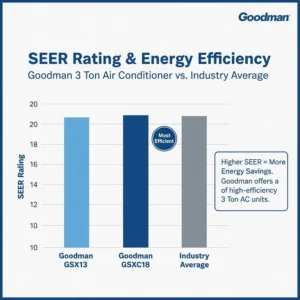
A SEER2 rating tells you how efficiently your air conditioner converts electricity into cooling. Higher numbers mean more cooling per dollar spent on electricity. According to the Environmental Protection Agency, upgrading from a 10-year-old 10 SEER unit to a modern 15 SEER2 system can cut your cooling costs by approximately 50%. That’s not pocket change—we’re talking $400-$700 annually for most households.
How SEER2 Impacts Your Operating Costs
Let me break this down with real numbers. Assuming you run your AC 8 hours daily for 4 months (typical in most U.S. climates) at $0.14 per kWh (national average), here’s what different SEER2 ratings cost annually:
- 13.4 SEER2: ~$950/year
- 14.3 SEER2: ~$890/year
- 15.2 SEER2: ~$840/year
- 17.2 SEER2: ~$740/year
- 18 SEER2: ~$710/year
The difference between the budget GLXS3B (13.4 SEER2) and premium GSXC180361 (18 SEER2) is about $240 annually. Over 15 years, that’s $3,600 in energy savings—which more than pays for the higher upfront cost.
However, there’s nuance here. If you live in a mild climate where AC runs minimally, or you’re installing in a rental property you’ll sell in 3 years, paying extra for ultra-high SEER makes less financial sense. But if you’re in Texas, Arizona, or anywhere your AC runs 6+ months yearly, higher SEER pays dividends quickly.
Single-Stage vs. Two-Stage Compressors: Which Should You Choose?
This might be the most important technical decision you’ll make when selecting your goodman 3 ton air conditioner. The compressor is the heart of your AC system, and whether you choose single-stage or two-stage operation fundamentally affects comfort, efficiency, and longevity.
Single-Stage Compressors: Simple and Reliable
Single-stage compressors operate like a light switch—they’re either fully on or completely off. When your thermostat calls for cooling, the compressor fires up at 100% capacity, runs until the temperature drops to your setpoint, then shuts off entirely. It’s straightforward, reliable, and has fewer potential points of failure.
The advantages are cost and simplicity. Single-stage units cost $400-$800 less upfront and have fewer electronic components that can malfunction. They’re also easier for any HVAC technician to service—you don’t need specialized training or diagnostic equipment. For mild climates or budget-conscious buyers, single-stage makes perfect sense.
The drawbacks? More temperature swings (your house might fluctuate 2-3 degrees around your setpoint), shorter run cycles that waste energy, and less effective dehumidification. You’ll also hear more noise as the unit cycles on and off throughout the day.
Two-Stage Compressors: Enhanced Comfort and Efficiency
Two-stage compressors offer low-speed and high-speed operation. Most of the time (studies show 80% of cooling demand), they run at low speed (typically 65% capacity). This provides gentler, more consistent cooling that maintains tighter temperature control. Only during peak heat does the unit shift to high speed.
The benefits are substantial: better humidity removal (critical in humid climates), quieter operation during low-stage running, longer equipment life due to less stress on components, and 15-25% better energy efficiency. Your home stays within 1 degree of the setpoint instead of swinging 2-3 degrees.
The trade-off is cost—you’ll pay $600-$1,000 more upfront for two-stage capability. You also introduce more sophisticated electronics that could potentially need repair. However, for hot climates or homes where comfort matters more than bare-bones budget, two-stage is worth every penny.
R-32 vs. R-410A Refrigerant: Understanding the New Standard
You might notice some Goodman models use R-32 refrigerant while others still use R-410A. This isn’t just technical jargon—it affects your system’s environmental impact, efficiency, and future serviceability.
R-410A has been the industry standard since the early 2000s when it replaced R-22 (Freon). It works excellently, but it has a global warming potential (GWP) of 2,088, meaning it’s a potent greenhouse gas if it leaks. R-32, the newer alternative, has a GWP of 675—about 68% lower environmental impact.
Beyond environmental benefits, R-32 also offers slightly better heat transfer properties, which can improve efficiency by 3-5% compared to R-410A in the same system design. It requires less refrigerant charge (typically 20% less), which reduces costs and environmental impact further.
However, there’s an important compatibility note: R-32 systems require R-32 compatible indoor coils or air handlers. You cannot simply swap an R-410A outdoor unit with an R-32 condenser without replacing indoor components. According to ASHRAE standards, mixing refrigerants or using incompatible components voids warranties and creates safety hazards.
For new installations, R-32 is future-proof—it’s the direction the industry is heading. For replacement projects, you’ll need to verify indoor component compatibility before selecting your outdoor condenser.
What Size Home Does a 3 Ton Unit Cool?
Let’s tackle the most common question: Is 3 tons the right size for your home? The answer depends on several factors beyond just square footage, though that’s where most people start.
The Square Footage Rule of Thumb
As a general guideline, one ton of cooling capacity handles approximately 500-600 square feet in average conditions. This means a goodman 3 ton air conditioner typically covers 1,500-1,800 square feet. However, this is a rough estimate—your actual needs vary based on multiple factors.
Factors That Affect Sizing
Climate Zone: A 1,600 sq ft home in Minnesota needs less capacity than the same home in Arizona. HVAC design manuals account for local climate with detailed cooling degree day calculations.
Insulation Quality: Poor insulation can increase required capacity by 20-30%. Well-insulated modern homes need less capacity than older homes with single-pane windows and minimal attic insulation.
Window Exposure: South and west-facing windows receive intense afternoon sun, increasing cooling loads. Large windows or poorly shaded glass can significantly impact requirements.
Ceiling Height: The standard calculation assumes 8-foot ceilings. If you have 10-12 foot ceilings or vaulted spaces, you need additional capacity.
Home Construction: Open floor plans cool more efficiently than compartmentalized layouts. Two-story homes often need more capacity than ranch-style homes of similar square footage.
The Dangers of Oversizing
Here’s where many homeowners go wrong: they assume bigger is better. It’s not. An oversized unit causes short-cycling—running briefly, shutting off, then rapidly restarting. This wastes energy, provides poor dehumidification, and accelerates wear on components. A properly sized unit runs longer cycles, which removes more humidity and provides more even temperatures.
Professional contractors use Manual J load calculations (the industry standard) to determine exact requirements. These calculations consider all the factors above plus dozens more. While it costs $150-$300, it ensures you buy the right size unit, potentially saving thousands in wasted energy and equipment replacement.
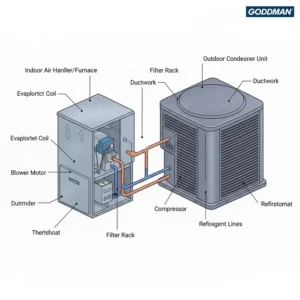
Installation Considerations and Professional Requirements
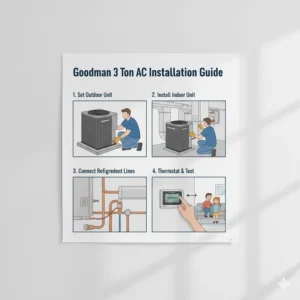
You might be handy with tools and tempted to install your goodman 3 ton air conditioner yourself to save money. Let me be blunt: don’t do it unless you’re an EPA-certified HVAC technician. Here’s why.
EPA Certification Requirements
Federal law requires EPA Section 608 certification to handle refrigerants. Violating this carries fines up to $37,500 per day. You can legally purchase equipment without certification, but you cannot legally charge it with refrigerant. Most units ship pre-charged with a 15-foot lineset allowance, but final connections and adjustments require certified handling.
What Professional Installation Involves
A proper installation isn’t just connecting some copper pipes. It includes:
Load Calculations: Verifying the unit matches your home’s requirements
Electrical Upgiring: Installing proper 220V circuit with correct amperage
Refrigerant Management: Evacuating lines, checking for leaks, proper charging
Ductwork Modifications: Sealing leaks, properly sizing supply and return ducts
Condensate Drainage: Installing proper drainage to prevent water damage
Startup and Testing: Verifying all safety controls, measuring actual temperatures and pressures
Warranty Registration: Documenting installation to validate Goodman’s warranty
Professional installation typically costs $1,500-$3,500 depending on complexity. Yes, that’s significant, but consider this: Goodman’s 10-year parts warranty typically requires professional installation with proper registration. Self-installation voids this protection, and a replacement compressor costs $800-$1,500. One warranty repair pays for professional installation.
Additionally, poorly installed systems waste 15-30% of their potential efficiency through refrigerant leaks, improper charging, or duct leakage. That inefficiency costs you $150-$300 annually in higher utility bills—again, quickly erasing any savings from DIY installation.
Maintenance Schedule to Maximize Lifespan
Here’s a truth that HVAC companies don’t publicize enough: proper maintenance extends system life from 10-12 years to 18-20 years. A goodman 3 ton air conditioner represents a $4,000-$7,000 investment—protecting it with $200 annual maintenance makes excellent financial sense.
Monthly Tasks (DIY)
Air Filter Replacement: Check monthly, replace every 1-3 months depending on home conditions. Clogged filters are the #1 cause of reduced efficiency and frozen coils. Standard fiberglass filters cost $1-$3, while high-quality pleated filters run $10-$20 but provide better filtration.
Visual Inspection: Walk around your outdoor unit checking for debris, vegetation growth, or unusual noises. Clear leaves, grass clippings, and other obstructions that block airflow.
Thermostat Check: Verify accurate temperature reading and proper operation. If temperatures seem off, recalibrate or replace the thermostat ($25-$150 depending on features).
Seasonal Tasks (DIY)
Coil Cleaning: Use a garden hose with gentle spray to rinse debris from outdoor coil fins. Avoid pressure washers, which bend delicate fins. Special coil cleaning products ($15-$25) remove stubborn buildup.
Condensate Drain Check: Pour a cup of vinegar down the condensate drain line to prevent algae growth that causes clogs. Clear any visible blockages carefully.
Electrical Connection Inspection: With power off, verify wire connections are tight. Loose connections cause overheating and eventual failure.
Annual Professional Service
Schedule professional maintenance before each cooling season. A thorough tune-up includes:
- Refrigerant level check and adjustment if needed
- Electrical component testing (capacitors, contactors, relays)
- Compressor amperage draw verification
- Condenser coil deep cleaning
- Blower motor and bearings lubrication
- Ductwork inspection for leaks
- Full system performance testing
Professional service typically costs $150-$250 but prevents 80-90% of major failures. Many HVAC companies offer maintenance agreements ($15-$25 monthly) that include annual service plus priority emergency repair scheduling and discounts on parts.
Common Problems and Troubleshooting
Even the best goodman 3 ton air conditioner eventually experiences issues. Knowing common problems helps you determine what’s DIY-fixable versus when to call a professional.
AC Won’t Turn On
Check First: Circuit breaker at main panel and disconnect switch near outdoor unit. Reset if tripped.
Next Step: Verify thermostat has power and is set to “Cool” mode with temperature below current room temp.
Pro Call Needed: If both check out, you likely have failed capacitor ($150-$300 repair), contactor ($100-$200), or control board ($300-$500).
Unit Runs But Doesn’t Cool
Check First: Air filter—a severely clogged filter prevents airflow, causing frozen evaporator coil.
Next Step: Look for ice on indoor coil or refrigerant lines. If frozen, shut off system for 4-6 hours to defrost.
Pro Call Needed: If filter is clean and no ice, you may have refrigerant leak ($500-$1,500 to find, repair, and recharge).
Short Cycling (Frequent On/Off)
Check First: Thermostat location—if in direct sunlight or near heat source, it misreads temperature.
Next Step: Verify outdoor unit has proper clearance (24 inches all sides) and isn’t blocked by vegetation.
Pro Call Needed: Oversized unit or faulty components cause short-cycling. May require downsizing or component replacement.
High Utility Bills
Check First: Compare SEER rating and expected costs. Lower SEER naturally costs more to operate.
Next Step: Check for air leaks around doors, windows, and ductwork. Seal obvious leaks with weatherstripping or mastic.
Pro Call Needed: Duct leakage assessment with pressure testing. Duct sealing typically costs $800-$1,500 but cuts cooling costs 20-30%.
Water Leaks Inside Home
Check First: Condensate drain line for clogs. Disconnect and blow out with compressed air or flush with vinegar.
Next Step: Verify drain pan isn’t cracked or rusted (common in units 10+ years old).
Pro Call Needed: If drain and pan are fine, you may have frozen coil causing overflow—indicates airflow or refrigerant problem.
Goodman Warranty Coverage Explained
Understanding your warranty matters almost as much as choosing the right unit. Goodman offers competitive warranty protection, but there are important nuances to understand.
Standard Parts Warranty
Goodman provides a 10-year limited parts warranty on all residential equipment when properly registered within 60 days of installation. Without registration, coverage drops to 5 years. This protects against manufacturing defects but doesn’t cover labor, refrigerant, or normal wear items.
The 10-year coverage includes all major components: compressor, coil, heat exchanger (if applicable), and other functional parts. However, certain components have enhanced coverage:
Compressor: Many models include lifetime compressor warranty when registered and professionally installed. This is significant since compressor replacement is the most expensive potential repair.
Heat Exchanger: If your system includes heating, the heat exchanger typically carries extended coverage due to its critical safety function.
What’s Not Covered
Understanding exclusions prevents disappointment:
- Labor costs for diagnosis or repair
- Refrigerant and charging services
- Damage from improper installation, maintenance, or repair
- Normal wear items like filters, contactors, or capacitors
- Modifications not approved by Goodman
- Cosmetic damage that doesn’t affect functionality
- Consequential damages (property damage from unit failure)
Making Warranty Claims
When warranty service is needed:
- Contact your installing contractor first—they handle most claims
- Have your model and serial numbers ready plus proof of installation date
- Describe the problem and any diagnostic findings
- Contractor orders warranty parts directly from distributor
- You pay only for labor, refrigerant, and non-covered items
Many contractors offer extended labor warranties ($300-$500 for 5-10 years) that cover technician fees for warranty repairs. This prevents situations where the part is free but you pay $500 in labor.
Energy-Saving Tips to Reduce Cooling Costs
Once you’ve invested in a quality goodman 3 ton air conditioner, maximizing efficiency through smart operation keeps bills low. Here are proven strategies that work:
Thermostat Management
Set your thermostat to 78°F when home, 85°F when away. Each degree below 78°F increases energy use by approximately 3-5%. Programmable thermostats ($50-$150) automate this, while smart thermostats ($150-$250) learn your patterns and optimize automatically.
Avoid the temptation to set your thermostat extra low to “cool faster.” Your AC cools at the same rate regardless of setting—you just end up with an icebox and enormous bills.
Strategic Window Management
Close blinds and curtains on sun-exposed windows during peak heat hours (typically 2-6 PM). This simple step blocks 45-50% of solar heat gain. Consider cellular or blackout shades ($25-$75 per window) for maximum effect.
Window film ($2-$5 per square foot) blocks UV and infrared radiation without darkening rooms. It’s particularly effective on large south or west-facing windows.
Ceiling Fans Work Wonders
Run ceiling fans counterclockwise during cooling season. The downdraft creates a wind-chill effect that makes rooms feel 3-4°F cooler, allowing you to raise thermostat setting without sacrificing comfort. Fans cost about $2-$3 monthly to run constantly versus $300-$400 monthly for AC.
However—and this is crucial—fans cool people, not rooms. Turn them off in unoccupied spaces; they waste energy if no one’s there to feel the breeze.
Seal Air Leaks
Homes lose 20-30% of cooled air through gaps and cracks. Common culprits:
- Ductwork Joints: Seal with mastic (not duct tape, which fails) for $50-$100 DIY
- Electrical Outlets: Install foam gaskets behind cover plates ($10 for 20-pack)
- Door Thresholds: Add weatherstripping or door sweeps ($15-$30)
- Attic Hatch: Install foam board and weatherstripping ($30-$50)
- Recessed Lighting: Use rated covers or seal from attic side
Professional duct sealing costs $800-$1,500 but typically pays for itself in 3-5 years through reduced bills.
Smart Appliance Use
Major appliances generate significant heat. Run dishwashers, washing machines, dryers, and ovens during cooler morning or evening hours rather than peak afternoon heat. This reduces your AC’s workload by 10-15%.
Consider grilling outdoors instead of using your oven—it saves electricity and doesn’t heat your home. An oven can raise kitchen temperature 10-15°F, forcing your AC to work overtime.
Frequently Asked Questions
❓ How long does a goodman 3 ton air conditioner typically last?
❓ Can I install a goodman 3 ton air conditioner myself to save money?
❓ What's the difference between 14 SEER and 18 SEER in real-world savings?
❓ Which goodman 3 ton air conditioner model offers the best value?
❓ Do I need to replace my furnace when installing a new AC?
Conclusion: Making Your Smart Purchase Decision
After diving deep into specifications, efficiency ratings, and real-world performance, you now have the knowledge to confidently select your goodman 3 ton air conditioner. Let’s recap the essential points that should guide your decision.
For premium efficiency and comfort, the GSXC180361 delivers unmatched performance with its 18 SEER rating and two-stage operation. Yes, it costs more upfront, but homeowners in hot climates recover the investment through lower utility bills within 5-7 years. If you plan to stay in your home long-term, this is the smart financial choice.
Budget-conscious buyers should focus on the GLXS4BA3610 or GLXS5B. Both provide reliable cooling at accessible price points, with the GLXS5B offering notably better efficiency for a modest price increase. These models prove you don’t need to choose between affordability and quality—Goodman delivers both.
The mobile home market has a clear winner in the GPCH33631 packaged unit. Its all-in-one design, factory testing, and corrosion-resistant components make it purpose-built for manufactured housing applications.
Remember these key principles:
Sizing matters more than features. An oversized 3-ton unit performs worse than a properly sized 2.5-ton system. Invest in professional Manual J calculations before purchasing.
SEER ratings translate to real savings. Higher efficiency costs more initially but pays dividends monthly. Calculate your expected usage and payback period before choosing.
Two-stage beats single-stage for comfort. If your budget allows, the improved humidity control and temperature consistency justify the extra cost.
Professional installation isn’t optional. Protect your warranty, ensure proper operation, and maximize efficiency by hiring certified technicians.
Your home deserves reliable cooling that doesn’t drain your bank account. Goodman’s 3-ton lineup offers options for every budget and requirement—now you know exactly which one fits your needs.
🌟 Transform Your Home Comfort Today!
Ready to beat the heat? Don’t wait until the next heatwave hits. Click any highlighted model above to check current Amazon pricing and start enjoying consistent, affordable cooling. Your family deserves comfort—make it happen now! 💨❄️
Recommended for You
- Goodman 2 Ton Air Conditioner: 7 Best Models 2025 Review
- DC Current Air Conditioner: 7 Best Models That Slash Energy Bills
- Water Cooled Air Conditioner: 7 Best Top Picks That Actually Work
Disclaimer: This article contains affiliate links. If you purchase products through these links, we may earn a small commission at no additional cost to you.
✨ Found this helpful? Share it with your friends! 💬🤗
