
In This Article
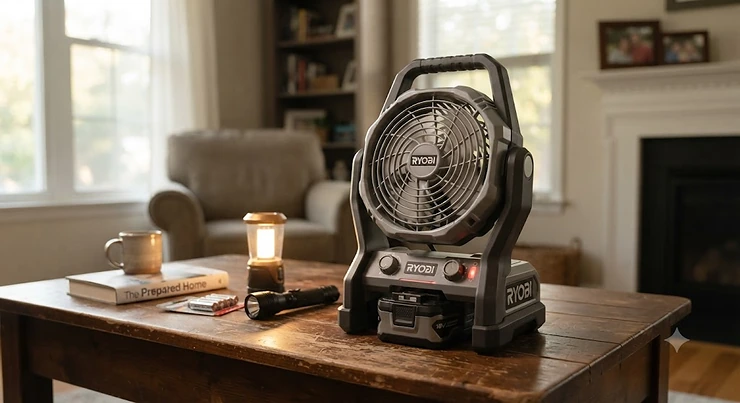
A fan for power outage situations is a battery-powered or rechargeable cooling device designed to keep air moving through your home when the grid goes down, typically running anywhere from a few hours to more than two full days on a single charge. If you have ever sat in a dark, muggy living room during a summer storm, sweat pooling at your collar while your phone battery ticks down, you already know why this category of gadget has quietly become one of the more essential items in a modern emergency kit. Outages used to mean candles and a paper fan from the junk drawer. Now they mean a purpose-built machine that can outlast the storm itself.
The thing is, not every rechargeable fan is built for the job. A dainty desk fan that dies in ninety minutes is fine for a coffee shop, but it is nearly useless when a hurricane knocks your power out for three days. That gap between “camping accessory” and “genuine emergency preparedness tool” is exactly what this guide sorts through. Federal emergency guidance encourages households to plan for batteries and alternative power sources before an outage happens, and a dependable backup fan belongs on that same list alongside flashlights and a charged power bank.
Below, you will find seven real, currently available models spanning handheld pocket fans up through heavy-duty floor units, plus the comparison data, buying criteria, and troubleshooting advice that Amazon listings never bother to include. We will talk honestly about battery backup duration, airflow strength, noise, and where each model actually shines, so you are not gambling on a dead fan the next time the lights go out.
Quick Comparison Table: Fan for Power Outage at a Glance
| Product | Battery Capacity | Runtime (Low–High) | Best For |
|---|---|---|---|
| O2COOL Treva 10-Inch Smart Power Fan | Internal + 8 D-cell backup | Varies by power source | Multi-power flexibility |
| JISULIFE Life9 Handheld Turbo Fan | 5,000mAh | Up to 18 hours | Personal cooling, bug-out bags |
| OPOLAR 10,000mAh Clip-On Fan | 10,000mAh | Up to 24 hours | Cribs, desks, tight spaces |
| Lasko RB200 Rechargeable Fan | 18V lithium-ion | 4–15 hours | Whole-room breeze, patios |
| Ryobi 18V ONE+ Hybrid Fan | 18V ONE+ (2.0–4.0Ah) | 3–8 hours (battery-dependent) | Households already on Ryobi tools |
| PANERGY 20,000mAh Box Fan | 20,000mAh | Up to 55 hours | Long multi-day outages |
| Geek Aire CF2SE 16-Inch Floor Fan | 19,200mAh | 3–24 hours | High-velocity whole-room airflow |
Looking at the spread here, the real story is capacity versus airflow trade-off. The PANERGY 20,000mAh Box Fan wins on sheer endurance, which matters most when you genuinely do not know if the outage will last four hours or four days. The Geek Aire CF2SE sacrifices some of that runtime for dramatically stronger airflow, which matters more in a stuffy, un-air-conditioned house than a battery gauge does. Meanwhile, something like the JISULIFE Life9 is not trying to cool a room at all — it is a personal-comfort tool that happens to be small enough to grab on your way out the door.
💬 Which style fits your household? Scroll down to the full breakdown below before you decide.
Top 7 Fan for Power Outage Picks: Expert Analysis
1. O2COOL Treva 10-Inch Smart Power Fan — runs on four different power sources
The standout here is flexibility: this fan automatically defaults to whichever power source is cheapest and available, cycling between an AC adapter, a car DC adapter, eight D-cell batteries, or its own rechargeable pack. That “Smart Power” switching sounds like a gimmick until you are three days into an outage with a dwindling stash of batteries and suddenly appreciate a fan that will not force you to choose one power format and stick with it. The 10-inch blade moves a modest but usable amount of air across two speeds, and a built-in USB port lets it double as a small phone charger in a pinch. On paper, this means the O2COOL Treva trades outright airflow power for something arguably more valuable during a genuine grid-down scenario: the ability to keep running no matter which power sources you happen to have on hand.
Based on the spec comparison with single-battery competitors, this model is best suited to households that already keep D-cell batteries around for flashlights and radios, since that redundancy is the whole point of buying it. Reviewers consistently note that the fold-flat design and integrated handle make it easy to store in a hurricane kit without eating much closet space, though a few mention the airflow feels underwhelming on the low setting compared to dedicated high-velocity models. If you cannot verify a specific runtime figure for the internal battery alone, that is worth flagging — O2COOL markets this unit primarily around its multi-power flexibility rather than one headline runtime number, so budget backup batteries or a car charger as insurance.
Pros:
- ✅ Switches automatically between four separate power sources
- ✅ USB port doubles as an emergency phone charger
- ✅ Folds flat for compact storage in a go-bag
Cons:
- ❌ Airflow on low speed feels weak next to high-velocity models
- ❌ Requires D-cell batteries on hand for backup runtime
Expect to pay in the $35–$50 range at the time of research; check current price before buying since availability shifts. Given how many backup options it packs into one unit, it is a reasonable value pick for anyone who wants insurance against running out of one power type mid-outage.
2. JISULIFE Life9 Handheld Turbo Fan — smallest option with an 18-hour runtime
What most buyers overlook about handheld fans is that a good one is not a toy — the JISULIFE Life9 packs a three-phase brushless motor and a nine-blade turbine design that manufacturers claim reaches around 40,000 RPM, noticeably stronger than the cheap single-speed handheld fans sold at gas stations. Its 5,000mAh battery is rated for up to 18 hours of runtime at the lowest of five speeds, and the whole unit weighs well under half a pound, small enough to clip to a bag strap or toss into a glove box. This is not a room-cooling device; it is a personal-comfort tool, and that distinction matters when you are deciding what belongs in your emergency kit.
Here is what to weigh: for a family of four sheltering in one room during an outage, one of these per person is a cheap way to add personal airflow without draining your bigger fan’s battery on every family member simultaneously. Reviewers consistently flag the noise level as louder on the top two speed settings, in the 60-70 dB range by JISULIFE’s own published figures, which is worth knowing if you plan to use it at night in a quiet room. The trade-off for that portability and turbo airflow is exactly what you would expect: it will not move air across a whole living room, and its usefulness in a genuine blackout fan role is limited to close-range personal cooling rather than whole-room circulation.
Pros:
- ✅ Up to 18 hours of runtime from a compact 5,000mAh battery
- ✅ Turbo airflow is strong for its handheld size class
- ✅ Lightweight enough to carry in a pocket or bag
Cons:
- ❌ Only cools the person holding it, not a room
- ❌ Higher speed settings get noticeably loud
Price typically falls in the $15–$25 range depending on color and bundle. As a stocking-stuffer-priced addition to a family emergency kit, the value case is easy to make.
3. OPOLAR 10,000mAh Clip-On Fan — doubles as a desk fan and a clip fan
The clamp is the standout feature here, and it is a genuinely useful one: an 8-inch, three-blade fan head paired with a roughly 2.3-inch spring clamp that can grip a crib rail, a treadmill frame, a desk edge, or a tent pole. The 10,000mAh internal battery is rated for up to roughly 24 hours of runtime on its lowest of what OPOLAR lists as multiple speed settings, and a Type-C fast-charging port brings it back to full in around 8 hours from a standard adapter. What sets this apart from a plain desk fan is the versatility of mounting positions — it converts from clip mode to a freestanding desk unit by rotating the frame, so it is not locked into one physical setup the way most rechargeable desk fans are.
The spec sheet won’t tell you this, but the practical value shows up most clearly in situations where a floor fan cannot be used at all: nurseries with a baby who should not have a floor-standing appliance nearby, or a home office desk where floor space is already claimed by a battery backup or a laptop stand. What most buyers overlook is that the clamp strength is also the limiting factor: it grips well on standard desk edges and crib rails but will not securely hold on unusually thick surfaces like a headboard post, so measure before assuming it fits your specific furniture.
Pros:
- ✅ Up to 24 hours of runtime from a 10,000mAh battery
- ✅ Converts between clip-mount and freestanding desk fan
- ✅ Type-C fast charging cuts recharge time significantly
Cons:
- ❌ Clamp will not grip unusually thick surfaces
- ❌ Airflow radius is limited compared to floor fans
Expect a price in the $30–$45 range, positioning it squarely as a mid-budget pick for anyone who needs targeted, mountable airflow rather than whole-room circulation.
4. Lasko RB200 Rechargeable Fan — 17-inch head with a dedicated battery charging station
Lasko has built fans for more than a century, and the RB200 leans into that heritage with a straightforward, no-frills design: an 18V lithium-ion battery pack, a separate charging cradle with an LED indicator, and a bundled AC adapter as a fallback if the battery ever fails. Reported runtime is up to 15 hours on the lowest of five speeds and roughly 4 hours on the highest, moving air at a published range of 100 to 475 CFM depending on setting. The 17-inch head and pivoting design mean this is genuinely built to cool a room, not just a face, which separates it from most of the compact clip and handheld fans in this category.
Based on the spec comparison against smaller rechargeable units, what most buyers overlook about the RB200 is the value of that separate charging cradle: it lets you keep the battery topped off in storage without running the fan itself, which matters if this is going to sit unused in a closet for eleven months of the year waiting for a storm. Reviewers consistently note the fan’s weight, at around 5 pounds, as a plus for stability on uneven ground outdoors but a minor downside for anyone hoping to hang it. Aggregated feedback on major retail platforms frequently mentions the ETL safety listing as reassuring for indoor overnight use, which lines up with the baseline expectations laid out in CPSC’s voluntary safety standards for household batteries and battery-powered appliances.
Pros:
- ✅ Separate charging cradle keeps battery topped off in storage
- ✅ 17-inch head genuinely circulates air across a full room
- ✅ ETL-listed for indoor and outdoor safety compliance
Cons:
- ❌ High-speed runtime drops to roughly 4 hours
- ❌ At 5 pounds, it is heavier than clip or handheld options
Pricing typically sits in the $70-$90 range, which places it firmly in the mid-tier for households wanting real room-scale airflow without stepping up to a heavy-duty floor fan.
5. Ryobi 18V ONE+ Hybrid Fan — runs on the same battery as your power tools
If your garage already has a shelf of Ryobi 18V ONE+ batteries for a drill, a shop vacuum, or a string trimmer, this fan is close to a free accessory during an outage. The hybrid design runs on any ONE+ battery or, when the grid is up, via a standard extension cord, and Ryobi’s own marketing leans directly into the emergency-use case: the ability to keep this running for hours off the same batteries powering the rest of your tool collection. Runtime naturally scales with whichever battery you slot in, from a couple of hours on a smaller 2.0Ah pack up toward a full workday on a larger 4.0 or 6.0Ah pack, since the fan itself is the constant and the battery is the variable.
Here is what to weigh if you do not already own the ONE+ platform: buying the fan as a bare tool is cheap, but building out battery and charger capacity from zero erases most of that savings, so this pick makes the most financial sense as an add-on rather than a first purchase. What the spec sheet won’t tell you, but user reports on the Whisper Series line suggest, is that the newer 7.5-inch Whisper fans run noticeably quieter than Ryobi’s earlier fan models, addressing a common complaint about tool-platform fans buzzing louder than dedicated cooling products. For anyone already invested in cordless power tools, this is original-content territory Amazon listings rarely mention: cross-compatibility turns a $40 accessory into effectively unlimited runtime as long as you keep rotating charged batteries.
Pros:
- ✅ Shares batteries with the entire Ryobi 18V ONE+ tool lineup
- ✅ Hybrid design also runs on AC extension cord power
- ✅ Whisper Series motor is quieter than earlier Ryobi fan models
Cons:
- ❌ Batteries and charger sold separately if starting from scratch
- ❌ Runtime is inconsistent since it depends entirely on battery size
Bare-tool pricing is generally in the $35–$50 range, with kits bundling a battery and charger running higher, roughly $65-$90. Value here depends almost entirely on whether you already own the battery ecosystem.

6. PANERGY 20,000mAh Rechargeable Box Fan — up to 55 hours on a single charge
The number that jumps off the spec sheet is 55 hours, an unusually long runtime made possible by pairing a 20,000mAh battery with a low-power sleep-friendly mode rated around 25dB. The 10-inch square box design with a 270-degree tilt is meant to slot into a window frame or sit on a floor or tabletop, and its four speed settings top out at what the manufacturer lists as roughly 13 feet per second of airflow on the highest setting. A Type-C fast-charging port brings the battery back from empty in about 8 hours, and a built-in 5V/2A USB port lets it function as a backup power bank for a phone in an actual emergency.
What most buyers overlook about long-runtime box fans like this one is that the headline hour figure is measured at the lowest, weakest speed setting, a pattern worth watching across this entire product category since manufacturers naturally lead with their best number. Reviewers consistently note that the slim, window-fan-style profile makes this easier to tuck into a tight apartment window than the bulkier metal floor fans in this list, though the plastic housing feels less rugged than metal-bodied competitors. Based on the spec comparison against the Lasko and O2COOL units above, the trade-off is straightforward: dramatically longer runtime in exchange for a lighter-duty build that is better suited to indoor use than repeated outdoor camping trips.
Pros:
- ✅ Up to 55 hours of runtime on the lowest speed setting
- ✅ Slim window-fan profile fits tighter spaces than floor fans
- ✅ USB output doubles as an emergency phone power bank
Cons:
- ❌ Plastic housing feels less rugged than metal-bodied competitors
- ❌ 55-hour figure only applies at the weakest airflow setting
Typical pricing lands in the $80–$100 range, positioning this as a strong upper-mid-tier pick specifically for buyers who prioritize outlasting a multi-day outage over raw airflow strength.
7. Geek Aire CF2SE 16-Inch High-Velocity Floor Fan — 2,300 CFM from a metal-bodied build
This is the airflow flagship of the group. A 19,200mAh battery pairs with a brushless DC motor to push a manufacturer-rated 2,300 CFM at the top speed, roughly triple the output of the smaller desk and clip fans covered above, while still claiming up to 24 hours of runtime on the lowest of its stepless speed settings. The all-metal housing and blades are built for repeated outdoor use — garages, warehouses, tailgates — while remaining IPX4 water-resistant enough to handle a sudden downpour. A 360-degree tilting head and locking rear wheel round out a design clearly built for durability rather than portability alone.
Based on the spec comparison with plastic-bodied competitors like the PANERGY box fan above, what stands out is the trade-off: less headline runtime at the extreme low end, but dramatically more usable airflow at every speed in between, which matters more in a genuinely hot, stuffy house than a battery gauge does. Reviewers consistently point to the detachable battery pack as a practical feature, since it doubles as a USB power bank for charging other devices and lets you keep a spare charged and ready to swap in in mid-outage. The metal construction adds real weight, however, so this is not the fan you grab for a quick evacuation; it is the fan you leave running in a garage or living room for the duration.
Pros:
- ✅ Rated up to 2,300 CFM, the strongest airflow in this roundup
- ✅ Detachable battery doubles as a USB power bank
- ✅ Metal housing and IPX4 rating built for repeated outdoor use
Cons:
- ❌ Noticeably heavier than plastic-bodied floor fans
- ❌ Premium price compared to lighter-duty competitors
Expect pricing in the $110–$150 range at the time of research. For anyone treating a whole-room blackout fan as a serious preparedness investment rather than a backup accessory, this is the model built to justify that spend.
Practical Usage Guide: Getting the Most From Your Backup Battery Fan
Buying the right emergency fan power outage tool is only half the job; how you store and charge it determines whether it actually works when you need it. Start by charging the battery to full as soon as you unbox it, then set a recurring reminder to top it off every one to two months even if you never use the fan, since lithium-ion cells lose a small amount of charge naturally over time. During active hurricane or storm seasons, keep the fan plugged in or topped off at all times so you are never caught with a half-charged unit when the forecast turns.
A common first-30-days mistake is storing the fan in an attic or hot garage, where high ambient heat accelerates battery degradation. Keep it somewhere climate-stable instead, like a hall closet. For units with detachable batteries, such as the Geek Aire CF2SE, consider buying a second battery pack early on so you always have one charged as backup; this single habit roughly doubles your effective runtime during a multi-day outage without buying a second fan. Wipe blades and intake vents monthly, since dust buildup on the motor housing reduces airflow efficiency over time, and always fully charge the unit before long-term storage rather than leaving it empty, which stresses the cell chemistry.
Real-World Scenarios: Matching a Fan to Your Household
Consider a college student in a third-floor apartment with no central air and a landlord slow to fix outages. Budget and portability matter more than raw power here, which makes something like the JISULIFE Life9 or the OPOLAR 10,000mAh Clip-On Fan a sensible pick — cheap, dorm-room-sized, and easy to clip to a desk or bed frame.
Now picture a family of four in a suburban home in a hurricane-prone region, where outages regularly stretch past 48 hours. Here, endurance and room-scale airflow matter more than portability, which points toward the PANERGY 20,000mAh Box Fan for its 55-hour ceiling, paired with a couple of JISULIFE handheld units for personal comfort in bedrooms.
Finally, think about a homeowner with a detached garage workshop who already owns cordless power tools. The Ryobi 18V ONE+ Hybrid Fan slots directly into batteries they already own, while the Geek Aire CF2SE earns its higher price tag by doubling as a year-round high-velocity garage fan, not just an emergency-only purchase gathering dust in a closet.
✨ Not sure which profile matches your household? Scroll back up to the comparison table to line up your priorities before you buy.
No Electricity Fan Problems: Common Issues and Solutions
Problem: The fan barely lasts a few hours. This is almost always a battery capacity mismatch — a 5,000mAh handheld fan was never built to cool a room for a full night. Match capacity to your actual outage length; for multi-day scenarios, look at 15,000mAh-plus models like the PANERGY or Geek Aire CF2SE.
Problem: The battery won’t hold a charge after a year in storage. Lithium-ion cells degrade fastest when left fully drained or fully charged for months at a time. Store at roughly 80 percent charge and cycle it every few months per the usage guide above.
Problem: Airflow feels weak even on the highest setting. Compare the CFM rating on your model against the others in this guide; smaller handheld and clip fans simply were not engineered for whole-room circulation, so the fix is often adding a stronger secondary unit rather than assuming your fan is broken.
Problem: The fan is too loud to sleep near. Check the published dB rating before buying rather than after — the PANERGY box fan’s roughly 25dB low-speed rating is considerably quieter than a handheld turbo fan running at full speed.
Problem: You forgot to charge it and the power just went out. This is a habit problem, not a product problem — set a recurring monthly phone reminder tied to a fixed date, like the first of the month, to check and top off every backup device in your kit.
How to Choose a Fan for Power Outage: 6 Criteria That Actually Matter
- Match battery capacity to your realistic outage length. A weekend camping trip and a week-long grid failure call for very different mAh ratings; oversizing costs a little more upfront but removes the anxiety of watching a battery gauge during a real emergency.
- Check the CFM or airflow rating, not just the mAh number. A huge battery paired with a weak motor still leaves you sweating; the strongest performers in this guide, like the Geek Aire CF2SE, balance both figures rather than maximizing one.
- Consider your existing battery ecosystems. If you already own cordless power tools, a hybrid option like the Ryobi 18V ONE+ Hybrid Fan can be dramatically cheaper than buying a standalone unit from scratch.
- Weigh portability against room coverage. Handheld and clip fans excel at personal comfort in tight spaces; box and floor fans excel at circulating air through an entire room, and few products do both well.
- Look for a UL or ETL safety listing. Given that lithium-ion battery packs are the power source, a recognized safety certification is not optional. It reflects the same baseline standards regulators reference when evaluating consumer battery products for fire and short-circuit risk.
- Factor in noise level for overnight use. A fan you cannot sleep next to defeats half its purpose during a multi-night outage; check the published dB rating, not just the marketing copy.
Common Mistakes When Buying an Emergency Fan Power Outage Tool
The single biggest mistake is buying based on price alone without checking runtime at your realistic usage speed, not the manufacturer’s best-case low-speed number. A close second is assuming a personal handheld fan can substitute for a room fan; it cannot, and buyers who make this swap are often disappointed within the first hot night. Some shoppers also skip checking for a detachable or swappable battery, which becomes a real limitation the moment a single built-in battery dies mid-outage with no way to recharge it. Finally, plenty of buyers never actually test their fan before an emergency hits, only discovering a dead battery or malfunctioning switch once the power is already out and it is too late to return the unit or order a replacement.
Blackout Fan Rechargeable vs. Traditional Corded Fans
A rechargeable blackout fan and a standard corded fan solve fundamentally different problems, even though they look similar on a store shelf. A corded fan is generally cheaper and offers unlimited runtime as long as the outlet has power, but it is entirely useless the moment the grid goes down, which is precisely the scenario this whole guide is built around. A rechargeable model trades that unlimited runtime for independence from the wall outlet, at the cost of a finite battery life measured in hours rather than indefinitely.
The practical answer for most households is not choosing one over the other, but owning both: corded fans for everyday use when the power is reliably on, since electricity from the wall is essentially free compared to battery wear, and a dedicated battery backup fan reserved specifically for outages. Reviewers who have lived through actual blackouts consistently point to this dual-ownership approach as the difference between mild inconvenience and genuine discomfort during an extended outage.
What to Expect: Real-World Performance During an Outage
Manufacturer specs describe ideal lab conditions, so it helps to translate them into what actually happens in your living room. A fan rated for 2,000-plus CFM, like the Geek Aire CF2SE, will noticeably move papers and lightweight curtains across a mid-sized room, similar to a standard box fan plugged into the wall. A fan in the 200-500 CFM range, like the Lasko RB200 on its higher settings, creates a personal breeze effective within roughly 6 to 10 feet rather than circulating an entire room. Handheld units under 100 CFM equivalent output are, realistically, built for the person holding them and nobody else in the room.
Temperature perception matters as much as raw airflow. On paper, a fan does not lower a room’s actual temperature, it just increases evaporative cooling on your skin. That is why CDC guidance on heat and health specifically warns against treating a fan as your only defense during genuinely extreme heat, since moving air creates a sense of comfort without actually reducing body temperature or preventing heat-related illness on its own. During a summer outage, treat a battery fan as one layer of a broader cooling strategy — closed blinds, damp towels, hydration — rather than a total substitute for air conditioning.
Backup Battery Fans for Different Households
For renters and apartment dwellers with limited storage, compact clip and desk options like the OPOLAR 10,000mAh Clip-On Fan make the most sense, since floor space and closet room are both at a premium. For families in hurricane- or wildfire-prone regions who face outages measured in days rather than hours, prioritize the longest-runtime models here, namely the PANERGY 20,000mAh Box Fan, alongside a couple of handheld units for individual bedrooms. For homeowners with garages, workshops, or existing cordless tool collections, the Ryobi 18V ONE+ Hybrid Fan and the metal-bodied Geek Aire CF2SE both double as everyday equipment rather than single-purpose emergency gear, which stretches the value of the purchase across the whole year, not just outage days.
For households with infants or elderly family members with heat sensitivity, prioritize both quiet operation and mountable, hands-free positioning, which points toward the OPOLAR clip fan for cribs or the Lasko RB200 for a stable, higher-airflow option that does not need to be held.
Long-Term Cost & Maintenance: What Backup Battery Fan Duration Really Costs You
Lithium-ion battery packs typically hold a meaningful charge for 300 to 500 full charge cycles before capacity noticeably degrades, according to general figures published across battery manufacturer datasheets. In practice, since most households only run these fans a handful of times a year outside of actual outages, that translates to several years of useful life for the battery pack itself, assuming reasonably careful storage as outlined earlier in this guide. Total cost of ownership, then, is mostly the upfront purchase price plus the rare cost of a replacement battery years down the line, since most models in this guide do not require any consumable parts beyond the pack itself.
Comparing that to a household running a portable generator for the same outages, the fan option is dramatically cheaper both upfront and over time, with no fuel costs, no maintenance schedule, and no carbon monoxide risk indoors. For the average household experiencing a handful of outages per year, spending $70-$150 once on a durable model like the Lasko RB200 or Geek Aire CF2SE works out to a lower cost per outage than repeatedly replacing cheaper units that fail after a season or two of use.
Safety, Regulations & Emergency Preparedness Guide
Every product in this guide relies on a lithium-ion or similar rechargeable battery pack, and battery safety is not a place to cut corners. Look for products carrying a UL or ETL listing, which indicates independent testing against recognized safety standards. Never charge a rechargeable fan battery unattended overnight on a flammable surface like a couch or bed, and stop using any unit that feels unusually hot to the touch during charging, since that can signal a failing cell.
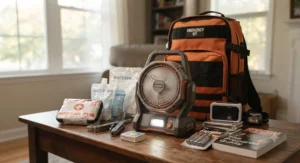
On the broader emergency preparedness side, treat your fan for power outage purchase as one item on a larger checklist, not a standalone solution, and it helps to understand the basic chemistry doing the work inside every model on this list. Most of these fans run on lithium-ion battery cells, which store energy efficiently but degrade faster in extreme heat or when left fully drained for long stretches — one more reason the storage habits covered earlier in this guide genuinely matter. Round out your kit with flashlights, a first-aid kit, and enough water and non-perishable food for at least 72 hours. If anyone in your household relies on refrigerated medication or medical equipment, build a specific outage plan around those needs well before storm season, since a fan alone will not solve a medical-grade power dependency.
Frequently Asked Questions
❓ How long does a fan for power outage typically run on one charge?
❓ Can I run a rechargeable fan continuously for multiple days straight?
❓ Do battery backup fans work as well as plug-in electric fans?
❓ Is a bigger mAh battery always better for an emergency fan?
❓ How do I maintain battery backup duration over several years of storage?
Conclusion
Choosing the right fan for power outage situations comes down to matching capacity and airflow to your realistic scenario, not chasing the single highest spec number on a listing page. A renter in a small apartment gets more genuine value from a compact clip fan like the OPOLAR 10,000mAh Clip-On Fan than from a heavy metal floor unit that will spend most of its life in a closet. A family bracing for multi-day hurricane season outages, on the other hand, is better served by the extended runtime of the PANERGY 20,000mAh Box Fan or the raw airflow of the Geek Aire CF2SE, even at a higher price point.
Whichever model you land on, the maintenance habits matter as much as the purchase itself: keep it charged, store it somewhere climate-stable, and treat it as one piece of a broader power failure cooling strategy alongside hydration, shade, and a genuine emergency plan. Power outages are unpredictable by nature, but your response to them does not have to be.
✨ Don’t Miss These Exclusive Deals!
🔍 Take your power outage preparedness to the next level with these carefully selected fans. Click on any highlighted product name above to check current pricing and availability. These picks will help you build authentic peace of mind your whole household can count on when the lights go out!
Recommended for You
- Battery Fan for Camping: 7 Best Picks That Actually Survive 2026
- 7 Best Battery Powered Box Fans of 2026
- 7 Best Battery Powered Fan Picks for 2026
Disclaimer: This article contains affiliate links. As an Amazon Associate, I earn from qualifying purchases. If you purchase products through these links, we may earn a small commission at no additional cost to you.
✨ Found this helpful? Share it with your friends! 💬🤗
