
In This Article
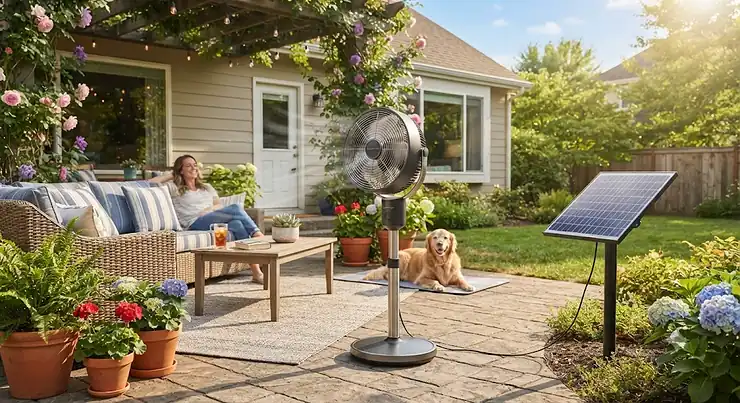
A solar powered fan is a cooling device — anything from a handheld camping fan to a full roof-mounted attic ventilator — that runs on electricity generated by its own onboard solar panel instead of pulling from your utility meter. That’s the whole pitch, and it’s a good one: no outlet, no extension cord snaking across the yard, no line item on your power bill just to keep air moving.

Here’s the thing nobody tells you before you start shopping, though: “solar fan” is really two different product categories wearing the same name tag. There’s the personal cooling fan — the kind you’d clip to a tent pole or set on a workbench — and there’s the whole-building attic fan, a mechanical exhaust system that quietly fights a war against 140-degree roof cavities all summer long. Confusing the two is probably the single most common mistake we see in solar fan reviews across the internet, and it’s why so many people end up disappointed with a purchase that was never wrong for anyone — just wrong for them.
We spent real research time digging into seven actual products on the market right now, cross-referencing specs against aggregated owner feedback rather than just repeating what’s printed on the box. Below you’ll find the best solar powered fan for seven distinct situations: desk, tent, patio, worksite, and three flavors of attic. Grab a glass of iced tea. This is the long version, and it’s worth it.
Quick Comparison Table
| Product | Category | Power Source | Best For |
|---|---|---|---|
| Cowin Solar Fan System | Personal / portable | 15W panel + battery + AC | All-rounder indoor-outdoor use |
| Seddex 5W Desktop Solar Fan | Desktop / greenhouse | 5W panel, direct-drive | Tiny spaces, coops, greenhouses |
| TonyEst 16″ Solar Powered Fan | Outdoor floor fan | 30W panel, 20,000mAh battery | Patios and worksites |
| DBF 18″ Solar Powered Fan | Outdoor floor fan | 40W panel, 30,000mAh battery | All-day heavy-duty cooling |
| Broan-NuTone 345SOWW | Attic ventilator | 28W panel, direct-drive | Compact attics on a budget |
| Amtrak Solar 50W Attic Fan | Attic ventilator | 50W panel + thermostat option | Variable-climate attics |
| Natural Light 36-Watt Attic Fan | Attic ventilator | 36W panel, direct-drive | Large attics needing maximum airflow |
Looking at this lineup, the split becomes obvious fast: four products move air around you, and three move air around your house. The Cowin Solar Fan System earns its spot as the most versatile of the personal fans since it bridges indoor and outdoor use with a battery backup, while the Natural Light 36-Watt Attic Fan simply moves more cubic feet per minute than anything else here, at the cost of drawing the most wattage to do it. If your search started with “which solar panel fan best fits my situation,” this table is your fastest answer — match your square footage or your use case to the right row before you read another word.
☀️ Ready to stop guessing and start comparing real specs? Scroll down to see exactly how each pick performed.
Top 7 Best Solar Powered Fans: Expert Analysis
1. Cowin Solar Fan System — best all-rounder for indoor-outdoor cooling
The Cowin Solar Fan System is the fan equivalent of a Swiss Army knife, and that versatility is exactly why it opens our list. Under the hood you’re looking at a 16-inch blade spinning on a 35W DC motor, powered by a detachable 15W solar panel with an 18V output, backed by a 6V 4.5Ah rechargeable battery pack. In practice, that combination means roughly eight hours of runtime at low speed or four hours at high speed on a full charge — plenty for an afternoon on the porch or an overnight camping trip. What most buyers overlook about this model is the AC adapter fallback: on an overcast week, you’re not stuck with a paperweight, since the same fan runs off a wall outlet.
This is the pick for someone who wants one fan that works equally well in a garage, a tent, or next to a hammock — not a specialist tool, but a genuinely flexible one. Reviewers consistently report satisfaction with the three-speed control and the bonus LED light and USB charging port, though a recurring theme in aggregated feedback is that the solar panel connection itself can be finicky for a subset of buyers, occasionally requiring a firmer plug-in than expected. Some owners also note a faint clicking sound during oscillation, which is worth knowing before you buy one for a bedroom.
Pros:
- ✅ Three real speed settings plus a dual charging method
- ✅ USB port lets you charge a phone off the same battery
- ✅ AC adapter backup means cloudy days aren’t a dealbreaker
Cons:
- ❌ Solar panel connection reported as finicky by some owners
- ❌ Oscillation produces a faint clicking noise for some units
Pricing on this one typically lands in the $40-$60 range depending on the retailer and any active promotions — check current price before buying, since availability shifts often. For the number of jobs it can do, it’s a strong value pick to open the list.
2. Seddex 5W Desktop Solar Fan — smallest footprint for desks, coops & greenhouses
Not every cooling problem needs 500 CFM of muscle. Sometimes you just need to move a little air across a chicken coop, a greenhouse bench, or a cramped RV dashboard, and that’s precisely the job the Seddex 5W Desktop Solar Fan was built for. The whole unit measures a mere 4 x 4 x 4 inches, dwarfed by its own 8.7 x 7-inch solar panel, and it runs directly off that panel’s 5 watts without an intermediate battery to manage.
Here’s what the spec sheet won’t tell you, but the design implies clearly: direct-drive solar fans like this one only spin when the sun is actually hitting the panel, so don’t expect nighttime operation. That trade-off is exactly why it’s the right call for daytime-only applications — a greenhouse that needs airflow precisely when the sun is baking it, or a chicken coop where the whole goal is preventing heat stress during peak afternoon hours. Buyers consistently describe it as impressively quiet for something so small, which matters if it’s sitting six inches from where you work.
Pros:
- ✅ Tiny 4-inch footprint fits almost anywhere
- ✅ Runs whisper-quiet compared to larger models
- ✅ Simple direct-drive design with nothing to charge overnight
Cons:
- ❌ No battery means zero airflow once the sun sets
- ❌ Underpowered for anything larger than a small enclosed space
Expect to pay in the $20-$30 range for this one — it’s one of the more affordable entries on this list, and the value verdict is simple: for its specific niche, nothing else here comes close on price.
3. TonyEst 16″ Solar Powered Fan — sturdiest build for patios and worksites
Step up in size and you land on the TonyEst 16″ Solar Powered Fan, which pairs a 16-inch blade with a 30W solar panel and a 20,000mAh battery — a meaningful jump in both muscle and stamina over the compact desktop options. The metal construction and aluminum blades are the standout feature here, and they matter more than they sound: plastic-bodied fans left outdoors tend to go brittle and yellow within a season or two, while this build is designed to shrug off worksite conditions.
The stepless speed control is the other detail worth calling out, since it lets you dial in airflow rather than jumping between three fixed settings. Based on the spec comparison against lighter competitors, this is the fan for someone cooling a patio, a garage bay, or a job site where the unit might get bumped, dusted, or left out in weather that would kill a cheaper fan within a month. Reviewers in this category consistently mention appreciating the sturdier feel over flimsier plastic alternatives, even though it does mean more heft to carry.
Pros:
- ✅ Metal body and aluminum blades built for rougher outdoor use
- ✅ 20,000mAh battery supports a full evening of runtime
- ✅ Stepless speed control fine-tunes airflow precisely
Cons:
- ❌ Noticeably heavier than plastic desktop or camping fans
- ❌ Premium build pushes the price above entry-level models
Pricing typically runs $60-$90, positioning it squarely as a mid-range option — you’re paying for durability here, not extra features, and that’s a fair trade if you actually need it.
4. DBF 18″ Solar Powered Fan — longest all-day runtime for serious outdoor cooling
If you’ve read enough outdoor solar fan reviews to notice a pattern, it’s that battery size is where most models quietly cut corners. The DBF 18″ Solar Powered Fan doesn’t: it pairs an 18-inch blade with a genuinely oversized 40W solar panel and a 30,000mAh battery, a combination that consistently outperforms cheaper alternatives when you need cooling that lasts from breakfast until well after sundown.
What that 40W panel means in practice is faster recharging even on partly cloudy afternoons, since it’s simply capturing more raw wattage per hour than the 15-20W panels found on smaller fans. Paired with the 30,000mAh battery, you get a buffer deep enough to run multiple days without direct sun if you ration speed settings. This is the fan for anyone treating outdoor cooling as a serious, all-day requirement — think open-air workshops, extended camping stays, or a covered patio that hosts people for hours at a stretch, not just a quick sit-down. The size and weight are the honest trade-off, and reviewers note it’s not something you’re tossing in a daypack.
Pros:
- ✅ 40W panel recharges faster than smaller-panel competitors
- ✅ 30,000mAh battery supports true multi-day, all-day runtime
- ✅ 18-inch blade moves noticeably more air than 16-inch models
Cons:
- ❌ Bulk and weight limit portability compared to smaller fans
- ❌ Higher price point than compact personal fan alternatives
Price typically falls in the $90-$130 range, which sits at the top of the personal-fan category here — but given the runtime numbers, the value verdict holds up for anyone who genuinely needs all-day cooling away from an outlet.
5. Broan-NuTone 345SOWW Surface Mount Solar Attic Ventilator — best value for compact attics
Now we shift categories entirely. The Broan-NuTone 345SOWW is a roof-mounted attic ventilator, not a portable fan, and it represents the budget-friendly end of that market. A 28-watt polycrystalline solar panel drives a 12-inch, one-piece aluminum five-blade fan rated at a maximum 537 CFM — enough, per the manufacturer’s own coverage figures, to ventilate roughly a 3,222 cubic foot attic space.
Based on the spec comparison against larger attic units later in this list, the 345SOWW is clearly scoped for smaller to mid-sized homes rather than sprawling roof cavities. Its low-profile, integrated dome design is a genuine advantage most buyers don’t think to ask about: it sits flush against the roofline instead of standing up on props like some competitors, which matters both for curb appeal and for wind resistance in storm-prone regions. The corrosion-resistant aluminum screen keeps out birds and debris without choking airflow, and the compact base footprint means fewer shingles need cutting during installation — a detail any roofer will tell you saves real labor time.
Pros:
- ✅ 537 CFM covers a realistic small-to-mid attic footprint
- ✅ Low-profile dome blends into the roofline discreetly
- ✅ Corrosion-resistant screen and tempered glass panel add durability
Cons:
- ❌ No included thermostat for automatic seasonal cutoff
- ❌ Retailer availability has been inconsistent for this specific model
Expect a price range in the low-to-mid $200s installed-panel-included — a solid value verdict for anyone with a modest attic who doesn’t need the biggest CFM number on this list, just a reliable one.

6. Amtrak Solar 12-Inch 50W Solar Attic Fan with Thermostat — smartest control for variable climates
Where the Broan unit runs whenever the sun hits it, the Amtrak Solar 50W Attic Fan is built around the idea that you might not always want that. Its 12-inch fan pairs with a 50-watt monocrystalline solar panel, and — critically — it supports an optional inline thermostat that keeps the fan powered down during cold months, preventing it from pulling warm air out of an attic that’s trying to stay insulated in winter.
Here’s what most buyers overlook when comparing wattage numbers alone: a bigger panel doesn’t just mean more raw output, it means more usable output on hazy or partly cloudy days, since there’s simply more surface area catching diffuse light. Made in the USA and wind-tunnel tested by Revcor, this unit is aimed squarely at homeowners in climates with real seasonal swings — hot, humid summers followed by genuinely cold winters — where a fan that runs unconditionally twelve months a year isn’t actually doing you any favors. The plug-and-play wiring keeps installation approachable for a confident DIYer, though the thermostat itself is sold as a separate add-on rather than bundled in.
Pros:
- ✅ Optional thermostat prevents unwanted winter operation
- ✅ 50W monocrystalline panel performs better on hazy days
- ✅ Plug-and-play wiring simplifies a DIY installation
Cons:
- ❌ Thermostat is sold separately, adding to total cost
- ❌ Rated coverage tops out around 2,250 square feet
Pricing sits around $199-$260 for the fan and panel kit, with the thermostat add-on typically running extra — check current price for the bundle that matches your climate needs.
7. Natural Light 36-Watt Solar Attic Fan — highest airflow for large attic spaces
Closing out the list is the heavyweight: the Natural Light 36-Watt Solar Attic Fan, which delivers a genuinely large 1,628 CFM of airflow, with manufacturer coverage estimates reaching roughly 2,625 square feet of attic space. That CFM figure isn’t a rounding error — it’s meaningfully higher than every other attic unit on this list, and it’s the reason this model shows up so often in “top rated solar fan” roundups aimed at large or older homes with big, unbroken roof cavities.
The honest trade-off, and it’s worth stating plainly rather than glossing over: this fan also carries the largest power draw in its category at 36 watts, which means its output is more sensitive to cloud cover than the smaller units on this list. Users note that on days with heavy cloud cover, output noticeably drops even if the ambient air temperature outside stays hot — a physics problem no amount of engineering fully solves, since solar output scales with light intensity, not air temperature. For homeowners with genuinely large attics and a roof that gets consistent, unobstructed sun, this is the fan that will actually keep pace with the space. For anyone in a consistently overcast climate, it’s worth pairing expectations accordingly.
Pros:
- ✅ 1,628 CFM is the highest output on this list
- ✅ Large panel covers up to roughly 2,625 square feet
- ✅ Established brand with a long market track record
Cons:
- ❌ Largest power draw of the group at 36 watts
- ❌ Output drops noticeably under heavy, sustained cloud cover
Pricing typically runs $350-$450 for the full kit, positioning it as the premium pick here — justified specifically for large attics, less so for anything under 2,000 square feet.
Practical Usage Guide: Setup & Maintenance Tips
Getting a solar powered fan working well on day one is mostly about sun angle, not electronics. For portable units like the Cowin or TonyEst, angle the detachable panel to face the sun as directly as possible rather than leaving it flat — even a 20-30 degree tilt toward the light source noticeably improves charging speed versus a panel lying flush on the ground. For roof-mounted units like the Broan-NuTone 345SOWW or Amtrak Solar 50W, orientation is baked into the install, but keeping the panel free of leaf litter and dust is a maintenance task people forget for months at a time.
A simple 30-day habit avoids the most common early complaint we found across solar fan reviews: buyers assuming a fan is defective when it’s actually just underperforming from a dirty or poorly angled panel. Wipe the panel surface with a damp cloth monthly during pollen or dust-heavy seasons. For battery-backed personal fans, avoid letting the internal battery sit fully depleted for extended stretches — like most rechargeable packs, they hold capacity better long-term with periodic partial charging rather than deep, prolonged drains. And if you’re mounting an attic fan yourself, double-check the flashing seal around the roof penetration before the first hard rain; a solid install here prevents the single most common regret owners report months later.
✨ Don’t Miss These Exclusive Deals!
🔍 Ready to bring free, off-grid airflow into your own space? Click through to check current pricing on any pick above — these solar fans make it easy to build a cooler, greener setup your whole household will appreciate!
Real-World Scenarios: Outdoor Solar Fan Reviews From Three Different Lives
Reading spec sheets only gets you so far, so here’s how these picks actually map to real situations. Take a college student living in a dorm-adjacent studio with a tiny balcony and no interest in running an extension cord out a window — the Cowin Solar Fan System solves that cleanly, since it charges on the balcony rail and runs indoors on its battery reserve, with the AC adapter as backup during finals-week cloudy stretches.
Now picture a family that spends every third weekend at a remote campsite with genuinely zero hookups. For them, the calculus shifts toward runtime over portability, and that’s exactly where the DBF 18″ Solar Powered Fan earns its keep: its 30,000mAh battery means the fan is still moving air well after the campfire’s out, without anyone babysitting a charge cable. Finally, consider a homeowner in a 1990s-built house with a cramped, poorly vented attic that turns the upstairs bedrooms into saunas every July. That’s a textbook case for the Broan-NuTone 345SOWW — modest square footage, budget-conscious, and looking for a install-it-and-forget-it fix rather than a smart-thermostat system they’ll never fully configure.
Problem → Solution: Common Solar Fan Frustrations, Solved
Problem: “My fan barely spins on cloudy days.” This is almost always a panel-wattage-to-fan-size mismatch, not a defect. Smaller panels like the Seddex’s 5W unit are proportioned for direct sun; if your climate skews overcast, a higher-wattage option like the TonyEst or DBF will tolerate diffuse light far better.
Problem: “The battery drains overnight even when the fan’s off.” Many rechargeable battery packs have a small parasitic draw from onboard electronics like remote-control receivers or LED indicators. If you’re not using the fan for an extended stretch, disconnect the battery entirely rather than leaving it wired in standby.
Problem: “My attic fan runs in winter when I don’t want it to.” This is precisely the gap the Amtrak Solar 50W‘s optional thermostat closes — without one, any direct-drive attic fan will run whenever there’s sun, insulation season or not.
Problem: “I can’t tell if my attic even needs a fan this powerful.” Measure your attic’s square footage and cross-reference it against each product’s coverage rating in the comparison table above rather than assuming bigger is automatically better — oversizing wastes money without meaningfully improving comfort.
Problem: “The panel cable doesn’t reach where I want to mount it.” Several portable models, including the Cowin, ship with panels on a fixed cable length. Before buying, measure the actual distance from your preferred fan location to the sunniest available surface — a cheap extension cable rated for low-voltage DC can solve this without replacing the whole unit.

How to Choose the Best Solar Powered Fan
If you’re trying to find the top rated solar fan for your specific situation, work through these seven questions in order rather than jumping straight to star ratings:
- Identify your category first. Decide whether you need a personal cooling fan or a whole-attic ventilator — this single decision eliminates half the market immediately.
- Measure your space. For attic fans, get a real square footage number; for personal fans, note whether you need portability or a stationary setup.
- Match panel wattage to your climate. Consistently sunny regions can run smaller panels efficiently; cloudier climates benefit from oversized panels like the DBF’s 40W unit.
- Check battery capacity for personal fans. A higher mAh rating translates directly into nighttime or cloudy-day runtime — non-negotiable for camping use.
- Decide if you need thermostat control. Attic fans running unconditionally through winter can undermine insulation performance; thermostat-equipped models solve this.
- Weigh build materials against your environment. Metal-bodied fans like the TonyEst outlast plastic ones in constant outdoor exposure.
- Confirm the price range fits your budget tier. Compare against the ranges listed throughout this guide rather than chasing the single cheapest listing, which often sacrifices battery life or build quality.
What “Photovoltaic Powered” Actually Means for Real-World Airflow
Every fan on this list is, at its core, a small photovoltaic system — a panel of semiconductor cells that convert sunlight directly into electrical current, no combustion or moving parts involved in the energy generation itself. That matters practically because photovoltaic output isn’t a simple on/off switch; it scales continuously with light intensity, angle, and cloud cover, which is exactly why two fans with the same wattage rating can perform noticeably differently depending on where and how they’re mounted.
Here’s the detail that separates genuinely well-engineered photovoltaic powered fans from bargain-bin versions: panel efficiency and battery management circuitry. A cheap panel wastes a meaningful chunk of captured sunlight as heat rather than converting it to usable current, while a well-designed battery controller protects against overcharging and deep discharge — both extending the practical lifespan of the whole unit by years. When you’re comparing wattage numbers side by side in any solar fan reviews you read elsewhere, remember that raw watts only tell half the story; the other half is how efficiently that power actually reaches the motor.
Renewable Energy Fan vs Traditional Electric Fans
| Factor | Renewable Energy Fan (Solar) | Traditional Electric Fan |
|---|---|---|
| Running cost | Zero ongoing electricity cost | Adds to monthly utility bill |
| Installation | No wiring for portable models; simple mount for attic units | Requires outlet or hardwiring |
| Reliability in outages | Keeps running during a power outage | Stops working immediately |
| Performance ceiling | Output tied to available sunlight | Consistent output regardless of weather |
| Best For | Off-grid, remote, or outage-prone locations | Indoor spaces needing constant, weather-independent airflow |
The core trade-off here is consistency versus cost. A traditional electric fan will spin at full speed at 2 a.m. during a thunderstorm; a renewable energy fan generally won’t, unless it’s paired with a battery large enough to bridge that gap, like the DBF‘s 30,000mAh pack. What you gain in exchange is meaningful: zero operating cost over the life of the unit, continued function during grid outages, and — for attic ventilators specifically — a system that happens to run hardest exactly when your attic is hottest, since solar output and heat load rise together throughout a sunny afternoon.
Off Grid Cooling: Solar Fans for Cabins, RVs & Remote Living
For anyone actually living off grid cooling isn’t a nice-to-have feature, it’s the entire point of the purchase. Cabins without utility hookups, RVs boondocking away from campgrounds, and remote properties waiting on grid connection all share the same constraint: any appliance that needs mains power simply isn’t an option. This is where battery-backed personal fans like the DBF 18″ and TonyEst 16″ genuinely shine, since their oversized batteries mean airflow doesn’t stop the moment the sun dips behind a ridge line.
Following ENERGY STAR’s guidance on attic ventilation, even off-grid cabins benefit from active attic ventilation to prevent moisture buildup and heat damage — a job the Amtrak Solar 50W or Broan-NuTone 345SOWW can handle without any connection to a generator or battery bank at all. The practical takeaway for anyone building out an off-grid setup: pair a personal battery-backed fan for living space comfort with a direct-drive attic unit for structural protection, rather than trying to make one product do both jobs.
Common Mistakes When Buying a Solar Panel Fan
The single most common misstep is buying the solar panel fan best suited to someone else’s climate rather than your own — a 15W panel that performs beautifully in Arizona can underwhelm badly in the Pacific Northwest’s frequent overcast. A close second: ignoring battery capacity entirely and focusing purely on blade size or CFM, which leaves buyers stranded once the sun sets on a camping trip.
Buyers also frequently skip measuring their actual space before ordering an attic fan, defaulting instead to whichever model has the most five-star reviews regardless of whether its coverage rating even matches their attic’s square footage. And a subtler mistake: assuming every solar fan includes a battery at all. Direct-drive units like the Seddex desktop fan are excellent for their niche precisely because they skip the battery, but that also means zero after-dark operation — a dealbreaker if you didn’t realize that going in.
Long-Term Cost & Maintenance: The Real ROI
The math on solar fans is refreshingly simple compared to most home upgrades: there’s no electricity cost to track over the life of the unit, which means the entire value proposition comes down to upfront price divided by expected lifespan. Personal fans in the $20-$130 range typically need battery replacement every few years of regular use, a modest cost that’s still far below running an equivalent electric fan on grid power for the same period.
Attic ventilators represent the bigger investment, running from the low $200s into the $400s for the units reviewed here, but they’re also solving a structural problem rather than a comfort one. Reducing attic heat buildup lightens the load on a home’s air conditioning system, and per the Department of Energy’s guidance on home ventilation, proper attic airflow plays a meaningful role in both cooling efficiency and moisture control that protects roofing materials over time. Maintenance costs stay low across the board — periodic panel cleaning and, for battery units, occasional pack replacement — which is exactly why these products tend to have such long practical lifespans once installed correctly.
Features That Actually Matter (And Those That Don’t)
Genuinely worth paying extra for: battery capacity on portable fans, thermostat compatibility on attic units, and metal construction for anything living outdoors permanently. These three features directly affect whether the fan still works when you actually need it — after dark, in winter, or after a season of weather exposure.
Less worth obsessing over: marginal blade-count differences, cosmetic panel color options, and marketing claims about “smart” features on basic personal fans that amount to little more than a remote control. A three-speed fan with a solid battery will outperform a five-speed fan with a weak one every single time it actually matters.
Frequently Asked Questions
❓ Do solar powered fans work on cloudy days?
❓ How long do solar fan batteries last?
❓ Can a solar attic fan replace my home's air conditioning?
❓ What size solar attic fan do I need?
❓ Are solar powered fans loud?
Conclusion
Sorting through solar fan reviews can feel overwhelming precisely because “solar fan” covers such different ground — a $25 desktop unit and a $400 attic ventilator share a power source and little else. The good news is that narrowing down the best solar powered fan for your life is mostly a matter of answering two questions honestly: what space are you cooling, and how much sunlight can you realistically count on where you live.
For most personal, portable needs, the Cowin Solar Fan System remains the most balanced starting point on this list. For serious off-grid or all-day outdoor use, the DBF 18″ Solar Powered Fan‘s battery capacity is hard to beat. And for whole-attic ventilation, your choice comes down to attic size — modest spaces are well served by the Broan-NuTone 345SOWW, while larger or hotter attics justify stepping up to the Amtrak Solar 50W or Natural Light 36-Watt models. Whichever direction you go, you’re trading a small amount of upfront cost for a fan that never adds another cent to your power bill again.
✨ Found the right pick for your space? Check current pricing on your favorite from the list above and start cooling down for free! 💬🤗
Recommended for You
- Smart Thermostat for AC: 7 Best Picks Reviewed for 2026
- Smart Tower Fan: 7 Best Picks to Transform Cooling in 2026
- Smart AC Controller Guide: 7 Best Picks That Slash Bills in 2026
Disclaimer: This article contains affiliate links. As an Amazon Associate, I earn from qualifying purchases. If you purchase products through these links, we may earn a small commission at no additional cost to you.
✨ Found this helpful? Share it with your friends! 💬🤗
