
In This Article
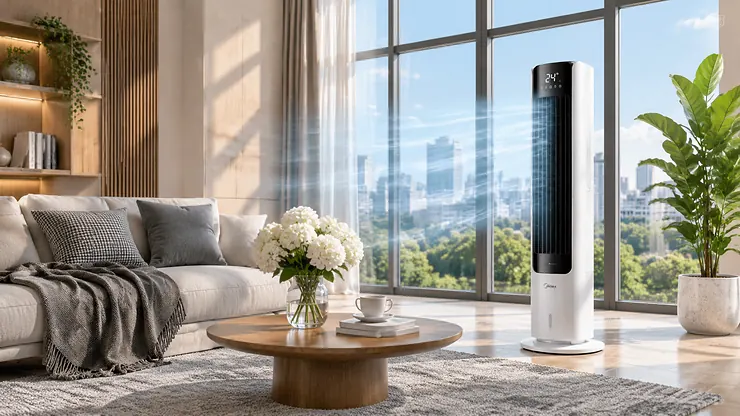
Picture a 400-square-foot living room: a sectional on one wall, the TV across from it, a dining nook sprawling off the side. One fan sits in the corner and blasts a single armchair. Everyone else stews in stagnant air. An oscillating tower fan for large living room use exists to fix exactly that. Choosing one comes down to sweep, speed range, and portability, not brand loyalty.
Here’s what most product pages skip: fans don’t cool air. As the U.S. Department of Energy explains in its guide to cooling with fans, moving air cools you through a wind-chill effect on your skin, not the room. So coverage beats raw power. A fan that sweeps across your sofa, reading chair, and dining table will outperform one that hammers a single spot.
This guide compares seven real models using manufacturer specs, published expert roundups, and aggregated review sentiment. We haven’t lab-tested them ourselves, so every verdict below is spec-based reasoning, not a claim of ownership. Prices appear as ranges as of November 2026 and shift constantly, so check current price before you buy.
What Is an Oscillating Tower Fan for Large Living Room Spaces?
An oscillating tower fan for large living room spaces is a tall, slim floor fan that hides its impeller inside a vertical housing and sweeps airflow side to side. Paired with a wide oscillation angle, several speeds, and a remote, it spreads a steady breeze across multiple seating zones without the footprint of a pedestal or box fan.
Think of it as a vertical air column: slim enough to tuck beside a media console, tall enough to deliver air at seated head height.
Quick Comparison: 7 Best Oscillating Tower Fan for Large Living Room Picks
| Product | Height | Oscillation | Speeds | Timer | Built-in handle | Price range | Best For |
|---|---|---|---|---|---|---|---|
| Lasko Wind Curve T42951 | ~42.5″ | 60° | 3 | 0.5–7.5 hrs | Yes | ~$55–$90 | Sleep-friendly all-rounder |
| Honeywell QuietSet HYF290B | 40″ | ~75° | 8 | Up to 8–12 hrs* | Yes | ~$65–$100 | Fine speed control |
| Dreo Pilot Max | ~42.5″ | 30/60/90/120° | 12 | 12 hrs | Yes | ~$120–$150 | Widest adjustable sweep |
| PELONIS 40-Inch | 40″ | 90° | 3 | 15 hrs | Yes | ~$55–$80 | Budget wide coverage |
| Vornado OZI42 | ~42.2″ | 70° | 5 | 1–8 hrs | Not verified | ~$110–$150 | Whole-room circulation |
| Lasko High Velocity U35115 | 35″ | 60° | 3 | 7 hrs | Yes | ~$80–$110 | Maximum air throw |
| Dyson Purifier Cool TP07 | ~41″ | Up to 350° | 10 | Yes | Not verified | ~$400–$550 | Allergies plus cooling |
*Honeywell timer limits vary by source; confirm on the current listing.
Looking at the table, the Dreo Pilot Max offers the widest adjustable sweep and the most speed steps for the money, which suits a sprawling sectional. On a tight budget, the PELONIS 40-Inch delivers a 90° sweep and a 15-hour timer for roughly half the price. The Lasko High Velocity U35115 leads on air throw in a shorter frame, and the Dyson Purifier Cool TP07 only makes sense if you want purification bundled with airflow.
💬 Just one click — help others make better buying decisions too!😊
Top 7 Oscillating Tower Fan for Large Living Room Options: Expert Analysis
Every pick below gets the same treatment: what the spec means in a real living room, what reviewers keep saying, and who should skip it.
1. Lasko Wind Curve T42951 — easiest set-it-and-sleep all-rounder
The Nighttime setting is the party trick. It eases the fan speed down and dims the control lights on its own, so the fan shifts gears while you drift off on the sofa.
On paper, this 42.5-inch tower pairs three speeds with 60° oscillation, a half-hour-to-7.5-hour timer, a remote that docks on the unit, and a built-in carry handle. Lasko’s argument is that a narrower sweep brings the breeze back to you sooner. That’s true, but it also means one seating cluster is served better than a whole open-plan zone. The listing claims roughly 262 CFM, modest next to high-velocity rivals.
Based on the spec comparison, this is the fan for a living room that’s large but organized: one sofa wall, one TV zone. Weight figures conflict across retailers (roughly 11 to 15 pounds), so don’t assume it’s featherweight.
Reviewers consistently call it quiet and simple, and listing ratings sit in the mid-4s across tens of thousands of reviews. Common gripes: the timer button cycles clumsily through combinations, and at least one retailer reviewer found the remote bulky and the airflow underwhelming.
Pros:
- ✅ Nighttime mode dims lights and lowers speed
- ✅ Built-in carry handle and remote storage
- ✅ Timer from 0.5 to 7.5 hours
Cons:
- ❌ Only three speeds and a 60° sweep
- ❌ Timer set by cycling one button
Roughly $55–$90 at the time of research: strong value if you want sleep-friendly extras without smart-fan pricing.

2. Honeywell QuietSet HYF290B — eight speeds and a dimmable display
Where most tower fans give you three clunky steps, this one offers eight, from near-silent Sleep up to full Power Cool.
It stands 40 inches tall on a 10-inch footprint and adds a remote with on-board storage, a reach-through carry handle, a Breeze mode, and a display with five brightness levels, including off. Retailer listings put oscillation near 75°, and timer ranges differ by source (some list 1-, 2-, 4- and 8-hour options, others 12 hours). Those eight adjustable speed settings matter in a big room. You can nudge airflow up when afternoon sun hits, then drop it for movie night, without lurching between “gentle” and “gale.”
Based on the specs, it suits households that live in the room all day and tweak comfort constantly. The trade-off is throw: one comparison table measured about 6.9 mph of airflow two feet away, below the roughly 8 mph recorded for a couple of rivals.
NBC Select reported an average of about 4.5 stars across more than 29,000 Amazon reviews. Reviewers praise the low noise and easy assembly; the recurring caveat is that the breeze is gentle rather than forceful.
Pros:
- ✅ Eight speeds from Sleep to Power Cool
- ✅ Dimmable display with five brightness levels
- ✅ Reach-through handle for easy moves
Cons:
- ❌ Breeze is gentler than high-velocity rivals
- ❌ Timer limits differ between listings
Roughly $65–$100: a sensible middle-ground value for people who prize quiet and fine control.
3. Dreo Pilot Max — widest sweep with selectable 120° oscillation
This is the model that makes a long sectional feel fairly served. Oscillation can be set to 30°, 60°, 90°, or 120°.
Specs include a 42.5-inch frame, about 10 pounds, 12 speeds, four modes (Normal, Standard, Sleep, Auto), a 12-hour timer in one-hour steps, a remote, app and voice control, a removable grille, and a handle at the top. Listed noise runs roughly 25–48 dB depending on speed. Narrow the sweep for a focused stream at your favorite chair, or widen it to 120° to cover people at opposite ends of a couch. TechRadar noted the range meant the fan didn’t need shuffling around the room.
For a living room over 300 square feet with several seating spots, the spec comparison makes this the strongest on airflow coverage. It would feel oversized in a small apartment. A newer Pilot Max S variant exists and sits at the upper end of the range, so confirm which version you’re buying.
Reviewers consistently highlight quiet running and easy cleaning. Critics note the base feels less sturdy than the tower above it, that some features live in the app rather than on the fan, and that at heart it’s still just a fan.
Pros:
- ✅ Selectable 30°/60°/90°/120° oscillation
- ✅ 12 speeds plus Auto and Sleep modes
- ✅ Top handle and removable grille
Cons:
- ❌ Base reportedly feels less sturdy
- ❌ Overkill for smaller rooms
Roughly $120–$150: worth it only if you’ll use the sweep options and the app.
4. PELONIS 40-Inch Oscillating Tower Fan — 90° sweep and 15-hour timer on a budget
The headline is the 15-hour programmable timer, long enough to cover a full workday.
This 40-inch tower offers 90° oscillation, three speeds, three wind modes (Normal, Natural, Sleep), a remote with about 16 feet of range, a rear carry handle, a fused plug, and roughly 8 pounds of weight. Pelonis sells several 40-inch variants, and some have 60° sweep and a 7-hour timer. Match model number PFT40A4AGB for the 90°/15-hour version before ordering. That 90° beats the Lasko’s 60° for open layouts, and at 8 pounds you can carry it one-handed.
It’s the pick for buyers who want broad coverage cheaply. Treat noise claims with suspicion, though. Listings range from the high 20s to the high 40s in dB.
Independent hands-on coverage is thinner than for the Lasko or Honeywell, and I couldn’t verify a deep pool of reviews. Roundups credit the wide sweep for big living rooms, and shoppers describe airflow stronger than expected for the size. Treat that as directional.
Pros:
- ✅ 90° sweep at an entry-level price
- ✅ 15-hour programmable timer
- ✅ Light with a rear carry handle
Cons:
- ❌ Only three speed steps
- ❌ Inconsistent noise figures and model variants
Roughly $55–$80: arguably the best value per degree of sweep in this lineup.
5. Vornado OZI42 — whole-room circulation with a 5-year guarantee
Vornado built its reputation on moving all the air in a room instead of sweeping a narrow beam.
The OZI42 stands about 42 inches tall and weighs roughly 11.5 pounds. It has five speeds on auto-dimming touch controls, a remote, timer steps of 1, 2, 4, or 8 hours, and 70° oscillation you can switch off for a fixed stream. Air exits at roughly 1,164 feet per minute, and the maker backs it with a 5-year satisfaction guarantee. Turn oscillation off, aim at a far wall, and let the room’s air circulate. Or turn it on for a sweeping breeze. The OZI42DC cousin adds a DC motor and 99 speeds at the top of the price range.
Choose it if longevity and circulation matter more than gadgetry. I couldn’t verify a built-in handle on this model, so if moving it between rooms is essential, look at the Honeywell or Lasko picks.
Roundups name it best for air circulation, and a retailer Q&A notes the remote needs direct line of sight to the fan. There wasn’t enough verified review data to summarize further.
Pros:
- ✅ Focused high-velocity airflow
- ✅ 5-year satisfaction guarantee
- ✅ Oscillation is optional
Cons:
- ❌ Only five speeds on the standard model
- ❌ No verified carry handle
Roughly $110–$150: you’re paying mostly for the warranty and circulation approach.
6. Lasko High Velocity U35115 — brute-force airflow in a 35-inch frame
This is the Lasko you buy when “gentle” isn’t the goal.
The listing cites 509 CFM at about 96 watts, three speeds, 60° oscillation, a 7-hour timer, a remote with on-board storage, louvers that angle airflow up or down, an easy-grip handle, and delivery fully assembled. Listed noise runs from about 35 dBA on low to about 56 dBA on high. The shorter frame sits closer to seated height, and the louvers let you aim at the sofa. CFM claims aren’t standardized across brands, so don’t compare 509 directly with another maker’s number.
It’s best where the air has to travel: hot, sun-baked, or open spaces where you want a breeze to arrive 20 to 30 feet away. The cost is volume at top speed.
Reviewers describe a strong breeze reaching well past 30 feet, while one found the remote cheap. Lasko markets it toward garages, gyms, and basements, so expect utility over style.
Pros:
- ✅ 509 CFM high-velocity airflow
- ✅ Louvers aim air up or down
- ✅ Arrives fully assembled with handle
Cons:
- ❌ Noticeably louder at top speed
- ❌ Remote criticized as flimsy
Roughly $80–$110: the pick when throw distance matters more than whisper-quiet running.
7. Dyson Purifier Cool TP07 — 350° oscillation plus HEPA purification
Dyson sells this less as a fan and more as an air-quality appliance that moves air gracefully.
It stands about 41 inches tall, weighs roughly 11 pounds, and offers 10 speeds, oscillation up to 350° with adjustable angles, a sealed HEPA H13 filter with activated carbon, a remote and app, night mode, and a timer. A Target listing shows a 2-year warranty. Three hundred fifty degrees is nearly a full circle of coverage. The filter also means ongoing replacement costs.
It makes sense for allergy-prone households or city air. As a pure cooling fan, the value is poor. I couldn’t confirm a built-in carry handle in the spec sheets I reviewed, though at 11 pounds it still moves.
Expert reviewers, including PCMag and RTINGS, rate it highly as both purifier and fan. Critics, including Modern Castle, note less customization than other Dyson models, and price is the main objection.
Pros:
- ✅ Up to 350° oscillation
- ✅ Sealed HEPA H13 filtration
- ✅ 10 speeds with remote and app
Cons:
- ❌ Costs several times more than other picks
- ❌ Filter replacements add upkeep
Roughly $400–$550: a premium buy that only pays off if you’ll use the purifier.
Setup and Placement Guide: Getting the Most From Your Oscillating Tower Fan for Large Living Room Comfort
Buying the right fan is half the job. Placement is the other half, and it’s where most living rooms go wrong.
Set the fan roughly 6 to 10 feet from your main seating, angled so the sweep crosses sofa and chairs, not a wall. Air speed fades with distance, which is why even a 120° sweep can’t rescue a fan parked behind a couch. The DOE’s ceiling-fan guidance suggests that moving air lets you nudge the thermostat up about 4°F without losing comfort. A tower fan aimed at people should behave similarly, though results vary with placement. And as the DOE reminds us, fans cool people, not rooms, so switch it off when nobody’s there.
Your first 30 days:
- Week one: Test every speed from where you actually sit. Pick one for daytime, one for evening.
- Week two: Try Sleep or Natural modes and set the timer for bedtime.
- Weeks three and four: Reposition once if any seat feels dead, then leave it alone.
Maintenance schedule:
- Weekly: Wipe the air inlet grille.
- Monthly: Vacuum vents, wipe the housing, check remote batteries.
- End of season: Deep-clean and store covered.
Common mistakes: Parking the fan in a corner facing a wall, running it on maximum all day, and ignoring dust buildup that quietly strangles airflow.

Real-World Scenarios: Which Oscillating Tower Fan for Large Living Room Fits Your Life
The open-plan renter. Picture 450 square feet, two seating zones, a budget under $100, and about five hours of evening use. The PELONIS 40-Inch matches that with its 90° sweep and long timer. If you want a Nighttime mode and on-board remote storage, the Lasko Wind Curve T42951 fits better, at the cost of a narrower sweep.
The movie-night family. Imagine a long sectional seating four or five, a budget around $150, and kids who go to bed early. The Dreo Pilot Max earns its price here. Set the 120° sweep so everyone gets air, then drop to Sleep mode as the credits roll.
The sun-baked bonus room. Think west-facing windows, hot afternoons, and a need to move air a long way. The Lasko High Velocity U35115 throws air farthest on paper, while the Vornado OZI42 with oscillation off can bounce a focused stream off a far wall and circulate the whole room. If anyone in the house has allergies, the Dyson Purifier Cool TP07 adds filtration to the mix.
The pattern: match sweep to seating layout first, then pay for extras you’ll use daily.
✨ Ready to Find Your Fan?
🔍 Take your living room comfort to the next level with these carefully selected products. Click on any highlighted item to check current pricing and availability. These picks will help you create the cool, breezy evenings your family will love!
How to Choose an Oscillating Tower Fan for Large Living Room Spaces
- Map your seating zones, not just square footage. A 400-square-foot room with one seating cluster needs less sweep than a 300-square-foot room with three.
- Match the sweep to your layout. Pick 90° or wider for multiple zones. A 60°–70° sweep is fine for one concentrated area.
- Count real speed steps. Three is workable, five is comfortable, and eight or more suits tinkerers.
- Treat CFM claims skeptically. Fans deliver high-volume, low-pressure flow, as Wikipedia’s overview of fans explains, and brands measure ratings differently. Weigh throw distance and reviewer feedback alongside the number.
- Confirm the remote and timer. Check remote range, timer length, and whether the remote stores on the unit.
- Check portability and warranty. Look for a real handle, a weight you can lift, and coverage from one year to five.
Wide-Angle Oscillation and Airflow Coverage: How to Read the Specs
Wide-angle oscillation sounds like pure upside, but it comes with a trade-off. A wider sweep spends less time pointed at you, so each pass feels gentler. That’s why Lasko defends 60° and Dreo offers a narrow setting. For true airflow coverage, three things multiply: sweep angle, throw distance, and speed.
Consider the spread in this lineup. The Dreo Pilot Max reaches 120°, the PELONIS 40-Inch 90°, the Vornado OZI42 70°, and the two Lasko models 60°. The Dyson Purifier Cool TP07 claims up to 350°, which effectively covers a hemisphere of the room. On paper, sweep angle sets how many seats you can reach, while throw distance determines whether the far sofa gets anything at all.
Here’s the practical read. In an open layout, prioritize wide-angle oscillation and strong speed. In a squarer room with one gathering spot, a narrower sweep delivers a firmer breeze. Either way, test the sweep at your actual seat, not the fan’s front.
Adjustable Speed Settings: How Many Do You Really Need?
More isn’t always better, but it isn’t nothing either. With three adjustable speed settings (Lasko, PELONIS), you get low, medium, and high. That’s perfectly fine if you set and forget. Five steps (Vornado OZI42) add a comfortable middle gradient. Eight (Honeywell QuietSet HYF290B) and twelve (Dreo Pilot Max) let you fine-tune airflow as sunlight, activity, and mood shift through the day. The Vornado OZI42DC goes to 99 steps, which is more granularity than most living rooms need.
My read: returns diminish after about eight. What matters more is whether the lowest speed is truly quiet and whether the highest actually reaches your seat. Look for dedicated Sleep or Auto modes, which automate the gentle-evening logic so you don’t fiddle. And remember, listed noise is measured on the lab’s terms. The same fan sounds different bouncing off hard floors and bare walls.
Tall Tower Fan With Remote and Timer: Features Worth Paying For
A tall tower fan with remote and timer saves you from the classic couch-to-outlet shuffle. Height matters because airflow delivered at 35 to 42 inches lands near seated torso level, right where you want it.
For remotes, check range (the PELONIS lists about 16 feet), whether it needs line of sight (Vornado’s does), and whether it docks on the fan so it doesn’t vanish into the cushions (both Lasko models, and the Honeywell). Replacement batteries also differ: the Dreo uses a coin cell.
For timers, match length to habit. The Lasko High Velocity U35115 tops out at 7 hours, the Dreo Pilot Max at 12, and the PELONIS 40-Inch at 15. A short timer is fine for falling asleep. A long one suits “on while I work” days. The Lasko Wind Curve’s Nighttime mode combines timer and speed-down logic in one button, which is a nice touch if you want sleep help without programming anything.

Tower Fan With Built-In Handle for Moving Rooms: A Practical Guide
A tower fan with built-in handle for moving rooms turns one purchase into a whole-house solution. Living room by day, bedroom by night.
Handles come in different forms. The Honeywell QuietSet HYF290B has a reach-through handle, the Dreo Pilot Max carries from the top, the PELONIS 40-Inch has a rear grip, and the Lasko High Velocity U35115 has an easy-grip handle. Weight spans roughly 8 pounds (PELONIS) to 11 pounds or more (Vornado, Dyson), so check your own lifting comfort.
Problem → solution:
- Cord too short? Cords run around 6 feet on several models, so plan outlet access before choosing a spot.
- Worried about tipping? Keep the base on a flat surface, and avoid thick rugs where possible.
- Moving it nightly? Pick a lighter model and park it near the outlet you use most.
If portability is non-negotiable, skip any model where you can’t verify a handle on the current listing.
Oscillating Tower Fan vs. Other Options for a Large Living Room
| Option | Where it shines | Where it struggles | Best For |
|---|---|---|---|
| Tower fan | Slim footprint, remote, quiet modes | Fixed height, limited aiming | Multi-zone rooms with limited floor space |
| Pedestal fan | Adjustable height, strong airflow | Bigger footprint, exposed blades | People who want maximum force |
| Box fan | Lowest cost, high volume | Bulky, noisy, no oscillation | Window ventilation and workshops |
| Ceiling fan | Always-on, whole-room coverage | Installation needed, fixed position | Permanent, silent circulation |
The table shows why a tower fan wins the living room: it takes little floor, looks reasonable, and comes with convenience features like remotes and timers. If you need maximum force, a pedestal may deliver more, while a ceiling fan is the better permanent solution if you can install one. UC Berkeley’s Center for the Built Environment maintains a fans guidebook that lays out where tower fans sit among other fan types. For renters, a tower fan like the Lasko Wind Curve T42951 avoids installation entirely.
Long-Term Cost and Maintenance: What Your Fan Really Costs
Let’s do honest math. Assume an illustrative 17 cents per kilowatt-hour (swap in your own rate). A 50-watt fan running 8 hours a day uses about 0.4 kWh daily, roughly $2 a month. The Dreo Pilot Max, listed near 36 watts, lands closer to $1.50. The Lasko High Velocity U35115, at about 96 watts on high, climbs to roughly $4. These are estimates, since actual draw varies by speed.
The bigger variable is lifespan and support. Warranties here run from one year (Lasko, Honeywell, PELONIS) to two (Dyson, per a retailer listing) to five (Vornado). Spread a roughly $75 fan across several summers and you’re paying pennies per hot day. The Dyson’s price is the exception, and filter replacements add recurring cost.
For upkeep, a few minutes of dusting every month protects airflow and motor life. Dust-clogged vents force the motor to work harder and quietly shrink your breeze. The Dreo Pilot Max helps here with its removable grille.
Safety Guide: When a Fan Helps and When It Doesn’t
Fans work by speeding the evaporation of sweat, which means they have limits. The CDC has long cautioned against relying on fans above about 90°F, while the WHO sets a higher threshold near 104°F. Newer research covered by WebMD suggests fans may help at somewhat higher temperatures than once thought, as long as you stay hydrated. At 104°F, researchers saw signs bodies were heating up.
Bottom line: use a fan for ordinary hot days, not as a heat-wave shield. Older adults, young children, and people with heart conditions should follow local health guidance and use air conditioning or a cooling center when temperatures soar. Studies in this area are limited, so when in doubt, ask a doctor.
On the product side, tower fans enclose their impellers, which many families like around kids. Look for ETL or similar safety listings and fused plugs (the Lasko and PELONIS models list them), and keep cords out of walkways.

FAQ: Oscillating Tower Fan for Large Living Room Questions
❓ What size room can one tower fan cover?
❓ Is a tower fan better than a pedestal fan for a big living room?
❓ How much electricity does a tower fan use?
❓ Where should I put a tower fan in a large living room?
❓ Is a tower fan with remote and timer worth paying extra for?
Conclusion: Your Best Oscillating Tower Fan for Large Living Room Comfort
The right oscillating tower fan for large living room use comes down to your layout, not the loudest spec on the box. If you have several seating zones, the Dreo Pilot Max with its adjustable 120° sweep is the strongest on paper. If you want maximum value, the PELONIS 40-Inch gives you a 90° sweep and a 15-hour timer for the lowest prices here.
Prefer sleep-friendly simplicity? The Lasko Wind Curve T42951 has you covered. Want fine speed control in a quiet package? The Honeywell QuietSet HYF290B has eight steps. When you need air to travel far, the Lasko High Velocity U35115 delivers, and the Vornado OZI42 circulates the whole room with a 5-year guarantee. The Dyson Purifier Cool TP07 is for buyers who want purification and a near-360° sweep and can afford the premium.
Whichever you choose, aim it at people, keep the grille clean, and remember that fans have limits in extreme heat. Then enjoy a living room where everyone, not just one armchair, actually feels the breeze.
Recommended for You
- Cooling Seat Pad For Truck Drivers: 7 Best Picks In 2026
- Stadium Seat Cooling Cushion: 7 Best Picks For 2026
- Wheelchair Cooling Pad: 7 Best Picks To Beat The Heat (2026)
Disclaimer: This article contains affiliate links. As an Amazon Associate, I earn from qualifying purchases. If you purchase products through these links, we may earn a small commission at no additional cost to you.
✨ Found this helpful? Share it with your friends! 💬🤗
