
In This Article
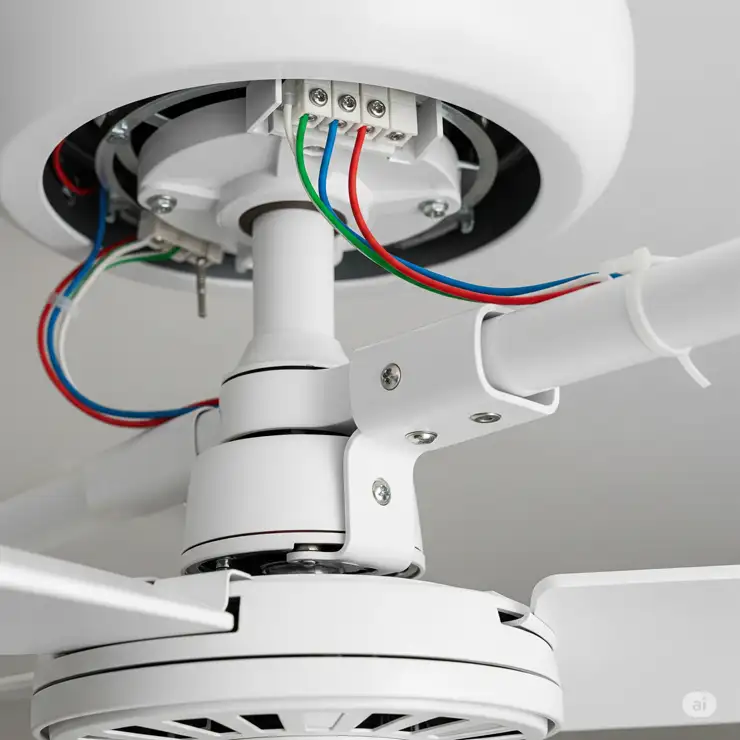
A ceiling fan downrod is the metal pipe that connects a ceiling fan’s motor housing to the ceiling bracket, and it also carries the power wires down to the motor. Its length sets how far the blades hang below the ceiling, which decides airflow, headroom, and whether the fan looks right in the room.
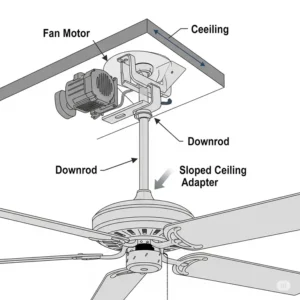
Most shoppers obsess over blade finish, light kits, and remote controls. Then they hang the whole thing from a stubby 4-inch stick in a room with a 12-foot ceiling and wonder why the breeze never reaches the sofa. The rod is the least glamorous part of the fan. It’s also the part that decides whether the other parts get to do their jobs.
The target is simple. ENERGY STAR’s ceiling fan basics says to hang the fan at least 7 feet above the floor, and 8 to 9 feet if the ceiling allows it. It also notes that downrods are sold from 6 inches (for a 9-foot ceiling) up to 120 inches (for a 20-foot ceiling). Everything else is figuring out which rod gets you to that zone with your specific fan.
That “specific fan” part is where people get burned. Rods aren’t universal. Diameters, threading, and pin holes vary by brand, and a rod that’s perfect on paper can be a dead end in your garage.
Below you’ll find seven real options, a length chart, install steps, a problem-solver, and a buying framework. No fluff, just the stuff the listing won’t tell you.
7 Best Ceiling Fan Downrod Options at a Glance
Here’s the fast version. Every product below gets a full breakdown later, so treat this table as your cheat sheet.
| Downrod | Length | Diameter / Threading | Price Range* | Best For |
|---|---|---|---|---|
| DPXMYG 24 Inch | 24 in | 1 in, unthreaded, extension cord included | Mid-$20s to around $30 | 12-foot ceilings on unthreaded 1-inch fans |
| Sibosen 18 Inch | 18 in | 1 in, unthreaded, no cord | Roughly $15-$25 | 10-11 foot ceilings and simple swaps |
| AICWIOO 4 Inch | 4 in | 1 in, ball head included | Mid-teens | Standard 8-foot rooms |
| GDFYMI 12 Inch | 12 in | 1 in, unthreaded | Roughly $15-$25 | 9-10 foot ceilings |
| Minka-Aire DR536-CL | 36 in | 3/4 in, threaded one end | $50-$65 range | Minka-Aire fans on 12-13 foot ceilings |
| Hunter 26007 | 24 in | 3/4 in, tapered threads | Check current price | Hunter Original fans |
| BOOSANT 72 Inch | 72 in | 3/4 in, wiring included | Around $80 range | Tall vaulted rooms |
*Prices may vary. Ranges reflect comparable listings at the time of research, so check current price before you buy.
Looking at the table, the DPXMYG 24 Inch and Sibosen 18 Inch deliver the best value if your fan takes a 1-inch unthreaded rod. The Minka-Aire DR536-CL and Hunter 26007 cost more because they’re brand-matched, and they only make sense if your fan is from that family. Buyers on tall ceilings should note that the BOOSANT 72 Inch is the only pick here that includes wiring in its listing, which saves a headache you’d otherwise meet halfway through the install.
💬 Just one click — help others make better buying decisions too!😊
Top 7 Ceiling Fan Downrod Picks: Expert Analysis
Every pick below is judged on specs, real-world meaning, and what verifiable review data exists. Where I couldn’t confirm review details, I say so instead of guessing.
1. DPXMYG 24 Inch Ceiling Fan Downrod — best-selling all-rounder for 12-foot ceilings
Two feet is the workhorse length. One manufacturer’s guide pairs a 24-inch rod with a 12-foot ceiling, which puts the blades right in that 8-to-9-foot sweet spot.
The DPXMYG 24 Inch has a 1-inch outside diameter, a black finish, and an included extension cord. It’s unthreaded, so it locks with pin-and-set-screw hardware rather than screwing into the motor. The listing says you move the hanging ball from your original rod onto this one. On paper this means a clean swap, but only if your original rod is also unthreaded. The listing itself warns that a threaded original won’t fit.
The cord matters more than it looks. A longer drop eats wire slack, and the factory leads on some fans can run short once you add two feet. Based on the spec comparison, this is the lowest-drama pick for owners of unthreaded 1-inch fans.
On reviews, a snapshot of the listing from February 2026 showed a 4.6-star average across roughly 250 reviews, plus a #1 rank in Amazon’s ceiling fan downrod category. I couldn’t pull individual review text, so I won’t characterize specific complaints or praise.
Pros:
- ✅ Included extension cord reduces wiring guesswork
- ✅ Strong rating across a sizable review pool
- ✅ Available in many other lengths for matching
Cons:
- ❌ Won’t fit fans with a threaded original rod
- ❌ Plain finish options limit decorative matching
Price runs in the mid-$20s to around $30 range, which is solid value for a rod with a cord. Check current price.
2. Sibosen 18 Inch Ceiling Fan Downrod — tidy fix for 10-11 foot ceilings
Eighteen inches is the “my ceiling is a little too tall” size. It’s what you reach for when 12 inches feels short but 24 feels like overkill. Manufacturer charts put an 18-inch rod at roughly 11 feet, though fan body height shifts that by a notch either way.
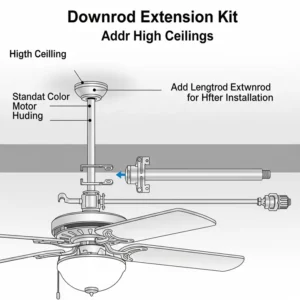
The Sibosen 18 Inch is a 1-inch diameter, matte black, unthreaded rod. The listing language describes it as a fan boom only, with no thread and no cord. That’s an important detail. You’re relying entirely on your fan’s existing wire length, so measure before you buy. If your leads are tight, plan on an extension kit.
What most buyers overlook is the finish. Matte black pairs well with modern fans, but it’s a poor match for brushed nickel or oil-rubbed bronze housings. A mismatched rod is a small thing that looks like a big thing on a high ceiling.
A third-party roundup lists a 4.7-star average across about 160 reviews. That’s the only review data I could verify, so I can’t tell you which themes dominate.
Pros:
- ✅ Handy mid-length fits several ceiling heights
- ✅ Matte black suits modern fan housings
- ✅ High average rating on a listed review pool
Cons:
- ❌ No cord or wiring in the package
- ❌ Unthreaded design excludes some fan brands
Expect a roughly $15-$25 range. It’s good value if your wires have slack. Check current price.
3. AICWIOO 4 Inch Ceiling Fan Downrod — compact replacement for standard 8-foot rooms
Short rods get no respect, yet they’re the most common type in homes. ENERGY STAR notes that standard mounts typically ship with a 3 to 5 inch rod, so a 4-inch rod is the baseline most fans are designed around.
The AICWIOO 4 Inch is a 1-inch black rod that comes with a hanger ball. Think of it as a spare part more than an upgrade. It’s the answer when your original rod is damaged, lost, or the wrong finish. The ball-head design means you can often skip transferring hardware from the old rod.
Here’s the honest analysis: this rod won’t lower your fan. It simply replaces a short one. On an 8-foot ceiling, a 4-inch drop keeps the blades near the 7-foot minimum, so it’s best matched to rooms where you’re already at the limit and want the blades as high as safely possible.
I couldn’t verify a meaningful pool of customer reviews for this exact listing, so I’m withholding sentiment rather than guessing.
Pros:
- ✅ Ball head included for easier swaps
- ✅ Suits standard-height rooms
- ✅ Budget-friendly spare part
Cons:
- ❌ Does nothing for tall ceilings
- ❌ Limited verifiable review data
It lands in the mid-teens range. For a replacement part, that’s fair. Check current price.
4. GDFYMI 12 Inch Ceiling Fan Extension Rod — modest drop for 9-10 foot ceilings
A 12-inch rod is the gentle upgrade. It’s what you pick when a standard rod leaves the fan feeling jammed against the ceiling. Manufacturer charts vary on exactly which ceiling it suits, with some placing it at 10 feet and others using it for 9-foot rooms with deeper fans.
The GDFYMI 12 Inch is a black, 1-inch outside diameter, unthreaded rod. As with other unthreaded rods, the rule is simple: check your original. If your existing rod has threads, this isn’t your part.
In practice, a foot of extra drop pulls the blades out of the “dead air” zone near the ceiling. Blades need breathing room above them to draw air. Minka-Aire’s own guidance says a standard 6-inch rod suits most 8-foot installs for that reason. Go to 12 inches when you have a 9- to 10-foot ceiling and a fan that otherwise hangs too snug.
The GDFYMI 12 Inch appears in at least one product roundup, but I couldn’t confirm a stable rating or review count. I’d treat it as an unproven value pick.
Pros:
- ✅ Short extension for modest ceiling bumps
- ✅ Matches common 1-inch unthreaded fans
- ✅ Simple black finish blends in
Cons:
- ❌ Review history is hard to verify
- ❌ Unthreaded design limits compatibility
It sits around the $15-$25 range. Fine for the job, but verify the fit first. Check current price.
5. Minka-Aire DR536-CL 36 Inch Downrod — brand-matched drop for 12-13 foot ceilings
Here’s where compatibility stops being a gamble. The Minka-Aire DR536-CL is a 36-inch rod in a Coal finish, built for Minka-Aire fans. It’s a 3/4-inch steel rod, threaded on one end, with a predrilled port for the lock pin.
Retailers market this model for 12-foot ceilings. That’s a slightly different answer than some generic charts, which would put 36 inches at 13 feet. The gap exists because fan body height differs by manufacturer. That’s exactly why OEM-matched rods deserve respect: the maker calculated the drop for their motor housing.
The trade-off is flexibility. Minka-Aire states this rod only fits its own fans, so it’s useless on a generic unit. If you own a compatible Minka-Aire fan, you’ll appreciate the matched finish and the threaded connection.
Review evidence is thin and uneven. One retailer lists the Coal finish with a short “solid downrod” summary across a small pool, and another shows a perfect score. A different finish of the same rod shows 3.1 out of 5 elsewhere. Small samples, so don’t read too much into them.
Pros:
- ✅ Designed to match Minka-Aire fan geometry
- ✅ Threaded connection with lock-pin port
- ✅ Wide finish range for matching
Cons:
- ❌ Works only with Minka-Aire fans
- ❌ Pricier than generic 1-inch rods
Expect a $50-$65 range. Fair value if it matches your fan, wasted money if it doesn’t. Check current price.
6. Hunter 26007 24 Inch Original Downrod — factory-matched for Hunter Original fans
Hunter keeps its downrods in-family on purpose. The Hunter 26007 is a 24-inch, 3/4-inch rod in New Bronze, made for Hunter Original collection fans. It features tapered threads for deeper engagement and is dry-rated for indoor use.
Those tapered threads are the quiet hero. Deeper engagement translates into a more stable connection, which helps when you add length. Hunter also tells installers to tighten set screws with pliers until firm, not by hand, on its Original rods. A loose set screw is the number one reason a long drop wobbles.
Don’t use this outdoors or in humid spaces. Hunter’s guidance for these rods is indoor and dry locations only, so bathrooms and covered porches are out. Sloped ceilings need an angled mount, since Hunter specifies angled ceiling mounts for slopes up to 45 degrees on its Original line.
A Walmart listing for this rod shows 4.1 stars across 48 reviews as of January 2026. Reviewers there describe good quality, a flat finish, and a match with the fan body, with slow shipping noted as a drawback.
Pros:
- ✅ Tapered threads for secure engagement
- ✅ Built for Hunter Original fans
- ✅ Solid review average on a small pool
Cons:
- ❌ Indoor and dry locations only
- ❌ Useless on non-Hunter fans
I couldn’t confirm a stable current price range, so check current price. Hunter-branded rods generally cost more than generic ones.
7. BOOSANT 72 Inch Ceiling Fan Downrod with Wiring — longest reach for tall vaulted rooms
Six feet of drop is cathedral-ceiling territory. For reference, a manufacturer chart puts 60 inches at 15 feet, so 72 inches suits roughly 15 to 16 feet depending on the fan.
The BOOSANT 72 Inch is a 3/4-inch steel rod with extended wiring included, plus a predrilled hole for a lock pin. The wiring is the headline. On a six-foot drop, standard factory leads almost never stretch far enough, so having wire in the box saves a trip to the hardware store.
There’s one wrinkle worth flagging. The listing title says “Not Threaded,” yet a bullet point says the rod is threaded at one end. Those two statements disagree. Before ordering, confirm the threading with the seller and compare it with your fan’s connection. BOOSANT also says the rod is designed for its own fans and others with the same construction.
On long rods, wobble is the enemy. A longer lever arm amplifies any imbalance, so use a solid rod, tighten the hardware properly, and balance your blades. I couldn’t verify review data for this listing.
Pros:
- ✅ Included wiring for long drops
- ✅ Reaches very tall ceilings in one piece
- ✅ Steel construction with lock-pin hole
Cons:
- ❌ Conflicting threading info in the listing
- ❌ Compatibility centers on BOOSANT-style fans
It runs around the $80 range, which is reasonable for a six-foot rod with wiring. Check current price.
Ceiling Fan Downrod Installation: A Practical Step-by-Step Guide
Swapping a ceiling fan downrod is a one-person job for most DIYers, but only if you do things in the right order. Here’s the sequence that avoids the classic traps.
Before you start
- Turn off power at the breaker and confirm with a voltage tester.
- Have your fan manual nearby. It overrides any general advice here.
The steps
- Lower the canopy and disconnect the fan from the bracket.
- Remove the old rod, noting how the hanging ball and pins are arranged.
- Thread your fan’s wires through the new ceiling fan downrod before attaching anything.
- Move the hanging ball onto the new rod if your rod doesn’t include one.
- Align the pin holes, insert the cross pin, and add the retaining clip.
- Tighten the set screws firmly with pliers, not just by hand, as Hunter recommends for its rods.
- Reconnect the wires, secure the canopy, and test on low before running it high.
First-30-day habits
- Check for wobble after the first week, then again after a month.
- Re-tighten set screws if you notice any rattle or hum.
- Wipe the rod during regular dusting so grime doesn’t build up at the joint.
If your drop exceeds six feet, a downrod coupler can join two rods. Minka-Aire’s DR500 coupler, for example, is listed for creating drops of 73 to 144 inches with 3/4-inch rods. Use manufacturer-matched couplers only.
Which Ceiling Fan Downrod Fits Your Room? Real-World Scenarios
Specs are abstract. Rooms are not. Here are three hypothetical profiles that show how the decision plays out.
Scenario 1: The renter with a 10-foot bedroom ceiling. Budget: under $25. The fan is a basic 52-inch model with an unthreaded 1-inch rod. Use is nightly. The GDFYMI 12 Inch or Sibosen 18 Inch fits the job, but only after checking the original rod for threads. Pick the 18-inch if the wires have slack and the room feels tall.
Scenario 2: The family room at 12 feet. Budget: $50-$70. The fan is a Minka-Aire model. The Minka-Aire DR536-CL is the sensible call. Because the maker pairs 36 inches with 12-foot ceilings, you’re buying a calculated drop rather than a guess. A generic rod could technically work, but you’d be inventing the fit.
Scenario 3: The vaulted great room at roughly 15-16 feet. Budget: $80-$100. Daily use, high visibility. The BOOSANT 72 Inch is the practical match if your fan shares its rod construction, with wiring in the box. Verify the thread situation first.
A fourth quick case: Hunter Original owners on 11-12 foot ceilings should lean toward the Hunter 26007 since it’s factory-matched, then size the length from Hunter’s own chart.
The pattern across all three? Brand match and thread type first, length second, finish third. Get that order wrong and you’ll be returning boxes.
Ceiling Fan Downrod Problems and How to Fix Them
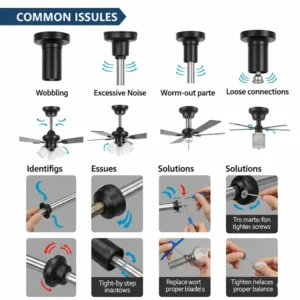
Most downrod headaches come from five repeat offenders. Here’s the problem-and-fix list.
Problem 1: The new rod won’t fit the fan. Cause: mismatched diameter or threading. Fix: measure the old rod’s outside diameter, check for threads, and buy a rod that explicitly lists your brand or fan model. Both DPXMYG 24 Inch and Sibosen 18 Inch warn that threaded originals won’t work.
Problem 2: The wires are too short. Cause: a longer drop than the factory leads allow. Fix: pick a rod with included wiring, like the BOOSANT 72 Inch or DPXMYG 24 Inch, or buy a compatible extension kit.
Problem 3: The fan wobbles. Cause: loose set screws, unbalanced blades, or a rod too thin for the drop. Fix: tighten the hardware with pliers, use a balancing kit on the blades, and check the ceiling box is fan-rated.
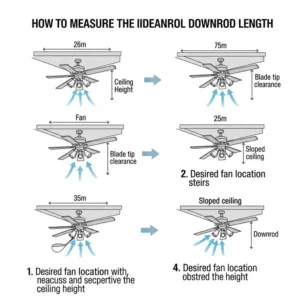
Problem 4: The fan is crooked on a sloped ceiling. Fix: use the sloped-ceiling formula from PickHVAC’s downrod sizing guide: fan radius times rise over run, plus 4 inches. Then confirm your canopy supports your slope angle.
Problem 5: The blades hang too low. Fix: if lengthening dropped the blades under 7 feet, shorten the rod, or move to a low-profile mount instead.
How to Choose a Ceiling Fan Downrod
The short answer: match diameter and threading to your fan, then pick a length that lands the blades at 8 to 9 feet. Here’s the process.
- Measure your ceiling height. Floor to ceiling, in the room you’re fitting. Odd rooms with slopes need a separate calculation.
- Aim for 8 to 9 feet blade height. This is the optimal airflow zone, and 7 feet is the floor for safety.
- Subtract the fan’s own body height. A fan’s motor and blades take up space, so your downrod length isn’t simply ceiling minus 8 feet.
- Check your fan’s diameter and thread. Rods come in 1/2-inch, 3/4-inch, and 1-inch diameters, and threaded versus unthreaded matters.
- Prefer the fan manufacturer’s rod when available. It guarantees pin alignment and connection style.
- Confirm wire length. If your leads can’t reach, choose a rod with wiring or buy an extension kit.
Hunter’s guidance also says that to meet UL and ETL guidelines, fan blades should sit at least 7 feet from the floor and 30 inches from the blade tip to the nearest wall or obstruction. Write that on a sticky note. It’s the line you can’t cross.
Ceiling Fan Downrod Length Chart by Ceiling Height
Use this table as a starting point. It follows one manufacturer’s published guide, and other brands differ because fan bodies differ.
| Ceiling Height | Typical Downrod Length | What It Means | Best For |
|---|---|---|---|
| 8-9 ft | 4-6 in (or none under 8 ft) | Standard mount, blades near the 7-foot floor | AICWIOO 4 Inch replacements |
| 10 ft | 12 in | Small drop clears dead air | GDFYMI 12 Inch |
| 11 ft | 18 in | Brings blades toward 8-9 ft | Sibosen 18 Inch |
| 12 ft | 24 in | Workhorse drop for common tall rooms | DPXMYG 24 Inch, Hunter 26007 |
| 13 ft | 36 in | Longer drop, more attention to wobble | Minka-Aire DR536-CL |
| 14-15 ft | 48-60 in | Specialty lengths, wiring becomes critical | Brand-matched rods |
| 16 ft+ | 72 in or coupler | Cathedral spaces | BOOSANT 72 Inch |
Notice the chart’s logic: roughly one extra foot of ceiling adds six inches or so of rod until you reach the double-digit heights. It isn’t perfectly linear because fan bodies vary. Minka-Aire, for instance, labels its 36-inch rod for 12-foot ceilings while a generic chart might assign it to 13. Treat any chart as a guide and defer to your fan’s manual when it conflicts.
Common Mistakes When Buying a Ceiling Fan Downrod
Most returns trace back to a handful of avoidable errors. Here they are, with the commentary.
Assuming rods are universal. They aren’t. Diameter, threading, and pin placement differ, and some brands are explicit that their rods fit only their own fans, as with the Minka-Aire DR536-CL and Hunter 26007.
Ignoring threading. Several 1-inch generic rods, including the DPXMYG 24 Inch and Sibosen 18 Inch, are unthreaded and say a threaded original won’t fit. A two-minute check saves a week of shipping.
Buying by finish alone. Matte black looks sharp online, then clashes with a bronze motor housing in person. Match the finish to the fan, not to the room.
Dropping the fan too low. A long rod can push blades beneath 7 feet in rooms with low furniture clearance or tall occupants.
Forgetting wire length. The rod isn’t the only part that has to stretch. Without extra wiring, the install halts mid-ladder.
Skimping on a long rod. At six feet, the wobble risk climbs. Better hardware and a firm install matter more than saving ten dollars.
Using damp or outdoor spots with dry-rated rods. Hunter says its Original rods are indoor and dry only. Moisture and a bare steel rod are a poor pairing.
Ceiling Fan Downrod vs Flush Mount: Which Is Better?
A downrod isn’t always the right answer. Sometimes the correct “rod” is no rod at all. Here’s how the mounting styles compare.
| Mounting Style | Ceiling Height | Airflow | Best For |
|---|---|---|---|
| Downrod mount | 8 ft and up, especially 9+ | Strongest, blades in open air | Living rooms and tall spaces |
| Flush (hugger) mount | Under 8 ft | Reduced, blades close to ceiling | Low-ceiling bedrooms and hallways |
| Angled or sloped mount | Sloped or vaulted | Depends on rod and slope | Vaulted rooms with a matched canopy |
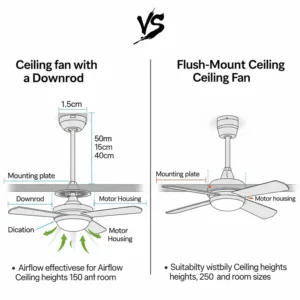
For rooms under 8 feet, Hunter’s support guidance points to hugger fans that mount directly to the ceiling bracket, so the blades don’t hang too low. ENERGY STAR adds that hugger fans don’t move as much air because the blades sit close to the ceiling. That’s the trade-off in a sentence.
So what does the table say in practice? If you have 9 feet or more of ceiling, a ceiling fan downrod is the better airflow choice almost every time. If you’re stuck under 8 feet, a hugger is safer than any rod. The in-between zone, standard 8-foot rooms, usually works with the stock 4-to-6 inch rod, and that’s rarely worth upgrading.
Features That Actually Matter (And Those That Don’t)
Listings throw adjectives at you. Here’s the filter.
What matters
- Diameter and threading. Non-negotiable. If these don’t match, nothing else counts.
- Pin holes and set-screw design. These determine stability, especially on long drops.
- Grounding holes. Some rods list them for proper electrical grounding.
- Included wiring. Worth real money on drops over about two feet.
- Steel construction. Strength matters more as length grows.
- Dry, damp, or wet rating. Check this for anywhere moisture is possible.
What matters less
- Finish name. “Coal,” “matte black,” and “New Bronze” are pretty. They don’t change performance.
- Marketing talk about universal fit. Listings that claim broad compatibility still require you to check threads and diameter.
- Load-capacity boasts. Some listings advertise huge weight ratings. Ceiling fans are light, and the more relevant limit is the electrical box and your hardware.
One more thing: warranty. Hunter lists a one-year limited warranty on its Original-series downrods. It’s modest, but it’s more support than a no-name rod typically offers. Weigh that against the price.
Safety and Clearance Rules for Every Ceiling Fan Downrod Install
Fans spin. Rods hold them over your head. Take clearances seriously.
The rule everyone cites is the 7-foot minimum from floor to blades, along with 30 inches from the blade tip to the nearest wall or obstruction under UL and ETL guidelines, according to Hunter’s support documentation. ENERGY STAR gives a slightly different wall figure, 18 inches from walls, in its general guidance. The safe move is to follow your fan’s manual and use the larger clearance when they differ.
Also pay attention to the electrical box. Use one specifically rated for fan weight and vibration, because a standard light box isn’t built for the constant motion. NSW’s energy guidance, a government source, makes the same point about installing at a safe ceiling height and using a fan-rated box.
For sloped ceilings, confirm your canopy supports the angle. Hunter’s Original line, for example, requires an angled mount for slopes up to 45 degrees. And don’t use dry-rated rods in damp spaces.
✨ Don’t Miss These Exclusive Deals!
🔍 Take your ceiling fan setup to the next level with these carefully selected downrods. Click on any highlighted item to check current pricing and availability. The right rod will help you build a room that stays comfortable all season long!
Long-Term Cost and Maintenance of a Ceiling Fan Downrod
A downrod is a one-time purchase, so the real cost question is whether the right rod saves you money elsewhere. It can.
Start with the upside. According to the U.S. Department of Energy, a ceiling fan lets you raise the thermostat by about 4°F without losing comfort. The agency also says ENERGY STAR certified ceiling fans are up to 60% more efficient than conventional models, and that fans cool people, not rooms. A fan hung at the wrong height cools fewer people less effectively, so the rod is part of the efficiency equation.
Now the math. A generic rod in the $15-$30 range pays itself back if it puts the blades at 8 to 9 feet and lets you run the AC less. A brand-matched rod at the $50-$65 range makes sense when you own the matching fan, because it eliminates compatibility gambles. At the high end, premium OEM rods can run far higher. One Wayfair listing for a Fanimation 72-inch rod sat near $195, which is a lot for a metal tube. Unless your fan demands it, the BOOSANT 72 Inch and generic alternatives offer a cheaper route.
Maintenance is minimal:
- Re-tighten set screws a few weeks after install.
- Dust the rod when you dust the blades.
- Inspect the pin and clip once a year.
That’s it. Total ownership cost is basically the purchase price.
FAQ
❓ What size ceiling fan downrod do I need for a 10 foot ceiling?
❓ Can I use any ceiling fan downrod with any fan?
❓ How much does a ceiling fan downrod cost?
❓ Do I need extra wiring with a longer ceiling fan downrod?
❓ Is a ceiling fan downrod better than a flush mount?
Conclusion
Picking a ceiling fan downrod isn’t glamorous, but it’s the kind of decision that quietly decides whether your fan works well or just spins. The formula is straightforward. Match diameter and threading to your fan, pick a length that lands the blades at 8 to 9 feet, and never drop below the 7-foot clearance line.
If you have a 1-inch unthreaded fan, the DPXMYG 24 Inch and Sibosen 18 Inch cover the most common tall-ceiling needs for the least money. Short fixes belong to the AICWIOO 4 Inch and GDFYMI 12 Inch. If you own a Minka-Aire or Hunter fan, buying the Minka-Aire DR536-CL or Hunter 26007 takes the compatibility gamble off the table. And if your room soars, the BOOSANT 72 Inch brings wiring along for the ride, provided you confirm its threading first.
One last thing. Measure twice, check the thread, and read your fan’s manual before you click buy. That five-minute habit prevents nearly every return.
✨ Ready to give your room the airflow it deserves? 🔍 Browse the picks above, check current pricing, and choose the ceiling fan downrod that fits your fan and your ceiling. Your future, properly cooled self will thank you!
Recommended for You
- 7 Best Brass Ceiling Fan Models That Transform Your Home in 2025
- 7 Best Wooden Ceiling Fan Options That Transform Your Home in 2025
- 7 Best Vaulted Ceiling Fan Solutions for Ultimate Comfort in 2025
Disclaimer: This article contains affiliate links. As an Amazon Associate, I earn from qualifying purchases. If you purchase products through these links, we may earn a small commission at no additional cost to you.
✨ Found this helpful? Share it with your friends! 💬🤗
