
In This Article
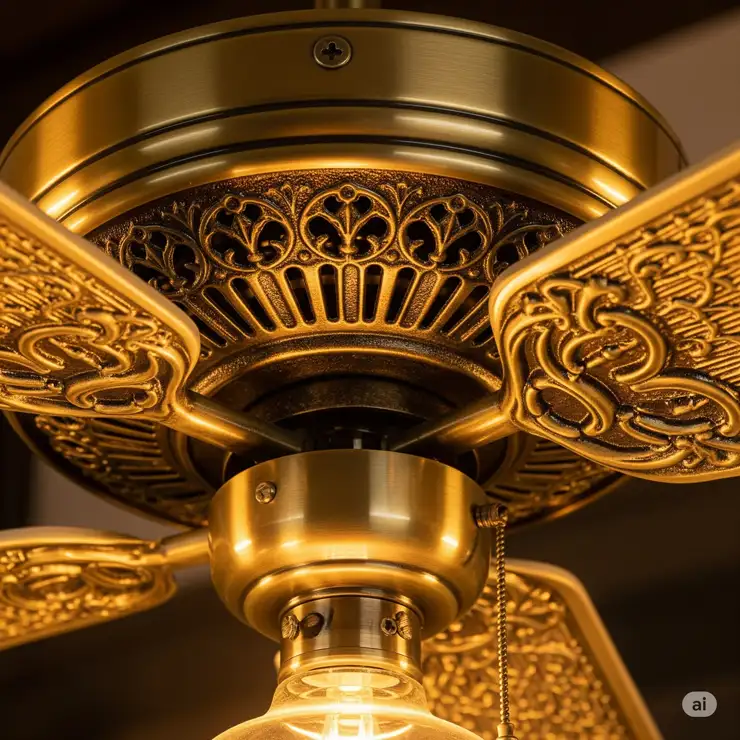
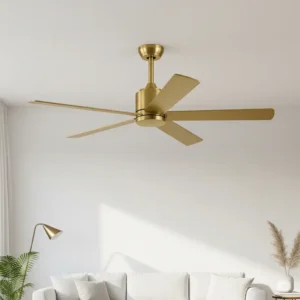
A brass ceiling fan is a ceiling-mounted fan whose motor housing, trim, or fittings are finished in brass (solid, plated, or brass-toned) to add warm metallic character alongside airflow. Most pair that golden body with wood, carbon, or white blades, and many include an LED light kit.
Brass has had a rollercoaster decade. Not long ago it was the finish everyone swore to rip out of a 1990s dining room. Now designers can’t stop specifying it. It’s warmer than nickel, friendlier than black, and flattering to just about every wood tone. The modern brass ceiling fan isn’t your aunt’s glossy polished hugger, either. You’ll find soft brass, brushed brass, antique brass, and “legacy” brass, paired with coal, cherry, or white blades.
That’s the fun part. The risky part is that style is easy to judge from a thumbnail while airflow is nearly impossible to judge. A fan is a machine first and jewelry second. Ceiling fans have been circulating air since the late 1800s for a reason, and a gorgeous fan that barely moves the air is just an expensive ceiling ornament.
So here’s the plan. This guide compares seven real models across budget, mid-range, and premium tiers and translates each spec into what you’ll actually feel in the room. It also covers sizing, finish care, running costs, and the mistakes that trip up first-time buyers. Everything comes from manufacturer specs, retailer listings, and published efficiency guidance gathered in October 2026. I haven’t tested any of these fans myself, and prices appear as ranges only because they shift constantly. This article contains affiliate links, so see the disclaimer at the end.
Quick Comparison: 7 Brass Ceiling Fan Picks at a Glance
Think of this table as the menu before the full tasting. It lists each fan’s size, light setup, and price range, and the best use for it.
| Fan | Size | Blades | Light | Price range | Best For |
|---|---|---|---|---|---|
| Westinghouse Contractor’s Choice 52″ Polished Brass | 52″ | 5 | No light kit listed | Low $100s | Budget bedrooms and rentals |
| Hunter Low Profile 42″ Antique Brass | 42″ | 5 | Optional kit | Under $200 | Low ceilings, small rooms |
| Hunter Studio Series 52″ (53063) | 52″ | 5 | 4 LED bulbs | $170-$240 | Everyday living rooms |
| Minka-Aire Orb 54″ | 54″ | 4 | 16W LED + remote | $250-$310 | Modern, industrial looks |
| Minka-Aire Simple 44″ Outdoor | 44″ | 3 | Kit sold separately | $390-$470 | Covered patios |
| Minka-Aire Pike 56″ | 56″ | 3 | Integrated LED | Mid-$400s | Large, busy rooms |
| Kichler Ridley II 52″ | 52″ | 3 | 17W LED | Mid-$500s to mid-$600s | Wall-control, premium feel |
Looking at the comparison above, the Hunter Studio Series is the sensible default for most households. It balances price, light, and a lifetime motor warranty. The Westinghouse Contractor’s Choice wins on cost alone, while the Minka-Aire Pike and Minka-Aire Simple justify their higher price tags with stronger efficiency numbers. If you want the quietest, most refined control experience, the Kichler Ridley II is where the money goes.
Prices come from retailer listings at the time of research and move often, so check current pricing before you buy.
💬 Just one click — help others make better buying decisions too!😊
Top 7 Brass Ceiling Fan Picks: Expert Analysis
Seven fans, three budget tiers, one question for each: what will this feel like in your room? Every spec below is followed by what it means in practice.
1. Westinghouse Contractor’s Choice 52″ Polished Brass — cheapest way into the brass look
If you want a brass ceiling fan on a budget, this is the entry ticket. It’s a gleaming polished brass body hung with five wood-look blades in walnut and oak tones, plus three speeds and a reversible switch.
Retail listings put high-speed airflow around 4,700 CFM, driven by a 153 x 15 mm silicon steel motor with a triple capacitor. In plain English, that’s enough push for a bedroom or living room, and the 52-inch span matches the size the U.S. Department of Energy recommends for larger rooms. The hugger design keeps the fan about 13 inches tall, so it won’t threaten your forehead under an 8-foot ceiling. A remote is listed with this version.
Here’s the honest trade-off. A sibling model in this line draws about 65 watts for roughly 4,100 CFM, which works out near 63 CFM per watt. ENERGY STAR also notes that hugger fans move less air than hanging ones. That makes this a smart pick for a guest room or rental and a weaker pick for the room you live in all day. The retailer listings I found for this finish also didn’t show a UL or ETL mark, so confirm the safety listing on the exact product page.
I couldn’t verify a meaningful pool of reviews for this specific finish, so use the review tab as your final check. Scan for mentions of wobble, remote pairing, and finish consistency.
Pros:
- ✅ Lowest entry price for genuine polished brass style
- ✅ Remote listed with this version
- ✅ Compact hugger height suits 8-foot ceilings
Cons:
- ❌ Efficiency trails ENERGY STAR-class competitors
- ❌ Safety listing unclear on retailer spec pages
Expect the low-$100s at the time of research. That’s fair value for the look, provided the safety listing checks out.
2. Hunter Low Profile 42″ Antique Brass — hugs low ceilings without drama
Some rooms simply can’t spare the headroom. This 42-inch antique brass model is Hunter’s answer for low ceilings, with five reversible blades in dark walnut and English cherry tones. Those tones turn the fan into a warm, traditional focal point rather than a gadget.
The motor is Hunter’s WhisperWind design, which the brand markets for quiet operation. I couldn’t find an independent decibel measurement, so treat “whisper” as a marketing promise rather than a number. The listing describes it as low-ceiling adaptable but not sloped-ceiling compatible. That matters, because many buyers assume any hugger can angle with a vaulted ceiling. This one can’t.
The Department of Energy suggests 36- to 44-inch fans for rooms up to about 225 square feet, so a 42-inch span fits a bedroom, office, or nursery. Light kits are sold separately and Hunter says its universal kits are compatible, which lets you add a brass-finish fixture later. The trade-off is physics. A small hugger can’t match a 52-inch hanging fan, so don’t buy it for a great room.
Review sentiment couldn’t be verified for this exact finish at research time, so check the listing for comments on noise and blade finish consistency.
Pros:
- ✅ Fits low ceilings where bigger fans won’t
- ✅ Warm antique brass with reversible blade tones
- ✅ Works with Hunter universal light kits
Cons:
- ❌ Not compatible with sloped ceilings
- ❌ Smaller span limits airflow in big rooms
Expect it to land under $200 (verify current pricing). It’s good value for small, low-ceilinged spaces.
3. Hunter Studio Series 52″ Antique Brass (53063) — the dependable all-rounder with four LEDs
This is the brass ceiling fan I’d steer most people toward first. It’s a traditional 52-inch design with five reversible blades in walnut and medium oak, four LED bulbs at 3000K, and a pull-chain three-speed motor.
The spec sheet lists about 4,412 CFM at roughly 39 watts, with a 145 RPM motor and a 13-degree blade pitch. Dividing airflow by wattage lands well above 100 CFM per watt, though retailers report the efficiency figure inconsistently. Check the EnergyGuide label on the box for the official number. At about 12 inches tall with the included 3-inch downrod, it suits standard ceilings, and it can handle sloped ceilings with an extra downrod. The AC motor carries a limited lifetime warranty, a meaningful signal from a company that has built fans for well over a century.
What the spec sheet won’t tell you is how it looks lit. Four small bulbs spread soft, even light, which flatters bedrooms but won’t replace a reading lamp. Pull chains are charmingly old-school and mildly annoying, so budget a minute to find the reach.
Aggregated review sentiment for this exact model wasn’t verifiable during research, so read recent reviews for notes on blade fit and light brightness.
Pros:
- ✅ Strong airflow for its listed wattage
- ✅ Limited lifetime motor warranty
- ✅ Sloped-ceiling compatible with extra downrod
Cons:
- ❌ Pull-chain control only
- ❌ Small bulbs give modest brightness
Expect roughly $170-$240. It’s excellent value for a mainstream living space.
4. Minka-Aire Orb 54″ Soft Brass — industrial-modern with a remote in the box
The Orb flips the traditional brass ceiling fan script. A flat-white or carbon motor body is accented with soft brass, and four brushed-carbon blades sweep out a 54-inch circle. It reads as modern farmhouse rather than grandmother’s study.
Specs list about 4,985 CFM at roughly 59 watts and 163 RPM, which is about 84 CFM per watt. The integrated 16-watt LED is dimmable, runs 3000K, and carries a 94 CRI, which is unusually high. A high CRI means skin tones and wood grain look natural instead of washed out. A remote ships with it and a 6-inch downrod is included. At about 16.75 inches tall, this is not a hugger. Plan on a ceiling of roughly 8.5 to 9 feet or more.
The blade construction is plywood with a paper overlay, so keep it away from steamy bathrooms. The 54-inch span fits a large bedroom or small great room.
I couldn’t confirm a reliable review sample for this exact finish. Check recent listings for remote reliability and blade fit.
Pros:
- ✅ High-CRI dimmable LED with warm 3000K light
- ✅ Remote included for speed and dimming
- ✅ Distinctive modern brass styling
Cons:
- ❌ Too tall for low ceilings
- ❌ Plywood blades dislike damp spaces
Expect around $250-$310. The remote and light quality make it strong value.
5. Minka-Aire Simple 44″ Outdoor Soft Brass — wet-rated, so the patio gets brass too
Most brass fans are dry-location only. This one is rated wet and built for covered patios, porches, and pergolas. It’s a 44-inch, three-blade fan in soft brass with coal blades.
The numbers are impressive for the size: about 5,323 CFM on high and 1,615 CFM on low. Power draw is roughly 48 watts on high and under 4 watts on low. That puts high-speed efficiency near 111 CFM per watt and low-speed efficiency in the hundreds. The steep 26-degree blade pitch is how a compact fan moves so much air. It’s ENERGY STAR listed, ETL approved, and includes a remote and a 6-inch downrod. It’s only about 12.6 inches tall.
The catch is that no light is included. A compatible LED kit is sold separately, so budget for it. If you live near salt air, ask the manufacturer about the finish warranty, because brass finishes can age quickly in coastal conditions.
Reviews couldn’t be verified for this finish at research time, so look for patio-specific feedback on finish aging.
Pros:
- ✅ Wet-rated for covered outdoor spaces
- ✅ Excellent airflow-per-watt
- ✅ Remote included
Cons:
- ❌ Light kit costs extra
- ❌ Pricey for a 44-inch fan
Expect about $390-$470. It’s strong value for a covered patio and overpriced for a bedroom.
6. Minka-Aire Pike 56″ Legacy Brass — big airflow with ENERGY STAR credentials
If your room is large and your fan runs often, this is the efficiency pick. The 56-inch Pike pairs legacy brass with three coal-black blades, and the listing shows ENERGY STAR status.
Airflow is listed around 5,499 CFM on high at 127 CFM per watt, which implies roughly 43 watts. That’s the best high-speed number in this lineup. The motor spins at 143 RPM, so it moves air steadily rather than frantically. The listing shows a dimmable LED at 3000K and 90 CRI, with a rated life of 30,000 hours. The lumen figures conflict (about 1,600 versus 2,150 depending on the line you read), so expect bright but verify. A remote and a 6-inch downrod are included, and at 13.25 inches tall it fits standard ceilings.
ABS blades typically resist humidity warping better than wood, which is a plus in kitchens and coastal homes. On the downside, plastic blades lack the warmth of wood, and some buyers prefer the look of real grain.
Review data couldn’t be verified at research time, so scan recent listings for feedback on remote pairing and the glass shade.
Pros:
- ✅ Highest efficiency in this roundup
- ✅ ENERGY STAR listed with strong airflow
- ✅ Humidity-resistant ABS blades
Cons:
- ❌ Plastic blades lack wood’s warmth
- ❌ Conflicting lumen figures across listings
Expect the mid-$400s. It’s excellent value if the fan runs most of the day.
7. Kichler Ridley II 52″ Natural Brass — premium build with wall control
Kichler’s Ridley II is the splurge. It combines a natural brass finish, cherry blades, and a minimalist design. The natural brass finish is meant to look like aged antique metal, with darker oxidized variation rather than uniform gloss. That’s character, not a defect.
The AC induction motor (153 x 18 mm) delivers about 4,388 CFM at 50 watts on high, around 87 CFM per watt. On low it drops to 584 CFM at only 9 watts, which is the real gem for overnight bedroom use. The integrated 17-watt LED runs 3000K, dims fully, and puts out about 1,600 lumens. It’s controlled by a three-speed wall control, so there’s no remote to lose. A metal cap is included for light-free use. The fan is UL/CUL rated for dry locations and covers sloped ceilings up to 30 degrees. Warranty coverage is limited lifetime.
Dimming works best with Kichler’s own fan controls, so confirm compatibility before swapping in a third-party dimmer. At roughly 17 pounds, it also needs a properly rated mounting box.
I couldn’t verify a statistically meaningful review pool for this finish, so check recent buyer comments on wall-control setup.
Pros:
- ✅ Excellent low-speed efficiency for quiet nights
- ✅ Wall control with full-range light dimming
- ✅ Sloped-ceiling capable with limited lifetime warranty
Cons:
- ❌ Highest price in this lineup
- ❌ Dimming works best with Kichler controls
Expect the mid-$500s to mid-$600s. It’s premium pricing that buys build quality and a refined control experience.
Performance & Efficiency Snapshot
| Fan | High-speed airflow | Power (high) | Approx. CFM/W | Height | Rating |
|---|---|---|---|---|---|
| Westinghouse Contractor’s Choice | ~4,700 CFM | ~65W (sibling) | ~63 (sibling) | ~13″ | Indoor |
| Hunter Low Profile 42″ | Not verified | Not verified | Not verified | Hugger | Indoor |
| Hunter Studio Series | ~4,412 CFM | ~39W | ~113 (calculated) | ~12.3″ | Dry |
| Minka-Aire Orb | ~4,985 CFM | ~59W | ~84 | ~16.75″ | Indoor |
| Minka-Aire Simple 44″ | ~5,323 CFM | ~48W | ~111 | ~12.6″ | Wet |
| Minka-Aire Pike | ~5,499 CFM | ~43W (implied) | ~127 | ~13.25″ | Indoor |
| Kichler Ridley II | ~4,388 CFM | ~50W | ~87 | ~14.5-16.25″ | Dry |
CFM per watt figures are high-speed and derived from listed numbers, so check each EnergyGuide label for official values.
The table makes the pattern obvious: the Minka-Aire Pike and Minka-Aire Simple lead on efficiency, and the Hunter Studio Series looks surprisingly frugal for its price. The Westinghouse is the thirstiest of the group, which is the real cost of that bargain price. The Kichler Ridley II looks middling on high speed, but its tiny low-speed draw is where it earns its keep.
Practical Usage Guide: Install, Break In, and Keep Brass Gleaming
A great fan can still disappoint if it’s installed carelessly. Run through this list before you climb the ladder.
Before you install:
- Confirm the electrical box is rated to support a ceiling fan, not just a light fixture.
- Make sure the blades will hang at least 7 feet above the floor and about 18 inches from walls, per ENERGY STAR guidance.
- Cut power at the breaker, not just the switch.
The first 30 days:
- Re-tighten blade screws after a week. Vibration loosens them, and loose blades cause most wobble complaints.
- Use the balancing clip that ships with many fans before blaming the motor.
- Run the fan counterclockwise in summer for a cooling breeze and clockwise on low in winter to push warm air down.
Keeping brass bright:
Brass is an alloy of copper and zinc, which is why it tarnishes. First work out what you have. Lacquered brass has a clear protective coating, so wipe it with a damp microfiber cloth and dry it immediately. Skip abrasive cleaners, because they can scratch the lacquer. Unlacquered brass develops a patina and can be polished with a brass polish if you want it bright again. A quick magnet test also helps. If a magnet sticks, the piece is brass-plated steel, and plain soap and water is safest.
A thin layer of clear wax on clean, dry brass can slow tarnish, though it’s optional.
Real-World Scenarios: Matching a Brass Ceiling Fan to Your Home
Specs are abstract. Rooms are not. Here are three common situations.
The college rental bedroom. An 11-by-12 room with an 8-foot ceiling, used mostly at night, and a tight budget. The Westinghouse Contractor’s Choice brings the brass look at the lowest cost, and the Hunter Low Profile 42″ is the safer pick if headroom is truly tight. Because usage is light, the efficiency penalty barely registers.
The family living room. An 18-by-20 space with 9-foot ceilings and the fan on six hours a day. Here efficiency and airflow dominate. The Minka-Aire Pike delivers the strongest airflow per watt, and the Kichler Ridley II is the better choice if you want wall controls and quiet low-speed operation for evenings.
The covered patio. A 12-by-14 space exposed to humidity but not direct rain. The Minka-Aire Simple 44″ is the only wet-rated option here, and it ships with a remote. Add a light kit if you entertain after dark.
If your situation sits between these, the Hunter Studio Series and Minka-Aire Orb are the flexible middle. The Hunter suits traditional rooms and the Orb suits modern ones.
✨ Don’t Miss These Exclusive Deals!
🔍 Take your next brass ceiling fan upgrade to the next level with these carefully selected products. Click on any highlighted item to check current pricing and availability. These fans will help you create a warm, comfortable space your whole family will love!
Problem → Solution: Fixing Common Brass Ceiling Fan Headaches
Problem: the fan wobbles. Check blade screws and the canopy first, then use the balancing kit. A fan this size also needs a securely mounted, fan-rated box.
Problem: the light hums or flickers on a dimmer. Many fan lights need a compatible control. The Kichler Ridley II specifically recommends Kichler’s own controls, so match the control to the fan before blaming the bulbs.
Problem: the brass looks dull or spotty. Identify lacquered versus unlacquered first. Lacquer needs gentle cleaning only, and unlacquered brass can be polished. Natural-brass finishes such as the Kichler Ridley II are meant to show some oxidation variation, so decide whether that’s charm or a flaw before you panic.
Problem: the room still feels warm. Check direction and speed. Counterclockwise on medium or high in summer is the starting point, and the Department of Energy notes that a ceiling fan lets you raise the thermostat about 4°F without losing comfort. If it still falls short, a hugger like the Westinghouse may simply be undersized for the space.
Problem: the light is too yellow or too harsh. Check color temperature. The Minka-Aire Orb and Minka-Aire Pike use 3000K light with high CRI, which is warm without looking muddy.
How to Choose a Brass Ceiling Fan: 7 Steps That Prevent Regret
The short answer: match blade span to room size, check ceiling height, favor higher airflow efficiency, confirm the location rating, and then pick your brass tone. Here are the steps.
- Measure the room. The Department of Energy suggests 36- to 44-inch fans for rooms up to about 225 square feet and 52 inches or more for larger rooms. In rooms longer than 18 feet, two fans work better than one.
- Check ceiling height. ENERGY STAR advises at least 7 feet from floor to blades, ideally 8 to 9 feet, with about 18 inches of clearance from walls.
- Decide hugger or hanging. Huggers fit low ceilings but move less air.
- Compare efficiency. Look at CFM per watt on the EnergyGuide label, not just wattage.
- Match the location rating. Dry, damp, or wet determines where the fan can legally and safely live.
- Pick your control. Pull chain, remote, or wall control each change daily convenience.
- Choose your brass. Polished, antique, soft, and natural brass look very different, so check them against your other fixtures.
Features That Actually Matter in a Brass Ceiling Fan (And Those That Don’t)
Marketing copy loves adjectives. Spec sheets love numbers. Trust the numbers.
What matters:
- Airflow at the speed you’ll use. A fan’s low-speed CFM tells you more about bedroom comfort than its high-speed headline number.
- Motor warranty. Limited lifetime motor coverage, as on the Hunter Studio Series and Kichler Ridley II, signals manufacturer confidence.
- Control type. You’ll touch it every day.
- Light quality. CRI and color temperature decide whether the room looks warm or sickly.
- Location rating. It determines whether the fan is safe in that space.
What matters less:
- Blade count. Five blades look classic and three look modern, but pitch and RPM matter more than count.
- “Whisper quiet” claims without decibel data.
- Reversible blade colors, which are a nice touch but won’t change performance.
- Whether the brass is solid or plated. It matters for repairs and feel, but plated brass is perfectly normal on many fans.
Brass Ceiling Fan vs Brushed Nickel and Bronze Finishes
Brass isn’t the only game in town. Here’s how it stacks up against the two finishes it most often competes with.
| Finish | Look | Upkeep | Pairs Well With | Best For |
|---|---|---|---|---|
| Polished brass | Bright, traditional | Wipe-down if lacquered | Dark wood, classic decor | Westinghouse Contractor’s Choice buyers |
| Antique brass | Warm, aged | Low | Cherry and walnut | Hunter Studio Series buyers |
| Soft/brushed brass | Muted, modern | Low | White, gray, carbon | Minka-Aire Orb buyers |
| Natural brass | Evolving patina | Moderate | Rustic, Scandinavian | Kichler Ridley II buyers |
| Brushed nickel / bronze | Cool or dark neutral | Low | Cooler palettes | Homes avoiding gold tones |
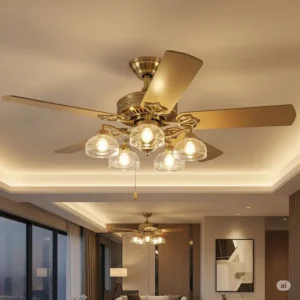
Brass wins when you want warmth, especially next to wood, white walls, or black fixtures. Nickel suits cooler palettes, and bronze is the quiet, dark option. Because brass comes in so many sub-finishes, the safest move is to match undertones with your existing fixtures. A soft brass fan beside a bright polished chandelier can look accidental rather than intentional.
What to Expect: Real-World Performance
Airflow numbers are abstract until you translate them. A fan rated near 4,400 to 5,500 CFM on high moves a lot of air, but most people run their fan on medium or low. That’s why low-speed data matters.
The Kichler Ridley II moves around 584 CFM on low while drawing only about 9 watts, which is gentle bedroom air. The Minka-Aire Simple 44″ moves about 1,615 CFM on low at under 4 watts, which is a lot more breeze for the same quiet-hour electricity. In practical terms, the Simple feels like a steady current and the Kichler feels like a soft whisper.
ENERGY STAR certified fans are described by the Department of Energy as up to 60 percent more efficient than conventional models, so airflow and efficiency don’t have to be a trade-off. I couldn’t find verified decibel measurements for these models, so noise comparisons here rely on motor design and brand claims rather than lab data. A fan is only as quiet as its installation, so a securely mounted, balanced fan will always beat a wobbly premium one.
Long-Term Cost & Maintenance of a Brass Ceiling Fan
Sticker price is only the opening bid. Running cost is the long game.
Yearly Power Math
EnergyGuide labels estimate cost using 12 cents per kilowatt-hour and 6.4 hours of daily use. Applying that to listed high-speed wattage, excluding lights, gives rough estimates for each fan.
| Fan | Price range | Est. yearly power (high speed) | Value verdict |
|---|---|---|---|
| Westinghouse Contractor’s Choice | Low $100s | ~$18 (sibling wattage) | Cheap now, costlier to run |
| Hunter Studio Series | $170-$240 | ~$11 | Strong all-round value |
| Minka-Aire Orb | $250-$310 | ~$17 | Fair for style and remote |
| Minka-Aire Simple 44″ | $390-$470 | ~$13 | Best for covered patios |
| Minka-Aire Pike | Mid-$400s | ~$12 | Best efficiency per dollar |
| Kichler Ridley II | Mid-$500s to mid-$600s | ~$14 | Premium feel, quiet on low |
Those are worst-case figures, since few people run a fan on high all day. Drop the Kichler Ridley II to its low setting and the cost falls to a few dollars a year. For context, ENERGY STAR’s long-standing criteria, summarized by UF/IFAS Extension, set minimum efficiency targets that tighten at lower speeds. These criteria may have been revised since, so check the current spec.
Over a few years, the Westinghouse’s extra electricity won’t erase its price advantage, but the Minka-Aire Pike’s efficiency gap makes a stronger case in a heavily used room.
Upkeep
Expect to dust blades occasionally, re-tighten screws once or twice a year, and clean the brass according to its finish type. Lacquered finishes need little more than a damp cloth.
Common Mistakes When Buying a Brass Ceiling Fan
Most disappointments trace back to a handful of avoidable errors.
- Buying by thumbnail. Brass photographs differently on every screen. Compare finish names such as soft, antique, polished, and natural against your existing fixtures.
- Ignoring ceiling height. A fan like the Minka-Aire Orb at roughly 16.75 inches tall won’t suit a low ceiling.
- Wrong size for the room. Undersized fans work harder and may feel inadequate.
- Assuming “indoor” means “anywhere.” Only the Minka-Aire Simple 44″ in this list is wet rated.
- Skipping control compatibility. Dimming works best with the manufacturer’s recommended control.
- Forgetting the light kit. The Minka-Aire Simple 44″ ships without one, and a separate kit adds real cost.
- Skipping the safety mark. Confirm a UL or ETL listing on the exact product page.
Safety, Ratings & Regulations Guide
Labels can look like alphabet soup, but each one answers a practical question.
Location Ratings
- Dry: indoor rooms without moisture exposure, such as the Kichler Ridley II and Hunter Studio Series.
- Damp: covered or humid areas.
- Wet: direct moisture exposure, as with the Minka-Aire Simple 44″.
Efficiency and Safety Labels
Since fall 2018, FTC EnergyGuide labels have appeared on ceiling fan packaging, showing airflow, wattage, and efficiency. ENERGY STAR certification marks the more efficient models, and the Department of Energy has also finalized federal minimum efficiency standards for ceiling fans. A UL or ETL mark tells you the fan was tested to a safety standard.
Installation Basics
Use a fan-rated electrical box, keep blades at least 7 feet above the floor, and leave about 18 inches to the nearest wall. If you’re not comfortable working with household wiring, hire a licensed electrician.
FAQ: Brass Ceiling Fan Questions
❓ Are brass ceiling fans out of style in 2026?
❓ Can I dim the light on a brass ceiling fan?
❓ Is a brass ceiling fan safe for a bathroom?
❓ How long does a brass ceiling fan last?
❓ Does a brass ceiling fan work with a sloped ceiling?
Conclusion: Which Brass Ceiling Fan Should You Buy?
A good brass ceiling fan does two jobs: it moves air and it makes the room look finished. The trick is not letting the second job distract you from the first.
If budget rules, the Westinghouse Contractor’s Choice delivers the look for the lowest price, as long as you confirm its safety listing. For small or low-ceilinged rooms, the Hunter Low Profile 42″ is the practical pick. The Hunter Studio Series is the best all-round value for most homes, and the Minka-Aire Orb adds a remote and high-CRI lighting for modern spaces. For a covered patio, the wet-rated Minka-Aire Simple 44″ stands alone. If you run a fan all day in a big room, the Minka-Aire Pike offers the strongest efficiency in this roundup. And if you want a premium feel with wall control and quiet low-speed operation, the Kichler Ridley II earns its price.
Whatever you choose, measure your room, check your ceiling height, and confirm the location rating before you click buy. Brass will carry the style, but sizing and efficiency carry the comfort.
✨ Ready to Upgrade Your Space?
🔍 Compare current pricing and availability on your favorite brass ceiling fan today. A well-chosen fan will keep your room comfortable for years to come, and it will look great doing it!
Recommended for You
- 7 Best Wooden Ceiling Fan Options That Transform Your Home in 2025
- 7 Best Vaulted Ceiling Fan Solutions for Ultimate Comfort in 2025
- 7 Best Rustic Ceiling Fan Options for Ultimate Country Charm in 2025
Disclaimer: This article contains affiliate links. As an Amazon Associate, I earn from qualifying purchases. If you purchase products through these links, we may earn a small commission at no additional cost to you.
✨ Found this helpful? Share it with your friends! 💬🤗
