

In This Article
A greenhouse is a polite oven. Sunlight pours in, turns into heat, and has nowhere to go. By mid-afternoon in July, the air at plant height can sail past what most crops tolerate, and your tomato blossoms respond by dropping like flies. A greenhouse exhaust fan is the most dependable cure: it shoves hot air out one end while cooler outdoor air rushes in the other.
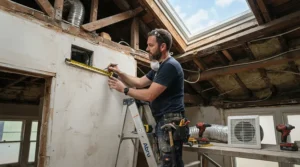
Here’s the twist, though. Most “my fan doesn’t work” stories aren’t fan stories. They’re math stories, or intake stories. Extension researchers at UMass Amherst call improper fan sizing a major cause of poor ventilation in greenhouses. A fan that’s too small loses the fight. A fan with nowhere to pull air from loses it too, and it sulks loudly while doing so.
So this guide does three jobs. First, it ranks seven real fans, from compact budget units to commercial-style workhorses. Second, it hands you the ventilation sizing math in plain English. Third, it covers the half of the system most buyers forget: the intake exhaust balance that decides whether any fan performs as advertised.
One honesty note before we start. I haven’t tested these fans personally. Everything here comes from published specs, retailer data, third-party roundups, and extension research. Where I couldn’t verify real customer reviews, I say so.
Quick Comparison: 7 greenhouse exhaust fan Options at a Glance
| Product | Rated Airflow | Control Style | Best For |
|---|---|---|---|
| VEVOR 10-Inch EC Shutter Exhaust Fan | 820 CFM | Temp/humidity controller, 10 speeds | Tiny greenhouses and sheds |
| iLIVING 12-Inch ILG8SF12V-ST | 960 CFM | Thermostat + variable speed | Small hobby houses |
| iLIVING 16-Inch ILG8SF16V-ST | 1,200 CFM | Thermostat + variable speed | Mid-size backyard houses |
| iLIVING 16-Inch ILG8SF16V-DC | 1,736 CFM | Digital temp/humidity, EC motor | Efficiency-minded growers |
| Canarm SD14-E2 14-Inch | 2,180 CFM | Two-speed, add a thermostat | Ag-grade durability |
| VEVOR 24-Inch 3320 CFM | 3,320 CFM | Fan-only (controller variants exist) | Big airflow on a budget |
| Bootstrap Farmer 24-Inch | 4,450 CFM | Add thermostat separately | Hoop houses and small commercial |
Read that table as a ladder of airflow, not a ranking of quality. The VEVOR 10-Inch EC Shutter Exhaust Fan and iLIVING 12-Inch ILG8SF12V-ST suit small structures. The 14- and 16-inch models cover typical backyard houses. The two 24-inchers, the VEVOR 24-Inch 3320 CFM and Bootstrap Farmer 24-Inch, are for hoop houses where a single fan has to move a serious volume of air.
💬 Just one click — help others make better buying decisions too!😊
What Is a greenhouse exhaust fan? (The 50-Word Answer)
A greenhouse exhaust fan is a wall-mounted, shuttered fan that pushes hot, humid air out of a growing space. That creates slight negative pressure, which pulls cooler outside air in through intake vents on the opposite side. It’s rated in CFM (cubic feet per minute), and in summer it should replace your greenhouse’s air roughly once every minute.
You’ll also see the same hardware called a greenhouse vent fan, a shutter fan, or a wall exhaust fan. They’re the same family. The shutter is the clever bit: louvers swing open when the fan runs and drop closed when it stops, so you’re not leaking heat out in January.
It’s also worth separating exhaust fans from circulation fans. Circulation fans stir air inside the house. They don’t remove heat. A proper plan for greenhouse exhaust ventilation uses the exhaust fan to swap air with the outdoors and, if the house is long or crowded, a small circulation fan to erase dead spots.
Top 7 greenhouse exhaust fan Picks: Honest Analysis
Seven fans follow, ordered roughly from small and budget-friendly to large and commercial. Each gets the same treatment: what the specs mean, who it fits, what review data actually exists, and a verdict.
1. VEVOR 10-Inch EC Shutter Exhaust Fan — compact smart control for small houses
This is the fan for a greenhouse that’s closer to a garden shed than a barn. It’s rated at 820 CFM, uses an EC (electronically commutated) motor, and ships with a temperature and humidity controller that offers 10 speed steps. It carries an ETL listing.
In practice, that speed ladder matters more than the motor type. Extension guidance suggests winter ventilation needs only about a quarter of summer airflow, so a fan that can trickle along gently beats one that only blasts. As for coverage, 820 CFM is about one air exchange per minute for roughly 100 square feet at 8 feet tall. That makes this a fit for an 8×10 or 8×12 house, with little cushion beyond that.
On reviews, the seller’s own listing shows a 4.8 average across 202 reviews. Its summary says buyers praise effectiveness and easy installation, while some struggle with programming the controls. A retailer’s own page deserves a pinch of salt.
Pros:
- ✅ Ten speed steps for gentle winter airflow
- ✅ Humidity trigger helps fight fungal problems
- ✅ ETL-listed and simple wall mounting
Cons:
- ❌ Controller programming has a learning curve
- ❌ Outgrown quickly past roughly 100 square feet
Price tier: budget to mid-range (check current price). Verdict: great value for a small VEVOR 10-Inch EC Shutter Exhaust Fan build, and a poor choice if you plan to expand.
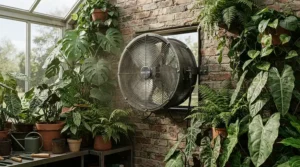
2. iLIVING 12-Inch ILG8SF12V-ST — thermostat bundled for plug-and-forget cooling
Think of this as the “set it and walk away” starter. The listing shows 960 CFM, a 0.6A draw, automatic shutters, and a thermostat with variable speed control.
Here’s the part the spec sheet won’t tell you. One roundup credits it with 1,400 square feet of coverage, but that figure is a general-space claim, not a greenhouse one. At one exchange per minute and an 8-foot ceiling, 960 CFM serves about 120 square feet. Treat the coverage number as marketing and do your own ventilation sizing instead. On the plus side, 0.6A at 115V works out to roughly 70 watts, so the efficiency math looks respectable for its size.
I couldn’t verify a meaningful pool of independent customer reviews. One third-party roundup rates it highly, but that’s one opinion, not buyer consensus.
Pros:
- ✅ Thermostat included, so no extra controller
- ✅ Low amperage keeps running costs small
- ✅ Automatic shutters seal when idle
Cons:
- ❌ Coverage claim is wildly optimistic for greenhouses
- ❌ Little verifiable independent review history
Price tier: budget (under roughly $250, verify). Verdict: a smart pick for a 10×10 house, provided you ignore the coverage hype.
3. iLIVING 16-Inch ILG8SF16V-ST — the thermostat model buyers keep returning to
The sweet spot in the iLIVING lineup is the 16-inch. It’s rated at 1,200 CFM from a 1/20 HP motor at 1550 RPM, with a Thermospeed controller covering 32–130°F and shutters that open automatically. It lists UL/cUL certification and a noise level under 65 dB, roughly the volume of a lively conversation.
Based on the spec comparison, 1,200 CFM covers about 150 square feet at 8 feet tall. That’s a solid match for a 10×14 house. The draw is only 0.85A, so the electric bill won’t flinch.
Reviews are thin but instructive. A Home Depot listing shows a 4.3 average across 20 ratings. One Wayfair buyer reported easy installation, then noted the fan pulled the greenhouse door open and they had to add intake vents. That’s the best intake exhaust balance lesson you’ll find in a single sentence.
Pros:
- ✅ Built-in thermostat and variable speed control
- ✅ UL/cUL certified with galvanized frame
- ✅ Strong airflow for a modest 0.85A draw
Cons:
- ❌ Needs generous intake openings to perform
- ❌ Review pool is small across retailers
Price tier: mid-range, with wide retailer variation (check current price). Verdict: the best all-round buy here for a typical backyard house.
4. iLIVING 16-Inch ILG8SF16V-DC — EC motor with temperature and humidity logic
Same 16-inch frame, but this one swaps in an EC motor and a digital controller. It’s rated at 1,736 CFM at 1600 RPM, with temperature control from 50–99°F plus humidity control, and carries an ETL listing.
Why care? A 16-inch frame delivering roughly 45% more airflow than the iLIVING 16-Inch ILG8SF16V-ST stretches your options without enlarging the wall hole. The listing’s claim of 2,500 square feet of coverage is, once again, inflated. At one exchange per minute, 1,736 CFM handles about 215 square feet at 8 feet tall.
This is a newer listing, and I found no verified reviews. That’s the honest trade-off: modern efficiency tech, but no track record yet.
Pros:
- ✅ Highest airflow in a 16-inch frame here
- ✅ Humidity-aware digital controller
- ✅ EC motor can sip power at low speed
Cons:
- ❌ Limited review history to confirm durability
- ❌ Coverage claim overstates real greenhouse capacity
Price tier: mid to upper range (check current price). Verdict: tempting for 12×16 houses if you’re comfortable being an early adopter.
5. Canarm SD14-E2 14-Inch — ag-grade construction with two clean speeds
Canarm builds fans for barns and greenhouses, and it shows in the spec sheet. This 14-inch model is rated at about 2,180 CFM, runs on a 1/4 HP 115V motor, and offers two speeds. The motor is totally enclosed and thermally protected, the housing is welded steel with a powder-coat finish, and the aluminum louvers ride on nylon bushings. It’s ETL certified.
Here’s why that matters. Greenhouse air is dusty and wet, and Greenhouse Management advises totally enclosed motors for exactly those conditions. Two speeds also map neatly to seasons: high for summer, low for the shoulder months. Canarm models show up in University of Illinois BESS Lab test data, though I didn’t find a published test for this specific 14-inch unit. Wisconsin Greenhouse Company also sells Canarm packages that bundle motorized intake shutters and a thermostat.
I couldn’t verify enough customer reviews to summarize sentiment.
Pros:
- ✅ Totally enclosed, thermally protected motor
- ✅ Two-speed operation fits seasonal needs
- ✅ Welded steel housing resists corrosion
Cons:
- ❌ Thermostat and intake shutters cost extra
- ❌ Pricier than comparable-airflow budget fans
Price range: roughly $350–$430 at retailers I found. Verdict: the durability-first buy for a serious 12×20 house.
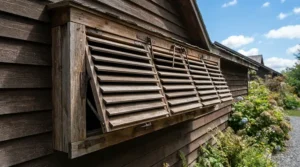
6. VEVOR 24-Inch 3320 CFM — big airflow, small bill
If you want the most air per dollar, this is the contender. Model VV-ACPQS-24 is an AC-motor fan rated at 3,320 CFM at 1300 RPM, with outer dimensions of 28.5 × 28.5 inches. It arrives fully assembled, and its gravity-operated aluminum shutters close when the power’s off.
At one exchange per minute, 3,320 CFM serves about 415 square feet at 8 feet tall. That fits a 12×30 hoop house. One caution on the listing: it’s FCC listed, which addresses electromagnetic emissions, not the electrical-safety certification you’d get from UL or ETL. If safety listings matter to you, factor that in.
One third-party roundup scored it 6.8 out of 10, recommending it for growers who want a big fan without assembly headaches and don’t need top efficiency.
Pros:
- ✅ Large airflow for a modest price
- ✅ Arrives fully assembled
- ✅ Gravity shutters seal when idle
Cons:
- ❌ FCC listing is not a safety certification
- ❌ Efficiency described as middling in roundups
Price range: around $150 in one roundup (check current price; variants with controllers cost more). Verdict: a fine budget workhorse if you add a quality thermostat.
7. Bootstrap Farmer 24-Inch — commercial-feel fan for hoop houses
This is the heavyweight. Listings show 4,450 CFM at high speed, a 24.5-inch shutter, a 24.5 × 24.5 inch rough opening, a 3-wing blade, 1/3 HP, and 3.2A draw. It’s UL 705 safety certified and weighs about 61 pounds. A roundup describes the motor as TEAO (totally enclosed air over) with an IP55 rating and calls the unit American-made, though you should confirm that on the seller’s page.
At one exchange per minute, 4,450 CFM covers about 555 square feet at 8 feet tall, so a 16×30 house sits comfortably within range. That 61-pound weight means you’ll want real framing support around the opening.
The seller’s page showed no reviews on partner listings, while the same roundup scored it 8.1 out of 10 for build quality. Stock has also shown as sold out at times, so check availability.
Pros:
- ✅ UL 705 certified, heavy-duty construction
- ✅ Serious airflow for 500-plus square feet
- ✅ Kit options available with thermostats
Cons:
- ❌ Heavy, so it needs reinforced framing
- ❌ Stock fluctuates between sold out and available
Price range: roughly $370–$410 for the fan alone. Verdict: the pick when downtime costs real money.
Spec Snapshot: What to Plan Around
| Product | Motor & Control | Intake to Plan (sq ft)* | Price Range | Best For |
|---|---|---|---|---|
| VEVOR 10-Inch EC Shutter Exhaust Fan | EC, 10-speed controller | ~1.4 | Budget tier | Sheds, lean-tos |
| iLIVING 12-Inch ILG8SF12V-ST | AC, thermostat | ~1.6 | Budget tier | 10×10 houses |
| iLIVING 16-Inch ILG8SF16V-ST | AC, thermostat | ~2.0 | Mid tier | 10×14 houses |
| iLIVING 16-Inch ILG8SF16V-DC | EC, digital controller | ~3.0 | Mid-upper tier | 12×16 houses |
| Canarm SD14-E2 14-Inch | AC, two-speed | ~3.7 | $350–$430 | Durability seekers |
| VEVOR 24-Inch 3320 CFM | AC, fan-only | ~5.6 | ~$150 range | Budget hoop houses |
| Bootstrap Farmer 24-Inch | AC, add thermostat | ~7.6 | ~$370–$410 | Small commercial |
*Intake figures are my calculation at roughly 1.7 square feet per 1,000 CFM, drawn from older Nursery Management guidance.
The surprise in this table is the right-hand intake column. The Bootstrap Farmer 24-Inch needs about 7.6 square feet of open intake, more than most backyard builders expect to cut into a wall. If you can’t provide that, the VEVOR 24-Inch 3320 CFM or a pair of smaller fans may be the more realistic route. Budget buyers should note that the cheapest fans often need the same intake discipline as expensive ones.
How to Choose a greenhouse exhaust fan: 7 Steps
- Calculate your volume. Multiply length × width × average height. Use 8 feet for a standard house.
- Set your summer target. One air exchange per minute is the baseline, meaning your CFM roughly equals your cubic feet.
- Add a cushion. Free-air ratings overstate real-world delivery once shutters and screens add resistance, so leave 15–25% headroom.
- Pick a control strategy. A thermostat is the minimum, and variable speed or a two-speed fan handles shoulder seasons better.
- Check the motor and certifications. Totally enclosed motors and UL or ETL listings fit damp, dusty greenhouses.
- Plan the intake first. Decide where air enters before you decide where the fan goes.
- Verify noise and power. Check amperage against your circuit and decibels against your neighbors.
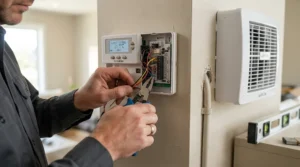
Ventilation Sizing: The Math Behind the Fan
Ventilation sizing is simpler than it sounds. The eXtension guide to greenhouse ventilation recommends sizing for one volume of air per minute to a height of 8 feet in summer. Its example: a 25 × 96 foot house times 8 feet equals 19,200 CFM. Spring can drop to about three-quarters of that, and winter to a quarter.
Applied to backyard-scale houses:
| Greenhouse Size | Volume (8 ft) | Summer CFM | Spring (¾) | Winter (¼) | Fan Pairing |
|---|---|---|---|---|---|
| 8×10 | 640 | 640 | 480 | 160 | VEVOR 10-Inch EC Shutter Exhaust Fan |
| 10×12 | 960 | 960 | 720 | 240 | iLIVING 16-Inch ILG8SF16V-ST |
| 12×16 | 1,536 | 1,536 | 1,152 | 384 | iLIVING 16-Inch ILG8SF16V-DC |
| 12×24 | 2,304 | 2,304 | 1,728 | 576 | Canarm SD14-E2 14-Inch (tight) |
| 16×30 | 3,840 | 3,840 | 2,880 | 960 | Bootstrap Farmer 24-Inch |
Notice the 10×12 row. The iLIVING 12-Inch ILG8SF12V-ST hits 960 CFM on paper, but with zero margin, so I’d step up to the 16-inch. Also keep in mind what one exchange per minute buys you. It typically holds the interior only about 8–10°F above the incoming air, so hot climates may call for shade cloth or evaporative cooling on top of airflow.
Intake Exhaust Balance: The Half Everyone Skips
A fan can only move air it can pull from somewhere. When it can’t, the greenhouse behaves like a vacuum cleaner with a blocked hose. Intake exhaust balance simply means the fresh-air opening is big enough that air flows in smoothly and the fan runs at its rated pace.
UMass guidance suggests intake louver area should be at least 1¼ times the fan area, and it offers a handy diagnostic: if the plastic gets pulled tight against the frame or the door is hard to open while the fan runs, your intake is too small. That’s precisely what the buyer of the iLIVING 16-Inch ILG8SF16V-ST ran into.
Three practical rules:
- Place intake opposite the fan. Cross-flow sweeps the whole house instead of short-circuiting.
- Use motorized or gravity shutters. They stay sealed when the fan’s off.
- Seal everything else. Gaps and open doors create shortcuts that bypass your crop.
When in doubt, go bigger on the intake. Oversized openings cost you almost nothing, while undersized ones can cost you a growing season.
Hot Air Removal Greenhouse Setup: A 30-Minute Practical Guide
Good hot air removal greenhouse performance comes from placement and control, not just horsepower. Here’s a first-install checklist.
Mount high on one end wall. Hot air collects overhead, so the fan should pull from the warmest layer.
Put the intake low and opposite. That creates a sweep across the plants instead of over their heads.
Position the thermostat sensor properly. Nursery Management advises placing the sensor at plant height near the center of the growing area. Don’t hang it where the sun hits it directly, or it’ll trigger the fan constantly.
Set the first thresholds. A reasonable starting point is a summer trigger in the low-80s °F with a few degrees of differential, then adjust after a week of observing.
Watch the first 30 days. Check for door suction, plastic billowing, and a hot far corner. Those are your intake and circulation signals.
Finally, put the fan on a GFCI-protected outlet. Greenhouses are damp, and so is the ground beneath you.
Greenhouse Vent Fan vs Roof Vents and Roll-Up Sides
A greenhouse vent fan isn’t the only way to shed heat, and sometimes it isn’t the best. Roof vents, roll-up sides, and circulation-only setups all have a place.
| Method | Cooling on Still Days | Control | Upkeep | Best For |
|---|---|---|---|---|
| Powered exhaust (e.g., iLIVING 16-Inch ILG8SF16V-ST) | Strong, wind-independent | Thermostat-driven | Cleaning, occasional shutter care | Hot, still summers |
| Roof/ridge vents | Moderate, relies on convection | Manual or auto openers | Low | Mild climates |
| Roll-up sides | Strong with breeze, weak without | Manual or motorized | Moderate | Hoop houses |
| Circulation fans only | Poor (moves heat, doesn’t remove it) | Simple | Low | Add-on to the above |
The takeaway is wind independence. Natural venting works when there’s a breeze or a big temperature gap, and fails on the still, brutal afternoons when you need it most. A greenhouse vent fan works whether or not the wind cooperates, which is why hybrid setups (vents plus a fan) are popular. Roll-up sides still win for sheer volume in large hoop houses, so the Bootstrap Farmer 24-Inch and roll-up sides can complement each other.
Real-World Scenarios: Matching the Fan to the Grower
Scenario 1: The weekend hobbyist. Imagine an 8×10 backyard house, used mainly for tomatoes and peppers, on a budget. The VEVOR 10-Inch EC Shutter Exhaust Fan handles the volume, and its humidity-aware controller helps in damp spring weather. Add a 12×12 inch passive intake and you’re done.
Scenario 2: The market gardener. Picture a 16×30 hoop house where heat stress means lost income. The Bootstrap Farmer 24-Inch covers the airflow on paper, and the VEVOR 24-Inch 3320 CFM is the cost-conscious alternative if paired with a trusted thermostat. Here, a properly sized intake becomes the whole project.
Scenario 3: The seedling starter in a cool climate. Heat isn’t the main enemy. Humidity and fungal pressure are. A two-speed Canarm SD14-E2 14-Inch or the humidity-capable iLIVING 16-Inch ILG8SF16V-DC can run on a gentle low setting through shoulder seasons.
Match budget, structure, and season, and the right fan tends to pick itself.
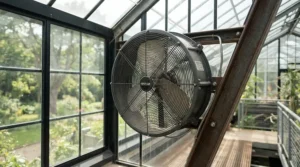
Hot Air Expulsion Problems and Fixes
When hot air expulsion falls short, one of five culprits is usually responsible.
The fan runs but the house stays hot. Likely an undersized fan or a blocked intake. Recheck your volume math and open more intake area.
The plastic sucks inward and the door fights you. That’s classic intake starvation. Add louvers until pressure normalizes.
There’s a hot pocket at the far end. Dead air. A small circulation fan evens things out.
The fan short-cycles. Your thermostat’s differential is too tight, or the sensor sits in direct sun. Widen the differential and relocate the sensor.
Seedlings get blasted. Use variable speed, or choose the VEVOR 10-Inch EC Shutter Exhaust Fan or iLIVING 16-Inch ILG8SF16V-DC, whose controllers allow gentler airflow.
Features That Actually Matter (And Those That Don’t)
Worth paying for:
- A real thermostat or controller. Automation protects crops when you’re at work.
- Automatic shutters. They close when idle, which cuts winter heat loss.
- A totally enclosed motor. Greenhouse dust and humidity kill open motors.
- UL or ETL listing. It’s safety assurance, not a luxury.
Mostly marketing:
- “Coverage area” claims. As shown above, they ignore greenhouse volume.
- Peak-CFM headlines. Always ask at what static pressure.
- Stylish housings. Function beats finish in a damp, dusty building.
Common Mistakes When Buying a greenhouse exhaust fan
The first mistake is buying by price per CFM and ignoring the intake. The second is trusting free-air ratings without a cushion. The third is mounting the fan and the intake on the same wall, which short-circuits airflow. The fourth is skipping thermostat placement, so the fan cycles on the sun’s glare rather than the plants’ temperature. The fifth is ignoring winter: a greenhouse that’s perfectly cooled in July can be a damp mold factory in January if the fan has no low-speed option.
One more, which is subtler: buying the biggest fan “just in case.” Oversized fans without variable speed blast cold air onto seedlings and waste electricity. Aim for right-sized with a speed control.
Long-Term Cost and Maintenance
Running costs are small if you choose sensibly. Using amps times volts as a rough proxy, the iLIVING 16-Inch ILG8SF16V-ST draws about 100 watts, and the Bootstrap Farmer 24-Inch around 370 watts. Run each for about 600 summer hours and you’re looking at roughly 60 kWh and 220 kWh respectively, so a few dollars to a few tens of dollars per season at typical US rates. That’s an illustration, not a quote.
Efficiency is worth a glance. Greenhouse Management recommends fans with a ventilation efficiency ratio (cfm per watt) of 15 or higher, and notes University of Illinois testing in which dust and dirt reduced airflow by as much as 30%. Intake-side shutters also moved about 10% more air than exhaust-side shutters in those tests.
Maintenance routine:
- Monthly in season: wipe blades and shutters.
- Each spring: check shutter hinges and fasteners.
- Each fall: inspect cords, guards, and seals.
A fan that’s cleaned twice a year behaves like a larger fan than one that’s neglected.
FAQ
❓ Is a thermostat-controlled greenhouse exhaust fan worth the extra money?
❓ Can I run a greenhouse vent fan without an intake shutter?
❓ How loud is a greenhouse exhaust fan?
❓ Should the fan run in winter?
❓ Is an EC motor better than an AC motor for a greenhouse exhaust fan?
Conclusion
The best greenhouse exhaust fan is the one sized to your volume, paired with enough intake, and controlled by a thermostat placed where the plants actually live. For most backyard growers, the iLIVING 16-Inch ILG8SF16V-ST hits the practical sweet spot. If you’re working with a very small space, the VEVOR 10-Inch EC Shutter Exhaust Fan is a clever fit. Efficiency seekers should watch the iLIVING 16-Inch ILG8SF16V-DC as it builds a track record, and those wanting durability will find the Canarm SD14-E2 14-Inch compelling. For hoop houses, the VEVOR 24-Inch 3320 CFM is the budget route, with the Bootstrap Farmer 24-Inch as the sturdier, pricier one.
Remember the through-line: do the ventilation sizing, respect the intake exhaust balance, and treat greenhouse exhaust ventilation as a system rather than a single gadget. Do that, and your plants get to stay cool while you stay out of the heat.
Recommended for You
- Best Greenhouse Fan: 7 Proven Picks That Actually Work (2026)
- Cooling Products For Elderly: 7 Best Safe Picks For 2026
- 7 Best Cooling Products For Pregnancy In 2026
Disclaimer: This article contains affiliate links. As an Amazon Associate, I earn from qualifying purchases. If you purchase products through these links, we may earn a small commission at no additional cost to you.
✨ Found this helpful? Share it with your friends! 💬🤗
