
In This Article
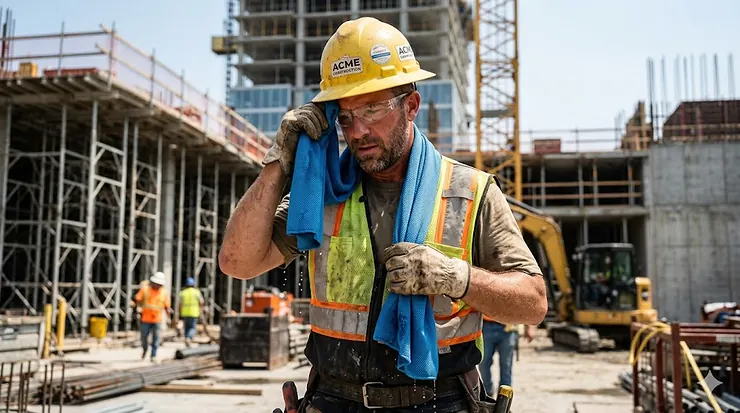
Picture this: it’s 11 a.m. in July, the asphalt is radiating heat like a pizza oven, your hard hat has turned into a slow cooker, and you’ve still got six hours left on the clock. This isn’t a horror story — it’s Tuesday on a construction site in the American South. And if you’ve ever worked a full shift in that kind of heat without gear built for it, you already know exactly what I’m talking about.
A cooling towel for construction workers isn’t just a nice-to-have anymore. It’s increasingly becoming a job site essential — sitting right alongside your steel-toes and safety glasses. According to OSHA’s Heat Illness Prevention rulemaking, heat is the leading cause of death among all weather-related phenomena in the U.S., and OSHA is actively pushing a national standard to protect workers in construction, manufacturing, and agriculture. Construction workers, specifically, are dangerously overrepresented: they make up just 7% of the workforce but account for more than one-third of all occupational heat-related deaths, according to CPWR research published in August 2025.
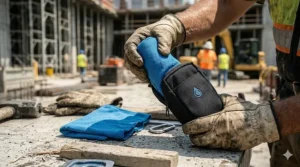
So what exactly is a cooling towel for construction workers? Simply put, it’s a purpose-built towel — usually made from PVA (polyvinyl alcohol) or high-performance microfiber — that activates when wet and uses evaporative cooling to pull heat away from your skin, keeping you noticeably cooler for hours at a time. Not AC-level cool. But enough to meaningfully reduce heat stress, improve focus, and keep you safer on the job.
In this guide, I’ve rounded up seven real, currently available products on Amazon — tested across materials, sizes, cooling duration, and job-site durability — so you can cut through the marketing noise and find the towel that actually works for your specific situation.
Quick Comparison Table: Top Cooling Towels for Construction Workers at a Glance
| Product | Material | Size | Cooling Duration | UPF Rating | Best For |
|---|---|---|---|---|---|
| Ergodyne Chill-Its 6602 | PVA | 13″ x 29.5″ | Up to 4 hours | UPF 50+ | Hard-hat wearers, all-day cooling |
| Ergodyne Chill-Its 6603 (2-Pack) | PVA | Neck band | Up to 4 hours | UPF 50+ | Targeted neck cooling under hard hat |
| FROGG TOGGS Chilly Pad | Hyper-evaporative | 33″ x 13″ | 3–4 hours | UPF 50+ | Budget-conscious outdoor crews |
| MISSION Original Cooling Towel | Microfiber | 12″ x 35″ | Up to 2 hours | UPF 50+ | Quick-refresh, machine washable |
| MISSION Max Plus Cooling Towel | Advanced microfiber | 12″ x 35″ | Up to 3 hours | UPF 50+ | Extended shift coverage |
| Tough Outdoors Cooling Towel | Microfiber | 38.5″ x 12″ | 1–2 hours | UPF 50 | Budget pick, multi-use |
| COLD FACTOR Cooling Neck Towel | PVA/Microfiber hybrid | 13″ x 29.5″ | Up to 3 hours | UPF 50+ | Versatile dual-tech cooling |
Table Analysis: The PVA-based options — the Ergodyne 6602, 6603, and COLD FACTOR — consistently outperform standard microfiber in raw cooling duration, which is critical for workers doing 8–10 hour shifts in direct sun. That said, the MISSION line wins on reactivation convenience (wet, wring, wave — done in under a minute) and machine-washability without stiffening issues. Budget buyers should note that the Tough Outdoors towel trades cooling duration for a lower price point, making it a solid bulk-purchase option for construction crews.
💬 Just one click — help others make better buying decisions too! 😊
Top 7 Cooling Towels for Construction Workers: Expert Analysis
1. Ergodyne Chill-Its 6602 Evaporative Cooling Towel
If you asked me to hand one product to every ironworker and roofer walking onto a job site in July, the Ergodyne Chill-Its 6602 would be it. This towel has been the gold standard in industrial cooling for years — and for good reason.
Key specs and what they actually mean: The 6602 is built from PVA (polyvinyl alcohol) material measuring 13″ x 29.5″. PVA isn’t your typical towel fabric — it’s a synthetic polymer that behaves almost like a sponge, absorbing dramatically more water per ounce than cotton or microfiber. When wet and placed against skin, it creates an evaporative cooling effect that feels noticeably colder than ambient temperature. Ergodyne claims up to four hours of cooling relief on a single soak, and in my experience, that’s not marketing fluff — in dry heat, you can realistically stretch it to that range before needing to re-wet.
Who is this for: Any construction worker on a long outdoor shift who needs reliable, lasting relief without fussing with re-wetting every 45 minutes. The 13″ x 29.5″ size wraps comfortably around the neck or drapes over the back of the head under a hard hat without adding bulk. UPF 50+ protection is a bonus if you’re also fighting direct sun exposure.
What customers say: Workers in foundry and roofing environments consistently rate this as the go-to for sustained heat relief, noting it stays effective even in high-humidity conditions where some other towels underperform.
✅ Lasts up to 4 hours on one soak
✅ Lightweight and bulk-free under PPE
✅ Reusable — just re-wet and go
❌ Dries stiff (re-wet to soften — annoying if you forget it in your bag)
❌ Smaller size than some competitors
Price range & value verdict: In the under-$15 range, this is arguably the best dollar-for-dollar value for serious job-site use. Check current pricing and availability on Amazon.
2. Ergodyne Chill-Its 6603 Evaporative Cooling Band (2-Pack)
Think of the 6603 as the 6602’s more sophisticated sibling — same PVA technology, different form factor, smarter for anyone wearing a hard hat all day.
Key specs and what they actually mean: Where the 6602 is a traditional towel you drape, the 6603 is a slim band with a unique pull-through design that locks it around your neck. That sounds like a small difference, but on a job site where you’re constantly bending, climbing, and moving, a towel that stays PUT matters enormously. It’s also PVA-based with UPF 50+ protection and the same up-to-four-hour cooling window. Coming in a 2-pack means you can keep one wet and active while the other dries — rotating them for all-day coverage.
Who is this for: This is the hard hat wearer’s best friend. The slim profile of the 6603 fits neatly under the brim of a hard hat without pushing it up or creating pressure points — something the bulkier towel-style options simply can’t match. The 2-pack makes it especially smart for crew supervisors buying for multiple workers, or for individuals working split shifts.
What customers say: Customers in mining, construction, and landscaping praise the secure fit, noting that unlike standard neck wraps, the pull-through design doesn’t slip during heavy activity.
✅ Stays in place during active movement
✅ 2-pack = constant rotation coverage
✅ Slim enough to wear under hard hat
❌ Less surface coverage than a full towel
❌ Can feel tight if neck measurement is on the larger side
Price range & value verdict: Typically in the $15–$22 range for the 2-pack — genuinely excellent value when you factor in the “always-one-ready” rotation system. Check current pricing on Amazon.
3. FROGG TOGGS Chilly Pad Cooling Towel
FROGG TOGGS has been in the personal cooling game since 1996 — they predate the current “cooling towel” craze by decades — and the Chilly Pad remains one of the most trusted outdoor-worker staples on the market.
Key specs and what they actually mean: Sized at 33″ x 13″, the Chilly Pad is noticeably larger than most competitors, which means better coverage across the back of the neck, shoulders, or head. It’s made from FROGG TOGGS’ proprietary hyper-evaporative material — not PVA, not microfiber, but their own formulation that the brand says can cool up to 30 degrees below ambient temperature when activated. Cooling duration runs 3–4 hours depending on environmental conditions (wind and low humidity dramatically extend it). It absorbs up to 8x its weight in water, is reusable, and packs into its own included carrying case — handy for tossing in a tool bag.
Who is this for: The Chilly Pad is ideal for budget-conscious crews or workers who need a larger coverage area. The 33-inch length gives you serious drape flexibility — over the neck, around a shoulder, or folded under a hard hat liner. It comes in multiple colors and is also available in a 2-pack for crew purchases.
What customers say: Buyers across construction, firefighting, and landscaping consistently mention the cooling effect is immediate and more intense than expected, though some note the material feels slightly plastic-y compared to microfiber alternatives.
✅ Larger than average (33″ x 13″)
✅ Comes with storage tube — toss it in any bag
✅ UPF 50+ sun protection
❌ Not machine washable in all configurations — check care instructions
❌ Material texture isn’t for everyone
Price range & value verdict: Usually in the $8–$15 range for a single towel, making it one of the most accessible hard hat cooling towel options for individual workers or first-time buyers. Check current pricing on Amazon.
4. MISSION Original Cooling Towel
MISSION has built a serious following among outdoor athletes — but their Original Cooling Towel deserves a lot more love from the construction and trades crowd than it typically gets.
Key specs and what they actually mean: At 12″ x 35″, the MISSION Original is longer than many competitors, wrapping comfortably around the neck with room to drape. The key differentiator here is the HydroActive Wet-to-Cool Technology: wet it, wring it, wave it for a few seconds — and the towel activates to cool up to 30 degrees below average body temperature in under one minute. Cooling duration is up to two hours, which is shorter than the PVA options above. But what MISSION trades in duration it wins back in convenience: this towel is machine washable, resists odors even after repeated use (anyone who’s grabbed a musty construction towel at end of shift knows why this matters), and reactivates almost instantly. UPF 50+ is woven into the fabric structure itself — it doesn’t wash out.
Who is this for: Workers on sites with access to running water for quick reactivation, or anyone who prefers softer, more fabric-like materials against skin after hours in the heat. The MISSION towel is also excellent for construction workers who’ll be mixing job-site use with after-shift gym sessions or outdoor activities.
What customers say: Users love the soft feel and the lack of that stiff “dried fish” texture that PVA towels are infamous for, though some note they wish the cooling lasted longer.
✅ Machine washable without stiffening
✅ Soft, comfortable fabric — no harsh texture
✅ UPF 50+ built into the weave (won’t wash out)
❌ Shorter cooling window (up to 2 hoursvs. 4 for PVA)
❌ Needs waving/snapping to activate — slightly more steps
Price range & value verdict: Typically in the $10–$18 range, it’s a reasonable investment for workers who prioritize comfort and ease of maintenance. Check current pricing on Amazon.
5. MISSION Max Plus Cooling Towel
If the Original Cooling Towel is MISSION’s everyday driver, the Max Plus is the heavy-duty truck — built for longer shifts, tougher heat, and workers who can’t afford to re-wet every two hours.
Key specs and what they actually mean: The Max Plus pushes MISSION’s cooling technology to up to three hours per activation — a meaningful jump over the Original’s two-hour window. It uses a thicker, more advanced microfiber construction that holds more water per square inch, which directly translates to longer-lasting evaporative cooling. The trade-off, as CNN Underscored’s testing noted, is that the denser material is slightly harder to fully saturate and wring — it takes a few more seconds to prep properly. Once it’s going, though, it delivers noticeably more sustained relief than the Original in side-by-side conditions.
Who is this for: Workers on 10-hour shifts in high-heat environments where stopping to re-wet a towel multiple times per day isn’t practical — think concrete finishers, structural steel workers, or anyone doing sustained physical work in direct sun during peak afternoon hours.
What customers say: Experienced buyers who’ve owned both MISSION models generally agree the Max Plus is worth the small price premium for long shifts, with several reviewers specifically calling out improved performance during afternoon heat spikes.
✅ Up to 3 hours cooling — 50% longer than the Original
✅ Machine washable, odor-resistant
✅ UPF 50+ protection
❌ Slightly thicker material is harder to fully wet and wring
❌ Costs more than the Original
Price range & value verdict: Usually $3–$6 more than the Original — a smart upgrade for anyone doing 8+ hour shifts. Check current pricing on Amazon.
6. Tough Outdoors Cooling Towel
Tough Outdoors was founded in California by someone who was tired of paying premium prices for basic outdoor gear — and that ethos comes through clearly in their cooling towel. It’s unpretentious, functional, and priced to make sense even if you’re outfitting an entire roofing crew.
Key specs and what they actually mean: At 38.5″ x 12″, the Tough Outdoors towel is one of the longer options in this roundup, giving it excellent coverage flexibility. It’s made from microfiber and activates with the standard wet-wring-wave method. Cooling duration is on the shorter end — roughly one to two hours per activation — but at its price point, that’s a trade-off most buyers understand going in. The material is soft and comfortable against skin, machine washable, and compact enough to fit in a work pants pocket when folded.
Who is this for: Budget-conscious workers, crews that need to outfit multiple people at once, or construction sites where towels tend to get lost, damaged, or left behind. Buying a four-pack of these costs roughly the same as one premium option — which makes a lot of sense if your job site has a high towel attrition rate (and most of them do).
What customers say: Buyers appreciate the value-to-quality ratio, particularly for casual outdoor use. Some experienced workers note the cooling isn’t as intense as PVA alternatives in peak heat.
✅ Long coverage (38.5″)
✅ Excellent value — low per-unit cost
✅ Soft, comfortable feel
❌ Shorter cooling duration than PVA competitors
❌ Less suitable
for extreme industrial heat environments
Price range & value verdict: Generally under $10 for a single towel, making it one of the most affordable job site cooling towel options available. Check current pricing on Amazon.
7. COLD FACTOR Cooling Neck Towel
COLD FACTOR takes an interesting approach that separates it from the pack: instead of picking one cooling technology and betting everything on it, they’ve built a multi-technology system — offering PVA, microfiber, and phase-change materials across their line — all in the same 13″ x 29.5″ format.
Key specs and what they actually mean: The COLD FACTOR towel’s PVA/microfiber hybrid construction absorbs up to 10 times its weight in water when fully saturated — a figure that meaningfully outpaces single-technology options. The phase-change variant in their lineup goes further: it uses materials that transition between solid and liquid states to absorb and release heat, acting more like a controlled temperature regulator than a simple evaporative system. Standard activation time is under a minute. UPF 50+ protection is included. At 13″ x 29.5″, it fits comfortably around the neck for hands-free use.
Who is this for: Workers who want versatility — either buying different variants for different conditions, or crews that want to test a technology before committing to a larger purchase. It’s also a smart choice for workers in high-humidity environments where pure evaporative cooling underperforms, since the phase-change option doesn’t rely on ambient dryness to work.
What customers say: Users specifically praise the absorption capacity and note the towel stays noticeably cooler longer than standard microfiber options, even in humid Southern U.S. conditions.
✅ High water absorption (up to 10x weight)
✅ Multiple technology options available
✅ Works better in humidity than pure evaporative designs
❌ Less brand recognition than Ergodyne or FROGG TOGGS
❌ Phase-change variant costs more than basic models
Price range & value verdict: Typically in the $10–$20 range depending on variant — competitive pricing for a more advanced technological package. Check current pricing on Amazon.
How to Get Maximum Cooling from Your Towel on the Job Site
You can spend $20 on a great cooling towel and still get mediocre results — if you’re using it wrong. These aren’t beach towels. There’s a technique, and the difference between doing it right and wrong is genuinely significant.
Step 1: Saturate Fully, Not Just Damp
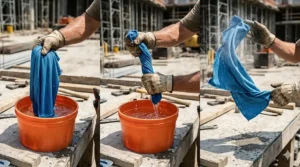
The most common mistake is under-wetting. A “quick rinse” won’t cut it. For PVA towels like the Ergodyne 6602, you need to soak for a full minute in any temperature water — warm or cold, doesn’t matter — until the towel becomes visibly pliable and heavy. For microfiber options like the MISSION line, a 20–30 second soak is usually sufficient. The goal is full saturation, not surface moisture.
Step 2: Wring, Don’t Drip
Wring out the excess water until the towel is damp but not dripping on your tools, materials, or safety gear. A dripping towel isn’t cooler than a well-wrung one — it’s just messier. For microfiber towels, follow the “wet, wring, wave” protocol: a few firm snaps in the air activate the evaporative cooling process faster.
Step 3: Placement Matters More Than You Think
This is where most workers leave cooling performance on the table. The most effective placement points are your neck (carotid arteries), wrists (radial pulse), and forehead/temples. These are areas where blood vessels run close to the surface — cooling them directly affects your perceived body temperature faster than cooling, say, your forearm. For hard hat wearers, the back of the neck is consistently the highest-value placement.
Step 4: Re-wet Before It Dries Completely
Don’t wait until the towel is bone dry to re-wet it. Re-wetting when still slightly damp cuts reactivation time dramatically — most towels cool back down within 30 seconds when re-wet before fully drying. Keep a water bottle on your belt or within easy reach so reactivation happens in seconds, not minutes.
Step 5: Store It Right
After your shift, rinse PVA towels with clean water, wring them out, and store dry (not sealed wet — that’s how you get mold and odor). Microfiber options can go straight in the laundry with mild detergent. Air dry both types when possible — the dryer degrades performance over time for most brands.
Which Cooling Towel Fits Your Work Situation? A Real-World Scenario Guide
Not every construction worker has the same needs. Here’s how I’d match the products above to three common real-world scenarios.
Scenario A: “The All-Day Outdoor Worker” — Roofer, Iron Worker, or Bridge Crew
You’re exposed to direct sun from dawn to dusk, wearing a hard hat, and sweating through your shirt by 9 a.m. You need maximum cooling duration and a fit that works under PPE.
Best pick: Ergodyne Chill-Its 6603 (2-pack). Rotate between two bands — one cooling while one dries. The pull-through design sits snug under your hard hat without interfering with your brim or liner. Four-hour PVA cooling per activation means you’re re-wetting twice per shift, not every hour. The Ergodyne 6602 is a strong secondary option if you prefer full towel coverage over the band format.
Scenario B: “The Rotating Shift Worker” — Crew Supervisor, Equipment Operator, or HVAC Installer
You move between outdoor heat and indoor work, and you’re not always in direct sun. You need a towel that activates fast, feels comfortable, and doesn’t smell after repeated use.
Best pick: MISSION Max Plus Cooling Towel. Machine washable, odor-resistant, three hours of coverage, and soft enough to wear continuously without skin irritation during those long cab-time stretches. The MISSION Original is a solid budget alternative if you’re refreshing it frequently anyway.
Scenario C: “The Whole Crew” — Foreman or Site Safety Manager Outfitting Multiple Workers
You need to equip 5–15 workers at once without blowing the safety budget, and you want something durable enough to survive job site conditions — getting dropped in concrete dust, tossed in a tool bag, and washed repeatedly.
Best pick: Tough Outdoors Cooling Towel in bulk, or FROGG TOGGS Chilly Pad 2-packs. Both offer excellent per-unit value. For higher-risk heat environments (foundry work, summer roofing in Florida or Texas), upgrade the high-exposure workers to the Ergodyne 6602 — the PVA performance difference justifies the extra few dollars for your most vulnerable crew members.
How to Choose a Cooling Towel for Construction Workers: 6 Criteria That Actually Matter
With so many options out there, the spec sheets start blurring together fast. Here’s how to cut through it.
1. Material Technology: PVA vs. Microfiber
This is the most important decision you’ll make. PVA towels (Ergodyne 6602, 6603, COLD FACTOR) hold significantly more water per square inch and deliver longer cooling — typically 3–4 hours. Their weakness is texture: they dry rock-solid and feel plasticky to some people. Microfiber towels (MISSION, Tough Outdoors) are softer, machine washable without stiffening issues, and easier to reactivate — but cooling windows are shorter, typically 1–3 hours. For outdoor job site use in extreme heat, PVA generally wins on performance. For multi-use workers who value comfort and convenience, quality microfiber is the smarter call.
2. Size and Coverage
Bigger isn’t automatically better. A 33-inch towel (FROGG TOGGS) gives you flexibility to wrap it multiple ways, but it can also be awkward under a hard hat or bump into safety equipment. A 13-inch x 29.5-inch towel (Ergodyne, COLD FACTOR) is sized specifically for neck placement — which is where you want it for maximum effect. Think about how you’ll actually wear it before optimizing for size.
3. Cooling Duration Per Activation
Do the math on your shift. A two-hour cooling window means 4–5 re-wettings per 8-hour shift. A four-hour window cuts that to 2–3. If you’re constantly moving and don’t have easy water access, longer duration matters a lot. If you’re near a water station or cooler, shorter duration with faster reactivation is less of an issue.
4. UPF Protection
Every towel on this list offers UPF 50+, but there’s an important distinction: some towels achieve UPF through chemical treatment (which washes out), while others weave it into the fabric structure. The MISSION line specifically builds UPF into the fabric construction itself — meaning it doesn’t diminish with washing. For construction workers getting constant sun exposure, this matters for long-term skin protection.
5. Hard Hat Compatibility
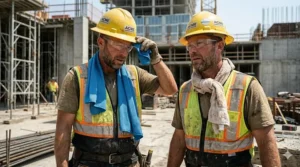
Not every cooling towel works well under a hard hat. Bulkier options can lift your hard hat, create pressure points, or interfere with suspension systems. The Ergodyne 6603 is specifically designed for this use case — slim, secure, and tested for industrial worker applications. If you’re in hard hat territory all day, verify the fit before committing.
6. Durability and Washability
Job sites are brutal on gear. Whatever you buy needs to survive concrete dust, tool bag abuse, washing with harsh detergents, and the occasional accidental bleach splash. The MISSION line and FROGG TOGGS are among the most wash-durable in this category. PVA towels like the Ergodyne models are also highly durable but require a specific care routine (air dry, not machine dry) to maintain performance.
Common Mistakes When Buying a Cooling Towel for Construction Work
Mistake #1: Buying Based on Price Alone
I get it — when you’re outfitting a crew, cheap sounds appealing. But a $3 bargain towel that barely cools and disintegrates after two washes isn’t actually cheap — it’s a recurring cost. The sweet spot for most construction workers is the $10–$20 range, where quality and durability converge with reasonable price.
Mistake #2: Ignoring the Material Type for Your Environment
Humidity is the enemy of evaporative cooling. In high-humidity environments — think Florida summer, Gulf Coast construction, or indoor industrial settings without AC — pure evaporative towels (which rely on dry air to pull moisture away) underperform significantly. If you’re working in humid conditions, the COLD FACTOR phase-change variant or a towel used in combination with a cooling vest will serve you far better.
Mistake #3: Expecting a Cooling Towel to Replace Hydration
This one’s important enough that I’d be doing you a disservice by skipping it. A cooling towel is a tool for managing heat stress — it is not a substitute for water intake. OSHA recommends workers drink approximately one cup (8 oz) of water every 15–20 minutes in hot conditions. A cooling towel helps reduce perceived heat and slow the rate of core temperature rise. It doesn’t address dehydration. Use both.
Mistake #4: Not Testing the Fit Under Your PPE
A cooling towel that’s perfectly comfortable on a weekend camping trip may be completely impractical under a hard hat with a four-point suspension system, hearing protection, and a face shield. Before buying in bulk for a crew, test one unit under your actual PPE setup during a real shift.
Mistake #5: Storing a Wet PVA Towel in a Sealed Bag
Leaving a PVA towel sealed wet in a tool bag or lunchbox will result in mildew smell that’s basically impossible to fully eliminate. If it’s a FROGG TOGGS or Ergodyne PVA product, let it dry before storage. The MISSION microfiber line is more forgiving here — it tolerates damp storage better — but air drying is still the best practice for any cooling towel.
Cooling Towel vs. Other Job Site Cooling Methods: What the Data Actually Shows
Let’s be honest about what a cooling towel can and can’t do — because there’s a lot of breathless marketing that oversells these products.
| Cooling Method | Cost | Effectiveness | Portability | Duration | Notes |
|---|---|---|---|---|---|
| Cooling towel | $ | Moderate | Excellent | 1–4 hours | Best for targeted relief |
| Cooling vest (phase change) | $$$ | High | Good | 2–4 hours | Heavy; best for stationary work |
| Neck fan | $$ | Moderate | Good | Battery-dependent | Noise concerns on some sites |
| Water misting | $ | High (short bursts) | Limited | Minutes | Impractical in dusty environments |
| Shade + rest breaks | Free | High | Fixed | Ongoing | OSHA’s primary recommendation |
Table Analysis: Cooling towels sit in a uniquely practical niche: they’re inexpensive enough to be accessible to individual workers, portable enough to carry in a pocket, and effective enough to meaningfully reduce heat stress when used correctly. They’re not as powerful as a full-body cooling vest — but cooling vests cost $50–$300, require ice pack refills, and add significant weight. For most construction workers doing physical labor, a cooling towel paired with adequate hydration and periodic shade breaks is the most realistic and effective combination. The National Institute for Occupational Safety and Health (NIOSH) recommends layered heat management strategies, and a cooling towel is one of the easiest layers to add.
Heat Illness Prevention & OSHA Safety Compliance: What Every Construction Worker Should Know in 2026
This section matters more in 2026 than it did even two years ago. OSHA’s push for a formal national heat standard is ongoing — the agency held public hearings on the proposed Heat Injury and Illness Prevention rule through July 2025, and the post-hearing comment period closed in late 2025. In April 2026, the Department of Labor revised its National Emphasis Program on heat-related hazards, using BLS data from 2022–2025 to direct inspections to 55 high-risk industries — including construction.
What does that mean practically? OSHA is actively inspecting construction sites for heat hazard compliance. Even without a finalized standard, violations of the General Duty Clause (which requires employers to provide a workplace free from recognized hazards) are being issued for inadequate heat protections.
What smart employers and workers are doing now:
- Providing workers with personal cooling equipment (including cooling towels) as part of a written heat illness prevention plan
- Scheduling high-exertion tasks for early morning or late afternoon when possible
- Creating acclimatization protocols for new workers or those returning from time off
- Maintaining readily accessible cool water and shade
- Training workers to recognize symptoms of heat exhaustion and heat stroke
A cooling towel fits squarely into this framework as a personal protective measure — and having one on your person is a practical step any worker can take independently of what their employer does or doesn’t provide.
✨ Don’t Miss These Exclusive Deals!
🔍 Take your job site heat protection to the next level with these carefully selected cooling towels. Click any highlighted product name to check current pricing and availability — your crew’s safety is worth the 30 seconds.
Frequently Asked Questions About Cooling Towels for Construction Workers
❓ Are cooling towels effective in high humidity environments like Florida or Texas construction sites?
❓ Can I wear a cooling towel under my hard hat all shift?
❓ How often do I need to replace a cooling towel for construction work?
❓ Does a cooling towel actually lower your core body temperature?
❓ Are cooling towels OSHA compliant for construction heat illness prevention plans?
Conclusion: The Right Cooling Towel Is the One That Actually Gets Used
Here’s the truth about cooling towels: the “best” one is the one that fits your job, your PPE, and your routine so well that you actually reach for it every single day. The fanciest phase-change technology in the world doesn’t help if the towel’s sitting at the bottom of your tool bag because it’s awkward to use.
For most construction workers, the Ergodyne Chill-Its 6602 or 6603 represent the smartest investment — purpose-built for industrial environments, tested by actual workers, and proven in conditions that would destroy lesser options. If comfort and washability matter more than raw cooling duration, the MISSION Max Plus is the upgrade I’d recommend without hesitation. On a tight budget or outfitting a crew? FROGG TOGGS Chilly Pad and Tough Outdoors deliver respectable performance at genuinely accessible price points.
Start with one good towel. Use it. Notice how different your afternoon feels when you’re not cooking in your own sweat. Then tell your crew.
Heat illness kills people. It’s a slow, quiet risk that’s easy to dismiss until it isn’t. A cooling towel for construction workers is a $10–$20 investment that takes about 60 seconds to activate. In the scheme of things — in the scheme of a construction career measured in decades — that’s about as smart a safety investment as you can make.
✨ Don’t Miss These Exclusive Deals!
🔍 Browse the full selection and check current pricing and availability on Amazon — protect yourself and your crew before the next heat wave hits.
Recommended for You
- Best Extra Large Cooling Towel: 7 Top Picks for 2026
- Best Cooling Towel for Running in 2026: 7 That Actually Work
- 7 Best Cooling Towel for Gym in 2026 — Beat the Heat Fast!
Disclaimer: This article contains affiliate links. As an Amazon Associate, I earn from qualifying purchases. If you purchase products through these links, we may earn a small commission at no additional cost to you.
✨ Found this helpful? Share it with your friends! 💬🤗
