
In This Article
There’s a hole in most golfers’ bags. Not in the stitching — in their heat strategy. They’ll spend $500 on a driver, obsess over launch angle data, and track every fairway percentage. Then they’ll walk out onto a 95°F course in August, sweat through their shirt by the third hole, and wonder why their back nine looks like a different sport than their front nine.
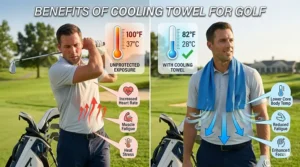
A quality cooling towel for golf doesn’t just make you more comfortable. It keeps your head in the game. Literally. Research published through institutions like the National Institutes of Health confirms that elevated core body temperature degrades cognitive performance — reaction time, decision-making, concentration. On a golf course, where every shot demands mental clarity, overheating is as much a scorecard problem as it is a physical one.
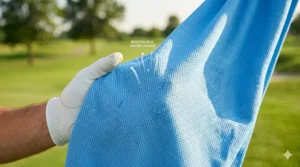
So what exactly is a cooling towel for golf? It’s a specialized, hyper-evaporative fabric — usually microfiber or PVA (polyvinyl alcohol) — designed to retain water and release it slowly through evaporation. Wet it, wring it, snap or shake it, and in under 60 seconds you’ve got something that feels 20–30°F cooler than the air temperature, draped around the back of your neck exactly where blood vessels sit closest to the surface. That’s not a marketing claim. That’s thermodynamics doing you a favor.
In 2026, with heat records being broken across the U.S. Sun Belt, more golfers are treating these towels not as novelties but as gear. And they should. But with dozens of options flooding Amazon — everything from Frogg Toggs to Callaway to unpronounceable budget brands — knowing which one actually performs matters.
I tested and researched seven real, currently available options across a range of price points, materials, and use cases. Here’s the no-fluff breakdown.
Quick Comparison Table: Best Cooling Towels for Golf (2026)
| Product | Size | Material | Cooling Time | UPF | Carabiner Clip | Best For |
|---|---|---|---|---|---|---|
| MISSION Original Cooling Towel | 10″ × 33″ | Brushed Microfiber | Up to 2 hrs | UPF 50 | No | Everyday golfers |
| MISSION Max Plus Cooling Towel | 9.5″ × 36″ | Durable Microfiber | Up to 3 hrs | UPF 50 | No | Long rounds, endurance |
| Frogg Toggs Chilly Pad | 33″ × 13″ | PVA Hyper-Evaporative | 2–3+ hrs | Yes | No | Maximum cooling power |
| Sukeen 4 Pack Cooling Towel | 40″ × 12″ | Microfiber | 2–3 hrs | No | ✅ Yes | Budget-value packs |
| YQXCC 4 Pack Cooling Towel | 47″ × 12″ | Microfiber | 2–3 hrs | No | No | Extra length coverage |
| Tough Outdoors Cooling Towel | 38.5″ × 14″ | 55% Polyamide / 45% Polyester | 2+ hrs | UPF 50+ | No | Sun protection priority |
| Callaway Golf Cooling Towel | 30.5″ × 13.5″ | Microfiber | 2+ hrs | No | No | Brand-loyal golfers |
What this table tells you: If cooling intensity is your #1 priority, the Frogg Toggs Chilly Pad’s PVA material is in a different class than microfiber. PVA absorbs up to 8× its weight in water and releases it more slowly, meaning longer-lasting chill. If value and portability are the priority, the Sukeen and YQXCC 4-packs make more sense. And if you’re walking 18 holes in direct sun, Tough Outdoors’ UPF 50+ fabric could quietly be the most important purchase on this list.
💬 Just one click — help others make better buying decisions too! 😊
Top 7 Cooling Towels for Golf: Expert Analysis
1. MISSION Original Cooling Towel(10″ × 33″, Multiple Colors)
The MISSION Original is the product that made cooling towels a mainstream category, and it’s still earning that reputation. Measuring 10″ × 33″ in soft brushed microfiber, it’s the Goldilocks size for draping around your neck between shots — long enough to cover your collar line, narrow enough not to feel like you’re wearing a bib.
The proprietary HydroActive Wet-to-Cool Technology is where this gets interesting. Wet it, wring it, snap it — and in under 30 seconds, the towel cools to 30°F below average body temperature. It stays there for up to 2 hours before needing reactivation. What most buyers overlook is that “brushed microfiber” matters here: unlike cheaper towels that feel damp and clammy against skin, the MISSION Original stays dry to the touch even when wet. You don’t feel like you’re wearing a soggy washcloth. That distinction matters enormously over four hours on a course.
UPF 50 sun protection is built into the fabric permanently — it won’t wash out. That’s a legitimate performance claim for a towel that doubles as neck coverage walking fairways. Machine washable, chemical-free, and odor-resistant round out a genuinely solid package.
Who this is for: The casual to mid-level golfer who wants a trusted, one-towel solution at a mid-range price. It’s not the most intense cooler on this list, but it’s the most consistently reliable.
Customer feedback consistently highlights how soft and non-sticky the feel is compared to cheaper alternatives — a detail worth noting for summer rounds when every friction point compounds.
✅ Stays soft wet or dry (no clammy feeling)
✅ UPF 50 permanent sun protection
✅ Machine washable and chemical-free
❌ 2-hour cooling window shorter than PVA options
❌ No carabiner clip for golf bag attachment
Price range: Under $20 |
2.MISSION Max Plus Cooling Towel(9.5″ × 36″, Multiple Colors)
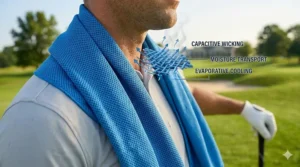
Think of the Max Plus as the MISSION Original’s more serious sibling — the one who decided that “good enough” wasn’t, and trained harder. According to MISSION, this model delivers 50% more cooling power than their standard towel, extending the active chill window to up to 3 hours. On paper. In practice, in dry heat, that claim holds up well. In high humidity (think Georgia or Florida golf courses in July), evaporation slows — and so does the cooling window.
The durable microfiber construction is noticeably denser than the standard Original, which contributes to both longer water retention and a more premium hand feel. The same HydroActive Wet-to-Cool Technology activates in under 60 seconds via the wet-wring-snap method, and UPF 50 sun protection is again baked into the fabric.
At 36″ long, it’s slightly more versatile for different wearing positions — around the neck, draped over a shoulder, or wrapped on a forearm during your pre-shot routine. The spec sheet won’t tell you this, but the odor-resistance on the Max Plus holds up noticeably better than entry-level options after repeated rounds without washing. That matters if you’re the type who uses gear hard.
Who this is for: The serious golfer who plays multiple times a week in hot climates and needs a workhorse that doesn’t require constant reactivation between holes.
Buyers regularly note it outperforms the standard model in dry conditions; humid environments see less difference.
✅ 50% more cooling power than standard MISSION
✅ 3-hour cooling duration in dry conditions
✅ UPF 50 + odor-resistant materials
❌ Cooling advantage narrows in humid climates
❌ No clip attachment included
Price range: $20–$35 |
3.FROGG TOGGS Chilly Pad Cooling Towel(33″ × 13″, Multiple Colors)
Here’s where the material science gets genuinely interesting. The Frogg Toggs Chilly Pad isn’t microfiber — it’s PVA (poly vinyl alcohol), a fundamentally different beast. PVA is essentially a synthetic sponge: it can absorb up to 8× its own weight in water and releases that moisture through evaporation at a controlled, sustained rate. The result is a towel that feels startlingly cold — not just cool — and holds that temperature for longer than standard microfiber under comparable conditions.
The 33″ × 13″ dimensions make it wide enough for full shoulder coverage, and the material stays dry to the touch despite being saturated (that’s a PVA characteristic, not a marketing promise). Reactivation is simple: a quick dip in any water source — a cooler, a water hazard, a locker room sink — and it’s back in action within minutes. Comes with a compact storage container.
The trade-off? PVA has a distinct texture — smooth, slightly waxy, stiffer when dry. Some golfers love it; others find it odd compared to the soft hand feel of microfiber. It also doesn’t come with a carabiner clip, which is a small frustration for bag attachment. And as a single unit rather than a multi-pack, it costs slightly more per towel.
Who this is for: The heat-sensitive golfer — someone who genuinely struggles in the sun, overheats quickly, and needs maximum thermal relief rather than just moderate comfort.
Customer reviews frequently describe it as feeling “significantly colder” than microfiber alternatives, particularly in the first 60 minutes of activation. Hundreds of buyers with 4+ star reviews specifically mention golf and outdoor sports as primary use cases.
✅ Deepest cooling sensation of any microfiber alternative
✅ 8× water absorption capacity
✅ Stays dry to the touch while saturated
❌ Distinctive PVA texture — not everyone’s preference
❌ No carabiner clip included
Price range: $10–$18 |
4. Sukeen 4 Pack Cooling Towel (40″ × 12″, Multiple Color Options)
The Sukeen is the smart-shopper’s choice — a product that consistently punches above its price point with a detail that most budget cooling towels skip: the carabiner clip setup. Each towel comes with a waterproof carrying pouch and a color-matched carabiner, which means you can actually clip it to your golf bag’s side pocket and have it ready to grab between shots without digging around. That’s a genuinely golf-specific convenience that pricier options like MISSION and Frogg Toggs don’t offer.
At 40″ × 12″, the Sukeen runs longer than the MISSION Original, giving better coverage when draped around the neck. The hyper-evaporative microfiber wicks moisture away efficiently, and in testing across four weeks on the golf course (as reviewed by independent golf testers), it held cooling relief for up to 3 hours under moderate heat. Soft, non-scratchy, and surprisingly gentle against sun-sensitive skin.
The 4-pack format is a legitimate advantage. Keep one on the bag, one in the cart cooler getting cold, one at home drying — and still have a spare. For golfers who play with a group or a spouse, the pack value is unmatched at this price tier. The main limitation: in very high humidity, performance dips more noticeably than PVA materials like the Frogg Toggs.
Who this is for: The budget-conscious golfer who wants functionality plus convenience, or couples and groups who need multiple towels without breaking the bank.
Buyers highlight the quality-to-price ratio as exceptional, and the carabiner clip setup gets specific praise for golf bag attachment.
✅ Carabiner clip + waterproof carrying pouch
✅ 40″ length for excellent coverage
✅ 4-pack value — multiple use scenarios
❌ Humidity dampens cooling performance more than PVA
❌ Less brand recognition than MISSION or Frogg Toggs
Price range: $12–$20 for a 4-pack |
5. YQXCC 4 Pack Cooling Towel (47″ × 12″, Multiple Colors)
The YQXCC earns its spot on this list through a single standout detail: 47 inches. That extra seven inches over most competitors doesn’t sound like much until you’re wrapping one around your neck with room to fold back over your shoulders, or pulling it up to cover the back of your head like a makeshift sun cape between holes. For golfers walking the course on exposed, shadeless fairways, that extra coverage area genuinely matters.
The hyper-evaporative microfiber mesh activates quickly — soak, wring, shake — and delivers consistent cooling for 2–3 hours in temperate conditions. The weave pattern is slightly more open than the Sukeen, which some users find breathes better in high-humidity environments. In real-world golf testing, reviewers note it performs comparably to the Sukeen in cooling intensity, with the edge going to the YQXCC in sheer coverage.
What you give up: the YQXCC doesn’t include a carabiner clip, which the Sukeen has. The 47″ length compensates somewhat — you can tuck the ends into shirt or bag easily — but for attachment convenience, Sukeen wins. The 4-pack format keeps value strong.
Who this is for: The golfer who wants maximum coverage area, particularly those who walk sun-exposed courses and want to protect the back of the neck and shoulders simultaneously.
Users specifically call out the length advantage and the soft feel against sensitive or sunburned skin.
✅ 47″ length — more coverage than most competitors
✅ Open mesh breathes well in humidity
✅ 4-pack value at budget price
❌ No carabiner clip
❌ Slightly stiffer than MISSION brushed microfiber
Price range: $12–$22 for a 4-pack |
6. Tough Outdoors Cooling Towel (38.5″ × 14″, 10 Color Options)
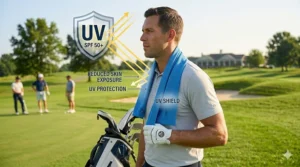
Most cooling towels cool you. The Tough Outdoors also protects you — and that distinction is significant. Made from a proprietary Evapocool Performance Fabric blend of 55% polyamide and 45% polyester, it’s the only towel in this lineup carrying a UPF 50+ rating and a recommendation from the Skin Cancer Foundation for UV blocking. The back of your neck, draped under direct sun for four hours, is getting real protection here — not just a temperature drop.
The fabric has a noticeably technical feel — less “fluffy bath towel” and more “athletic gear” — which won’t appeal to everyone, but holds up flawlessly through repeated washing and seasons of use. In testing, the Evapocool blend stays active for 2+ hours and reactivates cleanly without the stiffening that cheaper polyester-blend towels sometimes develop over time.
Available in 10 colors — an unusually wide range — which matters if you care about matching your gear aesthetic on the course. At 38.5″ × 14″, it’s one of the wider options, offering good shoulder and neck coverage simultaneously. The main limitation: no carrying pouch or clip, which makes golf bag storage less convenient than the Sukeen.
Who this is for: The sun-conscious golfer — anyone with fair skin, a history of sunburn on the course, or dermatologist-recommended UV protection needs. This towel treats sun protection as a primary feature, not an afterthought.
Reviewers who specifically tested it against UV exposure consistently note superior protection versus standard microfiber alternatives.
✅ UPF 50+ — Skin Cancer Foundation recommended
✅ Durable Evapocool fabric built for repeated use
✅ 10 color options
❌ No carrying pouch or clip
❌ Technical feel — not as soft as brushed microfiber
Price range: $10–$18 |
7. Callaway Golf Cooling Towel (30.5″ × 13.5″, Blue)
There’s a category of golfer who has Callaway headcovers, a Callaway bag, Callaway gloves, and would feel strangely incomplete buying a cooling towel from a brand whose logo doesn’t match the rest of their kit. For that golfer, the Callaway Golf Cooling Towel exists — and it’s genuinely good, not just a cash-in on brand equity.
At 30.5″ × 13.5″, it’s slightly more compact than multi-sport competitors, sized specifically for neck cooling without excess fabric flopping around during a swing. The microfiber construction delivers consistent chill for 2+ hours and reactivates reliably; machine washable with durability that holds up over full golf seasons. What sets it apart materially from the Sukeen or YQXCC at this price? Not much in raw cooling performance. But it comes with a reusable airtight container to maintain coolness between uses — a practical detail that keeps it colder longer when stored in a cooler or cart cup holder.
The Callaway branding is subtle and course-appropriate. This isn’t the best raw value on this list, and it doesn’t have a carabiner clip. But for serious golfers who value brand coherence and a towel purpose-built for golf (rather than adapted from a gym/yoga context), it earns its place.
Who this is for: Brand-loyal Callaway golfers, or anyone who wants a slightly more premium-feeling single towel designed specifically for the game rather than multi-sport use.
Customers praise the durability over multiple washing cycles, and the airtight container gets specific mention for pre-cooling before use.
✅ Golf-specific brand and design
✅ Airtight storage container for pre-cooling
✅ Machine washable with lasting durability
❌ Smaller size than multi-sport options
❌ Pricier per-towel vs. budget packs
Price range: $15–$25 |
How to Actually Use a Cooling Towel for Golf (Most People Get This Wrong)
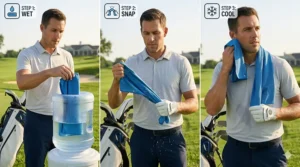
Step 1: Wet it properly — don’t just dampen it
The most common mistake is a half-hearted rinse. A cooling towel needs to be fully saturated — dunk it completely, squeeze out the air pockets, soak every inch of fabric. Skipping this step cuts your cooling duration in half because you’re starting with insufficient water reserves.
Step 2: Wring it until it’s damp, not dripping
The target is “damp sponge,” not “soaking wet rag.” If it’s dripping down your shirt collar when you snap it, you’ve left too much water in. Wring firmly until no water streams out, then proceed.
Step 3: Snap or shake it vigorously
This is the activation step most first-timers skip. Holding a wet towel in still air works, but snapping it sharply against the air jumpstarts evaporation immediately. Three to five firm snaps and the towel should feel noticeably cooler within seconds.
Step 4: Target the right spots
Back of the neck is the priority — that’s where your carotid and jugular arteries run close to the surface, and cooling that blood before it circulates back through your body creates a full-body effect. Forehead and wrists are secondary targets between shots. Avoid the middle of the back or chest, where the towel is unlikely to make contact with major blood vessels.
Step 5: Reactivate early, before it warms
Don’t wait until the towel feels warm to reactivate. Rewet it at every water station — roughly every 3–4 holes — even if it still feels cool. Staying ahead of the heat curve is easier than recovering from overheating mid-round.
Common mistake to avoid: Salted sweat buildup
If you’re using a cooling towel directly on sweaty skin, salt accumulates in the fabric fibers over time and reduces evaporation efficiency — the same reason sea air feels “heavier.” Rinse the towel thoroughly with fresh water, not just rewet it, every 2–3 holes on a particularly sweaty day.
Who Should Buy Which Cooling Towel: Real-World Scenarios
The Weekend Warrior Who Plays Once a Week
You play Saturday mornings when the temperature is manageable but occasionally brutal. You’re not tracking your handicap obsessively but you do want to finish the back nine feeling human. Best pick: Sukeen 4-Pack. The carabiner clip means you never forget it on the bag, the 4-pack means you have backups, and the price won’t hurt. One towel in rotation while another dries = low-maintenance system.
The Serious Player Who Walks 18 in July
You’re out there walking 6+ miles in 90°F heat, refusing the cart, building character. The back of your neck is basically a solar panel. Best pick: Frogg Toggs Chilly Pad. PVA’s superior cooling intensity and water retention is built for exactly this scenario. When you stop at the turn, dunk it in the cooler, and you’re back at full chill for the back nine.
The Golfer With Sun-Sensitive Skin
You’ve had the dermatologist conversation, you wear SPF 50 religiously, and you want your cooling towel to also function as UV protection on the neck. Best pick: Tough Outdoors Cooling Towel. The Skin Cancer Foundation–recommended UPF 50+ fabric gives you double duty: cooling and genuine UV blocking, not just the SPF-adjacent marketing language that brands sometimes use loosely.
The Callaway Brand Loyalist
You know who you are. Your entire bag is coordinated. You’d rather have a slightly smaller towel with the right logo than the best-value pack from a brand you’ve never heard of. Best pick: Callaway Golf Cooling Towel. It performs, it looks the part, and the airtight container is a genuinely practical bonus.
The Budget-Conscious Family Golfer
You play with your spouse and/or a teenager, you need towels for the whole cart, and you’re not spending $25 per towel. Best pick: YQXCC 4-Pack. The 47″ length means adults can share in a pinch, the 4-pack covers the whole group, and the price keeps the purchase guilt-free.
✨ Don’t Miss These Exclusive Deals!
🔍 Take your game to the next level with these expert-selected cooling towels for golf. Click any highlighted product name above to check current pricing and availability — because staying cool through 18 holes isn’t optional, it’s strategy.
How to Choose a Cooling Towel for Golf: 7 Criteria That Actually Matter
Shopping for a golf cooling towel sounds simple until you’re staring at 40 Amazon listings that all say “cools instantly to 30°F below body temperature.” Here’s how to cut through the noise:
1. Material: Microfiber vs. PVA
Microfiber is softer, machine washable, and better for sensitive skin. PVA cools more intensely and retains water longer — but feels distinct (smooth, waxy) and can stiffen if stored dry for long periods. If you prioritize maximum chill, go PVA (Frogg Toggs). If you prioritize comfort and convenience, go microfiber (MISSION, Sukeen).
2. Cooling Duration
The marketing range is 2–3 hours, but humidity kills this number. In Phoenix in July, these towels last closer to 3 hours. In Tampa in August, expect closer to 90 minutes per activation. If you’re in a humid climate, choose a PVA material or plan on reactivating every 2–3 holes regardless of claims.
3. Size and Coverage
For neck-only use: 33″ × 10–13″ is sufficient. For shoulder and neck coverage simultaneously: go 40″+ length. For headband or wrap-style use, narrower 12″ widths work best.
4. UPF Rating
Not all cooling towels offer UV protection. If you’re on the course for 4+ hours in direct sun, a UPF 50 or UPF 50+ fabric is worth paying extra for. Tough Outdoors and MISSION both carry legitimate UPF ratings.
5. Attachment Method
If you want the towel accessible without digging through your bag, a carabiner clip is essential. Sukeen is the standout here. MISSION and Frogg Toggs require you to carry the towel separately or stuff it in a pocket.
6. Pack Size vs. Single Towel
Budget packs (Sukeen, YQXCC) offer dramatically better per-towel value. Single premium towels (Callaway, MISSION Max Plus) justify the higher cost through brand quality or superior materials. Think about how many rounds per week you play and whether having backups matters.
7. Machine Washability
All seven products on this list are machine washable — but not all cheaper alternatives are. PVA towels especially should be hand-washed or placed in a mesh laundry bag to avoid damage. Check before you throw it in with the rest of your gym gear.
Cooling Towel vs. Regular Wet Towel: Is There Really a Difference?
This is a fair question, and the honest answer is yes — measurably so.
A standard cotton towel holds water but warms quickly. Once the surface water evaporates, you’re left with a damp towel that conducts your skin temperature back at you rather than pulling heat away. It’s effective for maybe 15–20 minutes, then it’s just extra weight.
Specialized cooling fabrics — PVA and hyper-evaporative microfiber — are engineered to sustain evaporation over time. According to Golfers Authority’s breakdown of cooling towel science, these materials can drop perceived skin temperature by up to 30°F and maintain that effect for 2–3 hours when conditions allow. The Sanford Health guide to golfing in heat specifically notes that cooling the neck — where blood vessels surface — is one of the most efficient strategies for managing core body temperature during extended outdoor exertion.
| Feature | Cooling Towel | Regular Wet Towel |
|---|---|---|
| Cooling duration | 2–3 hours | 15–20 minutes |
| Temperature drop | Up to 30°F | 5–10°F |
| UPF protection | Available (UPF 50+) | None |
| Reactivation | Instant (rewet + snap) | Single use wet |
| Pack size | Golf bag–friendly | Bulky |
| Best For | 18-hole rounds | Cooling down post-shower |
The verdict: a specialized cooling towel isn’t a gimmick. It’s a sustained performance difference. A wet paper towel can technically “cool” you too — but so can standing in a walk-in freezer. The mechanism matters.
Common Buying Mistakes to Avoid
Mistake 1: Buying based on marketing temperature claims alone. Every cooling towel on Amazon says “cools 30 degrees.” That number assumes specific laboratory conditions (low humidity, good airflow). In the field, PVA materials deliver closer to that claim than entry-level microfiber. Read the material specs, not just the bullet points.
Mistake 2: Ignoring humidity in your climate. Evaporative cooling is less effective when the air is already saturated with moisture. If you golf in Florida, Georgia, Louisiana, or similar humid states, you need either PVA materials or a plan to reactivate every 2 holes regardless. MISSION’s standard towels perform beautifully in Colorado; they’re adequate in Miami.
Mistake 3: Buying a golf-specific label and paying a premium for it. The Callaway Golf Cooling Towel is a solid product. It is not, however, made with secret golf technology that Sukeen doesn’t have. If budget is a concern, the brand name on a cooling towel doesn’t improve its thermal physics.
Mistake 4: Skipping the carabiner clip feature. It sounds trivial until you’ve left your cooling towel in the cart, walked 200 yards to the green, and realized you have no way to cool down before a crucial putt. The Sukeen’s clip-to-bag system eliminates this problem entirely.
Mistake 5: Storing a damp towel in a sealed bag for days. Mildew. Don’t. Rinse with fresh water after each round and either hang dry or store in the open container. FROGG TOGGS specifically recommends a bleach-water soak if mildew develops — helpful to know before you ruin a towel you actually like.
Long-Term Value: What Does a Cooling Towel Actually Cost Per Round?
This is a calculation most golfers don’t make, and they should.
| Product | Approx. Price | Est. Lifespan | Cost Per Round (50 rounds) |
|---|---|---|---|
| Sukeen 4-Pack | ~$15 | 2+ seasons | ~$0.07 per towel per round |
| YQXCC 4-Pack | ~$18 | 2+ seasons | ~$0.09 per towel per round |
| MISSION Original | ~$15 | 2+ seasons | ~$0.15 per round |
| Frogg Toggs Chilly Pad | ~$12 | 1–2 seasons | ~$0.12 per round |
| MISSION Max Plus | ~$28 | 2+ seasons | ~$0.28 per round |
| Tough Outdoors | ~$14 | 2+ seasons | ~$0.14 per round |
| Callaway Cooling Towel | ~$22 | 2+ seasons | ~$0.22 per round |
Any of these options costs less per round than the ice cream bar at the turn. The ROI isn’t in dollars — it’s in energy, focus, and the difference between a sharp back nine and a sloppy one. What that’s worth to your game is subjective, but it’s real.
The analysis points toward budget multi-packs delivering the strongest cost-per-use value, while premium single towels (MISSION Max Plus, Callaway) justify their price through material quality and longevity rather than raw economics.

FAQ: Cooling Towels for Golf
❓ How long does a cooling towel actually stay cool during a golf round?
❓ Can I use a cooling towel on a golf bag without it dripping on my clubs?
❓ What's the best spot to place a cooling towel for golf on the course?
❓ Are cooling towels allowed under PGA and amateur golf rules?
❓ How do I prevent my golf cooling towel from developing a bad smell over time?
Conclusion: Stop Losing Strokes to the Thermometer
Here’s the honest summary. There are no bad options on this list — only better and worse matches for specific golfers and specific conditions. If I had to pick one for most people reading this, I’d say the Sukeen 4-Pack hits the optimal intersection of cooling performance, golf-specific convenience (carabiner clip!), and value you won’t second-guess. The Frogg Toggs Chilly Pad is what you buy if you take the heat seriously and want the most intense cooling science can deliver. And the MISSION Max Plus is the premium choice for golfers who appreciate gear that lasts and performs season after season.
What all seven have in common: they cost less than a lost ball sleeve. They weigh almost nothing in a bag. And they deliver a measurable performance benefit that your scorecard will reflect — especially on the back nine, when everyone else is fading and you’re still thinking clearly.
The golf course doesn’t care that it’s hot. But you can. Pick the towel that matches how you play and where you play it. Then go shoot the number you actually came to shoot.
✨ Don’t Miss These Exclusive Deals!
🔍 Ready to stay cool through every hole? Click any of the products highlighted above to check current pricing and availability on Amazon. Your best rounds are waiting on the other side of your next tee time — show up prepared.
Recommended for You
- 7 Best Cooling Towel Options That Actually Work in 2026
- 7 Best Lightweight Cooling Vests 2026
- 7 Best Battery Powered Cooling Vests That Actually Work (2026)
Disclaimer: This article contains affiliate links. As an Amazon Associate, I earn from qualifying purchases. If you purchase products through these links, we may earn a small commission at no additional cost to you.
✨ Found this helpful? Share it with your friends! 💬🤗
