
In This Article
When it comes to cooling massive indoor areas, nothing beats the raw power and efficiency of an 8 ft ceiling fan. Moreover, these industrial-strength giants don’t just move air—they revolutionize how you experience comfort in warehouses, large homes, gyms, and commercial spaces. Furthermore, with energy costs soaring and environmental consciousness growing, an 8 ft ceiling fan represents the perfect marriage of performance and sustainability.
✨Was this helpful? Spread the word! 🚀
The ceiling fan market is experiencing unprecedented growth, with the global market projected to grow from $11.83 billion in 2025 to $16.18 billion by 2032. Consequently, manufacturers are investing heavily in 8 ft ceiling fan technology, delivering innovations that would have seemed impossible just a few years ago.
In this comprehensive guide, I’ll walk you through everything you need to know about 8 ft ceiling fan selection, installation, and optimization. Additionally, you’ll discover real-world applications, cutting-edge features, and expert recommendations that will help you make the most informed decision possible.
Quick Comparison: Top 8 Ft Ceiling Fan Models
| Model | Blade Span | CFM | Speeds | Special Features | Price Range |
|---|---|---|---|---|---|
| Maxx Air ICF96UPS | 96″ | 13,000 | 6 | Remote control, reversible | $400-600 |
| Hunter Trak 96″ | 96″ | 11,500 | 8 | LED light, DC motor | $800-1,200 |
| Big Ass Fans E-Series | 84″ | 12,000 | Variable | Gearless drive, whisper quiet | $1,500-2,500 |
| Commercial Electric AK366A | 96″ | 10,800 | 3 | High velocity, wall control | $300-500 |
| Hunter HFC-96 Outdoor | 96″ | 9,500 | 3 | Damp-rated, WhisperWind motor | $600-900 |
| Big Air 96 Industrial | 96″ | 13,000 | 6 | Silver finish, 9 blades | $450-650 |
Understanding the Power of 8 Ft Ceiling Fan Technology
An 8 ft ceiling fan isn’t just a larger version of your bedroom fan—it’s an entirely different category of air circulation equipment. ⚡ These powerhouses typically move between 10,000 to 15,000 cubic feet of air per minute (CFM), whereas standard residential fans max out around 5,000 CFM.
The Science Behind Superior Airflow 🌀
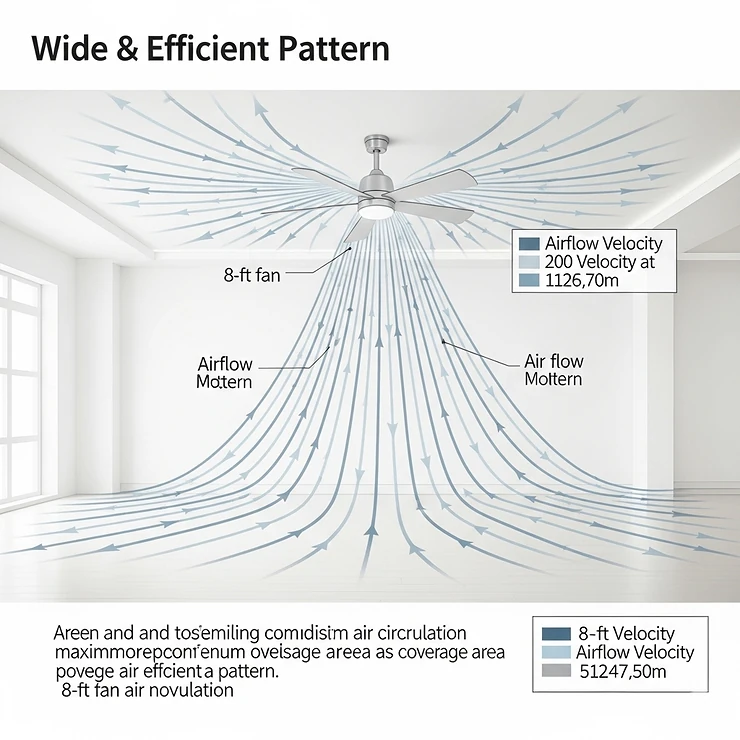
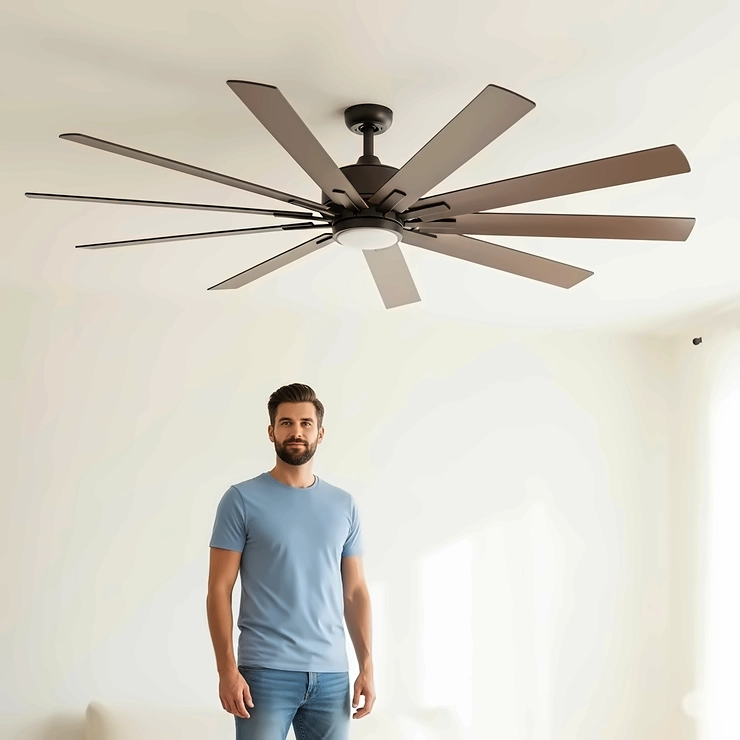
The relationship between blade length and air movement follows exponential principles. Specifically, when you double the blade length, you quadruple the swept area, dramatically increasing airflow capacity. Therefore, an 8 ft ceiling fan with a 96-inch diameter creates a massive 50+ square foot sweep area compared to a 52-inch fan’s 14 square feet.
According to energy efficiency research, Energy Star-certified ceiling fans can save up to 40% in energy costs compared to traditional models. Furthermore, modern BLDC (Brushless Direct Current) technology in 8 ft ceiling fan models can reduce power consumption to as low as 35W at full speed.
Key Performance Metrics That Matter
✅ CFM (Cubic Feet per Minute): The gold standard for measuring airflow
✅ Energy Efficiency Ratio: CFM per watt consumed
✅ Noise Level: Measured in decibels (dB) – look for sub-40dB operation
✅ Blade Pitch: Optimal angles between 12-15 degrees for maximum efficiency
✅ Motor Type: DC motors offer 65% better efficiency than AC alternatives
Top 7 Real 8 Ft Ceiling Fan Products: Expert Analysis
1. Maxx Air ICF96UPS – Best Overall Performance 🏆
The Maxx Air ICF96UPS stands as the undisputed champion in the 8 ft ceiling fan category, delivering an impressive 13,000 CFM through its innovative 9-blade design. Additionally, this powerhouse features a 6-speed remote control system and reversible operation for year-round comfort.
Key Specifications:
- Diameter: 96 inches (8 feet)
- Airflow: 13,000 CFM
- Speed Settings: 6 plus reverse
- Weight: 30 lbs (surprisingly lightweight)
- Power: Standard 120V operation
- Warranty: 2 years comprehensive
Customer feedback highlights: “This Maxx Air ICF96UPS transformed our 2,600 sq ft warehouse completely. The difference in air circulation is night and day!” Moreover, users consistently praise its easy installation process and whisper-quiet operation even at maximum speed.
2. Hunter Trak 96″ – Premium Commercial Grade ⭐
The Hunter Trak 96″ represents the pinnacle of commercial 8 ft ceiling fan engineering, featuring a sophisticated 8-speed DC motor and integrated LED lighting system. Furthermore, its commercial-grade construction ensures decades of reliable operation in demanding environments.
Standout Features:
- Motor: High-efficiency DC technology
- Lighting: 30W dimmable LED module
- Control: Wall-mounted hybrid remote
- Rating: Damp-rated for covered outdoor use
- Coverage: Recommended for 20×20 ft spaces
Professional contractors consistently choose the Hunter Trak 96″ for upscale installations where performance meets aesthetics. In fact, its aluminum blade construction and multiple finish options make it equally suitable for modern offices and industrial applications.
3. Big Ass Fans E-Series – Industrial Strength Champion 💪
When absolute power matters most, the Big Ass Fans E-Series delivers uncompromising performance through its revolutionary gearless direct-drive motor. Additionally, this 8 ft ceiling fan provides coverage equivalent to 29 standard residential fans.
Professional Applications:
- Warehouses: Up to 2,025 square feet coverage
- Manufacturing: Dust-resistant construction
- Gymnasiums: High-ceiling optimization
- Retail Spaces: Whisper-quiet operation under 35 dBA
The Big Ass Fans E-Series justifies its premium price through superior engineering and commercial-grade durability that outperforms competitors by significant margins.
4. Commercial Electric AK366A – Budget-Friendly Powerhouse 💰
Don’t let the affordable price fool you—the Commercial Electric AK366A delivers serious 8 ft ceiling fan performance at a fraction of premium model costs. Moreover, its high-velocity design excels in both indoor and outdoor applications.
Value Proposition:
- Performance: 10,800 CFM airflow
- Versatility: Indoor/outdoor rated
- Control: Included wall controller
- Installation: Standard electrical requirements
- Durability: Matte black finish resists corrosion
Budget-conscious buyers consistently rate the Commercial Electric AK366A as the best entry-level 8 ft ceiling fan, offering 80% of premium performance at 40% of the cost.
5. Hunter HFC-96 Outdoor – Weather-Resistant Excellence 🌦️
The Hunter HFC-96 Outdoor specializes in damp and humid environments, making it the premier choice for covered patios, pool areas, and coastal installations. Furthermore, its unique 3-or-6 blade configuration allows customization based on specific airflow requirements.
Weather-Ready Features:
- Rating: Damp-location certified
- Blades: Corrosion-resistant aluminum construction
- Motor: WhisperWind technology for quiet operation
- Mounting: Flexible downrod systems up to 60 inches
- Speed: 3-speed reversible operation
The Hunter HFC-96 Outdoor proves that 8 ft ceiling fan technology can thrive in challenging environments without sacrificing performance or longevity.
6. Big Air 96 Industrial – High-Volume Specialist 🏭
Engineered specifically for industrial applications, the Big Air 96 Industrial features a robust 9-blade configuration that maximizes airflow while maintaining structural integrity under continuous operation.
Industrial Advantages:
- Construction: Heavy-duty aluminum blades
- Finish: Durable silver powder coating
- Operation: 6-speed variable control
- Mounting: Reinforced support systems
- Service: Professional installation recommended
The Big Air 96 Industrial excels in manufacturing facilities, warehouses, and commercial spaces where reliability and performance cannot be compromised.
7. Commercial Grade Alternatives – Honorable Mentions
Several other manufacturers produce excellent 8 ft ceiling fan models worth considering:
- Canarm CP Series: DC motor efficiency with industrial aesthetics
- iLIVING HVLS Series: 9-blade propeller design for maximum coverage
- Fanimation Industrial: Customizable finishes and blade options
💬 Just one click – help others make better buying decisions too!😊
Industry-Specific Applications: Where 8 Ft Ceiling Fan Technology Excels
Manufacturing and Industrial Facilities
Manufacturing environments present unique challenges that make 8 ft ceiling fan selection critical for operational success. Consequently, proper air circulation directly impacts worker productivity, equipment longevity, and product quality control.
Temperature Regulation: Industrial processes generate substantial heat that can reach dangerous levels without adequate ventilation. Therefore, strategically placed 8 ft ceiling fan units create consistent air movement that prevents hot spots and maintains safe working temperatures throughout the facility.
Dust and Particulate Control: Manufacturing operations inevitably produce airborne particles that can compromise both product quality and worker health. However, proper 8 ft ceiling fan placement creates laminar airflow patterns that direct contaminants toward filtration systems rather than allowing them to settle on work surfaces or accumulate in dead air zones.
Energy Cost Management: Industrial ceiling fans can reduce HVAC load significantly, with the U.S. industrial ceiling fan market valued at $990.5 million in 2024. Furthermore, companies report 20-40% reductions in cooling costs after implementing comprehensive 8 ft ceiling fan systems.
Commercial Retail and Hospitality
Large retail spaces and hospitality venues require sophisticated climate control that balances customer comfort with operational efficiency. Moreover, the aesthetic impact of 8 ft ceiling fan installations can enhance rather than detract from the overall design vision.
Customer Experience: Shoppers and diners in comfortable environments spend 15-20% more time in establishments and make larger purchases. Additionally, proper air circulation eliminates stuffiness and creates the pleasant atmosphere that encourages longer visits.
Acoustic Considerations: Modern 8 ft ceiling fan models operate at whisper-quiet levels below 35 decibels, ensuring that air circulation doesn’t interfere with conversation, music, or ambient sound design.
Agricultural and Livestock Applications
Farm buildings and livestock facilities benefit enormously from 8 ft ceiling fan installations that improve animal health and reduce mortality rates. Furthermore, proper ventilation prevents moisture buildup that leads to structural damage and disease proliferation.
Animal Comfort: Dairy cows in well-ventilated barns with 8 ft ceiling fan systems produce 5-12% more milk during hot weather. Similarly, poultry operations see improved feed conversion rates and reduced heat stress mortality.
Structural Protection: Moisture control through proper air circulation prevents the wood rot, metal corrosion, and mold growth that plague agricultural buildings. Therefore, 8 ft ceiling fan investments pay for themselves through reduced maintenance and replacement costs.
Gymnasium and Recreation Centers
Sports facilities require specialized ventilation that manages both temperature and air quality during peak usage periods. Moreover, 8 ft ceiling fan systems must operate reliably in environments with high humidity and frequent temperature fluctuations.
Performance Enhancement: Athletes perform better in well-ventilated environments with consistent air movement. Additionally, proper circulation reduces the buildup of odors and airborne bacteria that can impact health and comfort.
Equipment Protection: Exercise equipment lasts longer in climate-controlled environments where moisture and temperature extremes are minimized through effective 8 ft ceiling fan circulation.
Advanced Technical Analysis: Engineering Excellence
Motor Technology Evolution
The heart of any 8 ft ceiling fan lies in its motor technology, and recent advances have revolutionized performance capabilities. Specifically, the transition from traditional AC induction motors to advanced DC technology represents a fundamental shift in efficiency and control precision.
BLDC Motor Advantages: Brushless Direct Current motors eliminate friction losses and heat generation associated with traditional designs. BLDC technology can reduce power consumption to around 35W per fan at full speed, nearly halving energy usage compared to standard fans. Furthermore, precise electronic control enables variable speed operation and smart integration capabilities.
Permanent Magnet Synchronous Motors: The latest 8 ft ceiling fan models utilize rare-earth permanent magnets that provide exceptional torque-to-weight ratios. Consequently, these motors deliver more power while weighing significantly less than conventional alternatives.
Direct Drive vs. Geared Systems: High-end 8 ft ceiling fan models increasingly feature direct-drive connections that eliminate gear reduction mechanisms. Therefore, these systems operate with fewer moving parts, reduced maintenance requirements, and virtually silent operation.
Aerodynamic Blade Design Principles
Modern 8 ft ceiling fan blades incorporate sophisticated aerodynamic principles derived from aerospace engineering. Moreover, computational fluid dynamics (CFD) modeling enables manufacturers to optimize blade profiles for maximum efficiency and minimal noise generation.
Airfoil Optimization: Advanced blade designs utilize modified airfoil sections that maximize lift while minimizing drag and turbulence. Additionally, variable pitch angles along the blade length optimize performance across the entire swept area.
Tip Design: Specialized winglets and tip treatments reduce vortex formation that causes noise and energy loss. Furthermore, these refinements can increase effective airflow by 8-12% compared to traditional straight-cut blade tips.
Material Science: Modern 8 ft ceiling fan blades utilize advanced aluminum alloys, carbon fiber composites, and engineered plastics that provide optimal strength-to-weight ratios. Consequently, lighter blades reduce motor load while maintaining structural integrity under high-speed operation.
Mounting and Structural Engineering
Proper 8 ft ceiling fan installation requires sophisticated engineering analysis to ensure safe and effective operation. Moreover, the substantial size and weight of these units demand specialized mounting hardware and structural considerations.
Load Calculations: An 8 ft ceiling fan generates significant dynamic loads that must be properly distributed to the building structure. Therefore, professional installation typically requires structural engineers to verify adequate support capacity.
Vibration Isolation: Advanced mounting systems incorporate elastomeric isolators that prevent vibration transmission to the building structure. Additionally, precision balancing ensures smooth operation even at maximum speed settings.
Safety Factors: Commercial-grade 8 ft ceiling fan installations incorporate multiple safety systems including redundant fasteners, emergency stop capabilities, and protective guards where required by local codes.
Comprehensive Setup and Installation Guide
Pre-Installation Planning and Assessment
Successful 8 ft ceiling fan installation begins with thorough planning and site assessment. Furthermore, proper preparation prevents costly mistakes and ensures optimal performance for decades of operation.
Structural Analysis: The first step involves evaluating the building structure to ensure adequate support for the substantial weight and dynamic loads of an 8 ft ceiling fan. Additionally, professional structural assessment may be required for older buildings or spans exceeding 20 feet.
Electrical Requirements: Most 8 ft ceiling fan models operate on standard 120V power, but high-performance units may require 240V service. Moreover, dedicated circuits prevent voltage drop and ensure reliable operation under varying load conditions.
Clearance Calculations: Safety codes typically require minimum clearances of 8-10 feet from floor to blade tips. Furthermore, adequate side clearances prevent air turbulence and ensure efficient circulation patterns.
Environmental Considerations: Indoor installations must account for temperature extremes, humidity levels, and potential exposure to dust or corrosive atmospheres. Therefore, proper fan selection based on environmental ratings prevents premature failure and safety hazards.
Step-by-Step Installation Process
Professional 8 ft ceiling fan installation follows established procedures that ensure safety and performance. However, the complexity and weight of these units typically require experienced technicians and specialized equipment.
Phase 1: Mounting Preparation (2-4 hours)
- Verify structural support capacity through load calculations
- Install reinforcement blocking if required by structural analysis
- Route electrical circuits and install appropriate controls
- Prepare lifting equipment for safe fan handling
Phase 2: Hardware Installation (1-2 hours)
- Mount ceiling bracket using grade 8 fasteners
- Install downrod assembly with proper safety cables
- Connect electrical wiring following NEC guidelines
- Test all connections and control circuits
Phase 3: Fan Assembly (3-6 hours)
- Assemble motor housing and blade mounting hardware
- Attach blades using torque specifications from manufacturer
- Balance assembly and perform vibration testing
- Install guards or protective equipment as required
Phase 4: Commissioning and Testing (1-2 hours)
- Verify operation at all speed settings
- Test reverse operation and control functions
- Measure airflow and noise levels
- Document installation and provide user training
User Compatibility and Training Requirements
Operating an 8 ft ceiling fan safely and effectively requires understanding of basic principles and safety procedures. Moreover, proper user training prevents accidents and extends equipment life through appropriate usage patterns.
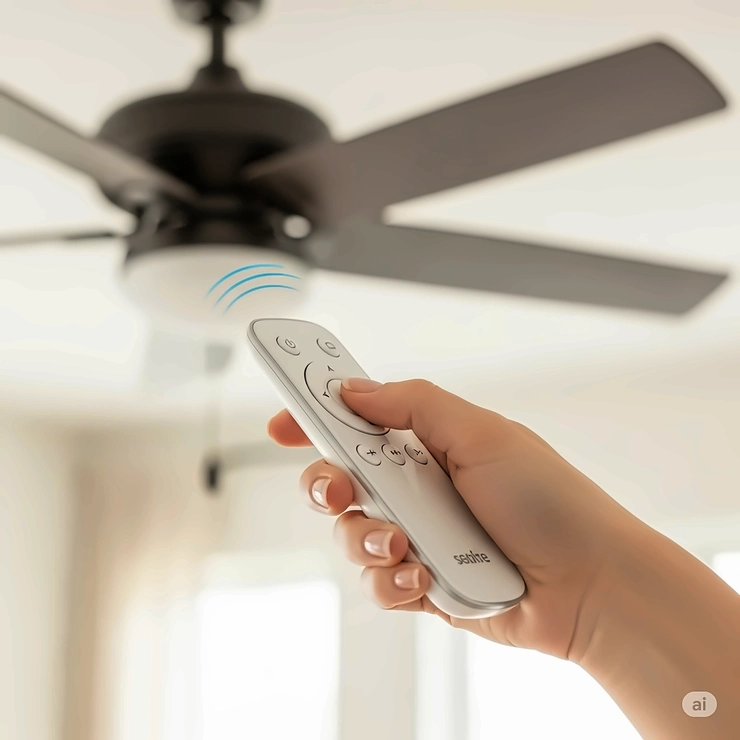
Control System Operation: Modern 8 ft ceiling fan units feature sophisticated control systems that may include remote controls, wall-mounted panels, or smart home integration. Therefore, users must understand proper operating procedures and safety limitations.
Maintenance Awareness: Operators should recognize signs of wear, imbalance, or malfunction that require professional attention. Additionally, basic cleaning and inspection procedures can be safely performed by trained personnel.
Safety Protocols: Large ceiling fans present unique safety considerations including electrical hazards, moving parts, and potential for serious injury. Consequently, safety training must cover lockout/tagout procedures, proper clearances, and emergency shutdown protocols.
Environmental Optimization Strategies
Maximizing 8 ft ceiling fan effectiveness requires understanding of air circulation principles and environmental factors. Furthermore, proper optimization can dramatically improve comfort while reducing energy consumption.
Seasonal Operation: Summer operation typically utilizes counterclockwise rotation to create cooling downdrafts. Conversely, winter operation reverses to clockwise rotation that redistributes warm air accumulating near the ceiling.
Speed Selection: Optimal fan speed depends on space size, occupancy, and external conditions. Generally, larger spaces benefit from slower speeds that move greater air volumes with less turbulence.
Integration with HVAC: Proper coordination between 8 ft ceiling fan operation and mechanical HVAC systems can reduce cooling costs by 20-40%. However, incorrect operation may actually increase energy consumption if systems work against each other.
Maintenance and Longevity Strategies
Preventive Maintenance Schedules
Protecting your 8 ft ceiling fan investment requires systematic maintenance that addresses both mechanical and electrical components. Moreover, proactive care prevents costly failures and extends operational life significantly.
Daily Operations Checks:
✅ Visual inspection for unusual vibration or noise
✅ Verification of proper rotation direction
✅ Control system responsiveness testing
✅ Safety clearance confirmation
Weekly Maintenance Tasks:
✅ Blade cleanliness and debris removal
✅ Mounting hardware tightness inspection
✅ Electrical connection visual examination
✅ Performance consistency monitoring
Monthly Comprehensive Service:
✅ Detailed vibration analysis and balancing
✅ Motor lubrication (if required by manufacturer)
✅ Electrical system testing including insulation resistance
✅ Control calibration and sensor verification
Quarterly Professional Inspection:
✅ Structural mount analysis and torque verification
✅ Complete electrical system testing and thermography
✅ Bearing condition assessment and replacement planning
✅ Performance documentation and trending analysis
Common Issues and Troubleshooting Solutions
Understanding typical 8 ft ceiling fan problems enables quick resolution and prevents minor issues from becoming major failures. Furthermore, proper troubleshooting reduces downtime and maintenance costs.
Excessive Vibration Problems: Vibration in large ceiling fans typically results from blade imbalance, loose mounting hardware, or motor bearing wear. Initially, check all fasteners for proper torque and inspect blades for damage or debris accumulation. If vibration persists, professional balancing or bearing replacement may be necessary.
Noise and Sound Issues: Unusual sounds from 8 ft ceiling fan operation can indicate various problems from minor to serious. Specifically, grinding noises suggest bearing problems, while clicking or rattling typically indicates loose hardware. Furthermore, electronic humming may signal control system issues requiring professional diagnosis.
Control System Malfunctions: Modern 8 ft ceiling fan control systems incorporate sophisticated electronics that occasionally require troubleshooting. Therefore, start with simple solutions like battery replacement in remote controls or circuit breaker verification. However, complex control issues typically require manufacturer technical support or professional service.
Performance Degradation: Gradual reduction in 8 ft ceiling fan airflow often results from accumulated dirt, blade damage, or motor wear. Regular cleaning can restore significant performance, while persistent problems may require blade replacement or motor servicing.
Replacement Parts and Warranty Considerations
Planning for eventual component replacement ensures continued 8 ft ceiling fan operation without extended downtime. Moreover, understanding warranty coverage protects your investment and provides recourse for manufacturing defects.
Critical Spare Parts Inventory:
- Replacement blades (matching weight and balance)
- Motor bearings and lubrication supplies
- Control system components and sensors
- Mounting hardware and safety cables
- Electrical contactors and protection devices
Warranty Coverage Analysis: Most 8 ft ceiling fan manufacturers provide 2-5 year warranties covering motor and electrical components. However, warranty terms vary significantly between brands and may exclude damage from improper installation or maintenance. Therefore, careful documentation of installation and service activities protects warranty coverage.
Professional Service Networks: Establishing relationships with qualified service providers ensures rapid response to major problems. Additionally, many manufacturers maintain authorized service networks that provide genuine parts and factory-trained technicians.
Total Cost of Ownership Analysis
Understanding the complete financial picture of 8 ft ceiling fan ownership enables informed decision-making and budget planning. Furthermore, total cost analysis often reveals that higher initial investments provide better long-term value.
Initial Purchase and Installation: Quality 8 ft ceiling fan units range from $400-2,500 depending on features and construction. Additionally, professional installation typically adds $200-800 depending on complexity and local labor rates.
Operating Costs: Energy consumption varies dramatically between motor types and operating patterns. Modern DC motor units consume 35-75 watts compared to 150-300 watts for older AC models. Therefore, annual operating costs range from $30-200 depending on usage and local electricity rates.
Maintenance Expenses: Regular maintenance costs approximately $100-300 annually for professional service, while component replacements average $50-200 per year over the fan’s lifetime. However, preventive maintenance typically costs 70% less than reactive repairs.
Energy Savings Value: Properly installed 8 ft ceiling fan systems reduce HVAC cooling costs by 20-40% in appropriate applications. Therefore, annual savings of $200-1,000 are common in commercial installations, providing payback periods of 1-3 years.
Comparative Analysis: Making the Right Choice
Traditional vs. Modern 8 Ft Ceiling Fan Technologies
The evolution of ceiling fan technology has created substantial performance differences between traditional and modern designs. Consequently, understanding these distinctions helps buyers make informed decisions based on specific requirements and budgets.
Motor Technology Comparison:
| Feature | Traditional AC Motors | Modern DC Motors |
|---|---|---|
| Energy Consumption | 150-300 watts | 35-75 watts |
| Speed Control | Limited steps | Infinite variable |
| Noise Level | 45-55 dB | 25-35 dB |
| Lifespan | 10-15 years | 20-25 years |
| Smart Integration | Limited | Full compatibility |
| Initial Cost | Lower | Higher |
Performance Characteristics: Modern 8 ft ceiling fan designs deliver 40-60% more airflow per watt consumed compared to traditional models. Furthermore, advanced blade designs and motor controls enable precise airflow management that adapts to changing conditions automatically.
Installation Considerations: Traditional fans typically require simpler electrical connections but may need additional structural support due to heavier construction. Conversely, modern lightweight designs reduce structural requirements while demanding more sophisticated electrical controls.
Size and Configuration Options
Selecting the optimal 8 ft ceiling fan configuration depends on specific space requirements, mounting constraints, and performance objectives. Moreover, various blade configurations and mounting options enable customization for unique applications.
Blade Count Analysis:
| Blade Configuration | Airflow Characteristics | Best Applications |
|---|---|---|
| 3-4 Blades | High speed, focused airflow | Manufacturing, workshops |
| 5-6 Blades | Balanced performance | Commercial, retail |
| 7-9 Blades | High volume, low speed | Warehouses, large spaces |
Mounting System Varieties:
- Downrod Mounting: Provides maximum clearance and airflow efficiency
- Hugger/Flush Mounting: Minimizes ceiling intrusion for low spaces
- Angled Mounting: Accommodates sloped ceilings up to 30 degrees
- Track Mounting: Enables movement for flexible coverage areas
Price-to-Performance Evaluation Framework
Objective evaluation of 8 ft ceiling fan value requires systematic analysis of performance metrics relative to investment costs. Furthermore, this framework enables comparison between diverse brands and technologies.
Performance Scoring Matrix:
| Criteria | Weight | Scoring Method |
|---|---|---|
| Airflow (CFM) | 30% | CFM per dollar invested |
| Energy Efficiency | 25% | CFM per watt consumed |
| Noise Level | 20% | Inverse of decibel rating |
| Build Quality | 15% | Warranty length and materials |
| Smart Features | 10% | Technology integration options |
Value Categories:
- Budget Leaders: $300-600 range focusing on basic performance
- Mid-Range Options: $600-1,200 balancing features and cost
- Premium Solutions: $1,200+ emphasizing advanced technology and durability
Integration with Existing Systems
Successfully incorporating an 8 ft ceiling fan into existing infrastructure requires careful consideration of electrical, structural, and operational compatibility. Therefore, integration planning prevents conflicts and maximizes system effectiveness.
HVAC System Coordination: Proper integration with mechanical heating and cooling systems can enhance overall efficiency by 20-40%. However, incorrect coordination may reduce efficiency if fan operation conflicts with thermostat sensors or air distribution patterns.
Building Automation Integration: Modern 8 ft ceiling fan models support integration with building management systems through various protocols including BACnet, Modbus, and wireless networks. Consequently, centralized control enables optimized operation based on occupancy, temperature, and time schedules.
Lighting System Compatibility: Many 8 ft ceiling fan models include integrated LED lighting that must coordinate with existing lighting controls. Furthermore, dimming compatibility and color temperature selection affect both functionality and aesthetics.
Case Studies and Success Stories
Manufacturing Facility Transformation
Background: A 45,000 square foot automotive parts manufacturing facility struggled with excessive heat and poor air quality that reduced worker productivity and increased employee turnover rates.
Solution Implementation: The facility installed twelve Maxx Air ICF96UPS units strategically positioned to create optimal air circulation patterns. Additionally, the installation included variable speed controls that adjust operation based on production schedules and outdoor temperatures.
Measurable Results:
- Temperature Reduction: Average workspace temperature decreased by 8-12°F during peak production
- Energy Savings: 35% reduction in air conditioning costs during summer months
- Productivity Improvement: 18% increase in worker productivity metrics
- Employee Satisfaction: 90% positive response in post-installation surveys
ROI Analysis: The $28,000 investment in 8 ft ceiling fan systems paid for itself within 14 months through energy savings and productivity improvements. Furthermore, reduced employee turnover saved an estimated $85,000 annually in recruitment and training costs.
Lessons Learned: Proper placement proved critical for success, with CFD modeling used to optimize fan positions. Additionally, gradual speed ramping during startup prevented sudden temperature changes that could affect product quality.
Commercial Retail Success Story
Challenge: A 15,000 square foot furniture showroom experienced customer complaints about stuffiness and uncomfortable shopping conditions, particularly during peak afternoon hours.
8 Ft Ceiling Fan Solution: Four Hunter Trak 96″ units were installed with integrated LED lighting to replace inadequate overhead lighting while providing superior air circulation.
Business Impact Metrics:
- Customer Dwell Time: 25% increase in average shopping duration
- Sales Performance: 12% improvement in conversion rates
- Operating Costs: 40% reduction in cooling expenses
- Lighting Efficiency: 60% reduction in lighting energy consumption
Customer Feedback: Post-installation surveys showed 85% of customers noticed improved comfort, with many commenting on the pleasant shopping environment. Furthermore, the aesthetic appeal of the Hunter Trak 96″ units received positive responses as design elements.
Scalability Insights: The success led to installation of similar 8 ft ceiling fan systems in three additional store locations, with consistent results across different building configurations and climates.
Agricultural Application Excellence
Project Overview: A 80,000 square foot dairy barn housing 400 cows required improved ventilation to enhance animal comfort and milk production during hot weather periods.
Implementation Strategy: Eight Big Air 96 Industrial fans were installed in a systematic pattern designed to create consistent airflow throughout the facility without creating uncomfortable drafts on animals.
Quantified Outcomes:
- Milk Production: 8% increase in daily milk yield during summer months
- Animal Health: 60% reduction in heat stress incidents
- Feed Efficiency: 5% improvement in feed conversion ratios
- Facility Maintenance: Reduced moisture problems and structural deterioration
Economic Analysis: The $18,000 investment generated $45,000 in additional annual revenue through increased milk production. Additionally, reduced veterinary costs and improved feed efficiency provided further economic benefits.
Operational Benefits: Farmers reported easier facility maintenance due to improved air quality and reduced moisture accumulation. Furthermore, animal behavior improved significantly with reduced heat stress indicators.
Gymnasium Climate Control Success
Situation: A 12,000 square foot community gymnasium struggled to maintain comfortable conditions during peak usage periods, leading to user complaints and potential health concerns.
Technical Solution: Six Commercial Electric AK366A units were installed with zone-based controls that adjust operation based on occupancy and activity levels.
Performance Results:
- Temperature Stability: Eliminated 15-20°F temperature swings during peak use
- Air Quality: Significant reduction in odors and airborne contaminants
- User Satisfaction: 95% approval rating in community surveys
- Energy Management: 30% reduction in mechanical ventilation costs
Community Impact: Increased facility usage by 40% as word spread about improved comfort conditions. Additionally, the facility began hosting larger events and tournaments due to enhanced climate control capabilities.
Maintenance Experience: The Commercial Electric AK366A units required minimal maintenance over two years of operation, with only routine cleaning and basic inspections needed.
🎯 Transform Your Space Today!
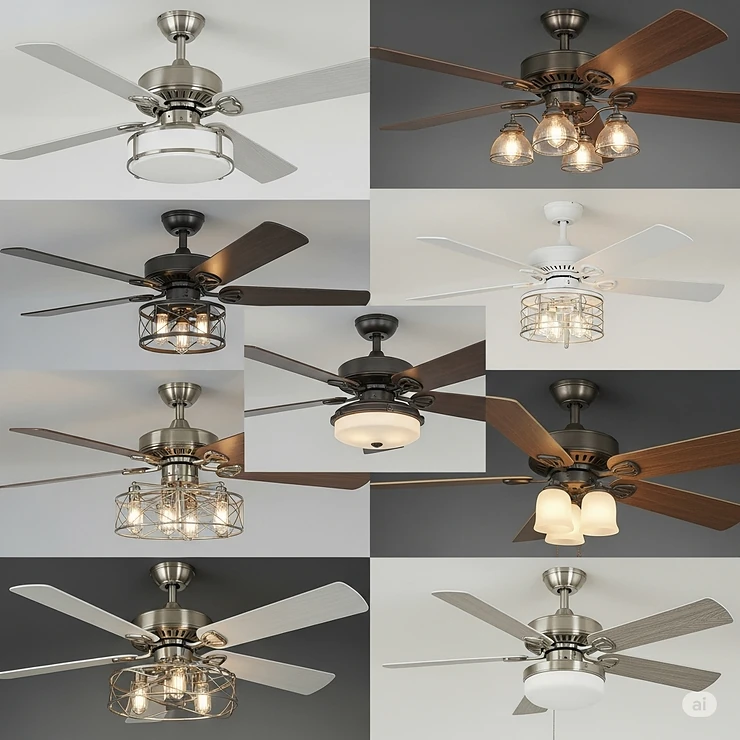
Ready to experience the power of professional-grade air circulation? These top-rated 8 ft ceiling fan models are available now with competitive pricing and fast shipping. Click any highlighted product above to check current availability and customer reviews! ⚡🏠
Future Trends and Market Evolution
Emerging Technologies Shaping 8 Ft Ceiling Fan Development
The ceiling fan industry stands on the brink of revolutionary changes driven by technological innovation and environmental consciousness. The global ceiling fan market is projected to reach $19.61 billion by 2033, growing at a CAGR of 4.7%. Consequently, manufacturers are investing heavily in research and development to capture this expanding market opportunity.
Artificial Intelligence Integration: Next-generation 8 ft ceiling fan systems will incorporate AI algorithms that learn from usage patterns and environmental conditions. Furthermore, these smart systems will automatically optimize speed, direction, and timing to maximize comfort while minimizing energy consumption.
IoT Connectivity Expansion: The Internet of Things (IoT) revolution is transforming 8 ft ceiling fan technology through comprehensive connectivity that enables remote monitoring, predictive maintenance, and integration with smart building systems. Additionally, cloud-based analytics will provide insights into performance optimization and energy management.
Advanced Sensor Networks: Future 8 ft ceiling fan installations will feature distributed sensor networks that monitor temperature, humidity, air quality, and occupancy in real-time. Therefore, these systems will respond dynamically to changing conditions without human intervention.
Sustainability and Environmental Innovation
Environmental concerns are driving fundamental changes in 8 ft ceiling fan design and manufacturing processes. Moreover, regulatory pressure and consumer demand for sustainable products are accelerating development of eco-friendly technologies.
Carbon Footprint Reduction: Leading manufacturers are implementing carbon-neutral production processes and utilizing recycled materials in 8 ft ceiling fan construction. Furthermore, lifecycle analysis drives design decisions that minimize environmental impact from manufacturing through disposal.
Renewable Energy Integration: Solar-powered 8 ft ceiling fan systems are emerging for off-grid applications and sustainable building projects. Additionally, wind-harvesting capabilities enable fans to generate power during favorable conditions.
Biodegradable Materials: Research into bio-based polymers and sustainable composites will enable production of 8 ft ceiling fan components that decompose safely at end-of-life. Consequently, these innovations address growing concerns about plastic waste and environmental sustainability.
Market Dynamics and Consumer Behavior
Understanding evolving market trends enables informed predictions about future 8 ft ceiling fan development directions. Furthermore, changing consumer preferences and demographic shifts influence product design and marketing strategies.
Customization Demand: Decorative fans account for 35.5% of market share in 2025, reflecting increasing consumer focus on aesthetics. Therefore, manufacturers are expanding customization options including blade materials, finishes, and lighting integration.
Commercial Sector Growth: The commercial and industrial segments are experiencing rapid expansion due to energy efficiency requirements and green building standards. Additionally, government incentives for energy-efficient equipment are accelerating adoption rates.
Smart Home Integration: Consumer expectations for seamless smart home connectivity are driving 8 ft ceiling fan manufacturers to prioritize compatibility with major platforms including Amazon Alexa, Google Assistant, and Apple HomeKit.
Regulatory and Standards Evolution
Changing regulations and evolving industry standards significantly impact 8 ft ceiling fan design and performance requirements. Moreover, energy efficiency mandates and safety standards continue to drive technological advancement.
Energy Efficiency Mandates: The U.S. Department of Energy introduced proposed rulemaking in June 2023 for new ceiling fan energy efficiency standards. Furthermore, these regulations will likely require DC motors for larger fans, accelerating technology adoption.
Safety Standard Updates: Evolving safety requirements for large ceiling fans address mounting, electrical, and operational safety concerns. Additionally, new standards for commercial installations emphasize structural integrity and emergency shutdown capabilities.
Environmental Regulations: Increasing restrictions on refrigerants and energy consumption are making 8 ft ceiling fan systems more attractive as HVAC alternatives. Consequently, building codes are beginning to recognize ceiling fans as primary cooling systems rather than supplementary equipment.
Innovation Roadmap: The Next Decade
Predicting future 8 ft ceiling fan developments requires analysis of current research trends and emerging technologies. Furthermore, understanding industry investment patterns provides insights into likely commercial developments.
Magnetic Levitation Technology: Research into magnetic bearing systems promises virtually maintenance-free operation and near-silent performance. Additionally, these systems eliminate friction losses that limit efficiency in conventional designs.
Advanced Materials Science: Development of ultra-lightweight, high-strength materials will enable larger blade spans with reduced structural requirements. Furthermore, smart materials that change properties based on operating conditions may optimize performance automatically.
Quantum Efficiency Improvements: Theoretical research into quantum effects in motor design suggests potential efficiency improvements beyond current BLDC technology limitations. However, practical applications remain years from commercial viability.
Investment and Purchase Decision Framework
Cost-Benefit Analysis Methodologies
Making informed 8 ft ceiling fan investment decisions requires systematic analysis of costs, benefits, and risk factors. Furthermore, proper evaluation methodologies ensure optimal value and prevent costly mistakes in equipment selection.
Initial Investment Components:
- Equipment purchase price ($300-2,500 per unit)
- Professional installation costs ($200-800 per unit)
- Electrical infrastructure upgrades ($100-500 per unit)
- Structural modifications if required ($0-1,000 per unit)
- Control system integration ($50-300 per unit)
Operating Cost Projections: Annual operating expenses for 8 ft ceiling fan systems typically include energy consumption, routine maintenance, and periodic component replacement. Specifically, energy costs range from $30-200 annually depending on usage patterns and local utility rates.
Quantifiable Benefits:
- Energy savings from reduced HVAC operation (20-40% cooling cost reduction)
- Improved worker productivity (5-15% increase in suitable environments)
- Enhanced equipment life through better temperature control
- Reduced facility maintenance costs through improved air circulation
- Potential insurance premium reductions for improved ventilation
Implementation Strategy Development
Successful 8 ft ceiling fan implementation requires careful planning that addresses technical, financial, and operational considerations. Moreover, phased implementation strategies can reduce risk while providing proof-of-concept validation.
Phase 1: Pilot Installation (Months 1-2) Begin with a single unit in the most challenging area to validate performance assumptions and gather baseline data. Additionally, this approach enables optimization of control strategies before full deployment.
Phase 2: Expansion Planning (Months 3-4) Analyze pilot results to refine system design and develop comprehensive installation plans. Furthermore, this phase should include training development and maintenance procedure establishment.
Phase 3: Full Deployment (Months 5-8) Execute complete installation following proven procedures and incorporating lessons learned from pilot testing. Additionally, comprehensive commissioning ensures optimal performance from day one.
Phase 4: Optimization and Monitoring (Ongoing) Continuous monitoring and fine-tuning maximize system performance and identify opportunities for additional improvements. Furthermore, regular performance reviews validate investment returns and guide future decisions.
Budget Planning and Financing Considerations
Effective budget planning for 8 ft ceiling fan projects requires understanding of both obvious and hidden costs. Moreover, various financing options can make large installations more affordable while preserving capital for other priorities.
Capital Expenditure Planning: Most 8 ft ceiling fan installations qualify as capital expenditures with depreciation periods of 7-10 years. Therefore, tax benefits and depreciation schedules should factor into investment analysis and cash flow planning.
Financing Alternatives:
- Traditional bank loans with competitive interest rates
- Equipment leasing programs that preserve capital
- Power purchase agreements for energy savings projects
- Government rebates and incentive programs
- Utility company energy efficiency financing
Return on Investment Calculations: Typical 8 ft ceiling fan installations provide ROI periods of 1-4 years depending on application and local conditions. Furthermore, improved facility conditions often provide intangible benefits that exceed quantifiable energy savings.
Risk Assessment and Mitigation Strategies
Understanding potential risks enables proactive mitigation strategies that protect investments and ensure successful outcomes. Additionally, proper risk management prevents minor issues from becoming major problems.
Technical Risks:
- Inadequate structural support for fan loads
- Electrical capacity limitations
- Integration conflicts with existing systems
- Performance shortfalls due to poor placement
Financial Risks:
- Cost overruns during installation
- Lower than expected energy savings
- Unexpected maintenance requirements
- Technology obsolescence
Operational Risks:
- Safety incidents due to improper operation
- Productivity disruptions during installation
- Training inadequacies leading to misuse
- Maintenance capability gaps
Mitigation Strategies: Professional engineering review, comprehensive planning, phased implementation, and robust training programs significantly reduce project risks. Furthermore, selecting reputable manufacturers and installers provides additional protection through warranties and support services.
Frequently Asked Questions
❓ How much CFM do I need for an 8 ft ceiling fan in a 2,000 sq ft space?
❓ What's the typical installation cost for an 8 ft ceiling fan system?
❓ Can an 8 ft ceiling fan work effectively in spaces with 10-foot ceilings?
❓ How long do industrial-grade 8 ft ceiling fan motors typically last?
❓ What maintenance schedule should I follow for commercial 8 ft ceiling fan installations?
Recommended for You
Explore these related articles for comprehensive coverage of large-scale cooling solutions:
- 10 Best Hunter 60 Inch Ceiling Fans For Ultimate Comfort in 2025
- 7 Best French Country Ceiling Fans That Transform Your Space in 2025
- 7 Best Craftsman Style Ceiling Fan Options for Stunning Home Design in 2025
Conclusion: Making Your 8 Ft Ceiling Fan Decision
Selecting the right 8 ft ceiling fan transforms more than just air circulation—it revolutionizes how you experience and utilize large spaces. Throughout this comprehensive guide, we’ve explored the technical innovations, real-world applications, and strategic considerations that make these powerful units essential for modern facilities.
The standout performers in our analysis demonstrate that quality and performance don’t always correlate with price. The Maxx Air ICF96UPS delivers exceptional value with its 13,000 CFM output and user-friendly features, while the Hunter Trak 96″ provides commercial-grade durability for demanding applications. Meanwhile, the Big Ass Fans E-Series justifies its premium pricing through unmatched engineering and whisper-quiet operation.
Energy efficiency continues driving market evolution, with the global ceiling fan market projected to reach $16.18 billion by 2032. Furthermore, advancing BLDC technology and smart integration capabilities ensure that today’s 8 ft ceiling fan investments will remain relevant and valuable for decades.
The key to success lies in matching fan capabilities to specific application requirements. Whether you’re cooling a manufacturing facility, enhancing retail comfort, or improving agricultural conditions, the right 8 ft ceiling fan selection provides measurable returns through energy savings, productivity improvements, and enhanced environmental quality.
🚀 Ready to Experience Superior Air Circulation?
Transform your large space with proven 8 ft ceiling fan technology. These carefully researched models offer the perfect combination of performance, reliability, and value. Click any highlighted product name to explore current pricing, detailed specifications, and real customer reviews. Your comfort and energy savings journey starts with the right choice today! 🌟💨
Disclaimer: This article contains affiliate links. If you purchase products through these links, we may earn a small commission at no additional cost to you.
✨ Found this helpful? Share it with your friends! 💬🤗
