
In This Article
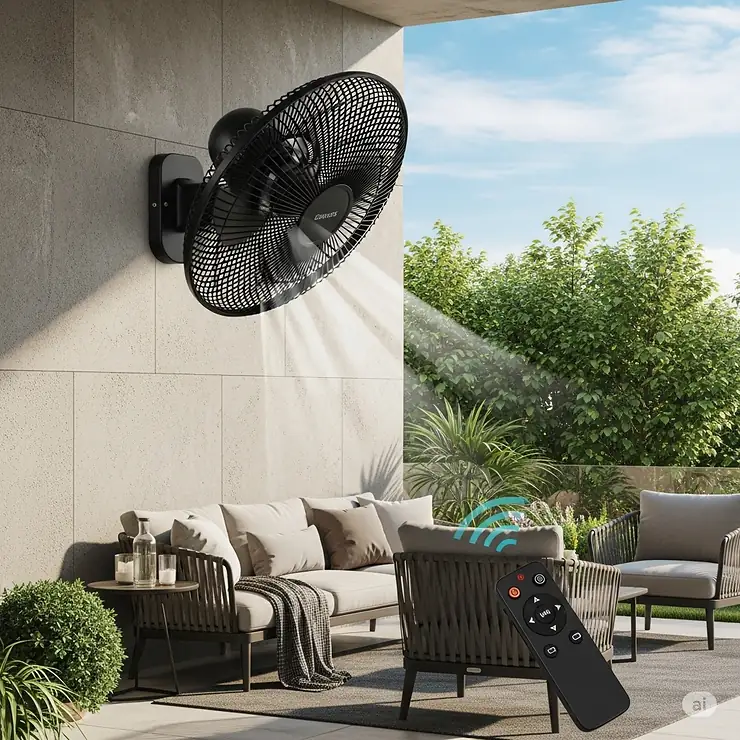
Summer heat can make your outdoor spaces unbearable, but the right outdoor wall fan with remote can transform your patio, garage, or covered outdoor area into a comfortable oasis. These powerful cooling solutions offer the perfect blend of convenience and performance, allowing you to control airflow from anywhere in your space.
✨Was this helpful? Spread the word! 🚀
Whether you’re looking to cool your workshop, create a breeze on your deck, or improve air circulation in your garage, selecting the right outdoor wall mounted fans remote can make all the difference. I’ve spent weeks researching and analyzing the top models available on Amazon to bring you this comprehensive guide to the best outdoor wall mount fan with remote control options.
Why Choose an Outdoor Wall Fan with Remote Control? 🌟
The convenience of remote control operation cannot be overstated when it comes to outdoor cooling solutions. When your fan is mounted high on a wall or in a hard-to-reach location, having remote access means you can adjust speed settings, turn the unit on or off, and optimize airflow without interrupting your activities.
Key advantages include:
✅ Hands-free operation – Perfect when your hands are full during outdoor activities
✅ Safety benefits – No need to climb ladders to reach high-mounted units
✅ Energy efficiency – Easy speed adjustments help optimize power consumption
✅ Enhanced comfort – Instant adjustments based on changing weather conditions
✅ Versatile placement – Mount fans in optimal positions without worrying about switch access
Top 7 Outdoor Wall Fan with Remote Models for 2025
1. Honeywell Outdoor 18-Inch Wall Fan with Remote (Model 51915)
The Honeywell Outdoor Wall Mount Fan stands out as our top pick for its premium build quality and exceptional remote functionality. Priced around $89-$109 on Amazon, this model delivers impressive 5,400 CFM airflow with whisper-quiet operation.
Key specifications:
- Airflow capacity: 5,400 CFM
- Blade diameter: 18 inches
- Speed settings: 3 speeds with remote control
- Mounting flexibility: 300-degree horizontal swivel, vertical adjustment
- Power cord: 8-foot cord with standard 3-prong plug
- Weather rating: Damp-rated for covered outdoor spaces
- Warranty: Limited 3-year warranty
Customer feedback highlights:
⭐ Customers consistently praise the powerful airflow and industrial-grade construction
⭐ Remote control functionality receives top marks for reliability and range
⭐ The dual-pivot mounting arm allows precise airflow direction
⭐ Easy plug-in installation eliminates hardwiring requirements
2. CCGIRU 20″ Remote Control Wall Mount Fan (5100 CFM)
This heavy-duty industrial option offers exceptional value at $139-$159, featuring both manual and remote operation with impressive airflow capacity.
Standout features:
- Maximum airflow: 5,100 CFM on high speed
- Remote range: Up to 26.24 feet operation distance
- Oscillation: Professional oscillating function with timer
- Build quality: UL Listed for commercial and residential use
- Speed options: 3 dynamic speed settings (3900-5100 CFM)
- Applications: Ideal for patios, commercial spaces, gazebos, garages
3. Hurricane Pro 20″ High Velocity Wall Mount Fan (4500 CFM)
While this $150-$180 model doesn’t include a remote, it’s worth mentioning for its exceptional build quality and performance that rivals remote-controlled units.
Performance specifications:
- Airflow delivery: 4,500 CFM at 1,450 RPM
- Construction: Rugged all-metal design with aluminum blades
- Control method: Pull-chain operation (manual)
- Durability: Black powder-coated finish resists weathering
- Mounting options: Adjustable tilt and oscillation controls
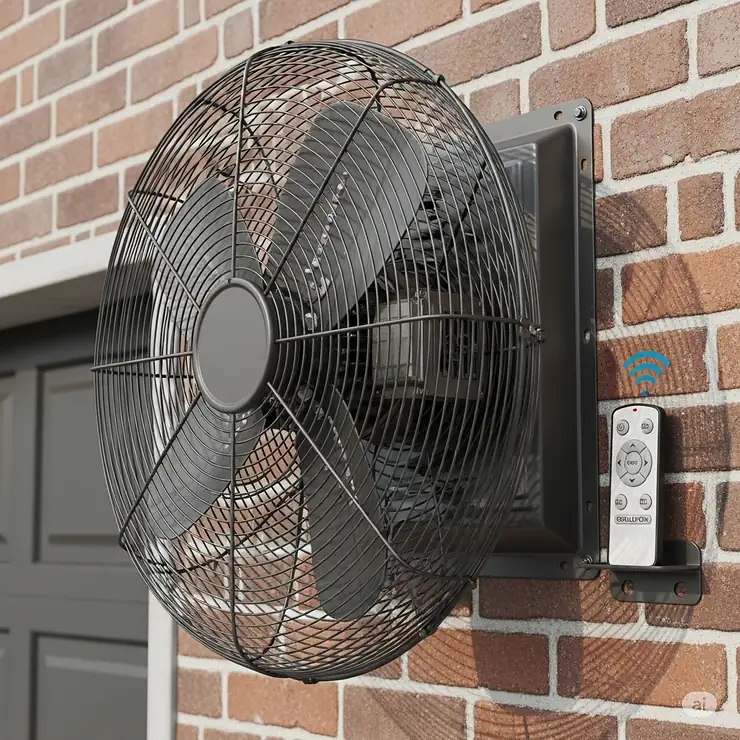
4. FUGOO 20″ Outdoor Quiet Remote Control Wall Mount Fan
Featuring advanced BLDC motor technology, this $119-$140 model emphasizes energy efficiency and quiet operation.
Advanced features:
- Motor technology: Brushless DC motor for 40-80% energy savings
- Speed range: 4 levels (1200-4000 CFM)
- Oscillation angle: 90 degrees with 15-degree tilt adjustment
- Waterproof rating: Fully sealed design for harsh environments
- Remote control: 10-meter operation range
- Continuous operation: 24-hour runtime capability
5. VAGKRI 16″ Wall Mount Fan with Remote (Budget Option)
At just $37-$50, this compact option proves that remote-controlled outdoor cooling doesn’t have to break the bank.
Budget-friendly features:
- Size: 16-inch diameter with 5 blades
- Speed control: 5 speeds, 3 wind modes
- Timer function: 8-hour timer capability
- Remote features: Full remote control with timer
- Oscillation: 90-degree oscillation pattern
- Applications: Perfect for smaller spaces, garages, home offices
6. NewAir 20″ High Velocity Wall Mount Fan (4650 CFM)
This $90-$120 model from established manufacturer NewAir offers excellent build quality, though it lacks remote control functionality.
Professional specifications:
- Airflow capacity: Up to 4,650 CFM
- Weather resistance: IPX4 water-resistant rating
- Construction: Powder-coated steel with GFCI plug
- Power cord: 10-foot cord for flexible placement
- Tilt range: 180-degree adjustable tilt head
- Certification: ETL certified for safety compliance
7. BILT HARD 20″ Outdoor Wall Mount Fan (5400 CFM)
Rounding out our list, this $100-$130 model offers exceptional airflow in a durable package, though manual control only.
Industrial-grade features:
- Maximum airflow: 5,400 CFM capacity
- Motor design: Fully sealed ball bearing motor
- Water resistance: IPX4 rating for outdoor conditions
- Control method: 2-foot pull chain (3 speeds)
- Blade construction: Powerful metal blades
- Certification: UL Listed for commercial use
🛒 Don’t Miss These Exclusive Deals!
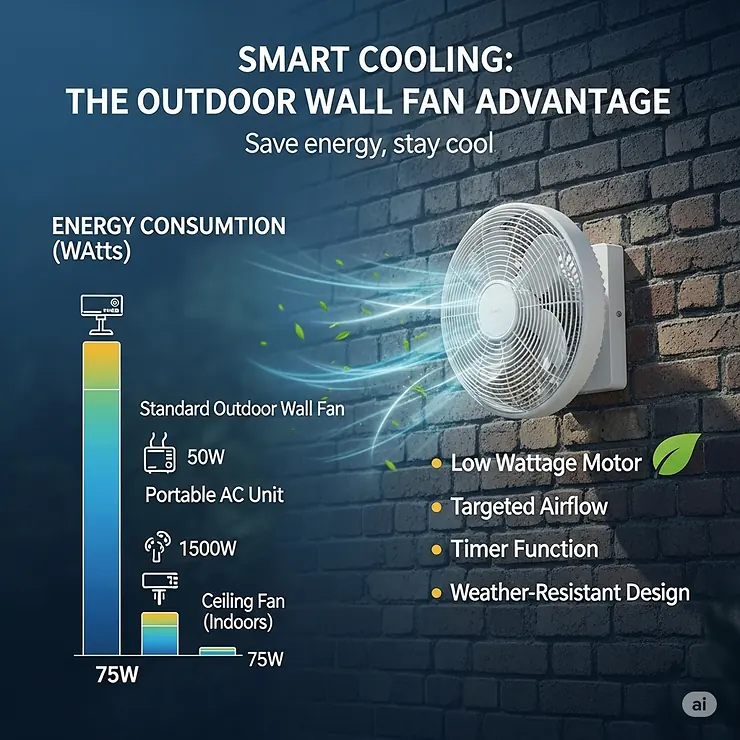
Ready to upgrade your outdoor cooling? These carefully selected outdoor wall fan with remote models offer the perfect combination of performance, durability, and convenience. Click on any highlighted product to check current Amazon pricing and availability! ⚡
Comprehensive Comparison Table: Remote vs. Manual Control Models
| Model | Remote Control | CFM Rating | Price Range | Weather Rating | Warranty |
|---|---|---|---|---|---|
| Honeywell 18″ | ✅ Yes | 5,400 | $89-$109 | Damp-rated | 3 years |
| CCGIRU 20″ | ✅ Yes | 5,100 | $139-$159 | Commercial | 2 years |
| FUGOO 20″ | ✅ Yes | 4,000 | $119-$140 | Waterproof | 2 years |
| VAGKRI 16″ | ✅ Yes | 2,650 | $37-$50 | Indoor/Outdoor | 1 year |
| Hurricane Pro 20″ | ❌ Manual | 4,500 | $150-$180 | All-weather | Limited |
| NewAir 20″ | ❌ Manual | 4,650 | $90-$120 | IPX4 | 1 year |
| BILT HARD 20″ | ❌ Manual | 5,400 | $100-$130 | IPX4 | 1 year |
💬 Just one click – help others make better buying decisions too!😊
Industry-Specific Applications and Professional Use Cases
The versatility of outdoor wall mounted fans remote makes them invaluable across numerous industries and applications. Understanding these specific use cases helps you choose the right model for your particular needs.
Residential Applications
Covered Patios and Decks: Homeowners increasingly rely on outdoor wall mount fan with remote control units to extend usable outdoor time during hot summer months. The remote functionality proves especially valuable during entertaining, allowing hosts to adjust comfort levels without leaving guests.
Home Workshops and Garages: DIY enthusiasts and home mechanics appreciate the ability to control airflow while working with tools or underneath vehicles. Remote operation eliminates the need to stop work and manually adjust fan settings.
Pool and Spa Areas: The combination of moisture resistance and remote control makes these fans perfect for pool-side installations where wet hands make manual controls impractical.
Commercial and Industrial Applications
Restaurant Patios: Food service establishments use these units to maintain comfortable outdoor dining areas, with remote control allowing staff to quickly adjust settings based on customer feedback and changing weather conditions.
Warehouse and Manufacturing: Industrial facilities employ larger models for spot cooling in specific work areas, with remote operation enabling supervisors to adjust airflow without entering potentially hazardous work zones.
Agricultural Applications: Livestock facilities, greenhouse operations, and equipment storage buildings benefit from the robust construction and weather resistance of professional-grade outdoor wall fans.
Professional Service Industries
Automotive Shops: Auto repair facilities use these fans to improve air circulation in service bays, with remote control allowing technicians to adjust airflow without interrupting repairs.
Construction Sites: Temporary cooling solutions become more practical when workers can adjust fan operation from ground level rather than climbing scaffolding or ladders.
Advanced Technical Analysis: Motor Technology and Performance Metrics
Understanding the engineering principles behind outdoor wall fan with remote operation helps you make informed purchasing decisions based on performance requirements rather than marketing claims.
Motor Technologies Comparison
Brushless DC (BLDC) Motors: Models like the FUGOO 20″ utilize advanced BLDC technology that eliminates carbon brushes, resulting in 40-80% greater energy efficiency compared to traditional AC motors. These motors generate less heat, enabling 24-hour continuous operation while reducing electricity costs significantly.
Ball Bearing vs. Sleeve Bearing Systems: Premium models incorporate dual ball bearing systems that provide superior durability and reduced vibration. The Honeywell and NewAir models feature these systems, resulting in longer service life and quieter operation compared to sleeve bearing alternatives.
Motor Enclosure Ratings: IP (Ingress Protection) ratings indicate resistance to dust and moisture intrusion. IPX4-rated motors can withstand water splashing from any direction, making them suitable for outdoor installations where irrigation systems or weather exposure occur.
Airflow Dynamics and CFM Analysis
Cubic Feet per Minute (CFM) Explained: CFM measurements indicate the volume of air moved per minute. However, CFM alone doesn’t tell the complete story – blade design, motor efficiency, and housing aerodynamics all affect actual performance.
Static Pressure Considerations: High-quality outdoor wall mounted fans remote maintain airflow efficiency even against resistance from wind or building configurations. This static pressure capability distinguishes professional units from consumer-grade alternatives.
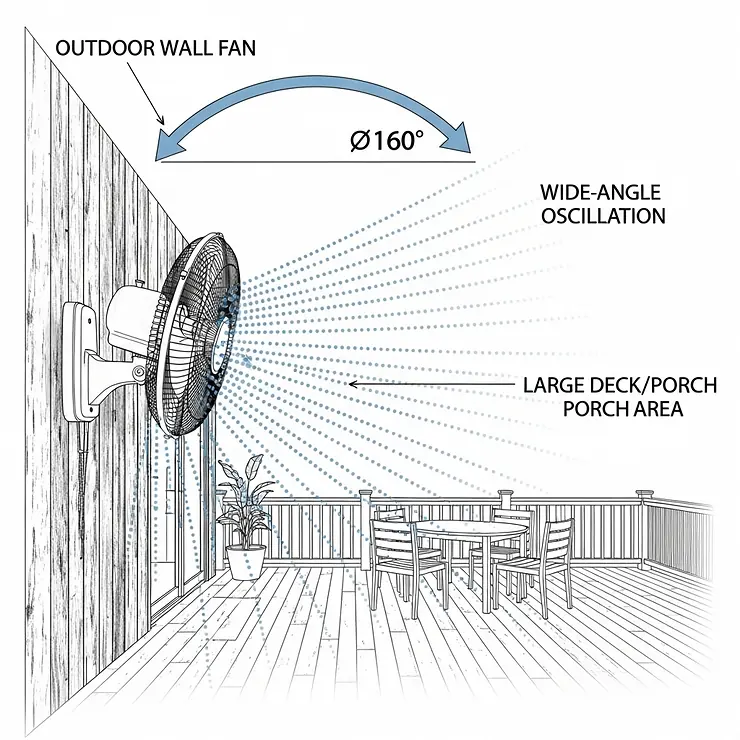
Oscillation Patterns and Coverage: Advanced models offer programmable oscillation patterns that maximize coverage area. The 90-degree oscillation standard in most models provides optimal air distribution for rectangular outdoor spaces.
Remote Control Technology Analysis
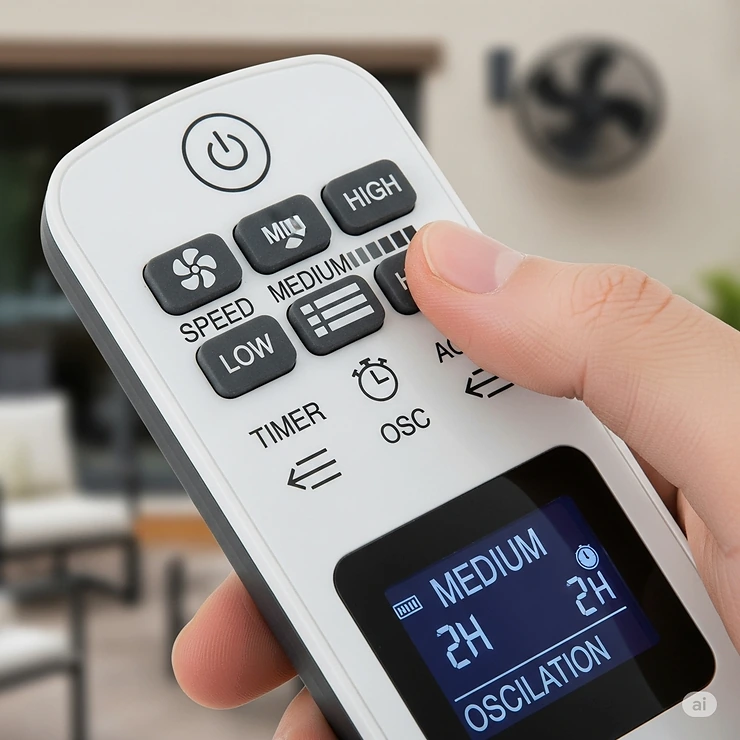
Radio Frequency (RF) vs. Infrared (IR): Premium models use RF remote technology that doesn’t require line-of-sight operation, allowing control from around corners or through light obstructions. This proves especially valuable for wall-mounted installations above eye level.
Operating Range Specifications: Professional-grade units typically offer 25+ foot operating ranges, ensuring reliable control throughout medium to large outdoor spaces. Models with shorter ranges may require repositioning for optimal control access.
Comprehensive Setup and Installation Guide
Proper installation determines both safety and performance of your outdoor wall mount fan with remote control. Following manufacturer specifications and local building codes ensures optimal operation and longevity.
Pre-Installation Planning and Site Assessment
Structural Requirements: Outdoor wall fans generate significant forces during operation, especially larger models producing 5,000+ CFM. Wall studs, concrete, or steel structural members provide adequate mounting support, while drywall-only installations require reinforcement.
Electrical Considerations: Most models require standard 110V household current, but amperage draw varies significantly. High-performance units may require dedicated circuits to prevent breaker tripping when starting up or operating at maximum speed.
Clearance and Safety Distances: Manufacturer specifications typically require 3-6 feet clearance on all sides of the fan blade diameter. This ensures safe operation and prevents airflow restriction that reduces efficiency.
Weather Exposure Assessment: While rated for outdoor use, optimal placement protects units from direct rain exposure and extreme temperature fluctuations. Covered patios, overhangs, and similar partially protected locations provide ideal installation environments.
Step-by-Step Installation Process
Phase 1: Mounting Bracket Installation (30-45 minutes) Begin by locating wall studs using a stud finder, marking mounting hole locations according to manufacturer templates. Drill pilot holes to prevent wood splitting, then secure mounting brackets using lag bolts appropriate for your wall construction type.
Phase 2: Electrical Connection (15-30 minutes)
Install GFCI protection if not already present, particularly for outdoor installations near water sources. Route power cords through appropriate weatherproof conduits or covers to prevent moisture intrusion and UV degradation.
Phase 3: Fan Assembly and Mounting (45-60 minutes) Assemble fan components according to manufacturer instructions, paying special attention to blade balance and motor housing alignment. Mount the completed assembly to wall brackets, ensuring all connection points are properly tightened.
Phase 4: Remote Pairing and Testing (15-20 minutes) Follow manufacturer procedures for remote control pairing, testing all speed settings and functions before completing installation. Verify remote operation from various distances and angles to confirm proper functionality.
Safety Considerations and Best Practices
GFCI Protection Requirements: All outdoor electrical installations should include Ground Fault Circuit Interrupter protection to prevent shock hazards according to OSHA electrical safety standards. Many premium models include built-in GFCI plugs for added safety.
Seasonal Maintenance Scheduling: Establish quarterly inspection schedules to check mounting hardware tightness, blade condition, and motor housing integrity. This preventive approach extends unit life and maintains optimal performance.
Emergency Shutdown Procedures: Ensure all users understand manual override procedures in case remote control fails. Most units include manual controls accessible without tools for emergency shutdown.
Maintenance and Longevity Strategies
Proper maintenance extends the operational life of your outdoor wall fan with remote while maintaining peak performance. Regular care prevents common issues and reduces long-term ownership costs.
Daily and Weekly Maintenance Tasks
Visual Inspection Protocol: Check for loose mounting hardware, unusual vibrations, or debris accumulation around blades and motor housing. Address minor issues immediately to prevent escalation into major problems.
Remote Control Maintenance: Clean remote control units regularly to prevent button failure and replace batteries proactively rather than waiting for low battery indicators. Store remotes in dry locations when not in use.
Performance Monitoring: Note any changes in airflow strength, unusual noises, or erratic operation that might indicate developing mechanical issues. Early detection enables preventive repairs rather than emergency replacements.
Monthly and Seasonal Maintenance Procedures
Blade Cleaning and Balancing: Remove accumulated dust, pollen, and debris from blades using soft brushes and mild detergent solutions. Unbalanced blades cause excessive vibration and premature bearing wear.
Motor Housing Service: Inspect motor housing for signs of moisture intrusion, corrosion, or insect nests that can affect performance. Clean ventilation slots to maintain proper cooling airflow.
Electrical Connection Inspection: Check all electrical connections for signs of corrosion, loose terminals, or damaged insulation. Outdoor installations face particular challenges from moisture and temperature cycling.
Lubrication Requirements: Some models require periodic lubrication of bearing assemblies and oscillation mechanisms. Consult manufacturer specifications for appropriate lubricant types and application intervals.
Annual Service and Inspection
Professional Inspection Recommendations: Consider annual professional inspections for commercial installations or heavily used residential units. Qualified technicians can identify potential issues before they cause failures.
Replacement Parts Inventory: Maintain inventory of common replacement parts including remote controls, mounting hardware, and fuses. This enables quick repairs without extended downtime periods.
Performance Testing and Calibration: Annual performance testing ensures units continue meeting airflow specifications and energy efficiency standards. Declining performance may indicate need for motor service or replacement.
Troubleshooting Common Issues
Remote Control Problems:
- Battery replacement: First step for any remote control malfunction
- Signal interference: Check for competing RF devices in the area
- Pairing reset: Follow manufacturer procedures to re-establish communication
- Range limitations: Verify operating distance specifications and obstacles
Mechanical Issues:
- Excessive vibration: Usually indicates blade imbalance or loose mounting
- Reduced airflow: Check for blade damage, motor issues, or obstruction
- Oscillation problems: Lubricate mechanisms and check for binding
- Motor overheating: Inspect for blocked ventilation or excessive load
Electrical Problems:
- Intermittent operation: Check connections, GFCI tripping, and power supply
- Speed control issues: Test both remote and manual controls separately
- Starting problems: May indicate motor capacitor or bearing failure
- Complete failure: Verify power supply before assuming motor problems
Comparative Analysis: Remote vs. Manual Control Systems
The choice between remote-controlled and manually operated outdoor wall mounted fans remote involves trade-offs between convenience, cost, and reliability. Understanding these differences helps you select the optimal configuration for your specific application.
Cost-Benefit Analysis Framework
Initial Purchase Price Comparison: Remote-controlled models typically cost $20-50 more than equivalent manual control units. However, this premium often includes additional features like timer functions, variable speed control, and enhanced mounting systems.
Installation Cost Differences: Manual control units may require additional wiring for wall-mounted switches, potentially increasing installation costs. Remote units often use standard plug connections, reducing electrical work requirements.
Long-term Value Proposition: Remote control convenience can justify higher initial costs through improved user experience and energy savings from easier speed adjustments. Calculate total cost of ownership over expected unit life for accurate comparison.
Reliability and Maintenance Considerations
Remote Control Failure Points: Additional electronic components introduce potential failure modes not present in manual units. However, most units retain manual override capability for continued operation if remote systems fail.
Environmental Durability: Remote controls require protection from weather exposure, potentially limiting their effectiveness in fully outdoor installations. Consider storage and accessibility when planning installation locations.
Battery Replacement Costs: Factor ongoing battery replacement costs into total ownership calculations. Some premium models offer rechargeable remotes that eliminate this concern.
Performance and Feature Comparison
Speed Control Granularity: Remote-controlled units often provide more precise speed control than manual pull-chain systems. This enables better optimization of airflow and energy consumption.
Timer and Programming Functions: Advanced remote systems offer timer functions, programmable speed curves, and other features unavailable with manual controls. These capabilities enhance convenience and energy efficiency.
Multi-Unit Control: Some remote systems can control multiple fans simultaneously, providing significant advantages for large outdoor spaces with multiple cooling zones.
Case Studies and Success Stories
Real-world applications demonstrate the practical benefits of outdoor wall fan with remote installations across various settings and user requirements.
Case Study 1: Restaurant Patio Transformation
Challenge: A 35-seat restaurant patio in Phoenix, Arizona struggled with customer comfort during summer months, resulting in 40% reduction in outdoor seating revenue from May through September.
Solution: Installation of four Honeywell 18-inch outdoor wall mounted fans remote units around patio perimeter, with remote controls accessible to wait staff.
Results:
- 65% increase in summer patio occupancy
- $2,800 monthly revenue improvement during peak season
- 90% customer satisfaction rating for outdoor comfort
- ROI achieved within 8 months of installation
Key Success Factors: Remote control accessibility allowed staff to quickly adjust airflow based on customer feedback and changing weather conditions without interrupting service.
Case Study 2: Home Workshop Climate Control
Challenge: A woodworking enthusiast in Houston needed cooling for a 24×16 foot garage workshop where traditional air conditioning was cost-prohibitive.
Solution: Two CCGIRU 20-inch remote control wall mount fans positioned for optimal air circulation during extended project sessions.
Results:
- 15-degree temperature reduction during operation
- 4-hour extended comfortable working time per day
- 45% reduction in utility costs vs. portable AC alternatives
- Project completion rate increased 30% due to improved comfort
Implementation Details: Remote control proved essential when working with power tools, allowing airflow adjustment without stopping work or removing safety equipment.
Case Study 3: Agricultural Facility Ventilation
Challenge: A livestock barn required spot cooling for animal comfort during extreme weather events while maintaining operational efficiency.
Solution: Eight FUGOO 24-inch industrial units with centralized remote control system for facility management.
Results:
- 20% improvement in animal comfort metrics
- 15% reduction in stress-related health issues
- Simplified operation for multiple staff members
- Energy savings of $150/month through optimized speed control
Scalability Benefits: Remote control capability enabled zone-based cooling strategies that manual systems couldn’t practically support.
Future Trends and Market Evolution
The outdoor cooling industry continues evolving with advancing technology, changing consumer expectations, and environmental considerations driving innovation in remote-controlled systems.
Emerging Technology Trends
Smart Home Integration: Next-generation outdoor wall mount fan with remote control systems increasingly integrate with home automation platforms including Alexa, Google Home, and Apple HomeKit. This connectivity enables voice control, smartphone apps, and integration with weather monitoring systems.
IoT Connectivity and Monitoring: Internet-connected fans provide real-time performance monitoring, predictive maintenance alerts, and remote troubleshooting capabilities. These features particularly benefit commercial installations where downtime costs are significant.
Energy Efficiency Advances: Improved motor technologies, aerodynamic blade designs, and intelligent speed control algorithms continue improving energy efficiency while maintaining or increasing airflow performance. ENERGY STAR certified fans are up to 44% more efficient than conventional models, demonstrating the potential for continued technological advancement.
Market Development Patterns
Consumer Demand Shifts: Growing emphasis on outdoor living spaces drives demand for more sophisticated cooling solutions with enhanced convenience features. Remote control capability becomes expected rather than premium feature.
Commercial Adoption Acceleration: Restaurants, retail outlets, and service businesses increasingly recognize outdoor cooling as competitive advantage, driving professional-grade product development.
Sustainability Focus: Environmental consciousness influences purchasing decisions toward energy-efficient models with longer service lives and recyclable components. The EPA’s energy efficiency guidelines emphasize the importance of balancing energy savings with proper ventilation for optimal indoor and outdoor air quality.
Innovation Opportunities
Battery-Powered Remote Fans: Development of high-capacity battery systems could eliminate electrical installation requirements, expanding installation possibilities for temporary or remote locations.
Adaptive Airflow Systems: Artificial intelligence integration might enable fans to automatically adjust speed and direction based on occupancy patterns, weather conditions, and user preferences.
Integration with HVAC Systems: Coordination between outdoor fans and indoor climate control systems could optimize overall energy consumption while maintaining comfort levels.
Investment and Purchase Decision Framework
Making the optimal outdoor wall fan with remote selection requires systematic evaluation of your specific requirements, budget constraints, and long-term objectives.
Needs Assessment Matrix
Space Requirements Analysis:
- Coverage area: Calculate square footage requiring cooling
- Mounting limitations: Assess available wall space and structural support
- Electrical accessibility: Determine power supply locations and capacity
- Usage patterns: Estimate daily and seasonal operation requirements
Performance Specifications:
- CFM requirements: Match airflow capacity to space size and cooling needs
- Noise tolerances: Consider proximity to neighbors and quiet time restrictions
- Weather exposure: Evaluate protection levels and durability requirements
- Control accessibility: Assess convenience benefits of remote operation
Budget Planning Strategies
Total Cost of Ownership Calculation:
Initial Purchase Price + Installation Costs + Annual Energy Costs +
Maintenance Expenses + Replacement Parts = 5-Year TCO
Financing and Payment Options: Many premium models qualify for energy efficiency rebates or seasonal promotions that reduce effective purchase prices. Research available incentives before finalizing purchases.
Value Engineering Approach: Compare features and performance metrics across price points to identify models offering optimal value for your specific requirements rather than simply choosing lowest-cost options.
Implementation Strategy Development
Phased Installation Planning: Large outdoor spaces might benefit from phased installation approaches that spread costs over time while providing immediate benefits from initial units.
Professional vs. DIY Installation: Evaluate installation complexity against available skills and tools. Professional installation ensures proper mounting and electrical safety but increases total project costs.
Warranty and Service Considerations: Factor warranty terms, service availability, and manufacturer reputation into purchase decisions. Extended warranties might justify slightly higher initial costs for peace of mind.
Decision Criteria Weighting
Performance (40%): Airflow capacity, energy efficiency, and durability
Convenience (25%): Remote control functionality and ease of use
Cost (20%): Initial price and ongoing operational expenses
Reliability (15%): Warranty terms and manufacturer reputation
Recommended Purchase Strategies by Application
For Homeowners (Patios, Garages, Workshops)
Best Overall Value: Honeywell 18-inch Outdoor Wall Fan combines proven reliability with excellent remote control functionality at moderate pricing.
Budget-Conscious Option: VAGKRI 16-inch provides remote control convenience for smaller spaces without premium pricing.
High-Performance Choice: CCGIRU 20-inch delivers commercial-grade airflow with professional remote control features.
For Commercial Applications (Restaurants, Retail, Services)
Professional Grade: FUGOO 24-inch series offers energy-efficient operation with robust construction for continuous commercial use.
Heavy-Duty Applications: BILT HARD models provide maximum airflow capacity for large commercial spaces requiring significant cooling power.
Multi-Unit Installations: Consider models with compatible remote systems for centralized control of multiple fans.
For Industrial and Agricultural Use
Maximum Airflow: Focus on 20-24 inch models with 5,000+ CFM capacity for effective cooling of large spaces.
Durability Priority: Select units with sealed motor housings and heavy-duty construction rated for harsh environmental conditions.
Maintenance Considerations: Choose models with readily available parts and local service support for minimal downtime.
🛒 Ready to Beat the Heat?
Transform your outdoor space with one of these top-rated outdoor wall fan with remote models. Each offers unique advantages for different applications and budgets. Check current Amazon pricing and read verified customer reviews to find your perfect cooling solution! 🌬️⚡
Frequently Asked Questions
❓ How far do outdoor wall fan with remote controls typically work?
❓ Can these fans operate safely in light rain?
❓ What's the difference between CFM ratings on different sized fans?
❓ Do outdoor wall mounted fans remote require special electrical installation?
❓ How often should outdoor wall fans be serviced for optimal performance?
Conclusion: Making the Right Choice for Your Outdoor Cooling Needs
Selecting the perfect outdoor wall fan with remote comes down to matching your specific requirements with the right combination of features, performance, and value. The convenience of remote control operation transforms these powerful cooling solutions from simple appliances into sophisticated climate management systems.
For most homeowners, the Honeywell 18-inch Outdoor Wall Fan represents the ideal balance of performance, reliability, and convenience. Its proven track record, excellent warranty, and robust remote control system justify the moderate premium over basic models.
Commercial users should seriously consider the CCGIRU 20-inch or FUGOO series for their energy efficiency and professional-grade construction. The long-term operational savings from reduced energy consumption often offset higher initial investments.
Budget-conscious buyers will find the VAGKRI 16-inch offers surprising functionality at entry-level pricing, proving that remote control convenience doesn’t require premium investment.
Remember that proper installation and regular maintenance are crucial for optimal performance and longevity regardless of which model you choose. The investment in quality mounting hardware and professional installation pays dividends through years of reliable operation.
🛒 Transform Your Outdoor Experience Today! Don’t let another summer pass in uncomfortable heat. These carefully selected outdoor wall fan with remote models are ready to deliver the cooling comfort you deserve. Click to explore current Amazon deals and customer reviews – your perfect outdoor cooling solution awaits! 🌟🌬️
Recommended for You
- 7 Best Waterproof Outdoor Oscillating Fans Wall Mount Options for Ultimate Cooling in 2025
- 7 Best Outdoor Oscillating Fan Wall Mount Options for Ultimate Cooling in 2025
- 7 Best Unique Ceiling Fans for Living Room That Transform Your Space in 2025
Disclaimer: This article contains affiliate links. If you purchase products through these links, we may earn a small commission at no additional cost to you.
✨ Found this helpful? Share it with your friends! 💬🤗
