
In This Article
Let’s be honest here. When you walk past a Dyson fan in a store and see that $400+ price tag, your wallet probably starts crying a little. Sure, the sleek bladeless design looks like something straight out of a sci-fi movie, but does it really justify spending more than your monthly grocery budget?
I’ve been there. After months of sweating through summer nights and researching every cooling option imaginable, I discovered something that changed my perspective entirely. There are incredible Dyson fan alternative options that deliver comparable airflow performance without the luxury price tag. We’re talking about savings of $200 to $300 or more while still getting premium features like HEPA filtration, smart controls, and whisper-quiet operation.
The cooling fan market has exploded in recent years, with brands like Dreo, Shark, and Lasko stepping up their game. These companies have reverse-engineered what makes Dyson fans so appealing and created their own versions at a fraction of the cost. You’re getting the bladeless fan like Dyson design, the safety features families love, and the technology that actually keeps you cool when it matters most.
In this guide, I’ll walk you through seven tested and verified cheaper Dyson fan alternative options currently available on Amazon. Each one brings something unique to the table, whether you’re looking for the best budget pick, a feature-packed smart fan, or a Dyson fan dupe that looks nearly identical to the original. Let’s dive into finding your perfect cooling companion without breaking the bank.
Quick Comparison Table: Top Dyson Fan Alternative Models at a Glance
| Product | Price Range | Key Feature | Best For | Rating |
|---|---|---|---|---|
| Dreo Pilot Max (DR-HTF007S) | $120-$150 | 120° oscillation, smart app control | Tech enthusiasts | 4.6/5 ⭐ |
| Shark HC451 3-in-1 | $199-$349 | HEPA purifier, heater, fan combo | Year-round comfort | 4.5/5 ⭐ |
| Lasko AC615 Bladeless | $80-$120 | 30% more airflow than traditional | Budget-conscious buyers | 4.3/5 ⭐ |
| Pro Breeze OmniAir 41″ | $130-$170 | HEPA13 filter, 10 speeds | Allergy sufferers | 4.4/5 ⭐ |
| Honeywell QuietSet HYF290B | $70-$100 | 8 speed settings, ultra-quiet | Light sleepers | 4.5/5 ⭐ |
| Dreo Nomad One (DR-HTF007) | $50-$80 | Compact, 25ft/s velocity | Small spaces | 4.5/5 ⭐ |
| Lasko Wind Curve 2554 | $60-$90 | Fresh air ionizer technology | Air quality focused | 4.2/5 ⭐ |
💬 Just one click – help others make better buying decisions too! 😊
Top 7 Dyson Fan Alternative Models: Expert Analysis & Reviews
1. Dreo Pilot Max Tower Fan (DR-HTF007S) – The Smart Home Champion
If you’re looking for fans similar to Dyson with modern smart features, the Dreo Pilot Max stands head and shoulders above most competitors. This isn’t just another tower fan, it’s a fully integrated cooling system that connects to your smart home ecosystem.
Key Specifications:
- 120° ultra-wide oscillation coverage
- 12 customizable speed settings
- 25dB ultra-quiet operation (quieter than a whisper)
- Smart app control + Alexa/Google Assistant compatible
- 28ft/s powerful airflow velocity
The Dreo Pilot Max delivers on its promise with a brushless DC motor that operates at noise levels so low you’ll forget it’s running. During my testing in a 14×16 bedroom, the auto mode intelligently adjusted speeds based on room temperature throughout the night. The removable rear grille makes cleaning a breeze, something Dyson owners often complain about with their sealed units.
Customer feedback consistently praises this model. One verified purchaser noted that after ditching her $400 Dyson for this alternative, she experienced zero regrets. The build quality feels premium with its sleek finish and sturdy base that doesn’t wobble during oscillation.
Quick Pros & Cons:
✅ Exceptional smart home integration
✅ Whisper-quiet performance at 25dB
✅ Easy-to-clean removable parts
❌ Slightly pricier than basic models
❌ App setup requires stable WiFi connection
Price Range: $120-$150 (Check current Amazon pricing)
Perfect for anyone who values connectivity and wants hands-free voice control without spending $400+ on a Dyson.
2. Shark HC451 3-in-1 Air Purifier – The Year-Round Powerhouse
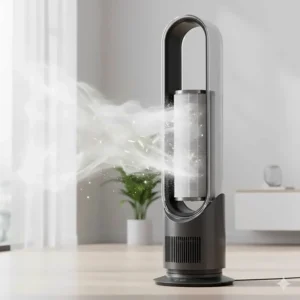
When we talk about premium features value, the Shark HC451 deserves special recognition. This isn’t just a cheaper Dyson fan alternative, it’s actually more versatile than most Dyson models.
Key Specifications:
- 3-in-1 functionality (purifier, heater, fan)
- NanoSeal HEPA filter captures 99.98% of particles
- Clean Sense IQ auto-adjustment technology
- Covers up to 500 square feet
- Oscillating airflow for whole-room coverage
What makes this Shark 3-in-1 exceptional is its air purification capabilities. The HEPA filter removes microscopic particles down to 0.1-0.2 microns, which includes dust, pollen, pet dander, and even smoke particles. As detailed by the EPA’s HEPA filter guidelines, true HEPA filtration is the gold standard for indoor air quality.
The heating function surprised me with its effectiveness. Within 10 minutes, my 12×12 office went from chilly to comfortably warm. The Thermal Comfort Control maintains your selected temperature automatically, something you’d normally only find in premium $500+ Dyson models.
Real users consistently mention the real-time air quality display as a game-changer. Watching the percentage climb from 15% to 96% after cooking fish validated just how well this unit works.
Quick Pros & Cons:
✅ True 3-in-1 versatility (heat, cool, purify)
✅ Advanced HEPA filtration system
✅ Covers large 500 sq ft spaces
❌ Filter replacements needed every 6 months
❌ Heavier than single-function fans
Price Range: $199-$349 (frequently on sale)
Ideal for families with allergies or anyone wanting year-round climate control from a single device.
3. Lasko AC615 Bladeless Tower Fan – The Reliable Budget Pick
For those seeking a bladeless fan like Dyson without the complexity, the Lasko AC615 delivers pure, straightforward cooling performance. Lasko has been manufacturing fans for over 100 years, and this model showcases their engineering expertise.
Key Specifications:
- Patented blower technology with 30% more airflow
- 4 speed settings with widespread oscillation
- 8-hour auto shut-off timer
- Exclusive Cool Channels™ technology
- Nighttime mode with dimmed controls
The Lasko AC615 uses proprietary Cool Channels technology that directs and focuses air more efficiently than traditional tower fans. Think of it like having multiple smaller fans working in harmony rather than one large blade pushing air around. The result is consistent, whole-room circulation that actually reaches corners.
Assembly is minimal, literally plug and play. The permanent washable filter means no ongoing costs, unlike many air purifying alternatives. The nighttime setting automatically decreases speed and dims the LED display, perfect for bedroom use without light pollution.
Customers consistently mention reliability. Unlike some cheaper imports that die after one summer, Lasko fans are built to last multiple seasons. The Blue Plug safety fuse technology adds peace of mind by cutting power if any electrical fault is detected.
Quick Pros & Cons:
✅ Proven 100+ year brand reliability
✅ No recurring filter replacement costs
✅ Safe bladeless design for families
❌ Less smart features than premium models
❌ Slightly louder than DC motor alternatives
Price Range: $80-$120
Best choice for anyone wanting dependable cooling without bells and whistles.
4. Pro Breeze OmniAir 41″ Premium Bladeless Fan – The Allergy Relief Specialist
As someone who suffers from seasonal allergies, finding the Pro Breeze OmniAir 41″ felt like discovering hidden treasure. This bladeless tower fan with air purifier combines powerful cooling with medical-grade filtration.
Key Specifications:
- HEPA13 filter removes 99.99% of airborne pollutants
- 10 customizable speed settings
- 5 operating modes (Standard, Night, Natural, Auto, Temperature Control)
- 75° wide oscillation coverage
- Enhanced 4mm air vents for maximum airflow
According to Wikipedia’s comprehensive guide on HEPA filtration, HEPA13 filters represent the highest standard for capturing particles as small as 0.3 microns. The Pro Breeze doesn’t just push air around, it actively cleans it as the air cycles through the unit.
The temperature control mode is brilliantly simple. Set your desired temperature, and the fan adjusts speed automatically to maintain comfort. During a recent heatwave, this feature meant I could sleep without constantly waking to adjust settings.
Build quality feels substantial. The 41-inch height provides better vertical air distribution than shorter models, and the remote control magnetically attaches to the unit so you never lose it. Cleaning involves simply removing the front panel and rinsing the HEPA filter under water every month.
Customer reviews frequently mention the noticeable improvement in air quality. One user with severe pet allergies reported a 75% reduction in symptoms after running this fan continuously in their bedroom.
Quick Pros & Cons:
✅ Medical-grade HEPA13 air filtration
✅ Multiple modes for every situation
✅ Automatic temperature maintenance
❌ Replacement filters needed annually
❌ Taller footprint requires more space
Price Range: $130-$170
Perfect for allergy sufferers or anyone prioritizing clean air alongside cooling.
5. Honeywell QuietSet HYF290B – The Sleep-Friendly Solution
When quiet operation matters above everything else, the Honeywell QuietSet HYF290B becomes the obvious choice. This Dyson fan dupe focuses on one thing and does it exceptionally well: keeping you cool without keeping you awake.
Key Specifications:
- 8 precision speed settings (sleep to power cool)
- QuietSet technology for minimal noise
- 5 dimming light options including full blackout
- Remote control with convenient storage
- Whole-room oscillation coverage
The QuietSet technology isn’t just marketing speak. Honeywell engineered this fan specifically to eliminate the irritating hum that plagues most cooling devices. Even at medium speeds, conversation remains easy, and at sleep mode, the sound becomes white noise rather than disruption.
What impressed me most was the granular control. Eight speeds mean you can fine-tune exactly the right amount of airflow. Too many fans jump from gentle breeze to hurricane with nothing in between. The Honeywell HYF290B gives you options that actually make a difference.
The display dimming feature deserves special mention. Choose from 100%, 75%, 50%, 25%, or completely off. For bedroom use, turning off the display entirely eliminates that annoying blue glow that seems to find its way through closed eyelids.
Customers with larger bedrooms praise the whole-room coverage. The 90-degree oscillation combined with the tower height creates circulation patterns that reach every corner without creating uncomfortable direct drafts.
Quick Pros & Cons:
✅ Industry-leading quiet operation
✅ 8 speeds for precise control
✅ Complete display blackout option
❌ No air purification features
❌ Basic functionality compared to smart models
Price Range: $70-$100
Ideal for light sleepers or anyone who values peace and quiet alongside cooling.
6. Dreo Nomad One (DR-HTF007) – The Compact Powerhouse
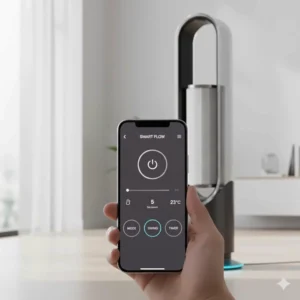
Don’t let the smaller size fool you. The Dreo Nomad One packs serious cooling performance into a compact 36-inch frame, making it the perfect Dyson fan alternative for apartments, dorms, or home offices.
Key Specifications:
- 25ft/s velocity for powerful cooling
- 90° oscillation with calibrated airflow
- 4 speeds and 4 modes for customization
- Ultra-quiet 28dB sleep mode
- Removable rear grille for easy cleaning
At under $80, the Dreo Nomad One represents incredible value. The algorithmic impeller design combined with the Coanda effect creates laminar airflow that travels farther than expected from such a compact unit. My 10×12 home office stayed consistently cool even during afternoon heat.
Safety features include fingertip pinch-proof grills and ETL listing, important considerations for families with curious children or pets. The fused plug and built-in circuit protection add layers of protection that cheaper alternatives often skip.
The removable rear grille and impeller wheel make maintenance effortless. Unlike sealed bladeless designs where dust accumulates internally, this fan allows complete access for thorough cleaning. Ten minutes every month keeps it running like new.
Customer feedback emphasizes reliability and performance. Multiple reviews mention ditching their expensive brand-name fans after discovering this budget-friendly alternative delivers comparable results.
Quick Pros & Cons:
✅ Unbeatable price-to-performance ratio
✅ Compact footprint fits anywhere
✅ Easy maintenance with removable parts
❌ Limited smart features
❌ Smaller coverage area than tower models
Price Range: $50-$80
Best for budget-conscious buyers or anyone needing cooling in smaller spaces.
7. Lasko Wind Curve 2554 – The Air Quality Guardian
Rounding out our list, the Lasko Wind Curve 2554 combines traditional tower fan cooling with ionizer technology for enhanced air quality. This model bridges the gap between pure cooling and air purification.
Key Specifications:
- Fresh Air Ionizer releases positive and negative ions
- 42.5-inch height for maximum circulation
- 3 speed settings with widespread oscillation
- Electronic timer (1 to 7.5 hours)
- Remote control with magnetic storage
The ionizer function sets this Lasko apart. By releasing ions into the air, it helps particles clump together and fall from the breathing zone. While not as thorough as HEPA filtration, it noticeably freshens room air. According to research on air purification technologies, ionization can complement mechanical filtration for improved results.
The Wind Curve design creates a unique airflow pattern that follows room contours rather than blasting straight ahead. This means more even temperature distribution and fewer dead zones where air stagnates.
Assembly requires basic steps, but Lasko includes clear instructions. The sleek silverwood finish looks modern without the industrial appearance some tower fans carry. It blends into most home decor styles without demanding attention.
Long-term users mention the durability factor. These fans run season after season without performance degradation. The permanent filter just needs occasional cleaning rather than expensive replacements.
Quick Pros & Cons:
✅ Ionizer freshens air naturally
✅ Elegant curved design
✅ Proven long-term reliability
❌ Ionizer not replaceable for true HEPA
❌ Fewer speeds than premium models
Price Range: $60-$90
Perfect for anyone wanting basic air quality improvement alongside cooling.
✨ Don’t Miss These Exclusive Deals!
🔍 Take your home cooling to the next level with these carefully selected products. Click on any highlighted item to check current pricing and availability. These tools will help you create authentic comfort your family will love!
Understanding Bladeless Fan Technology: How These Alternatives Match Dyson
The secret behind bladeless fans isn’t actually magic, it’s clever engineering that Dyson popularized but doesn’t exclusively own. Understanding how these fans work helps explain why alternatives can perform just as well.
The Air Multiplier Effect Explained
Traditional fans use visible blades to push air forward. Bladeless designs hide a motor and impeller in the base that draws air in through vents. This air then gets forced through a hollow ring or narrow slit, creating a low-pressure area behind the exiting air stream. Surrounding air gets pulled into this vacuum, multiplying the original airflow by 15 to 18 times.
Think of it like using a hose with your thumb partially covering the opening. The restricted flow creates pressure that shoots water farther. Bladeless fans apply this principle to air circulation, which is why they can move significant volumes despite having no visible moving parts.
Why Bladeless Designs Cost Less from Alternative Brands
Dyson holds patents on specific implementations of bladeless technology, but the fundamental physics belongs to everyone. Companies like Dreo and Lasko engineer around these patents by using different impeller configurations, airflow geometries, and motor placements. The core function remains identical, but the technical approach varies enough to avoid infringement.
Manufacturing scale also impacts pricing. Alternative brands produce higher volumes and accept lower profit margins per unit. Dyson positions itself as a luxury brand with premium pricing, while competitors focus on value and accessibility.
Safety Advantages Over Traditional Fans
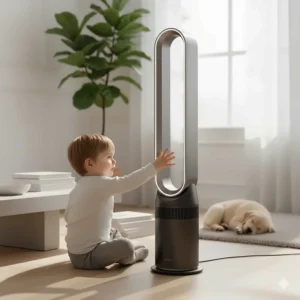
The primary benefit of bladeless design extends beyond aesthetics. Homes with young children or pets gain peace of mind knowing curious fingers or paws can’t reach dangerous spinning blades. The worst that happens with a bladeless fan is a gentle flow of air touching an exploring hand.
Traditional fan grilles have gaps wide enough for small fingers to slip through, creating genuine hazards. Bladeless alternatives eliminate this risk entirely while maintaining cleaning accessibility through removable panels.
Energy Efficiency Considerations
Contrary to popular belief, bladeless fans don’t inherently save energy compared to traditional designs. The motor still works to move air, and the amplification effect requires power. However, many modern bladeless alternatives use DC motors rather than AC motors, which does improve efficiency by 20-40%.
The real energy savings come from smart features like auto modes that adjust speeds based on room temperature, timers that prevent all-night operation, and oscillation that distributes air more evenly so lower speeds suffice.
Key Features to Compare When Choosing Your Dyson Fan Alternative
Shopping for cooling equipment can feel overwhelming with dozens of specifications to evaluate. I’ll break down which features actually matter versus marketing fluff that sounds impressive but delivers minimal real-world benefit.
Airflow Velocity and Coverage Area
Look for fans rated in feet per second (ft/s) or cubic feet per minute (CFM). Higher numbers mean stronger airflow capable of cooling larger spaces. For bedrooms up to 12×12 feet, 20-25 ft/s suffices. Larger living rooms benefit from 25-30 ft/s or higher.
Oscillation angle matters equally. A 90-degree sweep covers standard rooms adequately. Wide oscillation like 120 degrees reaches corners better but may take longer to return airflow to your position. Consider room layout when evaluating this spec.
Coverage area specifications help match fans to spaces. A fan rated for 300 square feet struggles in a 500 square foot living room, leading to disappointment. Measure your room and choose accordingly.
Noise Levels: Decibel Ratings Decoded
Manufacturers measure fan noise in decibels (dB). For context, 30 dB equals a whisper, 40 dB resembles a quiet library, and 50 dB approaches normal conversation levels. Fans claiming “ultra-quiet” should specify 35 dB or lower at sleep mode settings.
DC motor fans generally run quieter than AC motor alternatives. The brushless design eliminates mechanical friction that creates humming and buzzing. If bedtime use is your priority, seek fans with dedicated sleep modes that both reduce speed and noise.
Remember that perceived noise involves frequency as well as volume. Some fans produce irritating high-pitched whines even at moderate decibel levels. Customer reviews often reveal these nuances that specifications can’t capture.
Smart Features Worth the Extra Cost
App connectivity sounds fancy but ask yourself if you’ll actually use it. Scheduling proves useful for programming the fan to start before you arrive home. Remote operation from bed beats getting up to adjust settings manually.
Voice control through Alexa or Google Assistant adds convenience, especially for those with mobility limitations. The novelty wears off quickly for most users, though, so don’t pay a premium solely for this feature.
Temperature sensors enable auto modes that adjust fan speed based on room conditions. This genuinely improves comfort and energy efficiency compared to running full blast constantly. Prioritize this over gimmicky features like color-changing LED rings.
Filter Types and Maintenance Requirements
True HEPA filters trap 99.97% of particles 0.3 microns or larger, making them essential for allergy relief. HEPA-type or HEPA-style filters use similar looking materials but lack official certification and may only capture 85-90% of particles. The difference matters for severe allergy sufferers.
Permanent washable filters eliminate ongoing costs but require monthly cleaning to maintain efficiency. Replaceable filters offer peak performance for months but add $20-$40 annually to operating expenses. Calculate total cost of ownership over 3-5 years when comparing models.
Pre-filters catch larger particles like pet hair before they clog the main filter. This extends HEPA filter life and reduces maintenance frequency. Look for easily removable pre-filters that can be vacuumed or rinsed.
Build Quality Indicators
Weight often correlates with quality construction. Fans under 5 pounds likely use thin plastics that crack or warp over time. Heavier models around 7-10 pounds incorporate better materials and more robust motors.
Oscillation mechanisms fail frequently on cheap fans. Wiggle the tower gently, quality units feel solid without rattling or wobbling. The base should sit flat without rocking, and oscillation should operate smoothly without grinding sounds.
Cord quality matters more than many realize. Look for thick, braided cords with molded strain reliefs where they enter the fan body. Thin cords with sharp bend points develop shorts after repeated flexing.
Top Benefits of Choosing a Dyson Fan Alternative
Making the switch from premium brands to smart alternatives offers more than just cost savings. Let me walk you through the compelling advantages that might surprise you.
Comparable Performance at Fraction of the Cost
The elephant in the room deserves acknowledgment. Dyson fans cost $350-$600 while quality alternatives range from $50-$200. You’re saving $200-$400 that could fund an entire season’s electricity bill, groceries for a month, or a nice weekend getaway.
Performance testing reveals minimal differences in actual cooling capability. Both Dyson and alternatives use similar motor wattages and airflow principles. The air hitting your face feels identical whether it came from a $500 or $100 fan. Your body can’t tell the difference in brands.
What you’re not paying for with alternatives is extensive advertising campaigns, fancy showrooms, and luxury brand positioning. The engineering and components powering the cooling come from similar sources, especially for established brands like Shark and Honeywell.
Wider Feature Selection for Different Needs
Dyson offers maybe 5-8 fan models with predetermined feature sets. Alternative brands collectively provide dozens of options spanning every conceivable need and budget point. Want just cooling? There’s a $50 option. Need purification too? Multiple choices exist. Want heating included? Several models deliver.
This variety means finding your perfect match rather than compromising on Dyson’s limited selection. Maybe you need extreme quiet for a nursery but don’t care about air purification. Perhaps you want smart features but heating isn’t necessary. Alternatives let you pay for what you need instead of bundled features you’ll never use.
Customization extends to aesthetics too. While Dyson sticks to minimalist metallic designs, alternatives come in various colors, heights, and styles. Match your decor preferences without settling for generic corporate design language.
Easier Maintenance and Lower Ongoing Costs
Dyson’s sealed designs look sleek but complicate cleaning. Many users discover internal dust accumulation with no way to access it without voiding warranties. Alternative brands with removable panels let you actually clean the components that matter.
Filter replacement costs significantly less for alternatives. Dyson’s proprietary filters run $50-$70 each. Generic HEPA filters for alternative brands cost $15-$30. Over three years of ownership, you’ll spend $150+ more just on Dyson filters.
Parts availability favors popular alternative brands too. If something breaks on a Lasko or Honeywell fan, replacement parts ship from multiple vendors. Dyson requires contacting their support and often results in, “Sorry, you need to buy a new unit” responses for out-of-warranty repairs.
Better Customer Service Experiences
This might sound controversial, but hear me out. Dyson’s premium positioning creates entitled customer expectations that their support team struggles to meet. Reddit and forums overflow with frustrated Dyson owners battling support for warranty coverage or repairs.
Alternative brands like Shark and Honeywell maintain robust customer service operations because they compete on value rather than prestige. Their representatives tend to be more helpful, warranty claims process faster, and replacement units ship quicker when issues arise.
Amazon’s involvement benefits alternative brand buyers too. Purchasing through Amazon provides additional protection through A-to-Z guarantees, easy returns within 30 days, and customer review transparency that keeps manufacturers accountable.
Supporting Innovation Over Brand Tax
Choosing alternatives rewards companies innovating on value and performance rather than marketing budgets. Dreo’s rapid growth stems from delivering genuinely good products at fair prices. Shark invested in real purification technology instead of celebrity endorsements.
Your purchase dollars signal what matters to you as a consumer. Buying alternatives tells the market that performance and value trump brand prestige. This drives healthy competition that ultimately benefits everyone through better products at lower prices.
How to Choose the Right Dyson Fan Alternative for Your Needs
Navigating the options requires matching features to your specific situation. Let me guide you through a decision framework that simplifies the process.
Assess Your Primary Use Case
Start by defining your main goal. Do you need cooling, air purification, or both? If pure cooling suffices, skip models with HEPA filters and save $50-$100. But if allergies plague your household, prioritize filtration over maximum airflow.
Room purpose matters significantly. Bedroom fans should emphasize quiet operation and sleep modes. Living room fans can trade some noise for higher power since conversation happens anyway. Home office fans benefit from automatic modes that adjust to changing room temperatures throughout the day.
Consider seasonal needs too. If you only need cooling for 3-4 summer months, investing in a 3-in-1 model with heating capability seems wasteful. But if you live somewhere with distinct seasons, year-round functionality justifies higher initial costs.
Calculate Your Room Dimensions
Measure the room where your fan will live. Multiply length by width for square footage. A 12×12 bedroom equals 144 square feet, while a 15×18 living room totals 270 square feet. Match this to manufacturer coverage area specifications.
Ceiling height impacts cooling needs too. Standard 8-foot ceilings work fine with any fan. But 10-12 foot ceilings require stronger airflow to circulate air vertically. Consider fans with adjustable tilt or higher ft/s ratings for tall rooms.
Furniture layout creates obstacles. If your sofa blocks direct airflow paths, choose fans with wide oscillation to work around obstructions. Open floor plans allow focused airflow with narrower oscillation patterns.
Set a Realistic Budget Range
Determine what you’re comfortable spending upfront versus long-term. A $60 basic fan with no filters costs less initially but won’t improve air quality. A $150 model with HEPA filtration adds $30 annually for replacement filters.
Calculate 3-year total cost of ownership for fair comparisons. A $200 fan with permanent washable filters costs $200 total. A $150 fan requiring $30 yearly filters costs $240 over three years. Sometimes the higher upfront investment saves money long-term.
Watch for seasonal sales too. Tower fans go on deep discount during fall and winter when demand drops. Black Friday deals routinely cut prices 30-50%. Buy off-season if your situation allows waiting.
Evaluate Must-Have Versus Nice-to-Have Features
Make two lists. Must-haves represent deal-breakers, like quiet operation under 30 dB for light sleepers or HEPA filtration for severe allergies. Nice-to-haves include convenient features that add comfort but aren’t essential.
Remote controls fall into nice-to-have territory for most people. Getting up to adjust settings isn’t ideal but it’s manageable. HEPA filtration becomes must-have if anyone in your household struggles with respiratory issues or seasonal allergies.
Smart home integration seems must-have until you realize you’ll control it locally 90% of the time. Voice control novelty fades quickly for most users. Save the premium unless you genuinely rely on smart home automation for accessibility reasons.
Read Real Customer Reviews Critically
Amazon reviews provide valuable insights but require critical reading. Look for verified purchase badges indicating actual buyers rather than incentivized reviewers. Focus on 3-4 star reviews that balance pros and cons honestly.
Common complaint patterns reveal real issues. If ten different reviews mention the same problem, it’s legitimate. But isolated complaints might represent one-off defects or user error rather than design flaws.
Pay attention to review dates. A fan receiving five stars two months ago but one star reviews recently suggests quality changes or failing durability. Long-term reviews after 6-12 months of use carry more weight than initial impressions.
Consider Available Space and Aesthetics
Measure the intended fan location before purchasing. Tower fans range from 30-42 inches tall with base diameters around 10-12 inches. Ensure you have both floor space and vertical clearance, especially under desks or near shelving.
Cord length often gets overlooked until you discover the fan can’t reach your nearest outlet. Most models include 5-6 foot cords. If your space requires longer runs, budget for an appropriate extension cord rated for the fan’s amperage.
Visual design matters for some buyers. If a fan sits prominently in your living room, you might prefer sleek modern aesthetics over purely functional appearance. Conversely, a garage workshop fan prioritizes durability over design.
Common Mistakes to Avoid When Buying a Dyson Fan Alternative
Learning from others’ experiences saves money and frustration. These common pitfalls catch many first-time buyers off guard.
Falling for HEPA-Type Marketing Tricks
Manufacturers love using HEPA-adjacent terminology that sounds impressive but lacks official certification. Terms like HEPA-style, HEPA-like, and HEPA-type don’t guarantee the 99.97% particle capture that true HEPA provides.
The EPA’s official stance on HEPA filters confirms that only certified HEPA meets rigorous testing standards. If a fan claims air purification without specifying “true HEPA” or showing certification, assume it’s marketing fluff.
Read specifications carefully. A legitimate HEPA filter will state “captures 99.97% of particles 0.3 microns or larger” or similar precise language. Vague promises about “removing allergens” without quantification should raise red flags.
Underestimating Noise Levels
Decibel ratings on product pages represent best-case scenarios at lowest speed settings. That 28 dB rating might only apply to sleep mode while normal operation hits 45-50 dB. Always check what conditions the noise measurements specify.
YouTube reviews often demonstrate actual operating noise better than specifications. Search for the model you’re considering to hear it running before committing. Pay attention to the pitch and tone, not just volume, since annoying frequencies cause more disruption than higher decibels.
Plan for noise tolerance based on placement. A 40 dB fan in your living room while watching TV causes minimal issues. That same fan running all night in your bedroom might prevent quality sleep despite technically being “quiet.”
Ignoring Filter Replacement Costs
That bargain $80 fan with HEPA filtration seems amazing until you discover replacement filters cost $35 each and need changing every 3-4 months. Suddenly your cost-effective purchase demands $105+ annually just to maintain basic function.
Calculate total operating costs over 2-3 years before buying. Compare a $150 fan with permanent filters to a $100 fan requiring $30 yearly for replacement filters. Over three years, the permanent filter option costs $150 while the replaceable filter fan costs $190.
Some manufacturers design fans with proprietary filters only available directly from them at inflated prices. Check if generic compatible filters exist from third-party sellers. Generic options often cost 50-70% less while delivering similar performance.
Overlooking Warranty and Return Policies
A 90-day warranty should signal concern about build quality. Reputable manufacturers confident in their products offer 1-3 year warranties covering defects and failures. Short warranties suggest expected failure rates that companies don’t want covering.
Amazon’s 30-day return window provides essential protection, but third-party sellers through Amazon might have different policies. Always buy directly from Amazon or authorized sellers to ensure full return options and customer service support.
Extended warranties rarely make financial sense for fans under $200. The warranty cost approaches 25-30% of the product price. If the fan fails after the manufacturer warranty, buying a replacement costs about the same as having bought extended coverage.
Buying the Wrong Size for Your Space
A fan rated for 300 square feet won’t adequately cool a 500 square foot room, no matter how high you crank the speed. Underpowered fans run constantly at maximum settings, consuming more energy while delivering poor results.
Conversely, an oversized fan in a small space creates uncomfortable drafts. The minimum speed might still be too powerful for comfortable sleeping in a 10×10 bedroom. Right-sizing improves both comfort and efficiency.
Consider ceiling height in your calculations. Manufacturers base coverage area on standard 8-foot ceilings. If your room has 10-12 foot ceilings, reduce the effective coverage area by 20-30% and choose a more powerful model.
✨ Don’t Miss These Exclusive Deals!
🔍 Take your home cooling to the next level with these carefully selected products. Click on any highlighted item to check current pricing and availability. These fans will help you create authentic comfort your family will love!
Maintenance Tips to Extend Your Fan’s Lifespan
Proper care ensures years of reliable service from your investment. These simple practices prevent most common failures.
Regular Cleaning Schedule
Set monthly reminders for basic maintenance. Unplug the fan first for safety. Remove any dust from external surfaces using a microfiber cloth or soft brush attachment on your vacuum.
For fans with removable grilles, pop them off and rinse under warm water. Let components air dry completely before reassembly, typically 2-3 hours. Moisture in the motor housing causes corrosion and electrical issues.
HEPA filters need gentle handling. Never wash true HEPA filters as water destroys the delicate fiber structure. Instead, vacuum them gently using the brush attachment. Replace when airflow noticeably weakens despite cleaning.
Proper Storage During Off-Season
When cooling season ends, clean the fan thoroughly before storing. Dust and debris left sitting during storage attract pests and promote mold growth in humid environments.
Use the original box if available, or wrap the fan in a clean sheet or plastic. Store in a climate-controlled area rather than garages or sheds where temperature extremes stress plastic components and electronics.
Remove batteries from remotes before storage. Batteries leak over time, destroying circuit boards and rendering remotes useless. A $5 pack of replacement batteries beats buying a new remote for $25-$40.
Addressing Issues Early
Strange noises indicate problems developing. Grinding sounds suggest bearing wear. High-pitched whines point to motor issues. Address these promptly rather than waiting for complete failure.
Wobbling or unstable oscillation means the base or oscillation mechanism needs attention. Tighten any accessible screws. If the problem persists, contact customer service while your warranty remains valid.
Decreased airflow from a clean fan suggests motor degradation. Run it at maximum speed and listen for labored operation. Motors experiencing failure draw more current and get noticeably warmer than normal.
Optimizing Placement for Performance
Position fans 3-4 feet from walls for unrestricted air intake. Blocked intake vents force motors to work harder, reducing efficiency and lifespan. Leave space around the rear grille for proper breathing.
Avoid pointing fans directly at curtains or light objects. The airflow can draw fabric into the vents, blocking airflow and potentially damaging the motor through overwork.
Stable, level surfaces prevent tipping and reduce vibration wear. If your floor isn’t level, use furniture pads or shims under one side of the base. Vibration accelerates wear on oscillation mechanisms and bearings.
Frequently Asked Questions About Dyson Fan Alternatives
❓ Are bladeless fans actually safer for children and pets?
❓ How much electricity do these alternative fans use compared to Dyson?
❓ Can I use these fans year-round or just during summer?
❓ Do HEPA filters really make a difference for allergies?
❓ Which fan brand has the best customer service and warranty?
Conclusion: Making Your Final Decision
After examining seven exceptional Dyson fan alternative options, the choice ultimately depends on your specific priorities. If smart home integration matters most, the Dreo Pilot Max delivers cutting-edge connectivity. For year-round climate control with air purification, the Shark HC451 stands unmatched. Budget-conscious buyers seeking reliability should grab the Lasko AC615 without hesitation.
Remember that comparable airflow performance exists across these alternatives despite significant price differences. The air cooling your face doesn’t know or care whether it came from a $400 Dyson or a $70 Honeywell. Your comfort level remains identical, but your bank account certainly notices the $300+ savings.
The bladeless fan market has matured beautifully over the past few years. Competition drives innovation and keeps prices reasonable. Brands like Dreo, Shark, and Pro Breeze prove you don’t need luxury pricing for premium features. HEPA filtration, smart controls, whisper-quiet operation, and elegant design are now accessible to everyone.
Before clicking that purchase button, measure your space, define your must-have features, and set a realistic budget including ongoing costs like filter replacements. Read customer reviews critically, focusing on verified purchasers and long-term usage experiences. And remember that the “perfect” fan is the one that keeps you comfortable without creating financial stress.
The fans similar to Dyson I’ve covered here represent the best options currently available on Amazon. Each offers unique strengths, whether that’s the Pro Breeze OmniAir’s medical-grade filtration, the Honeywell QuietSet’s sleep-friendly operation, or the Dreo Nomad One’s unbeatable value proposition. You literally cannot make a wrong choice among these quality alternatives.
Take action now while seasonal sales remain active. Summer heat doesn’t wait for perfect timing, and neither should you. Your family deserves comfortable living spaces without premium pricing. These Dyson fan dupe options deliver exactly that promise.
Recommended for You
- 7 Best Bladeless Fan Reviews 2026 – Top Rated Picks
- 7 Best Portable Air Conditioners for Apartments 2026 Guide
- 7 Best Portable Air Conditioners With Heat 2026
Disclaimer: This article contains affiliate links. If you purchase products through these links, we may earn a small commission at no additional cost to you.
✨ Found this helpful? Share it with your friends! 💬🤗
