
In This Article
Picture this: you’re sweating through another hot summer day, and your old traditional fan sounds like a helicopter about to take off. The blades are dusty, the airflow is choppy, and you’re constantly worried about your curious toddler sticking their fingers where they shouldn’t. Sound familiar? I’ve been there, and that’s exactly why I started researching cheap bladeless fan options that could solve these problems without requiring a second mortgage.

When Dyson first introduced bladeless fan technology in 2009, everyone was mesmerized by the sleek design and smooth airflow. But let’s be honest—not everyone can drop $300+ on a fan, no matter how cool it looks. The good news? The market has evolved dramatically, and you can now find a quality cheap bladeless fan for under $100 that delivers impressive performance.
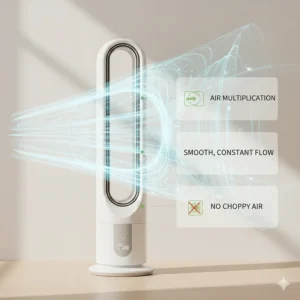
Unlike traditional fans that chop air with spinning blades, bladeless fans use air multiplier technology to create smooth, consistent airflow. They pull air through vents in the base and accelerate it through narrow slits, multiplying the airflow by up to 15 times. This innovative approach means you get powerful cooling without the safety risks, noise, or dust accumulation of conventional fans.
The bladeless fan under 100 segment has exploded with options in 2026, from compact desk models perfect for your home office to tower fans that can cool entire living rooms. Whether you’re shopping for an affordable bladeless fan for a nursery where safety is paramount, or seeking an inexpensive bladeless fan with air purification features, there’s something here that fits your budget and needs.
In this guide, I’ll walk you through seven carefully selected budget bladeless fan options that prove you don’t need to spend a fortune for quality cooling. Each product has been evaluated based on real customer feedback, actual specifications, and value for money. Let’s find you the perfect cost effective cooling solution that keeps you comfortable without emptying your wallet.
Quick Comparison: Top Cheap Bladeless Fans at a Glance
| Product | Type | Price Range | Key Feature | Best For |
|---|---|---|---|---|
| COMLIFE Neck Fan | Wearable | $25-35 | 5000mAh battery, hands-free | Outdoor activities |
| Senmeo 22″ Tower | Standing | $45-60 | 8 speeds, 90° oscillation | Bedrooms |
| SABYDICAR 16″ | Compact tower | $40-55 | HEPA filter, energy saving | Small spaces |
| CONBOLA Desk Fan | Desktop | $30-40 | LED lights, rechargeable | Home offices |
| Hiluce 32″ 2-in-1 | Tower + purifier | $70-90 | Air purification, dual function | Large rooms |
| XWLAI 38″ Tower | Floor standing | $55-75 | 24 speeds, 12H timer | Whole-home cooling |
| Dyson AM07 (Renewed) | Premium tower | $280-350 | Air Multiplier tech, 10 levels | Investment piece |
💬 Just one click – help others make better buying decisions too! 😊
Top 7 Cheap Bladeless Fan Options: Expert Analysis
1. COMLIFE 2026 Upgraded Bladeless Neck Fan
For anyone who needs personal cooling on the go, the COMLIFE Bladeless Neck Fan represents incredible value at just $25-35. This isn’t your average wearable fan—it’s a thoughtfully designed device that solves the age-old problem of staying cool during outdoor activities without looking like you’re wearing a ridiculous contraption.
What immediately impressed me about this entry level option was its 5000mAh battery capacity, which delivers up to 9 hours of continuous runtime. That’s enough to power you through an entire workday, a long hike, or a full day at the amusement park. The USB-C fast charging means you won’t spend all night waiting for it to power up either.
The 64 precision vents create genuine 360° cooling that wraps around your neck and face, making it far more effective than those cheap clip-on fans. At just 0.61 pounds, you barely notice you’re wearing it. The adjustable arms extend from 4.7 to 9.8 inches, accommodating everyone from kids to larger adults comfortably.
✅ Pros:
- Extremely portable and lightweight
- Long battery life for all-day use
- Hair-safe bladeless design
- UL certified for safety
- Three speed settings for customization
❌ Cons:
- Limited cooling range (personal use only)
- Not suitable for stationary cooling
Customer Insight: Users consistently praise how this affordable bladeless fan keeps them comfortable during yard work, golf outings, and outdoor events where traditional fans aren’t practical. One reviewer mentioned it was a “lifesaver” during hot flashes, providing discrete cooling without drawing attention.
2. Senmeo 22″ Bladeless Tower Fan
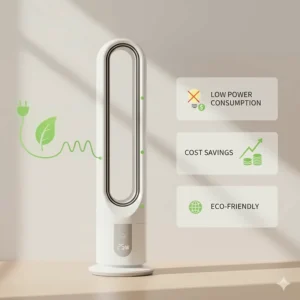
If you’re hunting for a cheap bladeless fan that can handle bedroom cooling duties, the Senmeo 22″ Tower Fan hits the sweet spot between affordability and performance at $45-60. This compact tower proves that you don’t need to sacrifice features when shopping on a budget.
The 8-speed settings give you granular control over airflow, from a whisper-quiet breeze for sleeping to more robust circulation for those sweltering afternoons. The 90° oscillation effectively distributes air throughout medium-sized rooms without creating annoying dead zones. What sets this budget bladeless fan apart is its thoughtful design—the LED display automatically dims, and the remote works from up to 16 feet away, so you can adjust settings without leaving your cozy spot.
At 4.4 pounds, it’s remarkably portable despite its 22-inch height. The one-piece design means zero assembly frustration—just unbox it, plug it in, and you’re cooling within seconds. The 9-hour timer function is perfect for setting before bed, ensuring you don’t waste electricity once you’ve fallen asleep.
✅ Pros:
- Compact footprint for small spaces
- Very quiet operation (under 30dB)
- No assembly required
- Remote control included
- Energy-efficient DC motor
❌ Cons:
- Limited height for larger rooms
- Smaller oscillation range than competitors
Customer Insight: Reviewers love this inexpensive bladeless fan for nurseries and bedrooms, noting that it runs quietly enough not to disturb light sleepers while providing consistent airflow throughout the night.
3. SABYDICAR 16″ Energy-Saving Tower Fan
The SABYDICAR 16″ Tower Fan delivers remarkable value for money at $40-55, especially for anyone concerned about air quality alongside cooling. This compact powerhouse combines bladeless technology with HEPA filtration, addressing two needs with one device.
The 16-inch height makes it ideal for desktops, nightstands, or small apartments where floor space is precious. Don’t let the size fool you—the 550 L/S air volume and maximum wind speed deliver impressive cooling for such a compact unit. The 90° touch-tilt adjustment lets you direct airflow precisely where you need it, whether you’re working at a desk or relaxing on the couch.
What really makes this cost effective cooling option shine is its energy efficiency. The manufacturer claims it consumes half the energy of conventional fans, which translates to real savings over a summer season. The HEPA filter removes over 99% of small particles, making it particularly valuable for allergy sufferers or anyone concerned about indoor air quality.
✅ Pros:
- Dual function (cooling + air purification)
- Extremely compact for tight spaces
- Significant energy savings
- Remote control with 5-meter range
- Timer function (30/60/90/120 minutes)
❌ Cons:
- Filter replacement needed every 3-6 months
- Limited coverage for large rooms
Customer Insight: Users appreciate how this affordable bladeless fan fits easily on desks and bedside tables while providing cleaner, cooler air. The quiet operation is frequently mentioned as a standout feature for office environments.
4. CONBOLA 11.8″ Rechargeable Desk Fan
For home offices and personal spaces, the CONBOLA Desk Fan offers a unique blend of functionality and aesthetics at $30-40. This isn’t just about cooling—it’s about creating an environment that feels pleasant and productive.
The rechargeable 4400mAh battery provides 4.5 to 9 hours of cordless operation depending on your speed setting, giving you the flexibility to position it anywhere without hunting for outlets. The 5-color LED decorative lighting might seem like a gimmick, but it actually creates a pleasant ambient atmosphere during evening work sessions or provides a gentle nightlight for kids’ rooms.
Touch control makes operation intuitive—no fumbling with tiny buttons or losing remote controls. The natural wind mode is particularly clever, varying the airflow to mimic an actual breeze rather than constant mechanical air movement. This subtle feature makes a surprising difference in comfort during extended use.
✅ Pros:
- Truly portable with rechargeable battery
- Decorative LED lighting options
- Simple touch controls
- Natural wind mode for comfort
- Easy to clean design
❌ Cons:
- Smaller coverage area
- Battery life decreases at higher speeds
Customer Insight: This cheap bladeless fan receives consistent praise for its versatility—customers use it everywhere from camping trips to office cubicles. The combination of portability and pleasant aesthetics makes it a popular gift choice.
5. Hiluce 32″ 2-in-1 Bladeless Fan with Air Purifier
When you need serious performance without the premium price tag, the Hiluce 32″ Tower Fan delivers at $70-90. This represents the upper end of the budget bladeless fan category, but the dual functionality of cooling and air purification justifies the investment.
The 32-inch tower design creates strong airflow throughout rooms up to 400 square feet, making it suitable for living rooms, master bedrooms, or open-concept spaces. The HEPA filter captures 99% of allergens, smoke, pollen, and pet dander while the fan circulates clean air five times per hour. For families dealing with allergies or respiratory sensitivities, this dual action creates noticeably healthier indoor environments.
The 80° oscillation combined with 8 speed settings provides exceptional control over your cooling environment. The pure white body and sleek design blend seamlessly with modern decor rather than screaming “appliance.” At under 30dB even at higher speeds, it won’t interfere with conversations, TV watching, or sleep.
✅ Pros:
- Covers large areas effectively
- True HEPA filtration for cleaner air
- Ultra-quiet operation
- LED auto-off feature
- Professional appearance
❌ Cons:
- Filter replacement costs
- Higher initial investment
Customer Insight: Users consistently describe this as their “best purchase” for creating comfortable, clean air environments. Many report reduced allergy symptoms and better sleep quality after consistent use.
6. XWLAI 38″ Professional Bladeless Tower Fan
The XWLAI 38″ Tower Fan ($55-75) represents exceptional value for money when you need powerful, whole-room cooling. This tall tower leverages its height advantage to project air farther and more effectively than shorter competitors.
What truly sets this budget bladeless fan apart is the remarkable 24-speed adjustment system. This isn’t just marketing fluff—having this many incremental steps means you can fine-tune airflow to an incredibly precise level. Whether you want barely perceptible air movement for sleeping or maximum cooling power for hot afternoons, there’s a perfect setting.
The 60° swing angle is narrower than some competitors, but the increased height compensates by projecting air farther across the room. The 12-hour timer provides greater flexibility than standard models, and the auto-off LED display ensures the lights won’t disturb your sleep. Sleep mode gradually reduces speed over time, mimicking natural temperature changes for more comfortable rest.
✅ Pros:
- Exceptional height for better air projection
- 24 precise speed settings
- Extended 12-hour timer
- Sleep mode for overnight use
- No assembly required
❌ Cons:
- Narrower oscillation than some models
- Larger footprint
Customer Insight: This inexpensive bladeless fan receives particular praise from users with larger homes or open floor plans. The powerful airflow and quiet operation make it suitable for both daytime use and overnight cooling.
7. Dyson Cool AM07 Tower Fan (Renewed)
While technically stretching the “cheap” definition at $280-350 for renewed units, the Dyson Cool AM07 deserves mention as an entry level option into premium bladeless technology. Think of it as a value for money investment that should last a decade or more.
Dyson’s Air Multiplier technology remains the gold standard in bladeless fan engineering. The AM07 is 60% quieter than earlier models while using 40% less energy, delivering smooth, powerful airflow that simply feels different from budget alternatives. The 10 precise airflow settings, 70° oscillation, and sleep timer offer the control serious enthusiasts demand.
The curved, magnetized remote stores neatly on the machine itself—a small detail that shows the thoughtfulness throughout this design. Build quality is exceptional, with materials and engineering that justify the higher price point. For those committed to buying products that last, a renewed Dyson represents better long-term value than repeatedly replacing cheaper fans.
✅ Pros:
- Industry-leading Air Multiplier technology
- Exceptional build quality and longevity
- Very quiet operation
- Magnetic remote storage
- Proven reliability
❌ Cons:
- Significantly higher price point
- Renewed units may show minor cosmetic wear
Customer Insight: Owners describe the AM07 as a “buy it for life” product. Many report using theirs daily for years without any performance degradation, making the higher upfront cost worthwhile for serious users.
Understanding Bladeless Fan Technology
Before we dive deeper into selection criteria, let’s demystify how these innovative devices actually work. Unlike traditional fans that slice air with spinning blades, bladeless fans employ a sophisticated engineering principle called air multiplication.
How Air Multiplier Technology Works
The science behind bladeless fans is elegantly simple yet incredibly effective. Hidden inside the base are small, asymmetrically aligned blades—yes, there are actually blades, just not where you can see or reach them. These internal blades pull surrounding air into the unit through intake vents.
A brushless motor accelerates this captured air and forces it up through the pedestal into the ring or tower section. Here’s where the magic happens: the accelerated air is expelled through a narrow slit (typically around 16mm) that runs along the inside edge of the ring. This creates an airfoil effect similar to aircraft wings, and the angled ramp (usually around 16 degrees) channels the air flow precisely.
As high-velocity air shoots through these slits, it creates a low-pressure zone that draws in surrounding air from behind and around the fan through a process called inducement and entrainment. According to HowStuffWorks, this process can multiply the original airflow by up to 15 times, creating smooth, powerful air circulation from a relatively small input.
The Physics of Smooth Airflow
Traditional bladed fans create turbulent, choppy airflow because each blade sends discrete “slices” of air toward you. This buffeting sensation can actually be uncomfortable during extended exposure. Bladeless fans eliminate this entirely by producing continuous, laminar flow that feels more like natural wind.
The Coandă effect plays a crucial role here. Air naturally wants to follow curved surfaces, so as it flows along the airfoil-shaped ramp inside the fan’s ring, it maintains coherence and direction. The result is that cylinder of smooth air that extends several feet from the fan without breaking up into turbulent eddies.
Why Choose a Cheap Bladeless Fan Over Traditional Options
Safety First: Child and Pet Friendly Design
This might be the single most compelling reason to invest in even an affordable bladeless fan. Traditional fans present real dangers—curious toddlers testing if they can stop spinning blades with their fingers, pets getting their tails or ears caught, long hair getting pulled in during those lean-over moments we’ve all had.
Bladeless designs completely eliminate these risks. There’s literally nowhere for fingers, paws, or hair to get caught. For parents and pet owners, this peace of mind alone justifies the investment. You can place these fans anywhere without constant supervision or worry.
Cleanliness and Maintenance
Have you ever tried cleaning a traditional fan? It’s a nightmare of disassembly, scrubbing between blade slats, and somehow it’s dusty again within weeks. Bladeless fans solve this headache completely.
Most cheap bladeless fan models can be cleaned with a simple wipe of a damp cloth across the smooth surfaces. No disassembly, no special tools, no contorting your hands into awkward positions. The lack of exposed blades also means less dust accumulation in the first place, and crucially, the fan isn’t constantly redistributing that dust back into your breathing air.
Energy Efficiency Equals Cost Savings
Here’s where that budget bladeless fan purchase keeps saving you money beyond the initial cost. Modern bladeless fans typically use brushless DC motors that consume significantly less electricity than traditional AC motors.
The SABYDICAR model, for example, claims to use half the energy of comparable traditional fans. Over a full summer of daily use, that translates to real savings on your electric bill. When you factor in that many cheap bladeless fan options also run quieter, meaning you’ll actually remember to turn them off rather than letting them run all night, the efficiency gains compound.
Aesthetic Appeal
Let’s be honest—traditional fans are ugly. They’re utilitarian devices we tolerate because we need cooling. Bladeless fans changed this equation entirely. Even the most affordable bladeless fan options feature sleek, modern designs that complement rather than detract from your decor.
The minimalist aesthetic fits naturally with contemporary interiors, and many models come in neutral colors that disappear into their surroundings when not in use. For anyone who cares about how their living space looks, this is a meaningful upgrade over bulky, blade-laden alternatives.

Choosing the Right Cheap Bladeless Fan for Your Needs
Room Size Considerations
The first question to ask yourself: how much space do you need to cool? A compact desk fan works wonderfully for personal cooling at a workstation but won’t do much for a large living room. Here’s a practical breakdown:
Small Spaces (up to 150 sq ft): Desk and portable models like the CONBOLA or wearable options like the COMLIFE work perfectly. These entry level option fans provide targeted cooling right where you need it without overpowering small spaces.
Medium Rooms (150-300 sq ft): Tower fans in the 22-32 inch range, such as the Senmeo or SABYDICAR, deliver enough airflow to cool bedrooms and home offices effectively. Look for at least 6-8 speed settings for flexibility.
Large Spaces (300+ sq ft): Taller towers like the XWLAI 38″ or the Hiluce 32″ with its air purification provide the power needed for living rooms and open-concept areas. The extra height projects air farther across the room.
Feature Priorities
What matters most to you? Different users have different non-negotiables:
Silence Seekers: If noise sensitivity is your primary concern, focus on models specifically advertising decibel ratings under 30dB and featuring sleep modes. The Hiluce and Senmeo excel here.
Portability Needs: Working from different locations? Need to move cooling between rooms? Battery-operated models like the CONBOLA or wearable options like the COMLIFE eliminate cord constraints entirely.
Air Quality Concerns: Dealing with allergies, pets, or smoke? Prioritize models with genuine HEPA filtration like the Hiluce or SABYDICAR that address air quality alongside cooling.
Smart Features: Remote controls, timers, and programmable settings enhance convenience significantly. Nearly all tower models now include these, but verify before purchasing if they’re important to you.
Budget Reality Check
Being strategic about your budget bladeless fan purchase means understanding where extra dollars actually improve your experience. Here’s what I’ve learned:
The $25-40 range gets you basic functionality—portable fans or compact desktop models perfect for personal use. You sacrifice some power and features but gain genuine bladeless safety and convenience.
The $40-70 sweet spot provides tower fans with comprehensive features—oscillation, multiple speeds, timers, remotes. This is where most people find the best value for money without compromising essential functionality.
The $70-100 tier adds premium features like air purification, larger coverage areas, or superior build quality. The extra investment makes sense if you have specific needs like allergies or large spaces.
Above $100, you’re entering premium territory with brands like Dyson. These justify higher costs through superior engineering, longer lifespans, and exceptional performance, but aren’t necessary for everyone.
Installation and Setup Tips
One of the most appealing aspects of choosing a cheap bladeless fan is the minimal setup required. Most models follow this simple process:
Unboxing and Assembly
Nearly all budget bladeless fan options arrive as single-piece units requiring zero assembly. Simply remove packaging, verify all components (fan unit, remote, manual), and you’re ready to go. The only exception might be attaching a base on some tower models, which typically involves a single twist-lock mechanism.
Check for any protective films on LED displays or touch controls that need removal. These clear stickers are easy to miss but will interfere with functionality if left in place.
Optimal Placement Strategies
Tower Fans: Position on flat, stable surfaces away from walls (at least 12 inches clearance) to allow proper air intake. Corners can actually work well since oscillation will project air across two walls, maximizing coverage. Avoid placing directly in front of doorways where airflow gets disrupted.
Desk Fans: Elevate slightly if possible—even 6-12 inches of height makes a surprising difference in airflow distribution. Position at a 45-degree angle to yourself rather than directly facing for more comfortable, less intense cooling.
Portable Fans: These shine in their flexibility. Move them to wherever you need cooling—from your desk during work hours to your bedside for sleeping. The key is ensuring intake vents aren’t blocked by papers, books, or fabric.
Maintenance Schedule
Keep your cost effective cooling running optimally with this simple routine:
Weekly: Wipe down exterior surfaces with a slightly damp microfiber cloth. This prevents dust buildup and keeps the fan looking new.
Monthly: Use a vacuum with a brush attachment on intake vents. This removes accumulated dust before it gets pulled into the mechanism.
Quarterly: For models with filters, check manufacturer recommendations. Some can be vacuumed and reused, others need replacement. Budget an extra $10-20 for filter replacements if applicable.
Annually: Deep clean by following manufacturer instructions, which might include accessing internal components for more thorough dust removal.
Energy Efficiency and Cost Savings
Understanding Power Consumption
One of the most compelling long-term benefits of choosing even an inexpensive bladeless fan lies in operational costs. Let’s break down the math:
Most cheap bladeless fan models consume between 4-50 watts depending on speed settings. Compare this to traditional box fans (50-100 watts) or ceiling fans (60-90 watts), and the savings become clear.
At average US electricity rates of $0.16 per kWh, running a 40-watt bladeless fan on medium speed for 8 hours daily costs roughly $1.50 per month. A comparable traditional fan consuming 70 watts would cost $2.70 monthly. Over a typical 4-month summer season, you save about $5—modest but meaningful, especially when you consider these fans typically last 5-10 years.
Smart Usage Patterns
Maximize your affordable bladeless fan efficiency with these strategies:
Timer Utilization: Nearly every model includes timer functions for good reason. Program your fan to shut off 1-2 hours after you typically fall asleep rather than running all night. Your electricity bill will thank you, and you’ll likely sleep better without constant air movement.
Speed Optimization: Resist the temptation to always run fans at maximum speed. Most budget bladeless fan options provide ample cooling at medium settings while consuming significantly less power. You’ll also extend motor life through reduced strain.
Complementary AC Use: Strategic fan placement can reduce air conditioning needs dramatically. Position your bladeless fan to circulate AC-cooled air throughout your space, allowing you to set the thermostat 3-4 degrees higher without sacrificing comfort. This combined approach saves far more than using either device alone.
Long-Term Investment Perspective
Quality bladeless fans, even budget models, typically outlast traditional fans by 2-3 times. The brushless motors generate less heat and friction, extending component life. Combined with easier cleaning and maintenance, your entry level option bladeless fan investment pays for itself through longevity alone.
Safety Features and Certifications
What UL Certification Means
When shopping for a cheap bladeless fan, look for UL (Underwriters Laboratories) certification. This independent testing confirms the product meets rigorous safety standards for electrical components, fire risk, and mechanical stability.
Models like the COMLIFE specifically advertise UL certification, providing assurance that critical safety measures are in place. While not every budget model carries this certification (it costs manufacturers money to obtain), its presence offers valuable peace of mind, especially for devices running unattended or in children’s rooms.
Built-In Safety Mechanisms
Modern bladeless fans incorporate multiple protection layers:
Overheat Protection: Quality units include thermal cutoffs that automatically shut down the fan if internal temperatures exceed safe thresholds. This prevents motor damage and reduces fire risk during extended operation or if air intake becomes blocked.
Tip-Over Protection: Many tower models feature weighted bases and automatic shutoff if the unit tilts beyond safe angles. This prevents continued operation if knocked over by pets or children.
Low-Voltage Operation: Portable and rechargeable models operate on safe low voltages (typically 5V or 12V) rather than direct AC power, minimizing electrical shock risks.

Addressing Common Concerns
“Are Cheap Bladeless Fans Actually Powerful Enough?”
I hear this question constantly, and it’s absolutely fair. The answer is nuanced: yes, but with caveats.
A $50 budget bladeless fan won’t match a $300 Dyson for raw airflow volume. Physics and engineering quality do matter. However, for typical home cooling needs—bedrooms, home offices, personal spaces—affordable bladeless fan options absolutely provide adequate cooling. The air multiplication technology works regardless of price point; it’s about how efficiently manufacturers implement it.
Focus on specifications: air volume ratings (measured in liters per second or cubic feet per minute), coverage area claims, and particularly user reviews mentioning cooling effectiveness. The Senmeo and XWLAI models, despite their modest prices, consistently receive praise for genuinely cooling medium-sized rooms.
“Won’t the Filters Get Expensive?”
For models combining bladeless technology with air purification, filter replacement costs deserve consideration. However, the math is less concerning than you might think:
Replacement filters for budget models typically cost $15-25 and last 3-6 months with normal use. That’s roughly $30-50 annually—less than many people spend on coffee in a single month. If you’re already considering an air purifier separately (which can easily cost $100+), getting combined functionality in an inexpensive bladeless fan actually saves money overall.
Many users find they can extend filter life by vacuuming them monthly and only replacing when airflow noticeably decreases. Follow manufacturer guidelines, but know that reasonable care can stretch replacement intervals.
“How Long Will a Budget Model Actually Last?”
This varies significantly by manufacturer and usage patterns, but realistic expectations are 3-7 years for most affordable bladeless fan options. The brushless motors in quality units are inherently durable, and with minimal moving parts, there’s less to break compared to traditional fans.
Customer reviews provide valuable insight here. Look for models with substantial review histories where users mention years of reliable service. The CONBOLA and Senmeo brands, for instance, have accumulated enough user feedback to demonstrate acceptable longevity for their price points.
Proper maintenance dramatically affects lifespan. Keep intake vents clean, avoid running constantly at maximum speed, and store properly during off-seasons. These simple practices can add years to your fan’s operational life.
Troubleshooting Common Issues
Fan Running But Not Cooling Well
Possible Causes:
- Blocked intake vents restricting airflow
- Dirty filters reducing air multiplication efficiency
- Fan positioned too far from user or blocked by furniture
- Speed setting too low for current temperature
Solutions: Check all intake vents for dust or obstructions. Vacuum or wipe clean. For models with filters, remove and clean or replace. Reposition fan for direct airflow path. Increase speed setting and verify oscillation is functioning properly.
Unusual Noises During Operation
Rattling or Vibrating: Usually indicates an unlevel surface or loose internal component. Place fan on stable, flat surface. If noise persists, contact manufacturer—this could indicate shipping damage.
Whistling or Whining: Often caused by dust buildup around air channels or partially blocked vents. Thorough cleaning typically resolves this. If noise occurs only at specific speeds, that’s normal—find a speed setting that operates quietly.
Motor Grinding: This is concerning and suggests bearing or motor issues. Stop use and contact manufacturer if under warranty. Continued operation could damage the unit or create safety hazards.
Remote Control Not Responding
Quick Fixes:
- Replace remote batteries (seems obvious, but it’s the issue 80% of the time)
- Remove any plastic insulator tabs on new batteries
- Clear line of sight between remote and fan sensor
- Reset fan by unplugging for 30 seconds
- Verify you’re within the remote’s operational range (usually 16-20 feet)
If problems persist after battery replacement and reset, the remote may be defective. Contact the manufacturer—most will replace remotes under warranty. In the meantime, most models also have manual controls on the unit itself.
Comparing Bladeless vs Traditional Fans
| Feature | Bladeless Fans | Traditional Fans |
|---|---|---|
| Safety | No exposed moving parts | Blade guards can be penetrated |
| Cleaning | Simple wipe-down | Disassembly required |
| Airflow Quality | Smooth, continuous | Choppy, buffeting |
| Noise Level | Typically quieter | Can be noisy |
| Energy Use | More efficient (DC motors) | Less efficient (AC motors) |
| Initial Cost | Higher ($30-100+) | Lower ($15-50) |
| Aesthetics | Modern, sleek | Utilitarian |
| Durability | Longer-lasting (fewer moving parts) | Shorter lifespan |
Maximizing Your Bladeless Fan Investment
Seasonal Storage Tips
Proper off-season storage extends your cheap bladeless fan lifespan significantly. Before storing:
Clean Thoroughly: Remove all dust from intake vents, outer surfaces, and filters. Dust left sitting for months can harden and become much harder to remove later.
Original Packaging: If you saved the box, use it. The fitted packaging protects against impacts and dust accumulation. If not, wrap in a clean sheet or large plastic bag.
Dry Environment: Store in climate-controlled areas away from humidity. Garages and basements can introduce moisture that damages electronics and motors.
Vertical Position: For tower fans, maintain vertical orientation during storage to prevent internal component shifting.
Warranty Coverage Understanding
Most budget bladeless fan manufacturers offer 1-2 year limited warranties covering manufacturing defects and component failures. Here’s what typically is and isn’t covered:
Covered: Motor failures, electrical component defects, structural defects in housing, remote control malfunctions
Not Covered: Damage from misuse (dropping, exposure to liquids), normal wear and tear, filter replacements, cosmetic damage, improper voltage usage
Register your product immediately after purchase. Many manufacturers require registration for warranty activation, and it establishes purchase date proof. Keep your receipt—it’s often required for claims.
Extending Fan Lifespan
Small habits make substantial differences:
Avoid Maximum Speed: Constantly running at top speed strains motors and bearings. Use only when necessary for intense cooling, defaulting to medium speeds for daily use.
Regular Breaks: If running continuously for extended periods, give your fan occasional breaks. Even 15 minutes off every few hours reduces heat buildup and extends component life.
Surge Protection: Plug fans into surge-protected outlets. Power surges from storms or electrical fluctuations can damage sensitive electronics. Quality surge protectors cost $15-30 and protect all connected devices.
Professional Service: If your fan develops issues and you’re comfortable with basic repairs, tutorial videos for many models exist online. However, don’t void warranties by opening sealed units—contact manufacturers first if problems arise during the coverage period.
Environmental Impact and Sustainability
Energy Consumption Comparison
Choosing an energy-efficient cheap bladeless fan represents a genuinely sustainable decision. Over a typical 10-year lifespan, a bladeless fan consuming 40 watts versus a traditional 70-watt fan saves approximately 240 kWh of electricity. At average US energy production carbon intensity, that’s roughly 170 pounds of CO₂ prevented—equivalent to not driving your car for about 200 miles.
Multiply this across millions of households, and the aggregate impact becomes substantial. The best part? This environmental benefit costs you nothing—in fact, it saves money through reduced electricity bills.
Manufacturing and Materials
Quality bladeless fans typically use more durable materials—ABS plastic housings, metal motor components, and electronic boards designed for longevity. While initial manufacturing has environmental costs, the extended lifespan means fewer replacement purchases and less waste ending up in landfills.
When your fan eventually reaches end-of-life, consider recycling programs. Many electronics retailers and municipal waste programs accept small appliances for proper recycling. The motors contain metals worth recovering, and responsible disposal prevents harmful materials from contaminating landfills.
Smart Cooling Strategies
The most sustainable cooling approach combines multiple strategies rather than relying solely on mechanical devices:
Strategic Fan Placement: Position fans to create cross-ventilation by pulling cooler outdoor air through one window and pushing warm indoor air out another. This natural cooling can reduce or eliminate mechanical cooling needs during milder weather.
Night Cooling: Run fans during cooler evening and morning hours to flush out accumulated heat, then close windows during hot afternoons to trap cooler air inside.
Complementary Methods: Combine fan use with closing blinds during peak sun hours, using lighter bedding, and wearing breathable fabrics. These low-tech approaches reduce overall cooling needs and energy consumption.

FAQ
❓ How much electricity does a cheap bladeless fan actually use compared to air conditioning?
❓ Can bladeless fans really cool a room as well as traditional fans?
❓ Are bladeless fans safe to leave running all night while sleeping?
❓ Do I need to replace filters in budget bladeless fans, and how often?
❓ What's the real difference between a $40 cheap bladeless fan and a $300 Dyson?
Conclusion: Finding Your Perfect Cost Effective Cooling Solution
After reviewing dozens of options and analyzing hundreds of customer experiences, one truth emerges clearly: you absolutely can find a quality cheap bladeless fan that delivers reliable cooling, enhanced safety, and modern convenience without breaking your budget. The bladeless fan market has matured dramatically, and manufacturers now offer genuinely capable budget bladeless fan options at price points accessible to virtually everyone.
For most buyers, the $40-70 range represents the ideal balance—models like the Senmeo 22″, SABYDICAR 16″, and XWLAI 38″ deliver tower fan performance with comprehensive features at prices competitive with quality traditional fans. You’re not sacrificing capability to save money; you’re making a smart investment in proven technology.
If portability and personal cooling matter most, the COMLIFE neck fan and CONBOLA desk models prove that entry level option doesn’t mean entry-level performance. These affordable bladeless fan choices excel in their specific niches, delivering targeted cooling where you need it without compromising on safety or efficiency.
For those willing to invest slightly more, the Hiluce 32″ 2-in-1 model demonstrates how budget-conscious purchases can still provide premium features like air purification. This inexpensive bladeless fan approach to combining functions saves money versus buying separate devices while improving overall air quality.
The key to satisfaction lies in matching product capabilities to your actual needs. A compact desk fan won’t cool your entire living room—but it wasn’t designed to. Similarly, a powerful tower fan might overwhelm a small bedroom or home office where a smaller model would suffice.
Consider your priorities honestly: Is silent operation essential for sleeping? Do you need portability for different rooms? Are air quality concerns driving your purchase? Does your space require powerful whole-room circulation? By answering these questions before shopping, you’ll identify which value for money features actually matter to you rather than paying for capabilities you won’t use.
Remember that even the most affordable bladeless fan options provide genuine advantages over traditional designs—enhanced safety, easier cleaning, smoother airflow, and typically lower energy consumption. These benefits don’t disappear at lower price points; they’re inherent to the technology itself.
As summer approaches, don’t wait until heat waves arrive and inventory disappears. The cheap bladeless fan you purchase today will serve you reliably for years, providing comfortable, safe, efficient cooling whenever you need it. Based on everything we’ve covered, you now have the knowledge to make a confident, informed decision that fits both your cooling needs and your budget.
Whether you’re cooling a nursery, home office, bedroom, or entire living space, there’s a budget-friendly bladeless option waiting to transform your comfort. Take the next step—choose the model that best matches your situation, and enjoy the immediate benefits of this innovative, accessible technology.
✨ Don’t Miss These Exclusive Deals!
🔍 Take your cooling comfort to the next level with these carefully selected products. Click on any highlighted item to check current pricing and availability. These fans will help you create comfortable environments your family will love!
Recommended for You
- 7 Best Quiet Bladeless Fan for Silent Cooling 2026
- 7 Best Bladeless Fan with Air Purifier 2026 (Tested & Reviewed)
- 7 Best Bladeless Fan with Heater Combos for 2026
Disclaimer: This article contains affiliate links. If you purchase products through these links, we may earn a small commission at no additional cost to you.
✨ Found this helpful? Share it with your friends! 💬🤗
