
In This Article
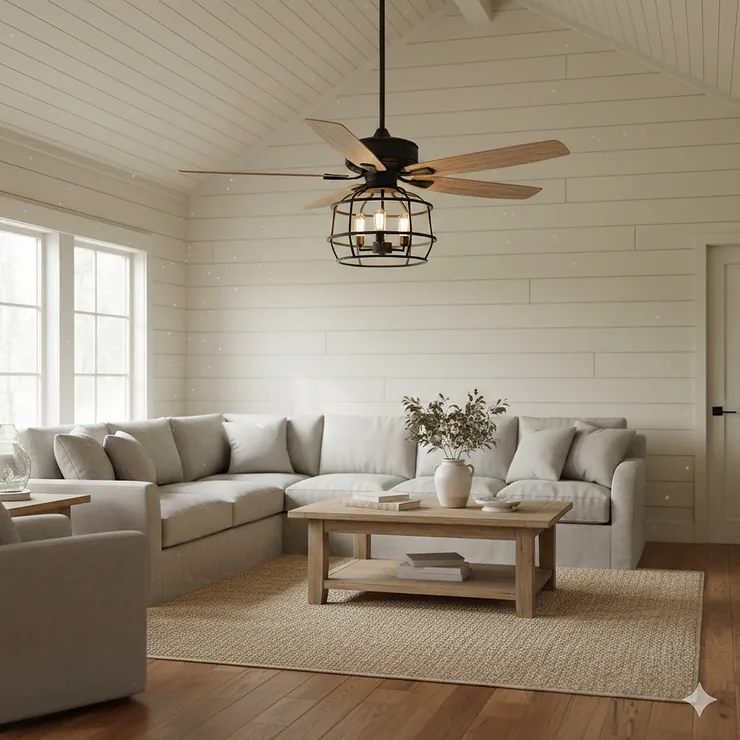
Picture this: you’re sitting in your living room on a warm summer evening, and a gentle breeze whispers through the space. That’s not just any breeze, though. It’s the carefully crafted airflow from a farmhouse ceiling fan that’s doing double duty as both functional cooling and stunning décor.
I’ve spent countless hours researching and analyzing farmhouse ceiling fan options, and honestly? The market has never been more exciting. These aren’t your grandmother’s ceiling fans anymore (though they do have that charming vintage appeal). Modern farmhouse ceiling fans blend rustic aesthetics with cutting-edge technology, offering everything from whisper-quiet DC motors to smart home integration.
What makes a farmhouse ceiling fan special? It’s all about that perfect marriage of form and function. Think natural wood tones paired with industrial metal accents, cage-style lighting that creates dramatic shadows, and designs that instantly transport you to a cozy countryside retreat. Whether you’re renovating a century-old cottage or adding character to a modern suburban home, the right farmhouse ceiling fan becomes the centerpiece that ties everything together.
The best part? You’re not sacrificing performance for style. Today’s farmhouse ceiling fans deliver powerful airflow while consuming up to 60% less energy than conventional models, according to ENERGY STAR standards.
Quick Comparison Table: Top Farmhouse Ceiling Fans at a Glance
| Fan Model | Size | Price Range | Best Feature | Room Size |
|---|---|---|---|---|
| SHLUCE 19″ Caged Flush Mount | 19″ | $89-$129 | Compact bladeless design | Small (100-150 sq ft) |
| Fanbulous 65″ Large | 65″ | $199-$249 | Dual-finish 8 blades | Extra large (400+ sq ft) |
| Melkelen 52″ Industrial | 52″ | $149-$189 | Cage light with barnwood blades | Medium (200-300 sq ft) |
| BOOSANT 52″ Solid Wood | 52″ | $159-$199 | Paulownia wood construction | Medium-Large (300 sq ft) |
| Hunter Builder 52″ | 52″ | $119-$159 | Budget-friendly classic | Medium (225 sq ft) |
| Minka-Aire Barn 65″ | 65″ | $599-$749 | Premium 10-blade smart fan | Large (400+ sq ft) |
| Prominence Home Reston 42″ | 42″ | $99-$139 | Dual finish LED | Small-Medium (200 sq ft) |
💬 Just one click – help others make better buying decisions too! 😊
Top 7 Farmhouse Ceiling Fans: Expert Analysis
1. SHLUCE 19″ Farmhouse Flush Mount Caged Ceiling Fan – Best Compact Option
When space is at a premium but style isn’t negotiable, the SHLUCE 19″ Caged Ceiling Fan (Model: FLA003A) delivers surprisingly robust performance from a compact footprint. This bladeless design features eight hidden ABS blades encased in a rustic metal cage, creating that coveted industrial farmhouse aesthetic.
Key Specifications:
- 19-inch diameter flush mount design
- 6-speed reversible DC motor
- Integrated LED lighting with remote control
- ETL certified for safety
The reversible motor is clutch for year-round use. Summer mode pushes cool air down, while winter mode circulates warm air from the ceiling. At around $89-$129, it’s an affordable entry point that doesn’t skimp on quality. Customer feedback consistently praises the quiet operation and easy installation, with most functional components pre-assembled.
✅ Pros:
- Perfect for rooms with low ceilings (8 feet or less)
- Bladeless design safe for children’s rooms
- Includes 2-year warranty plus 30-day refund policy
❌ Cons:
- Limited airflow for rooms over 150 square feet
- Cage design requires occasional dust cleaning
2. Fanbulous 65 Inch Ceiling Fan – Best for Large Spaces
If you’re dealing with a sprawling living room or great room, the Fanbulous 65 Inch Farmhouse Ceiling Fan commands attention while moving serious air. This beast features eight dual-finish blades (black/brown or grey/brown options) that span five-plus feet.
Key Specifications:
- 65-inch blade span covers up to 400 square feet
- DC motor with 6-speed settings
- 3-color temperature LED (3000K/4000K/5000K)
- Adjustable downrods: 5″/10″/15″
What sets this fan apart is its thoughtful engineering. The DC motor runs whisper-quiet while delivering powerful circulation, and the adjustable downrods accommodate ceiling heights from 8 to 15 feet. You can mount it on sloped ceilings up to 15 degrees without breaking a sweat.
Priced between $199-$249, it’s a mid-range option that performs like a premium model. The timer function (1/4/8 hours) means you won’t wake up freezing at 3 AM, and the reversible direction handles both cooling and heating seasons effortlessly.
✅ Pros:
- Exceptional coverage for open floor plans
- Energy-efficient DC motor saves up to 70% compared to AC
- Remote and app control included
❌ Cons:
- Installation requires two people due to size
- Higher price point than smaller options
3. Melkelen Farmhouse Ceiling Fan 52 Inch – Best Industrial Cage Design
The Melkelen MK03-BK nails that industrial farmhouse vibe with its matte black body and distinctive cage light fixture. Five dual-finish blades (black/barnwood) spin within a sturdy metal frame that screams authentic countryside charm.
Key Specifications:
- 52-inch diameter ideal for 200-300 square foot rooms
- Reversible quiet wind motor
- Industrial cage light (2x E26 base, 60W max)
- Optional 6″ or 10″ downrods included
This fan excels at creating ambiance. The Edison-style bulb compatibility (bulbs sold separately) casts gorgeous shadows through the cage design, transforming ordinary rooms into cozy retreats. Customer reviews highlight the solid construction and easy remote operation, with separate fan and light controls plus timing options (2H/4H/8H).
At $149-$189, the Melkelen hits a sweet spot for buyers wanting premium aesthetics without premium pricing. Melkelen’s decade-plus experience in fan manufacturing shows in the attention to detail and quality materials.
✅ Pros:
- Angle mounting up to 10 degrees for vaulted ceilings
- Authentic barnwood blade finish adds rustic warmth
- 30-day money-back guarantee
❌ Cons:
- Bulbs not included with purchase
- Cage assembly adds 15-20 minutes to installation
4. BOOSANT 52″ Solid Wood Ceiling Fan – Best Premium Wood Construction
For purists who appreciate genuine craftsmanship, the BOOSANT 52″ Ceiling Fan features three blades carved from 20-year-old Paulownia wood. This isn’t particle board pretending to be wood – it’s the real deal, hand-polished through over 30 artisan processes.
Key Specifications:
- Genuine Paulownia wood blades (known as “King of the Red Forest”)
- ETL certified DC pure copper core motor
- 230 RPM maximum speed, 7525 CFM airflow
- Input power: only 35W at full speed
The engineering nerds will love this: BOOSANT’s wide voltage DC inverter technology maintains consistent speed even when voltage fluctuates between 85-280V. Translation? Smooth, reliable performance that saves up to 75% on energy costs compared to traditional AC motors. You can literally run this fan at lowest speed for 476 hours on just 1 kWh of electricity.
Priced at $159-$199, it represents serious value considering the solid wood construction and lifetime motor warranty. One verified buyer noted the blades have a “delicate soft texture with glossy wood grain” that genuinely enhances home décor rather than merely existing as functional equipment.
✅ Pros:
- Authentic wood adds natural warmth impossible to replicate with synthetic materials
- Runs 476 hours per kWh at low speed
- Lifetime motor warranty demonstrates manufacturer confidence
❌ Cons:
- No integrated lighting (sold separately)
- Three-blade design generates less airflow than 5-blade models
5. Hunter Builder 52″ Ceiling Fan – Best Budget-Friendly Classic
The Hunter Builder 52″ proves you don’t need to drain your wallet for reliable performance. Hunter’s been manufacturing ceiling fans since 1886, and that institutional knowledge shows in this straightforward, dependable model.
Key Specifications:
- 52-inch reversible blades
- Three flared glass globes for lighting
- 3-inch downrod included
- WhisperWind motor technology
This fan strips away bells and whistles, focusing instead on core competencies: moving air quietly and looking good while doing it. The WhisperWind motor delivers 33% higher air velocity than leading competitors while maintaining wobble-free performance. It’s ideal for bedrooms where noise sensitivity matters most.
Bob Vila’s testing team called installation “standard and straightforward” with clear illustrated instructions. The only notable omission? No remote control – you’ll use pull chains for speed and light adjustments. But at $119-$159, that’s a trade-off many homeowners gladly accept.
✅ Pros:
- Hunter’s 135+ year reputation for quality
- ENERGY STAR certified efficiency
- Perfect for standard 8-foot ceilings
❌ Cons:
- Pull chain operation only (no remote)
- Basic design lacks industrial cage aesthetic
6. Minka-Aire Barn 65″ LED Smart Ceiling Fan – Best Premium Smart Option
When budget isn’t the primary concern, the Minka-Aire Barn 65″ delivers farmhouse elegance amplified by smart home integration. Ten blades create a distinctive barn-inspired aesthetic while generating powerful, evenly-distributed airflow.
Key Specifications:
- 65-inch blade span with 10 individual blades
- Smart home compatible (remote included)
- Integrated LED lighting with dual control
- Suitable for sloped ceilings (4:12 pitch tested)
Bob Vila’s testing team initially worried the ten-blade assembly would consume hours, but assembly clocked in under 45 minutes. The included 10-inch drop bar accommodates sloped ceilings without blade collision, and the remote control smoothly adjusts both fan speed and light intensity (once you master the dual-button dimming technique).
This premium option runs $599-$749, positioning it firmly in investment territory. You’re not just buying a fan – you’re installing a statement piece that guests will notice and compliment. The ten-blade configuration creates incredibly smooth, turbulence-free airflow that larger rooms genuinely benefit from.
✅ Pros:
- Professional-grade construction and aesthetics
- Handles sloped ceilings effortlessly
- Ten blades create uniquely smooth airflow pattern
❌ Cons:
- Significant upfront investment
- Light dimming requires reading instructions carefully
7. Prominence Home Reston 42″ Modern Farmhouse – Best for Smaller Rooms
Don’t overlook smaller spaces. The Prominence Home Reston brings modern farmhouse styling to bedrooms, dens, and medium-sized areas where a 52-inch fan would overwhelm the room.
Key Specifications:
- 42-inch blade span (ideal for rooms under 400 sq ft)
- Dual finish blades: Gray Cedar / Light Oak
- Integrated LED (2700K color temperature, 450 lumens)
- Pewter finish cylindrical housing
The dual-finish blade design offers installation flexibility – flip them to match your existing décor palette. The frosted white globe provides soft, dimmable LED illumination (20-100% range) without harsh shadows. Pull chain controls keep operation simple and reliable.
At $99-$139, the Reston represents exceptional value for smaller applications. Prominence Home backs it with a limited lifetime warranty, demonstrating confidence in long-term durability. Customer reviews consistently mention the quiet reversible motor and clean contemporary lines that complement both coastal and farmhouse aesthetics.
✅ Pros:
- Dual mount compatible (downrod or angled)
- Included LED bulbs use 90% less energy than incandescent
- Limited lifetime warranty
❌ Cons:
- 42-inch span insufficient for larger rooms
- No remote control option
✨ Don’t Miss These Exclusive Deals!
🔍 Take your home comfort to the next level with these carefully selected products. Click on any highlighted item to check current pricing and availability. These tools will help you create authentic farmhouse ambiance your family will love!
Understanding Farmhouse Ceiling Fan Styles
Farmhouse design occupies a unique middle ground between rustic and modern aesthetics. According to design experts at Bob Vila, farmhouse style typically features lighter wood grains and fresher color palettes compared to darker rustic designs, while still incorporating natural materials and traditional craftsmanship.
Key Design Elements
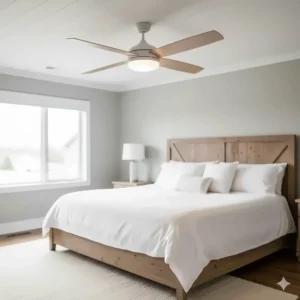
Wood Finishes: Genuine farmhouse ceiling fans often showcase natural wood tones – think weathered oak, light maple, or distressed barnwood. These finishes add warmth without overwhelming the space. The wood might be stained, sealed against moisture, or even hand-carved for authentic texture.
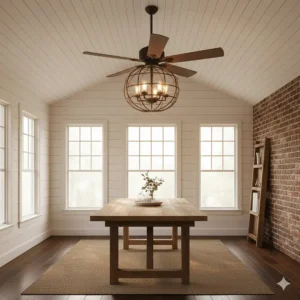
Industrial Accents: Many modern farmhouse ceiling fans incorporate metal elements that reference agricultural or industrial heritage. Cage-style light fixtures, exposed Edison bulbs, and wrought iron hardware create visual interest while maintaining that countryside connection.
Color Schemes: While traditional farmhouse leans toward neutrals (whites, creams, soft grays), modern interpretations aren’t afraid of bold contrast. Matte black against weathered wood creates drama, while pewter or brushed nickel offers subtle sophistication.
Energy Efficiency: Why It Matters More Than Ever
Here’s something most people don’t realize: ceiling fans don’t actually lower room temperature. According to the U.S. Department of Energy, they create a wind chill effect that makes you feel cooler by helping moisture evaporate from your skin more quickly.
The Numbers That Matter
ENERGY STAR certified ceiling fans operate up to 60% more efficiently than conventional models. That might sound modest, but it translates to real savings. By using a farmhouse ceiling fan strategically, you can raise your thermostat setting by about 4°F during summer without reducing comfort. The U.S. Department of Energy estimates you’ll save approximately 1% on your utility bill for every degree you raise the thermostat.
Run the math: if your monthly cooling costs average $150 during summer, a 4-degree thermostat adjustment could save $6-$8 per month, or $24-$32 over a typical cooling season. Multiply that across multiple fans in different rooms, and the savings compound quickly.
DC vs AC Motors: What You Need to Know
Traditional AC (alternating current) motors have powered ceiling fans for decades, but DC (direct current) motors represent a significant efficiency upgrade. DC motors consume 70-75% less electricity while delivering equivalent or superior airflow. They also run quieter, generate less heat, and offer more speed settings for precise comfort control.
The University of Florida’s Extension service confirms that DC motor fans can run at low speed for extended periods using minimal electricity – some models operate 476 hours per kilowatt-hour. That’s essentially free cooling when you consider typical electricity rates.
DC Motor vs AC Motor Comparison
| Feature | DC Motor | AC Motor |
|---|---|---|
| Energy Efficiency | 70-75% less consumption | Standard consumption |
| Noise Level | Whisper-quiet (<30dB) | Moderate (35-45dB) |
| Speed Settings | 6-8 speeds typical | 3 speeds typical |
| Lifespan | 10-15+ years | 5-10 years |
| Price Range | $150-$300 | $80-$150 |
✨ Don’t Miss These Exclusive Deals!
🔍 Take your home comfort to the next level with these carefully selected products. Click on any highlighted item to check current pricing and availability. These tools will help you create authentic farmhouse ambiance your family will love!
Room Size Matters: Matching Fan to Space
Installing the right-sized farmhouse ceiling fan prevents both inadequate cooling and overwhelming aesthetics. The Department of Energy provides clear guidance on proper sizing.
Square Footage Guidelines
Small Rooms (up to 144 sq ft): 29-36 inch diameter fans work best. Think powder rooms, small bedrooms, or walk-in closets.
Medium Rooms (144-225 sq ft): 36-42 inch fans provide adequate coverage. Perfect for standard bedrooms, home offices, or breakfast nooks.
Medium-Large Rooms (225-400 sq ft): 44-52 inch fans handle these spaces comfortably. Most living rooms, primary bedrooms, and dining rooms fall into this category.
Large Rooms (400+ sq ft): 52-60+ inch fans become necessary. Great rooms, vaulted spaces, and open floor plans require these larger models. In rooms longer than 18 feet, multiple fans work better than a single oversized unit.
Room Size to Fan Size Reference Table
| Room Square Footage | Recommended Fan Size | Typical Rooms |
|---|---|---|
| Up to 75 sq ft | 29-36 inches | Bathroom, Small closet |
| 76-144 sq ft | 36-42 inches | Small bedroom, Office |
| 144-225 sq ft | 42-48 inches | Standard bedroom, Den |
| 225-400 sq ft | 48-54 inches | Living room, Primary bedroom |
| 400+ sq ft | 52-65+ inches | Great room, Open floor plan |
Ceiling Height Considerations
Standard 8-foot ceilings require fans mounted 7 feet above the floor for safety and optimal performance. This typically means flush mount or hugger designs work best. For ceilings 9 feet or higher, downrod-mounted fans improve airflow by positioning blades closer to occupants.
Sloped or vaulted ceilings need special consideration. Most quality farmhouse ceiling fans include angled mounting brackets that accommodate pitches up to 15-20 degrees, ensuring blades remain parallel to the floor regardless of ceiling angle.
Installation Best Practices
Even if you’re hiring an electrician, understanding installation basics helps you make informed decisions about placement and electrical requirements.
Electrical Considerations
All ceiling fans require secure mounting to a ceiling joist or support beam. Never attempt to mount a fan to a standard light fixture box – the vibration and weight will eventually cause failure. Ceiling-rated electrical boxes specifically designed for fans handle the dynamic loads safely.
Most farmhouse ceiling fans operate on standard 120-volt household current and draw between 50-100 watts at full speed. Compare that to air conditioners consuming 500-2,000 watts, and the efficiency advantage becomes crystal clear.
Blade Clearance Requirements
For safety and performance, maintain at least 30 inches between blade tips and any wall or obstruction. The fan should sit at least 7 feet above the floor, with 8-9 feet being ideal for optimal air circulation.
In rooms with furniture like four-poster beds or tall bookcases, measure carefully to ensure adequate clearance at all points during blade rotation. Nothing ruins farmhouse ambiance quite like rhythmic thumping as blades strike nearby objects.
Maintenance and Longevity
Quality farmhouse ceiling fans should provide decades of reliable service with minimal maintenance. Here’s what you need to know about keeping them running smoothly.
Regular Cleaning Schedule
Dust accumulates on fan blades surprisingly quickly, reducing efficiency and creating an unsightly mess when the fan starts spinning after sitting idle. Clean blades monthly using a microfiber cloth or damp paper towel. For fans mounted high or in hard-to-reach locations, extendable dusters with pivoting heads make the job easier.
Cage-style farmhouse designs require occasional deeper cleaning. Disassemble the cage according to manufacturer instructions and wipe down each component to prevent dust buildup that dims lighting and reduces aesthetic appeal.
Motor Maintenance
Modern DC motors with sealed bearings require essentially zero maintenance. Oil bath motors (found in some older or budget models) need occasional oil addition – check your owner’s manual for specific recommendations.
If you notice wobbling, noise, or reduced performance, first check that all blade screws remain tight and blades haven’t warped from moisture exposure. Most problems stem from loose hardware rather than motor failure.
Wood Blade Care
Genuine wood blades benefit from occasional conditioning to prevent drying, cracking, or warping. Use furniture polish or wood conditioner every 6-12 months, applying sparingly and wiping away excess. Avoid excessive moisture, which can cause warping or delamination in composite wood construction.
Smart Home Integration
Modern farmhouse ceiling fans increasingly support smart home ecosystems, bringing voice control and automation to traditionally low-tech appliances.
Available Technologies
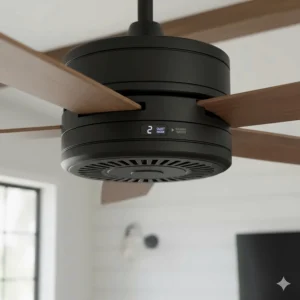
Wi-Fi Integration: Some models connect directly to your home network, enabling control through smartphone apps. You can adjust fan speed, lighting, and direction from anywhere – useful when you forget to turn off the fan before leaving for vacation.
Voice Assistant Compatibility: Alexa, Google Assistant, and Siri integration allows hands-free control. “Alexa, set the bedroom fan to medium” becomes second nature quickly.
Scheduling and Automation: Smart fans can turn on automatically when temperature rises above set thresholds or follow schedules that match your daily routine. Run the fan during peak cooling hours, then shut off automatically overnight.
The premium Minka-Aire Barn and similar high-end models support these features natively, while aftermarket smart switches can add basic smart functionality to traditional fans at lower cost.
Blade Pitch and Airflow Science
Blade pitch – the angle at which blades sit relative to the ceiling – significantly impacts performance. Most farmhouse ceiling fans feature blade pitches between 12-15 degrees.
The Physics Behind Performance
Steeper pitch angles (15+ degrees) move more air per revolution but require more powerful motors and consume more electricity. Manufacturers must balance airflow against efficiency and noise levels.
Blade material matters too. Solid wood blades are heavier than composite or plastic alternatives, requiring more powerful motors but potentially creating more momentum once spinning. Engineered wood and ABS plastic blades reduce weight while maintaining structural integrity, allowing efficient performance from smaller motors.
The ENERGY STAR program uses a metric called Ceiling Fan Energy Index (CFEI) that accounts for airflow, energy consumption, and standby power to provide comprehensive efficiency ratings. Look for CFEI ratings above 1.0, with higher numbers indicating superior performance.
Lighting Options and Ambiance
Many farmhouse ceiling fans integrate lighting, serving dual purposes in rooms where space or budget constraints make separate fixtures impractical.
Light Kit Styles
Edison Bulbs: These vintage-style filament bulbs create warm, inviting illumination perfect for farmhouse aesthetics. Available in various shapes (globe, torpedo, standard) and color temperatures.
Cage Enclosures: Industrial-style cages protect bulbs while creating distinctive shadow patterns. The interplay between light, metal, and shadow adds depth and character to rooms.
Frosted Globes: Softer diffused lighting reduces harsh shadows and provides more even illumination. Better for task-oriented spaces like kitchens or home offices.
LED Integration: Many modern fans feature integrated LED arrays rather than traditional bulb sockets. While this reduces replacement costs and improves efficiency, it also means you can’t swap bulbs to change color temperature or brightness (beyond dimming).
Color Temperature Considerations
Measured in Kelvin, color temperature dramatically impacts ambiance. Warm white (2700K-3000K) creates cozy, relaxed environments perfect for living rooms and bedrooms. Neutral white (3500K-4000K) provides better visibility for task areas. Cool white (5000K+) mimics daylight but can feel sterile in farmhouse settings.
Many premium farmhouse ceiling fans now offer adjustable color temperature, letting you shift from warm evening ambiance to brighter daytime illumination with remote control adjustments.
Seasonal Operation: Summer vs Winter
One of the most underutilized features of ceiling fans is the reversible motor that changes blade rotation direction.
Summer Mode (Counterclockwise)
During warm months, blades should rotate counterclockwise when viewed from below. This pushes air directly downward, creating the wind chill effect that makes you feel cooler. Set the fan to higher speeds for maximum cooling effect.
The Department of Energy confirms this allows you to raise thermostat settings by about 4°F without comfort reduction, translating to significant energy savings when you’re not constantly running air conditioning.
Winter Mode (Clockwise)
Reverse the motor direction to clockwise for winter operation, running the fan at low speed. This pulls cool air upward and pushes warm air (which naturally rises to the ceiling) back down along the walls and into the living space.
This gentle circulation can improve heating efficiency by up to 15% according to energy conservation research, preventing temperature stratification where the ceiling is 10-15 degrees warmer than the floor level.
Many people forget this winter setting exists, essentially wasting half the fan’s potential value. Set a reminder when you change thermostat settings for the season.
Budget Considerations: What to Expect
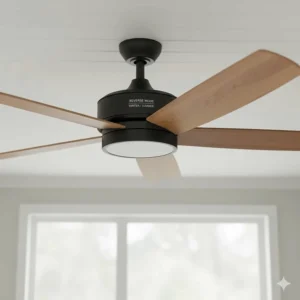
Farmhouse ceiling fans span a wide price spectrum, from budget-friendly basics under $100 to statement pieces exceeding $700.
Entry-Level ($80-$150)
These fans cover essential functionality – moving air and looking decent while doing it. Expect AC motors, simpler remote controls, and composite materials. The SHLUCE, Prominence Home Reston, and Hunter Builder fall into this category, offering solid value for cost-conscious buyers.
Quality varies significantly at this price point. Stick with established brands that back products with warranties and have responsive customer service. The lowest-priced options often sacrifice motor quality, blade balance, or finish durability.
Mid-Range ($150-$300)
Here you’ll find DC motors, better construction materials, more sophisticated remote controls, and improved aesthetics. The Fanbulous, BOOSANT, and Melkelen models demonstrate what’s achievable in this sweet spot – genuine wood or metal components, quiet operation, and designs that command attention.
This category offers the best performance-to-price ratio for most homeowners. You’re getting 80% of premium features at 40% of premium prices.
Premium ($300+)
Top-tier farmhouse ceiling fans like the Minka-Aire Barn deliver exceptional build quality, lifetime warranties, smart home integration, and breathtaking aesthetics. You’re paying for superior materials, advanced engineering, and designs developed by professional industrial designers rather than commodity manufacturers.
Justify the investment if the fan occupies a central position in a room where you spend significant time, if it serves as a focal point for your home’s aesthetic, or if energy efficiency savings will compound over decades of use.
Price vs Features Comparison
| Price Range | Motor Type | Materials | Warranty | Best For |
|---|---|---|---|---|
| $80-$150 | AC Motor | Composite/Basic wood | 1-2 years | Budget-conscious buyers |
| $150-$300 | DC Motor | Real wood/Metal | 2-5 years | Value seekers |
| $300+ | Premium DC | Premium materials | Lifetime | Statement pieces |
FAQ
❓ What is the best farmhouse ceiling fan size for a 300 square foot room?
❓ Do farmhouse ceiling fans actually save money on electricity bills?
❓ Can I install a farmhouse ceiling fan on a sloped ceiling?
❓ Which farmhouse ceiling fan is quietest for bedroom use?
❓ How often should I clean farmhouse ceiling fan blades?
Conclusion: Choosing Your Perfect Farmhouse Ceiling Fan
After analyzing dozens of options and comparing specifications, performance data, and customer experiences, the ideal farmhouse ceiling fan depends entirely on your specific situation. Room size matters most – undersized fans disappoint while oversized fans overwhelm. Match blade span to square footage using Department of Energy guidelines for optimal results.
Budget-conscious buyers should seriously consider the Hunter Builder 52″ or SHLUCE 19″ Flush Mount for reliable performance without premium pricing. Both deliver essential functionality backed by manufacturers with solid reputations and responsive customer support.
If you’re willing to invest in the mid-range sweet spot, the Fanbulous 65″ and BOOSANT 52″ represent exceptional value. DC motors, genuine wood construction, and thoughtful engineering details elevate these beyond commodity products into genuine home upgrades that’ll perform flawlessly for decades.
For buyers where budget isn’t the primary constraint, the Minka-Aire Barn 65″ justifies its premium positioning with professional-grade construction, smart home integration, and aesthetics that guests will notice and compliment. Sometimes the best value lies in buying quality once rather than replacing mediocre options every few years.
Remember that farmhouse ceiling fans serve dual purposes – functional cooling and aesthetic enhancement. Don’t compromise on either aspect. The right fan becomes a cherished feature that improves daily comfort while defining your home’s character. Take time to measure properly, read reviews thoroughly, and choose options from manufacturers who stand behind their products with meaningful warranties.
Your farmhouse ceiling fan represents an investment in year-round comfort and decade-spanning reliability. Choose wisely, install properly, and enjoy the perfect blend of rustic charm and modern performance.
Recommended for You
- 7 Best Crystal Ceiling Fans 2025: Expert Reviews & Guide
- 7 Best Three Blade Ceiling Fans 2025: Smart Buying Guide
- 7 Unique Ceiling Fans That Transform Any Space in 2025
Disclaimer: This article contains affiliate links. If you purchase products through these links, we may earn a small commission at no additional cost to you.
✨ Found this helpful? Share it with your friends! 💬🤗
