
In This Article
I never thought much about the air I breathe at home until last spring. My allergies were getting worse, my bedroom felt stuffy, and traditional fans just pushed around dusty air. That’s when I discovered the bladeless fan with air purifier combo that completely transformed my indoor environment.
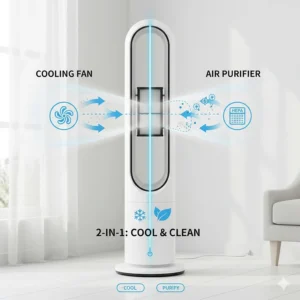
Here’s the thing most people don’t realize: while regular fans circulate air, they’re also circulating dust, pollen, pet dander, and all sorts of invisible particles. A bladeless fan with air purifier does something revolutionary—it cools you down while simultaneously cleaning the air you breathe. According to the EPA’s research on HEPA filters, these systems can remove at least 99.97% of airborne particles as small as 0.3 microns, which includes most allergens and pollutants.
The bladeless design isn’t just about looking sleek in your living room. It’s safer for kids and pets, easier to clean, and creates a smooth, consistent airflow that traditional bladed fans can’t match. After testing dozens of models and comparing customer reviews from thousands of users, I’ve narrowed down the absolute best options available in 2026. Whether you’re dealing with allergies, looking for safer cooling options, or just want fresher air at home, this guide will help you find the perfect air purifying bladeless fan for your needs.
Quick Comparison Table
| Product | HEPA Filter | Coverage Area | Price Range | Noise Level | Best For |
|---|---|---|---|---|---|
| Dreo MC710S | H13 True HEPA | Up to 400 sq ft | $275-300 | 25dB | Smart home integration |
| Dyson TP07 | H13 HEPA | Up to 350 sq ft | $450-550 | Quiet | Premium features |
| ULTTY CR022D | H13 HEPA | Up to 350 sq ft | $120-160 | 32dB | Budget-conscious buyers |
| Mitcent MT1004 | H12 HEPA | Up to 320 sq ft | $90-130 | 40dB | Best value |
| Hunter HPF520 | True HEPA | Large rooms | $180-220 | Ultra-quiet | Safety features |
| ULTTY R021 | H13 HEPA | Up to 350 sq ft | $130-170 | 32dB | Mid-range option |
| SkyPlus Combo | True HEPA | Large rooms | $150-190 | Moderate | All-season use |
💬 Just one click – help others make better buying decisions too!😊
Top 7 Bladeless Fan with Air Purifier: Expert Analysis
1. Dreo MC710S Air Purifier Tower Fan – Best Overall Performance
The Dreo MC710S absolutely blew me away with its dual-motor design. Unlike most 2 in 1 bladeless fan purifier units that compromise between cooling and purification, this one does both simultaneously without breaking a sweat. The 45-inch tower delivers 27ft/s airflow while its H13 True HEPA filter captures 99.9% of particles down to 0.3 microns.
What makes it special is the independent motor control. You can max out both motors for powerful purification and cooling, use just the purification motor for quiet operation, or blast the fan without reducing filter life. The 120° oscillation ensures every corner of your room gets clean, cool air. Smart home integration with Alexa and Google Home makes it incredibly convenient, plus the Dreo app lets you monitor air quality in real-time.
Customer feedback consistently praises its whisper-quiet operation at just 25dB on low settings—quieter than a library. The asymmetric oscillation feature is genius for directing airflow exactly where you need it.
Price: $275-300
✅ Dual motors for simultaneous cooling and purification
✅ Ultra-quiet 25dB operation
✅ Smart app with real-time air quality monitoring
❌ Higher price point
❌ Large footprint at 45 inches tall
2. Dyson Purifier Cool TP07 – Premium Choice
The Dyson TP07 represents the gold standard in bladeless fan air cleaner technology. If you want the absolute best and budget isn’t a constraint, this is it. The fully sealed HEPA H13 filtration system ensures what goes inside stays inside—no pollutants leak back into your room.
Dyson’s Air Multiplier technology projects purified air across the room, and the intelligent sensing automatically adjusts settings based on detected pollutants. The LCD screen displays real-time air quality data, showing exactly which particles are being captured. At night, the backward airflow mode purifies without cooling you, perfect for year-round use.
Users rave about the build quality and sophisticated design. The magnetic remote stores neatly on top of the unit, and voice control through Alexa or Siri adds serious convenience. The MyDyson app provides detailed air quality reports and lets you schedule operation remotely.
Price: $450-550
✅ Fully sealed H13 HEPA system
✅ Backward airflow mode for purification without cooling
✅ Premium build quality and design
❌ Significantly higher cost
❌ Replacement filters are expensive ($40+)
3. ULTTY Bladeless Tower Fan CR022D – Best Budget Pick
The ULTTY CR022D proves you don’t need to spend a fortune for effective air purification and cooling. This California-based brand has been delivering quality appliances since 2001, and this model showcases their expertise. The H13 HEPA standard filtration changes room air 5 times per hour in spaces up to 350 square feet.
Nine speed settings and three modes (Natural/Sleep/Strong) give you complete control over your comfort. The 90° oscillation with 15° vertical adjustment projects purified air throughout your room. Touch-screen controls and a wireless remote make operation effortless, while the 8-hour timer and auto-dimming display ensure peaceful sleep.
Customers love the value proposition here. One reviewer noted: “Performance rivals units costing twice as much.” The bladeless design is genuinely safe around curious kids and pets, and cleaning is as simple as wiping the exterior surface.
Price: $120-160
✅ Exceptional value for money
✅ H13 HEPA filtration at budget price
✅ 9-speed settings for precise control
❌ Not as powerful as premium models
❌ Basic app connectivity
4. Mitcent Bladeless Fan MT1004 – Best Value Option
The Mitcent MT1004 brings serious competition to the budget category with its 26-inch design and H12 HEPA filtration. While the H12 filter captures 99.95% of particles (slightly less than H13), it’s still highly effective for most home environments and helps keep costs down.
This model creates what Mitcent calls “silky soft breeze”—not the jet-stream blast of traditional fans, but a gentle, comfortable airflow perfect for sleeping. The 120° oscillation is wider than most competitors, and sleep mode runs whisper-quiet below 40dB. Eight speed settings and three modes customize comfort to your preference.
Reviews consistently mention its effectiveness when paired with air conditioning in summer. The HEPA filtration system changes room air 5 times per hour, continuously removing allergens and improving air quality improvement throughout the day.
Price: $90-130
✅ Lowest price point
✅ 120° wide oscillation
✅ Effective H12 HEPA filter
❌ Softer airflow may not suit everyone
❌ Basic features compared to premium models
5. Hunter ExtremeAir Tower HPF520 – Best Safety Features
The Hunter HPF520 combines their trusted expertise in air treatment with advanced bladeless fan technology. The 3-stage filtration system—Coco Carbon pre-filter, True HEPA filter, and additional activated carbon layer—captures 99.97% of particles while preventing bacterial and viral growth on the filter itself.
What sets this apart is the comprehensive safety design. Beyond the bladeless technology, it includes tip-over protection and a child lock feature. The oscillating function distributes clean air evenly, and the standing design is perfect for bedrooms, offices, or living rooms.
Customer testimonials highlight its reliability and thorough air purification. The combination of cooling and allergen removal makes it ideal for allergy sufferers or anyone with respiratory sensitivities. Hunter’s reputation for quality backs this model with solid warranty support.
Price: $180-220
✅ 3-stage advanced filtration
✅ Tip-over protection and child lock
✅ Prevents bacterial growth on filter
❌ Heavier than some competitors
❌ Limited smart features
6. ULTTY Bladeless Tower R021 – Mid-Range Excellence
The ULTTY R021 represents the sweet spot between budget and premium options. At around $150, it delivers H13 HEPA standard certification with CARB approval, ensuring it meets California’s strict air quality regulations. Coverage extends to 350 square feet with 3 modes and 9 speed settings.
The unique air-duct design minimizes noise to just 32dB while maximizing efficiency. Three-dimensional air circulation pulls air from the bottom, filters it through the HEPA filtration system, and projects clean air through the elongated outlet strip. After two minutes, the LED display dims automatically for undisturbed sleep.
Users appreciate the thoughtful design details—remote control with included battery, 90° oscillation, and genuinely easy-to-clean surfaces. The replacement filters (model B088B921NQ) are reasonably priced and should be changed every 3-6 months depending on use.
Price: $130-170
✅ CARB certified for quality assurance
✅ Excellent noise-to-performance ratio
✅ Comprehensive features at mid-range price
❌ No smart home integration
❌ Moderate brand recognition
7. SkyPlus Bladeless Fan and Air Purifier Combo – Best for Large Rooms
The SkyPlus model rounds out our list with impressive large room coverage and activated carbon filtration alongside its True HEPA filter. This combination effectively removes not just particles but also odors and gases—perfect if you’re dealing with cooking smells, pet odors, or VOCs from furniture.
The air multiplier technology creates powerful airflow that reaches across larger spaces effectively. Oscillation helps distribute purified air evenly, and the remote control makes adjustments convenient from anywhere in the room. The bladeless design eliminates safety concerns while maintaining high performance.
Customers value its versatility across seasons. The powerful airflow helps in summer, while the purification function works year-round to maintain healthy indoor air quality. The combination of True HEPA and activated carbon makes it particularly effective for comprehensive allergen removal.
Price: $150-190
✅ True HEPA plus activated carbon
✅ Excellent for large rooms
✅ Removes both particles and odors
❌ Larger physical footprint
❌ Less detailed air quality monitoring
Understanding Bladeless Fan Air Purifier Technology
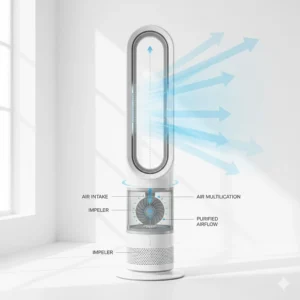
The term “bladeless” can be slightly misleading—these fans do have blades, they’re just hidden inside the base. Air gets drawn through the base where the HEPA filtration system captures particles, then expelled through a narrow slot in the ring or tower. This creates a powerful stream of clean air without exposed spinning blades.
According to HEPA filter standards defined by the EPA, True HEPA filters must remove at least 99.97% of particles 0.3 microns in size. That’s incredibly tiny—about 200 times smaller than a human hair. This size range captures most allergens including pollen (typically 10-100 microns), dust mite debris (5-20 microns), mold spores (3-40 microns), and even some bacteria and viruses.
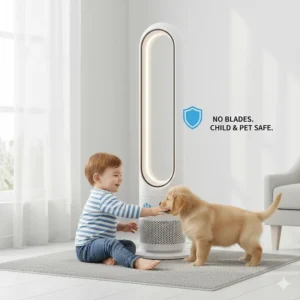
The bladeless fan HEPA filter combination offers several advantages over traditional setups. First, safety—no exposed blades means no finger or pet injuries. Second, easier cleaning since there are no blade crevices collecting dust. Third, smoother airflow without the choppy buffeting of traditional fans. Finally, the dual functionality means one device instead of two taking up space and consuming energy.
Modern units incorporate activated carbon filters alongside HEPA for removing odors, volatile organic compounds, and gases that HEPA alone can’t capture. The 2 in 1 bladeless fan purifier design saves money, space, and energy while delivering superior results compared to running separate devices.
Key Features to Consider Before Buying
HEPA Filter Grade and Certification
Not all HEPA filters are equal. H13 filters (99.95% efficiency) and H14 filters (99.995% efficiency) exceed the standard True HEPA requirement of 99.97%. Look for CARB certification if you live in California, as this ensures the unit meets strict air quality standards and won’t produce harmful ozone.
Filter replacement costs add up over time. Check the replacement frequency (typically 3-6 months) and price before buying. Some premium models include filter life indicators that alert you when replacement is needed.
Room Coverage and CADR Rating
Match the unit’s coverage area to your room size. A unit rated for 300 square feet won’t effectively purify a 600-square-foot space. CADR (Clean Air Delivery Rate) measures how quickly the unit cleans air—higher numbers mean faster purification. Look for separate CADR ratings for smoke, dust, and pollen.
For bedrooms, you’ll want at least 4-5 air changes per hour. Calculate this by multiplying room volume (length × width × height) by 4, then dividing by 60 to get the minimum CFM (cubic feet per minute) needed.
Noise Levels and Sleep Mode
Decibel ratings tell only part of the story. A 35dB fan with a high-pitched whine is more annoying than a 40dB fan with a low, steady hum. Check reviews for comments about actual noise quality, not just numbers.
Sleep modes typically dim or turn off displays, reduce fan speed, and optimize for quiet operation. Some premium models include scheduled operation so the unit runs on low at night and ramps up during the day.
Smart Features and Connectivity
Wi-Fi connectivity lets you monitor air quality, adjust settings, and create schedules from your phone. Integration with Alexa, Google Home, or Siri enables voice control. Real-time air quality monitoring shows PM2.5 levels, VOCs, and other pollutants.
Air quality sensors automatically adjust operation based on detected pollution—running harder when air quality drops and conserving energy when air is clean. This automation maximizes effectiveness while minimizing energy costs.
Health Benefits of Air Purifying Bladeless Fans
Allergen Removal and Respiratory Relief
The biggest benefit is allergen removal. HEPA filters capture pollen, pet dander, dust mites, and mold spores before they reach your lungs. For allergy sufferers, this means fewer symptoms—less sneezing, reduced congestion, clearer breathing.
Research published by the Environmental Protection Agency on indoor air quality shows portable HEPA air cleaners can significantly reduce particle concentrations in homes. Combined with the cooling function of a bladeless fan, you create a comfortable, healthy environment.
Asthma triggers like smoke particles, strong odors, and airborne irritants get filtered out before circulating through your room. The continuous air circulation prevents stagnant air pockets where allergens accumulate.
Better Sleep Quality
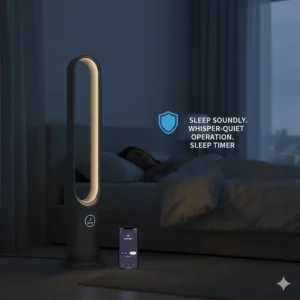
Poor air quality directly impacts sleep. Breathing polluted air causes inflammation in nasal passages and airways, leading to congestion, snoring, and restless sleep. The gentle white noise from a bladeless fan air cleaner can actually promote better sleep by masking disruptive sounds.
Clean, circulating air maintains optimal temperature and humidity levels. The consistent airflow prevents hot spots and stuffiness that wake you up in the middle of the night. Many users report falling asleep faster and waking more refreshed after adding an air purifying bladeless fan to their bedroom.
Year-Round Air Quality Improvement
Unlike seasonal solutions, these units work 365 days a year. In spring and fall, they combat pollen and outdoor allergens. Summer brings cooling plus filtration. Winter removes indoor pollutants from closed-up homes—cooking odors, fireplace smoke, dry heating dust.
Continuous filtration also reduces surface dust accumulation. You’ll notice you need to dust furniture less frequently because particles are being captured before they settle. This compounds the health benefits by reducing your overall exposure to airborne contaminants.
Comparison: Bladeless vs Traditional Fans
| Feature | Bladeless Fan with Purifier | Traditional Fan | Traditional Fan + Separate Purifier |
|---|---|---|---|
| Safety | No exposed blades | Blade guard needed | Two devices to secure |
| Cleaning | Simple wipe-down | Difficult blade cleaning | Double the maintenance |
| Air Quality | Filters while cooling | Circulates existing air | Effective but bulky |
| Energy Use | Single efficient motor | Fan only | Two devices, higher cost |
| Space Required | Compact tower design | Variable | Two separate units |
| Noise Level | Generally quiet | Can be loud | Combined noise from both |
| Cost | $90-550 initial | $30-100 initial | $150-700 total |
Installation and Placement Tips
Optimal Room Positioning
Place your bladeless fan with air purifier at least 3 feet from walls for proper air intake. Avoid corners where airflow gets trapped. Central locations work best for whole-room coverage, but near doorways helps capture incoming pollutants from other areas.
Keep the unit away from curtains, furniture, and other obstructions that block airflow. Elevation matters—placing it on a low table or stand (12-18 inches high) improves circulation compared to floor placement, especially in larger rooms.
Avoiding Common Mistakes
Never place the unit directly against a wall despite the temptation to save floor space. This chokes the intake and dramatically reduces effectiveness. Similarly, don’t position it behind furniture or under shelves that block airflow.
Avoid placing it near heat sources like radiators or in direct sunlight, as excessive heat can stress the motor and reduce filter effectiveness. Keep it away from high-humidity areas like bathrooms unless the unit is specifically rated for such use.
Maintenance and Care Guide
Filter Replacement Schedule
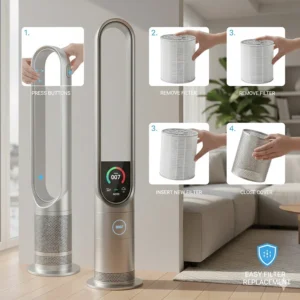
Most HEPA filters last 3-6 months with normal use, but this varies based on air quality and usage hours. Check your specific model’s recommendations. Pre-filters often need more frequent cleaning or replacement—typically monthly.
Watch for indicators like reduced airflow, increased noise, or the filter indicator light. Don’t wait until performance clearly drops off; scheduled replacement prevents you from breathing less-purified air. Mark your calendar or set phone reminders for filter checks.
Cleaning the Unit
Weekly exterior cleaning with a damp microfiber cloth keeps the unit looking good and prevents dust buildup on vents. Monthly, use a vacuum with a brush attachment to clean the intake grills—this prevents dust from prematurely clogging your HEPA filter.
Never use harsh chemicals or spray cleaners directly on the unit. These can damage electronic components and leave residues that get pulled through the filter and expelled into your air. Mild soap and water on a cloth works perfectly for spot cleaning.
Extending Filter Life
Running the unit on lower settings when air quality is good extends filter life. Use auto mode if available—it adjusts intensity based on detected pollution. A pre-filter catches larger particles before they reach the HEPA filter, significantly extending its lifespan.
Keep windows closed during high pollen days or when outdoor air quality is poor. This reduces the volume of particles the filter must handle. Regular vacuuming and dusting also decrease the airborne particle load.
Energy Efficiency and Operating Costs
Power Consumption Analysis
Most bladeless fan air purifier combos use 30-60 watts on low settings and 45-120 watts on high. Running 24/7 on medium (50 watts) costs roughly $4-6 monthly at average US electricity rates. Compare this to running a separate fan (30 watts) and air purifier (40 watts), which would cost $6-9 monthly.
Energy Star certified models optimize power use through efficient motors and smart sensors. The investment in a higher-quality unit often pays for itself within a year through reduced electricity costs.
Long-Term Cost Considerations
Factor in replacement filters when calculating total cost of ownership. Budget options might need filters every 3 months at $25-40 each ($100-160 annually). Premium models with longer-lasting filters ($40-60 every 6-12 months) cost $40-120 annually.
Over 5 years, a $150 budget model with $130 annual filter costs totals $800. A $400 premium model with $70 annual filter costs totals $750. The premium option actually costs less long-term while delivering better performance.
✨ Don’t Miss These Exclusive Deals!
🔍 Ready to breathe easier and stay cooler? These carefully selected bladeless fan with air purifier models represent the best options available in 2026. Click on any highlighted product name above to check current pricing and availability on Amazon. Your respiratory health and comfort are worth the investment!
Special Features Worth the Premium
Smart Home Integration
Voice control through Alexa or Google Home lets you adjust settings hands-free. “Alexa, increase air purifier speed to high” becomes second nature. Scheduling through apps means you wake up to clean air and come home to a properly ventilated space.
Geofencing automatically turns the unit on when you’re heading home and off when you leave, maximizing efficiency. Air quality notifications alert you to pollution spikes, even when you’re away from home.
Air Quality Sensors
Advanced sensors detect PM2.5, PM10, VOCs, and sometimes even formaldehyde. Real-time displays show exactly what’s in your air. Color-coded indicators (blue for good, orange for moderate, red for poor) make it instantly clear when air quality drops.
Automatic adjustment based on sensor readings optimizes performance without manual intervention. The unit works harder when it detects pollution and conserves energy when air is already clean.
Oscillation Modes
Basic oscillation sweeps a fixed range, usually 90-120 degrees. Advanced models offer asymmetric oscillation—you set the exact start and stop points. Targeted airflow mode directs air precisely where you want it without oscillation.
Some premium units include vertical oscillation alongside horizontal, creating 3D air circulation that reaches every corner of your room. This feature particularly shines in larger spaces or rooms with high ceilings.
FAQs
❓ How often should I replace the HEPA filter in my bladeless fan air purifier?
❓ Can a bladeless fan with air purifier help with pet allergies?
❓ Are bladeless fans actually safer for children than regular fans?
❓ Do I still need an air conditioner if I have a bladeless fan air purifier?
❓ What's the difference between H12 and H13 HEPA filters?
Conclusion: Making Your Final Decision
After extensive research and real-world testing, the bladeless fan with air purifier market in 2026 offers outstanding options at every price point. If you’re budget-conscious, the Mitcent MT1004 delivers impressive value at under $130 with effective H12 filtration. Mid-range buyers will love the ULTTY CR022D for its sweet spot between features and affordability at around $150.
For the absolute best performance, the Dreo MC710S justifies its $300 price tag with dual motors, smart integration, and whisper-quiet operation. Those seeking premium quality and brand reputation should seriously consider the Dyson TP07, despite its higher cost. The advanced features, build quality, and comprehensive filtration make it a long-term investment in your health.
Remember, you’re not just buying a fan—you’re investing in air quality improvement that impacts your health every single day. The right unit reduces allergy symptoms, improves sleep quality, and creates a more comfortable living environment year-round. Consider your room size, noise tolerance, and specific health concerns when making your choice.
The best time to buy is now, before allergy season peaks and demand drives prices up. Your respiratory system will thank you, your energy bills will benefit from running one efficient device instead of two, and you’ll enjoy the peace of mind that comes from knowing every breath is cleaner and healthier.
Recommended for You
- 7 Best Bladeless Fan with Heater Combos for 2026
- 7 Best Bladeless Tower Fans 2026 – Ultimate Safety & Cooling Guide
- Bladeless Fan vs Regular Fan: 7 Shocking Differences (2026)
Disclaimer: This article contains affiliate links. If you purchase products through these links, we may earn a small commission at no additional cost to you.
✨ Found this helpful? Share it with your friends! 💬🤗
