
In This Article
Basements have a personality problem. They’re cool in January, swampy in July, and somewhere in between they decide to grow a smell you can’t quite place. If you’ve ever gone looking for a portable air conditioner for basement use specifically, you already know the standard advice — “just get a window unit” — doesn’t apply when your only window is a slim glass block three feet off the floor. A basement portable AC has to do two jobs at once: pull the temperature down and, more importantly, wring the moisture out of air that’s basically sitting on top of damp soil.

What is a portable air conditioner for basement use? It’s a self-contained, wheeled cooling unit that vents hot exhaust through a short duct into a window, dryer vent, or wall port, and it typically pairs a compressor with a built-in dehumidifier — a combination that matters far more below grade than it does upstairs. Ordinary room units are engineered for dry, sunlit rooms. Basements need something that treats humidity as a first-class problem, not an afterthought.
We dug into real specs, aggregated owner feedback, and manufacturer documentation for seven models that actually hold up in below-grade conditions, from a budget-friendly starter unit to a serious dual-hose dehumidifying workhorse. According to an air-conditioner testing team that filtered through over 50 models specifically for high dehumidification ratings and self-evaporating systems critical to basement environments, cooling power alone isn’t the deciding factor down there — moisture removal is. Keep that in mind as you read, because it shapes almost every recommendation below. For a deeper look at the health stakes of getting this wrong, the EPA’s guidance on mold and moisture control is worth bookmarking before you buy anything.
Quick Comparison Table: Best Portable AC Basement Picks
If you’re short on time, here’s the condensed version. Every one of these units handles a below ground portable AC setup competently, but they’re not interchangeable — a college rec-room and a laundry-adjacent utility basement have very different needs.
| Rank | Model | Standout Strength | Best For |
|---|---|---|---|
| #1 | Whynter ARC-14S | 71-pint dehumidification, dual hose | Damp, mid-size basements |
| #2 | Honeywell HW4CEDAWW0 | 101-pint removal, continuous drain | Extreme humidity, unattended use |
| #3 | Midea Duo MAP12S1TBL | Inverter compressor, 42 dB quiet mode | Finished basement offices |
| #4 | LG LP1419IVSM | Dual Inverter, Wi-Fi, 44 dB sleep mode | Basement bedrooms/guest suites |
| #5 | EUHOMY 10,000 BTU 4-in-1 | Up to 96-pint dehumidifier mode | Budget-conscious high-moisture rooms |
| #6 | Black+Decker BPACT14WT | 76-pint removal, simple controls | Mid-size rec rooms |
| #7 | Black+Decker BPACT08WT | Compact, lightweight, low cost | Small basements or single rooms |
Looking at this table, the pattern is obvious: the units that top the list aren’t necessarily the most powerful coolers — they’re the ones that move the most water out of the air per day. The Whynter ARC-14S and Honeywell HW4CEDAWW0 both lean into dual-hose designs specifically because a single hose recirculates some humid indoor air, which is the last thing a basement needs. Budget shoppers shouldn’t panic, though — the Black+Decker BPACT08WT still gets real dehumidification, just at a smaller scale that matches its smaller price tag.
💬 Found a pick you like already? Scroll down to see the full breakdown before you decide — the specs tell a more interesting story than the ranking does.
Top 7 Portable Air Conditioners for Basement: Expert Analysis
1. Whynter ARC-14S — highest dehumidification-to-price ratio
The Whynter ARC-14S opens strong with a spec most basement shoppers overlook until it’s too late: a 71-pint-per-day dehumidifying capacity, paired with 14,000 BTU (9,500 BTU under the newer DOE/SACC standard) of cooling. That pairing matters because a basement portable AC that only cools without seriously dehumidifying will leave the room feeling clammy even once the thermometer reads comfortable. The dual-hose system draws outside air in for the condenser while exhausting separately, which is meaningfully more efficient in a below grade cooling scenario than single-hose competitors that just recirculate some of the room’s own humid air.
Based on the spec comparison, this unit is built for finished basements in the 400-500 square foot range — a home gym, a media room, or a walkout family room. Reviewers consistently note that the auto-drain system handles routine humidity without manual bucket-emptying, though in genuinely soggy basements (the ones pushing 70%+ relative humidity) owners report needing to run a continuous drain hose to a floor drain rather than relying on auto-evaporation alone. That’s not a flaw so much as physics — no auto-evaporation feature can out-pace a truly wet room.
Pros:
- ✅ 71-pint dehumidifier output rivals dedicated basement dehumidifiers
- ✅ Dual-hose design avoids recirculating humid indoor air
- ✅ Backed by a 3-year compressor warranty for long-term reliability
Cons:
- ❌ Bulkier than single-hose units, harder to move solo
- ❌ Auto-drain alone may not keep pace in very high-humidity basements
Expect to find the Whynter ARC-14S priced in the $500-$600 range, though prices may vary by retailer — check current price before buying. For a room that runs consistently damp, the value case is strong: you’re effectively buying a dehumidifier and an air conditioner in one footprint.

2. Honeywell HW4CEDAWW0 — best for extreme, unattended humidity
If the Whynter is built for “damp,” the Honeywell HW4CEDAWW0 is built for “wet.” Its headline number is a 101-pint-per-day dehumidification rating at 14,500 BTU, and it’s specifically designed to connect a standard garden hose to a continuous drain outlet — a detail that matters enormously if your basement runs unattended for stretches of a hot week while you’re at work.
What most buyers overlook about this model is that the continuous-drain compatibility isn’t a gimmick tacked onto the box copy — it’s the actual mechanism that lets the unit bypass its internal tank entirely, so it never hits capacity and shuts itself off. Reviewers consistently point to that as the deciding factor over similarly priced units, since a portable AC that silently stops cooling because its tank filled overnight defeats the purpose of automating basement moisture management in the first place. The dual-hose design covers spaces up to roughly 700-725 square feet, making it one of the larger-capacity options on this list.
Pros:
- ✅ 101 pints/day is the highest dehumidification rating here
- ✅ Continuous garden-hose drain removes tank-emptying entirely
- ✅ Covers larger open basements up to ~725 sq. ft.
Cons:
- ❌ Larger footprint demands more floor and hose clearance
- ❌ Overkill (and pricier to run) for small, dry basement rooms
Price sits roughly in the $430-$520 range at the time of research. For a basement that floods with humidity every summer regardless of what you do upstairs, this is the option built specifically for that fight.
3. Midea Duo MAP12S1TBL — quietest serious cooling power
The Midea Duo MAP12S1TBL swaps a traditional on/off compressor for variable-speed inverter technology, and the practical result is a unit that can run continuously at low output instead of cycling loudly on and off — Midea’s own testing puts it as low as 42 dB in its quietest mode. That’s a real advantage in a basement that’s been converted into an office, workout space, or guest suite where compressor cycling noise bounces off concrete and hard flooring far more than it would in a carpeted upstairs bedroom.
On paper this means roughly 40% better energy efficiency than the federal minimum standard, according to the manufacturer, because the inverter compressor doesn’t have to restart at full draw every time it cycles on. The hose-in-hose exhaust design is also worth calling out: it locks cool air in while venting hot air out through a single physical hose channel, simplifying installation versus true dual-hose units without sacrificing much efficiency. What the spec sheet won’t tell you, but reviewers note, is that the unit’s 72-pound weight makes it a “set it up once and leave it” appliance rather than something you roll between rooms weekly.
Pros:
- ✅ Inverter compressor runs as quiet as 42 dB
- ✅ App, Alexa, and Google Assistant control from anywhere
- ✅ Roughly 40% more energy-efficient than standard-compressor models
Cons:
- ❌ Heavy at ~73 lbs — not ideal for frequent relocation
- ❌ No heat function on the base MAP12S1TBL model
Expect a price in the $500-$600 range. If basement cooling portable noise is your main complaint about a current unit, this is the upgrade that actually addresses it.
4. LG LP1419IVSM — best for basement bedrooms and guest suites
The LG LP1419IVSM pairs LG’s Dual Inverter Compressor with a sleep-mode noise floor around 44 dB, which puts it in serious contention for basements doing double duty as a guest bedroom or in-law suite. Its dehumidification mode removes roughly 6.8 pints of moisture per hour in dry mode — a rate that, run over several hours, comfortably outpaces what most single-hose competitors manage in a full day.
Here’s what most buyers overlook about the dual inverter distinction versus a plain inverter: it modulates both the compressor and the fan motor independently, which is why LG can claim such a low minimum sound level without sacrificing peak cooling output. Based on the spec comparison, this unit sits closer to a “smart home appliance” than a utility box — Wi-Fi control means you can pre-cool the space from upstairs before you head down, which matters more in a basement than anywhere else in the house since below-grade rooms take longer to shed the day’s accumulated humidity once you walk in.
Pros:
- ✅ Dual Inverter Compressor keeps sleep-mode noise near 44 dB
- ✅ Wi-Fi app control lets you pre-cool before you go downstairs
- ✅ Auto-swing louvers distribute airflow more evenly in open layouts
Cons:
- ❌ Premium pricing compared to non-inverter competitors
- ❌ Window kit installation is fiddlier than simpler single-hose designs
Pricing typically lands in the $550-$650 range, prices may vary. For a basement guest room where a compressor hum would be the difference between a good night’s sleep and a bad one, this is the pick worth the premium.
5. EUHOMY 10,000 BTU 4-in-1 — best value for humidity control feature
The EUHOMY 10,000 BTU 4-in-1 is the value play on this list, and it earns that spot honestly: depending on the specific configuration, its dehumidifier mode is rated to remove up to 96 pints of moisture per day — a number that actually beats several pricier competitors here — while covering roughly 450 square feet of cooling. Dual drain ports support continuous drainage, which extends unattended runtime the same way the Honeywell’s garden-hose setup does, just at a friendlier price point.
Reviewers consistently note fast initial cooling and straightforward setup as the standout strengths, with the honest caveat that build materials feel noticeably lighter-duty than the metal-reinforced premium models above it. What most buyers overlook about budget dehumidification specs like this one is that a higher pint rating on a cheaper unit sometimes reflects a less efficient (not necessarily less effective) compressor cycle — it’s removing plenty of water, just using more energy per pint than an inverter model would. For a basement where the priority is knocking down basement moisture management costs without a big upfront spend, that trade-off is usually worth making.
Pros:
- ✅ Up to 96-pint dehumidifier mode rivals units twice the price
- ✅ Dual drain ports enable continuous, unattended operation
- ✅ Sleep mode dims the LED display for undisturbed rest
Cons:
- ❌ Build quality feels lighter-duty than premium competitors
- ❌ Less energy-efficient per pint removed than inverter models
Price generally falls in the $300-$380 range depending on the configuration. This is the pick for anyone who wants serious moisture control without a serious price tag.
6. Black+Decker BPACT14WT — dependable mid-range all-rounder
The Black+Decker BPACT14WT delivers 14,000 BTU (ASHRAE) cooling with a 76-pint-per-day moisture removal rating, according to manufacturer documentation, at a price point solidly between the budget and premium tiers on this list. It’s a single-hose unit, which is a real trade-off worth naming honestly: single-hose systems create slight negative pressure in the room, pulling a small amount of outside (or in this case, house) air in to replace what’s exhausted — in a basement, that can mean pulling slightly warmer, more humid air down from upstairs rather than losing efficiency to true outdoor infiltration the way an upstairs single-hose unit would.
Reviewers consistently praise its simplicity: a top-mounted control panel, a slide-out washable filter, and rolling casters that make it genuinely portable rather than “portable” in name only. Based on the spec comparison against its dual-hose competitors here, the BPACT14WT sacrifices a bit of raw efficiency for a much simpler, lighter installation — a fair trade for anyone who isn’t fighting extreme humidity and just wants dependable, uncomplicated basement cooling portable comfort.
Pros:
- ✅ 76 pints/day dehumidification at a mid-range price
- ✅ Simple electronic controls and washable filter maintenance
- ✅ Rolling casters and side handles for genuine portability
Cons:
- ❌ Single-hose design is less efficient than dual-hose alternatives
- ❌ No smart app or Wi-Fi control options
Expect pricing in the $350-$420 range, prices may vary by retailer. It’s the “no surprises” choice for a basement that needs solid, uncomplicated performance.
7. Black+Decker BPACT08WT — best budget pick for small basements
Not every basement needs 14,000 BTU of cooling — a small below-grade office, laundry nook, or single finished room often just needs something that takes the edge off without a $500 price tag. The Black+Decker BPACT08WT delivers 8,000 BTU (ASHRAE) / 4,000 BTU (SACC) cooling for spaces up to roughly 350 square feet, in a notably lighter 47-pound frame that’s genuinely easy for one person to reposition.
Honest analytical take: this is not the unit for a genuinely damp, unfinished basement fighting serious humidity — its dehumidification capacity is modest compared to the rest of this list, and it’s a 3-in-1 (cooling, dehumidifying, fan) rather than a heavy-duty moisture-removal machine. Where it shines is smaller, already-reasonably-dry basement rooms that just need supplemental cooling in peak summer weeks. Reviewers with over 700 combined ratings consistently cite easy setup and a compact footprint as its biggest strengths, with the honest trade-off being that it can’t match the larger units’ output in genuinely humid conditions.
Pros:
- ✅ Lightweight (47.4 lbs) and easy for one person to move
- ✅ R32 refrigerant with no ozone-depletion potential
- ✅ Lowest price point on this list for basic basement cooling
Cons:
- ❌ Modest dehumidification compared to higher-capacity units
- ❌ Best suited to smaller rooms, not full open basements
Typical pricing runs around $220-$270 — check current price, as this budget tier fluctuates the most with seasonal demand. For a small below ground portable AC need without a big investment, it’s a sensible starting point.
Practical Setup and First 30 Days: Getting Your Basement Portable AC Right
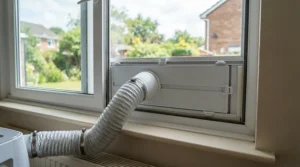
Getting a basement portable AC running well starts before you plug it in. Basements typically have smaller, higher, or non-standard windows, so measure your window opening before ordering and compare it against each unit’s window-kit range — most kits stretch from about 20 to 46-plus inches, but basement casement or slider windows sometimes fall outside that. If your basement has no usable window at all, a dryer-vent adapter kit or a through-wall port are your realistic options; a single-hose unit venting into an unsealed space will fight a losing, energy-wasting battle.
In the first 30 days, three habits prevent most complaints: seal the window-kit gaps with foam or tape (a loose seal lets humid outside air back in and undercuts your dehumidification numbers), keep the exhaust hose as short and straight as possible since kinks and extensions both reduce airflow, and check the drain or internal tank every few days until you know your basement’s actual moisture load. The most common first-month mistake isn’t a broken unit — it’s an underestimated humidity source, like an unsealed sump pit or a dryer vent leaking into the room, quietly working against the AC the whole time.
Real-World Basement Scenarios: Matching the Unit to the Room
Consider three common basement situations. A college student converting a cool, cinderblock basement bedroom into a dorm-away-from-dorm mainly needs quiet, since they’ll be sleeping next to the unit — the LG LP1419IVSM or Midea Duo MAP12S1TBL fit that brief far better than a louder single-hose budget model, even at a higher price. A family turning an unfinished basement into a home gym and playroom, used heavily but not overnight, is a better match for the Whynter ARC-14S or Honeywell HW4CEDAWW0 — rooms that see heavy use but not sleep tend to prioritize raw dehumidification and cooling capacity over whisper-quiet operation.
A homeowner on a tighter budget dealing with a small, already-drywalled basement office is the clearest case for the Black+Decker BPACT08WT or EUHOMY 10,000 BTU 4-in-1 — smaller square footage and a lower moisture load mean the extra capacity (and extra cost) of the premium picks would largely go to waste. In each case, the deciding factor isn’t really “which AC is best” in the abstract — it’s how the room is used, how often someone is present to manage the humidity, and how forgiving the budget is.
Common Problems in Basements — and Which Fix Actually Works
Musty smell that won’t go away. This is almost always a moisture problem, not an air-quality problem the AC alone can solve — running a unit with strong dehumidification, like the Honeywell HW4CEDAWW0 or Whynter ARC-14S, addresses the root cause, while air fresheners just mask it.
Water pooling near the unit. Usually a full internal tank or a drain hose that’s kinked or draining uphill. Switching to continuous drain (supported natively by the Honeywell HW4CEDAWW0 and EUHOMY 10,000 BTU 4-in-1) solves this permanently rather than requiring daily tank checks.
Room cools but still feels damp. This is the classic sign of an oversized-but-under-dehumidifying unit, exactly the scenario ENERGY STAR warns about: an oversized air conditioner costs more to purchase, wastes energy, and does not provide better cooling, and if it’s too large it cools the room before removing enough humidity, leaving cool, moist, clammy air behind. Matching BTU to actual square footage — not just buying the biggest number — usually fixes this.
Unit shuts off on its own during humid stretches. That’s a full-tank auto-shutoff, not a malfunction. Connecting a continuous drain line, where supported, is the fix; for units without that option, checking the tank twice daily during heat waves prevents the surprise.
Condensation on basement windows or pipes. This points to relative humidity running above the 50-60% range where condensation becomes likely on cool surfaces — worth confirming with a $10-15 hygrometer before assuming the AC itself is underperforming.
How to Choose a Portable Air Conditioner for Basement Spaces
- Start with square footage, not BTU alone. Measure the actual room, then match it against each unit’s rated coverage — oversizing wastes money and undersizing leaves you disappointed by August.
- Prioritize pint-per-day dehumidification over BTU count. A basement with high ambient humidity benefits more from a strong dehumidifier mode than from a few thousand extra BTUs of raw cooling.
- Check your window or venting situation before ordering. Basement windows are often smaller, higher, or oddly shaped — verify the included window kit actually fits before you buy.
- Decide how much noise you can live with. A basement bedroom or office calls for an inverter model under 45 dB; a workout room or storage space can tolerate a louder traditional compressor.
- Plan for drainage. If you won’t be around daily to empty a tank, prioritize models with continuous or garden-hose drain compatibility.
- Weigh single-hose versus dual-hose honestly. Dual-hose units cost more but avoid pulling humid house air into the basement to replace exhausted air — worth it in genuinely damp spaces.
- Set a realistic budget band, then compare within it. The gap between the cheapest and priciest units on this list is roughly $350, and the right pick depends far more on your basement’s moisture profile than on chasing the top spec sheet.
Common Mistakes When Buying a Basement Portable AC
The single biggest mistake is buying based on BTU rating alone, ignoring dehumidification specs entirely — a mistake basement shoppers make more than anyone else, since upstairs rooms rarely have the same moisture load. A close second is skipping the window-kit measurement step and discovering, after the box arrives, that a basement’s narrow slider window doesn’t accommodate the included bracket. Buyers also frequently underestimate noise: a compressor that sounds fine in a showroom can echo noticeably off a basement’s bare concrete and low ceiling.
Another recurring error is choosing a single-hose unit for a consistently damp below grade cooling situation purely to save money upfront, then discovering the ongoing struggle against humidity costs more in comfort — and often in electricity, from the unit running longer to compensate — than the dual-hose premium would have. Finally, plenty of buyers skip drainage planning entirely, assuming auto-evaporation will handle everything, only to find their unit shutting off mid-week during a humid stretch because the internal tank quietly filled.
Portable AC vs. Window AC vs. Mini-Split for Basements
A window air conditioner is often cheaper upfront and can be more energy-efficient per BTU, but it requires a suitable window — something many basements simply don’t have, or don’t have in a location that makes sense for the room’s layout. A ductless mini-split solves the venting problem entirely and tends to run quieter and more efficiently long-term, but it requires professional installation and a meaningfully higher upfront investment, which rules it out for renters or anyone wanting a same-week solution.
| Factor | Portable AC | Window AC | Mini-Split |
|---|---|---|---|
| Installation | DIY, no window required (dryer vent/wall kit works) | Requires a compatible window | Professional install required |
| Upfront cost | Low-moderate | Low | High |
| Basement dehumidification | Often built-in, up to 100+ pints/day | Limited, secondary function | Excellent, but add-on cost |
| Renter-friendly | Yes | Sometimes | Rarely |
| Noise | Moderate (unit sits in the room) | Moderate | Quietest option |
This is exactly why a basement portable AC wins for most homeowners and renters: it’s the only category built specifically to solve the venting problem basements create, while still offering serious dehumidification, without a contractor or a lease-violating installation. If you’re weighing whether the mini-split’s higher efficiency justifies its cost, the U.S. Department of Energy’s guidance on room air conditioner sizing is a useful gut-check either way — see ENERGY STAR’s room air conditioner sizing guide before committing to any option.
What to Expect: Real-World Performance in Below-Grade Spaces
Specs on a box rarely translate directly into lived experience, and basements amplify that gap. A 14,000 BTU unit rated for 500 square feet upstairs will often feel more powerful in a basement of the same size, simply because basements start cooler and are shielded from direct sun — but that same basement will also start more humid, so the dehumidification numbers matter more than they would in a sunlit living room. Expect the first 24-48 hours after setup to be the hardest stretch, as the unit works through the basement’s accumulated moisture before settling into steady-state maintenance mode.
Noise also behaves differently below grade. Hard concrete floors and lower ceilings reflect compressor hum more than carpeted, higher-ceilinged rooms upstairs, which is why the dB rating on the box tends to underrepresent perceived loudness in an unfinished basement specifically. If quiet operation matters, lean toward the inverter-compressor picks on this list rather than trusting the manufacturer’s decibel number in isolation.
Long-Term Cost & Maintenance for Basement Units
A portable air conditioner for basement use typically runs $30-$70 per month in added electricity during peak summer use, depending on local rates, unit efficiency, and how many hours a day it runs — inverter models like the Midea Duo MAP12S1TBL and LG LP1419IVSM generally land at the lower end of that range thanks to their variable-speed compressors. Filter cleaning every two weeks during active use is the single highest-leverage maintenance habit; a clogged filter forces the compressor to work harder, raising both noise and energy draw over time.
Total cost of ownership should also account for a realistic lifespan: most well-maintained units last 8-10 years, per manufacturer service data, with the compressor as the most common failure point after that window. Units with continuous-drain capability, like the Honeywell HW4CEDAWW0, tend to see less internal component wear over time since they aren’t cycling through repeated tank-full shutoffs during humid stretches — a small mechanical stress that adds up over years of basement duty.
Humidity Control Feature: Why It Matters More Than the BTU Number
Here’s the feature that actually deserves top billing in any basement buying decision: the humidity control feature, expressed as a pints-per-day dehumidification rating. Basements sit against soil that holds moisture year-round regardless of the weather upstairs, which means a portable AC down there is doing double duty as a de facto basement dehumidifier whether you think of it that way or not. The gap between the weakest and strongest performers on this list — roughly 51 pints to 101 pints per day — is a bigger practical difference than the BTU spread between them.
What most buyers overlook is that a strong humidity control feature also protects belongings stored in the basement — cardboard boxes, wood furniture, and electronics all suffer measurably in sustained humidity above roughly 60% relative humidity, the threshold most indoor air quality guidance treats as the ceiling before mold risk climbs. If your primary goal is basement moisture management rather than pure temperature comfort, prioritize the pint rating over the BTU rating when comparing any two units on this list — it’s the number that will actually determine whether your basement smells fresh or musty by August.
Safety, Regulations, and Basement-Specific Compliance
Most portable air conditioners draw a standard 15-amp household circuit, but basements frequently share circuits with sump pumps, freezers, or laundry appliances — running a high-draw AC on the same circuit risks nuisance tripping during peak load. It’s worth checking your basement’s electrical panel labeling before installation, and using a dedicated outlet where possible. Because basements often carry higher ambient moisture, look for units with GFCI-protected plugs or LCDI (leakage current detection and interruption) plugs, a feature the Whynter ARC-14S includes standard, precisely because damp environments raise the stakes around electrical safety.
Building and health authorities are consistent on the underlying issue a basement portable AC is fighting: indoor exposure to mold has been linked to upper respiratory symptoms, coughing, and wheezing in otherwise healthy people, and to worsened asthma symptoms in people who already have asthma. That’s not meant to alarm anyone — it’s meant to underline why the dehumidification spec isn’t a nice-to-have in a basement the way it might be upstairs. For the full clinical picture, the CDC’s overview of mold and health is a useful, non-alarmist reference if you’re weighing how seriously to take a musty smell you’ve been ignoring.

Frequently Asked Questions
❓ Can I use a regular portable air conditioner in a basement?
❓ Do I need a special portable AC for a basement with no windows?
❓ How many pints per day should a basement portable AC remove?
❓ Is a dual-hose or single-hose portable AC better for a basement?
❓ How often should I clean the filter on a basement portable air conditioner?
Conclusion
A basement portable AC isn’t just a smaller, cheaper version of the unit in your bedroom — it’s solving a genuinely different problem, one where humidity control matters as much as raw cooling power. The Whynter ARC-14S and Honeywell HW4CEDAWW0 earn their spots by treating dehumidification as the headline feature it should be for below-grade spaces, while the Midea Duo MAP12S1TBL and LG LP1419IVSM prove you don’t have to sacrifice quiet operation to get there. Budget shoppers aren’t left out either — the EUHOMY 10,000 BTU 4-in-1 delivers surprisingly strong moisture removal for the price, and the Black+Decker pair covers everything from mid-size rec rooms down to small basement offices.
The honest takeaway across all seven: match the unit’s dehumidification rating to your basement’s actual moisture level before you worry about anything else on the spec sheet. Get that right, and the temperature part takes care of itself.
Recommended for You
- Cooling Skull Cap: 7 Best Picks to Beat Brutal Helmet Heat (2026)
- 7 Best Cooling Headbands of 2026: Stay Cool, Sweat-Free & Focused
- Cooling Bandana: 7 Real Picks That Actually Beat 2026 Heat
Disclaimer: This article contains affiliate links. As an Amazon Associate, I earn from qualifying purchases. If you purchase products through these links, we may earn a small commission at no additional cost to you.
✨ Found this helpful? Share it with your friends! 💬🤗
